engine FORD SUPER DUTY 2010 2.G Diesel Supplement Manual
[x] Cancel search | Manufacturer: FORD, Model Year: 2010, Model line: SUPER DUTY, Model: FORD SUPER DUTY 2010 2.GPages: 104, PDF Size: 0.63 MB
Page 14 of 104
COLD WEATHER OPERATION
Changing to a lighter grade engine oil also makes starting easier under
these conditions. Refer toEngine oil specificationsin theMaintenance
and Specificationschapter of this supplement.
Diesel fuel is adjusted seasonally for cold temperatures. Diesel fuel which
has not been properly formulated for the ambient conditions may form
wax crystals which can clog the fuel filter. At temperatures below 20°F
(–7°C), if the engine starts, stalls after a short time, and then will not
restart, the fuel filter(s) may be clogged. For best results in cold
weather, use a diesel fuel which has been formulated for the ambient
conditions. If you have been using biodiesel, you may need to use a fuel
with lower biodiesel content, try another brand, or discontinue using
biodiesel.
Your vehicle is equipped with either an FCM or HFCM which recirculates
fuel from the engine to help prevent fuel filter clogging. Your vehicle is
also equipped with a bypass relief valve, located in the fuel tank pick-up
boot, which provides fuel flow to the engine if the fuel pickup should
become plugged. To allow the bypass valve to function and avoid engine
fuel starvation during cold weather operation of 32°F (0°C) or below, it
is recommended that the fuel level in your tank should not be allowed to
drop below
14full. This will help prevent air from entering the fuel
system and stalling the engine.
In cold weather below 32°F (0°C), the engine will slowly increase to a
higher idle speed if left idling in P (Park). As the engine warms-up, the
engine sound level will decrease due to the activation of PCM-controlled
sound reduction features.
If your vehicle is operated in a heavy snow storm or blowing snow
conditions, the engine air induction may become partially clogged with
snow and/or ice. If this occurs, the engine may experience a significant
reduction in power output. At the earliest opportunity, clear all the snow
and/or ice away from inside the air filter assembly. Take the top off the
assembly, leaving the air filter in, and remove any snow or ice.
In order to operate the engine in temperatures of 32°F (0°C) or lower,
read the following instructions:
•Make sure that the batteries are of sufficient size and are fully
charged. Check other electrical components to make sure they are in
optimum condition.
•Use Motorcraft Premium Engine Coolant solution at the concentration
recommended to protect the engine against damage from freezing.
•Try to keep the fuel tank full as much as possible at the end of
operation to prevent condensation in the fuel system.
Driving
14
2010 Econoline(eco)
Supplement(supplement), 1st Printing
USA(fus)
Page 15 of 104
•Make sure you use proper cold weather engine oil and that it is at its
proper level. Also, if necessary, make sure to follow the engine oil and
filter change schedule found under theSpecial operating conditions
section in thescheduled maintenance guideinformation.
•At temperatures of -10°F (-23°C) or below, it is recommended that
you use an engine block heater to improve cold engine starting.
•If operating in arctic temperatures of -20°F (-29°C) or lower, consult
your truck dealer for information about special cold weather
equipment and precautions.
Note:Idling in cold weather will not heat the engine to its normal
operating temperature. Long periods of idling in cold weather can cause
a buildup of heavy deposits of carbon and rust on valve stems causing
them to stick, which in turn, can cause valve train damage.
The following cold weather idling guidelines must be followed:
•Avoid idling the engine for more than 10 minutes at a time.
•Use Motorcraft Cetane improvers or non alcohol-based cetane
improvers from a reputable manufacturer.
•Maintain the engine cooling system properly.
•Do not shut the engine down after an extensive idling period
(10 minutes or more). Drive the vehicle for several miles with the
engine at normal operating temperatures under a moderate load to
burn off any accumulated carbon and varnish.
•Consider using an engine block heater.
•For extended idle times use an approved idle speed increase device.
Winter operating tips for Arctic operation -20°F (-29°C) and below
The following information is provided as a guideline only, and is not
intended to be the only source of possible solutions in resolving extreme
cold temperature issues.
Starting aids:
The use of the factory engine block heater (refer toEngine block heater
[if equipped]in theDrivingchapter of theOwner’s Guide) and oil pan
heaters (aftermarket) will assist in engine starting, in extreme cold
ambient temperatures.
WARNING:Do not use starting fluid, such as ether, in the air
intake system (see air filter decal). Such fluid could cause
immediate explosive damage to the engine and possible personal injury.
Driving
15
2010 Econoline(eco)
Supplement(supplement), 1st Printing
USA(fus)
Page 16 of 104
Idle control:
For periods of extended idle, the throttle should be set at an rpm that is
sufficient to keep the engine at normal operating temperatures. This
action can reduce the amount of engine damaging deposits.
•The engine contains a unique “Cold Weather - Idle up feature”
calibration strategy within the PCM. Under the appropriate conditions,
the strategy will automatically elevate the engine idle speed after
130 seconds of idling in cold ambient temperatures. For this feature to
be activated, the truck must be in P (Park) (for automatic
transmission), in neutral (for manual transmission) with the parking
brake applied and engine oil temperature below 158°F (70°C). This
strategy raises the rpm to a level that reduces the potential to
produce “coking” or “wet stacking”, which is common to all diesel
engines when idling for extended periods during cold ambient
temperatures.
•Your vehicle may have a factory option for a Stationary Elevated Idle
Control (SEIC) through dash-mounted Upfitter switches will allow the
operator to elevate the idle rpm for extended idle periods, as well as
aftermarket equipment such as PTO operation. This feature must be
configured even if ordered from the factory. See your authorized
dealer for required upfitting.
Operation in snow
Vehicle operation in heavy snowfall or extreme rain conditions may feed
excessive amounts of snow/water into the air intake system. This could
plug/soak the air filter with snow and may cause the engine to lose
power and possibly shut down.
You may not need to change the air filter and the vehicle may be driven
up to 200 miles (320 km) under the following conditions:
•Snow:At the earliest opportunity, open the hood and clear all the
snow and ice from the air filter housing inlet (do NOT remove the air
filter) and reset the air filter restriction gauge.
•Wet:The air filter will dry after about 15–30 minutes at highway
speeds. At the earliest opportunity, open the hood and reset the air
filter restriction gauge.
Refer toAir filter and restriction gaugein theMaintenance and
Specificationschapter of this supplement for more information.
Driving
16
2010 Econoline(eco)
Supplement(supplement), 1st Printing
USA(fus)
Page 17 of 104
Operation in standing water
Ingestion of water into the diesel engine can result in immediate and
severe damage to the engine. If driving through water, slow down to
avoid splashing water into the intake. If the engine stalls, and ingestion
of water into the engine is suspected, do not try to restart the engine.
Consult your dealer for service immediately.
Winter grille cover (F-Super Duty only) (if equipped)
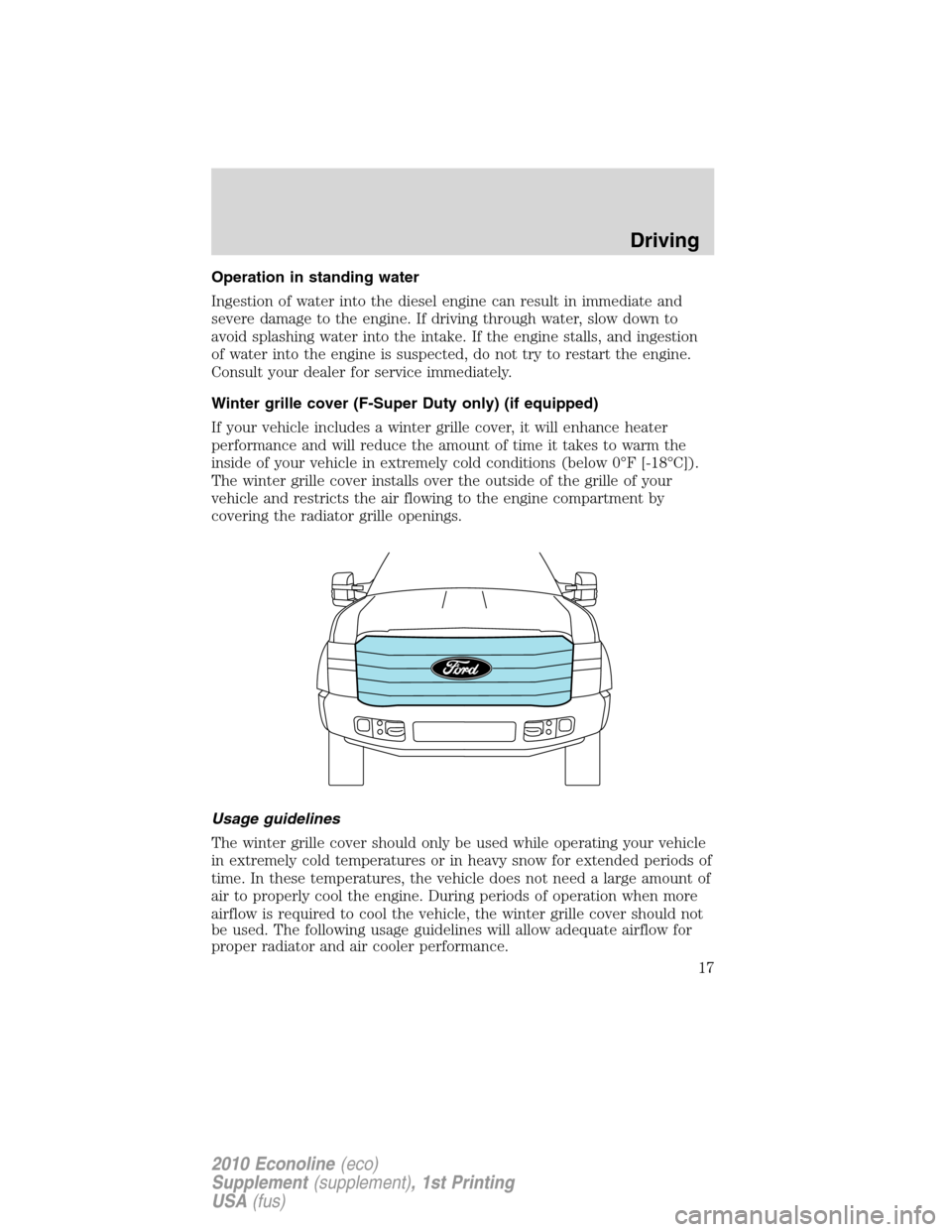
If your vehicle includes a winter grille cover, it will enhance heater
performance and will reduce the amount of time it takes to warm the
inside of your vehicle in extremely cold conditions (below 0°F [-18°C]).
The winter grille cover installs over the outside of the grille of your
vehicle and restricts the air flowing to the engine compartment by
covering the radiator grille openings.
Usage guidelines
The winter grille cover should only be used while operating your vehicle
in extremely cold temperatures or in heavy snow for extended periods of
time. In these temperatures, the vehicle does not need a large amount of
air to properly cool the engine. During periods of operation when more
airflow is required to cool the vehicle, the winter grille cover should not
be used. The following usage guidelines will allow adequate airflow for
proper radiator and air cooler performance.
Driving
17
2010 Econoline(eco)
Supplement(supplement), 1st Printing
USA(fus)
Page 18 of 104
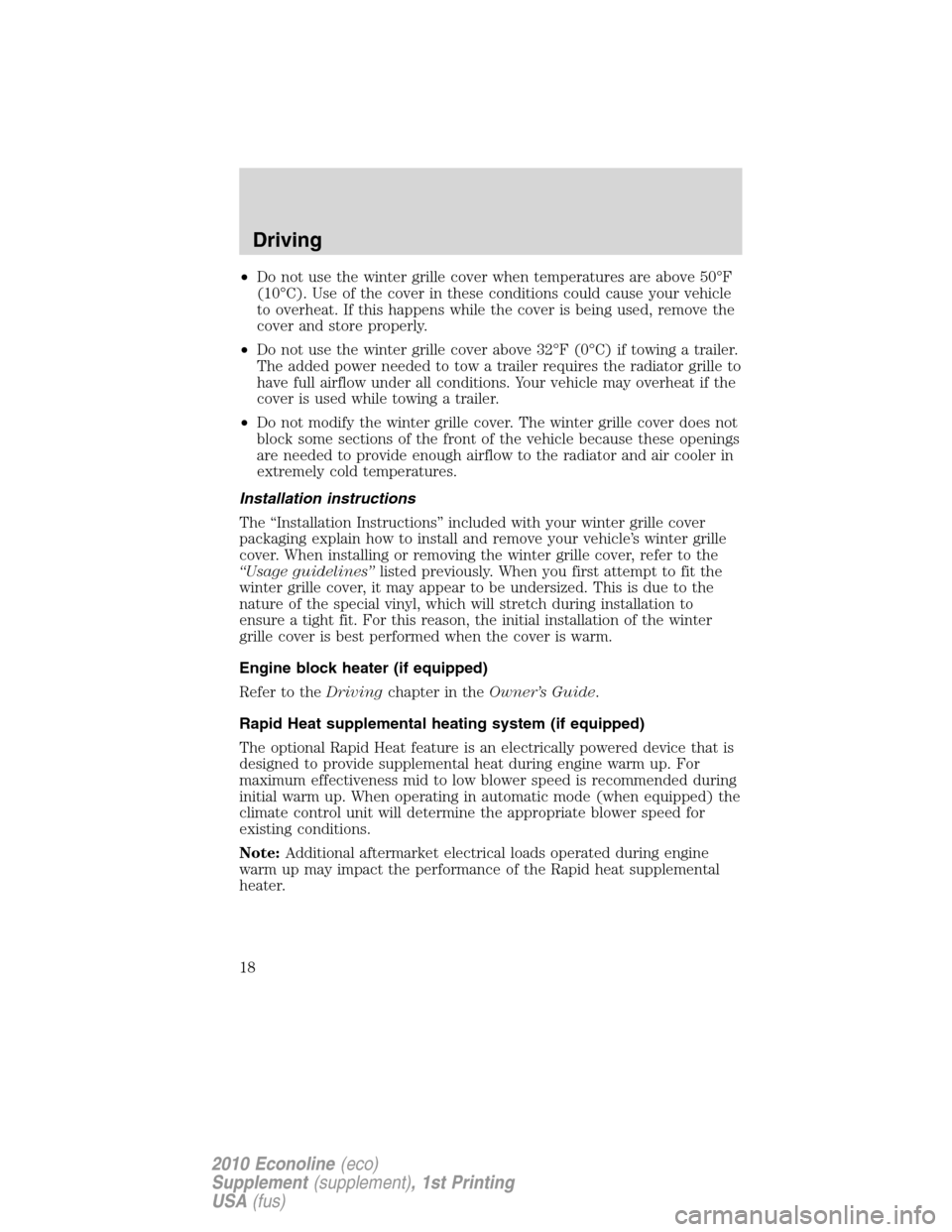
•Do not use the winter grille cover when temperatures are above 50°F
(10°C). Use of the cover in these conditions could cause your vehicle
to overheat. If this happens while the cover is being used, remove the
cover and store properly.
•Do not use the winter grille cover above 32°F (0°C) if towing a trailer.
The added power needed to tow a trailer requires the radiator grille to
have full airflow under all conditions. Your vehicle may overheat if the
cover is used while towing a trailer.
•Do not modify the winter grille cover. The winter grille cover does not
block some sections of the front of the vehicle because these openings
are needed to provide enough airflow to the radiator and air cooler in
extremely cold temperatures.
Installation instructions
The “Installation Instructions” included with your winter grille cover
packaging explain how to install and remove your vehicle’s winter grille
cover. When installing or removing the winter grille cover, refer to the
“Usage guidelines”listed previously. When you first attempt to fit the
winter grille cover, it may appear to be undersized. This is due to the
nature of the special vinyl, which will stretch during installation to
ensure a tight fit. For this reason, the initial installation of the winter
grille cover is best performed when the cover is warm.
Engine block heater (if equipped)
Refer to theDrivingchapter in theOwner’s Guide.
Rapid Heat supplemental heating system (if equipped)
The optional Rapid Heat feature is an electrically powered device that is
designed to provide supplemental heat during engine warm up. For
maximum effectiveness mid to low blower speed is recommended during
initial warm up. When operating in automatic mode (when equipped) the
climate control unit will determine the appropriate blower speed for
existing conditions.
Note:Additional aftermarket electrical loads operated during engine
warm up may impact the performance of the Rapid heat supplemental
heater.
Driving
18
2010 Econoline(eco)
Supplement(supplement), 1st Printing
USA(fus)
Page 19 of 104
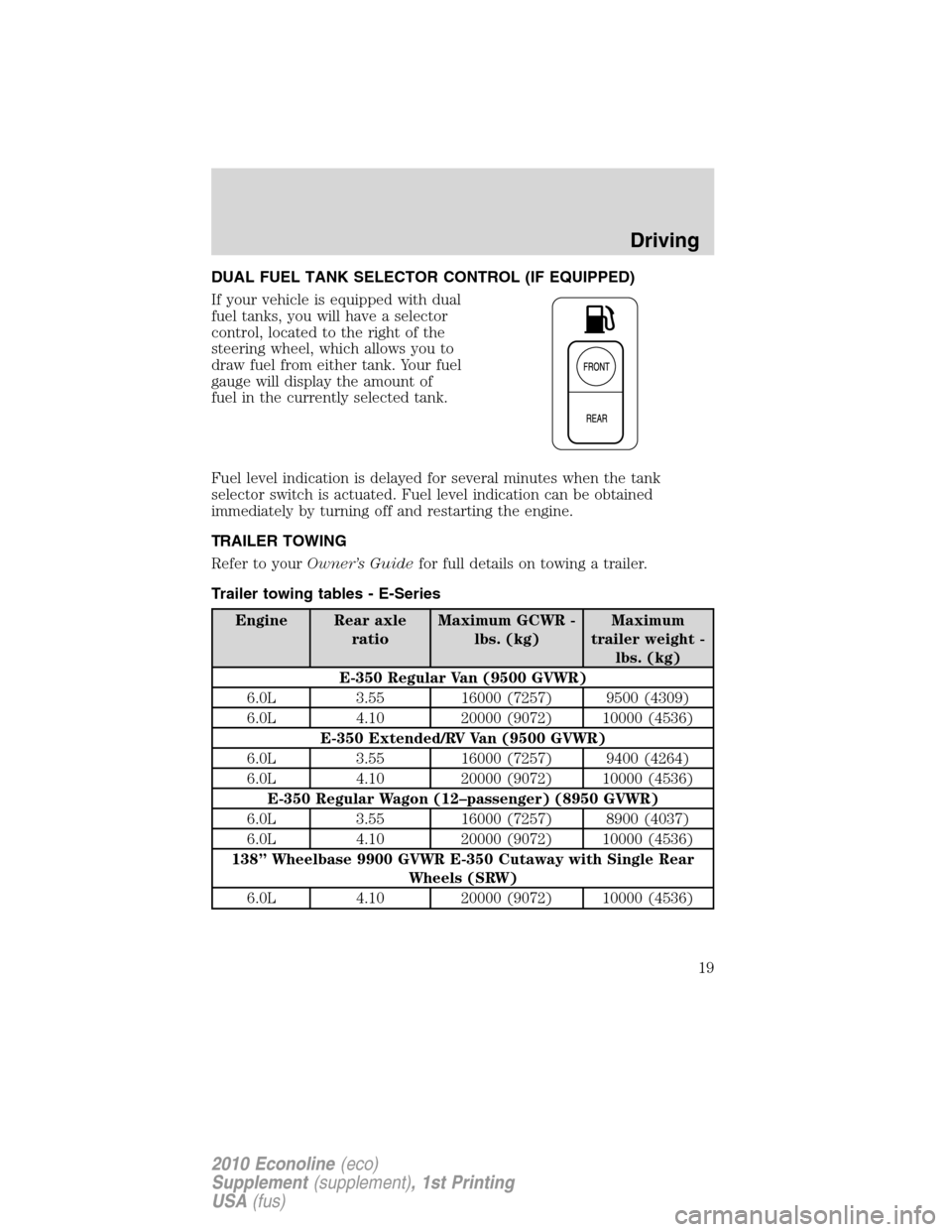
DUAL FUEL TANK SELECTOR CONTROL (IF EQUIPPED)
If your vehicle is equipped with dual
fuel tanks, you will have a selector
control, located to the right of the
steering wheel, which allows you to
draw fuel from either tank. Your fuel
gauge will display the amount of
fuel in the currently selected tank.
Fuel level indication is delayed for several minutes when the tank
selector switch is actuated. Fuel level indication can be obtained
immediately by turning off and restarting the engine.
TRAILER TOWING
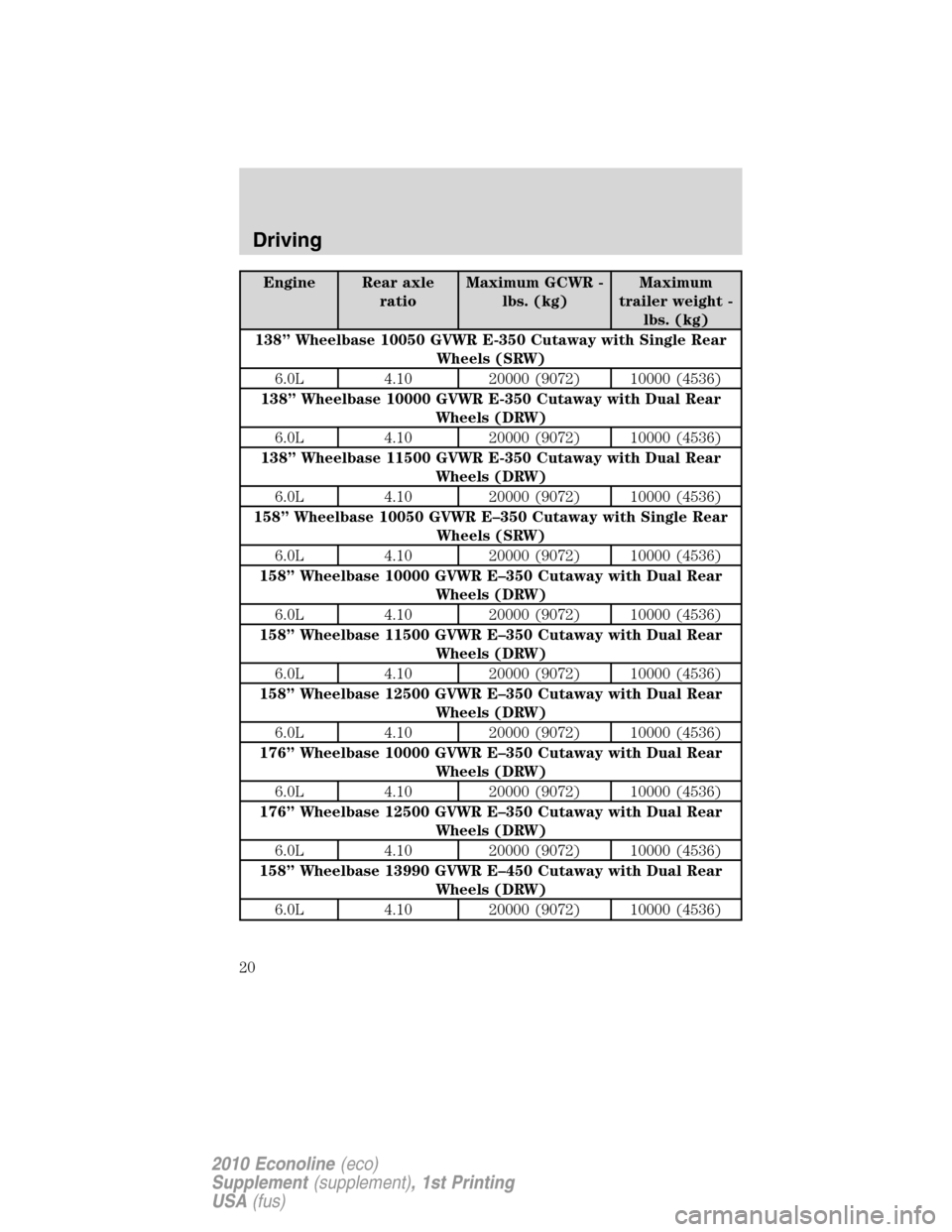
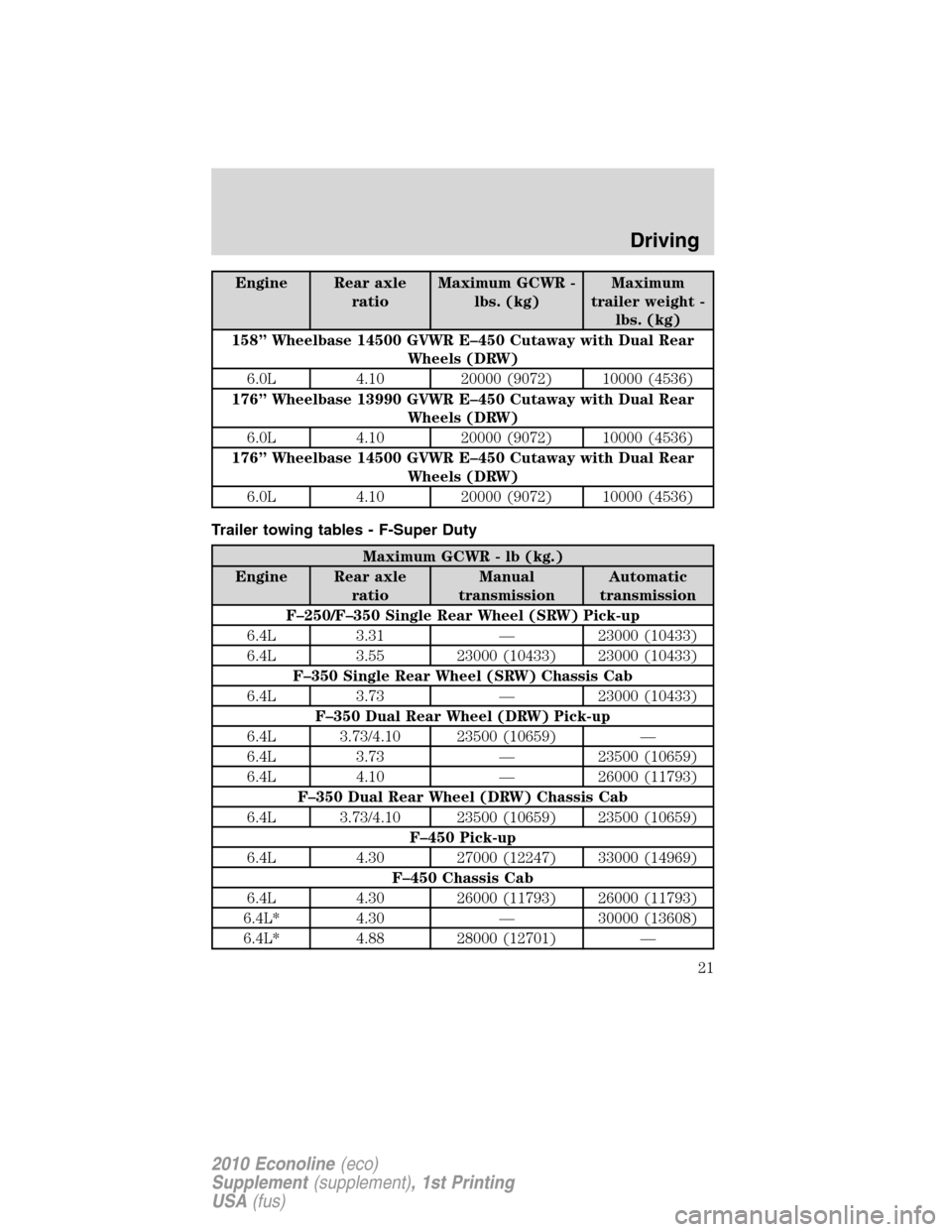
Refer to yourOwner’s Guidefor full details on towing a trailer.
Trailer towing tables - E-Series
Engine Rear axle
ratioMaximum GCWR -
lbs. (kg)Maximum
trailer weight -
lbs. (kg)
E-350 Regular Van (9500 GVWR)
6.0L 3.55 16000 (7257) 9500 (4309)
6.0L 4.10 20000 (9072) 10000 (4536)
E-350 Extended/RV Van (9500 GVWR)
6.0L 3.55 16000 (7257) 9400 (4264)
6.0L 4.10 20000 (9072) 10000 (4536)
E-350 Regular Wagon (12–passenger) (8950 GVWR)
6.0L 3.55 16000 (7257) 8900 (4037)
6.0L 4.10 20000 (9072) 10000 (4536)
138” Wheelbase 9900 GVWR E-350 Cutaway with Single Rear
Wheels (SRW)
6.0L 4.10 20000 (9072) 10000 (4536)
Driving
19
2010 Econoline(eco)
Supplement(supplement), 1st Printing
USA(fus)
Page 20 of 104
Engine Rear axle
ratioMaximum GCWR -
lbs. (kg)Maximum
trailer weight -
lbs. (kg)
138” Wheelbase 10050 GVWR E-350 Cutaway with Single Rear
Wheels (SRW)
6.0L 4.10 20000 (9072) 10000 (4536)
138” Wheelbase 10000 GVWR E-350 Cutaway with Dual Rear
Wheels (DRW)
6.0L 4.10 20000 (9072) 10000 (4536)
138” Wheelbase 11500 GVWR E-350 Cutaway with Dual Rear
Wheels (DRW)
6.0L 4.10 20000 (9072) 10000 (4536)
158” Wheelbase 10050 GVWR E–350 Cutaway with Single Rear
Wheels (SRW)
6.0L 4.10 20000 (9072) 10000 (4536)
158” Wheelbase 10000 GVWR E–350 Cutaway with Dual Rear
Wheels (DRW)
6.0L 4.10 20000 (9072) 10000 (4536)
158” Wheelbase 11500 GVWR E–350 Cutaway with Dual Rear
Wheels (DRW)
6.0L 4.10 20000 (9072) 10000 (4536)
158” Wheelbase 12500 GVWR E–350 Cutaway with Dual Rear
Wheels (DRW)
6.0L 4.10 20000 (9072) 10000 (4536)
176” Wheelbase 10000 GVWR E–350 Cutaway with Dual Rear
Wheels (DRW)
6.0L 4.10 20000 (9072) 10000 (4536)
176” Wheelbase 12500 GVWR E–350 Cutaway with Dual Rear
Wheels (DRW)
6.0L 4.10 20000 (9072) 10000 (4536)
158” Wheelbase 13990 GVWR E–450 Cutaway with Dual Rear
Wheels (DRW)
6.0L 4.10 20000 (9072) 10000 (4536)
Driving
20
2010 Econoline(eco)
Supplement(supplement), 1st Printing
USA(fus)
Page 21 of 104
Engine Rear axle
ratioMaximum GCWR -
lbs. (kg)Maximum
trailer weight -
lbs. (kg)
158” Wheelbase 14500 GVWR E–450 Cutaway with Dual Rear
Wheels (DRW)
6.0L 4.10 20000 (9072) 10000 (4536)
176” Wheelbase 13990 GVWR E–450 Cutaway with Dual Rear
Wheels (DRW)
6.0L 4.10 20000 (9072) 10000 (4536)
176” Wheelbase 14500 GVWR E–450 Cutaway with Dual Rear
Wheels (DRW)
6.0L 4.10 20000 (9072) 10000 (4536)
Trailer towing tables - F-Super Duty
Maximum GCWR - lb (kg.)
Engine Rear axle
ratioManual
transmissionAutomatic
transmission
F–250/F–350 Single Rear Wheel (SRW) Pick-up
6.4L 3.31 — 23000 (10433)
6.4L 3.55 23000 (10433) 23000 (10433)
F–350 Single Rear Wheel (SRW) Chassis Cab
6.4L 3.73 — 23000 (10433)
F–350 Dual Rear Wheel (DRW) Pick-up
6.4L 3.73/4.10 23500 (10659) —
6.4L 3.73 — 23500 (10659)
6.4L 4.10 — 26000 (11793)
F–350 Dual Rear Wheel (DRW) Chassis Cab
6.4L 3.73/4.10 23500 (10659) 23500 (10659)
F–450 Pick-up
6.4L 4.30 27000 (12247) 33000 (14969)
F–450 Chassis Cab
6.4L 4.30 26000 (11793) 26000 (11793)
6.4L* 4.30 — 30000 (13608)
6.4L* 4.88 28000 (12701) —
Driving
21
2010 Econoline(eco)
Supplement(supplement), 1st Printing
USA(fus)
Page 22 of 104
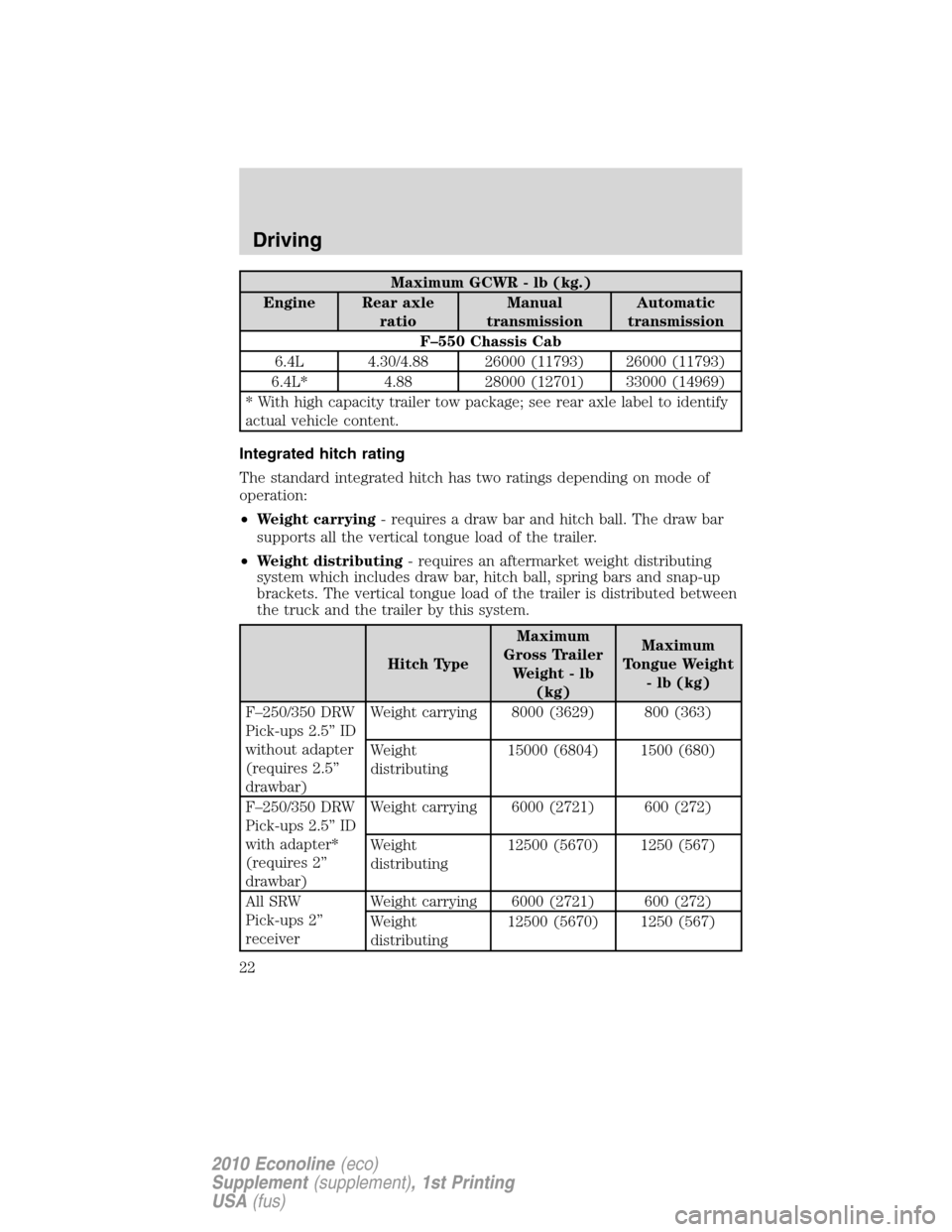
Maximum GCWR - lb (kg.)
Engine Rear axle
ratioManual
transmissionAutomatic
transmission
F–550 Chassis Cab
6.4L 4.30/4.88 26000 (11793) 26000 (11793)
6.4L* 4.88 28000 (12701) 33000 (14969)
* With high capacity trailer tow package; see rear axle label to identify
actual vehicle content.
Integrated hitch rating
The standard integrated hitch has two ratings depending on mode of
operation:
•Weight carrying- requires a draw bar and hitch ball. The draw bar
supports all the vertical tongue load of the trailer.
•Weight distributing- requires an aftermarket weight distributing
system which includes draw bar, hitch ball, spring bars and snap-up
brackets. The vertical tongue load of the trailer is distributed between
the truck and the trailer by this system.
Hitch TypeMaximum
Gross Trailer
Weight-lb
(kg)Maximum
Tongue Weight
- lb (kg)
F–250/350 DRW
Pick-ups 2.5” ID
without adapter
(requires 2.5”
drawbar)Weight carrying 8000 (3629) 800 (363)
Weight
distributing15000 (6804) 1500 (680)
F–250/350 DRW
Pick-ups 2.5” ID
with adapter*
(requires 2”
drawbar)Weight carrying 6000 (2721) 600 (272)
Weight
distributing12500 (5670) 1250 (567)
All SRW
Pick-ups 2”
receiverWeight carrying 6000 (2721) 600 (272)
Weight
distributing12500 (5670) 1250 (567)
Driving
22
2010 Econoline(eco)
Supplement(supplement), 1st Printing
USA(fus)
Page 24 of 104
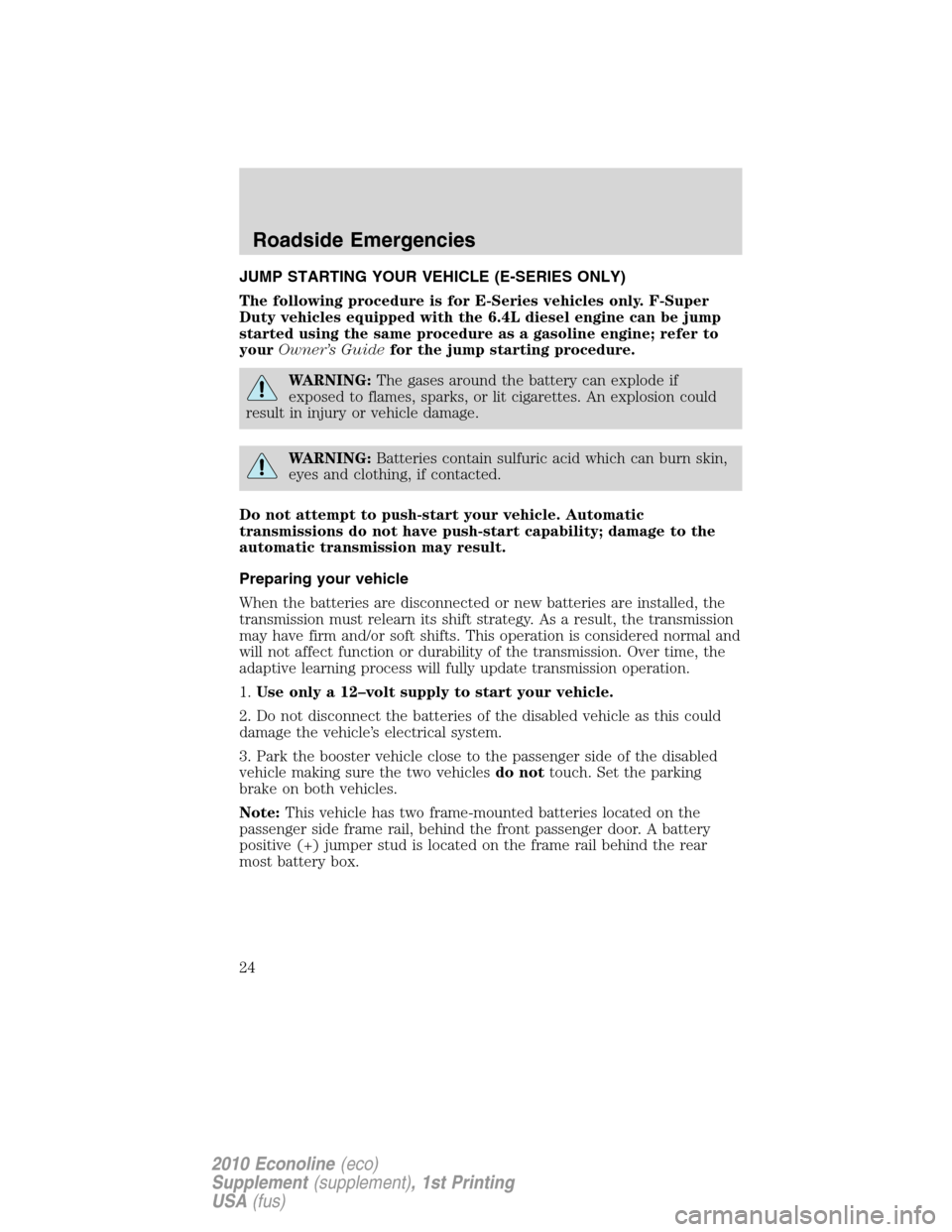
JUMP STARTING YOUR VEHICLE (E-SERIES ONLY)
The following procedure is for E-Series vehicles only. F-Super
Duty vehicles equipped with the 6.4L diesel engine can be jump
started using the same procedure as a gasoline engine; refer to
yourOwner’s Guidefor the jump starting procedure.
WARNING:The gases around the battery can explode if
exposed to flames, sparks, or lit cigarettes. An explosion could
result in injury or vehicle damage.
WARNING:Batteries contain sulfuric acid which can burn skin,
eyes and clothing, if contacted.
Do not attempt to push-start your vehicle. Automatic
transmissions do not have push-start capability; damage to the
automatic transmission may result.
Preparing your vehicle
When the batteries are disconnected or new batteries are installed, the
transmission must relearn its shift strategy. As a result, the transmission
may have firm and/or soft shifts. This operation is considered normal and
will not affect function or durability of the transmission. Over time, the
adaptive learning process will fully update transmission operation.
1.Use only a 12–volt supply to start your vehicle.
2. Do not disconnect the batteries of the disabled vehicle as this could
damage the vehicle’s electrical system.
3. Park the booster vehicle close to the passenger side of the disabled
vehicle making sure the two vehiclesdo nottouch. Set the parking
brake on both vehicles.
Note:This vehicle has two frame-mounted batteries located on the
passenger side frame rail, behind the front passenger door. A battery
positive (+) jumper stud is located on the frame rail behind the rear
most battery box.
Roadside Emergencies
24
2010 Econoline(eco)
Supplement(supplement), 1st Printing
USA(fus)