display FORD SUPER DUTY 2013 3.G Diesel Supplement Manual
[x] Cancel search | Manufacturer: FORD, Model Year: 2013, Model line: SUPER DUTY, Model: FORD SUPER DUTY 2013 3.GPages: 95, PDF Size: 2.42 MB
Page 40 of 95
Optional information display procedure
1. Start with the vehicle engine fully warmed.
2. From the main menu, select Gauge Mode and scroll through until one
of the following options appear:
•If the DPF needs cleaning and the vehicle is warmed up, you will be
prompted to hold OK to cleanExhaust xx% FullorExhaust Filter
Full. Press OK and then follow the prompts regarding exhaust
position as needed to initiate OCR. Be sure to understand each
prompt. If you are not sure what is being asked by each prompt,
contact your authorized dealer. The display will confirm the operation
has started and when it has finished.
•When the exhaust system is
overloaded cleaning will be
allowed until a certain saturation
level. If the vehicle is warmed up and ready the powertrain fault
indicator will illuminate and you will be prompted to hold OK to clean
Drive to Clean Exhaust System+Exhaust Filter Overloaded.
Press OK and then follow the prompts regarding exhaust position as
needed to initiate OCR. Be sure to understand each prompt. If you are
not sure what is being asked by each prompt, contact your authorized
dealer. The display will confirm the operation has started and when it
has finished. You can also drive to clean the filter. SeeActive
regenerationearlier in this chapter.
•The service engine soon light will
illuminate and the following
messagesExhaust Filter
Overloaded+Reduced Engine PowerorReduced Engine Power
will appear when the system is at the point of oversaturation you will
not be able to allow cleaning . The vehicle must be serviced by an
authorized dealer.
3. Once OCR starts, the engine’s rpm will rise to approximately 2,000 -
2,400 rpm and the cooling fan will increase speed; you will hear a change
in audible sound due to the fan and engine speed increase.
It is not necessary to open the hood on the engine compartment. Once
OCR is complete, the engine rpm and fan will return to normal idling.
The exhaust system will remain very hot for several minutes even after
regeneration is complete. Do not reposition the vehicle over materials
that could burn until the exhaust system has had sufficient time to
cool. Depending on the amount of soot collected by the DPF, ambient
temperature, and altitude, OCR may last from 10 to 25 minutes.
Fuel and Refueling
39
2013 Diesel(67l)
Supplement, 1st Printing
USA(fus)
Page 44 of 95
Among those acts which the U.S. Environmental Protection Agency may
presume to constitute tampering are the acts listed below:
•Removal of hood blanket, fender apron absorbers, fender apron
barriers, underbody noise shields or acoustically absorptive material.
•Tampering or rendering inoperative the engine speed governor, so as
to allow engine speed to exceed manufacturer’s specifications.
The complexity of the diesel engine makes it so the owner is discouraged
from attempting to perform maintenance other than the services
described in this supplement.
If you experience difficult starting, rough idling, excessive exhaust
smoke, a decrease in engine performance or excess fuel consumption,
perform the following checks:
•a plugged or disconnected air inlet system or engine air filter element.
•water in the fuel filter/water separator.
•a clogged fuel filter.
•contaminated fuel.
•air in the fuel system, due to loose connections.
•an open or pinched sensor hose.
•check engine oil level.
•wrong fuel or oil viscosity for climactic conditions.
If these checks do not help you correct the engine performance problem
you are experiencing, consult an authorized dealer.
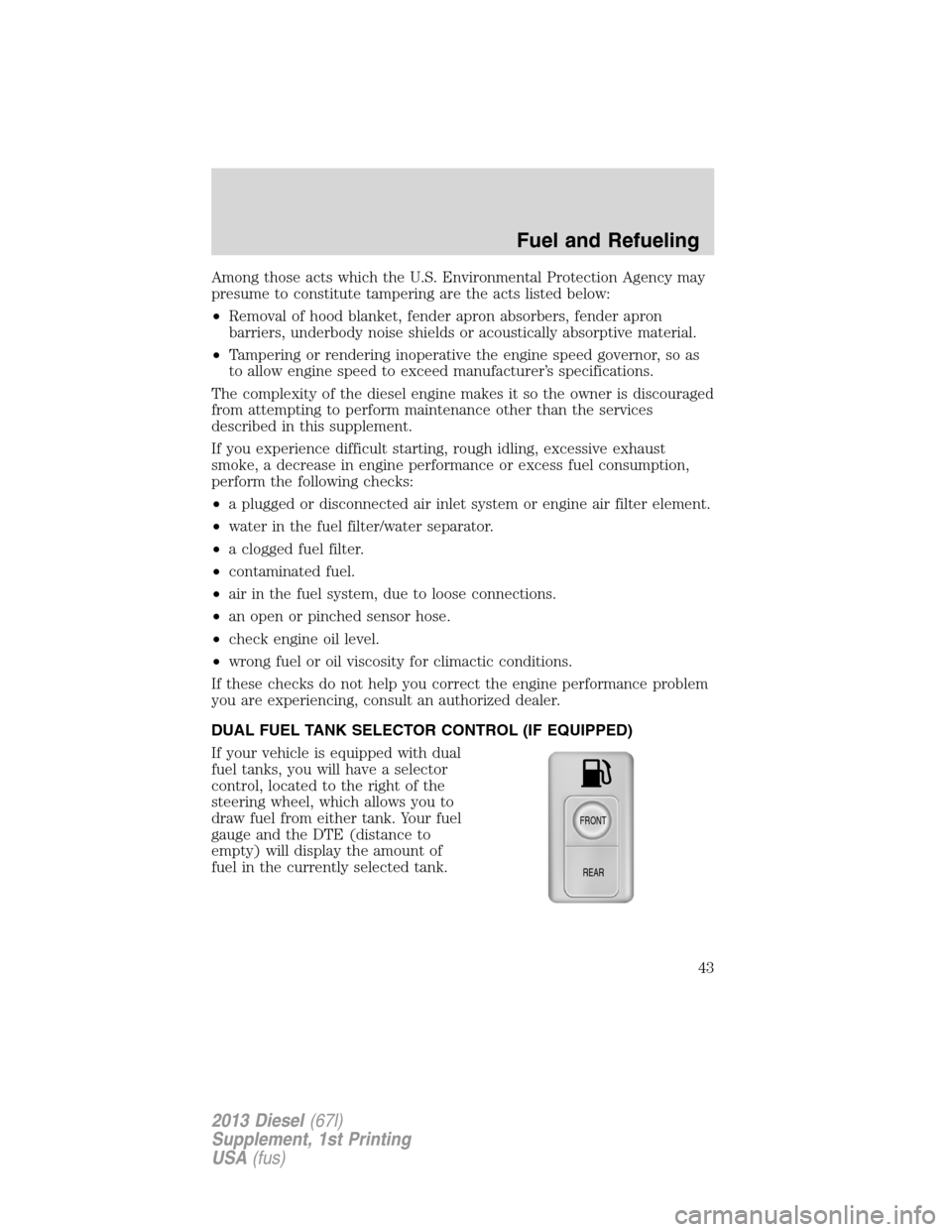
DUAL FUEL TANK SELECTOR CONTROL (IF EQUIPPED)
If your vehicle is equipped with dual
fuel tanks, you will have a selector
control, located to the right of the
steering wheel, which allows you to
draw fuel from either tank. Your fuel
gauge and the DTE (distance to
empty) will display the amount of
fuel in the currently selected tank.
FRONT
REAR
Fuel and Refueling
43
2013 Diesel(67l)
Supplement, 1st Printing
USA(fus)
Page 51 of 95
recommended oils because they will provide acceptable engine
performance and durability. These oils are also compatible with the
emission control equipment of your vehicle to meet the more stringent
emission standards.
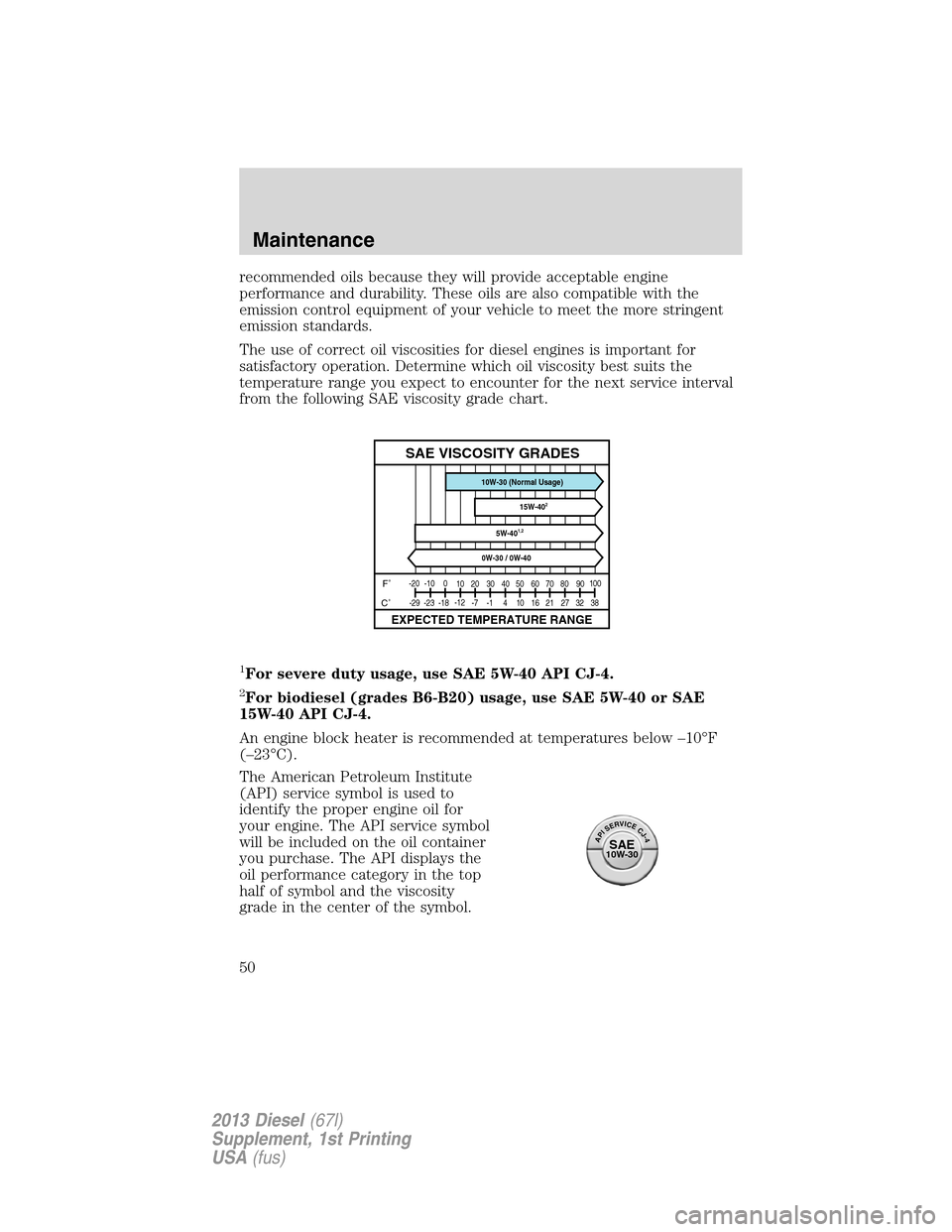
The use of correct oil viscosities for diesel engines is important for
satisfactory operation. Determine which oil viscosity best suits the
temperature range you expect to encounter for the next service interval
from the following SAE viscosity grade chart.
1For severe duty usage, use SAE 5W-40 API CJ-4.
2For biodiesel (grades B6-B20) usage, use SAE 5W-40 or SAE
15W-40 API CJ-4.
An engine block heater is recommended at temperatures below –10°F
(–23°C).
The American Petroleum Institute
(API) service symbol is used to
identify the proper engine oil for
your engine. The API service symbol
will be included on the oil container
you purchase. The API displays the
oil performance category in the top
half of symbol and the viscosity
grade in the center of the symbol.
-20
-100
10 20 30
40
38 32 27 21 16 10 4 -1 -7 -12
-18 -23 -2950 60
7080 9010 0
SAE VISCOSITY GRADES
EXPECTED TEMPERATURE RANGE
F˚
C˚
5W-401,2
0W-30 / 0W-4015W-40
2
10W-30 (Normal Usage)
API SERVICE CJ-4
SAE10W-30
Maintenance
50
2013 Diesel(67l)
Supplement, 1st Printing
USA(fus)
Page 52 of 95
Changing the engine oil and oil filter
WARNING:Do not handle a hot oil filter with bare hands.
WARNING:Continuous contact with used motor oil has caused
cancer in laboratory mice. Protect your skin by washing with
soap and water.
Your vehicle is equipped with an Intelligent Oil Life Monitor™ that
calculates the proper oil change service interval. When the information
display indicates:OIL CHANGE REQUIRED, change the engine oil and
oil filter. See theInformation Displayschapter in theOwner Manual
for more information.
Refer toMotorcraft part numberstheCapacities and Specifications
chapter for the engine oil filter part number. This filter protects your
engine by filtering harmful, abrasive or sludge particles and particles
significantly smaller than most available “will-fit” filters.
To change the engine oil and oil filter:
1. Unscrew the oil filter and oil pan drain plug and wait for the oil to drain.
Note:The oil pan drain plug only requires 1/4 turn to removal/install. A
3/8 inch socket drive may be used to assist with removal/installation, but be
careful not to over-tighten the plug during installation.
2. Replace the filter.
3. Reinstall the oil pan drain plug.
4. Refill the engine with new oil. For the proper capacity, seeCapacities
and Specificationschapter.
5. Reset the Intelligent Oil Life Monitor™. See theInformation Displays
chapter in theOwner Manualfor more information.
Engine lubrication for severe service operation
The following conditions define severe operation for which engine
operation with SAE 5W-40 API CJ-4 is recommended. Oil and oil filter
change intervals will be determined by the Intelligent Oil Life Monitor™
as noted previously.
•
frequent or extended idling (over 10 minutes per hour of normal driving)
•low-speed operation/stationary use
•if vehicle is operated in sustained ambient temperatures below -10°F
(-23°C) or above 100°F (38°C)
Maintenance
51
2013 Diesel(67l)
Supplement, 1st Printing
USA(fus)
Page 58 of 95
Checking coolant corrosion inhibitor additive strength
At specific mileage intervals of 15,000 miles (24,000 km), as listed in the
scheduled maintenance informationchapter, the coolant corrosion
inhibitor additive should be checked. The optional information display, if
equipped, will also display the messageCHECK COOLANT ADDITIVE
at this time. The purpose of checking is to verify the correct engine
coolant concentration (freeze point protection) and corrosion inhibitor
additive level (strength) of the coolant for maximum engine performance
and protection. Three products are available for ensuring the life and
health of the coolant: one tool, a test kit and a coolant inhibitor additive:
•Rotunda tool 300–ROB75240 available from your dealer –
recommended refractometer to test coolant concentration.
•
Rotunda 328-R071–ELC (Antifreeze Coolant ELC Contamination Kit) –
Evaluates the corrosion inhibitor additive strength. Note the first step is
to verify the vehicle’s coolant concentration is in the correct range of 40
– 60%. Coolant concentrations outside this range will not provide valid
test results. If the report results in a pass (i.e., the cooling system does
not show excessive contamination/the corrosion inhibitor additive
strength is sufficient), no action is required. If the report results as
insufficient (does not pass), the corrosion inhibitor additive strength of
the coolant is too low. If the ENGINE COOLING SYSTEM corrosion
inhibitor additive strength is low, add 48 fluid oz. of Motorcraft®
Specialty Orange Engine Coolant Revitalizer. If the SECONDARY
COOLING SYSTEM corrosion inhibitor additive strength is low, add 16
fluid oz. of Motorcraft® Specialty Orange Engine Coolant Revitalizer.
•Motorcraft® Specialty Orange Engine Coolant Revitalizer – Additive to
boost the corrosion inhibitor level based upon the test results of the
Antifreeze Coolant ELC Contamination Kit. The Revitalizer may be
added two times over the life of the coolant. If additional dosages are
required, the cooling system must be flushed and refilled per the
instructions in the Workshop Manual.
Refer to theCapacities and Specificationschapter for the proper
coolant and additive specifications.
Coolant change
At specific mileage intervals, as listed in thescheduled maintenance
information,the coolant should be changed. The optional information
display, if equipped, will also display the messageCOOLANT CHANGE
REQUIREDat this time.
Refer to theCapacities and Specificationschapter for the proper coolant.
Maintenance
57
2013 Diesel(67l)
Supplement, 1st Printing
USA(fus)
Page 72 of 95
Protecting Your Investment
Maintenance is an investment that will pay dividends in the form of
improved reliability, durability and resale value. To maintain the proper
performance of your vehicle and its emission control systems, it is
imperative that scheduled maintenance be completed at the designated
intervals.
Your vehicle is equipped with the Intelligent Oil-Life Monitor® (IOLM)
system which displays a message in the information display at the proper
oil change service interval; this interval may be up to one year or
10000 miles (16000 kilometers). When ENGINE OIL CHANGE DUE or
OIL CHANGE REQUIRED appears in the information display, it is time
for an oil change; the oil change must be done within two weeks or
500 miles (800 kilometers) of the ENGINE OIL CHANGE DUE or OIL
CHANGE REQUIRED message appearing. The Intelligent Oil-Life
Monitor® must be reset after each oil change; see theInformation
Displayschapter of yourOwner’s Manual.
If your information display is prematurely reset or becomes inoperative,
you should perform the oil change interval at six months or 5000 miles
(8000 kilometers) from your last oil change. Never exceed one year or
10000 miles (16000 kilometers) between oil change intervals.
Your vehicle is very sophisticated and built with multiple, complex,
performance systems. Every manufacturer develops these systems using
different specifications and performance features. That is why it is
important to rely upon your dealership to properly diagnose and repair
your vehicle.
Ford Motor Company has recommended maintenance intervals for
various parts and component systems based upon engineering testing.
Ford Motor Company relies upon this testing to determine the most
appropriate mileage for replacement of oils and fluids to protect your
vehicle at the lowest overall cost to you and recommends against
maintenance schedules that deviate from the scheduled maintenance
information.
Ford strongly recommends the use of only genuine Ford, Motorcraft® or
Ford-authorized remanufactured replacement parts because they are
engineered for your vehicle.
Additives and Chemicals
Ford Motor Company recommended additives and chemicals are listed in
the owner manual and in the Ford Workshop Manual. Additional
chemicals or additives not approved by Ford Motor Company are not
recommended as part of normal maintenance. Please consult your
warranty information.
Scheduled Maintenance
71
2013 Diesel(67l)
Supplement, 1st Printing
USA(fus)
Page 73 of 95
Oils, Fluids and Flushing
In many cases, fluid discoloration is a normal operating characteristic
and, by itself, does not necessarily indicate a concern or that the fluid
needs to be changed. However, discolored fluids that also show signs of
overheating and foreign material contamination should be inspected
immediately by a qualified expert, such as the factory-trained technicians
at your dealership. Your vehicle’s oils and fluids should be changed at the
specified intervals or in conjunction with a repair. Flushing is a viable
way to change fluid for many vehicle sub-systems during scheduled
maintenance. It is critical that systems are flushed only with new fluid
that is the same as that required to fill and operate the system, or using
a Ford-approved flushing chemical.
Owner Checks and Services
Certain basic maintenance checks and inspections should be performed by
the owner or a service technician at the intervals indicated. Service
information and supporting specifications are provided in theOwner’s Guide.
Any adverse condition should be brought to the attention of your dealer
or qualified service technician as soon as possible for the proper service
advice. The owner maintenance service checks are generally not covered
by warranties so you may be charged for labor, parts or fluids used.
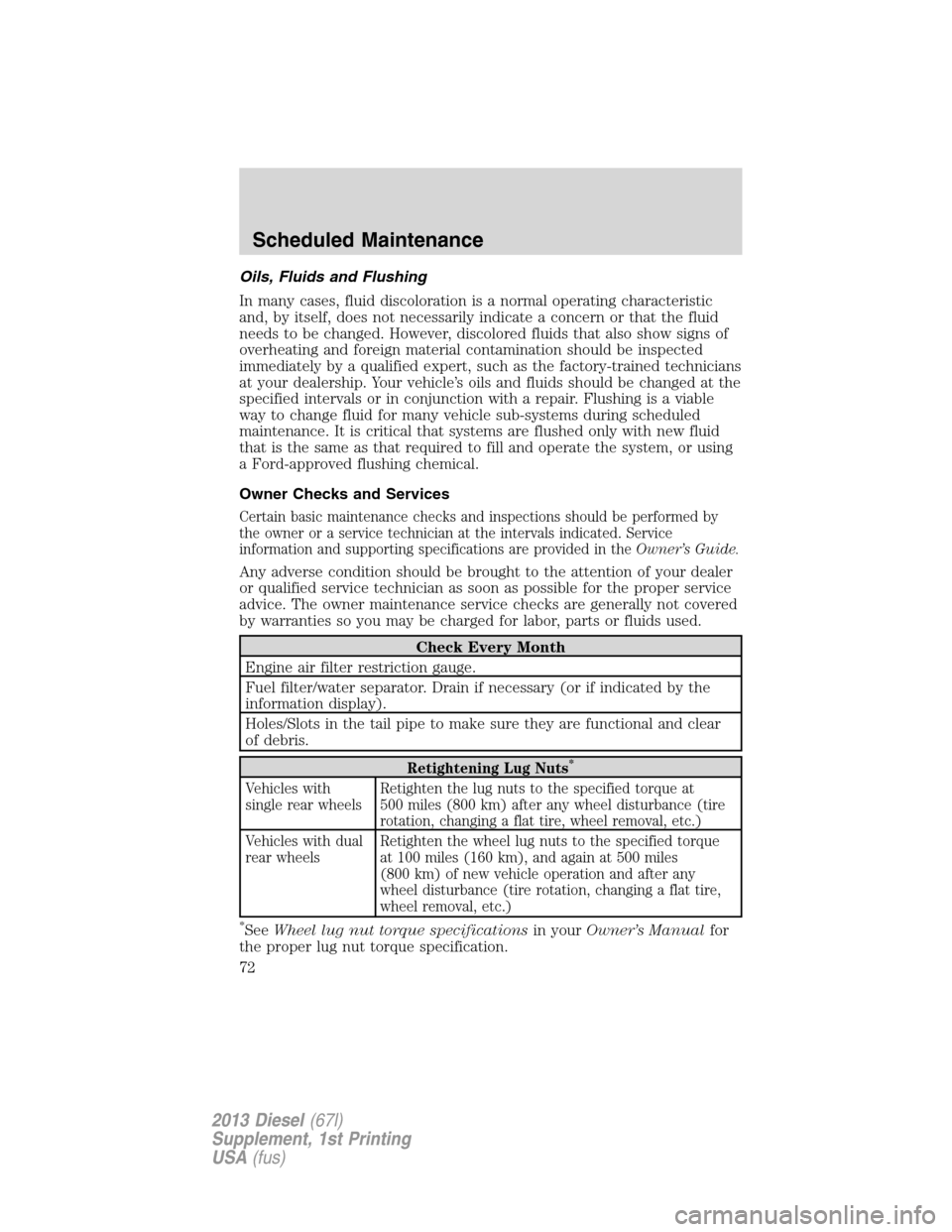
Check Every Month
Engine air filter restriction gauge.
Fuel filter/water separator. Drain if necessary (or if indicated by the
information display).
Holes/Slots in the tail pipe to make sure they are functional and clear
of debris.
Retightening Lug Nuts*
Vehicles with
single rear wheelsRetighten the lug nuts to the specified torque at
500 miles (800 km) after any wheel disturbance (tire
rotation, changing a flat tire, wheel removal, etc.)
Vehicles with dual
rear wheelsRetighten the wheel lug nuts to the specified torque
at 100 miles (160 km), and again at 500 miles
(800 km) of new vehicle operation and after any
wheel disturbance (tire rotation, changing a flat tire,
wheel removal, etc.)
*SeeWheel lug nut torque specificationsin yourOwner’s Manualfor
the proper lug nut torque specification.
Scheduled Maintenance
72
2013 Diesel(67l)
Supplement, 1st Printing
USA(fus)
Page 76 of 95
NORMAL SCHEDULED MAINTENANCE AND LOG
Intelligent Oil-Life Monitor®
Your vehicle is equipped with an Intelligent Oil-Life Monitor® that
determines when the engine oil needs to be changed based on how your
vehicle is used. By using several important factors in its calculations, the
monitor helps reduce the cost of owning your vehicle and reduce
environmental waste at the same time. This means you won’t have to
remember to change the oil on a mileage-based schedule; the vehicle lets
you know when an oil change is due by displaying OIL CHANGE
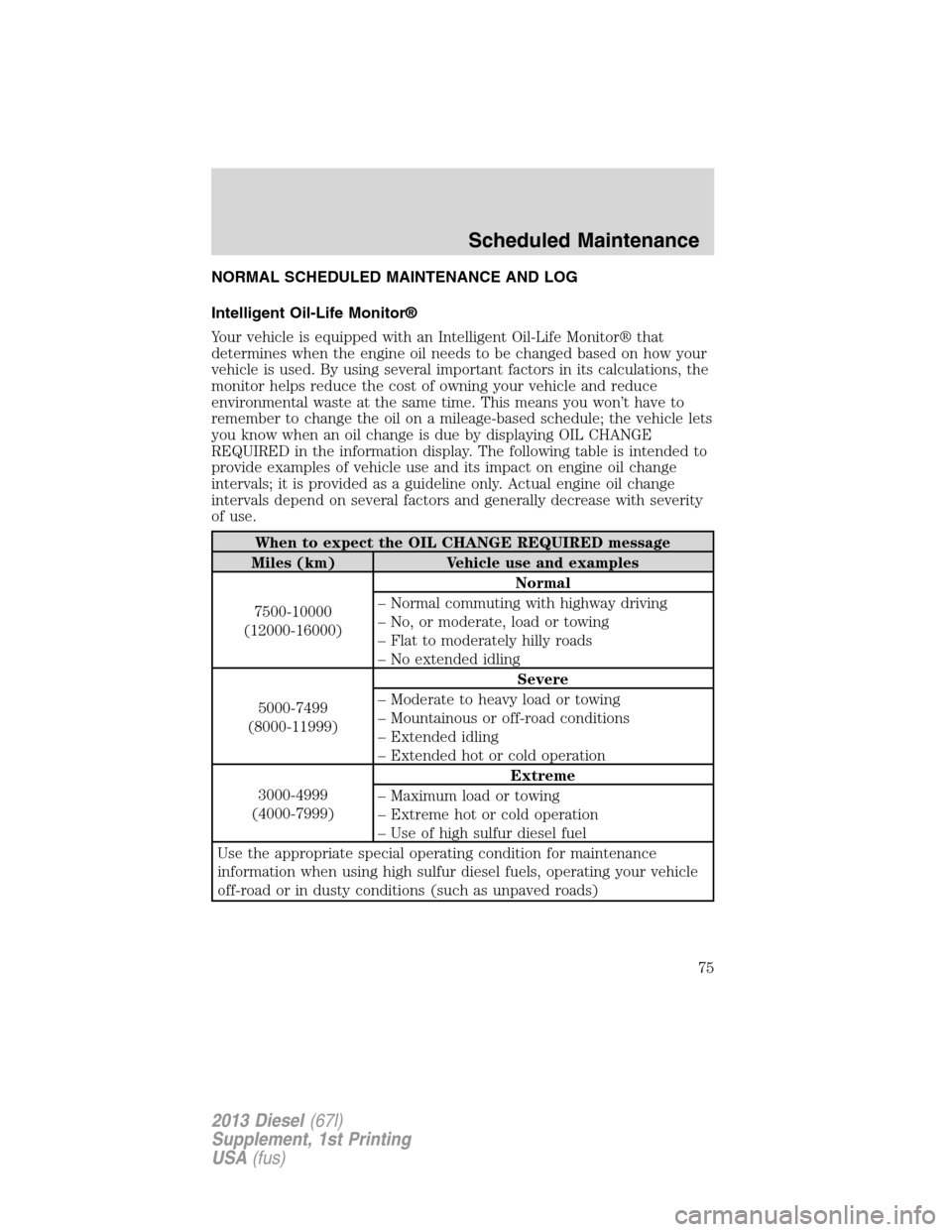
REQUIRED in the information display. The following table is intended to
provide examples of vehicle use and its impact on engine oil change
intervals; it is provided as a guideline only. Actual engine oil change
intervals depend on several factors and generally decrease with severity
of use.
When to expect the OIL CHANGE REQUIRED message
Miles (km) Vehicle use and examples
7500-10000
(12000-16000)Normal
– Normal commuting with highway driving
– No, or moderate, load or towing
– Flat to moderately hilly roads
– No extended idling
5000-7499
(8000-11999)Severe
– Moderate to heavy load or towing
– Mountainous or off-road conditions
– Extended idling
– Extended hot or cold operation
3000-4999
(4000-7999)Extreme
– Maximum load or towing
– Extreme hot or cold operation
– Use of high sulfur diesel fuel
Use the appropriate special operating condition for maintenance
information when using high sulfur diesel fuels, operating your vehicle
off-road or in dusty conditions (such as unpaved roads)
Scheduled Maintenance
75
2013 Diesel(67l)
Supplement, 1st Printing
USA(fus)
Page 77 of 95
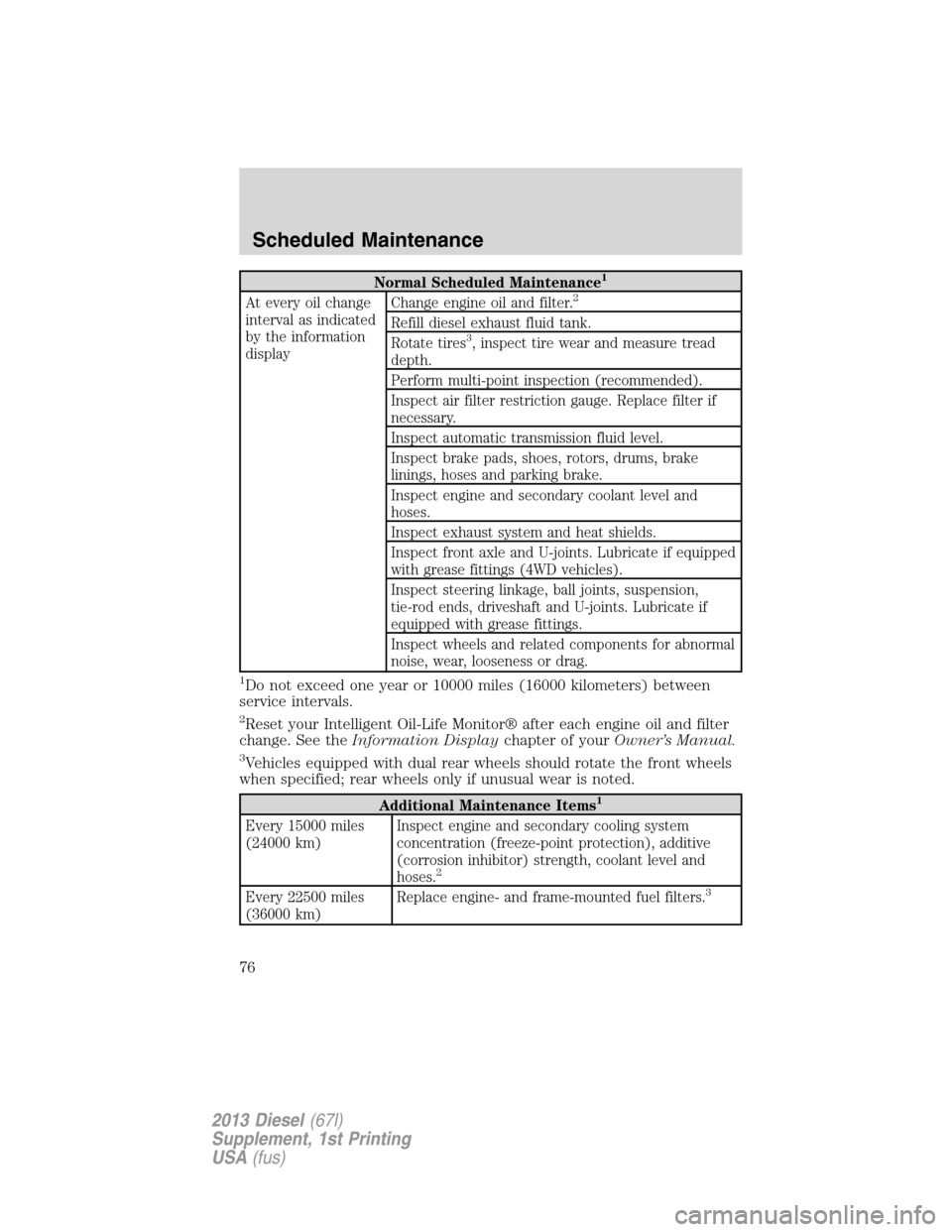
Normal Scheduled Maintenance1
At every oil change
interval as indicated
by the information
displayChange engine oil and filter.2
Refill diesel exhaust fluid tank.
Rotate tires3, inspect tire wear and measure tread
depth.
Perform multi-point inspection (recommended).
Inspect air filter restriction gauge. Replace filter if
necessary.
Inspect automatic transmission fluid level.
Inspect brake pads, shoes, rotors, drums, brake
linings, hoses and parking brake.
Inspect engine and secondary coolant level and
hoses.
Inspect exhaust system and heat shields.
Inspect front axle and U-joints. Lubricate if equipped
with grease fittings (4WD vehicles).
Inspect steering linkage, ball joints, suspension,
tie-rod ends, driveshaft and U-joints. Lubricate if
equipped with grease fittings.
Inspect wheels and related components for abnormal
noise, wear, looseness or drag.
1Do not exceed one year or 10000 miles (16000 kilometers) between
service intervals.
2Reset your Intelligent Oil-Life Monitor® after each engine oil and filter
change. See theInformation Displaychapter of yourOwner’s Manual.
3Vehicles equipped with dual rear wheels should rotate the front wheels
when specified; rear wheels only if unusual wear is noted.
Additional Maintenance Items1
Every 15000 miles
(24000 km)Inspect engine and secondary cooling system
concentration (freeze-point protection), additive
(corrosion inhibitor) strength, coolant level and
hoses.
2
Every 22500 miles
(36000 km)Replace engine- and frame-mounted fuel filters.3
Scheduled Maintenance
76
2013 Diesel(67l)
Supplement, 1st Printing
USA(fus)
Page 78 of 95
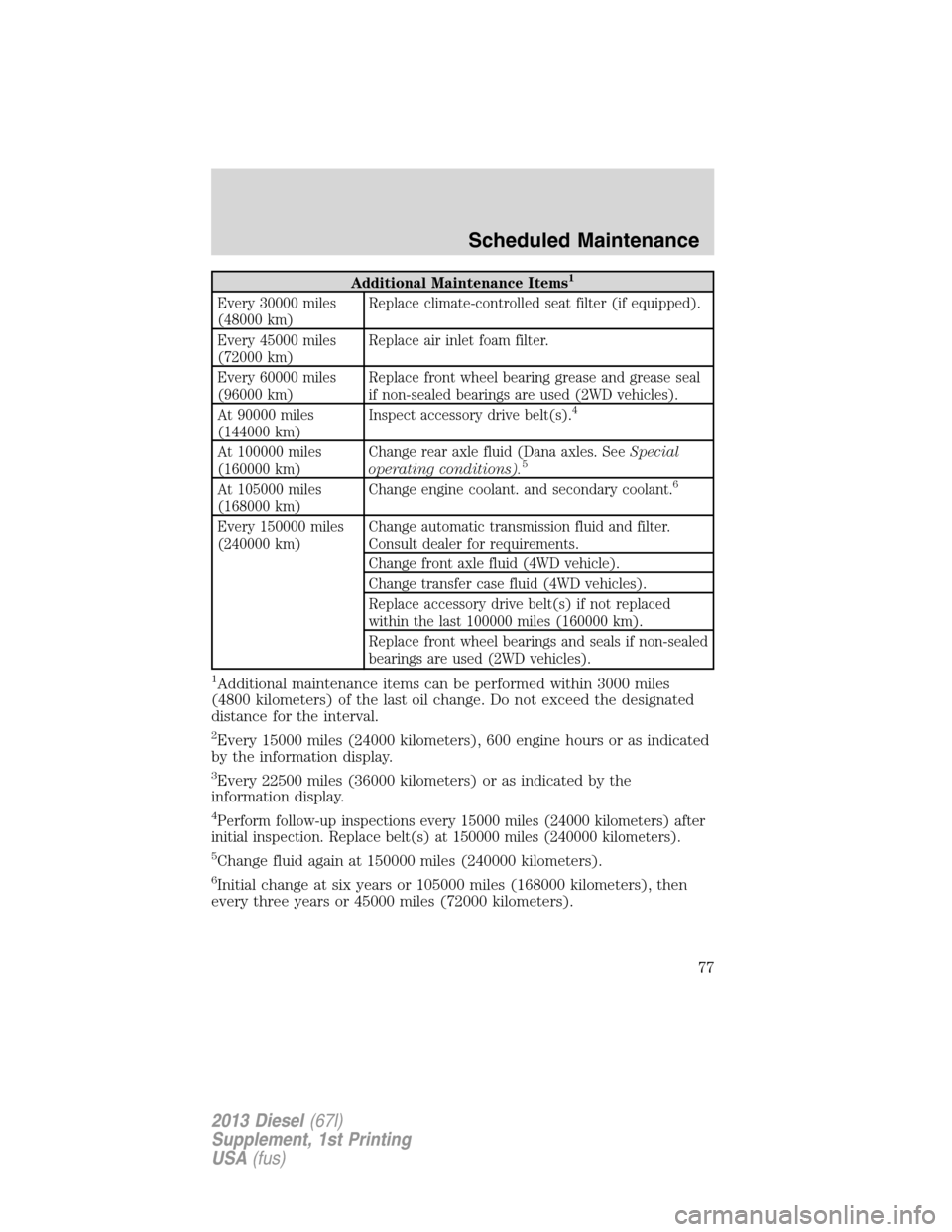
Additional Maintenance Items1
Every 30000 miles
(48000 km)Replace climate-controlled seat filter (if equipped).
Every 45000 miles
(72000 km)Replace air inlet foam filter.
Every 60000 miles
(96000 km)Replace front wheel bearing grease and grease seal
if non-sealed bearings are used (2WD vehicles).
At 90000 miles
(144000 km)Inspect accessory drive belt(s).
4
At 100000 miles
(160000 km)Change rear axle fluid (Dana axles. SeeSpecial
operating conditions).5
At 105000 miles
(168000 km)Change engine coolant. and secondary coolant.6
Every 150000 miles
(240000 km)Change automatic transmission fluid and filter.
Consult dealer for requirements.
Change front axle fluid (4WD vehicle).
Change transfer case fluid (4WD vehicles).
Replace accessory drive belt(s) if not replaced
within the last 100000 miles (160000 km).
Replace front wheel bearings and seals if non-sealed
bearings are used (2WD vehicles).
1Additional maintenance items can be performed within 3000 miles
(4800 kilometers) of the last oil change. Do not exceed the designated
distance for the interval.
2Every 15000 miles (24000 kilometers), 600 engine hours or as indicated
by the information display.
3Every 22500 miles (36000 kilometers) or as indicated by the
information display.
4Perform follow-up inspections every 15000 miles (24000 kilometers) after
initial inspection. Replace belt(s) at 150000 miles (240000 kilometers).
5Change fluid again at 150000 miles (240000 kilometers).
6Initial change at six years or 105000 miles (168000 kilometers), then
every three years or 45000 miles (72000 kilometers).
Scheduled Maintenance
77
2013 Diesel(67l)
Supplement, 1st Printing
USA(fus)