warning FORD SUPER DUTY 2013 3.G Diesel Supplement Manual
[x] Cancel search | Manufacturer: FORD, Model Year: 2013, Model line: SUPER DUTY, Model: FORD SUPER DUTY 2013 3.GPages: 95, PDF Size: 2.42 MB
Page 22 of 95
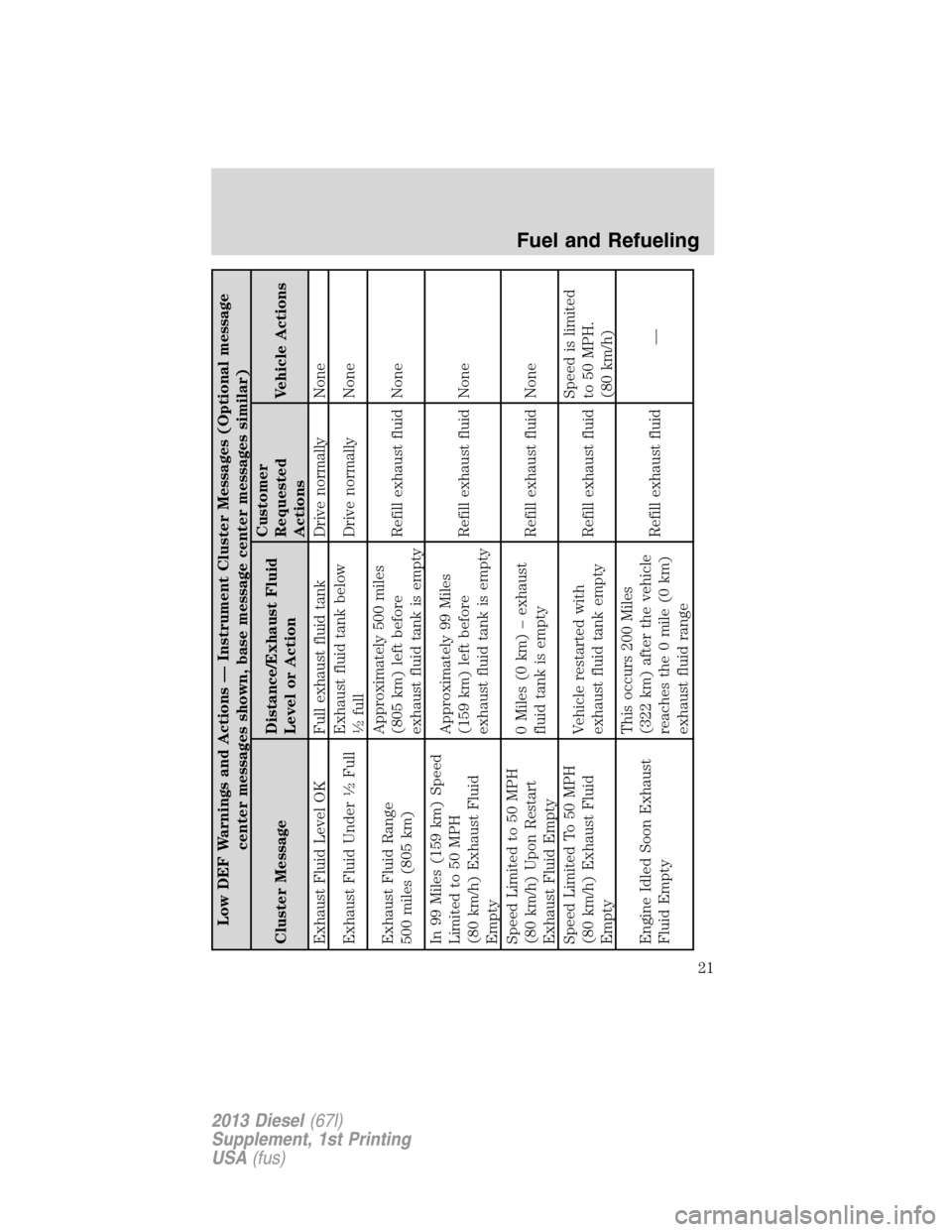
Low DEF Warnings and Actions — Instrument Cluster Messages (Optional message
center messages shown, base message center messages similar)
Cluster MessageDistance/Exhaust Fluid
Level or ActionCustomer
Requested
ActionsVehicle Actions
Exhaust Fluid Level OK Full exhaust fluid tank Drive normally None
Exhaust Fluid Under
12FullExhaust fluid tank below
12fullDrive normally None
Exhaust Fluid Range
500 miles (805 km)Approximately 500 miles
(805 km) left before
exhaust fluid tank is emptyRefill exhaust fluid None
In 99 Miles (159 km) Speed
Limited to 50 MPH
(80 km/h) Exhaust Fluid
EmptyApproximately 99 Miles
(159 km) left before
exhaust fluid tank is emptyRefill exhaust fluid None
Speed Limited to 50 MPH
(80 km/h) Upon Restart
Exhaust Fluid Empty0 Miles (0 km) – exhaust
fluid tank is emptyRefill exhaust fluid None
Speed Limited To 50 MPH
(80 km/h) Exhaust Fluid
EmptyVehicle restarted with
exhaust fluid tank emptyRefill exhaust fluidSpeed is limited
to 50 MPH.
(80 km/h)
Engine Idled Soon Exhaust
Fluid EmptyThis occurs 200 Miles
(322 km) after the vehicle
reaches the 0 mile (0 km)
exhaust fluid rangeRefill exhaust fluid —
Fuel and Refueling
21
2013 Diesel(67l)
Supplement, 1st Printing
USA(fus)
Page 23 of 95
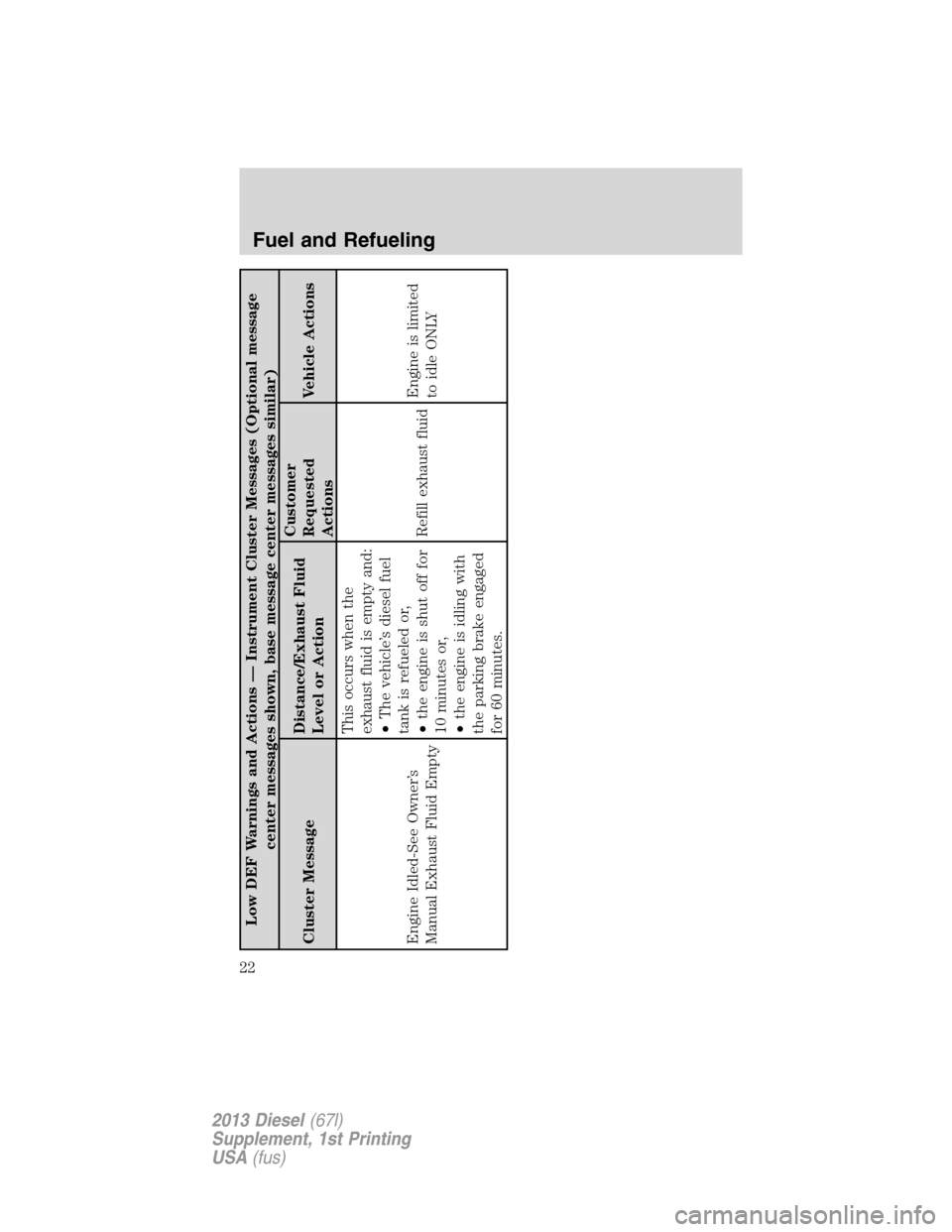
Low DEF Warnings and Actions — Instrument Cluster Messages (Optional message
center messages shown, base message center messages similar)
Cluster MessageDistance/Exhaust Fluid
Level or ActionCustomer
Requested
ActionsVehicle Actions
Engine Idled-See Owner’s
Manual Exhaust Fluid EmptyThis occurs when the
exhaust fluid is empty and:
•The vehicle’s diesel fuel
tank is refueled or,
•the engine is shut off for
10 minutes or,
•the engine is idling with
the parking brake engaged
for 60 minutes.Refill exhaust fluidEngine is limited
to idle ONLY
Fuel and Refueling
22
2013 Diesel(67l)
Supplement, 1st Printing
USA(fus)
Page 24 of 95
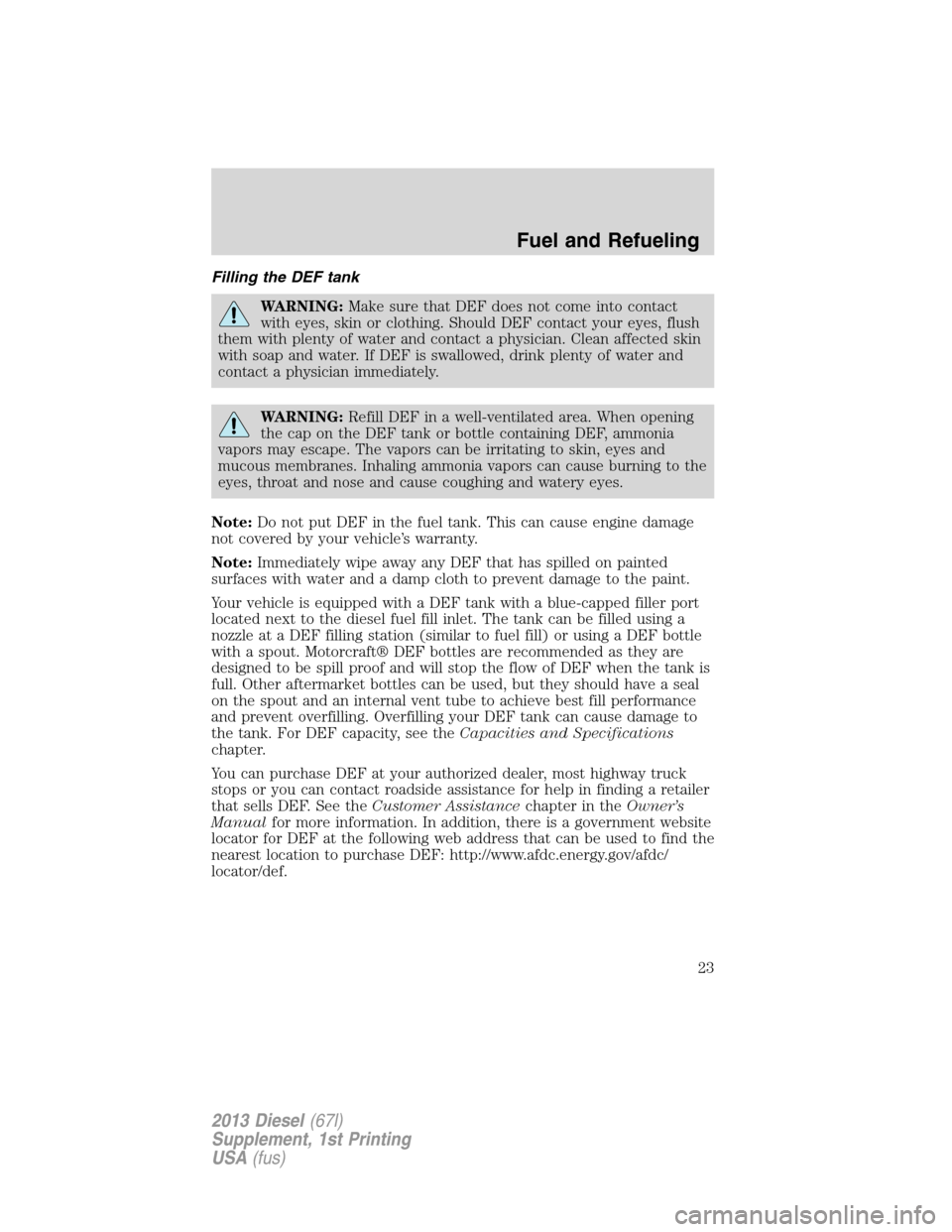
Filling the DEF tank
WARNING:Make sure that DEF does not come into contact
with eyes, skin or clothing. Should DEF contact your eyes, flush
them with plenty of water and contact a physician. Clean affected skin
with soap and water. If DEF is swallowed, drink plenty of water and
contact a physician immediately.
WARNING:Refill DEF in a well-ventilated area. When opening
the cap on the DEF tank or bottle containing DEF, ammonia
vapors may escape. The vapors can be irritating to skin, eyes and
mucous membranes. Inhaling ammonia vapors can cause burning to the
eyes, throat and nose and cause coughing and watery eyes.
Note:Do not put DEF in the fuel tank. This can cause engine damage
not covered by your vehicle’s warranty.
Note:Immediately wipe away any DEF that has spilled on painted
surfaces with water and a damp cloth to prevent damage to the paint.
Your vehicle is equipped with a DEF tank with a blue-capped filler port
located next to the diesel fuel fill inlet. The tank can be filled using a
nozzle at a DEF filling station (similar to fuel fill) or using a DEF bottle
with a spout. Motorcraft® DEF bottles are recommended as they are
designed to be spill proof and will stop the flow of DEF when the tank is
full. Other aftermarket bottles can be used, but they should have a seal
on the spout and an internal vent tube to achieve best fill performance
and prevent overfilling. Overfilling your DEF tank can cause damage to
the tank. For DEF capacity, see theCapacities and Specifications
chapter.
You can purchase DEF at your authorized dealer, most highway truck
stops or you can contact roadside assistance for help in finding a retailer
that sells DEF. See theCustomer Assistancechapter in theOwner’s
Manualfor more information. In addition, there is a government website
locator for DEF at the following web address that can be used to find the
nearest location to purchase DEF: http://www.afdc.energy.gov/afdc/
locator/def.
Fuel and Refueling
23
2013 Diesel(67l)
Supplement, 1st Printing
USA(fus)
Page 31 of 95
FUEL FILTER/WATER SEPARATOR
Diesel Fuel Conditioner Module (DFCM)
The vehicle is equipped with a diesel fuel conditioning module (DFCM)
located on the frame-rail under the driver-side floorboard near the
transmission
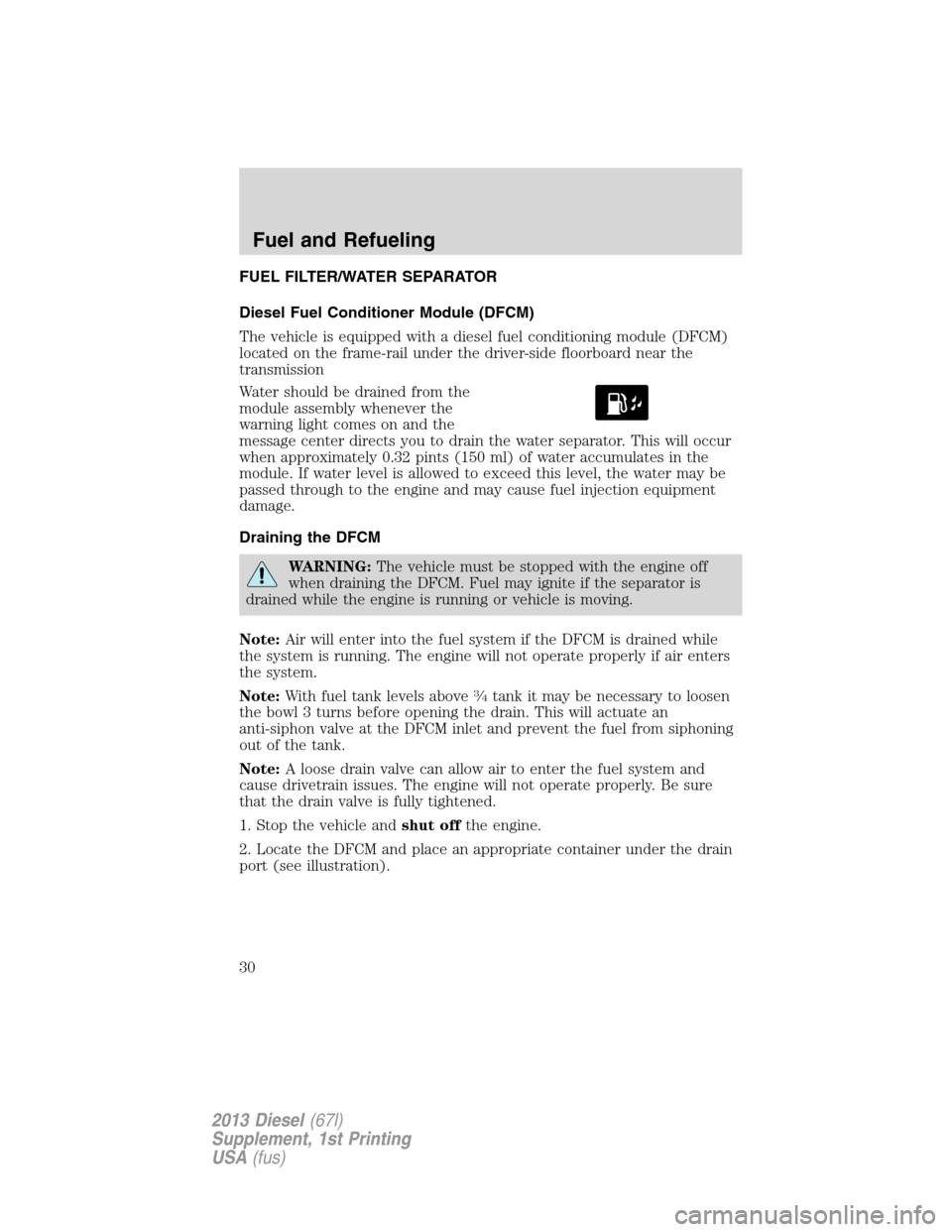
Water should be drained from the
module assembly whenever the
warning light comes on and the
message center directs you to drain the water separator. This will occur
when approximately 0.32 pints (150 ml) of water accumulates in the
module. If water level is allowed to exceed this level, the water may be
passed through to the engine and may cause fuel injection equipment
damage.
Draining the DFCM
WARNING:The vehicle must be stopped with the engine off
when draining the DFCM. Fuel may ignite if the separator is
drained while the engine is running or vehicle is moving.
Note:Air will enter into the fuel system if the DFCM is drained while
the system is running. The engine will not operate properly if air enters
the system.
Note:With fuel tank levels above
34tank it may be necessary to loosen
the bowl 3 turns before opening the drain. This will actuate an
anti-siphon valve at the DFCM inlet and prevent the fuel from siphoning
out of the tank.
Note:A loose drain valve can allow air to enter the fuel system and
cause drivetrain issues. The engine will not operate properly. Be sure
that the drain valve is fully tightened.
1. Stop the vehicle andshut offthe engine.
2. Locate the DFCM and place an appropriate container under the drain
port (see illustration).
Fuel and Refueling
30
2013 Diesel(67l)
Supplement, 1st Printing
USA(fus)
Page 38 of 95
OCR precautions and safe exhaust position
WARNING:Failure to comply with the following instructions for
operator commanded regeneration (OCR) may result in fire,
serious injury, death and/or property damage.
Before you start OCR, observe/do the following:
•Place the vehicle in P (Park) with the parking brake set on stable,
level ground.
•The vehicle must not be parked in a structure.
•The vehicle must be 10 – 15 feet (3 – 5 meters) away from any
obstructions,
•and must be away from materials that can easily combust or melt such
as: paper, leaves, petroleum products, fuels, plastics and other dry
organic material, such as grass.
•Make sure there is a minimum of 1/8 tank of fuel.
•Make sure all fluids are at proper levels.
Make sure that the louvers (holes) located at the tip of the exhaust are
also clear of any obstructions as they are used to introduce fresh air into
the tailpipe to cool the exhaust gas as it leaves. SeeExhaustunder the
Cleaningchapter for more information.
How to start operator commanded regeneration (OCR)
WARNING:Stay clear of exhaust tip during regeneration. You or
others can be burned.
Note:OCR will not be allowed until DPF load percentage has reached
100% (Full). The DPF load percentage will fluctuate up and down when
driving your vehicle due to active and passive regenerations.
Note:During the use of OCR, you may observe a light amount of white
smoke. This is normal.
OCR will not be allowed to operate
if the service engine soon light is
illuminated
Fuel and Refueling
37
2013 Diesel(67l)
Supplement, 1st Printing
USA(fus)
Page 42 of 95
Resonator/Tailpipe assembly maintenance
WARNING:Failure to maintain the functional holes, in the
tailpipe section of the exhaust, clean and free of debris or
foreign material may result in the holes becoming blocked or plugged.
Do not modify or remove the tail-pipe section. Blocked or plugged
holes or removal/modification of the system could result in elevated
exhaust gas temperatures which may result in vehicle/property damage
or personal injury.
WARNING:The normal operating temperature of the exhaust
system is very high. Never work around or attempt to repair any
part of the exhaust system until it has cooled. Use special care when
working around the diesel oxidation catalytic converter and/or the
diesel particulate filter (DPF). The diesel oxidation catalytic converter
and/or the DPF heats up to a high temperature after only a short
period of engine operation and can stay hot even after the engine is
turned off. Failure to follow these instructions may result in personal
injury.
Note:Additions of aftermarket devices or modifications to the exhaust
system can reduce the effectiveness of the exhaust system as well as
cause damage to the exhaust system and/or engine. These actions may
also affect the vehicle’s warranty. See theWarranty Guidefor more
information.
The diesel resonator tail-pipe assembly is a uniquely functioning device
that accompanies the Oxidation Catalyst/DPF assembly. The assembly
serves multiple functions. First it serves as an acoustic device to
attenuate exhaust noise. Second it provides an exit path for the exhaust
from the vehicle. It also is designed to help control the temperature of
the exhaust during DPF regeneration events. The visible holes in each
leg of the twin tip and the holes under the shield just inboard of the
right rear tire(s) are functional. The holes need to be kept clear of
mud/debris or foreign material to maintain proper function of the
exhaust system. Clean and remove debris or foreign material if present
as needed. Spraying with a hose during regular washing of vehicle should
help keep holes clean and clear of debris or foreign material.
Fuel and Refueling
41
2013 Diesel(67l)
Supplement, 1st Printing
USA(fus)
Page 43 of 95
EMISSION CONTROL SYSTEM(S) LAWS
WARNING:Do not remove or alter the original equipment floor
covering or insulation between it and the metal floor of the
vehicle. The floor covering and insulation protect occupants of the
vehicle from the engine and exhaust system heat and noise. On
vehicles with no original equipment floor covering insulation, do not
carry passengers in a manner that permits prolonged skin contact with
the metal floor. Provide adequate insulation. Failure to follow these
instructions may result in fire or personal injury.
In the U.S. federal law and certain state laws prohibit removing or
rendering inoperative emission control system(s). Similar federal or
provincial laws may apply in Canada. Ford recommends against any
vehicle modification without determining applicable law.
Tampering with emissions control
systems (including related sensors
and the diesel exhaust fluid (DEF)
injection system) can result in reduced engine power and the
illumination of the service engine soon light.
NOISE EMISSIONS WARRANTY, PROHIBITED TAMPERING ACTS
AND MAINTENANCE
On January 1, 1978, Federal regulation became effective governing the
noise emission on trucks over 10,000 lbs. (4,536 kg) GVWR (Gross
Vehicle Weight Rating). The following statements concerning prohibited
tampering acts and maintenance, and the noise warranty found in the
Warranty Guide, are applicable to complete chassis cabs over
10,000 lbs. (4,536 kg) GVWR.
Tampering with noise control system prohibited
Federal law prohibits the following acts or the causing thereof: (1) The
removal or rendering inoperative by any person other than for purposes
of maintenance, repair or replacement of any device or element of design
incorporated into any new vehicle for the purpose of noise control prior
to its sale or delivery to the ultimate purchaser or while it is in use, or
(2) the use of the vehicle after such device or element of design has
been removed or rendered inoperative by any person.
Fuel and Refueling
42
2013 Diesel(67l)
Supplement, 1st Printing
USA(fus)
Page 52 of 95
Changing the engine oil and oil filter
WARNING:Do not handle a hot oil filter with bare hands.
WARNING:Continuous contact with used motor oil has caused
cancer in laboratory mice. Protect your skin by washing with
soap and water.
Your vehicle is equipped with an Intelligent Oil Life Monitor™ that
calculates the proper oil change service interval. When the information
display indicates:OIL CHANGE REQUIRED, change the engine oil and
oil filter. See theInformation Displayschapter in theOwner Manual
for more information.
Refer toMotorcraft part numberstheCapacities and Specifications
chapter for the engine oil filter part number. This filter protects your
engine by filtering harmful, abrasive or sludge particles and particles
significantly smaller than most available “will-fit” filters.
To change the engine oil and oil filter:
1. Unscrew the oil filter and oil pan drain plug and wait for the oil to drain.
Note:The oil pan drain plug only requires 1/4 turn to removal/install. A
3/8 inch socket drive may be used to assist with removal/installation, but be
careful not to over-tighten the plug during installation.
2. Replace the filter.
3. Reinstall the oil pan drain plug.
4. Refill the engine with new oil. For the proper capacity, seeCapacities
and Specificationschapter.
5. Reset the Intelligent Oil Life Monitor™. See theInformation Displays
chapter in theOwner Manualfor more information.
Engine lubrication for severe service operation
The following conditions define severe operation for which engine
operation with SAE 5W-40 API CJ-4 is recommended. Oil and oil filter
change intervals will be determined by the Intelligent Oil Life Monitor™
as noted previously.
•
frequent or extended idling (over 10 minutes per hour of normal driving)
•low-speed operation/stationary use
•if vehicle is operated in sustained ambient temperatures below -10°F
(-23°C) or above 100°F (38°C)
Maintenance
51
2013 Diesel(67l)
Supplement, 1st Printing
USA(fus)
Page 54 of 95
Adding engine coolant
WARNING:Do not add coolant when the engine is hot. Steam and
scalding liquids released from a hot cooling system can burn you
badly. Also, you can be burned if you spill coolant on hot engine parts.
WARNING:Do not put coolant in the windshield washer fluid
container. If sprayed on the windshield, coolant could make it
difficult to see through the windshield.
WARNING:To reduce the risk of personal injury, make sure the
engine is cool before unscrewing the coolant pressure relief cap.
The cooling system(s) are under pressure; steam and hot liquid can
come out forcefully when the cap is loosened slightly.
WARNING:Do not add coolant further than the MAX mark.
Note:Do not use stop leak pellets, cooling system sealants or unapproved
additives as they can cause damage to the engine cooling and/or heating
systems. This damage would not be covered under your vehicle’s warranty.
Note:During normal vehicle operation, the engine coolant may change
color from orange to pink or light red. If the engine coolant is clear and
uncontaminated, this color change does not indicate the engine coolant
has degraded nor does it require the engine coolant to be drained, the
system to be flushed, or the engine coolant to be replaced.
•DO NOT MIX different colors or types of coolant in your vehicle. Only
use prediluted engine coolant that meets Ford specification . Mixing of
engine coolants may harm your engine’s cooling system. The use of an
improper coolant may harm engine and cooling system components
and may void the warranty.
•In case of emergency, a large amount of water without engine coolant
may be added in order to reach a vehicle service location. In this
instance, the cooling system must be drained, chemically cleaned, and
refilled with engine coolant as soon as possible per the instructions in
the Workshop Manual. Water alone (without engine coolant) can cause
engine damage from corrosion, overheating or freezing.DO NOTuse
this method for the secondary cooling system. The secondary cooling
system operates close to ambient temperature, and is susceptible to
freezing in any subfreezing environment, in the absence of coolant.
Maintenance
53
2013 Diesel(67l)
Supplement, 1st Printing
USA(fus)
Page 59 of 95
Engine-driven cooling fan (fan clutch)
Your vehicle is equipped with an engine driven cooling fan drive (also
called a fan clutch). This fan drive changes the fan speed to match the
vehicle’s changing cooling air flow requirements. Fan speed, fan noise
level and fuel consumption all will increase based on the driving
conditions that include trailer towing, hill climbing, heavy loads, high
speed and high ambient temperature, individually or in combination.
The fan drive is designed to provide the minimum fan speed (and
resulting minimum fan noise and fuel consumption) required to meet the
ever changing vehicle cooling air flow requirements. You will hear the
amount of fan noise increasing and decreasing as the engine power
requirements and vehicle driving conditions change as you drive. This is
to be expected as being normal to the operation of your vehicle. High
levels of fan noise might also be heard when your engine is first started,
and should normally decrease after driving for a short time.
AIR FILTER RESTRICTION GAUGE AND AIR FILTER REPLACEMENT
WARNING:To reduce the risk of vehicle damage and/or
personal burn injuries do not start your engine with the air filter
removed and do not remove it while the engine is running.
Note:Vehicle operation in heavy snowfall or extreme rain conditions
may feed excessive amounts of snow/water into the air intake system.
This could plug/soak the air filter with snow and may cause the engine to
lose power and possibly shut down.
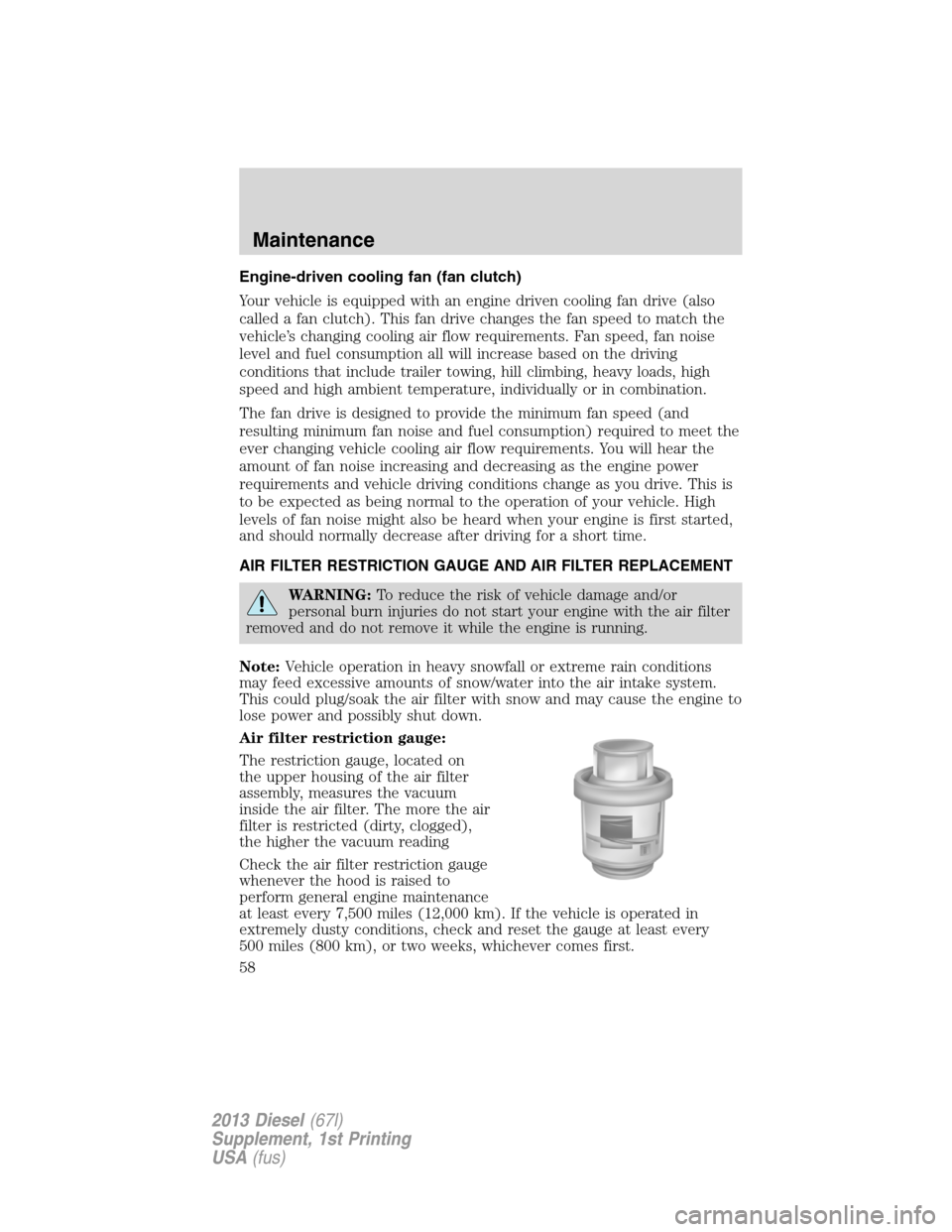
Air filter restriction gauge:
The restriction gauge, located on
the upper housing of the air filter
assembly, measures the vacuum
inside the air filter. The more the air
filter is restricted (dirty, clogged),
the higher the vacuum reading
Check the air filter restriction gauge
whenever the hood is raised to
perform general engine maintenance
at least every 7,500 miles (12,000 km). If the vehicle is operated in
extremely dusty conditions, check and reset the gauge at least every
500 miles (800 km), or two weeks, whichever comes first.
Maintenance
58
2013 Diesel(67l)
Supplement, 1st Printing
USA(fus)