engine FORD SUPER DUTY 2013 3.G Diesel Supplement Manual
[x] Cancel search | Manufacturer: FORD, Model Year: 2013, Model line: SUPER DUTY, Model: FORD SUPER DUTY 2013 3.GPages: 95, PDF Size: 2.42 MB
Page 22 of 95
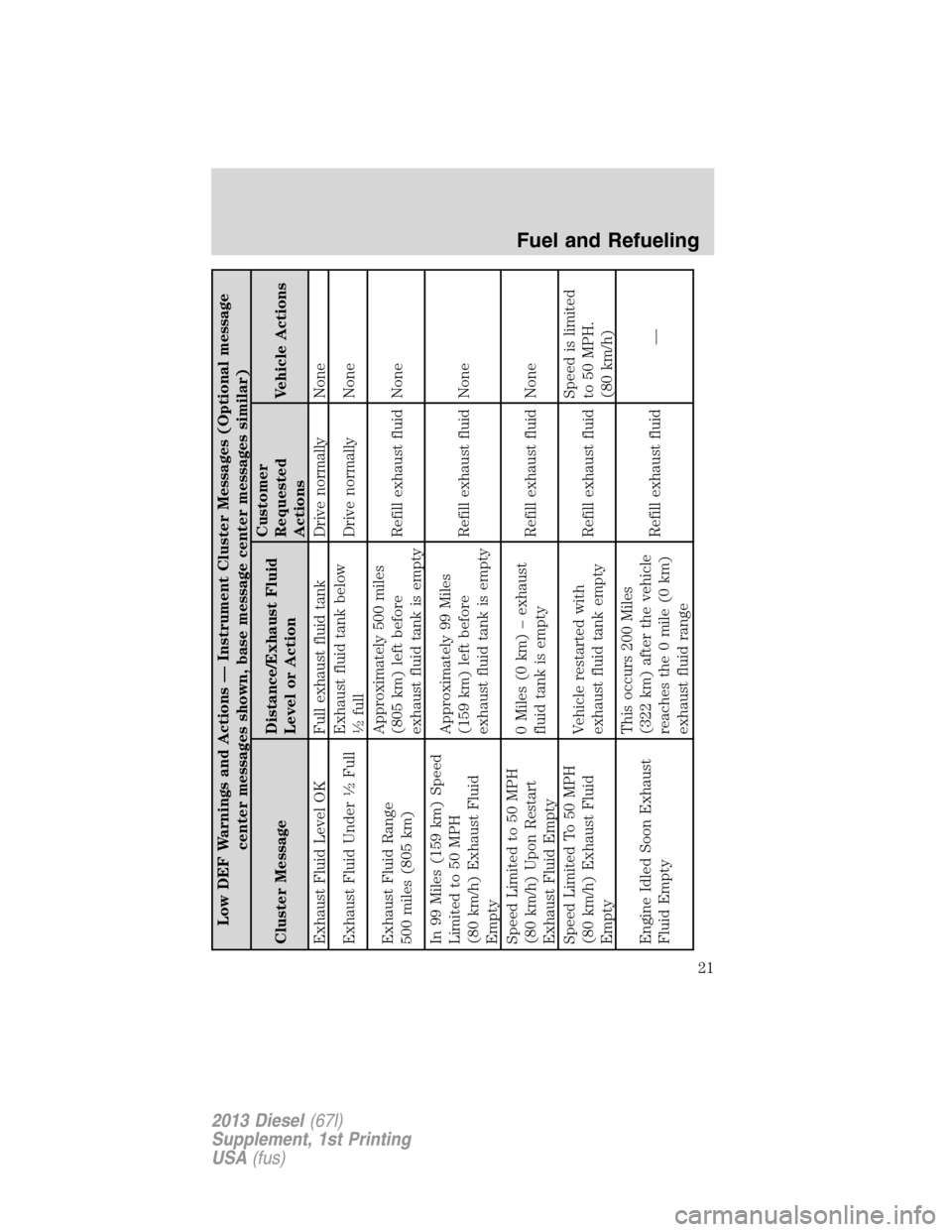
Low DEF Warnings and Actions — Instrument Cluster Messages (Optional message
center messages shown, base message center messages similar)
Cluster MessageDistance/Exhaust Fluid
Level or ActionCustomer
Requested
ActionsVehicle Actions
Exhaust Fluid Level OK Full exhaust fluid tank Drive normally None
Exhaust Fluid Under
12FullExhaust fluid tank below
12fullDrive normally None
Exhaust Fluid Range
500 miles (805 km)Approximately 500 miles
(805 km) left before
exhaust fluid tank is emptyRefill exhaust fluid None
In 99 Miles (159 km) Speed
Limited to 50 MPH
(80 km/h) Exhaust Fluid
EmptyApproximately 99 Miles
(159 km) left before
exhaust fluid tank is emptyRefill exhaust fluid None
Speed Limited to 50 MPH
(80 km/h) Upon Restart
Exhaust Fluid Empty0 Miles (0 km) – exhaust
fluid tank is emptyRefill exhaust fluid None
Speed Limited To 50 MPH
(80 km/h) Exhaust Fluid
EmptyVehicle restarted with
exhaust fluid tank emptyRefill exhaust fluidSpeed is limited
to 50 MPH.
(80 km/h)
Engine Idled Soon Exhaust
Fluid EmptyThis occurs 200 Miles
(322 km) after the vehicle
reaches the 0 mile (0 km)
exhaust fluid rangeRefill exhaust fluid —
Fuel and Refueling
21
2013 Diesel(67l)
Supplement, 1st Printing
USA(fus)
Page 23 of 95
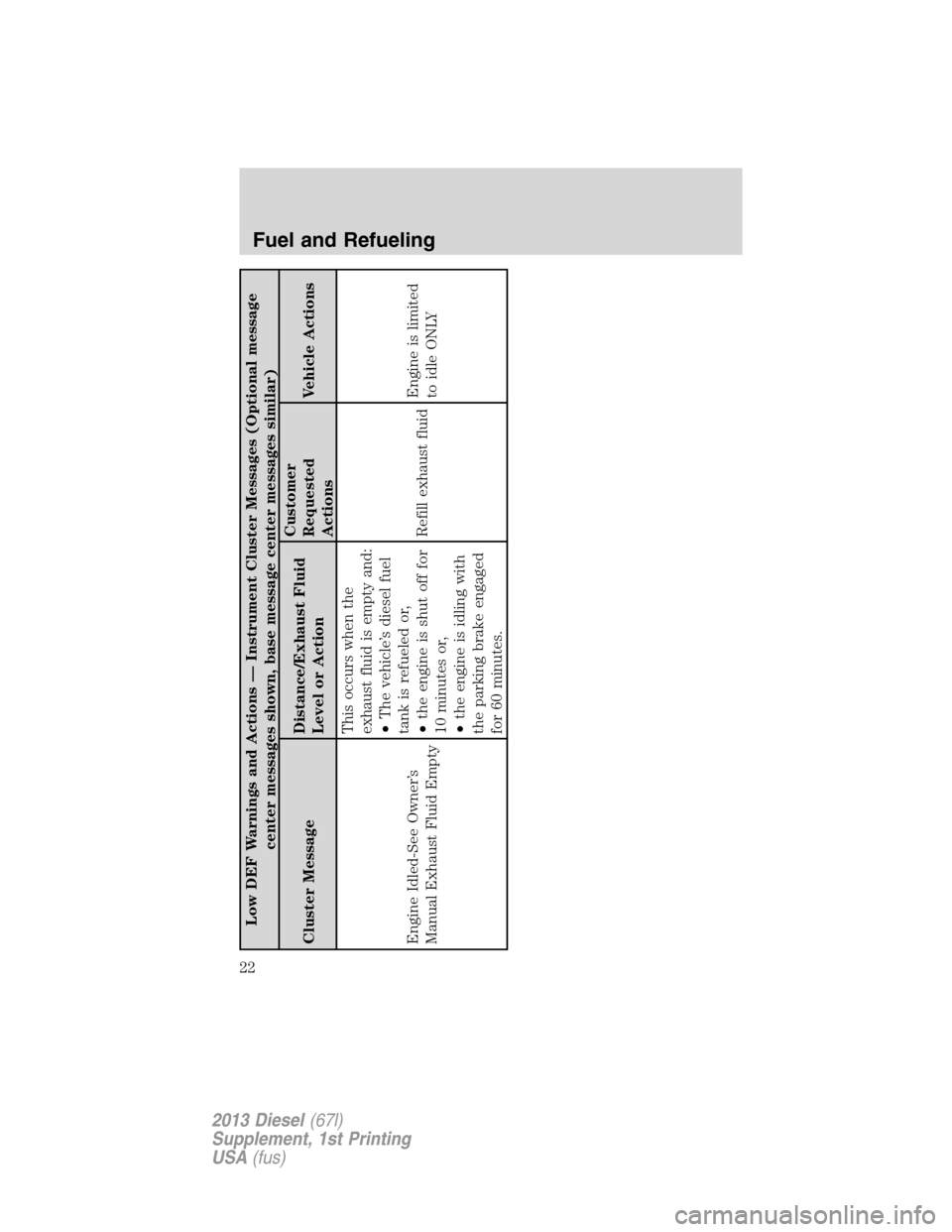
Low DEF Warnings and Actions — Instrument Cluster Messages (Optional message
center messages shown, base message center messages similar)
Cluster MessageDistance/Exhaust Fluid
Level or ActionCustomer
Requested
ActionsVehicle Actions
Engine Idled-See Owner’s
Manual Exhaust Fluid EmptyThis occurs when the
exhaust fluid is empty and:
•The vehicle’s diesel fuel
tank is refueled or,
•the engine is shut off for
10 minutes or,
•the engine is idling with
the parking brake engaged
for 60 minutes.Refill exhaust fluidEngine is limited
to idle ONLY
Fuel and Refueling
22
2013 Diesel(67l)
Supplement, 1st Printing
USA(fus)
Page 24 of 95
Filling the DEF tank
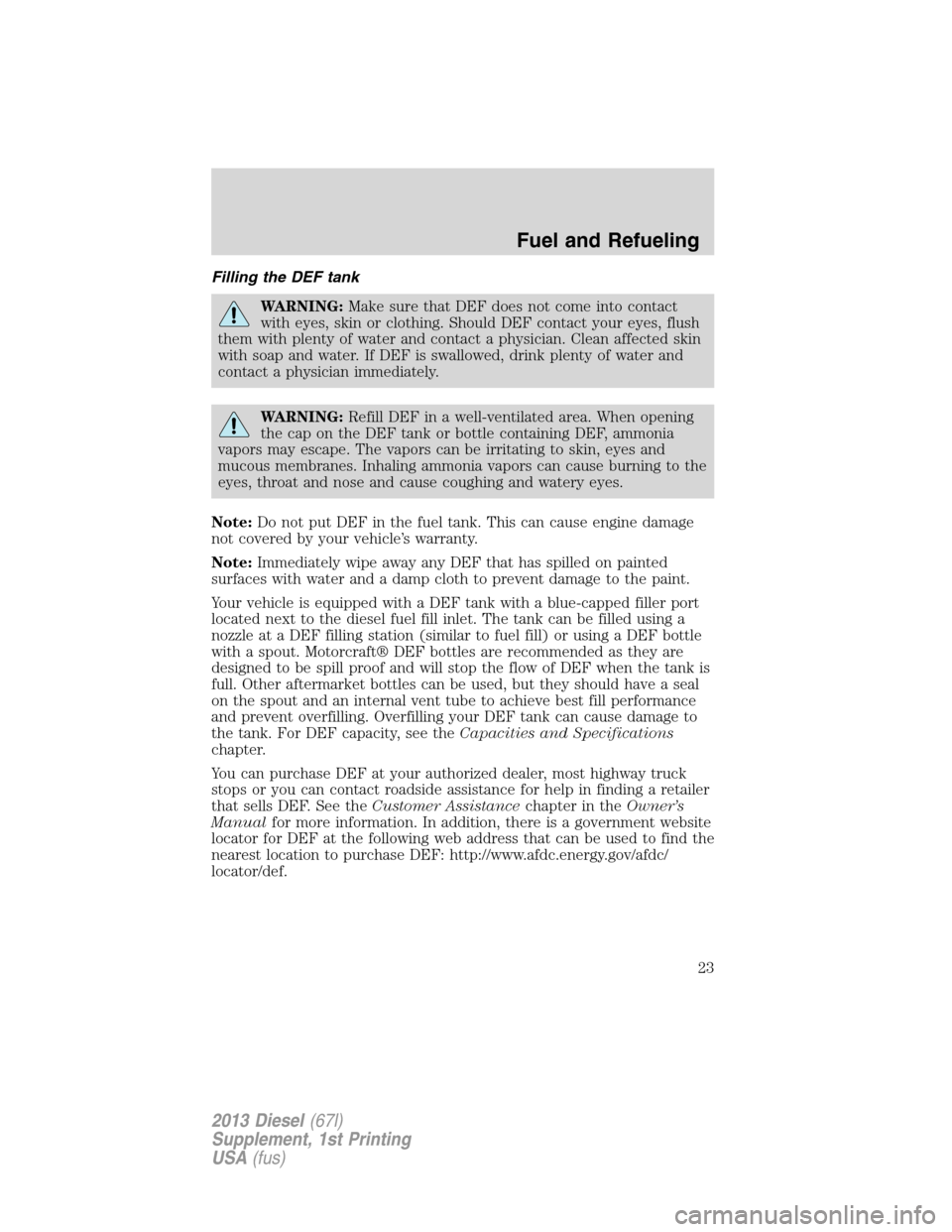
WARNING:Make sure that DEF does not come into contact
with eyes, skin or clothing. Should DEF contact your eyes, flush
them with plenty of water and contact a physician. Clean affected skin
with soap and water. If DEF is swallowed, drink plenty of water and
contact a physician immediately.
WARNING:Refill DEF in a well-ventilated area. When opening
the cap on the DEF tank or bottle containing DEF, ammonia
vapors may escape. The vapors can be irritating to skin, eyes and
mucous membranes. Inhaling ammonia vapors can cause burning to the
eyes, throat and nose and cause coughing and watery eyes.
Note:Do not put DEF in the fuel tank. This can cause engine damage
not covered by your vehicle’s warranty.
Note:Immediately wipe away any DEF that has spilled on painted
surfaces with water and a damp cloth to prevent damage to the paint.
Your vehicle is equipped with a DEF tank with a blue-capped filler port
located next to the diesel fuel fill inlet. The tank can be filled using a
nozzle at a DEF filling station (similar to fuel fill) or using a DEF bottle
with a spout. Motorcraft® DEF bottles are recommended as they are
designed to be spill proof and will stop the flow of DEF when the tank is
full. Other aftermarket bottles can be used, but they should have a seal
on the spout and an internal vent tube to achieve best fill performance
and prevent overfilling. Overfilling your DEF tank can cause damage to
the tank. For DEF capacity, see theCapacities and Specifications
chapter.
You can purchase DEF at your authorized dealer, most highway truck
stops or you can contact roadside assistance for help in finding a retailer
that sells DEF. See theCustomer Assistancechapter in theOwner’s
Manualfor more information. In addition, there is a government website
locator for DEF at the following web address that can be used to find the
nearest location to purchase DEF: http://www.afdc.energy.gov/afdc/
locator/def.
Fuel and Refueling
23
2013 Diesel(67l)
Supplement, 1st Printing
USA(fus)
Page 25 of 95
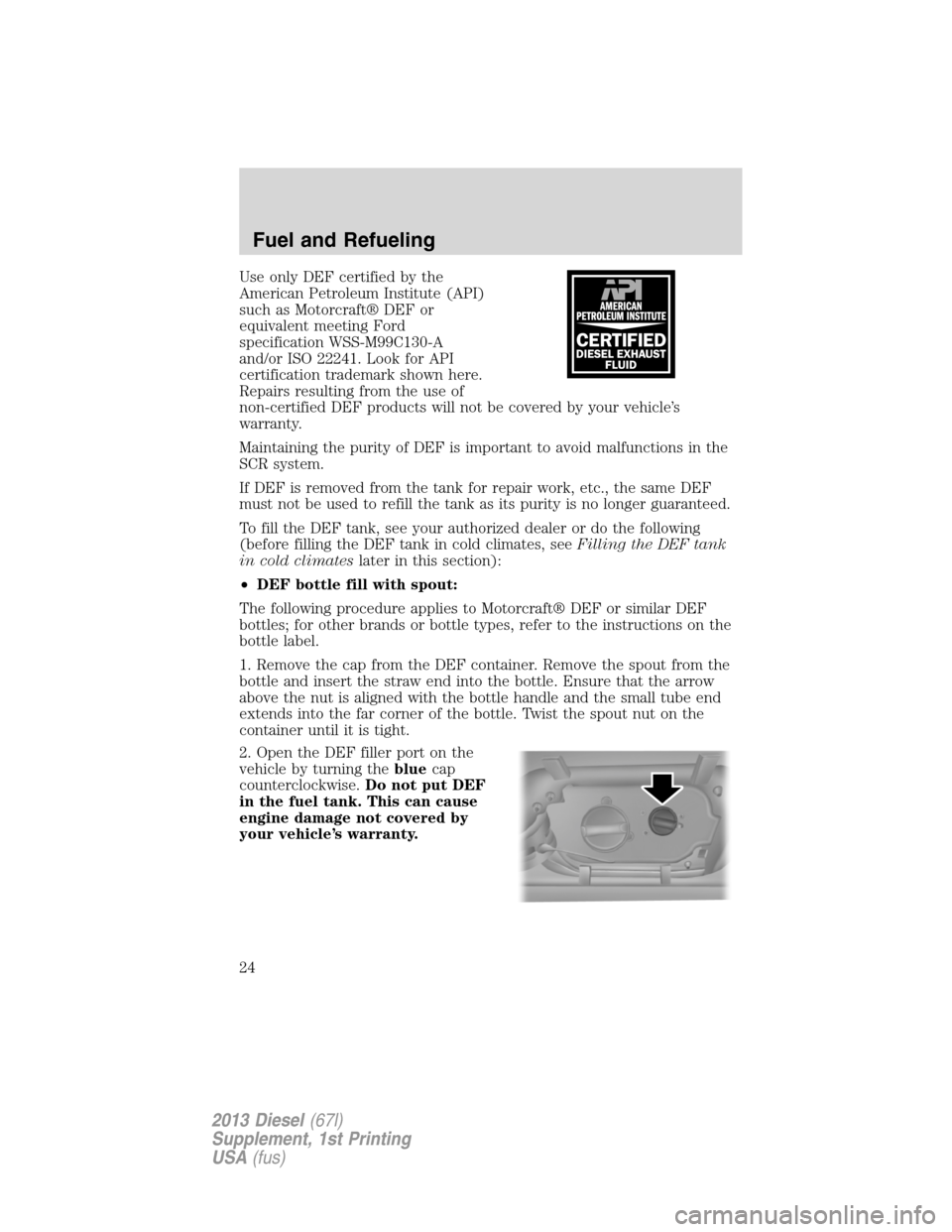
Use only DEF certified by the
American Petroleum Institute (API)
such as Motorcraft® DEF or
equivalent meeting Ford
specification WSS-M99C130-A
and/or ISO 22241. Look for API
certification trademark shown here.
Repairs resulting from the use of
non-certified DEF products will not be covered by your vehicle’s
warranty.
Maintaining the purity of DEF is important to avoid malfunctions in the
SCR system.
If DEF is removed from the tank for repair work, etc., the same DEF
must not be used to refill the tank as its purity is no longer guaranteed.
To fill the DEF tank, see your authorized dealer or do the following
(before filling the DEF tank in cold climates, seeFilling the DEF tank
in cold climateslater in this section):
•DEF bottle fill with spout:
The following procedure applies to Motorcraft® DEF or similar DEF
bottles; for other brands or bottle types, refer to the instructions on the
bottle label.
1. Remove the cap from the DEF container. Remove the spout from the
bottle and insert the straw end into the bottle. Ensure that the arrow
above the nut is aligned with the bottle handle and the small tube end
extends into the far corner of the bottle. Twist the spout nut on the
container until it is tight.
2. Open the DEF filler port on the
vehicle by turning thebluecap
counterclockwise.Do not put DEF
in the fuel tank. This can cause
engine damage not covered by
your vehicle’s warranty.
Fuel and Refueling
24
2013 Diesel(67l)
Supplement, 1st Printing
USA(fus)
Page 28 of 95
To prevent overfilling of the DEF tank when filling with a bottle, Ford
recommends using Motorcraft® DEF. Additionally, if the information
display indicatesEXHAUST FLUID UNDER 1/2 FULL, you should only
add a MAXIMUM of 2 gallons (6.7L) of DEF to the tank to prevent
freeze damage due to overfilling. If the information display indicates
EXHAUST FLUID LEVEL OK, do not add DEF.
Contaminated DEF or inoperative SCR system
SCR systems are sensitive to
contamination of the DEF. USE
ONLY API or ISO 22241 CERTIFIED
DIESEL EXHAUST FLUID. If the SCR becomes contaminated or
inoperative, the DEF light will illuminate and exhaust fluid system fault
messages will appear in the information display.
Continued driving without replacing DEF or having the SCR system
repaired will result in the following actions as required by the California
Air Resources Board (CARB) and /or U.S. Environmental Protection
Agency (EPA):
•Within a certain number of miles (kilometers) to empty, speed will be
limited upon restart. Prior to this occurring a message will appear in
the message center.
•
Further vehicle operation without replacing contaminated DEF will cause
the engine to enter an idle-only condition. This will only occur upon
vehicle refueling, vehicle idling in park for 1 hour, or engine shutdown for
10 minutes or more and will be indicated by a message in the message
center indicating required actions to resume normal operation.
For either vehicle speed limiting or idle-only condition, normal vehicle
operation will resume when the contaminated system is repaired.To
service a contaminated or inoperative system, see your
authorized dealer.
DEF guidelines and information
•Use only DEF that carries the trademark: American Petroleum
Institute (API) certified DEF or ISO 22241.
•Do not put DEF in the diesel fuel tank.
•Do not overfill the DEF tank.
•Do not re-use the DEF container once it is emptied.
•
Avoid spilling DEF on painted surfaces, carpeting or plastic components.
Immediately wipe away any DEF that has spilled with a damp cloth and
water. If it has already crystallized, use warm water and a sponge.
Fuel and Refueling
27
2013 Diesel(67l)
Supplement, 1st Printing
USA(fus)
Page 31 of 95
FUEL FILTER/WATER SEPARATOR
Diesel Fuel Conditioner Module (DFCM)
The vehicle is equipped with a diesel fuel conditioning module (DFCM)
located on the frame-rail under the driver-side floorboard near the
transmission
Water should be drained from the
module assembly whenever the
warning light comes on and the
message center directs you to drain the water separator. This will occur
when approximately 0.32 pints (150 ml) of water accumulates in the
module. If water level is allowed to exceed this level, the water may be
passed through to the engine and may cause fuel injection equipment
damage.
Draining the DFCM
WARNING:The vehicle must be stopped with the engine off
when draining the DFCM. Fuel may ignite if the separator is
drained while the engine is running or vehicle is moving.
Note:Air will enter into the fuel system if the DFCM is drained while
the system is running. The engine will not operate properly if air enters
the system.
Note:With fuel tank levels above
34tank it may be necessary to loosen
the bowl 3 turns before opening the drain. This will actuate an
anti-siphon valve at the DFCM inlet and prevent the fuel from siphoning
out of the tank.
Note:A loose drain valve can allow air to enter the fuel system and
cause drivetrain issues. The engine will not operate properly. Be sure
that the drain valve is fully tightened.
1. Stop the vehicle andshut offthe engine.
2. Locate the DFCM and place an appropriate container under the drain
port (see illustration).
Fuel and Refueling
30
2013 Diesel(67l)
Supplement, 1st Printing
USA(fus)
Page 32 of 95
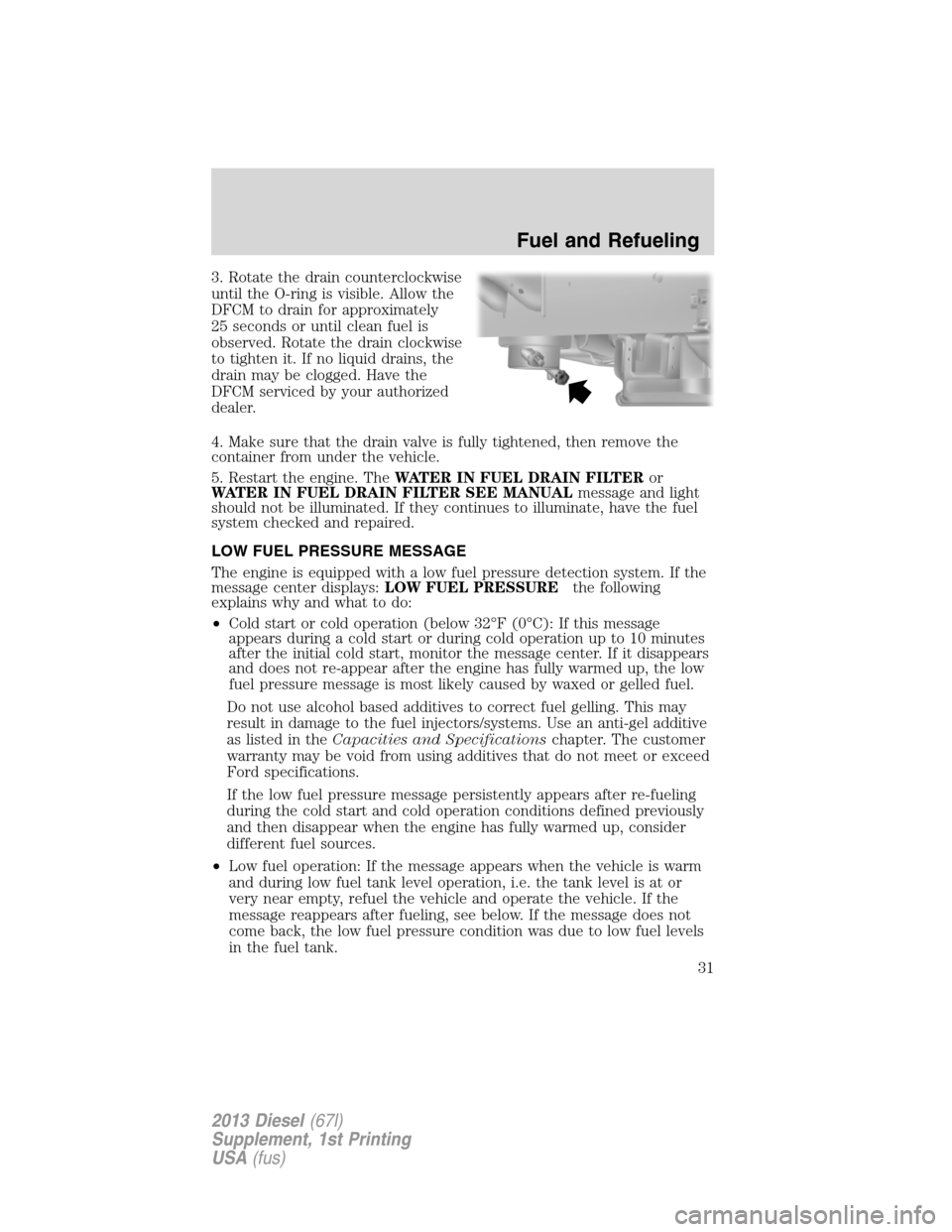
3. Rotate the drain counterclockwise
until the O-ring is visible. Allow the
DFCM to drain for approximately
25 seconds or until clean fuel is
observed. Rotate the drain clockwise
to tighten it. If no liquid drains, the
drain may be clogged. Have the
DFCM serviced by your authorized
dealer.
4. Make sure that the drain valve is fully tightened, then remove the
container from under the vehicle.
5. Restart the engine. TheWATER IN FUEL DRAIN FILTERor
WATER IN FUEL DRAIN FILTER SEE MANUALmessage and light
should not be illuminated. If they continues to illuminate, have the fuel
system checked and repaired.
LOW FUEL PRESSURE MESSAGE
The engine is equipped with a low fuel pressure detection system. If the
message center displays:LOW FUEL PRESSUREthe following
explains why and what to do:
•Cold start or cold operation (below 32°F (0°C): If this message
appears during a cold start or during cold operation up to 10 minutes
after the initial cold start, monitor the message center. If it disappears
and does not re-appear after the engine has fully warmed up, the low
fuel pressure message is most likely caused by waxed or gelled fuel.
Do not use alcohol based additives to correct fuel gelling. This may
result in damage to the fuel injectors/systems. Use an anti-gel additive
as listed in theCapacities and Specificationschapter. The customer
warranty may be void from using additives that do not meet or exceed
Ford specifications.
If the low fuel pressure message persistently appears after re-fueling
during the cold start and cold operation conditions defined previously
and then disappear when the engine has fully warmed up, consider
different fuel sources.
•Low fuel operation: If the message appears when the vehicle is warm
and during low fuel tank level operation, i.e. the tank level is at or
very near empty, refuel the vehicle and operate the vehicle. If the
message reappears after fueling, see below. If the message does not
come back, the low fuel pressure condition was due to low fuel levels
in the fuel tank.
Fuel and Refueling
31
2013 Diesel(67l)
Supplement, 1st Printing
USA(fus)
Page 33 of 95
•Normal operation: If the message appears during normal operation
when the vehicle / engine is fully warm, and fuel level is not low, the
fuel filters must be changed regardless of the maintenance schedule
interval.
•If replacement of the fuel filter does not remedy the low fuel pressure
message during normal operation as defined above, take the vehicle to
your authorized dealer.
CHANGING THE ENGINE-MOUNTED AND DFCM FUEL FILTERS
Your vehicle is equipped with two fuel filters; one is mounted on top of
the driver’s side of the engine and the second filter, inside the DFCM, is
mounted on the frame rail under the driver-side floorboard near the
transmission. Both filters should be replaced at the same time. Regular
fuel filter changes are an important part of engine maintenance; failing to
keep with the scheduled maintenance could lead to engine performance
issues and/or fuel injection system damage. Refer to thescheduled
maintenance informationof this supplement for more information.
Refer toMotorcraft part numbersin theMaintenancechapter for the
fuel filter replacement part number. This part number includes filters
and seals for both the engine-mounted and frame-mounted filters.
Removal - DFCM filter
The DFCM filter is located in the lower portion of the DFCM housing.
1. Drain the DFCM. SeeFuel filter/water separatorin theFuel and
Refuelingchapter.
To install the new DFCM filter, seeInstallation – DFCM filterin the
Fuel and Refuelingchapter.
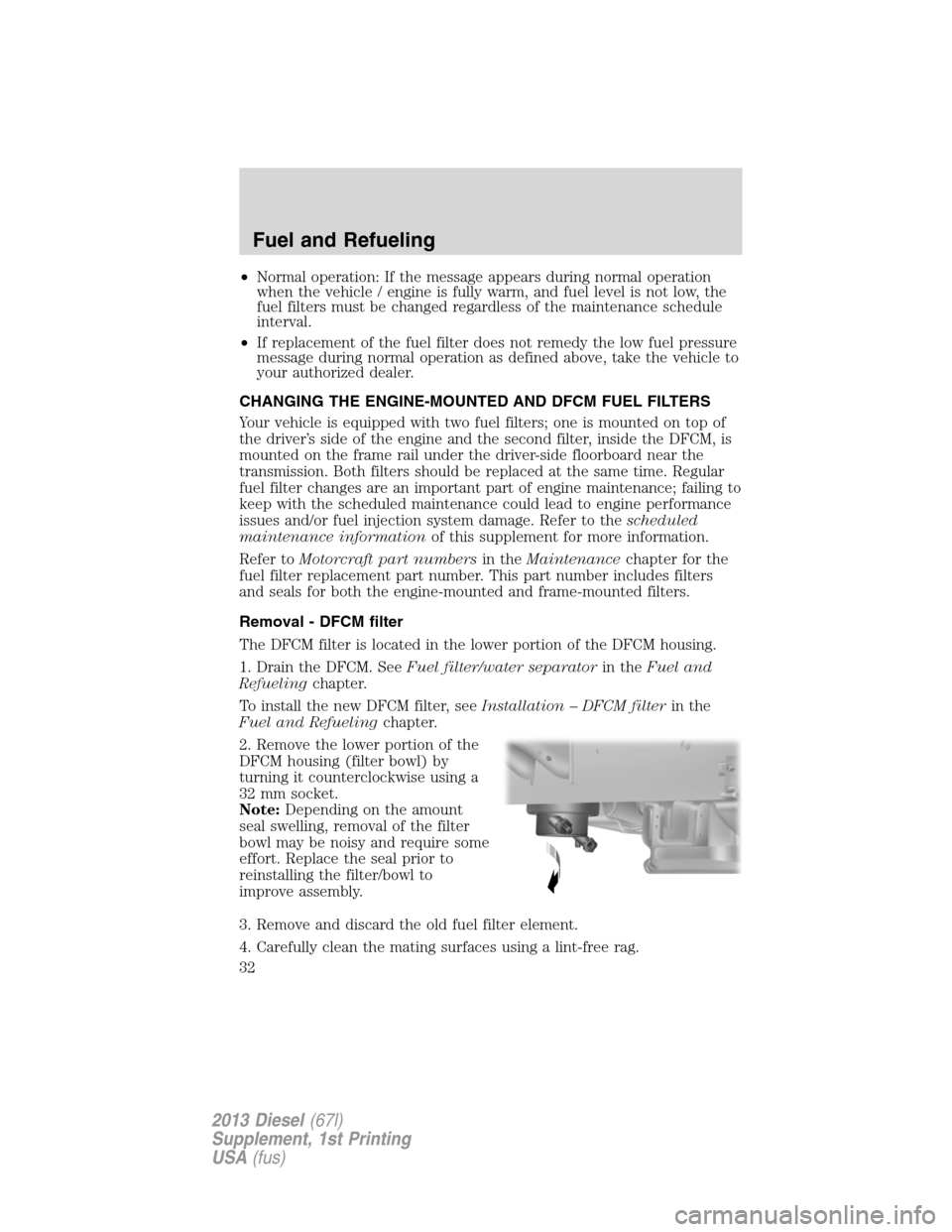
2. Remove the lower portion of the
DFCM housing (filter bowl) by
turning it counterclockwise using a
32 mm socket.
Note:Depending on the amount
seal swelling, removal of the filter
bowl may be noisy and require some
effort. Replace the seal prior to
reinstalling the filter/bowl to
improve assembly.
3. Remove and discard the old fuel filter element.
4. Carefully clean the mating surfaces using a lint-free rag.
Fuel and Refueling
32
2013 Diesel(67l)
Supplement, 1st Printing
USA(fus)
Page 34 of 95
Installation – DFCM filter
1. Install the new filter into the filter bowl tabs and replace the seal on
the DFCM header (top portion of DFCM). Refer toMotorcraft part
numbersin theMaintenancechapter for the fuel filter kit part number.
2. Lube O-ring with lubricant packet in the filter kit. This will assist in
making sure the filter gets properly tightened.
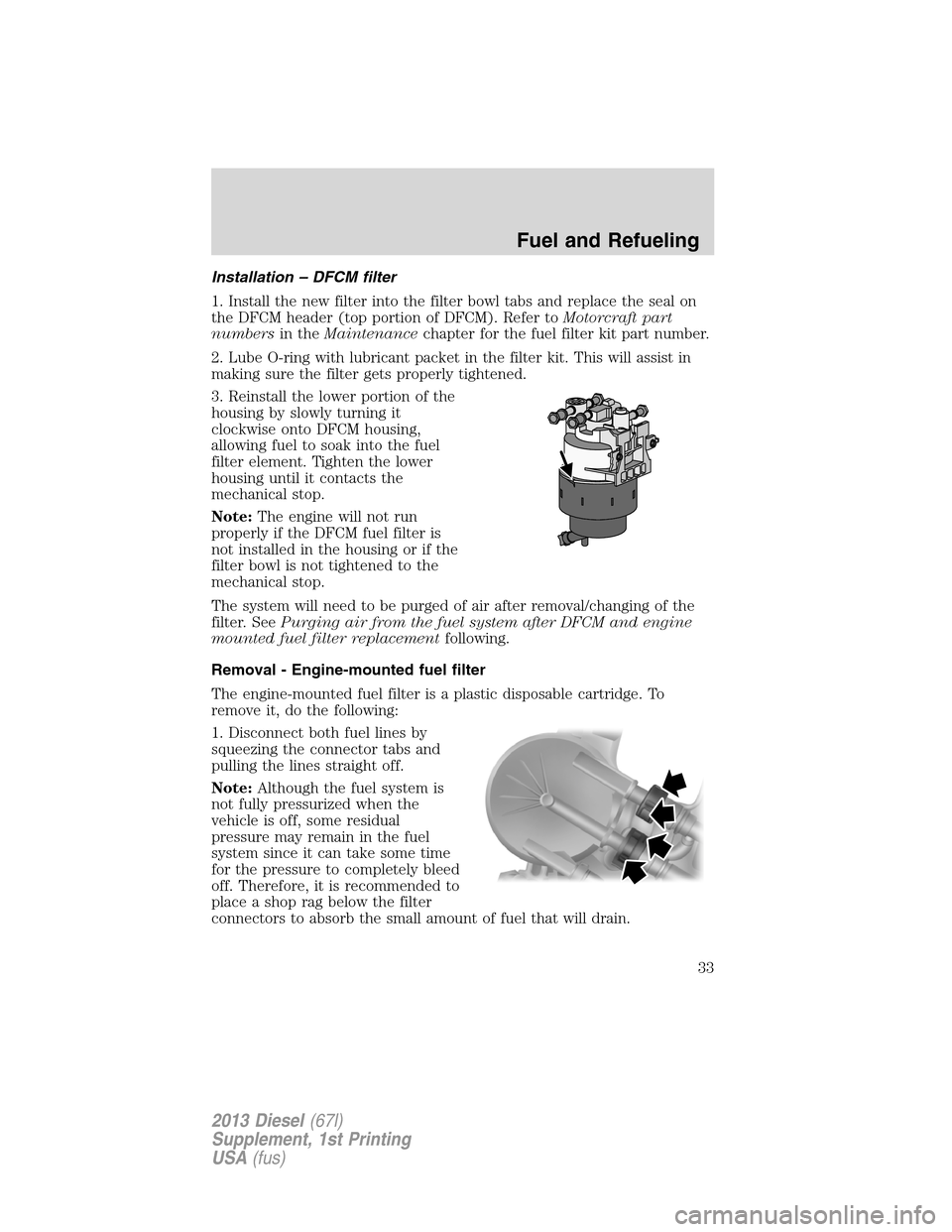
3. Reinstall the lower portion of the
housing by slowly turning it
clockwise onto DFCM housing,
allowing fuel to soak into the fuel
filter element. Tighten the lower
housing until it contacts the
mechanical stop.
Note:The engine will not run
properly if the DFCM fuel filter is
not installed in the housing or if the
filter bowl is not tightened to the
mechanical stop.
The system will need to be purged of air after removal/changing of the
filter. SeePurging air from the fuel system after DFCM and engine
mounted fuel filter replacementfollowing.
Removal - Engine-mounted fuel filter
The engine-mounted fuel filter is a plastic disposable cartridge. To
remove it, do the following:
1. Disconnect both fuel lines by
squeezing the connector tabs and
pulling the lines straight off.
Note:Although the fuel system is
not fully pressurized when the
vehicle is off, some residual
pressure may remain in the fuel
system since it can take some time
for the pressure to completely bleed
off. Therefore, it is recommended to
place a shop rag below the filter
connectors to absorb the small amount of fuel that will drain.
Fuel and Refueling
33
2013 Diesel(67l)
Supplement, 1st Printing
USA(fus)
Page 35 of 95
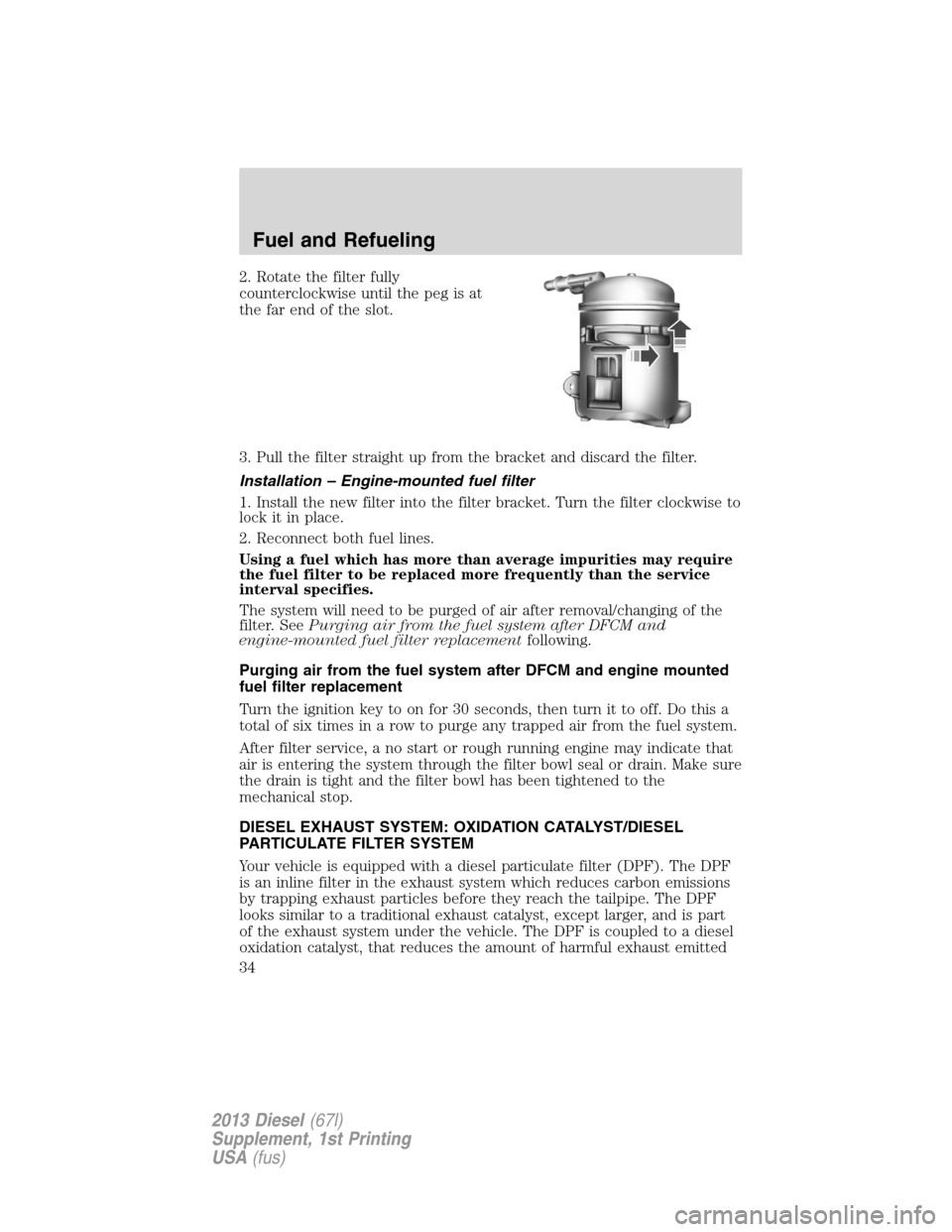
2. Rotate the filter fully
counterclockwise until the peg is at
the far end of the slot.
3. Pull the filter straight up from the bracket and discard the filter.
Installation – Engine-mounted fuel filter
1. Install the new filter into the filter bracket. Turn the filter clockwise to
lock it in place.
2. Reconnect both fuel lines.
Using a fuel which has more than average impurities may require
the fuel filter to be replaced more frequently than the service
interval specifies.
The system will need to be purged of air after removal/changing of the
filter. SeePurging air from the fuel system after DFCM and
engine-mounted fuel filter replacementfollowing.
Purging air from the fuel system after DFCM and engine mounted
fuel filter replacement
Turn the ignition key to on for 30 seconds, then turn it to off. Do this a
total of six times in a row to purge any trapped air from the fuel system.
After filter service, a no start or rough running engine may indicate that
air is entering the system through the filter bowl seal or drain. Make sure
the drain is tight and the filter bowl has been tightened to the
mechanical stop.
DIESEL EXHAUST SYSTEM: OXIDATION CATALYST/DIESEL
PARTICULATE FILTER SYSTEM
Your vehicle is equipped with a diesel particulate filter (DPF). The DPF
is an inline filter in the exhaust system which reduces carbon emissions
by trapping exhaust particles before they reach the tailpipe. The DPF
looks similar to a traditional exhaust catalyst, except larger, and is part
of the exhaust system under the vehicle. The DPF is coupled to a diesel
oxidation catalyst, that reduces the amount of harmful exhaust emitted
Fuel and Refueling
34
2013 Diesel(67l)
Supplement, 1st Printing
USA(fus)