engine coolant FORD SUPER DUTY 2013 3.G Diesel Supplement Manual
[x] Cancel search | Manufacturer: FORD, Model Year: 2013, Model line: SUPER DUTY, Model: FORD SUPER DUTY 2013 3.GPages: 95, PDF Size: 2.42 MB
Page 5 of 95
The fuel injection system is controlled through the Powertrain Control
Module (PCM).
Fuel is drawn from the fuel tank by a frame-mounted electric fuel pump
located inside the DFCM and provides pressurized fuel to the engine.
The fuel pump contains a pressure relief valve for overpressure
protection in the event of restricted flow.
Engine protection mode
Ford diesel engines are equipped with engine protection and emission
control systems. These systems monitor critical temperatures and
pressures, and modify engine operation accordingly. These features are
intended to modify engine performance characteristics.
If these modified engine
performance characteristics persist
for an extended period or either the
service engine soon or powertrain
malfunction/reduced power/
electronic throttle control light is
illuminated, seek service from your authorized dealer.
Lubrication system
It is important to change the engine oil at the recommended service
intervals to maintain oil viscosity. Extending the oil and filter change
interval beyond the recommended interval can negatively affect engine
performance, fuel economy and engine life. Refer toEngine oilin the
Maintenancechapter.
Fast start glow plug system
The diesel engine glow system consists of:
•eight glow plugs (one per cylinder)
•the glow plug control module (GPCM)
•engine coolant temperature (ECT) sensor
•barometric pressure (BARO) sensor
•environmental temperature sensor
Introduction
4
2013 Diesel(67l)
Supplement, 1st Printing
USA(fus)
Page 6 of 95
The glow plug system is
electronically controlled by the PCM
and GPCM. The GPCM energizes the
glow plugs immediately after the ignition is turned on and kept on as
determined by the GPCM using the ECT, BARO and environmental
temperature sensor. The required time for the glow plugs to be
energized decreases as the coolant temperature, barometric pressure and
environmental temperature increase.
Engine and secondary cooling system
The cooling system contains an engine cooling loop to cool the engine
and a secondary cooling loop to cool the transmission, exhaust gas
recirculation (EGR), charge air and fuel. The coolant serves three
primary purposes: to provide heat transfer, freeze point protection, and
corrosion protection using additives.
Vehicles with diesel engines typically are used to carry heavy loads and
accumulate mileage rapidly. These two factors may cause the additives in
the coolant to “wear out” in a shorter time. Refer to theSpecial
operating conditionssection for more information about coolant
additives and coolant change intervals. Operating the engine with
insufficient coolant and/or coolant additive can cause severe engine
damage.
Selective catalytic reduction (SCR) system
Your vehicle is equipped with a selective catalytic reduction (SCR)
system to help reduce emission levels of oxides of nitrogen from the
exhaust of the diesel engine. This system relies on the use of diesel
exhaust fluid (DEF) which must be replenished at certain intervals.
Failure to maintain proper DEF levels or if the DEF becomes
contaminated will result in vehicle speed limitations and/or result in the
vehicle entering an idle-only mode. SeeSelective catalytic reduction
(SCR) systemin theFuel and Refuelingchapter for more information.
Speed control (if equipped)
If vehicle speed goes outside a predetermined range from the set speed,
the RES (Resume) function will not reset vehicle speed. Vehicle speed
will need to be reset with the SET +/- button after reaching desired
speed using accelerator pedal.
Introduction
5
2013 Diesel(67l)
Supplement, 1st Printing
USA(fus)
Page 10 of 95
Do not crank the engine for more than 10 seconds as starter damage
may occur. If the engine fails to start, turn the key to 3 (off) and wait
30 seconds before trying again.
1. Turn the key to on without
turning the key to start. Do not
start the engine until the
glow-plug pre-heat indicator turns off.
2. When the glow plug pre-heat indicator turns off, turn the key to
start, then release the key as soon as the engine starts. The glow
plugs may remain on for a period of time after engine start. If the
engine is not started before the glow plug activation time ends, the
glow plugs will need to be reset by turning the key to off.
3. After the engine starts, allow it to idle for about 15 seconds. This is
to protect the engine. Do not increase engine speed until the oil
pressure gauge indicates normal pressure.
ENGINE IDLE SHUTDOWN (IF EQUIPPED)
Your vehicle may be equipped with an engine idle shutdown system. This
system automatically shuts down your engine when it has been idling in
P (Park) or N (Neutral) for five minutes (parking brake set) or
15 minutes (parking brake not set). When the engine idle shutdown
process has started:
•A chime sounds and the information display will showENGINE
TURNS OFF IN 30(seconds) and start counting down.
•The 5 or 15 minute timer can be restarted by changing the position
of the accelerator pedal, brake pedal or the park brake within the
final 30 seconds.
•When the timer reaches zero, the engine shuts down and this
message will appear in the information displayENGINE TURNED
OFF.
•One minute after the engine has shut down, the electrical system
simulates key off, even though the ignition is still in the on position,
initiating normal accessory delay period.
•The ignition must be moved to the off position to reset the system
before restarting the vehicle.
The engine idle shutdown idle timer does not start if:
•The engine is operating in power take-off (PTO) mode.
•The engine coolant temperature is below 60°F (16°C).
•The exhaust emission control device (DPF) is regenerating.
Starting and Stopping the Engine
9
2013 Diesel(67l)
Supplement, 1st Printing
USA(fus)
Page 12 of 95
In cold weather below 32°F (0°C), the engine may slowly increase to a
higher idle speed if left idling in P (Park). As the engine warms-up, the
engine sound level decreases due to the activation of PCM-controlled
sound reduction features.
If your vehicle is operated in a heavy snow storm or blowing snow
conditions, the engine air induction may become partially clogged with
snow and/or ice. If this occurs, the engine may experience a significant
reduction in power output. At the earliest opportunity, clear all the snow
and/or ice away from inside the air filter assembly. Remove the air
cleaner cover and the pleated paper filter, leaving the foam filter in and
remove any snow or ice. Make sure the foam filter is installed correctly
in place. Remove any debris, snow and/or ice on the foam filter by
brushing the surface with soft brush. Do not use water, solvents, or a
hard brush for cleaning the foam filter.
In order to operate the engine in temperatures of 32°F (0°C) or lower,
read the following instructions:
•Make sure that the batteries are of sufficient size and are fully
charged. Check other electrical components to make sure they are in
optimum condition.
•Use the proper coolant solution at the concentration recommended to
protect the engine against damage from freezing.
•Try to keep the fuel tank full as much as possible at the end of
operation to prevent condensation in the fuel system.
•Make sure you use proper cold weather engine oil and that it is at its
proper level. Also, if necessary, make sure to follow the engine oil and
filter change schedule found under theSpecial operating conditions
section listed in thescheduled maintenance information.
•At temperatures of -10°F (-23°C) or below, it is recommended that
you use an engine block heater to improve cold engine starting.
•If operating in arctic temperatures of -20°F (-29°C) or lower, consult
your truck dealer for information about special cold weather
equipment and precautions.
The following cold weather idling guidelines are recommended:
•Motorcraft® cetane improvers or non-alcohol-based cetane improvers
from a reputable manufacturer may be used as needed.
•Maintain the engine cooling system properly.
•Avoid shutting the engine down after an extensive idling period. Drive
the vehicle for several miles with the engine at normal operating
temperatures under a moderate load.
•Consider using an engine block heater.
•For extended idle times use an approved idle speed increase device.
Starting and Stopping the Engine
11
2013 Diesel(67l)
Supplement, 1st Printing
USA(fus)
Page 16 of 95
FUEL REQUIREMENTS - CHOOSING THE RIGHT FUEL: VEHICLES
OPERATED WHERE ULTRA LOW SULFUR DIESEL FUEL IS NOT
REQUIRED
For the engine to operate reliably on low-sulfur or high-sulfur diesel fuel,
the engine must be a factory built high-sulfur engine (available as a
dealer order option for select markets) or a ULSD (ultra low sulfur
diesel) fuel configured engine that has been retrofitted for high-sulfur
diesel fuel using Ford Motor Company dealer service parts. Failure to use
retrofit components other than those available through your authorized
dealer will result in engine coolant system damage, engine overheating,
SCR and/or DPF damage and possible base engine damage.
Use only a diesel engine that has been configured for use with high
sulfur diesel fuel in markets with diesel fuel that has sulfur content
greater than 15 ppm. Using low sulfur diesel fuel (16–500 ppm) or
high sulfur diesel fuel (greater than 500 ppm) in a diesel engine
designed to use only Ultra Low Sulfur Diesel fuel may result in
damage to engine emission control devices and the aftertreatment
system, potentially rendering the vehicle inoperable.
Vehicles with engines configured for use with high sulfur diesel fuel will
only be made available for sale in countries where ULSD fuel is generally
not available or mandated by the government. Vehicles originally sold in
a ULSD fuel market that are subsequently exported to non-ULSD fuel
markets will need to be retrofitted (at the customer’s expense using Ford
authorized dealer service parts) in order to be reliably operated on
non-ULSD fuel.
BIODIESEL
WARNING:Do not use home heating oil, agricultural fuel, raw
fats and oils, waste cooking greases, biodiesel fuels greater than
20% or any diesel fuel not intended for highway use. Damage to the
fuel injection system, engine and exhaust catalyst can occur if an
improper fuel is used. Do not add gasoline, gasohol or alcohol to diesel
fuel. This practice creates a serious fire hazard and engine
performance problems.
This vehicle may be operated on diesel fuels containing up to 20%
biodiesel, also known as B20.
Biodiesel fuel is a product that has been chemically converted from
renewable fuel sources, such as vegetable oils, animal fats and waste
cooking greases.
Fuel and Refueling
15
2013 Diesel(67l)
Supplement, 1st Printing
USA(fus)
Page 49 of 95
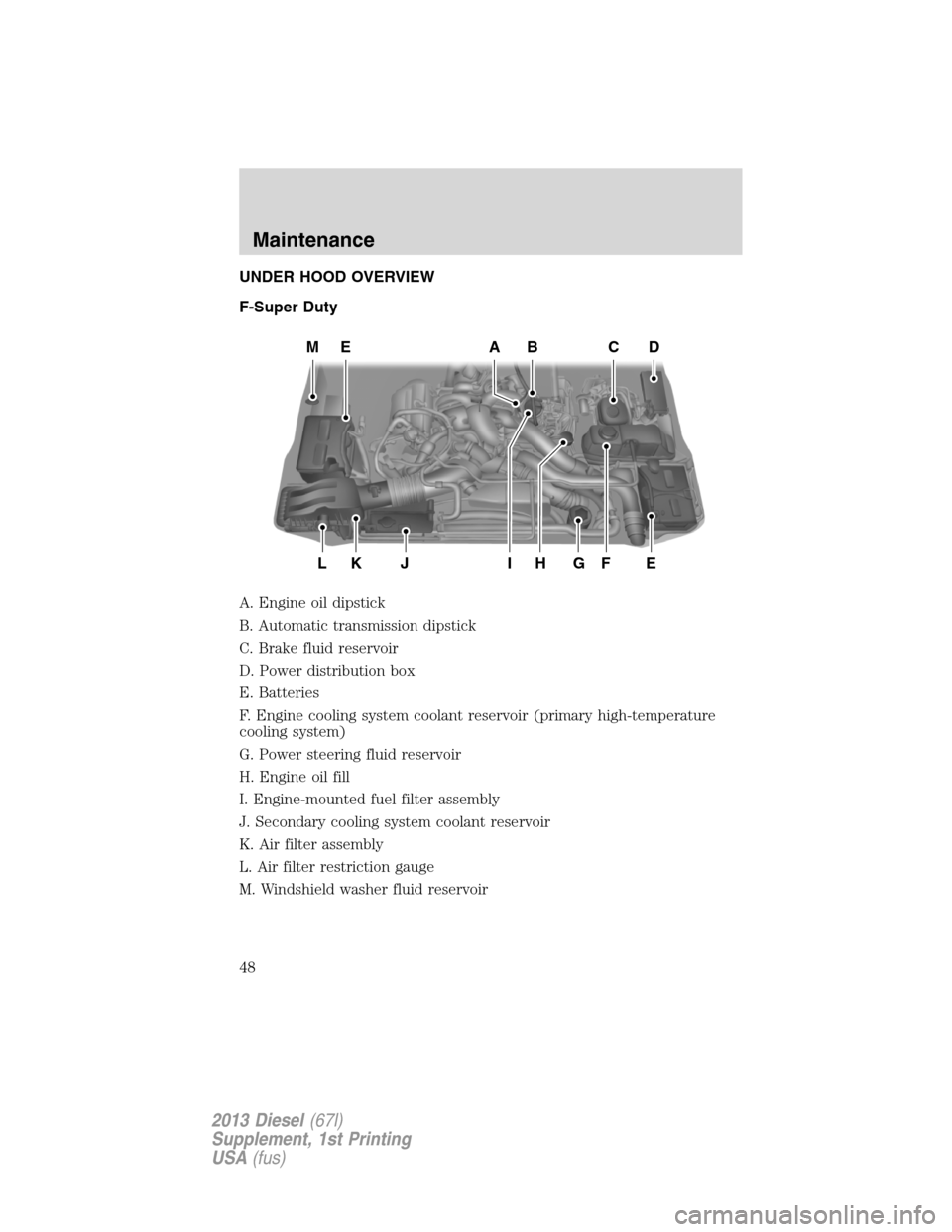
UNDER HOOD OVERVIEW
F-Super Duty
A. Engine oil dipstick
B. Automatic transmission dipstick
C. Brake fluid reservoir
D. Power distribution box
E. Batteries
F. Engine cooling system coolant reservoir (primary high-temperature
cooling system)
G. Power steering fluid reservoir
H. Engine oil fill
I. Engine-mounted fuel filter assembly
J. Secondary cooling system coolant reservoir
K. Air filter assembly
L. Air filter restriction gauge
M. Windshield washer fluid reservoir
MEBC
EGJKLF
DA
HI
Maintenance
48
2013 Diesel(67l)
Supplement, 1st Printing
USA(fus)
Page 50 of 95
SCHEDULED MAINTENANCE
The scheduled maintenance services in thescheduled maintenance
informationof this supplement are required because they are
considered essential to the life and performance of your vehicle.
Use only recommended fuel, lubricants, fluids and service parts
conforming to Ford specifications. Motorcraft® parts are designed and
built for best performance in your vehicle.
ENGINE OIL
Checking the engine oil level
Because it is normal to add some oil between oil changes, check your
engine oil level each time you stop for fuel. To check the engine oil level
consistently and accurately, the following procedure is recommended:
1. Have engine at normal operating temperature (at least into the
NORMAL range on the engine coolant temperature gauge).
2. Park the vehicle on a level surface, then turn off the engine and open
the hood.
3. Allow at least20 minutesafter engine shutdown to ensure that the oil
contained in the upper parts of the engine has returned to the oil pan.
4. Protecting yourself from engine heat, pull out the dipstick, wipe it
clean and reinsert fully.
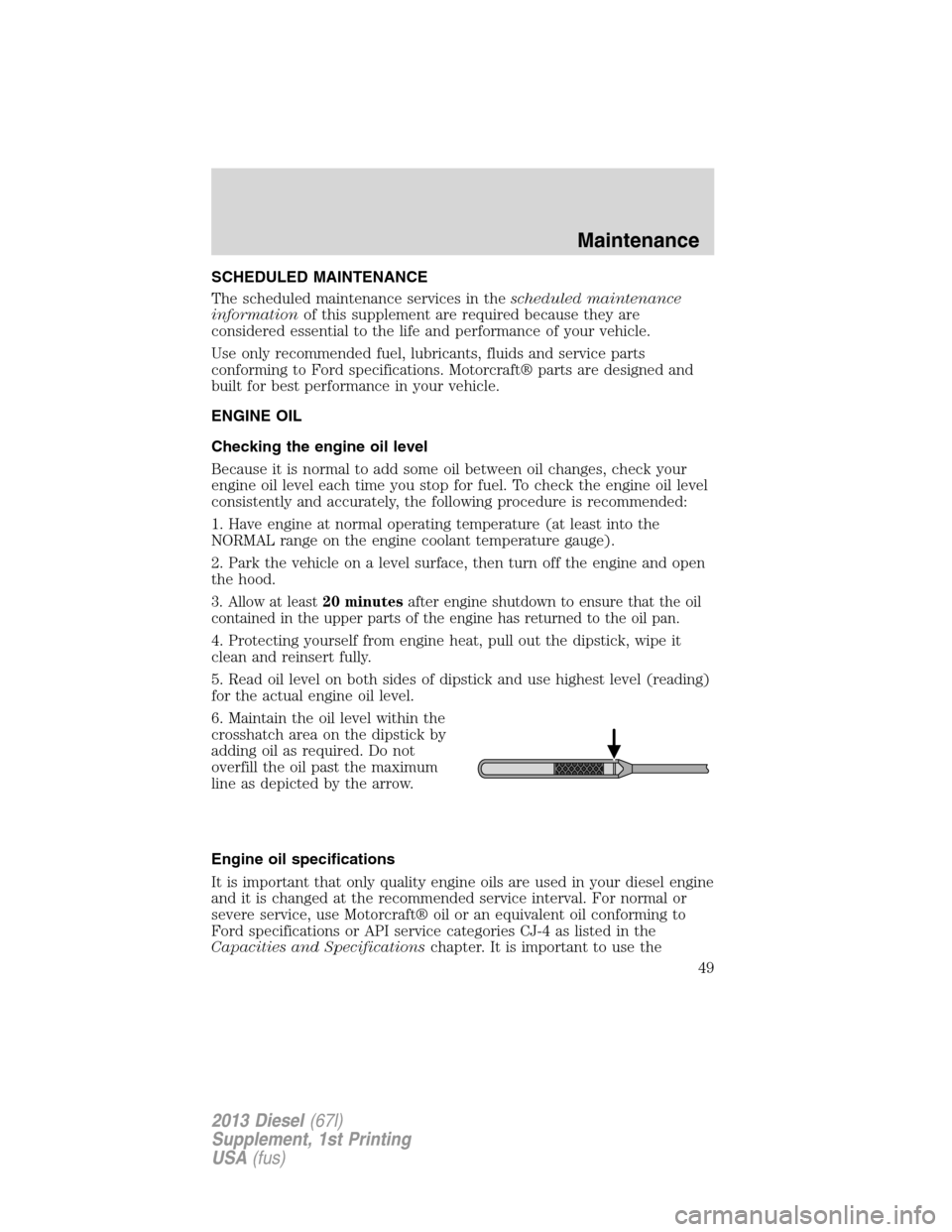
5. Read oil level on both sides of dipstick and use highest level (reading)
for the actual engine oil level.
6. Maintain the oil level within the
crosshatch area on the dipstick by
adding oil as required. Do not
overfill the oil past the maximum
line as depicted by the arrow.
Engine oil specifications
It is important that only quality engine oils are used in your diesel engine
and it is changed at the recommended service interval. For normal or
severe service, use Motorcraft® oil or an equivalent oil conforming to
Ford specifications or API service categories CJ-4 as listed in the
Capacities and Specificationschapter. It is important to use the
Maintenance
49
2013 Diesel(67l)
Supplement, 1st Printing
USA(fus)
Page 53 of 95
•frequent low-speed operation, consistent heavy traffic less than
25 mph (40 km/h)
•operating in severe dust conditions
•operating the vehicle off road
•towing a trailer over 1,000 miles (1,600 km)
•sustained, high-speed driving at Gross Vehicle Weight Rating
(maximum loaded weight for vehicle operation)
•
use of fuels with sulfur content other than ultra-low sulfur diesel (ULSD)
•use of high-sulfur diesel fuel
ENGINE AND SECONDARY COOLING SYSTEM COOLANT
Checking the engine coolant
The concentration, additive strength and level of coolant should be
checked at the mileage intervals listed in thescheduled maintenance
information.Be sure to read and understandPrecautions when
servicing your vehiclein yourOwner’s Manual.
When the engine is cold, check the level of coolant in the reservoirs. See
Under Hood Overviewfor the location of the engine and secondary
cooling system reservoirs. If the coolant has not been checked at the
recommended interval, the engine or secondary coolant reservoir may
become low or empty. If either reservoir is low or empty, add coolant to
the reservoir(s). Refer toEngine and secondary cooling system refill
procedurein this chapter.
Note:The engine coolant should be between the MIN and MAX marks
(within the COLD FILL RANGE), as listed on the engine coolant reservoirs.
Note:Coolant expands when it is hot. The level may extend beyond the
MAX mark.
If the level is below the MIN mark, add engine coolant immediately see
Adding coolantin this chapter.
Note:For best results, coolant concentration should be tested with a
refractometer such as Rotunda tool 300– ROB75240 available from your
dealer. Ford does not recommend the use of hydrometers or coolant test
strips for measuring coolant concentrations.
The coolant concentration should be maintained within 48% to 50%,
which equates to a freeze point between -30 °F and -34 °F.
Note:Automotive fluids are not interchangeable; do not use engine
coolant/antifreeze or windshield washer fluid outside of its specified
function and vehicle location.
Maintenance
52
2013 Diesel(67l)
Supplement, 1st Printing
USA(fus)
Page 54 of 95
Adding engine coolant
WARNING:Do not add coolant when the engine is hot. Steam and
scalding liquids released from a hot cooling system can burn you
badly. Also, you can be burned if you spill coolant on hot engine parts.
WARNING:Do not put coolant in the windshield washer fluid
container. If sprayed on the windshield, coolant could make it
difficult to see through the windshield.
WARNING:To reduce the risk of personal injury, make sure the
engine is cool before unscrewing the coolant pressure relief cap.
The cooling system(s) are under pressure; steam and hot liquid can
come out forcefully when the cap is loosened slightly.
WARNING:Do not add coolant further than the MAX mark.
Note:Do not use stop leak pellets, cooling system sealants or unapproved
additives as they can cause damage to the engine cooling and/or heating
systems. This damage would not be covered under your vehicle’s warranty.
Note:During normal vehicle operation, the engine coolant may change
color from orange to pink or light red. If the engine coolant is clear and
uncontaminated, this color change does not indicate the engine coolant
has degraded nor does it require the engine coolant to be drained, the
system to be flushed, or the engine coolant to be replaced.
•DO NOT MIX different colors or types of coolant in your vehicle. Only
use prediluted engine coolant that meets Ford specification . Mixing of
engine coolants may harm your engine’s cooling system. The use of an
improper coolant may harm engine and cooling system components
and may void the warranty.
•In case of emergency, a large amount of water without engine coolant
may be added in order to reach a vehicle service location. In this
instance, the cooling system must be drained, chemically cleaned, and
refilled with engine coolant as soon as possible per the instructions in
the Workshop Manual. Water alone (without engine coolant) can cause
engine damage from corrosion, overheating or freezing.DO NOTuse
this method for the secondary cooling system. The secondary cooling
system operates close to ambient temperature, and is susceptible to
freezing in any subfreezing environment, in the absence of coolant.
Maintenance
53
2013 Diesel(67l)
Supplement, 1st Printing
USA(fus)
Page 55 of 95
•Do not use alcohol, methanol or brine or any engine coolants mixed
with alcohol or methanol antifreeze (coolant). Alcohol and other
liquids can cause engine damage from overheating or freezing.
•Do not add extra inhibitors or unapproved additives to the coolant.
These can be harmful and compromise the corrosion protection of the
engine coolant.
Add prediluted engine coolant meeting the Ford specification
(Motorcraft® Orange Antifreeze/Coolant Prediluted). SeeCapacities
and Specificationsfor more information. Note: Generic coolants for all
makes and models may not meet the Ford specification and may cause
damage to the cooling system. This damage may void the warranty.
For vehicles with overflow coolant systems with a non-pressurized cap
on the coolant recovery system, add coolant to the coolant recovery
reservoir when the engine is cool. Add prediluted engine coolant
(Motorcraft® Orange Antifreeze/Coolant Prediluted) to the FULL COLD
level. For all other vehicles which have a coolant degas system with a
pressurized cap, or if it is necessary to remove the coolant pressure
relief cap on the radiator of a vehicle with an overflow system, follow
these steps to add engine coolant.
1. Turn the engine off and let it cool.
2. When the engine is cool, wrap a thick cloth around the coolant
pressure relief cap on the coolant reservoir (a translucent plastic bottle).
Slowly turn cap counterclockwise until pressure begins to release.
3. When you are sure that all the pressure has been released, use the
cloth to turn it counterclockwise and remove the cap.
4. Fill the coolant reservoir slowly with prediluted engine coolant to
within the FULL COLD level, or between the MIN and MAX marks
(within the COLD FILL RANGE), as listed on the engine coolant
reservoir. If you removed the radiator cap in an overflow system, fill the
radiator until the coolant is visible and radiator is almost full. If coolant is
added to bring the level within the COLD FILL RANGE when the engine
is not cold, the system may remain under filled.
5. Replace the cap. Turn until tightly installed. Cap must be tightly
installed to prevent coolant loss.
Whenever coolant has been added, the coolant level in the coolant
reservoir should be checked the next few times you drive the vehicle. If
necessary, add enough prediluted engine coolant to bring the coolant
level to the proper level.
Maintenance
54
2013 Diesel(67l)
Supplement, 1st Printing
USA(fus)