seats FORD SUPER DUTY 2013 3.G Owner's Manual
[x] Cancel search | Manufacturer: FORD, Model Year: 2013, Model line: SUPER DUTY, Model: FORD SUPER DUTY 2013 3.GPages: 563, PDF Size: 7.27 MB
Page 52 of 563
Passenger Airbag ON/OFF Switch (if equipped)
WARNING:An airbag ON/OFF switch may be installed in this
vehicle. Before driving, always look at the face of the switch to
be sure the switch is in the proper position in accordance with these
instructions and warnings. Failure to put the switch in a proper position
can increase the risk of serious injury or death in a collision.
Turning the Passenger Airbag Off
WARNING:If the light fails to illuminate when the passenger air
bag switch is off and the ignition is on, have the passenger air
bag switch serviced at your authorized dealer immediately.
WARNING:In order to avoid inadvertent activation of the
switch, always remove the ignition key from the passenger air
bag ON/OFF switch.
WARNING:An infant in a rear-facing seat faces a high risk of
serious or fatal injuries from a deploying passenger airbag. Rear
facing infant seats should NEVER be placed in the front seats, unless
the passenger airbag is turned off.
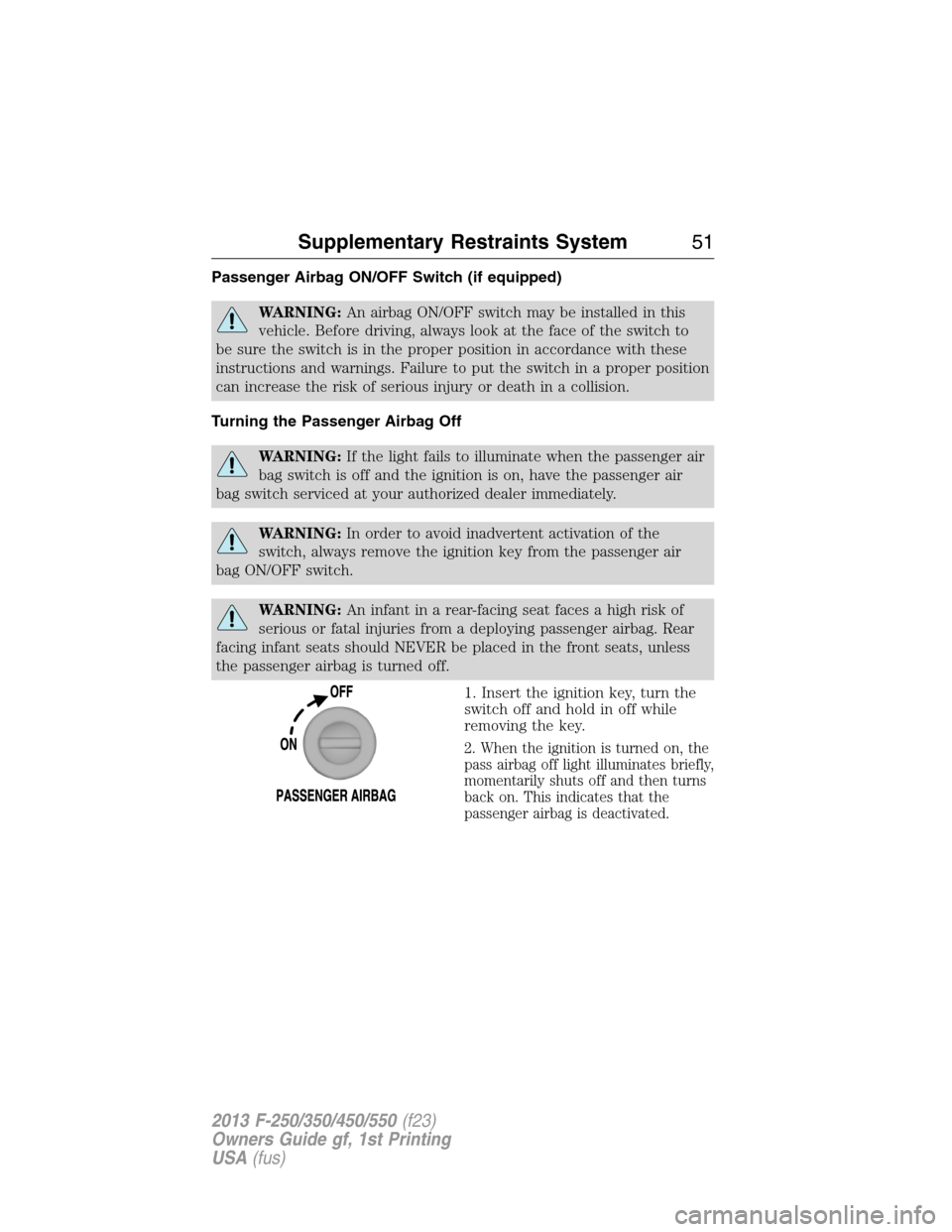
1. Insert the ignition key, turn the
switch off and hold in off while
removing the key.
2. When the ignition is turned on, the
pass airbag off light illuminates briefly,
momentarily shuts off and then turns
back on. This indicates that the
passenger airbag is deactivated.
Supplementary Restraints System51
2013 F-250/350/450/550(f23)
Owners Guide gf, 1st Printing
USA(fus)
Page 53 of 563
Turning the Passenger Airbag Back On
WARNING:The safety belts for the driver and right front
passenger seating positions have been specifically designed to
function together with the airbags in certain types of crashes. When
you turn OFF your airbag, you not only lose the protection of the
airbag, you also may reduce the effectiveness of your safety belt
system, which was designed to work with the airbag. If you are not a
person who meets the requirements stated in the NHTSA/Transport
Canada deactivation criteria turning OFF the airbag can increase the
risk of serious injury or death in a collision.
WARNING:If your vehicle has rear seats, always transport
children who are 12 and younger in the rear seat. Always use
safety belts and child restraints properly. DO NOT place a child in a
rear facing infant seat in the front seat unless your vehicle is equipped
with an airbag ON/OFF switch and the passenger airbag is turned OFF.
This is because the back of the infant seat is too close to the inflating
airbag and the risk of a fatal injury to the infant when the airbag
inflates is substantial.
WARNING:If the pass airbag off light is illuminated when the
passenger airbag switch is on and the ignition is on, have the
passenger airbag switch serviced at your authorized dealer immediately.
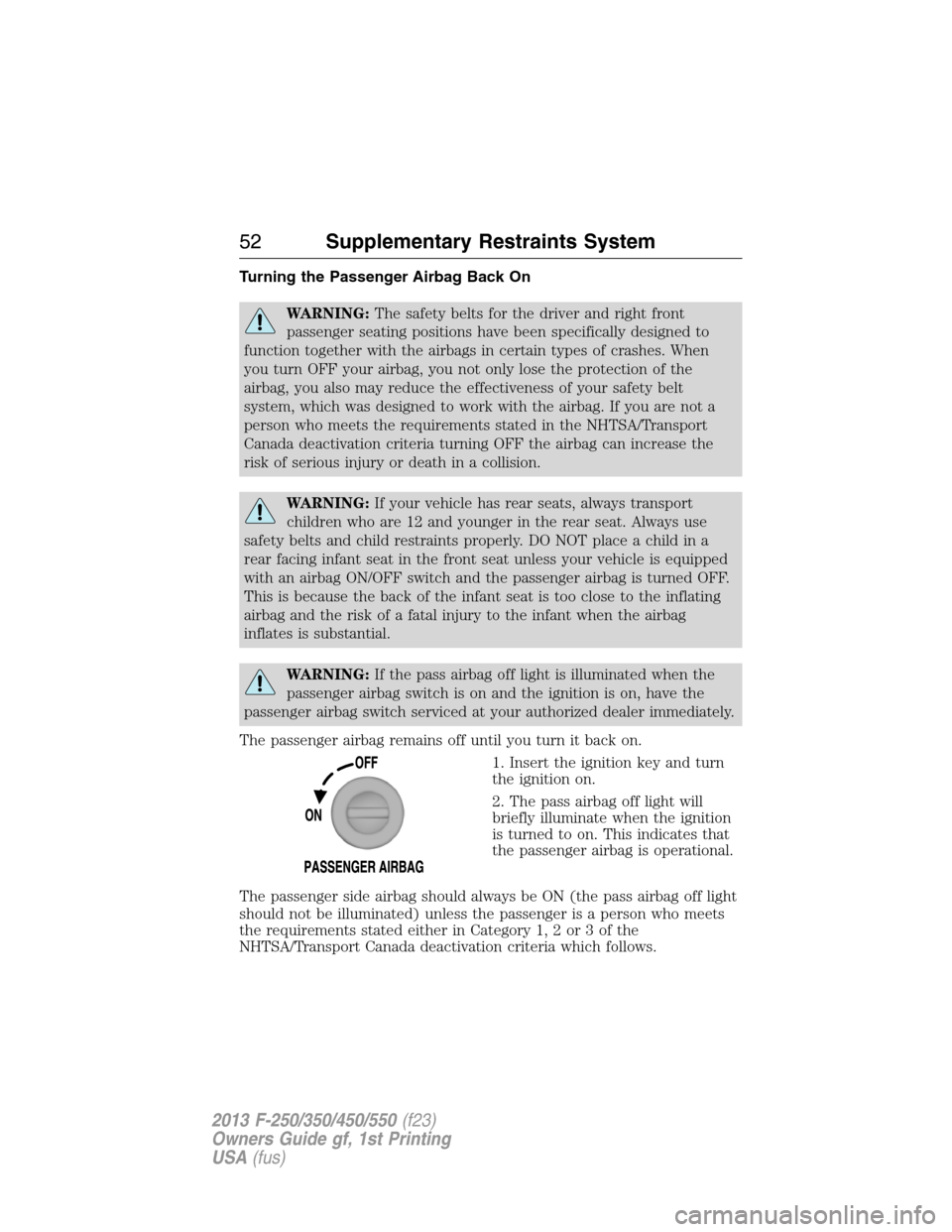
The passenger airbag remains off until you turn it back on.
1. Insert the ignition key and turn
the ignition on.
2. The pass airbag off light will
briefly illuminate when the ignition
is turned to on. This indicates that
the passenger airbag is operational.
The passenger side airbag should always be ON (the pass airbag off light
should not be illuminated) unless the passenger is a person who meets
the requirements stated either in Category 1, 2 or 3 of the
NHTSA/Transport Canada deactivation criteria which follows.
52Supplementary Restraints System
2013 F-250/350/450/550(f23)
Owners Guide gf, 1st Printing
USA(fus)
Page 56 of 563
2.Child age 12 or under:A child age 12 or under must ride in the
front seat because:
•my vehicle has no rear seat;
•although children age 12 and under ride in the rear seat whenever
possible, children age 12 and under have no option but to sometimes
ride in the front seat because rear seat space is insufficient; or
•the child has a medical condition that, according to the child’s
physician, makes it necessary for the child to ride in the front seat so
that the driver can monitor the child’s condition.
3.Medical condition:A passenger has a medical condition that,
according to his or her physician:
•poses a special risk for the passenger if the airbag deploys; and
•makes the potential harm from the passenger airbag deployment
greater than the potential harm from turning OFF the airbag and
experiencing a crash without the protection offered by the airbag
SIDE AIRBAGS
WARNING:Do not place objects or mount equipment on or near
the airbag cover, on the side of the seat backs (of the front
seats), or in front seat areas that may come into contact with a
deploying airbag. Failure to follow these instructions may increase the
risk of personal injury in the event of a crash.
WARNING:Do not use accessory seat covers. The use of
accessory seat covers may prevent the deployment of the side
airbags and increase the risk of injury in an accident.
WARNING:Do not lean your head on the door. The side airbag
could injure you as it deploys from the side of the seat back.
WARNING:Do not attempt to service, repair, or modify the
airbag, its fuses or the seat cover on a seat containing an airbag.
Contact your authorized dealer as soon as possible.
Supplementary Restraints System55
2013 F-250/350/450/550(f23)
Owners Guide gf, 1st Printing
USA(fus)
Page 57 of 563
WARNING:If the side airbag has deployed, the airbag will not
function again. The side airbag system (including the seat) must
be inspected and serviced by an authorized dealer. If the airbag is not
replaced, the unrepaired area will increase the risk of injury in a crash.
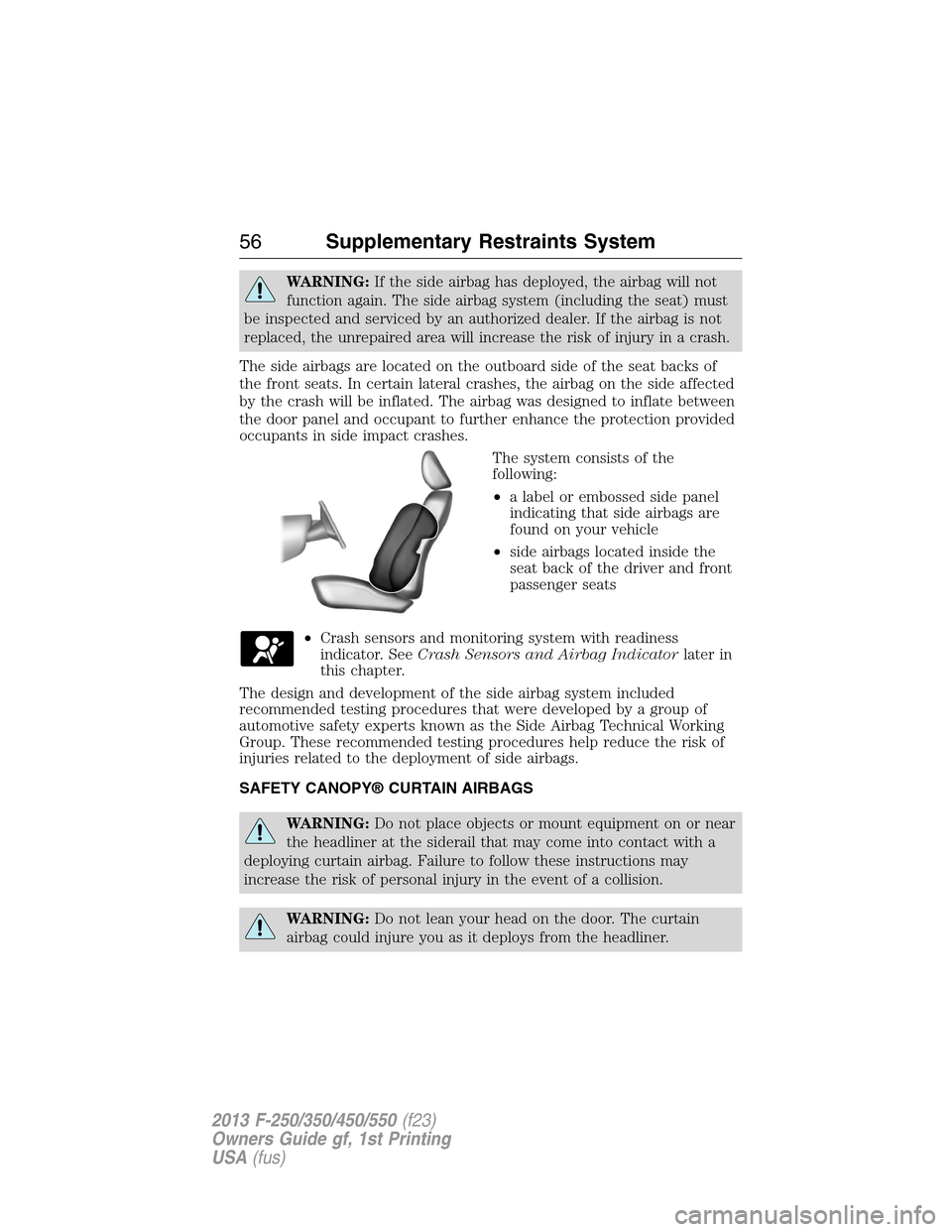
The side airbags are located on the outboard side of the seat backs of
the front seats. In certain lateral crashes, the airbag on the side affected
by the crash will be inflated. The airbag was designed to inflate between
the door panel and occupant to further enhance the protection provided
occupants in side impact crashes.
The system consists of the
following:
•a label or embossed side panel
indicating that side airbags are
found on your vehicle
•side airbags located inside the
seat back of the driver and front
passenger seats
•Crash sensors and monitoring system with readiness
indicator. SeeCrash Sensors and Airbag Indicatorlater in
this chapter.
The design and development of the side airbag system included
recommended testing procedures that were developed by a group of
automotive safety experts known as the Side Airbag Technical Working
Group. These recommended testing procedures help reduce the risk of
injuries related to the deployment of side airbags.
SAFETY CANOPY® CURTAIN AIRBAGS
WARNING:Do not place objects or mount equipment on or near
the headliner at the siderail that may come into contact with a
deploying curtain airbag. Failure to follow these instructions may
increase the risk of personal injury in the event of a collision.
WARNING:Do not lean your head on the door. The curtain
airbag could injure you as it deploys from the headliner.
56Supplementary Restraints System
2013 F-250/350/450/550(f23)
Owners Guide gf, 1st Printing
USA(fus)
Page 58 of 563
WARNING:Do not attempt to service, repair, or modify the
curtain airbags, its fuses, the A, B, or C pillar trim, or the
headliner on a vehicle containing curtain airbags. Contact your
authorized dealer as soon as possible.
WARNING:All occupants of your vehicle including the driver
should always wear their safety belts even when an airbag SRS
and curtain airbag is provided.
WARNING:To reduce risk of injury, do not obstruct or place
objects in the deployment path of the curtain airbag.
WARNING:If the curtain airbags have deployed,the curtain
airbags will not function again. The curtain airbags
(including the A, B and C pillar trim and headliner) must be
inspected and serviced by an authorized dealer.If the curtain
airbag is not replaced, the unrepaired area will increase the risk of
injury in a collision.
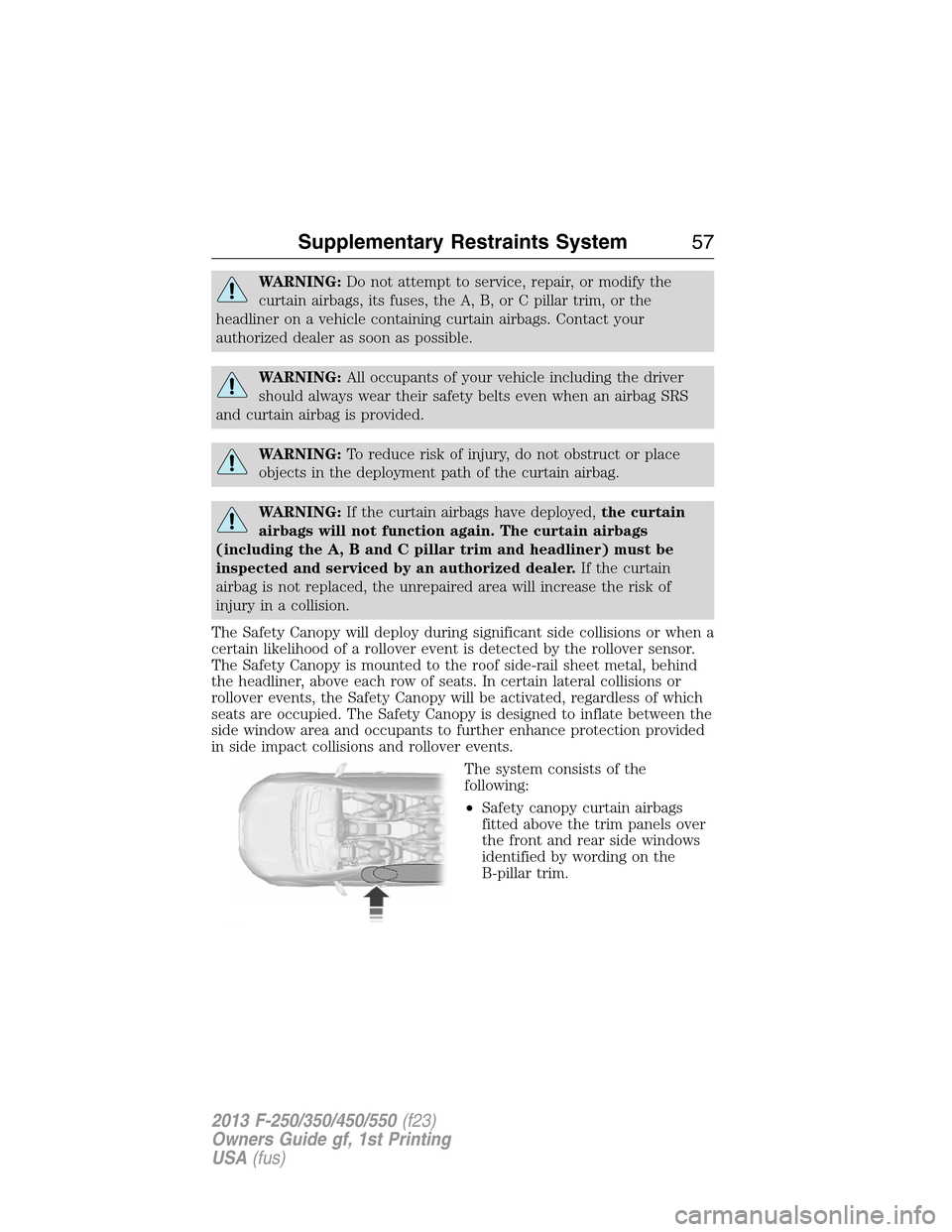
The Safety Canopy will deploy during significant side collisions or when a
certain likelihood of a rollover event is detected by the rollover sensor.
The Safety Canopy is mounted to the roof side-rail sheet metal, behind
the headliner, above each row of seats. In certain lateral collisions or
rollover events, the Safety Canopy will be activated, regardless of which
seats are occupied. The Safety Canopy is designed to inflate between the
side window area and occupants to further enhance protection provided
in side impact collisions and rollover events.
The system consists of the
following:
•Safety canopy curtain airbags
fitted above the trim panels over
the front and rear side windows
identified by wording on the
B-pillar trim.
Supplementary Restraints System57
2013 F-250/350/450/550(f23)
Owners Guide gf, 1st Printing
USA(fus)
Page 59 of 563
•A flexible headliner which opens above the side doors to allow air
curtain deployment.
•Crash sensors and monitoring system with readiness
indicator. SeeCrash Sensors and Airbag Indicatorin this
chapter.
Children 12 years old and under should always be properly restrained in
the rear seats. The Safety Canopy will not interfere with children
restrained using a properly installed child or booster seat because it is
designed to inflate downward from the headliner above the doors along
the side window opening.
The design and development of the Safety Canopy included
recommended testing procedures that were developed by a group of
automotive safety experts known as the Side Airbag Technical Working
Group. These recommended testing procedures help reduce the risk of
injuries related to the deployment of side airbags (including the Safety
Canopy).
CRASH SENSORS AND AIRBAG INDICATOR
WARNING:Modifying or adding equipment to the front end of
your vehicle (including frame, bumper, front end body structure
and tow hooks) may affect the performance of the airbag system,
increasing the risk of injury. Do not modify the front end of your
vehicle.
Your vehicle has a collection of crash and occupant sensors which
provide information to the restraints control module which deploys
(activates) the front safety belt pretensioners, driver airbag, passenger
airbag, seat mounted side airbags, and the Safety Canopy®. Based on the
type of accident (frontal impact, side impact or rollover) the restraints
control module will deploy the appropriate safety devices.
The restraints control module also monitors the readiness of the above
safety devices plus the crash and occupant sensors. The readiness of the
safety system is indicated by a warning indicator light in the instrument
cluster or by a backup tone if the warning light is not working. See the
Instrument Clusterchapter. Routine maintenance of the airbag is not
required.
A difficulty with the system is indicated by one or more of the following:
58Supplementary Restraints System
2013 F-250/350/450/550(f23)
Owners Guide gf, 1st Printing
USA(fus)
Page 79 of 563
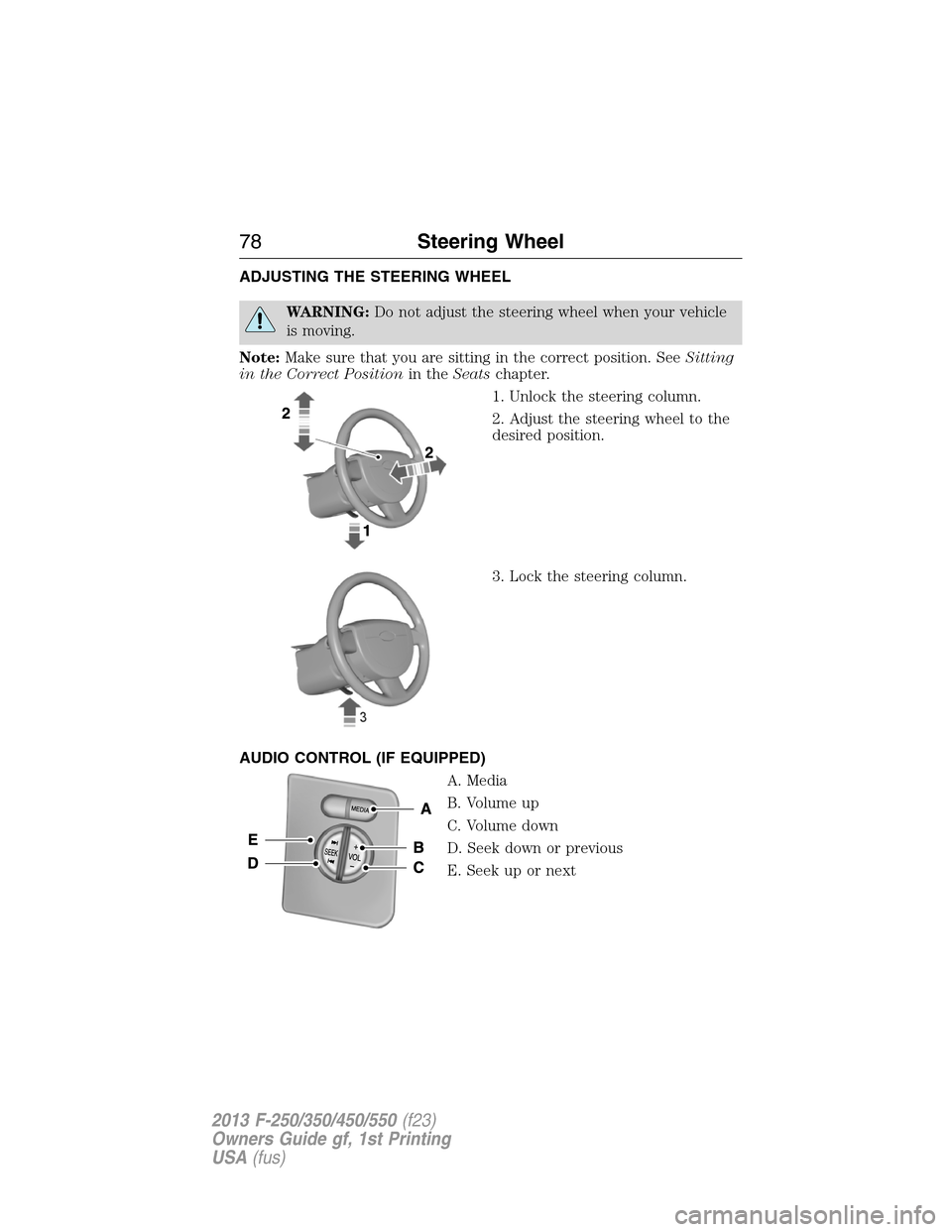
ADJUSTING THE STEERING WHEEL
WARNING:Do not adjust the steering wheel when your vehicle
is moving.
Note:Make sure that you are sitting in the correct position. SeeSitting
in the Correct Positionin theSeatschapter.
1. Unlock the steering column.
2. Adjust the steering wheel to the
desired position.
3. Lock the steering column.
AUDIO CONTROL (IF EQUIPPED)
A. Media
B. Volume up
C. Volume down
D. Seek down or previous
E. Seek up or next
78Steering Wheel
2013 F-250/350/450/550(f23)
Owners Guide gf, 1st Printing
USA(fus)
Page 82 of 563
ADJUSTABLE PEDALS (IF EQUIPPED)
WARNING:Never adjust the accelerator and brake pedal with
feet on the pedals while the vehicle is moving.
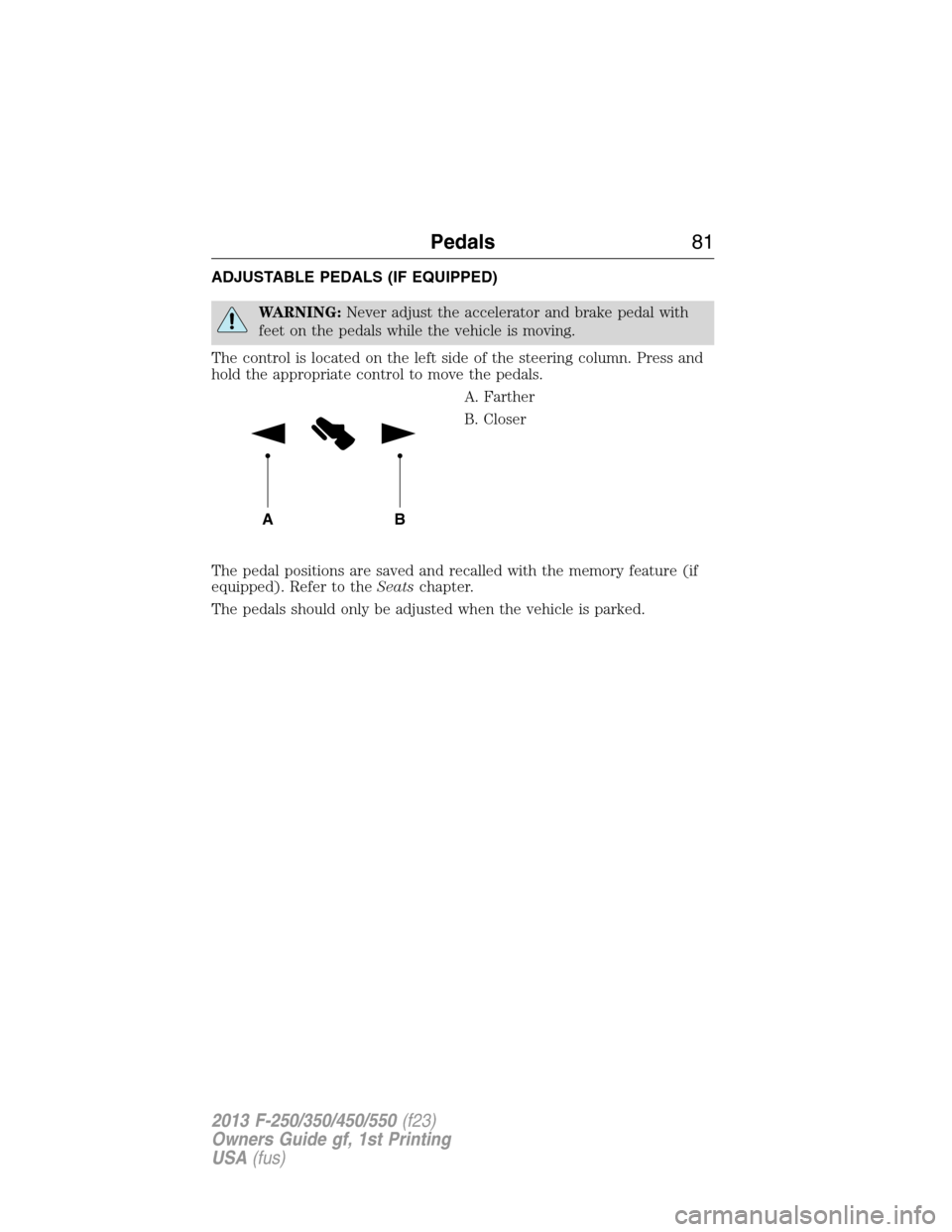
The control is located on the left side of the steering column. Press and
hold the appropriate control to move the pedals.
A. Farther
B. Closer
The pedal positions are saved and recalled with the memory feature (if
equipped). Refer to theSeatschapter.
The pedals should only be adjusted when the vehicle is parked.
AB
Pedals81
2013 F-250/350/450/550(f23)
Owners Guide gf, 1st Printing
USA(fus)
Page 92 of 563
Fold-Away Exterior Mirrors
Push the mirror toward the door window glass. Make sure that you fully
engage the mirror in its support when returning it to its original position.
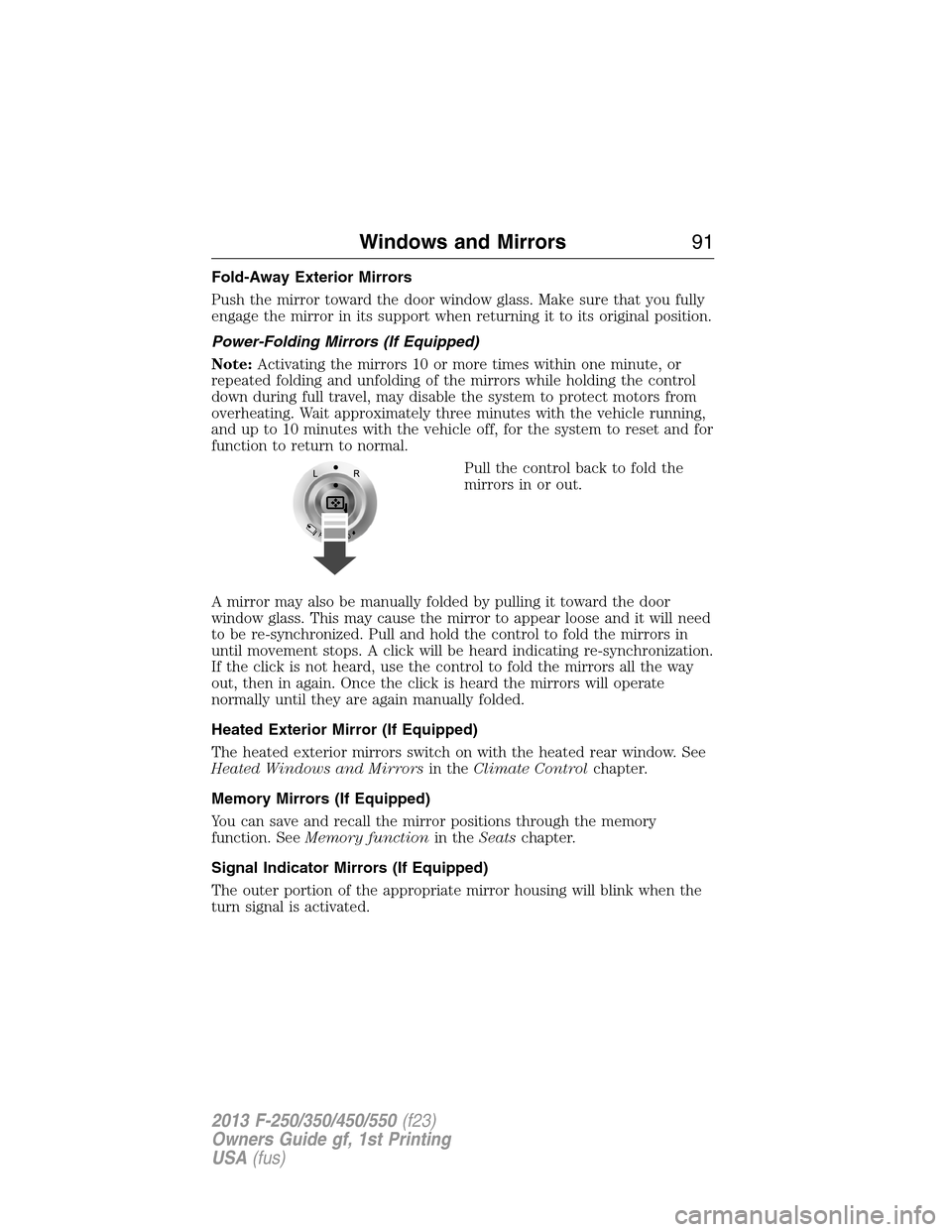
Power-Folding Mirrors (If Equipped)
Note:Activating the mirrors 10 or more times within one minute, or
repeated folding and unfolding of the mirrors while holding the control
down during full travel, may disable the system to protect motors from
overheating. Wait approximately three minutes with the vehicle running,
and up to 10 minutes with the vehicle off, for the system to reset and for
function to return to normal.
Pull the control back to fold the
mirrors in or out.
A mirror may also be manually folded by pulling it toward the door
window glass. This may cause the mirror to appear loose and it will need
to be re-synchronized. Pull and hold the control to fold the mirrors in
until movement stops. A click will be heard indicating re-synchronization.
If the click is not heard, use the control to fold the mirrors all the way
out, then in again. Once the click is heard the mirrors will operate
normally until they are again manually folded.
Heated Exterior Mirror (If Equipped)
The heated exterior mirrors switch on with the heated rear window. See
Heated Windows and Mirrorsin theClimate Controlchapter.
Memory Mirrors (If Equipped)
You can save and recall the mirror positions through the memory
function. SeeMemory functionin theSeatschapter.
Signal Indicator Mirrors (If Equipped)
The outer portion of the appropriate mirror housing will blink when the
turn signal is activated.
Windows and Mirrors91
2013 F-250/350/450/550(f23)
Owners Guide gf, 1st Printing
USA(fus)
Page 150 of 563
GENERAL OPERATING TIPS
Manual Heating and Air Conditioning System
•To reduce fog build-up on the windshield during humid weather, select
Defrost. Temperature and fan speed can also be increased to improve
clearing.
•To reduce humidity build-up inside the vehicle, do not drive with the
system off or with recirculated air engaged.
•Do not put objects under the front seats that will interfere with the
airflow to the back seats.
•Remove any snow, ice or leaves from the air intake area at the base of
the windshield.
•To improve the A/C cool down, drive with the windows slightly open
for 2-3 minutes after start-up or until the vehicle has been aired out.
•A small amount of air may be felt from the floor vent regardless of the
air distribution setting that is selected.
During extreme high ambient temperatures when idling stationary for
extended periods of time in gear, it is recommended to run the A/C in
the MAX A/C mode, adjust the blower fan speed to the lowest setting
and put the vehicle’s transmission into positionPto continue to receive
cool air from your A/C system.
For maximum cooling performance in AUTO or panel mode, press MAX
A/C.
For maximum cooling performance in panel/floor mode:
1. Move temperature control to the coolest setting.
2. Select A/C and recirculated air to provide colder airflow.
3. Set the fan to the highest speed initially, then adjust to maintain
comfort.
To aid in side window defogging and demisting in cold or humid weather:
1. Select Floor/Panel.
2. Select A/C.
3. Adjust the temperature control to maintain comfort.
4. Set the fan speed to the highest setting.
5. Direct the outer instrument panel vents toward the side windows.
6. To increase airflow to the outer instrument panel vents, close the
vents located in the middle of the instrument panel.
Climate Control149
2013 F-250/350/450/550(f23)
Owners Guide gf, 1st Printing
USA(fus)