seats FORD SUPER DUTY 2013 3.G Owners Manual
[x] Cancel search | Manufacturer: FORD, Model Year: 2013, Model line: SUPER DUTY, Model: FORD SUPER DUTY 2013 3.GPages: 563, PDF Size: 7.27 MB
Page 2 of 563
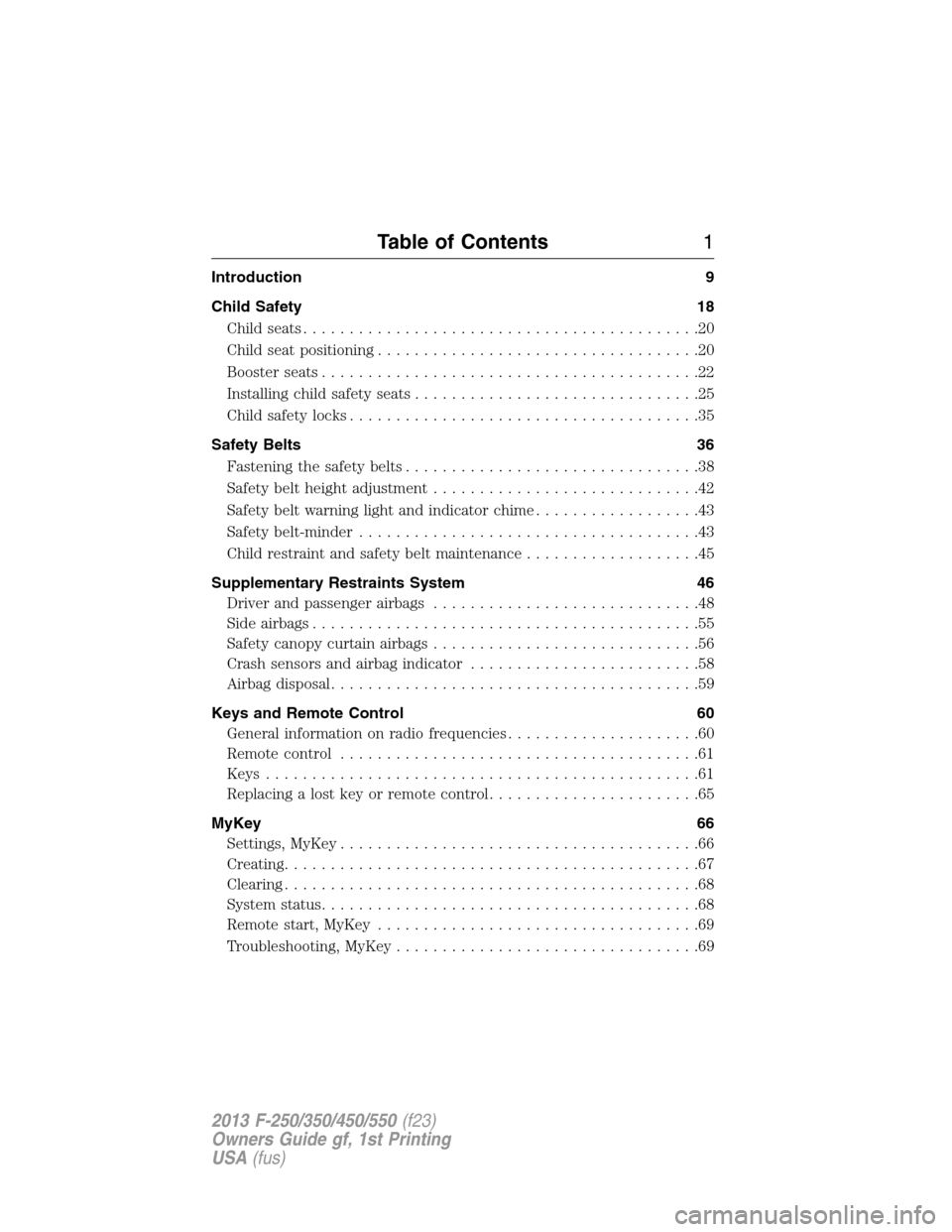
Introduction 9
Child Safety 18
Child seats...........................................20
Child seat positioning...................................20
Booster seats.........................................22
Installing child safety seats...............................25
Child safety locks......................................35
Safety Belts 36
Fastening the safety belts................................38
Safety belt height adjustment.............................42
Safetybeltwarninglightandindicatorchime..................43
Safety belt-minder.....................................43
Child restraint and safety belt maintenance...................45
Supplementary Restraints System 46
Driver and passenger airbags.............................48
Side airbags..........................................55
Safety canopy curtain airbags.............................56
Crash sensors and airbag indicator.........................58
Airbag disposal........................................59
Keys and Remote Control 60
General information on radio frequencies.....................60
Remote control.......................................61
Keys...............................................61
Replacing a lost key or remote control.......................65
MyKey 66
Settings, MyKey.......................................66
Creating.............................................67
Clearing.............................................68
System status.........................................68
Remote start, MyKey...................................69
Troubleshooting, MyKey.................................69
Table of Contents1
2013 F-250/350/450/550(f23)
Owners Guide gf, 1st Printing
USA(fus)
Page 4 of 563
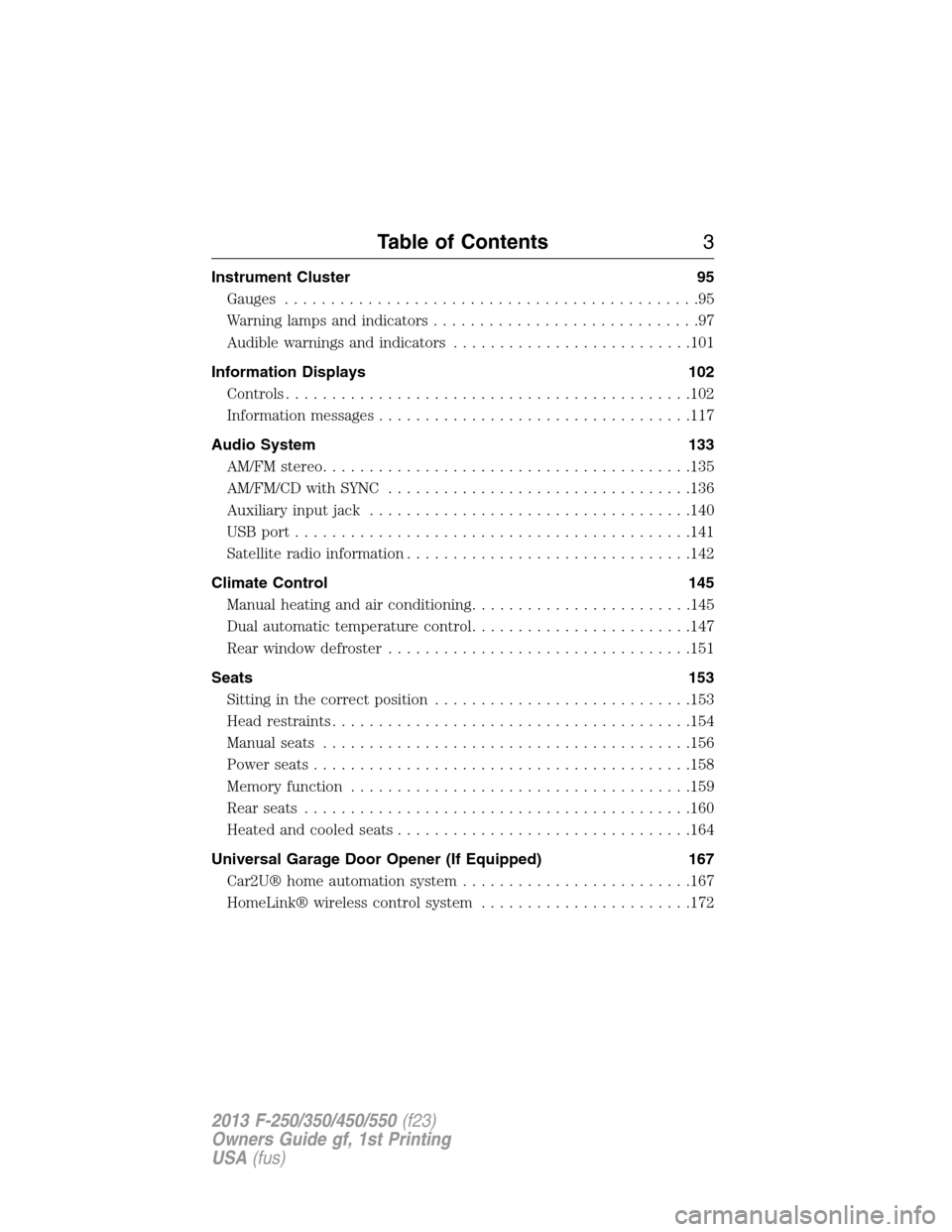
Instrument Cluster 95
Gauges.............................................95
Warning lamps and indicators.............................97
Audible warnings and indicators..........................101
Information Displays 102
Controls............................................102
Information messages..................................117
Audio System 133
AM/FMstereo........................................135
AM/FM/CD with SYNC.................................136
Auxiliary input jack...................................140
USBport...........................................141
Satellite radio information...............................142
Climate Control 145
Manual heating and air conditioning........................145
Dual automatic temperature control........................147
Rear window defroster.................................151
Seats 153
Sitting in the correct position............................153
Head restraints.......................................154
Manual seats........................................156
Power seats.........................................158
Memory function.....................................159
Rear seats..........................................160
Heated and cooled seats................................164
Universal Garage Door Opener (If Equipped) 167
Car2U® home automation system.........................167
HomeLink® wireless control system.......................172
Table of Contents3
2013 F-250/350/450/550(f23)
Owners Guide gf, 1st Printing
USA(fus)
Page 16 of 563
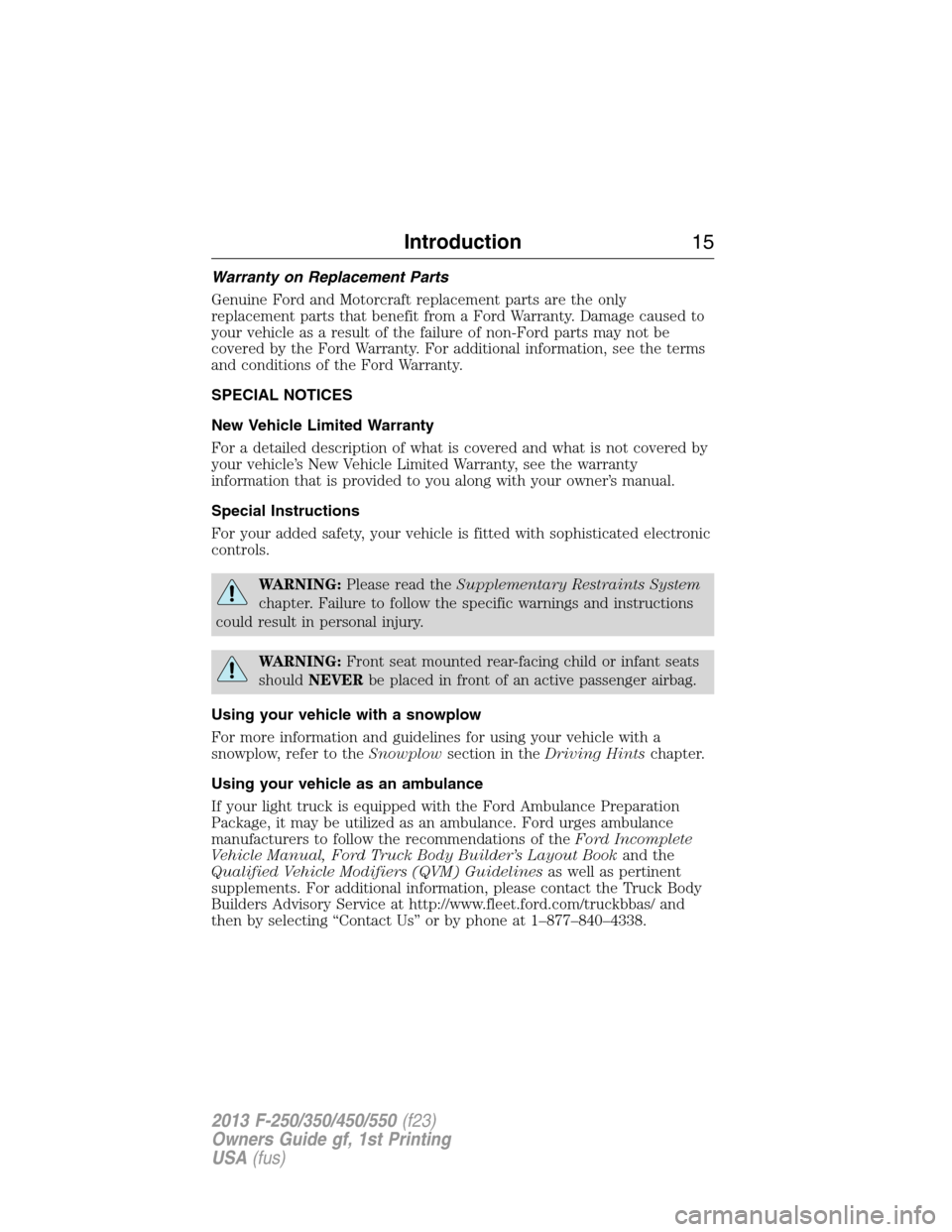
Warranty on Replacement Parts
Genuine Ford and Motorcraft replacement parts are the only
replacement parts that benefit from a Ford Warranty. Damage caused to
your vehicle as a result of the failure of non-Ford parts may not be
covered by the Ford Warranty. For additional information, see the terms
and conditions of the Ford Warranty.
SPECIAL NOTICES
New Vehicle Limited Warranty
For a detailed description of what is covered and what is not covered by
your vehicle’s New Vehicle Limited Warranty, see the warranty
information that is provided to you along with your owner’s manual.
Special Instructions
For your added safety, your vehicle is fitted with sophisticated electronic
controls.
WARNING:Please read theSupplementary Restraints System
chapter. Failure to follow the specific warnings and instructions
could result in personal injury.
WARNING:Front seat mounted rear-facing child or infant seats
shouldNEVERbe placed in front of an active passenger airbag.
Using your vehicle with a snowplow
For more information and guidelines for using your vehicle with a
snowplow, refer to theSnowplowsection in theDriving Hintschapter.
Using your vehicle as an ambulance
If your light truck is equipped with the Ford Ambulance Preparation
Package, it may be utilized as an ambulance. Ford urges ambulance
manufacturers to follow the recommendations of theFord Incomplete
Vehicle Manual, Ford Truck Body Builder’s Layout Bookand the
Qualified Vehicle Modifiers (QVM) Guidelinesas well as pertinent
supplements. For additional information, please contact the Truck Body
Builders Advisory Service at http://www.fleet.ford.com/truckbbas/ and
then by selecting “Contact Us” or by phone at 1–877–840–4338.
Introduction15
2013 F-250/350/450/550(f23)
Owners Guide gf, 1st Printing
USA(fus)
Page 19 of 563
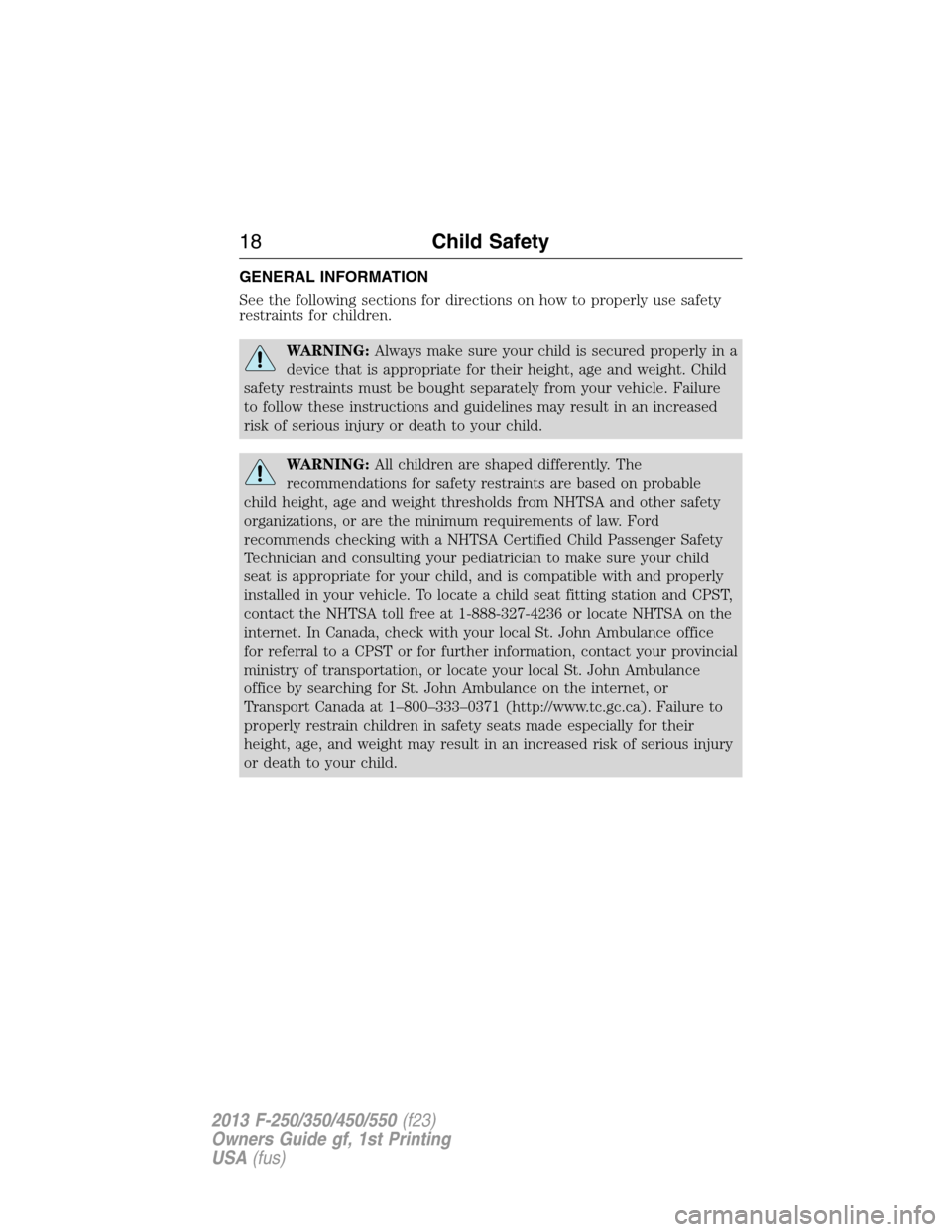
GENERAL INFORMATION
See the following sections for directions on how to properly use safety
restraints for children.
WARNING:Always make sure your child is secured properly in a
device that is appropriate for their height, age and weight. Child
safety restraints must be bought separately from your vehicle. Failure
to follow these instructions and guidelines may result in an increased
risk of serious injury or death to your child.
WARNING:All children are shaped differently. The
recommendations for safety restraints are based on probable
child height, age and weight thresholds from NHTSA and other safety
organizations, or are the minimum requirements of law. Ford
recommends checking with a NHTSA Certified Child Passenger Safety
Technician and consulting your pediatrician to make sure your child
seat is appropriate for your child, and is compatible with and properly
installed in your vehicle. To locate a child seat fitting station and CPST,
contact the NHTSA toll free at 1-888-327-4236 or locate NHTSA on the
internet. In Canada, check with your local St. John Ambulance office
for referral to a CPST or for further information, contact your provincial
ministry of transportation, or locate your local St. John Ambulance
office by searching for St. John Ambulance on the internet, or
Transport Canada at 1–800–333–0371 (http://www.tc.gc.ca). Failure to
properly restrain children in safety seats made especially for their
height, age, and weight may result in an increased risk of serious injury
or death to your child.
18Child Safety
2013 F-250/350/450/550(f23)
Owners Guide gf, 1st Printing
USA(fus)
Page 20 of 563
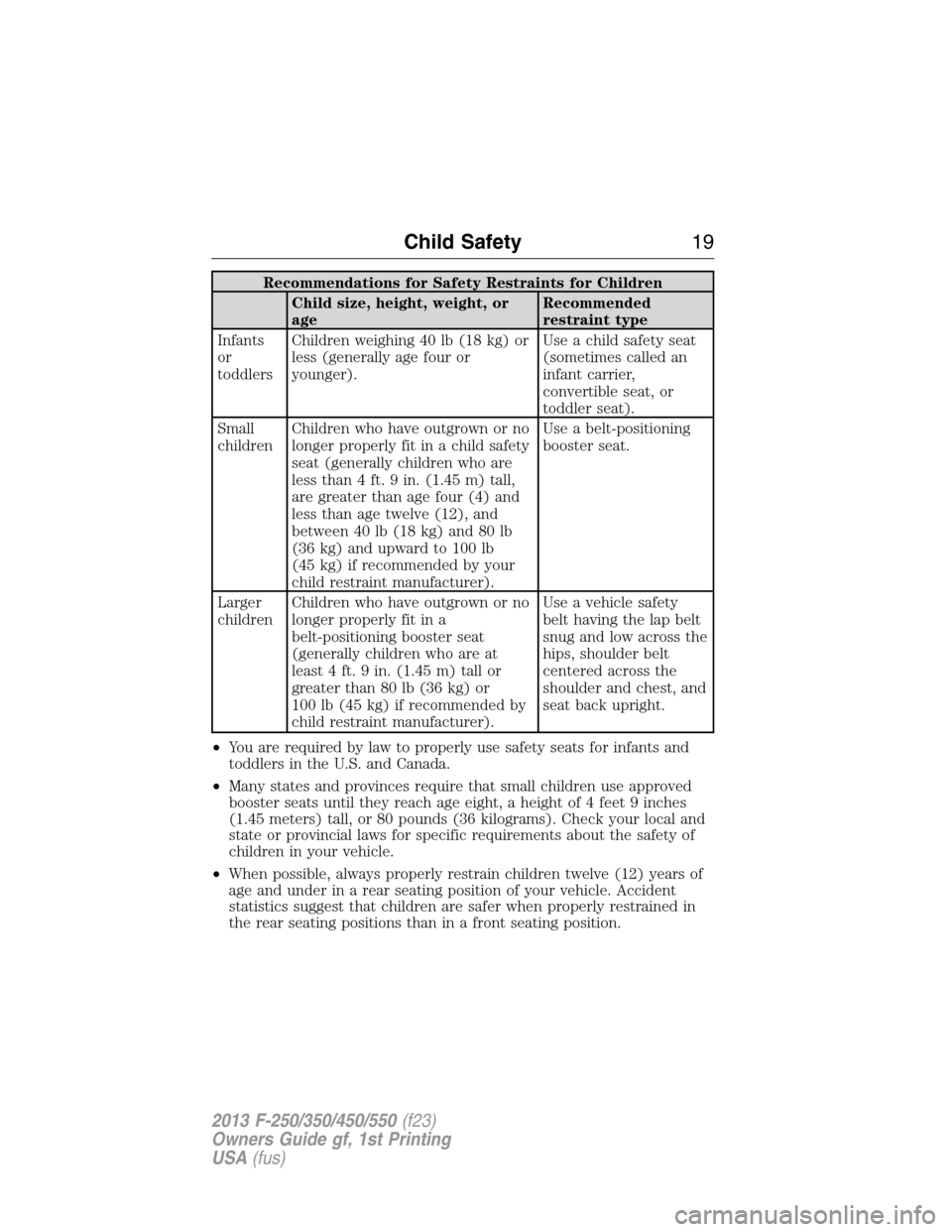
Recommendations for Safety Restraints for Children
Child size, height, weight, or
ageRecommended
restraint type
Infants
or
toddlersChildren weighing 40 lb (18 kg) or
less (generally age four or
younger).Use a child safety seat
(sometimes called an
infant carrier,
convertible seat, or
toddler seat).
Small
childrenChildren who have outgrown or no
longer properly fit in a child safety
seat (generally children who are
less than 4 ft. 9 in. (1.45 m) tall,
are greater than age four (4) and
less than age twelve (12), and
between 40 lb (18 kg) and 80 lb
(36 kg) and upward to 100 lb
(45 kg) if recommended by your
child restraint manufacturer).Use a belt-positioning
booster seat.
Larger
childrenChildren who have outgrown or no
longer properly fit in a
belt-positioning booster seat
(generally children who are at
least 4 ft. 9 in. (1.45 m) tall or
greater than 80 lb (36 kg) or
100 lb (45 kg) if recommended by
child restraint manufacturer).Use a vehicle safety
belt having the lap belt
snug and low across the
hips, shoulder belt
centered across the
shoulder and chest, and
seat back upright.
•You are required by law to properly use safety seats for infants and
toddlers in the U.S. and Canada.
•Many states and provinces require that small children use approved
booster seats until they reach age eight, a height of 4 feet 9 inches
(1.45 meters) tall, or 80 pounds (36 kilograms). Check your local and
state or provincial laws for specific requirements about the safety of
children in your vehicle.
•When possible, always properly restrain children twelve (12) years of
age and under in a rear seating position of your vehicle. Accident
statistics suggest that children are safer when properly restrained in
the rear seating positions than in a front seating position.
Child Safety19
2013 F-250/350/450/550(f23)
Owners Guide gf, 1st Printing
USA(fus)
Page 21 of 563
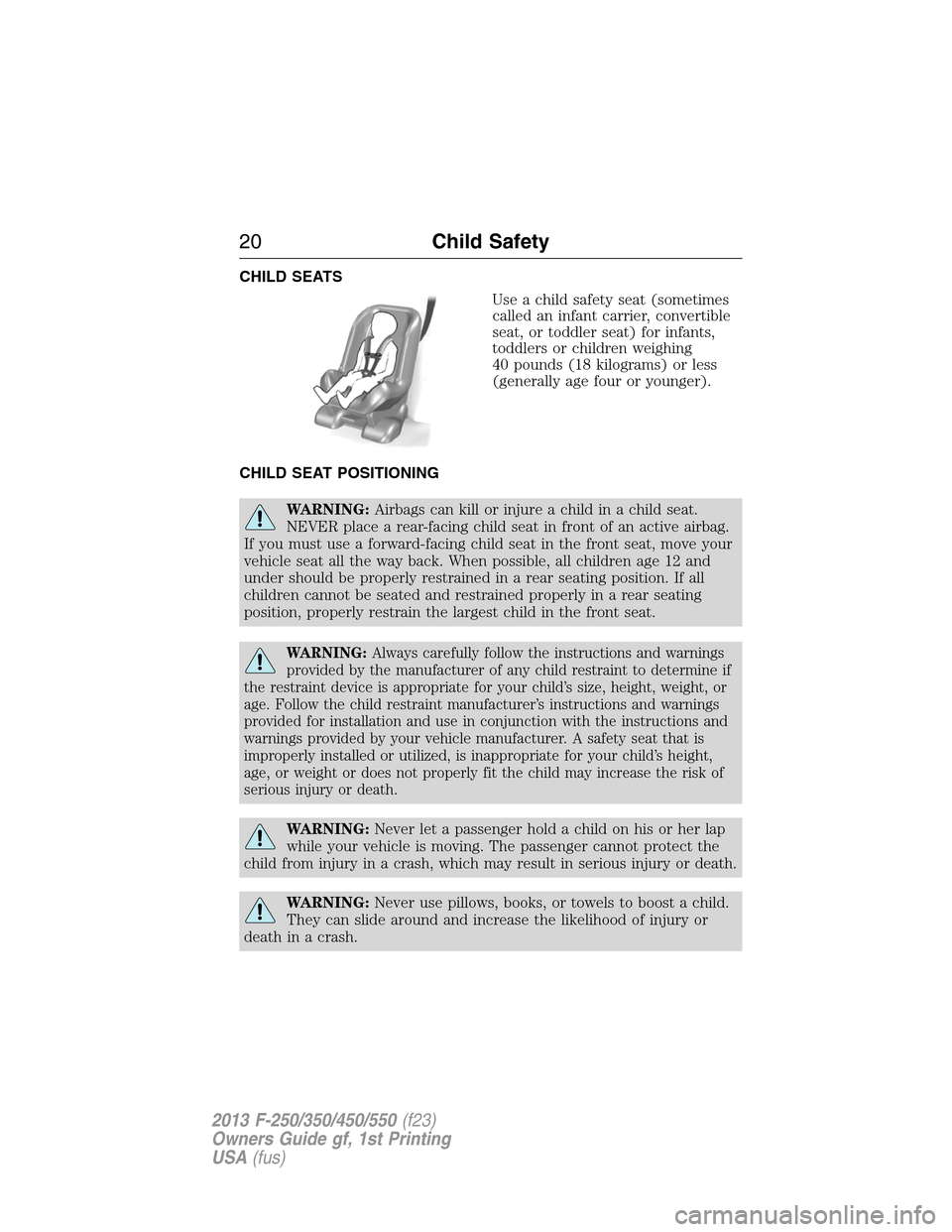
CHILD SEATS
Use a child safety seat (sometimes
called an infant carrier, convertible
seat, or toddler seat) for infants,
toddlers or children weighing
40 pounds (18 kilograms) or less
(generally age four or younger).
CHILD SEAT POSITIONING
WARNING:Airbags can kill or injure a child in a child seat.
NEVER place a rear-facing child seat in front of an active airbag.
If you must use a forward-facing child seat in the front seat, move your
vehicle seat all the way back. When possible, all children age 12 and
under should be properly restrained in a rear seating position. If all
children cannot be seated and restrained properly in a rear seating
position, properly restrain the largest child in the front seat.
WARNING:Always carefully follow the instructions and warnings
provided by the manufacturer of any child restraint to determine if
the restraint device is appropriate for your child’s size, height, weight, or
age. Follow the child restraint manufacturer’s instructions and warnings
provided for installation and use in conjunction with the instructions and
warnings provided by your vehicle manufacturer. A safety seat that is
improperly installed or utilized, is inappropriate for your child’s height,
age, or weight or does not properly fit the child may increase the risk of
serious injury or death.
WARNING:Never let a passenger hold a child on his or her lap
while your vehicle is moving. The passenger cannot protect the
child from injury in a crash, which may result in serious injury or death.
WARNING:Never use pillows, books, or towels to boost a child.
They can slide around and increase the likelihood of injury or
death in a crash.
20Child Safety
2013 F-250/350/450/550(f23)
Owners Guide gf, 1st Printing
USA(fus)
Page 22 of 563
WARNING:Always restrain an unoccupied child seat or booster
seat. These objects may become projectiles in a crash or sudden
stop, which may increase the risk of serious injury.
WARNING:Never place, or allow a child to place, the shoulder
belt under a child’s arm or behind the back because it reduces
the protection for the upper part of the body and may increase the risk
of injury or death in a crash.
WARNING:Do not leave children or pets unattended in your
vehicle.
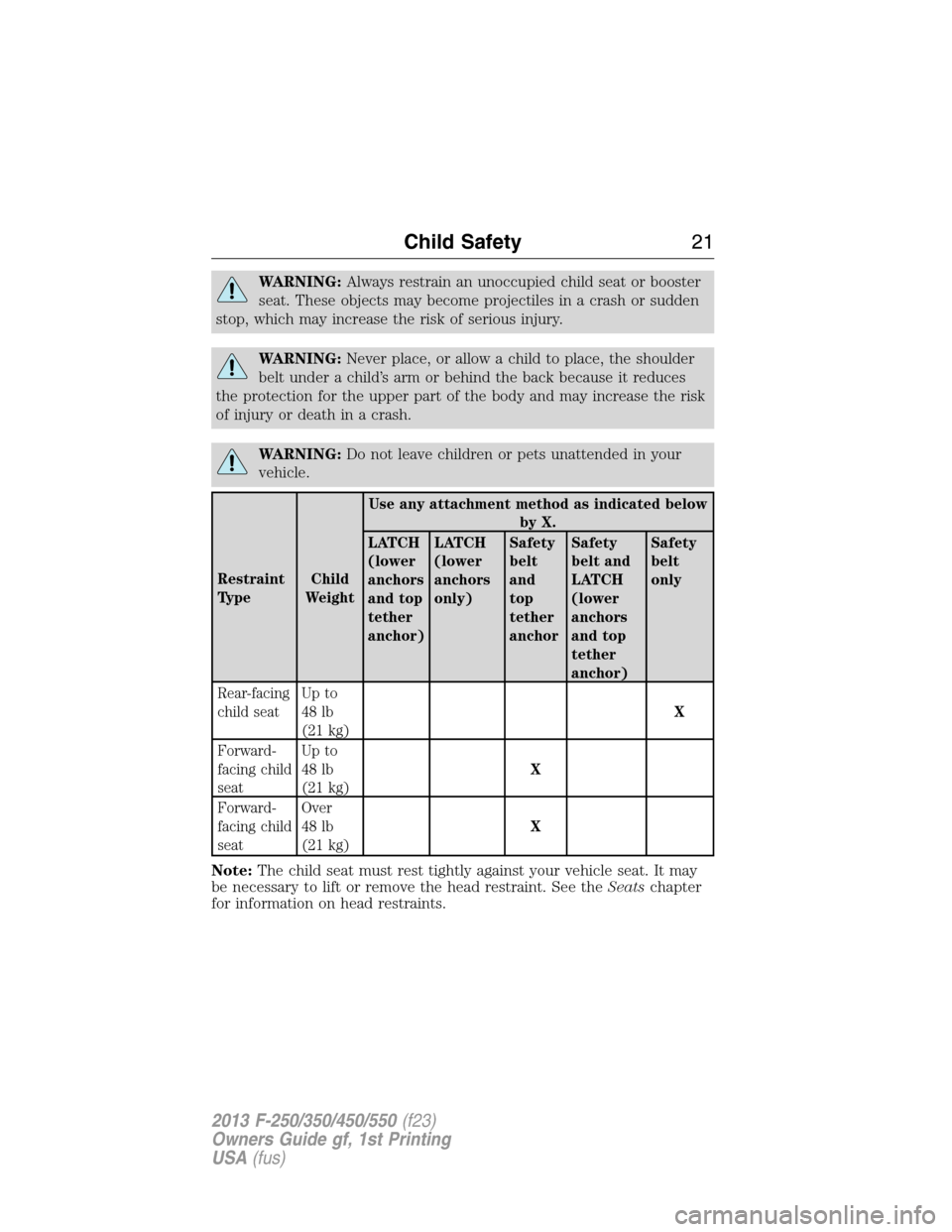
Restraint
TypeChild
WeightUse any attachment method as indicated below
by X.
LATCH
(lower
anchors
and top
tether
anchor)LATCH
(lower
anchors
only)Safety
belt
and
top
tether
anchorSafety
belt and
LATCH
(lower
anchors
and top
tether
anchor)Safety
belt
only
Rear-facing
child seatUp to
48 lb
(21 kg)X
Forward-
facing child
seatUp to
48 lb
(21 kg)X
Forward-
facing child
seatOver
48 lb
(21 kg)X
Note:The child seat must rest tightly against your vehicle seat. It may
be necessary to lift or remove the head restraint. See theSeatschapter
for information on head restraints.
Child Safety21
2013 F-250/350/450/550(f23)
Owners Guide gf, 1st Printing
USA(fus)
Page 23 of 563
BOOSTER SEATS
WARNING:Never place, or allow a child to place, the shoulder
belt under a child’s arm or behind the back because it reduces
the protection for the upper part of the body and may increase the risk
of injury or death in a crash.
Use a belt-positioning booster seat for children who have outgrown or no
longer properly fit in a child safety seat (generally children who are less
than 4 feet 9 inches (1.45 meters) tall, are greater than age four (4) and
less than age twelve (12), and between 40 pounds (18 kilograms) and
80 pounds (36 kilograms) and upward to 100 pounds (45 kilograms) if
recommended by your child restraint manufacturer). Many state and
provincial laws require that children use approved booster seats until
they reach age eight (8), a height of 4 feet 9 inches (1.45 meters) tall, or
80 pounds (36 kilograms).
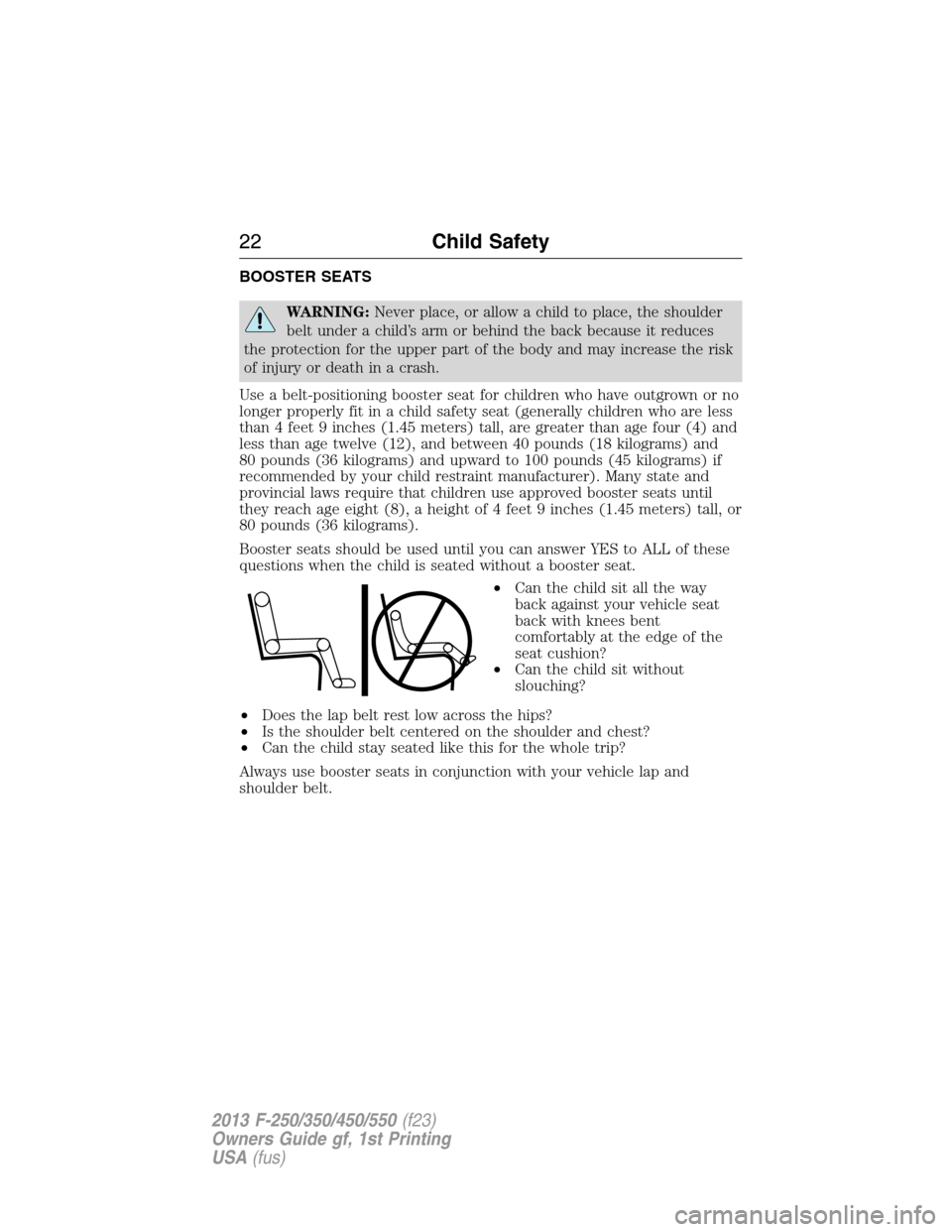
Booster seats should be used until you can answer YES to ALL of these
questions when the child is seated without a booster seat.
•Can the child sit all the way
back against your vehicle seat
back with knees bent
comfortably at the edge of the
seat cushion?
•Can the child sit without
slouching?
•Does the lap belt rest low across the hips?
•Is the shoulder belt centered on the shoulder and chest?
•Can the child stay seated like this for the whole trip?
Always use booster seats in conjunction with your vehicle lap and
shoulder belt.
22Child Safety
2013 F-250/350/450/550(f23)
Owners Guide gf, 1st Printing
USA(fus)
Page 24 of 563
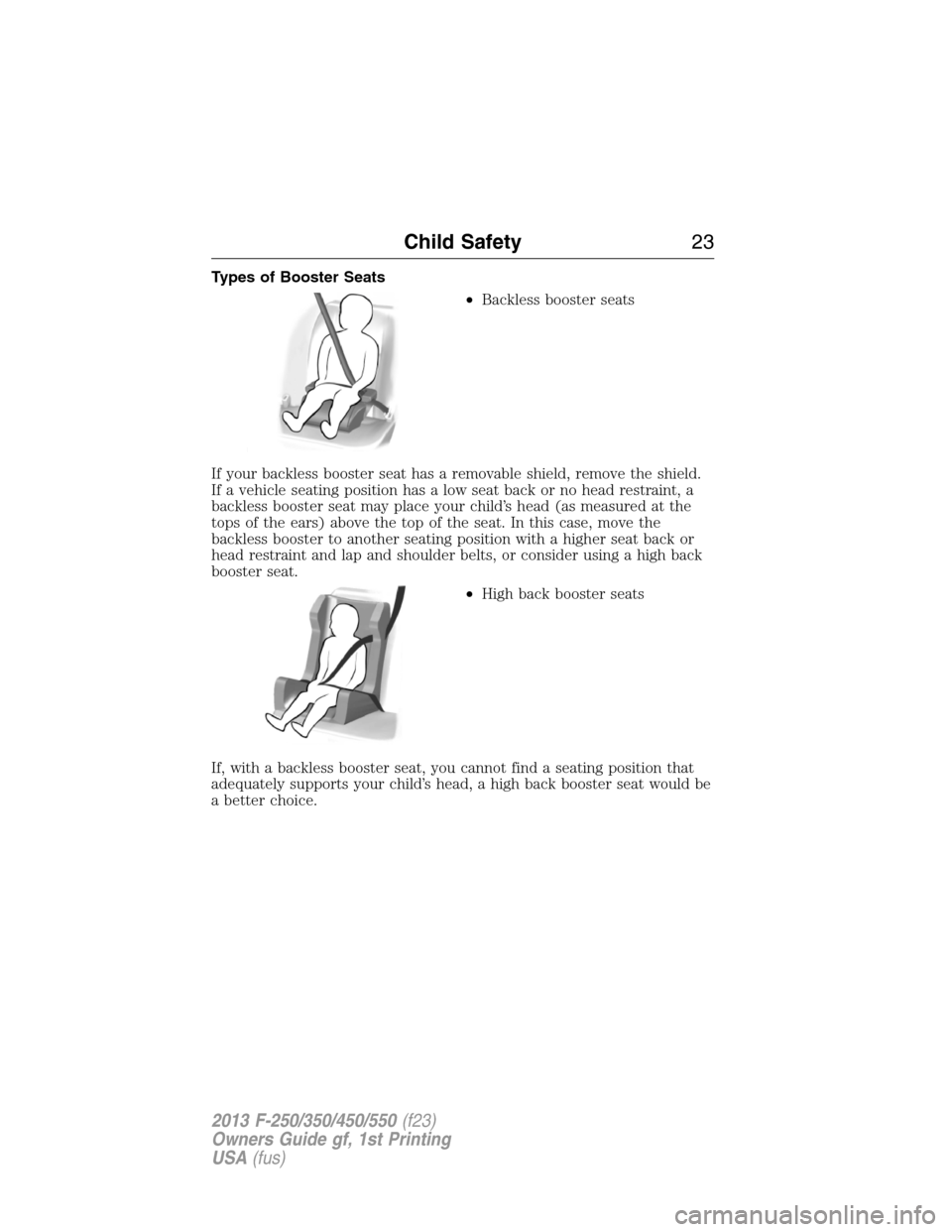
Types of Booster Seats
•Backless booster seats
If your backless booster seat has a removable shield, remove the shield.
If a vehicle seating position has a low seat back or no head restraint, a
backless booster seat may place your child’s head (as measured at the
tops of the ears) above the top of the seat. In this case, move the
backless booster to another seating position with a higher seat back or
head restraint and lap and shoulder belts, or consider using a high back
booster seat.
•High back booster seats
If, with a backless booster seat, you cannot find a seating position that
adequately supports your child’s head, a high back booster seat would be
a better choice.
Child Safety23
2013 F-250/350/450/550(f23)
Owners Guide gf, 1st Printing
USA(fus)
Page 25 of 563
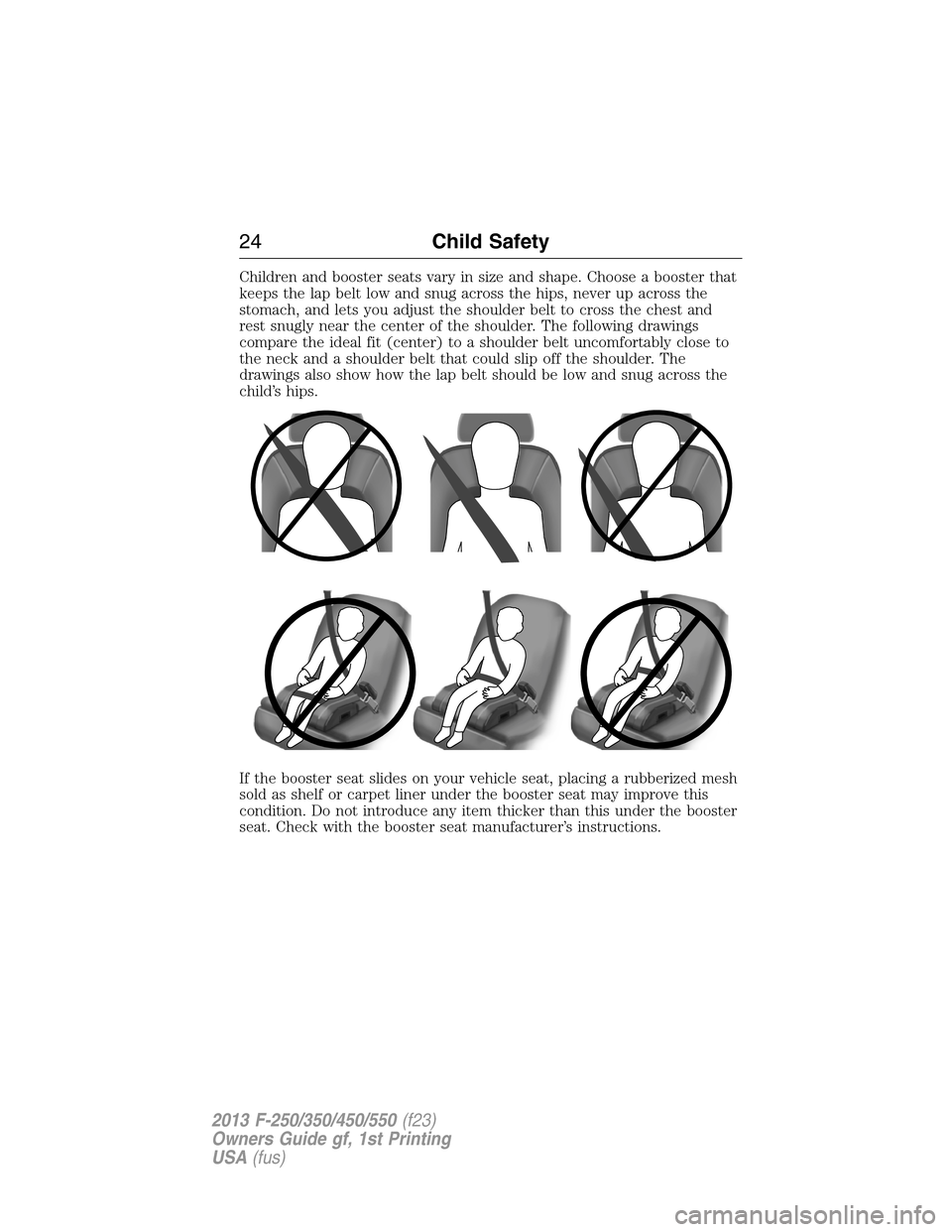
Children and booster seats vary in size and shape. Choose a booster that
keeps the lap belt low and snug across the hips, never up across the
stomach, and lets you adjust the shoulder belt to cross the chest and
rest snugly near the center of the shoulder. The following drawings
compare the ideal fit (center) to a shoulder belt uncomfortably close to
the neck and a shoulder belt that could slip off the shoulder. The
drawings also show how the lap belt should be low and snug across the
child’s hips.
If the booster seat slides on your vehicle seat, placing a rubberized mesh
sold as shelf or carpet liner under the booster seat may improve this
condition. Do not introduce any item thicker than this under the booster
seat. Check with the booster seat manufacturer’s instructions.
24Child Safety
2013 F-250/350/450/550(f23)
Owners Guide gf, 1st Printing
USA(fus)