check engine FORD SUPER DUTY 2014 3.G Diesel Supplement Manual
[x] Cancel search | Manufacturer: FORD, Model Year: 2014, Model line: SUPER DUTY, Model: FORD SUPER DUTY 2014 3.GPages: 82, PDF Size: 3.12 MB
Page 4 of 82
Introduction
About This Supplement.................................3
Instrument Cluster
Gauges..................................................................7
Warning Lamps and Indicators
....................7
Starting and Stopping the Engine
Starting a Diesel Engine.................................9
Switching Off the Engine..............................12
Engine Idle Shutdown....................................12
Engine Block Heater.......................................13
Fuel and Refueling
Fuel Quality
.......................................................14
Selective Catalytic Reduction System...........................................................20
Refueling...........................................................28
Emission Control System............................29
Fuel Tank Selector Switch..........................35
Brakes
General Information
......................................36
Towing
Towing a Trailer...............................................37
Roadside Emergencies
Fuel Shutoff
.....................................................38
Jump-Starting the Vehicle..........................38
Maintenance
Under Hood Overview
...................................41
Engine Oil Check.............................................42
Engine Coolant Check..................................44
Changing the Engine Air Filter...................49 Vehicle Care
Cleaning the Engine......................................53
Cleaning the Exhaust
....................................53
Capacities and Specific- ations
Engine Specifications
...................................54
Motorcraft Parts
.............................................54
Technical Specifications
.............................56
Scheduled Maintenance
General Maintenance Information..........58
Normal Scheduled Maintenance
..............61
Special Operating Conditions Scheduled Maintenance................................................64
Scheduled Maintenance Record
..............70
1
Super Duty (TFA) Table of Contents
Page 6 of 82
ABOUT THIS SUPPLEMENT
This supplement will acquaint you with the
Power Stroke diesel engine. It provides
recommendations on engine care and
operating procedures. For complete vehicle
information, also refer to your Owner
’s
Manual included with the vehicle. It also
describes equipment and gives
specifications for equipment that was in
effect when this guide was approved for
printing, and should be considered a
permanent part of the vehicle.
Note: Your vehicle ’s powertrain control
systems can detect and store information
about vehicle modifications that increase
horsepower and torque output such as
whether or not performance-enhancing
powertrain components commonly referred
to as performance chips have been used.
This information will stay in the system ’s
memory cannot be erased even if the
modification is removed. Ford Motor
Company, Ford of Canada, Ford of Mexico
and service or repair facilities can retrieve
this information when servicing your vehicle.
Ford Motor Company may use this
information to determine if your warranty
covers any needed repairs.
Note: Some aftermarket products may
cause severe engine/transmission and/or
exhaust system damage; refer to your
warranty information for more information.
Your new diesel engine will feel, drive and
function somewhat differently than a
gasoline engine. Therefore it is very
important that you read and thoroughly
familiarize yourself and others operating
the vehicle with this guide. A special
procedure for turning off the diesel engine
is in the Starting and Stopping the Engine
chapter, See Starting a Diesel Engine
(page 9). It is important to read and
understand this material in order to
maintain the best service life for your
engine. Ford may discontinue models or change
specifications without any notice and
without incurring obligations.
Warnings WARNING
Throughout this guide, you will find
warnings identified by the warning
symbol. Warnings remind you to be
especially careful to reduce the risk of
personal injury. Breaking-In Your Vehicle
Your vehicle does not need an extensive
break-in. Try not to drive continuously at
the same speed for the first 1000 miles
(1600 kilometers) of new vehicle
operation. Vary your speed to allow parts
to adjust themselves to other parts.
Drive your new vehicle at least 500 miles
(800 kilometers) before towing a trailer.
Make sure you use the specified engine oil.
See Technical Specifications (page 56
).
Do not add friction modifier compounds
or special break-in oils during the first few
thousand miles (kilometers) of operation,
since these additives may prevent piston
ring seating. See Engine Oil Check (page
42
).
Diesel Engine Information
The diesel engine fuel system is a
pressurized two-stage filtration system
and consists of:
• A frame-mounted Fuel and Water
Separator primary filter with an electric
fuel pump and water drain
• An engine-mounted secondary fuel
filter
• A fuel injector for each cylinder (8
total)
• A high-pressure fuel pump
3
Super Duty (TFA) Introduction
Page 7 of 82
•
A high-pressure fuel rail for each
cylinder bank (2 total)
• Numerous high-pressure pipes from
the high-pressure pump to the rails,
and rails to the injectors
The fuel and water separator removes
both water and impurities from the fuel.
The engine mounted filter filters finer
impurities from the diesel fuel. The
engine-mounted fuel filter and the fuel and
water separator filter should be changed
at the recommended service interval or
when indicated by the information display
LOW FUEL PRESSURE message. Refer to
the scheduled maintenance information
in this supplement for more information.
The fuel and water separator should be
drained at regular intervals (recommended
at every oil change) or when indicated by
the information display and water in fuel
indicator light. See Fuel Quality (page
14).
Proper fuel filter maintenance and prompt
water draining when the water in fuel light
illuminates is essential to prevent injection
equipment damage. Ignoring the water in
fuel light can cause your vehicle to go into
a reduced power mode.
A frame-mounted electric fuel pump
located inside the fuel and water separator
draws fuel from the fuel tank to provide
pressurized fuel to the engine. The fuel
pump contains a pressure relief valve for
overpressure protection in the event of
restricted flow.
The fuel injection system is controlled
through the powertrain control module. Engine protection mode
Ford diesel engines are equipped with
engine protection and emission control
systems. These systems monitor critical
temperatures and pressures, and modify
engine operation accordingly. These
modified engine performance
characteristics are normal.
If these modified engine performance
characteristics persist for an extended
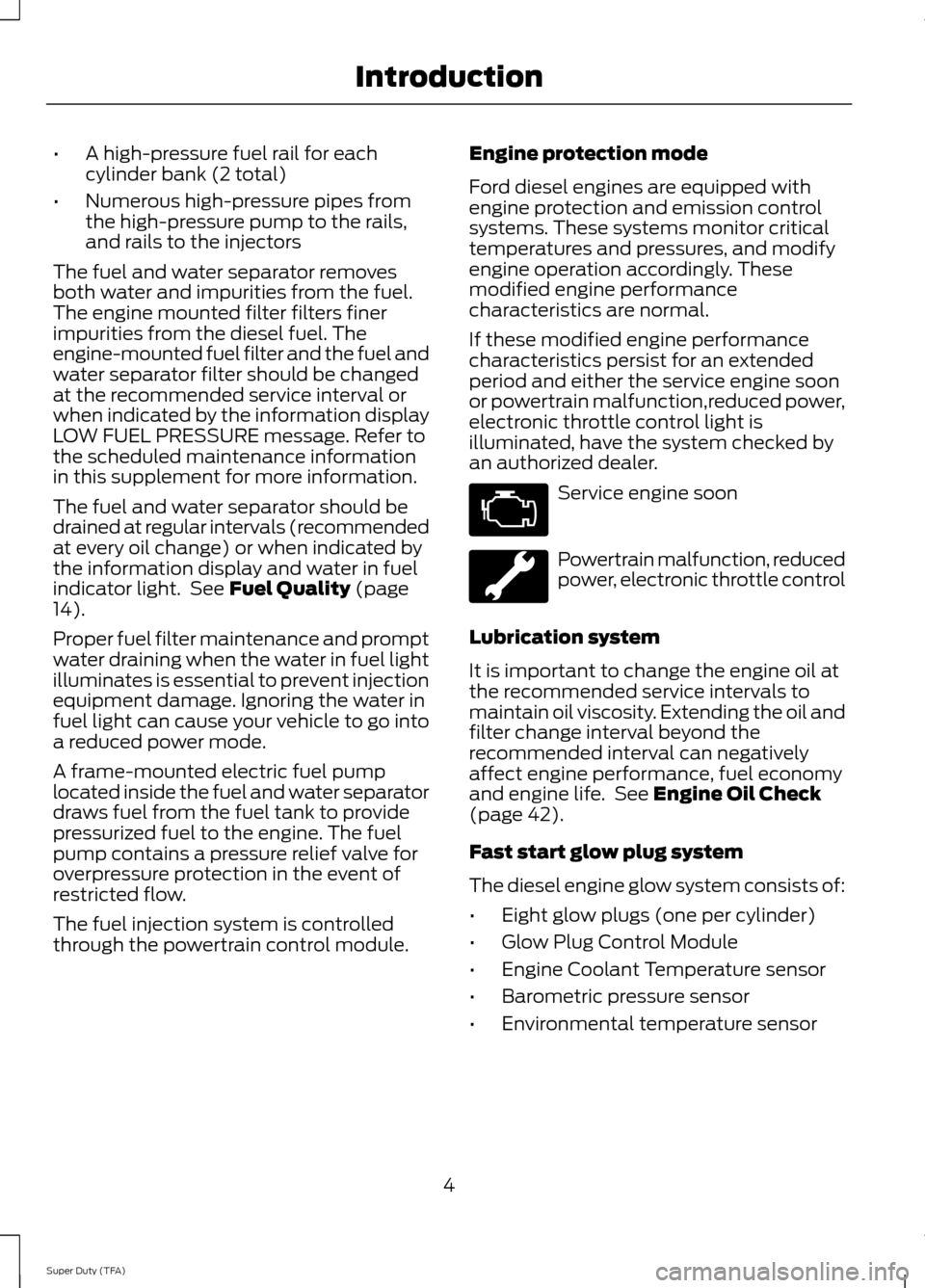
period and either the service engine soon
or powertrain malfunction,reduced power,
electronic throttle control light is
illuminated, have the system checked by
an authorized dealer.
Service engine soon
Powertrain malfunction, reduced
power, electronic throttle control
Lubrication system
It is important to change the engine oil at
the recommended service intervals to
maintain oil viscosity. Extending the oil and
filter change interval beyond the
recommended interval can negatively
affect engine performance, fuel economy
and engine life. See
Engine Oil Check
(page 42).
Fast start glow plug system
The diesel engine glow system consists of:
• Eight glow plugs (one per cylinder)
• Glow Plug Control Module
• Engine Coolant Temperature sensor
• Barometric pressure sensor
• Environmental temperature sensor
4
Super Duty (TFA) Introduction
Page 8 of 82
The powertrain and glow plug control
modules electronically control the glow
plug system. After you switch the ignition
on the glow plug control module
immediately energizes the glow plugs. The
glow plug control module using the engine
coolant temperature, barometric pressure
sensor and environmental temperature
sensor will determine how long the glow
plugs stay energized. The required time for
the glow plugs to be energized decreases
as the coolant temperature, barometric
pressure and environmental temperature
increase.
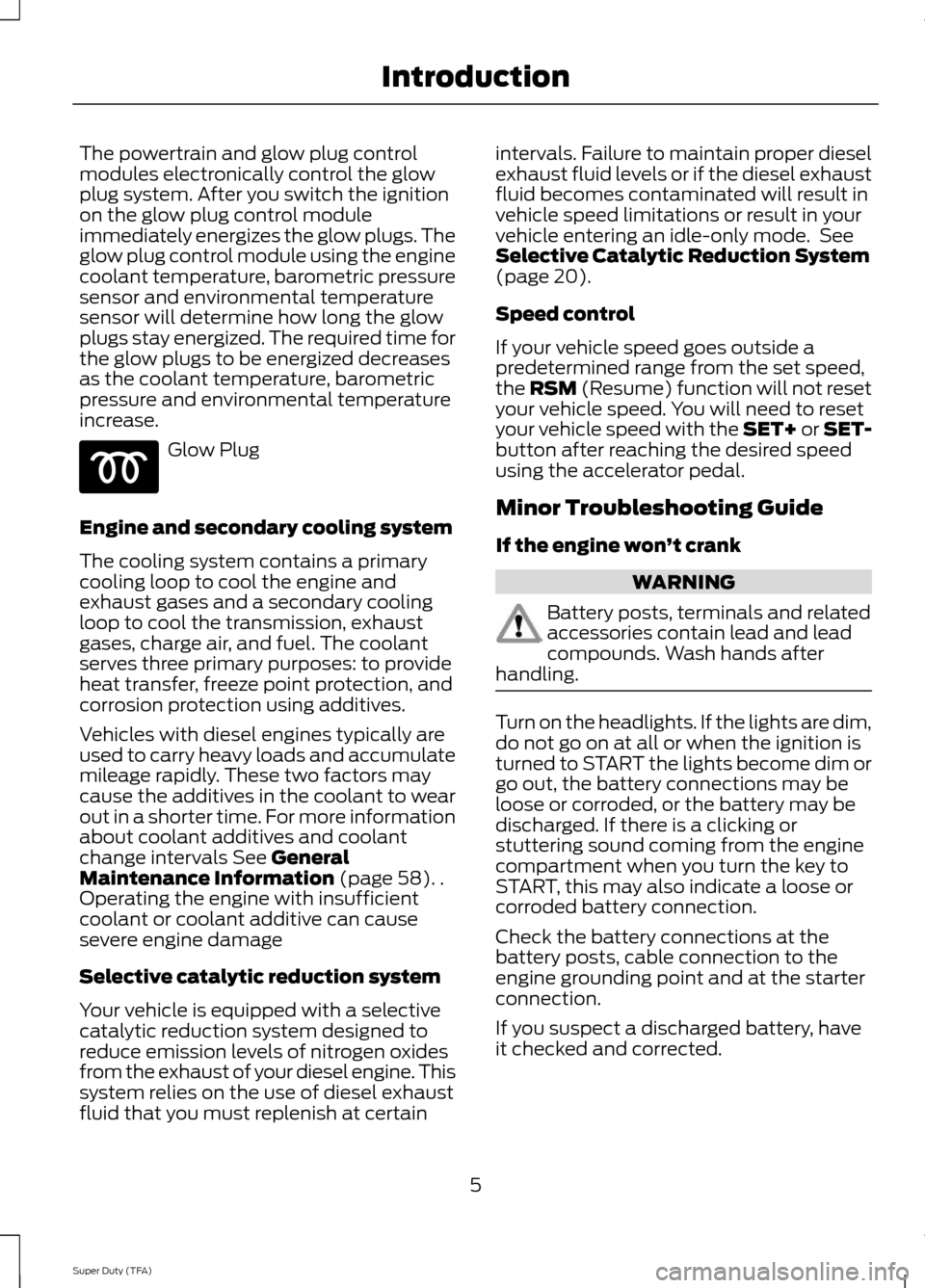
Glow Plug
Engine and secondary cooling system
The cooling system contains a primary
cooling loop to cool the engine and
exhaust gases and a secondary cooling
loop to cool the transmission, exhaust
gases, charge air, and fuel. The coolant
serves three primary purposes: to provide
heat transfer, freeze point protection, and
corrosion protection using additives.
Vehicles with diesel engines typically are
used to carry heavy loads and accumulate
mileage rapidly. These two factors may
cause the additives in the coolant to wear
out in a shorter time. For more information
about coolant additives and coolant
change intervals See General
Maintenance Information (page 58). .
Operating the engine with insufficient
coolant or coolant additive can cause
severe engine damage
Selective catalytic reduction system
Your vehicle is equipped with a selective
catalytic reduction system designed to
reduce emission levels of nitrogen oxides
from the exhaust of your diesel engine. This
system relies on the use of diesel exhaust
fluid that you must replenish at certain intervals. Failure to maintain proper diesel
exhaust fluid levels or if the diesel exhaust
fluid becomes contaminated will result in
vehicle speed limitations or result in your
vehicle entering an idle-only mode. See
Selective Catalytic Reduction System
(page
20).
Speed control
If your vehicle speed goes outside a
predetermined range from the set speed,
the RSM (Resume) function will not reset
your vehicle speed. You will need to reset
your vehicle speed with the SET+ or SET-
button after reaching the desired speed
using the accelerator pedal.
Minor Troubleshooting Guide
If the engine won ’t crank WARNING
Battery posts, terminals and related
accessories contain lead and lead
compounds. Wash hands after
handling. Turn on the headlights. If the lights are dim,
do not go on at all or when the ignition is
turned to START the lights become dim or
go out, the battery connections may be
loose or corroded, or the battery may be
discharged. If there is a clicking or
stuttering sound coming from the engine
compartment when you turn the key to
START, this may also indicate a loose or
corroded battery connection.
Check the battery connections at the
battery posts, cable connection to the
engine grounding point and at the starter
connection.
If you suspect a discharged battery, have
it checked and corrected.
5
Super Duty (TFA) Introduction
Page 9 of 82
•
The gearshift lever must be in P (Park)
or N (Neutral) in order for the starter
to operate.
• Try operating the starter switch several
times. This operation may clean
potentially corroded contacts or make
the switch temporarily operable until
you can reach the dealer.
• If all electrical connections are tight
and you need assistance to start, refer
to Jump Starting in the Roadside
Emergencies chapter of your Owner ’s
Manual.
If engine cranks but won ’t start
Prolonged starter cranking (in excess of 10
seconds) could cause damage to the
starter motor or the high-pressure fuel
pump.
• Check the fuel gauge. You may be out
of fuel. If the gauge shows that there
is fuel in the tank, the trouble may be
in the electrical system or the fuel
system. If equipped with an auxiliary
tank, be sure that the tank control
switch is set for the tank with fuel and
not on an empty tank.
• Leaving your ignition key turned to on
for over two minutes without starting
may make starting difficult because
the glow plugs will cease activation.
Reset the system by turning the ignition
key to off and then back to on again.
Note: If the system is out of fuel and the
engine will not start, do not continue
cranking the engine. Continued cranking can
damage the high-pressure fuel pump.
If the engine runs hot
The following could cause the engine to
overheat:
• Lack of coolant
• Dirty cooling system. •
Plugged radiator fins, A/C condenser
and/or oil cooler
• Malfunctioning fan drive
• Driving with frozen coolant
• Sticking thermostat
• Overloading or pulling heavy trailers
during hot weather
• Grill or radiator air blockage
• Slipping or missing drive belt
• Plugged or very dirty air filter
If fuses burn out WARNING
Replacement fuses and circuit
breakers must always be the same
rating as the original equipment
shown. Never replace a fuse or circuit
breaker with one of a higher rating. Higher
rated fuses or circuit breakers could allow
circuit overloading in the event of a circuit
malfunction, resulting in severe vehicle
damage or personal injury due to fire. Burned-out or blown fuses usually indicate
an electrical short-circuit, although a fuse
may occasionally burn out from vibration.
Insert a second fuse. If this fuse
immediately burns out and you cannot
locate the cause, return your vehicle to
your dealer for a circuit check.
Refer to the Owner
’s Manual for
replacement of fuses.
Selective catalytic reduction system
speed limit and Idle-only modes
If the vehicle ’s speed is limited or in an
idle-only mode, the selective catalytic
reduction system may be limiting the
vehicle ’s functions due to low or
contaminated diesel exhaust fluid. Check
the diesel exhaust fluid. See
Selective
Catalytic Reduction System (page 20).
6
Super Duty (TFA) Introduction
Page 14 of 82
In order to operate the engine in
temperatures of 32°F (0°C) or lower, read
the following instructions:
•
Make sure that the batteries are of
sufficient size and are fully charged.
Check other electrical components to
make sure they are in optimum
condition
• Use the proper coolant solution at the
concentration recommended
protecting the engine against damage
from freezing
• Try to keep the fuel tank full as much
as possible at the end of operation to
prevent condensation in the fuel
system
• Make sure you use proper cold weather
engine oil and that it is at its proper
level. Also, if necessary, make sure to
follow the engine oil and filter change
schedule found under the Special
operating conditions section listed in
the scheduled maintenance
information
• At temperatures of -10°F (-23°C) or
below, it is recommended that you use
an engine block heater to improve cold
engine starting
• If operating in arctic temperatures of
-20°F (-29°C) or lower, consult your
truck dealer for information about
special cold weather equipment and
precautions
The following cold weather idling
guidelines are recommended:
• You can use Motorcraft® cetane
improvers or non-alcohol-based
cetane improvers from a reputable
manufacturer as needed.
• Maintain the engine cooling system
properly. •
Avoid shutting the engine down after
an extensive idling period. Drive your
vehicle for several miles with the
engine at normal operating
temperatures under a moderate load.
• Consider using an engine block heater.
• For extended idle times use an
approved idle speed increase device.
Winter Operating Tips for Arctic
Operation -20°F (-29°C) and Below
The following information is a guideline
only and is no to be the only source of
possible solutions in resolving extreme
cold temperature issues.
Starting Aids WARNING
Do not use starting fluid, such as
ether, in the air intake system (see
air filter decal). Such fluid could
cause immediate explosive damage to the
engine and possible personal injury. The use of the factory engine block heater
assists in engine starting in extreme cold
ambient temperatures. Refer to Engine
block heater in the Starting and Stopping
the Engine chapter of your Owner
’s
Manual.
Idle Control
Your vehicle may have a factory option for
a stationary elevated idle control through
dash-mounted upfitter switches that
allows the operator to elevate the idle rpm
for extended idle periods, as well as
aftermarket equipment such as PTO
operation. You must configure this feature
even if ordered from the factory. See your
authorized dealer for required upfitting.
11
Super Duty (TFA) Starting and Stopping the Engine
Page 20 of 82
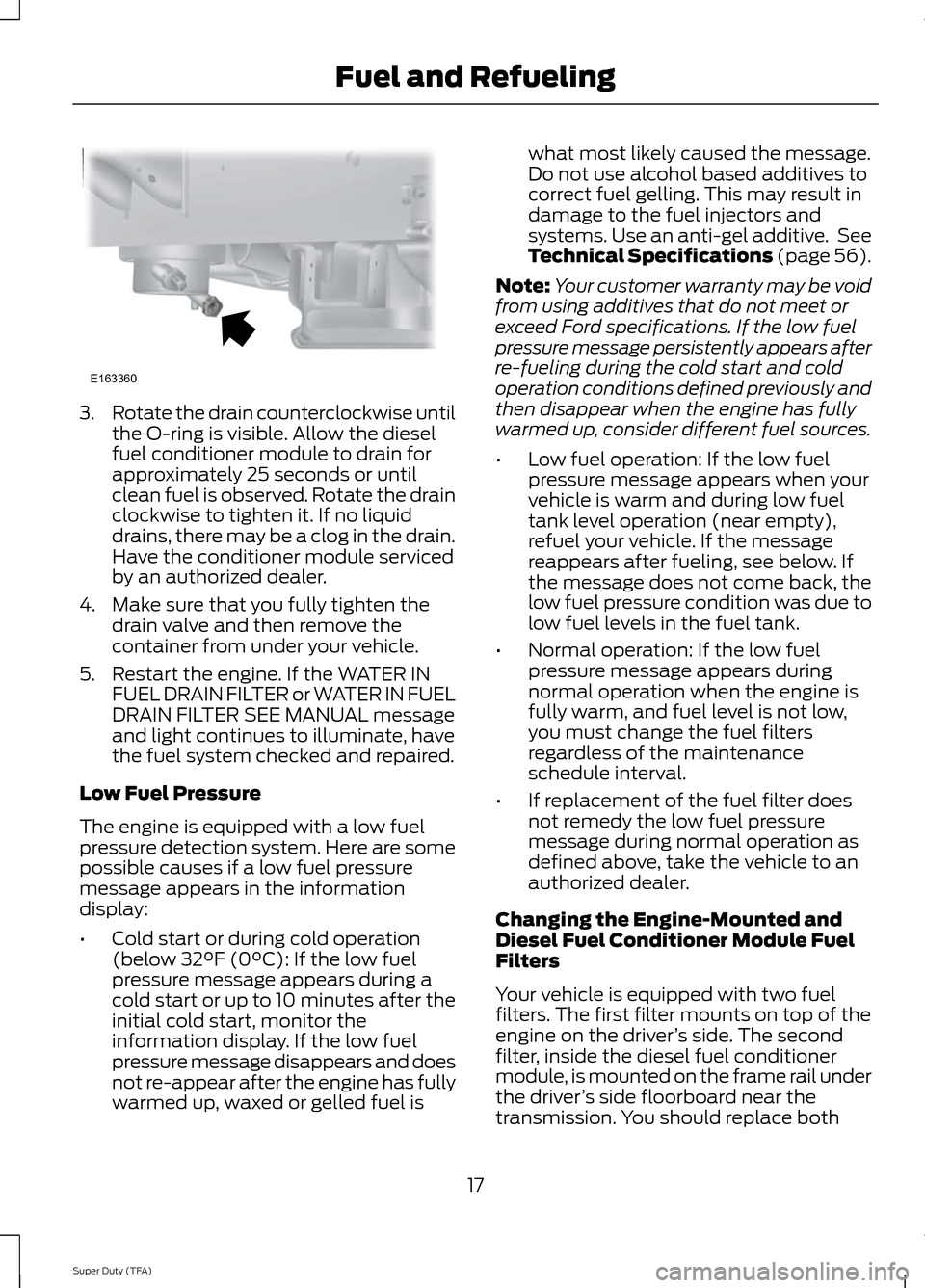
3.
Rotate the drain counterclockwise until
the O-ring is visible. Allow the diesel
fuel conditioner module to drain for
approximately 25 seconds or until
clean fuel is observed. Rotate the drain
clockwise to tighten it. If no liquid
drains, there may be a clog in the drain.
Have the conditioner module serviced
by an authorized dealer.
4. Make sure that you fully tighten the drain valve and then remove the
container from under your vehicle.
5. Restart the engine. If the WATER IN FUEL DRAIN FILTER or WATER IN FUEL
DRAIN FILTER SEE MANUAL message
and light continues to illuminate, have
the fuel system checked and repaired.
Low Fuel Pressure
The engine is equipped with a low fuel
pressure detection system. Here are some
possible causes if a low fuel pressure
message appears in the information
display:
• Cold start or during cold operation
(below 32°F (0°C): If the low fuel
pressure message appears during a
cold start or up to 10 minutes after the
initial cold start, monitor the
information display. If the low fuel
pressure message disappears and does
not re-appear after the engine has fully
warmed up, waxed or gelled fuel is what most likely caused the message.
Do not use alcohol based additives to
correct fuel gelling. This may result in
damage to the fuel injectors and
systems. Use an anti-gel additive. See
Technical Specifications (page 56).
Note: Your customer warranty may be void
from using additives that do not meet or
exceed Ford specifications. If the low fuel
pressure message persistently appears after
re-fueling during the cold start and cold
operation conditions defined previously and
then disappear when the engine has fully
warmed up, consider different fuel sources.
• Low fuel operation: If the low fuel
pressure message appears when your
vehicle is warm and during low fuel
tank level operation (near empty),
refuel your vehicle. If the message
reappears after fueling, see below. If
the message does not come back, the
low fuel pressure condition was due to
low fuel levels in the fuel tank.
• Normal operation: If the low fuel
pressure message appears during
normal operation when the engine is
fully warm, and fuel level is not low,
you must change the fuel filters
regardless of the maintenance
schedule interval.
• If replacement of the fuel filter does
not remedy the low fuel pressure
message during normal operation as
defined above, take the vehicle to an
authorized dealer.
Changing the Engine-Mounted and
Diesel Fuel Conditioner Module Fuel
Filters
Your vehicle is equipped with two fuel
filters. The first filter mounts on top of the
engine on the driver ’s side. The second
filter, inside the diesel fuel conditioner
module, is mounted on the frame rail under
the driver ’s side floorboard near the
transmission. You should replace both
17
Super Duty (TFA) Fuel and RefuelingE163360
Page 23 of 82
SELECTIVE CATALYTIC
REDUCTION SYSTEM
Your vehicle is equipped with a selective
catalytic reduction system to help reduce
emission levels of oxides of nitrogen from
the exhaust of the diesel engine. The
system automatically injects diesel
exhaust fluid into the exhaust system to
enable proper selective catalytic reduction
function.
Importance of maintaining the
Diesel Exhaust Fluid level
In order for the selective catalytic reduction
system to operate properly, the diesel
exhaust fluid level must be maintained.
Generally, the diesel exhaust fluid tank
should be filled during the oil change
service interval. See General
Maintenance Information (page 58).
However, certain conditions or driving
styles, such as trailer towing or fast rates
of acceleration, will require the refilling of
the diesel exhaust fluid tank more often.
The engine control unit will monitor the
amount of fluid available in the diesel
exhaust fluid tank. Running a system check
in the message center will indicate whether
the diesel exhaust fluid level is ok or if it is
less than 1/2 full. A message will display in
the message center when the diesel
exhaust fluid level is low and needs to be
refilled. When you see this message, you
should refill your tank. See the Information
displays chapter of your Owner ’s Manual
for information display functions. For
instructions on refilling your diesel exhaust
fluid tank, see filling the diesel exhaust
fluid tank in this supplement. Diesel Exhaust Fluid warning
messages and vehicle operations WARNINGS
Diesel exhaust fluid must be refilled
when low or replaced when
contaminated or the vehicle speed
will be speed limited to 50 mph (80 km/h).
In these conditions, drive with caution and
refill diesel exhaust fluid immediately. If
the diesel exhaust fluid becomes empty
or contaminated and fluid is not replaced,
your vehicle will become limited to idle
speed only once stopped. In these
conditions, be cautious where you stop
your vehicle because you may not be able
to drive long distances and will not be able
to maintain highway speeds until diesel
exhaust fluid is refilled or replaced. Tampering or disabling your vehicle
’s
exhaust aftertreatment system will
result in severe vehicle performance
limitation including eventual speed limiting
to 5 mph. Your vehicle
’s information display will
display a series of messages regarding the
amount of diesel exhaust fluid available.
A systems check will display messages
indicating the amount of diesel exhaust
fluid available (OK or under 1⁄2 full) or will
produce a warning message that displays
the mileage (kilometers) remaining as the
fluid in the diesel exhaust fluid tank nears
empty. For more information on warning
messages, see the Information Displays
chapter of your Owner ’s Manual. As the diesel exhaust fluid level
nears empty, the diesel exhaust
fluid warning symbol will be
displayed and chimes will sound with the
messages starting at 500 miles (805 km)
remaining before diesel exhaust fluid is
depleted. The warning symbol and
messages will continue until you refill the
diesel exhaust fluid tank.
20
Super Duty (TFA) Fuel and RefuelingE163176
Page 33 of 82
Diesel particulate filter maintenance
You must properly maintain your diesel
particulate filter in order for it to function
properly. Do not disregard the EXHAUST
OVERLOADED DRIVE TO CLEAN and
EXHAUST AT LIMIT DRIVE TO CLEAN
NOW
maintenance messages otherwise
system damage could result that your
warranty may not cover.
Failure to perform active or operator
commanded regeneration when instructed
might result in a clogged diesel particulate
filter that your dealer cannot clean. If your
diesel particulate filter fills beyond what
can safely be regenerated, active
regeneration and operator commanded
regeneration will be disabled. This could
result in irreversible damage to the filter
requiring replacement that your warranty
may not cover. If your vehicle is not
equipped with operator commanded
regeneration, check with your dealer for
availability.
Once the diesel particulate filter is full of
exhaust particles, the engine control
module will command the exhaust system
to clean the filter through a process called
active regeneration. Active regeneration
requires the engine computer to raise the
exhaust temperature to eliminate the
particles. During cleaning, the particles
convert to harmless gasses. Once cleaned
the diesel particulate filter will then be
ready to continue trapping exhaust
particles.
The regeneration process operates more
efficiently when you safely operate your
vehicle at least 30 mph (48 km/h) with a
steady pedal for approximately 20 minutes
to complete the process. The frequency
and duration of regeneration will fluctuate
by how you drive your vehicle, outside air
temperature, and altitude. For most driving,
regeneration frequency will vary from 100 - 500 miles (161 - 805 km) between
occurrences and each occurrence will last
from 9 - 20 minutes. You can usually
reduce the duration of regeneration if you
maintain a constant speed above 30 mph
(48 km/h).
When the engine control module detects
that the diesel particulate filter is nearly
full of particulates and you are not
operating your in a manner to allow
effective automatic cleaning, the
information display will display
EXH
OVERLOADED DRIVE TO CLEAN for
base information display and Exhaust
Overloaded Drive to Clean for the
optional information display. These
messages appear as a reminder for you to
drive in order to clean the diesel particulate
filter. If you operate your vehicle in a
manner to allow effective automatic
cleaning, the information display will
display a cleaning exhaust filter message,
which is the normal regeneration process.
See the Information Displays chapter of
the Owner Guide for more information.
You can also choose operator commanded
regeneration to clean the exhaust system
at this point. See How to start operator
commanded regeneration later in this
chapter.
If you are not able to drive in a manner that
allows effective automatic cleaning (active
regeneration) or you choose to perform
regeneration of the diesel particulate filter
(cleaning) while at idle (stationary), then
operator commanded regeneration would
need to be performed. See operator
commanded regeneration later in this
chapter.
30
Super Duty (TFA) Fuel and Refueling
Page 37 of 82
Emission Control System(s) Laws
WARNING
Do not remove or alter the original
equipment floor covering or
insulation between it and the metal
floor of the vehicle. The floor covering and
insulation protect occupants of the vehicle
from the engine and exhaust system heat
and noise. On vehicles with no original
equipment floor covering insulation, do not
carry passengers in a manner that permits
prolonged skin contact with the metal
floor. Provide adequate insulation. Failure
to follow these instructions may result in
fire or personal injury. In the U.S. federal law and certain state
laws prohibit removing or rendering
inoperative emission control system(s).
Similar federal or provincial laws may
apply in Canada. Ford recommends
against any vehicle modification without
determining applicable law.
Tampering with emissions
control systems (including
related sensors and the diesel
exhaust fluid injection system) can result
in reduced engine power and the
illumination of the service engine soon
light.
Tampering with a Noise Control
System
Federal law prohibits the following acts or
the causing thereof: (1) The removal or
rendering inoperative by any person other
than for purposes of maintenance, repair
or replacement of any device or element
of design incorporated into any new vehicle
for the purpose of noise control prior to its
sale or delivery to the ultimate purchaser
or while it is in use, or (2) the use of the
vehicle after such device or element of
design has been removed or rendered
inoperative by any person. Among those acts, which the U.S.
Environmental Protection Agency may
presume to constitute tampering are the
acts listed below:
•
Removal of hood blanket, fender apron
absorbers, fender apron barriers,
underbody noise shields or acoustically
absorptive material.
• Tampering or rendering inoperative the
engine speed governor, to allow engine
speed to exceed manufacturer ’s
specifications.
The complexity of the diesel engine makes
it so the owner is discouraged from
attempting to perform maintenance other
than the services described in this
supplement.
If you experience difficult starting the
engine, rough idling, excessive exhaust
smoke, a decrease in engine performance
or excess fuel consumption, perform the
following checks:
• A plugged or disconnected air inlet
system or engine air filter element
• Water in the fuel filter and water
separator
• A clogged fuel filter
• Contaminated fuel
• Air in the fuel system, due to loose
connections
• An open or pinched sensor hose
• Check engine oil level
• Wrong fuel or oil viscosity for climactic
conditions
If these checks do not help you correct the
engine performance problem you are
experiencing, consult an authorized dealer.
34
Super Duty (TFA) Fuel and Refueling