cooling FORD SUPER DUTY 2014 3.G User Guide
[x] Cancel search | Manufacturer: FORD, Model Year: 2014, Model line: SUPER DUTY, Model: FORD SUPER DUTY 2014 3.GPages: 458, PDF Size: 5.3 MB
Page 233 of 458
•
the engine coolant temperature gauge
moves fully into the red (hot) area
• the coolant temperature warning light
illuminates
• the service engine soon indicator
illuminates. WARNING
Never remove the coolant reservoir
cap while the engine is running or hot.
1. Pull off the road as soon as safely
possible and place the vehicle in P
(Park).
2. Leave the engine running until the coolant temperature gauge needle
moves away from the H range. After
several minutes, if this does not
happen, follow the remaining steps.
3. Turn the engine off and wait for it to cool before checking the coolant level.
4. If the coolant level is normal, you may restart your engine and continue on.
5. If the coolant is low, add coolant, restart the engine and take your vehicle
to an authorized dealer. See Adding
engine coolant in this chapter for more
information. Refer to fail-safe cooling
for additional information.
AUTOMATIC TRANSMISSION
FLUID CHECK
Have an authorized dealer check and
change the transmission fluid and filter at
the correct service interval. See
Scheduled Maintenance (page 428).
Do not use supplemental transmission
fluid additives, treatments or cleaning
agents. The use of these materials may
affect transmission operation and result
in damage to internal transmission
components. Checking Automatic Transmission
Fluid (If Equipped)
For scheduled intervals of the fluid checks
and changes, See
Scheduled
Maintenance (page 428). Your
transmission does not consume fluid.
However, the fluid level should be checked
if the transmission is not working properly,
i.e., if the transmission slips or shifts slowly
or if you notice some sign of fluid leakage.
Automatic transmission fluid expands
when warmed. To obtain an accurate fluid
check, drive the vehicle until it is at normal
operating temperature (approximately
19 mi (30 km)
). Verify that the
transmission fluid temperature gauge,
located on the instrument cluster, is within
normal range.
1. Drive the vehicle
19 mi (30 km)until it
reaches normal operating temperature.
2. Park the vehicle on a level surface and
engage the parking brake.
3. With the engine running, parking brake
engaged and your foot on the brake
pedal, move the gearshift lever through
all of the gear ranges. Allow sufficient
time for each gear to engage.
4. Latch the gearshift lever in P and leave
the engine running.
5. Remove the dipstick, wiping it clean with a clean, dry lint free rag. If
necessary, refer to the Under Hood
Overview in this chapter for the
location of the dipstick.
6. Install the dipstick making sure it is fully
seated in the filler tube.
7. Remove the dipstick and inspect the fluid level. The fluid should be in the
designated area for normal operating
temperature or ambient temperature.
Low Fluid Level
Type A
230
Super Duty (TFA) Maintenance
Page 255 of 458
•
Touch-up exposed or primed metal to
prevent rust.
• Cover chrome and stainless steel parts
with a thick coat of auto wax to prevent
discoloration. Re-wax as necessary
when your vehicle is washed.
• Lubricate all hood, door and trunk lid
hinges, and latches with a light grade
oil.
• Cover interior trim to prevent fading.
• Keep all rubber parts free from oil and
solvents.
Engine
• The engine oil and filter should be
changed prior to storage, as used
engine oil contain contaminates that
may cause engine damage.
• Start the engine every 15 days. Run at
fast idle until it reaches normal
operating temperature
• With your foot on the brake, shift
through all the gears while the engine
is running.
Fuel system
• Fill the fuel tank with high-quality fuel
until the first automatic shutoff of the
fuel pump nozzle.
Note: During extended periods of vehicle
storage (30 days or more), fuel may
deteriorate due to oxidation. Add a quality
gas stabilizer product to your vehicle's fuel
system whenever actual or expected
storage periods exceed 30 days. Follow the
instructions on the additive label. your
vehicle should then be operated at idle
speed to circulate the additive throughout
the fuel system. Cooling system
•
Protect against freezing temperatures.
• When removing your vehicle from
storage, check coolant fluid level.
Confirm there are no cooling system
leaks, and fluid is at the recommended
level.
Battery
• Check and recharge as necessary. Keep
connections clean.
• If storing your vehicle for more than 30
days without recharging the battery, it
may be advisable to disconnect the
battery cables to ensure battery charge
is maintained for quick starting.
Note: If battery cables are disconnected, it
will be necessary to reset memory features.
Brakes
• Make sure brakes and parking brake
are fully released.
Tires
• Maintain recommended air pressure.
Miscellaneous
• Make sure all linkages, cables, levers
and pins under your vehicle are covered
with grease to prevent rust.
• Move vehicles at least 25 feet (8
meters) every 15 days to lubricate
working parts and prevent corrosion.
Removing Vehicle From Storage
When your vehicle is ready to come out of
storage, do the following:
• Wash your vehicle to remove any dirt
or grease film build-up on window
surfaces.
• Check windshield wipers for any
deterioration.
252
Super Duty (TFA) Vehicle Care
Page 400 of 458
Recirculated air: Touch to turn the recirculated air on or off which may reduce
the amount of time needed to cool down the interior and help reduce odors
from reaching the interior. Recirculated air also engages automatically when
you select MAX A/C and may turn on manually in any airflow mode except
defrost. It may also turn off in all airflow modes except MAX A/C to reduce fog
potential.
D
MAX A/C: Touch to cool your vehicle with recirculated air. Touch again for
normal A/C operation. MAX A/C distributes air through instrument panel vents
and may help reduce odors from entering your vehicle. MAX A/C is more
economical and efficient than normal A/C mode.
E
A/C:
Touch to turn the air conditioning on or off. Use A/C with recirculated air
to improve cooling performance and efficiency. A/C engages automatically in
MAX A/C, defrost and floor/defrost.
F
AUTO:
Touch to engage automatic operation, then set the temperature using
the temperature control. The system automatically controls fan speed, airflow
distribution, A/C on or off and the use of fresh or recirculated air.
G
Rear defrost:
Touch to turn the rear window defroster and heated mirrors.
H
Defrost:
Touch to clear the windshield of fog and thin ice. Touch again to return
to the previous airflow selection. When on, defrost provides outside air to reduce
window fogging and distributes air through the windshield defroster vents and
demister vents.
I
Manual airflow distribution controls:
Floor and Defrost: Distributes air
through the windshield defroster vents, demister vents, floor vents and rear
seat floor vents, and provides outside air to reduce window fogging. Panel:
Distributes air through the instrument panel vents. Panel and Floor: Distributes
air through the instrument panel vents, demister vents, floor vents and rear seat
floor vents. Floor:
Distributes air through the demister vents, floor vents and
rear seat floor vents.
J
Driver settings:
Touch + or – adjust the temperature. Touch the heated seat
icon to control the heated seat. Touch the cooled seat icon to control the cooled
seat. See Seats (page 107). Touch and hold MyTemp to select a temperature
you would like your vehicle to remember and maintain for you. If your vehicle
is equipped with a heated steering wheel, touch the heated steering wheel icon
to warm the steering wheel.
J
Note: If your vehicle is equipped with a
wood-trimmed steering wheel, it does not
heat between the 10 o'clock and 2 o'clock
positions. Climate Control Voice Commands Press the voice button on the
steering wheel controls. When
prompted, say any of the
following commands:
397
Super Duty (TFA) MyFord Touch
™
(If Equipped)E142599
Page 432 of 458
Ford Motor Company has recommended
maintenance intervals for various parts
and component systems based upon
engineering testing. Ford Motor Company
relies upon this testing to determine the
most appropriate mileage for replacement
of oils and fluids to protect your vehicle at
the lowest overall cost to you and
recommends against maintenance
schedules that deviate from the scheduled
maintenance information.
We strongly recommend the use of only
genuine Ford, Motorcraft or
Ford-authorized re-manufactured
replacement parts engineered for your
vehicle.
Additives and Chemicals
This owner's manual and the Ford
Workshop Manual list the recommended
additives and chemicals for your vehicle.
We do not recommend using chemicals or
additives not approved by us as part of
your vehicle
’s normal maintenance. Please
consult your warranty information. Oils, Fluids and Flushing
In many cases, fluid discoloration is a
normal operating characteristic and, by
itself, does not necessarily indicate a
concern or that the fluid needs to be
changed. However, a qualified expert, such
as the factory-trained technicians at your
dealership, should inspect discolored fluids
that also show signs of overheating or
foreign material contamination
immediately.
Make sure to change your vehicle
’s oils and
fluids at the specified intervals or in
conjunction with a repair. Flushing is a
viable way to change fluid for many vehicle
sub-systems during scheduled
maintenance. It is critical that systems are
flushed only with new fluid that is the same
as that required to fill and operate the
system or using a Ford-approved flushing
chemical.
Owner Checks and Services
Make sure you perform the following basic
maintenance checks and inspections every
month or at six-month intervals. Check every month
Engine oil level.
Function of all interior and exterior lights.
Tires (including spare) for wear and proper pressure. Windshield washer fluid level. Check every six months
Battery connections. Clean if necessary.
Body and door drain holes for obstructions. Clean if necessary. Cooling system fluid level and coolant strength.
Door weatherstrips for wear. Lubricate if necessary.
429
Super Duty (TFA) Scheduled Maintenance
Page 434 of 458
Be sure to ask your dealership service
advisor or technician about the multi-point
vehicle inspection. It is a comprehensive
way to perform a thorough inspection of
your vehicle. Your checklist gives you
immediate feedback on the overall
condition of your vehicle.
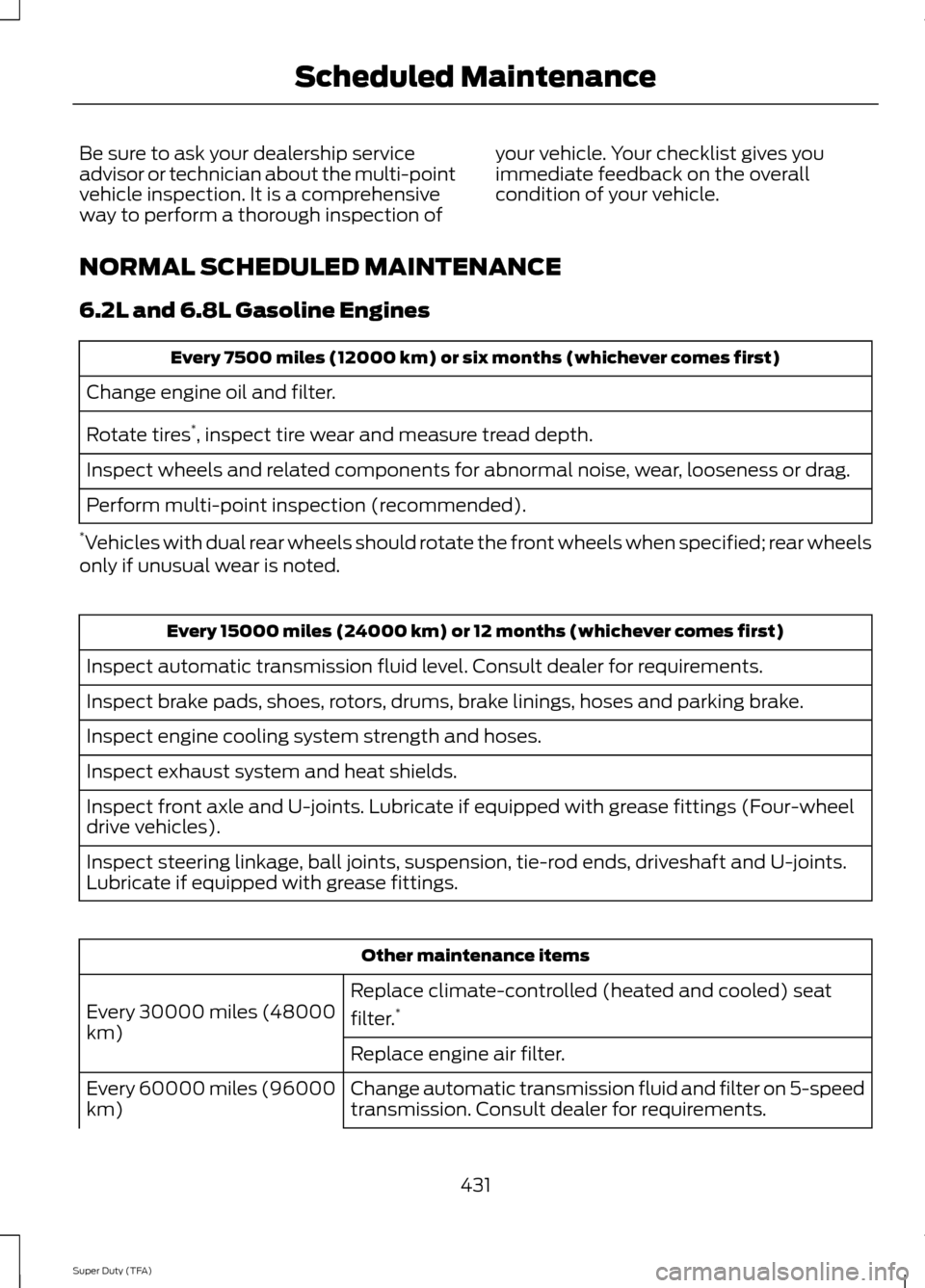
NORMAL SCHEDULED MAINTENANCE
6.2L and 6.8L Gasoline Engines Every 7500 miles (12000 km) or six months (whichever comes first)
Change engine oil and filter.
Rotate tires *
, inspect tire wear and measure tread depth.
Inspect wheels and related components for abnormal noise, wear, looseness or drag.
Perform multi-point inspection (recommended).
* Vehicles with dual rear wheels should rotate the front wheels when specified; rear wheels
only if unusual wear is noted. Every 15000 miles (24000 km) or 12 months (whichever comes first)
Inspect automatic transmission fluid level. Consult dealer for requirements.
Inspect brake pads, shoes, rotors, drums, brake linings, hoses and parking brake.
Inspect engine cooling system strength and hoses.
Inspect exhaust system and heat shields.
Inspect front axle and U-joints. Lubricate if equipped with grease fittings (Four-wheel
drive vehicles).
Inspect steering linkage, ball joints, suspension, tie-rod ends, driveshaft and U-joints.
Lubricate if equipped with grease fittings. Other maintenance items
Replace climate-controlled (heated and cooled) seat
filter. *
Every 30000 miles (48000
km)
Replace engine air filter.
Change automatic transmission fluid and filter on 5-speed
transmission. Consult dealer for requirements.
Every 60000 miles (96000
km)
431
Super Duty (TFA) Scheduled Maintenance
Page 450 of 458
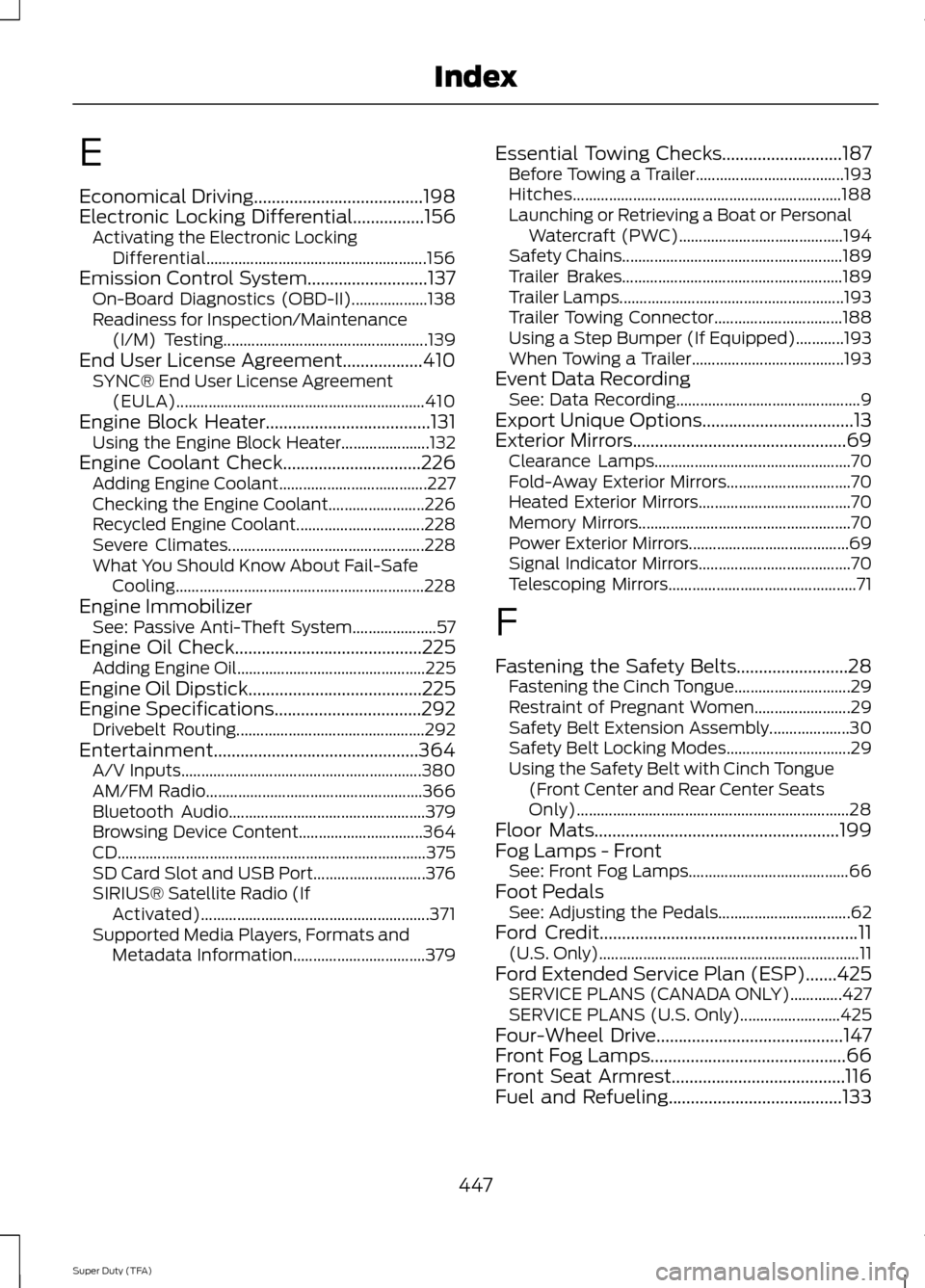
E
Economical Driving......................................198
Electronic Locking Differential................156 Activating the Electronic Locking
Differential....................................................... 156
Emission Control System...........................137 On-Board Diagnostics (OBD-II)................... 138
Readiness for Inspection/Maintenance (I/M) Testing................................................... 139
End User License Agreement..................410 SYNC® End User License Agreement
(EULA).............................................................. 410
Engine Block Heater.....................................131 Using the Engine Block Heater...................... 132
Engine Coolant Check
...............................226
Adding Engine Coolant..................................... 227
Checking the Engine Coolant........................ 226
Recycled Engine Coolant................................ 228
Severe Climates................................................. 228
What You Should Know About Fail-Safe Cooling.............................................................. 228
Engine Immobilizer See: Passive Anti-Theft System..................... 57
Engine Oil Check..........................................225 Adding Engine Oil............................................... 225
Engine Oil Dipstick.......................................225
Engine Specifications
.................................292
Drivebelt Routing............................................... 292
Entertainment..............................................364 A/V Inputs............................................................ 380
AM/FM Radio...................................................... 366
Bluetooth Audio................................................. 379
Browsing Device Content............................... 364
CD........................................................................\
..... 375
SD Card Slot and USB Port............................ 376
SIRIUS® Satellite Radio (If Activated)......................................................... 371
Supported Media Players, Formats and Metadata Information................................. 379Essential Towing Checks...........................187
Before Towing a Trailer..................................... 193
Hitches................................................................... 188
Launching or Retrieving a Boat or Personal Watercraft (PWC)......................................... 194
Safety Chains....................................................... 189
Trailer Brakes....................................................... 189
Trailer Lamps........................................................ 193
Trailer Towing Connector................................ 188
Using a Step Bumper (If Equipped)............193
When Towing a Trailer...................................... 193
Event Data Recording See: Data Recording.............................................. 9
Export Unique Options..................................13
Exterior Mirrors
................................................69
Clearance Lamps................................................. 70
Fold-Away Exterior Mirrors............................... 70
Heated Exterior Mirrors...................................... 70
Memory Mirrors..................................................... 70
Power Exterior Mirrors........................................ 69
Signal Indicator Mirrors...................................... 70
Telescoping Mirrors............................................... 71
F
Fastening the Safety Belts
.........................28
Fastening the Cinch Tongue............................. 29
Restraint of Pregnant Women........................ 29
Safety Belt Extension Assembly.................... 30
Safety Belt Locking Modes............................... 29
Using the Safety Belt with Cinch Tongue (Front Center and Rear Center Seats
Only).................................................................... 28
Floor Mats
.......................................................199
Fog Lamps - Front See: Front Fog Lamps........................................ 66
Foot Pedals See: Adjusting the Pedals................................. 62
Ford Credit
..........................................................11
(U.S. Only)................................................................. 11
Ford Extended Service Plan (ESP).......425 SERVICE PLANS (CANADA ONLY).............427
SERVICE PLANS (U.S. Only)......................... 425
Four-Wheel Drive
..........................................147
Front Fog Lamps............................................66
Front Seat Armrest.......................................116
Fuel and Refueling
.......................................133
447
Super Duty (TFA) Index
Page 456 of 458
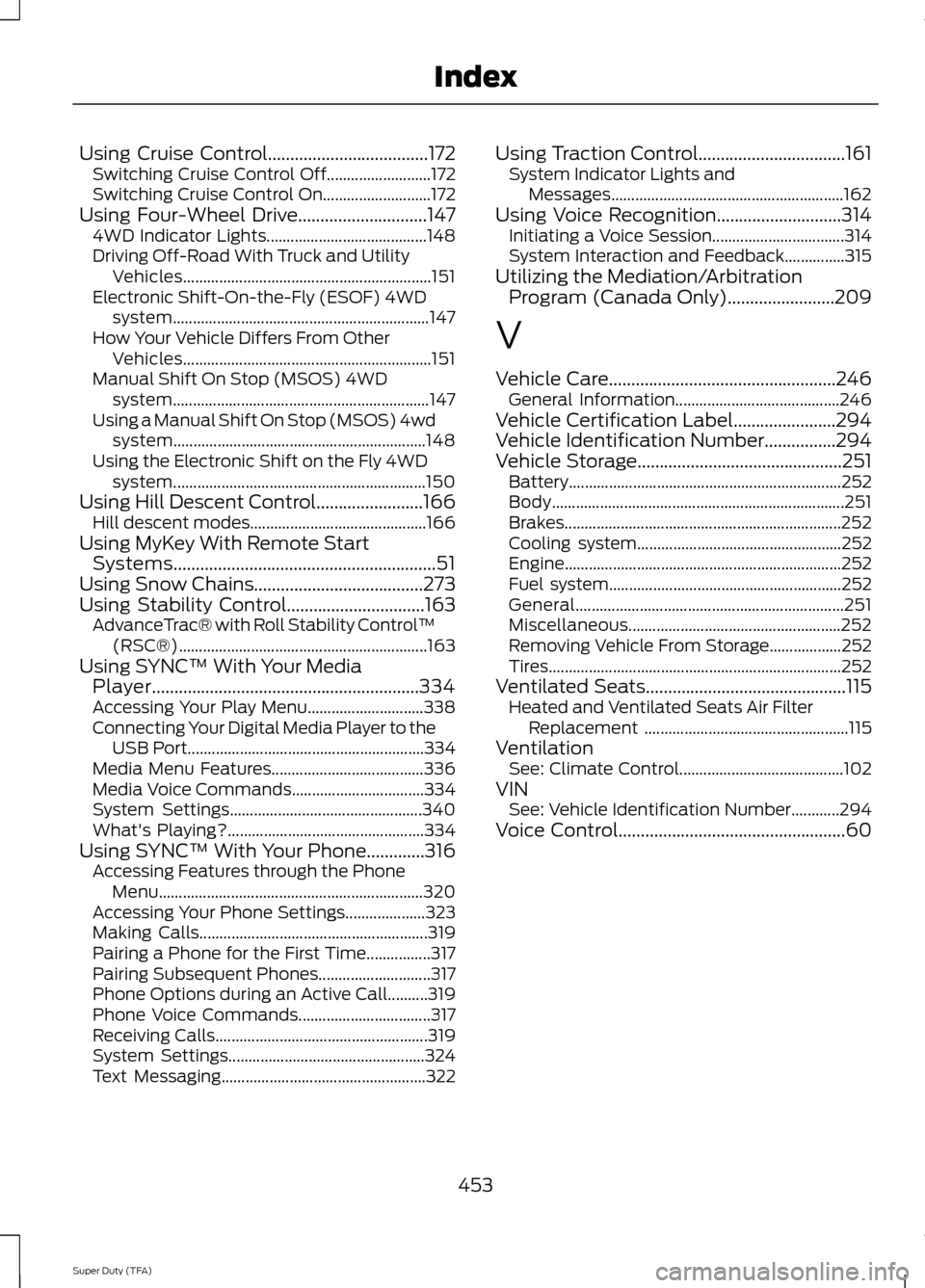
Using Cruise Control....................................172
Switching Cruise Control Off.......................... 172
Switching Cruise Control On........................... 172
Using Four-Wheel Drive.............................147 4WD Indicator Lights........................................ 148
Driving Off-Road With Truck and Utility Vehicles.............................................................. 151
Electronic Shift-On-the-Fly (ESOF) 4WD system................................................................ 147
How Your Vehicle Differs From Other Vehicles.............................................................. 151
Manual Shift On Stop (MSOS) 4WD system................................................................ 147
Using a Manual Shift On Stop (MSOS) 4wd system............................................................... 148
Using the Electronic Shift on the Fly 4WD system............................................................... 150
Using Hill Descent Control........................166 Hill descent modes............................................ 166
Using MyKey With Remote Start Systems
...........................................................51
Using Snow Chains......................................273
Using Stability Control...............................163 AdvanceTrac® with Roll Stability Control ™
(RSC®).............................................................. 163
Using SYNC™ With Your Media Player............................................................334
Accessing Your Play Menu............................. 338
Connecting Your Digital Media Player to the USB Port........................................................... 334
Media Menu Features...................................... 336
Media Voice Commands................................. 334
System Settings................................................ 340
What's Playing?................................................. 334
Using SYNC™ With Your Phone.............316 Accessing Features through the Phone
Menu.................................................................. 320
Accessing Your Phone Settings.................... 323
Making Calls......................................................... 319
Pairing a Phone for the First Time................317
Pairing Subsequent Phones............................ 317
Phone Options during an Active Call..........319
Phone Voice Commands................................. 317
Receiving Calls..................................................... 319
System Settings................................................. 324
Text Messaging................................................... 322Using Traction Control.................................161
System Indicator Lights and
Messages.......................................................... 162
Using Voice Recognition
............................314
Initiating a Voice Session................................. 314
System Interaction and Feedback...............315
Utilizing the Mediation/Arbitration Program (Canada Only)
........................209
V
Vehicle Care...................................................246 General Information......................................... 246
Vehicle Certification Label
.......................294
Vehicle Identification Number................294
Vehicle Storage..............................................251
Battery.................................................................... 252
Body........................................................................\
. 251
Brakes..................................................................... 252
Cooling system................................................... 252
Engine..................................................................... 252
Fuel system.......................................................... 252
General................................................................... 251
Miscellaneous..................................................... 252
Removing Vehicle From Storage.................. 252
Tires........................................................................\
. 252
Ventilated Seats.............................................115 Heated and Ventilated Seats Air Filter
Replacement ................................................... 115
Ventilation See: Climate Control......................................... 102
VIN See: Vehicle Identification Number............294
Voice Control
...................................................60
453
Super Duty (TFA) Index