warning FORD SUPER DUTY 2015 3.G Owner's Manual
[x] Cancel search | Manufacturer: FORD, Model Year: 2015, Model line: SUPER DUTY, Model: FORD SUPER DUTY 2015 3.GPages: 470, PDF Size: 18.24 MB
Page 37 of 470
Then...If...
The Belt-Minder feature will not activate.The driver's safety belt is buckled beforethe ignition switch is turned to the on posi-tion or less than 1-2 minutes have elapsedsince the ignition switch has been turnedto on...
The Belt-Minder feature is activated - thesafety belt warning light illuminates andthe warning chime sounds for six secondsevery 25 seconds, repeating for about fiveminutes or until the safety belts arebuckled.
The driver's safety belt is not buckled whenthe vehicle has reached at least 6 mph (9.7km/h) and 1-2 minutes have elapsed sincethe ignition switch has been turned to on...
The Belt-Minder feature is activated - thesafety belt warning light illuminates andthe warning chime sounds for six secondsevery 25 seconds, repeating for about fiveminutes or until the safety belts arebuckled.
The driver's safety belt becomes unbuckledfor about one minute while the vehicle istraveling at least 6 mph (9.7 km/h) andmore than 1-2 minutes have elapsed sincethe ignition switch has been turned to on...
Deactivating and Activating theBelt-Minder Feature (Driver Only)
WARNING
While the system allows you todeactivate it, this system is designedto improve your chances of beingsafely belted and surviving an accident.We recommend you leave the systemactivated for yourself and others who mayuse the vehicle. To reduce the risk of injury,do not deactivate or activate the systemwhile driving the vehicle.
Note:If you are using MyKey, you cannotdisable the Belt-Minder. Also, if theBelt-Minder has been previously disabled,it will be re-enabled during the use ofMyKey. See MyKey™ (page 50).
Read Steps 1 - 4 thoroughly beforeproceeding with the programmingprocedure.
Deactivate or activate the system byperforming the following procedure:
Before following the procedure, make surethat:
•The parking brake is set.
•The transmission is in park (P).
•The ignition is off.
•All vehicle doors are closed.
•The driver's safety belt is unbuckled.
1.Turn the ignition on. Do not start theengine.
2.Wait until the safety belt warning lightturns off (about one minute). Step 3must be completed within 30 secondsafter the safety belt warning light turnsoff.
3.Buckle then unbuckle the safety beltthree times at a moderate speed,ending with the safety belt in theunbuckled state. After Step 3, thesafety belt warning light will turn on.
34Super Duty (), enUSASafety Belts
Page 38 of 470
4.While the safety belt warning light ison, buckle then unbuckle the safetybelt. After Step 4, the safety beltwarning light will flash for confirmation.
•This will disable the feature if it iscurrently enabled.
•This will enable the feature if it iscurrently disabled.
CHILD RESTRAINT AND
SAFETY BELT MAINTENANCE
Inspect the vehicle safety belts and childsafety seat systems periodically to makesure they work properly and are notdamaged. Inspect the vehicle and childseat safety belts to make sure there are nonicks, tears or cuts. Replace if necessary.All vehicle safety belt assemblies, includingretractors, buckles, front safety belt buckleassemblies, buckle support assemblies(slide bar-if equipped), shoulder beltheight adjusters (if equipped), shoulderbelt guide on seat back (if equipped), childsafety seat LATCH and tether anchors, andattaching hardware, should be inspectedafter a crash. Read the child restraintmanufacturer's instructions for additionalinspection and maintenance informationspecific to the child restraint.
Ford Motor Company recommends thatall safety belt assemblies in use in vehiclesinvolved in a crash be replaced. However,if the crash was minor and an authorizeddealer finds that the belts do not showdamage and continue to operate properly,they do not need to be replaced. Safetybelt assemblies not in use during a crashshould also be inspected and replaced ifeither damage or improper operation isnoted.
Properly care for safety belts. See VehicleCare (page 256).
35Super Duty (), enUSASafety Belts
Page 39 of 470
PRINCIPLE OF OPERATION
WARNINGS
Airbags do not inflate slowly orgently, and the risk of injury from adeploying airbag is the greatest closeto the trim covering the airbag module.
All occupants of your vehicle,including the driver, should alwaysproperly wear their safety belts, evenwhen an airbag supplemental restraintsystem is provided. Failure to properly wearyour safety belt could seriously increasethe risk of injury or death.
Always transport children 12 yearsold and under in the back seat andalways properly use appropriatechild restraints. Failure to follow this couldseriously increase the risk of injury or death.
Never place your arm over the airbagmodule as a deploying airbag canresult in serious arm fractures orother injuries.
Airbags can kill or injure a child in achild seat. Never place a rear-facingchild seat in front of an active airbag.If you must use a forward-facing child seatin the front seat, move the seat upon whichthe child seat is installed all the way back.
Do not attempt to service, repair, ormodify the airbag supplementalrestraint systems or its fuses as youcould be seriously injured or killed. Contactyour authorized dealer as soon as possible.
Several airbag system componentsget hot after inflation. To avoid riskof injury, do not touch them afterinflation.
If the airbag has deployed, the airbagwill not function again and must bereplaced immediately. If the airbagis not replaced, the unrepaired area willincrease the risk of injury in a crash.
The airbags are a supplemental restraintsystem and are designed to work with thesafety belts to help protect the driver andright front passenger from certain upperbody injuries. Airbags do not inflate slowly;there is a risk of injury from a deployingairbag.
Note:You will hear a loud bang and see acloud of harmless powdery residue if anairbag deploys. This is normal.
The airbags inflate and deflate rapidlyupon activation. After airbag deployment,it is normal to notice a smoke-like, powderyresidue or smell the burnt propellant. Thismay consist of cornstarch, talcum powder(to lubricate the bag) or sodiumcompounds (for example, baking soda)that result from the combustion processthat inflates the airbag. Small amounts ofsodium hydroxide may be present whichmay irritate the skin and eyes, but none ofthe residue is toxic.
While the system is designed to helpreduce serious injuries, contact with adeploying airbag may also cause abrasionsor swelling. Temporary hearing loss is alsoa possibility as a result of the noiseassociated with a deploying airbag.Because airbags must inflate rapidly andwith considerable force, there is the risk ofdeath or serious injuries such as fractures,facial and eye injuries or internal injuries,particularly to occupants who are notproperly restrained or are otherwise out ofposition at the time of airbag deployment.Thus, it is extremely important thatoccupants be properly restrained as faraway from the airbag module as possiblewhile maintaining vehicle control.
Routine maintenance of the airbags is notrequired.
36Super Duty (), enUSASupplementary Restraints System
Page 40 of 470
DRIVER AND PASSENGER
AIRBAGS
WARNINGS
Never place your arm or any objectsover an airbag module. Placing yourarm over a deploying airbag canresult in serious arm fractures or otherinjuries. Objects placed on or over theairbag inflation area may cause thoseobjects to be propelled by the airbag intoyour face and torso causing serious injury.
Airbags can kill or injure a child in achild seat. Never place a rear-facingchild seat in front of an active airbag.If you must use a forward-facing child seatin the front seat, move the seat upon whichthe child seat is installed all the way back.
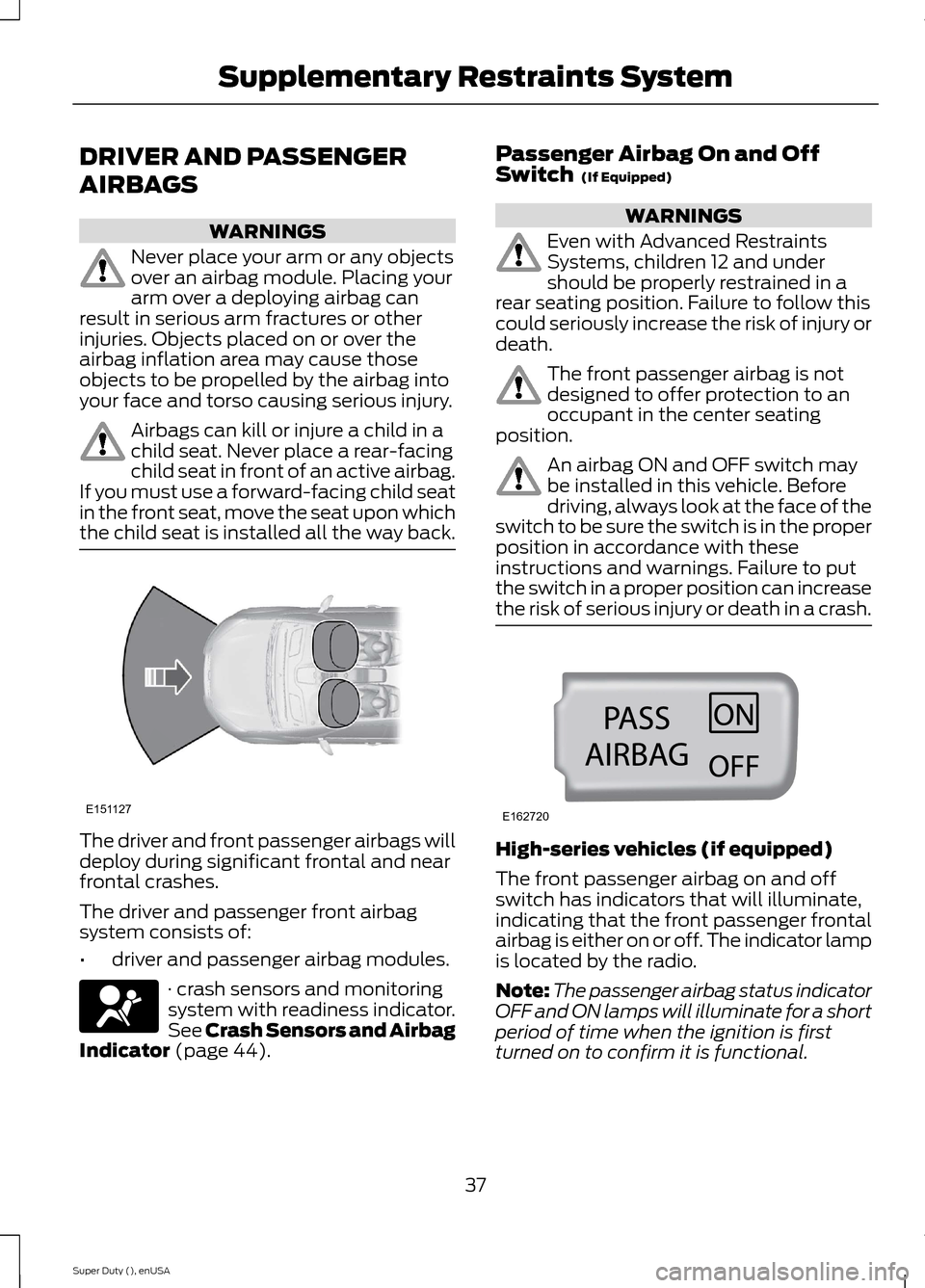
The driver and front passenger airbags willdeploy during significant frontal and nearfrontal crashes.
The driver and passenger front airbagsystem consists of:
•driver and passenger airbag modules.
· crash sensors and monitoringsystem with readiness indicator.See Crash Sensors and AirbagIndicator (page 44).
Passenger Airbag On and OffSwitch (If Equipped)
WARNINGS
Even with Advanced RestraintsSystems, children 12 and undershould be properly restrained in arear seating position. Failure to follow thiscould seriously increase the risk of injury ordeath.
The front passenger airbag is notdesigned to offer protection to anoccupant in the center seatingposition.
An airbag ON and OFF switch maybe installed in this vehicle. Beforedriving, always look at the face of theswitch to be sure the switch is in the properposition in accordance with theseinstructions and warnings. Failure to putthe switch in a proper position can increasethe risk of serious injury or death in a crash.
High-series vehicles (if equipped)
The front passenger airbag on and offswitch has indicators that will illuminate,indicating that the front passenger frontalairbag is either on or off. The indicator lampis located by the radio.
Note:The passenger airbag status indicatorOFF and ON lamps will illuminate for a shortperiod of time when the ignition is firstturned on to confirm it is functional.
37Super Duty (), enUSASupplementary Restraints SystemE151127 E162720
Page 41 of 470
Passenger airbagPassenger airbag statusindicatorSwitch position
DisabledOFF: LitOff
ON: Unlit
EnabledOFF: UnlitOn
ON: Lit
Low-series vehicles (if equipped)
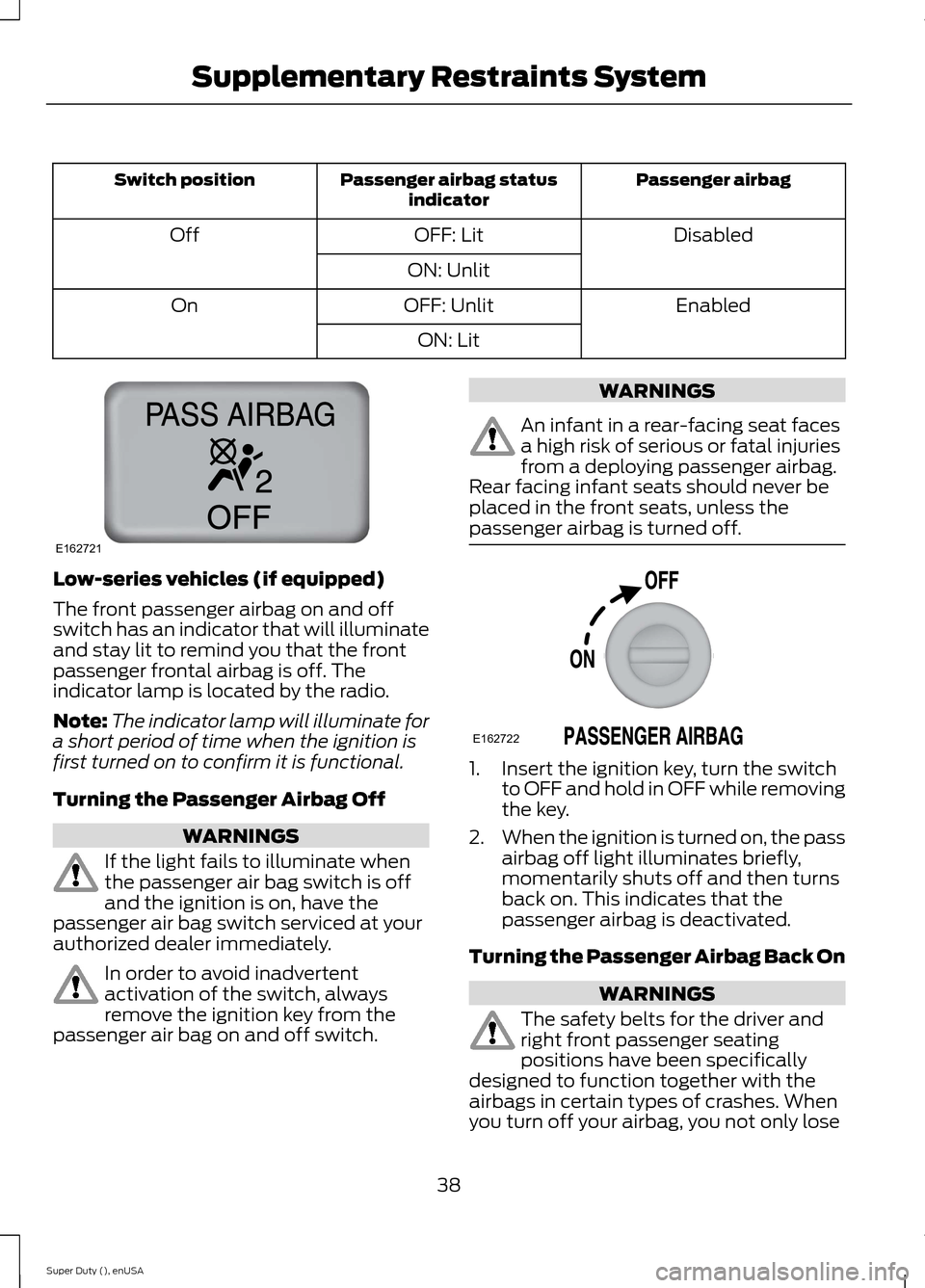
The front passenger airbag on and offswitch has an indicator that will illuminateand stay lit to remind you that the frontpassenger frontal airbag is off. Theindicator lamp is located by the radio.
Note:The indicator lamp will illuminate fora short period of time when the ignition isfirst turned on to confirm it is functional.
Turning the Passenger Airbag Off
WARNINGS
If the light fails to illuminate whenthe passenger air bag switch is offand the ignition is on, have thepassenger air bag switch serviced at yourauthorized dealer immediately.
In order to avoid inadvertentactivation of the switch, alwaysremove the ignition key from thepassenger air bag on and off switch.
WARNINGS
An infant in a rear-facing seat facesa high risk of serious or fatal injuriesfrom a deploying passenger airbag.Rear facing infant seats should never beplaced in the front seats, unless thepassenger airbag is turned off.
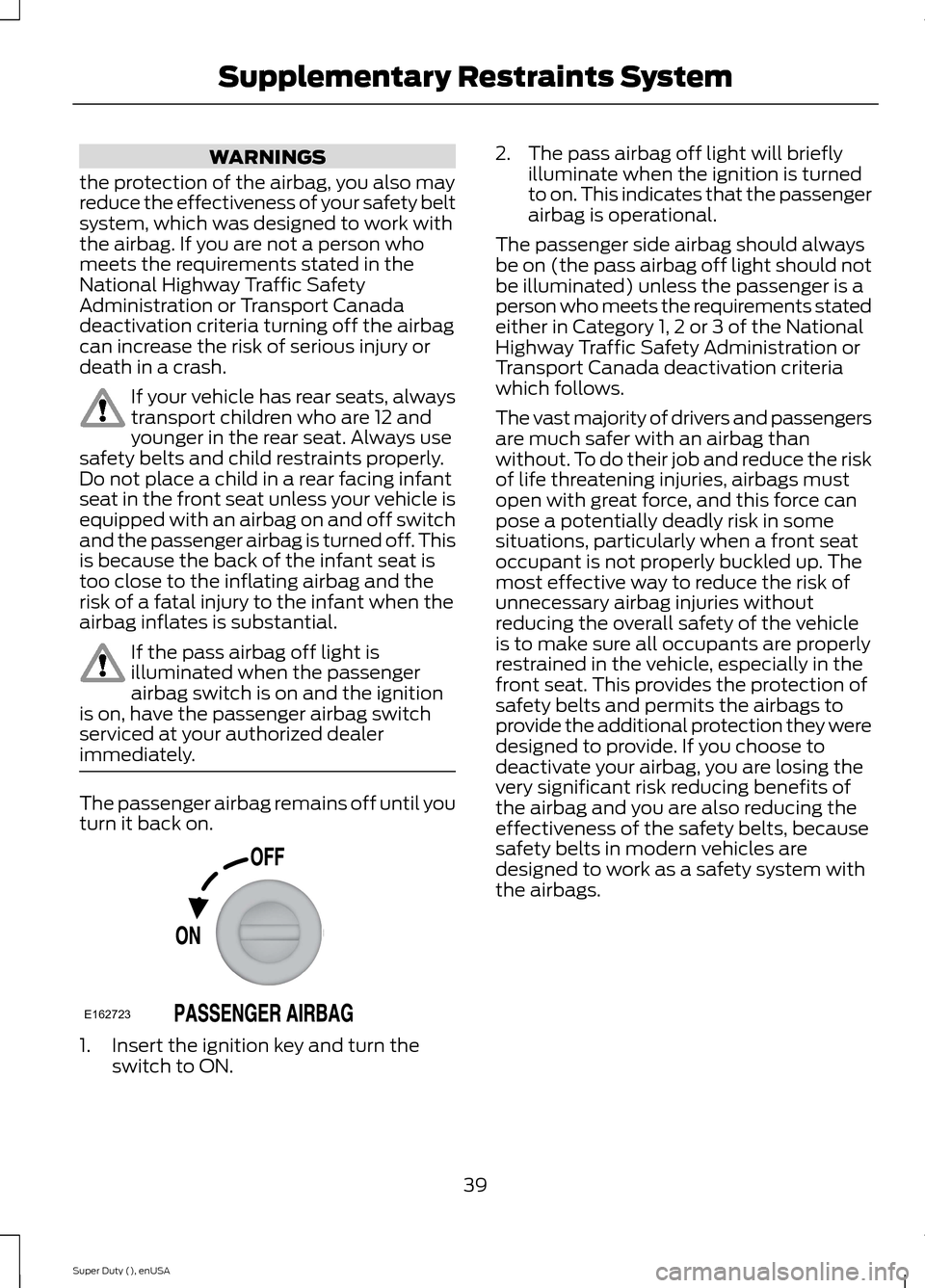
1.Insert the ignition key, turn the switchto OFF and hold in OFF while removingthe key.
2.When the ignition is turned on, the passairbag off light illuminates briefly,momentarily shuts off and then turnsback on. This indicates that thepassenger airbag is deactivated.
Turning the Passenger Airbag Back On
WARNINGS
The safety belts for the driver andright front passenger seatingpositions have been specificallydesigned to function together with theairbags in certain types of crashes. Whenyou turn off your airbag, you not only lose
38Super Duty (), enUSASupplementary Restraints SystemE162721 E162722
Page 42 of 470
WARNINGS
the protection of the airbag, you also mayreduce the effectiveness of your safety beltsystem, which was designed to work withthe airbag. If you are not a person whomeets the requirements stated in theNational Highway Traffic SafetyAdministration or Transport Canadadeactivation criteria turning off the airbagcan increase the risk of serious injury ordeath in a crash.
If your vehicle has rear seats, alwaystransport children who are 12 andyounger in the rear seat. Always usesafety belts and child restraints properly.Do not place a child in a rear facing infantseat in the front seat unless your vehicle isequipped with an airbag on and off switchand the passenger airbag is turned off. Thisis because the back of the infant seat istoo close to the inflating airbag and therisk of a fatal injury to the infant when theairbag inflates is substantial.
If the pass airbag off light isilluminated when the passengerairbag switch is on and the ignitionis on, have the passenger airbag switchserviced at your authorized dealerimmediately.
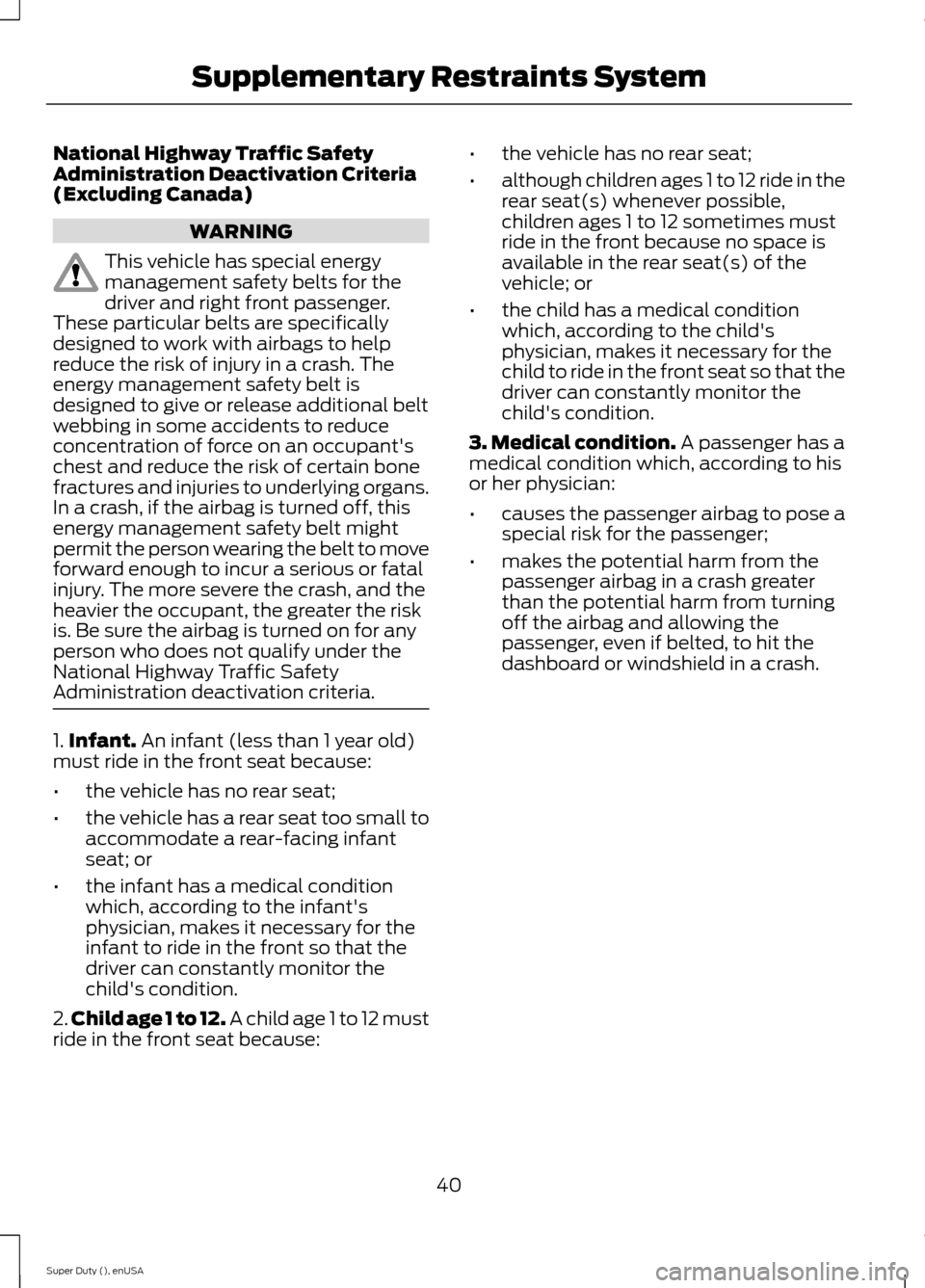
The passenger airbag remains off until youturn it back on.
1.Insert the ignition key and turn theswitch to ON.
2.The pass airbag off light will brieflyilluminate when the ignition is turnedto on. This indicates that the passengerairbag is operational.
The passenger side airbag should alwaysbe on (the pass airbag off light should notbe illuminated) unless the passenger is aperson who meets the requirements statedeither in Category 1, 2 or 3 of the NationalHighway Traffic Safety Administration orTransport Canada deactivation criteriawhich follows.
The vast majority of drivers and passengersare much safer with an airbag thanwithout. To do their job and reduce the riskof life threatening injuries, airbags mustopen with great force, and this force canpose a potentially deadly risk in somesituations, particularly when a front seatoccupant is not properly buckled up. Themost effective way to reduce the risk ofunnecessary airbag injuries withoutreducing the overall safety of the vehicleis to make sure all occupants are properlyrestrained in the vehicle, especially in thefront seat. This provides the protection ofsafety belts and permits the airbags toprovide the additional protection they weredesigned to provide. If you choose todeactivate your airbag, you are losing thevery significant risk reducing benefits ofthe airbag and you are also reducing theeffectiveness of the safety belts, becausesafety belts in modern vehicles aredesigned to work as a safety system withthe airbags.
39Super Duty (), enUSASupplementary Restraints SystemE162723
Page 43 of 470
National Highway Traffic SafetyAdministration Deactivation Criteria(Excluding Canada)
WARNING
This vehicle has special energymanagement safety belts for thedriver and right front passenger.These particular belts are specificallydesigned to work with airbags to helpreduce the risk of injury in a crash. Theenergy management safety belt isdesigned to give or release additional beltwebbing in some accidents to reduceconcentration of force on an occupant'schest and reduce the risk of certain bonefractures and injuries to underlying organs.In a crash, if the airbag is turned off, thisenergy management safety belt mightpermit the person wearing the belt to moveforward enough to incur a serious or fatalinjury. The more severe the crash, and theheavier the occupant, the greater the riskis. Be sure the airbag is turned on for anyperson who does not qualify under theNational Highway Traffic SafetyAdministration deactivation criteria.
1.Infant. An infant (less than 1 year old)must ride in the front seat because:
•the vehicle has no rear seat;
•the vehicle has a rear seat too small toaccommodate a rear-facing infantseat; or
•the infant has a medical conditionwhich, according to the infant'sphysician, makes it necessary for theinfant to ride in the front so that thedriver can constantly monitor thechild's condition.
2.Child age 1 to 12. A child age 1 to 12 mustride in the front seat because:
•the vehicle has no rear seat;
•although children ages 1 to 12 ride in therear seat(s) whenever possible,children ages 1 to 12 sometimes mustride in the front because no space isavailable in the rear seat(s) of thevehicle; or
•the child has a medical conditionwhich, according to the child'sphysician, makes it necessary for thechild to ride in the front seat so that thedriver can constantly monitor thechild's condition.
3. Medical condition. A passenger has amedical condition which, according to hisor her physician:
•causes the passenger airbag to pose aspecial risk for the passenger;
•makes the potential harm from thepassenger airbag in a crash greaterthan the potential harm from turningoff the airbag and allowing thepassenger, even if belted, to hit thedashboard or windshield in a crash.
40Super Duty (), enUSASupplementary Restraints System
Page 44 of 470
Transport Canada Deactivation Criteria(Canada Only)
WARNING
This vehicle has special energymanagement safety belts for thedriver and right front passenger.These particular belts are specificallydesigned to work with airbags to helpreduce the risk of injury in a crash. Theenergy management safety belt isdesigned to give or release additional beltwebbing in some accidents to reduceconcentration of force on an occupant'schest and reduce the risk of certain bonefractures and injuries to underlying organs.In a crash, if the airbag is turned off, thisenergy management safety belt mightpermit the person wearing the belt to moveforward enough to incur a serious or fatalinjury. The more severe the crash, and theheavier the occupant, the greater the riskis. Be sure the airbag is turned on for anyperson who does not qualify under theNational Highway Traffic SafetyAdministration deactivation criteria.
1.Infant: An infant (less than 1 year old)must ride in the front seat because:
•my vehicle has no rear seat;
•the rear seat in my vehicle cannotaccommodate a rear-facing infantseat;
•the infant has a medical conditionwhich, according to the infant'sphysician, makes it necessary for theinfant to ride in the front seat so thatthe driver can monitor the infant'scondition.
2.Child age 12 or under: A child age 12 orunder must ride in the front seat because:
•my vehicle has no rear seat;
•although children age 12 and under ridein the rear seat whenever possible,children age 12 and under have nooption but to sometimes ride in thefront seat because rear seat space isinsufficient;
•the child has a medical condition that,according to the child's physician,makes it necessary for the child to ridein the front seat so that the driver canmonitor the child's condition.
3.Medical condition: A passenger has amedical condition that, according to his orher physician:
•poses a special risk for the passengerif the airbag deploys; and
•makes the potential harm from thepassenger airbag deployment greaterthan the potential harm from turningoff the airbag and experiencing a crashwithout the protection offered by theairbag
Proper Driver and Front PassengerSeating Adjustment
WARNING
The National Highway Traffic SafetyAdministration recommends aminimum distance of at least 10inches (25 centimeters) between anoccupant’s chest and the driver airbagmodule.
To properly position yourself away fromthe airbag:
•Move your seat to the rear as far as youcan while still reaching the pedalscomfortably.
•Recline the seat slightly (one or twodegrees) from the upright position.
41Super Duty (), enUSASupplementary Restraints System
Page 45 of 470
After all occupants have adjusted theirseats and put on safety belts, it is veryimportant that they continue to sitproperly. Properly seated occupants situpright, lean against the seat back, andcenter themselves on the seat cushion,with their feet comfortably extended onthe floor. Sitting improperly can increasethe chance of injury in a crash event. Forexample, if an occupant slouches, liesdown, turns sideways, sits forward, leansforward or sideways, or puts one or bothfeet up, the chance of injury during a crashis greatly increased.
Children and Airbags
WARNING
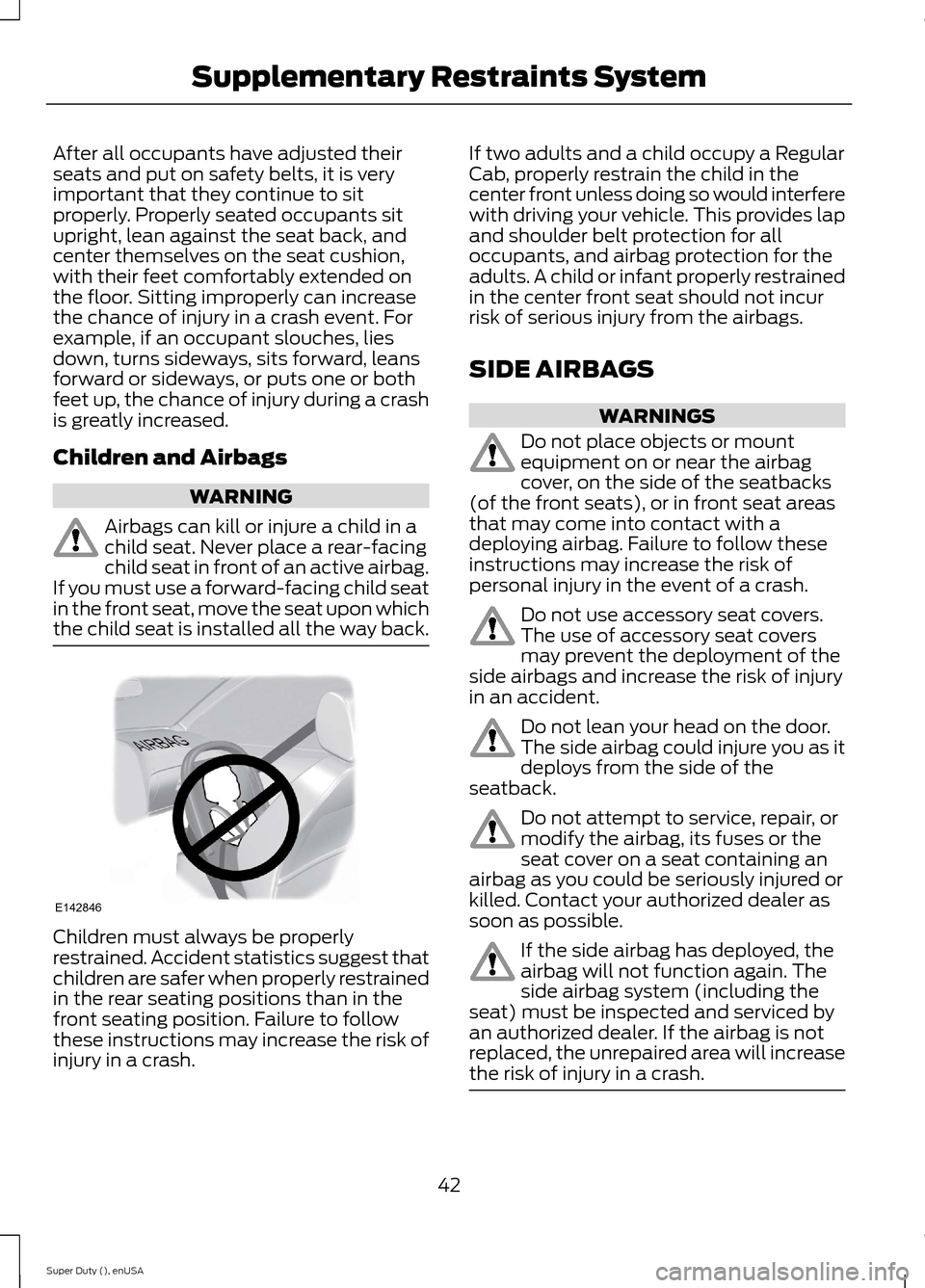
Airbags can kill or injure a child in achild seat. Never place a rear-facingchild seat in front of an active airbag.If you must use a forward-facing child seatin the front seat, move the seat upon whichthe child seat is installed all the way back.
Children must always be properlyrestrained. Accident statistics suggest thatchildren are safer when properly restrainedin the rear seating positions than in thefront seating position. Failure to followthese instructions may increase the risk ofinjury in a crash.
If two adults and a child occupy a RegularCab, properly restrain the child in thecenter front unless doing so would interferewith driving your vehicle. This provides lapand shoulder belt protection for alloccupants, and airbag protection for theadults. A child or infant properly restrainedin the center front seat should not incurrisk of serious injury from the airbags.
SIDE AIRBAGS
WARNINGS
Do not place objects or mountequipment on or near the airbagcover, on the side of the seatbacks(of the front seats), or in front seat areasthat may come into contact with adeploying airbag. Failure to follow theseinstructions may increase the risk ofpersonal injury in the event of a crash.
Do not use accessory seat covers.The use of accessory seat coversmay prevent the deployment of theside airbags and increase the risk of injuryin an accident.
Do not lean your head on the door.The side airbag could injure you as itdeploys from the side of theseatback.
Do not attempt to service, repair, ormodify the airbag, its fuses or theseat cover on a seat containing anairbag as you could be seriously injured orkilled. Contact your authorized dealer assoon as possible.
If the side airbag has deployed, theairbag will not function again. Theside airbag system (including theseat) must be inspected and serviced byan authorized dealer. If the airbag is notreplaced, the unrepaired area will increasethe risk of injury in a crash.
42Super Duty (), enUSASupplementary Restraints SystemE142846
Page 46 of 470
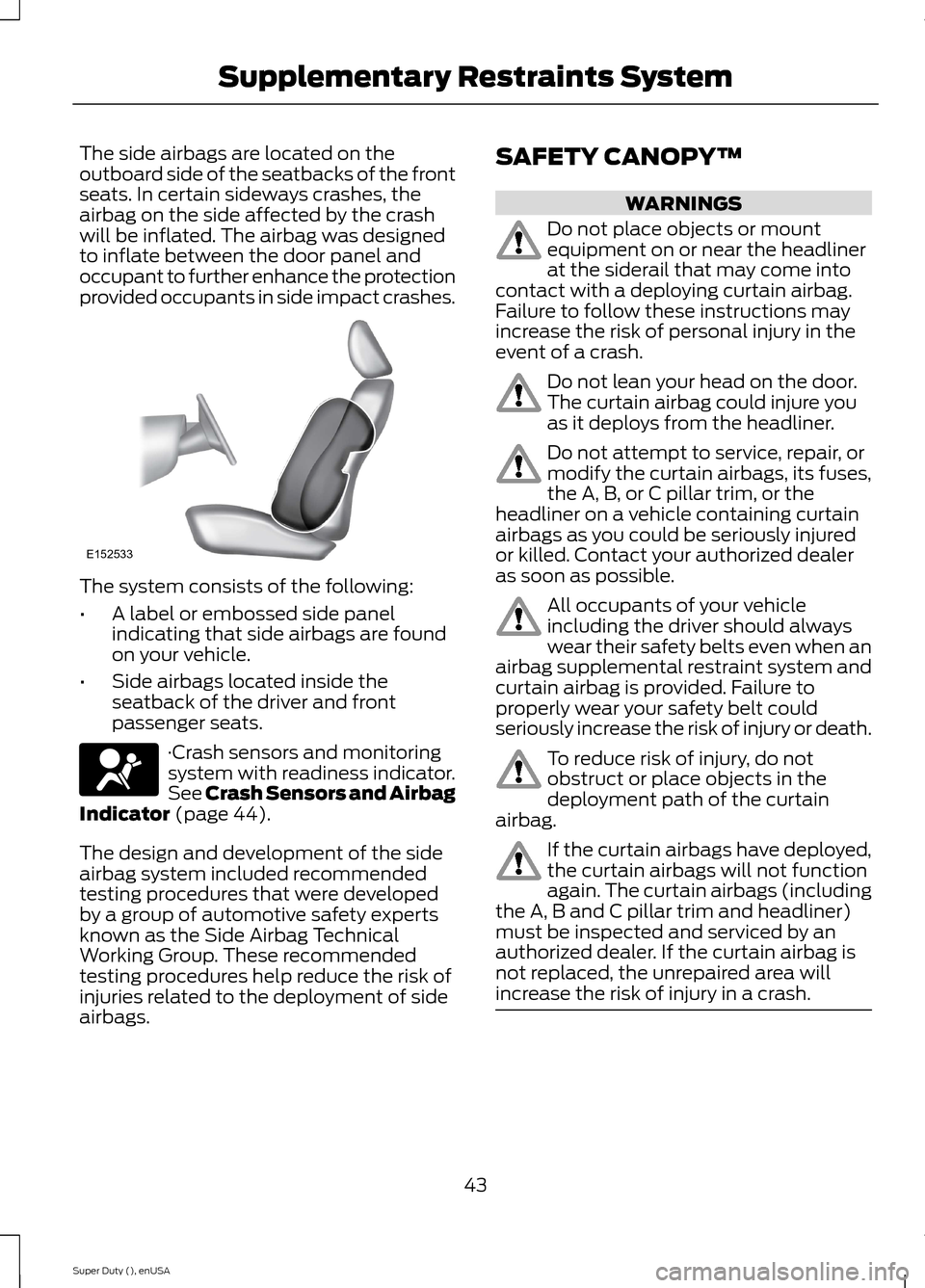
The side airbags are located on theoutboard side of the seatbacks of the frontseats. In certain sideways crashes, theairbag on the side affected by the crashwill be inflated. The airbag was designedto inflate between the door panel andoccupant to further enhance the protectionprovided occupants in side impact crashes.
The system consists of the following:
•A label or embossed side panelindicating that side airbags are foundon your vehicle.
•Side airbags located inside theseatback of the driver and frontpassenger seats.
·Crash sensors and monitoringsystem with readiness indicator.See Crash Sensors and AirbagIndicator (page 44).
The design and development of the sideairbag system included recommendedtesting procedures that were developedby a group of automotive safety expertsknown as the Side Airbag TechnicalWorking Group. These recommendedtesting procedures help reduce the risk ofinjuries related to the deployment of sideairbags.
SAFETY CANOPY™
WARNINGS
Do not place objects or mountequipment on or near the headlinerat the siderail that may come intocontact with a deploying curtain airbag.Failure to follow these instructions mayincrease the risk of personal injury in theevent of a crash.
Do not lean your head on the door.The curtain airbag could injure youas it deploys from the headliner.
Do not attempt to service, repair, ormodify the curtain airbags, its fuses,the A, B, or C pillar trim, or theheadliner on a vehicle containing curtainairbags as you could be seriously injuredor killed. Contact your authorized dealeras soon as possible.
All occupants of your vehicleincluding the driver should alwayswear their safety belts even when anairbag supplemental restraint system andcurtain airbag is provided. Failure toproperly wear your safety belt couldseriously increase the risk of injury or death.
To reduce risk of injury, do notobstruct or place objects in thedeployment path of the curtainairbag.
If the curtain airbags have deployed,the curtain airbags will not functionagain. The curtain airbags (includingthe A, B and C pillar trim and headliner)must be inspected and serviced by anauthorized dealer. If the curtain airbag isnot replaced, the unrepaired area willincrease the risk of injury in a crash.
43Super Duty (), enUSASupplementary Restraints SystemE152533