fuel cap FORD SUPER DUTY 2023 Owners Manual
[x] Cancel search | Manufacturer: FORD, Model Year: 2023, Model line: SUPER DUTY, Model: FORD SUPER DUTY 2023Pages: 738, PDF Size: 18.49 MB
Page 11 of 738
Glasses Holder.............................................201
Starting and Stopping theEngine
Starting and Stopping the Engine –Precautions...............................................202
Ignition Switch.............................................202
Push Button Ignition Switch...................203
Starting the Engine....................................203
Engine Block Heater..................................205
Stopping the Engine.................................206
Idle Timer.......................................................207
Automatic Engine Stop...........................208
Accessing the Passive Key BackupPosition......................................................209
Starting and Stopping the Engine –Troubleshooting.....................................209
Starting and Stopping the Engine Videos.........................................................................213
Fuel and Refueling
Fuel and Refueling Precautions.............214
Fuel Quality....................................................214
Running Out of Fuel....................................217
Refueling.........................................................218
Fuel Tank Capacity....................................220
Fuel and Refueling – Troubleshooting........................................................................220
Diesel Particulate Filter
What Is the Diesel Particulate Filter......221
How Does the Diesel Particulate FilterWork..............................................................221
Diesel Particulate Filter Precautions.........................................................................221
Diesel Particulate Filter Requirements........................................................................222
Diesel Particulate Filter ManualRegeneration............................................222
Diesel Particulate Filter –Troubleshooting......................................224
Selective Catalytic ReductionSystem
What Is the Selective CatalyticReduction System..................................226
How Does the Selective CatalyticReduction System Work......................226
Selective Catalytic Reduction SystemPrecautions...............................................226
Selective Catalytic Reduction SystemRequirements..........................................228
Selective Catalytic Reduction SystemGuidelines..................................................228
Filling the Selective Catalytic ReductionSystem Tank.............................................228
Checking the Selective CatalyticReduction System Status...................230
Diesel Exhaust Fluid Capacity andSpecification............................................230
Selective Catalytic Reduction System –Troubleshooting......................................230
Catalytic Converter
What Is the Catalytic Converter............233
Catalytic Converter Precautions...........233
Catalytic Converter – Troubleshooting........................................................................233
Automatic Transmission
Automatic Transmission Precautions........................................................................234
Automatic Transmission Positions......234
Shifting Your Vehicle Into Gear..............235
Automatic Transmission PositionIndicators...................................................235
Manually Shifting Gears...........................235
Using Progressive Range Selection......236
Automatic Transmission AudibleWarnings....................................................236
Power Take-Off...........................................236
Four-Wheel Drive
How Does Four-Wheel Drive Work......238
7
2023 Super Duty (TFH) Canada/United States of America, enUSA, Edition date: 202211, DOMTable of Contents
Page 19 of 738
Wheel and Tire Information
Locating the Tire label..............................478
Department of Transportation UniformTire Quality Grades................................478
Information on the Tire Sidewall..........479
Glossary of Tire Terminology.................484
Tire Replacement Requirements.........485
Using Snow Chains....................................487
Tire Care
Checking the Tire Pressures..................490
Inflating the Tires.......................................490
Inspecting the Tire for Wear...................494
Inspecting the Tire for Damage............494
Inspecting the Wheel Valve Stems......498
Tire Rotation................................................498
Tire Pressure MonitoringSystem
What Is the Tire Pressure MonitoringSystem........................................................501
Tire Pressure Monitoring SystemOverview.....................................................501
Tire Pressure Monitoring SystemPrecautions..............................................502
Tire Pressure Monitoring SystemLimitations................................................502
Viewing the Tire Pressures.....................503
Resetting Tire Pressure MonitoringSystem.......................................................503
Tire Pressure Monitoring System –Troubleshooting.....................................506
Tire Pressure Monitoring System Videos.......................................................................508
Changing a Road Wheel
Changing a Flat Tire..................................509
Wheel Nuts....................................................519
Capacities and Specifications
Engine Specifications - 6.7L Diesel......520
Engine Specifications - 6.8L, Gasoline.........................................................................521
Engine Specifications - 7.3L, Gasoline........................................................................522
Motorcraft Parts - 6.7L Diesel................523
Motorcraft Parts - 6.8L, Gasoline.........524
Motorcraft Parts - 7.3L, Gasoline..........525
Engine Oil Capacity and Specification -6.7L Diesel.................................................526
Engine Oil Capacity and Specification -6.8L, Gasoline..........................................528
Engine Oil Capacity and Specification -7.3L, Gasoline...........................................530
Cooling System Capacity andSpecification - 6.7L Diesel...................532
Cooling System Capacity andSpecification - 6.8L, Gasoline............533
Cooling System Capacity andSpecification - 7.3L, Gasoline.............534
Fuel Tank Capacity - Diesel....................534
Fuel Tank Capacity - Gasoline...............535
Air Conditioning System Capacity andSpecification............................................536
Washer Fluid Specification.....................536
Diesel Exhaust Fluid Capacity andSpecification.............................................537
Automatic Transmission Fluid Capacityand Specification - Diesel...................538
Automatic Transmission Fluid Capacityand Specification - Gasoline.............538
Brake Fluid Specification.........................539
Transfer Case Fluid Capacity andSpecification............................................540
Front Axle Fluid Capacity andSpecification............................................540
Rear Axle Fluid Capacity andSpecification............................................542
Hydraulic Power Steering Fluid Capacityand Specification...................................546
15
2023 Super Duty (TFH) Canada/United States of America, enUSA, Edition date: 202211, DOMTable of Contents
Page 27 of 738
SYMBOLS USED ON YOUR
VEHICLE
These are some of the symbols you maysee on your vehicle.
Airbag
Air conditioning system
Air conditioning system lubricanttype
Anti-lock braking system
Avoid smoking, flames or sparks
Battery
Battery acid
Blower motor
Brake fluid - non petroleumbased
Brake system
Brake system
Cabin air filter
Check fuel cap
Child safety door lock or unlock
Child seat lower anchor
Child seat tether anchor
Cruise control
Do not open when hot
Electric Parking brake
Engine air filter
Engine coolant
Engine coolant temperature
Engine oil
Explosive gas
Fan warning
Fasten seatbelt
Flammable
Front fog lamps
23
2023 Super Duty (TFH) Canada/United States of America, enUSA, Edition date: 202211, DOMSymbols GlossaryE67017 E162384 E231157 E67020 E139220 E67021 E139227 E139209 E67024 E270480 E139223 E139211 E141128 E332905 E139219 E139212 E103308 E67022 E139221 E139228 E71880 E231160
Page 33 of 738
MOBILE DEVICE DATA
If you connect a mobile device to yourvehicle, you can display data from yourdevice on the touchscreen for example,music and album art. You can share yourvehicle data with mobile apps on yourdevice through the system. See AppRequirements (page 575).
The mobile apps function operates by yourconnected device sending data to us in theUnited States. The data is encrypted andincludes, for example, the vehicleidentification number of your vehicle, theSYNC module serial number, odometer,enabled apps, usage statistics anddebugging information. We retain it onlyas long as necessary to provide the service,to troubleshoot, for continuousimprovement and to offer you productsand services that may be of interest to youaccording to your preferences and whereallowed by law.
If you connect a cell phone to the system,the system creates a profile that links tothat cell phone. The cell phone profileenables more mobile features and efficientoperation. The profile contains, forexample data from your phonebook, readand unread text messages and call history,including history of calls when your cellphone was not connected to the system.
If you connect a media device, the systemcreates and retains a media device indexof supported media content. The systemalso records a short diagnostic log ofapproximately 10 minutes of all recentsystem activity.
The cell phone profile, media device indexand diagnostic log remain in your vehicleunless you delete them and are generallyaccessible only in your vehicle when youconnect your cell phone or media device.If you no longer plan to use the system oryour vehicle, we recommend you use thesystem reset function to erase the storedinformation. See Performing a SystemReset (page ?).
System data cannot be accessed withoutspecial equipment and access to yourvehicle's module.
For additional information about ourprivacy policy, refer to the local Fordwebsite.
Note:To find out if your vehicle hasconnectivity technology, visitwww.FordConnected.com.
EMERGENCY CALL SYSTEM
DATA
When the emergency call system is active,it may disclose to emergency services thatyour vehicle has been in a crash involvingthe deployment of an airbag or activationof the fuel pump shut-off. Certain versionsor updates to the emergency call systemmay also be capable of electronically orverbally disclosing to emergency servicesoperators your vehicle location or otherdetails about your vehicle or crash to assistemergency services operators to providethe most appropriate emergency services.If you do not want to disclose thisinformation, do not activate the emergencycall system.
Note:You cannot deactivate emergencycall systems that are required by law.
29
2023 Super Duty (TFH) Canada/United States of America, enUSA, Edition date: 202211, DOMData Privacy
Page 71 of 738
WHAT IS 911 ASSIST
911 Assist is a SYNC system feature thatcan call for help.
For more information, visitwww.owner.ford.com.
HOW DOES 911 ASSIST WORK
If a crash deploys an airbag, excluding kneeairbags and rear inflatable seatbelts, oractivates the fuel pump shut-off, yourvehicle may be able to contact emergencyservices by dialing 911 through a paired andconnected Bluetooth® enabled phone.
Not all crashes deploy an airbag or activatethe fuel pump shut-off. If a connected cellphone sustains damage or loses itsconnection to SYNC during a crash, SYNCsearches for and tries to connect to apreviously paired cell phone. SYNC thenattempts to call the emergency services.
Before making the call:
•SYNC provides about 10 seconds tocancel the call. If you fail to cancel thecall, SYNC attempts to dial 911.
•SYNC says the following, or a similarmessage: SYNC will attempt to call 911,to cancel the call, press Cancel on yourscreen or press and hold the phonebutton on your steering wheel.
If you do not cancel the call and SYNCmakes a successful call a pre-recordedmessage plays for the 911 operator. Theoccupants in your vehicle are able to talkwith the operator. Be prepared to provideyour name, phone number and locationimmediately because not all 911 systemsare capable of receiving this informationelectronically.
During an emergency call the systemtransmits vehicle data to the emergencyservice.
EMERGENCY CALL
REQUIREMENTS
WARNING: Do not wait for 911Assist to make an emergency call if youcan do it yourself. Dial emergencyservices immediately to avoid delayedresponse time which could increase therisk of serious injury or death after acrash. If you do not hear 911 Assist withinfive seconds of the crash, the system orphone may be damaged ornon-functional.
WARNING: Always place yourphone in a secure location in your vehicleso it does not become a projectile or getdamaged in a crash. Failure to do so maycause serious injury to someone ordamage the phone which could prevent911 Assist from working properly.
WARNING: Unless the 911 Assistsetting is set on before a crash, thesystem will not dial for help which coulddelay response time, potentiallyincreasing the risk of serious injury ordeath after a crash.
•SYNC is powered and working properlyat the time of the incident andthroughout feature activation and use.
•The 911 Assist feature must be set onbefore the incident.
•You must pair and connect aBluetooth® enabled and compatiblecell phone to SYNC.
•A connected Bluetooth® enabledphone must have the ability to makeand maintain an outgoing call at thetime of the incident.
67
2023 Super Duty (TFH) Canada/United States of America, enUSA, Edition date: 202211, DOM911 Assist
Page 222 of 738
Use the following guidelines to avoidelectrostatic charge build-up, which canproduce a spark, when filling anungrounded fuel container:
•Only use an approved fuel container totransfer fuel to your vehicle. Place thecontainer on the ground when filling it.
•Do not fill a fuel container when it isinside your vehicle (including the cargoarea).
•Keep the fuel pump nozzle in contactwith the fuel container when filling it.
•Do not use a device that holds the fuelpump nozzle lever in the fill position.
ADDING FUEL FROM A PORTABLEFUEL CONTAINER
WARNING: Do not pry open thefuel tank filler valve. This could damagethe fuel system. Failure to follow thisinstruction could result in fire, personalinjury or death.
WARNING: Do not dispose of fuelin the household refuse or the publicsewage system. Use an authorized wastedisposal facility.
When refueling the vehicle fuel tank froma fuel container, do the following:
1.Fully open the fuel filler door.
2.Turn the fuel filler capcounterclockwise and remove it.
3.Add fuel to your vehicle from the fuelcontainer.
4.To replace the fuel filler cap, turn itclockwise until you feel a strongresistance and it clicks.
5.Fully close the fuel filler door.
Note:If your vehicle runs out of fuel add aminimum of 1.3 gal (5 L) of fuel to restartthe engine.
Note:You may need to switch the ignitionfrom off to on several times after refuelingto allow the fuel system to pump the fuelfrom the tank to the engine. Whenrestarting, cranking time takes a fewseconds longer than normal.
REFUELING
REFUELING SYSTEM OVERVIEW
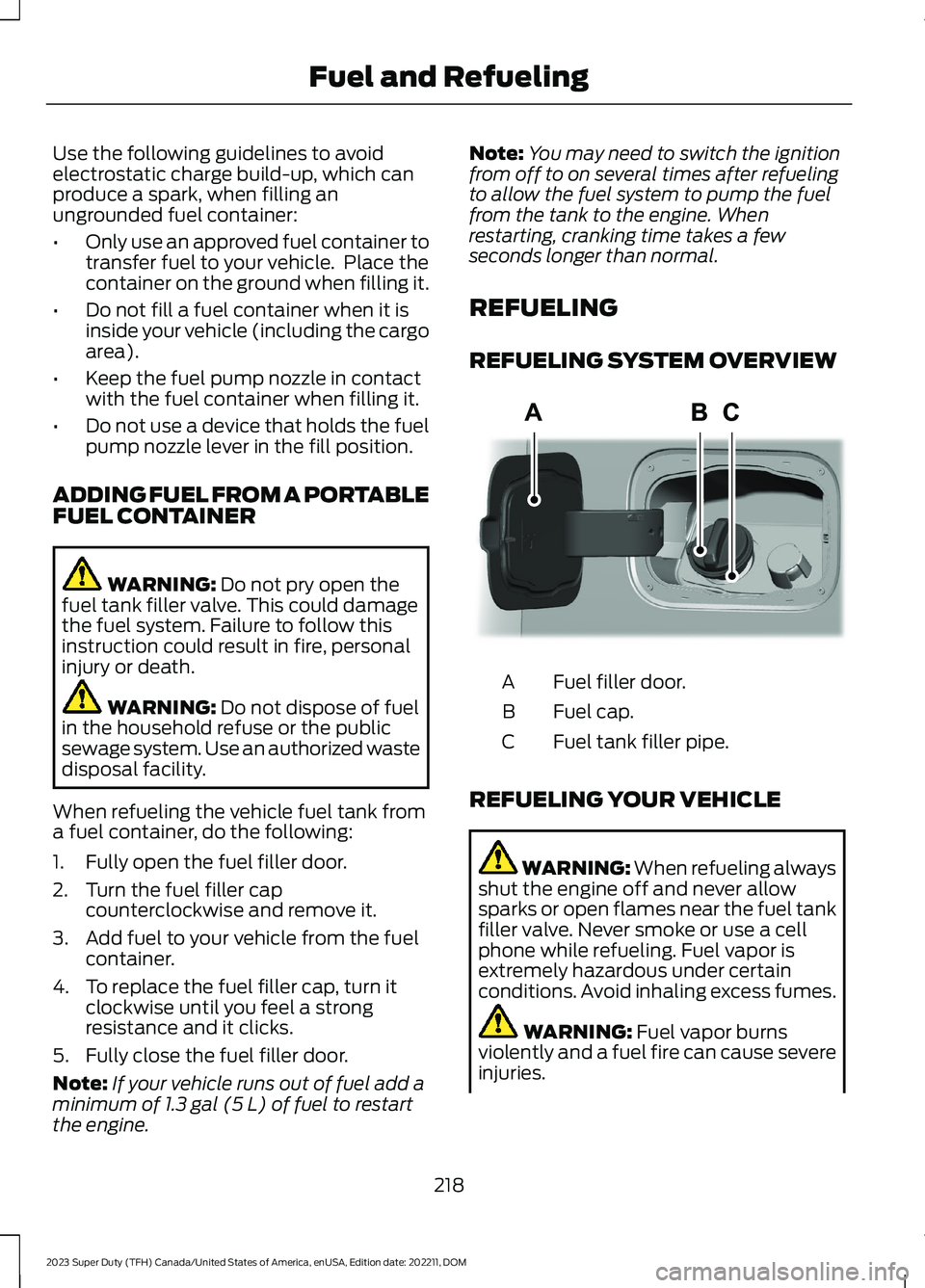
Fuel filler door.A
Fuel cap.B
Fuel tank filler pipe.C
REFUELING YOUR VEHICLE
WARNING: When refueling alwaysshut the engine off and never allowsparks or open flames near the fuel tankfiller valve. Never smoke or use a cellphone while refueling. Fuel vapor isextremely hazardous under certainconditions. Avoid inhaling excess fumes.
WARNING: Fuel vapor burnsviolently and a fuel fire can cause severeinjuries.
218
2023 Super Duty (TFH) Canada/United States of America, enUSA, Edition date: 202211, DOMFuel and RefuelingAAE346555
Page 223 of 738
WARNING: The fuel system maybe under pressure. If you hear a hissingsound near the fuel filler inlet, do notrefuel until the sound stops. Otherwise,fuel may spray out, which could causeserious personal injury.
WARNING: Keep children awayfrom the fuel pump. Never let childrenpump fuel.
WARNING: Do not pry open thefuel tank filler valve. This could damagethe fuel system. Failure to follow thisinstruction could result in fire, personalinjury or death.
WARNING: Stay outside yourvehicle and do not leave the fuel pumpunattended when refueling your vehicle.
WARNING: Do not remove the fuelpump nozzle from its fully insertedposition when refueling.
WARNING: Stop refueling whenthe fuel pump nozzle automaticallyshuts off for the first time. Failure tofollow this will fill the expansion spacein the fuel tank and could lead to fueloverflowing.
WARNING: Do not overfill the fueltank. The pressure in an overfilled tankmay cause leakage and lead to fuel sprayand fire.
WARNING: Wait at least fiveseconds before removing the fuel pumpnozzle to allow any residual fuel to draininto the fuel tank.
1.Fully open the fuel filler door.
2.Remove the fuel filler cap by turning itcounterclockwise.
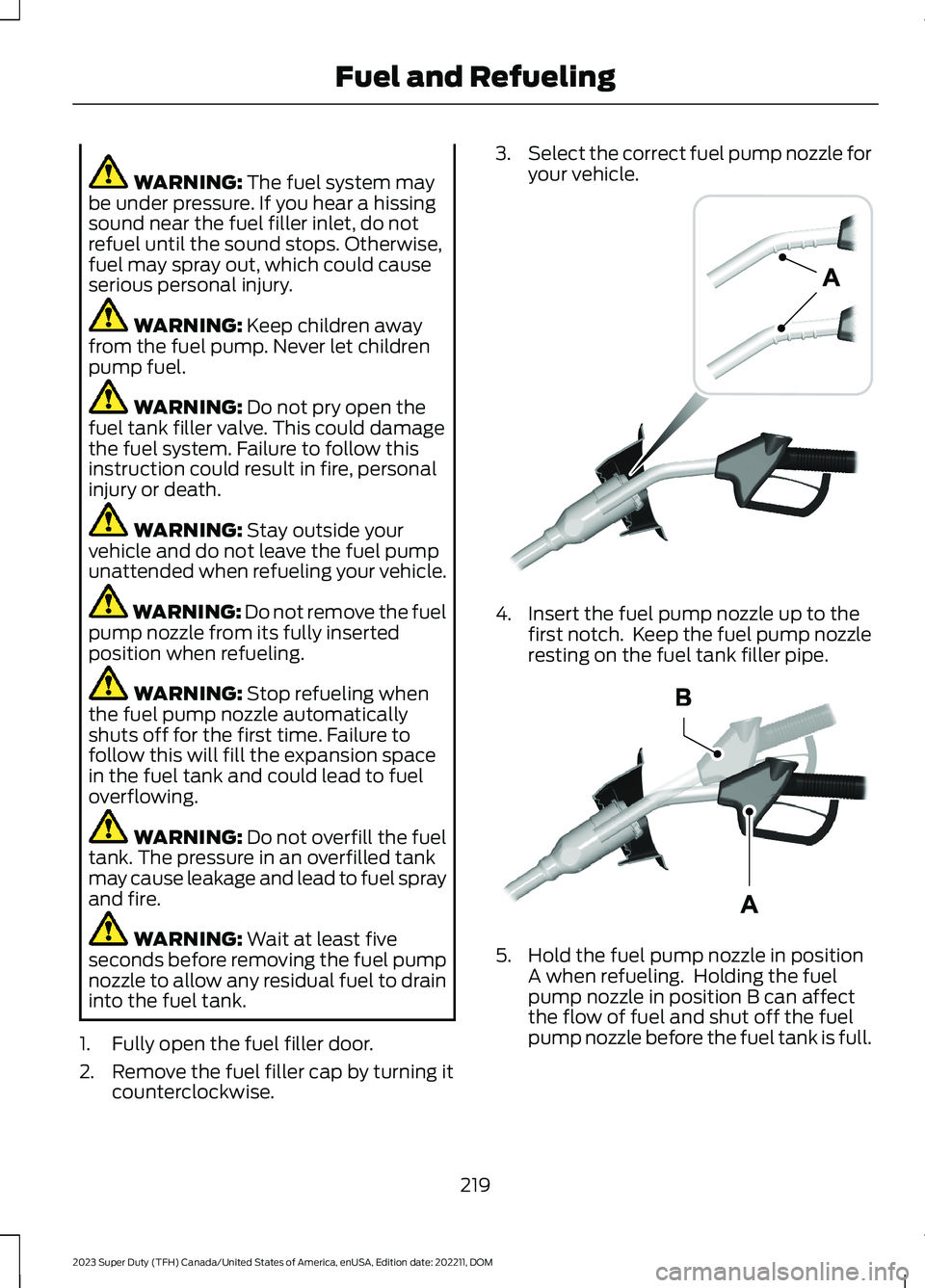
3.Select the correct fuel pump nozzle foryour vehicle.
4.Insert the fuel pump nozzle up to thefirst notch. Keep the fuel pump nozzleresting on the fuel tank filler pipe.
5.Hold the fuel pump nozzle in positionA when refueling. Holding the fuelpump nozzle in position B can affectthe flow of fuel and shut off the fuelpump nozzle before the fuel tank is full.
219
2023 Super Duty (TFH) Canada/United States of America, enUSA, Edition date: 202211, DOMFuel and RefuelingE139202 E327438
Page 224 of 738
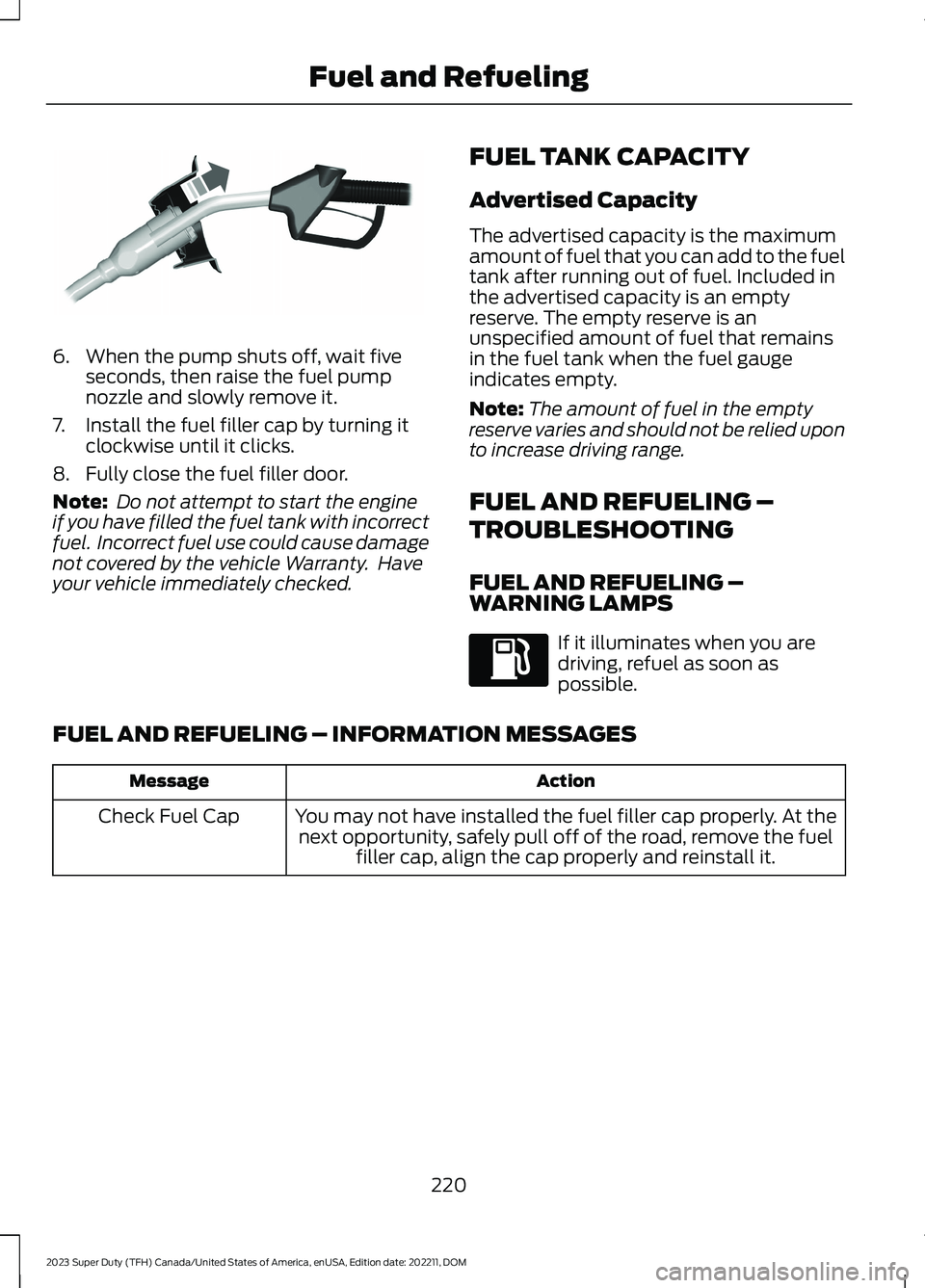
6.When the pump shuts off, wait fiveseconds, then raise the fuel pumpnozzle and slowly remove it.
7.Install the fuel filler cap by turning itclockwise until it clicks.
8.Fully close the fuel filler door.
Note: Do not attempt to start the engineif you have filled the fuel tank with incorrectfuel. Incorrect fuel use could cause damagenot covered by the vehicle Warranty. Haveyour vehicle immediately checked.
FUEL TANK CAPACITY
Advertised Capacity
The advertised capacity is the maximumamount of fuel that you can add to the fueltank after running out of fuel. Included inthe advertised capacity is an emptyreserve. The empty reserve is anunspecified amount of fuel that remainsin the fuel tank when the fuel gaugeindicates empty.
Note:The amount of fuel in the emptyreserve varies and should not be relied uponto increase driving range.
FUEL AND REFUELING –
TROUBLESHOOTING
FUEL AND REFUELING –WARNING LAMPS
If it illuminates when you aredriving, refuel as soon aspossible.
FUEL AND REFUELING – INFORMATION MESSAGES
ActionMessage
You may not have installed the fuel filler cap properly. At thenext opportunity, safely pull off of the road, remove the fuelfiller cap, align the cap properly and reinstall it.
Check Fuel Cap
220
2023 Super Duty (TFH) Canada/United States of America, enUSA, Edition date: 202211, DOMFuel and RefuelingE119081
Page 230 of 738
WHAT IS THE SELECTIVE
CATALYTIC REDUCTION
SYSTEM
The selective catalytic reduction systemhelps reduce tailpipe emissions andrequires Diesel Exhaust Fluid (DEF) toconvert nitrogen oxides into nitrogen andwater.
HOW DOES THE SELECTIVE
CATALYTIC REDUCTION
SYSTEM WORK
The selective catalytic reduction systeminjects diesel exhaust fluid into the exhaustsystem to enable correct selective catalyticreduction system function.
The usage of diesel exhaust fluid hasincreased from prior model years in orderto meet more stringent emissionsrequirements. The diesel exhaust fluidusage ranges from approximately 2-6%of fuel burned (100.00 gal (378.54 L) offuel requires approximately 2.00 gal(7.57 L)to 6.00 gal (22.71 L) of dieselexhaust fluid) depending on vehicle usage.Factors that influence diesel exhaust fluidusage may include:
•Payload/Towing
•Driving Style
•Altitude
•Humidity
•Temperature
SELECTIVE CATALYTIC
REDUCTION SYSTEM
PRECAUTIONS
WARNING: Keep diesel exhaustfluid out of reach of children. Avoidcontact with skin, eyes or clothing. Incase of contact with your eyes, flushimmediately with water and get promptmedical attention. In case of contactwith your skin, clean immediately withsoap and water. If you swallow anydiesel exhaust fluid, drink plenty ofwater, call a physician immediately.
WARNING: Only refill the dieselexhaust fluid tank in a well ventilatedarea. When you remove the dieselexhaust fluid tank filler cap or a dieselexhaust fluid container cap, ammoniavapors may escape. Ammonia vaporscan be irritating to skin, eyes and mucousmembranes. Inhaling ammonia vaporscan cause burning to the eyes, throat andnose and cause coughing and wateryeyes.
WARNING: Diesel exhaust fluidmust be refilled when low or replacedwhen contaminated or your vehiclespeed becomes limited to 50 mph(80 km/h). In these conditions, drive withcaution and refill diesel exhaust fluidimmediately. If the diesel exhaust fluidbecomes empty or contaminated andfluid is not replaced, your vehiclebecomes limited to engine idle only oncestopped. In these conditions, be cautiouswhere you stop your vehicle because youmay not be able to drive long distancesor maintain highway speeds until yourefill or replace the diesel exhaust fluid.
226
2023 Super Duty (TFH) Canada/United States of America, enUSA, Edition date: 202211, DOMSelective Catalytic Reduction System (If Equipped)
Page 233 of 738
If the DEF tank is frozen, it may notrecognize when the tank is refilled. The DEFlevel will update once the tank thaws out.It is best to fill the DEF tank prior to, or aftera drive cycle greater than 20 minutes toallow the remaining frozen DEF in the tankto liquefy. If the tank is overfilled and thefluid freezes it may cause damage thatyour Warranty will not cover.
FILLING THE SELECTIVECATALYTIC REDUCTION SYSTEMTANK USING A FUEL STATIONPUMP
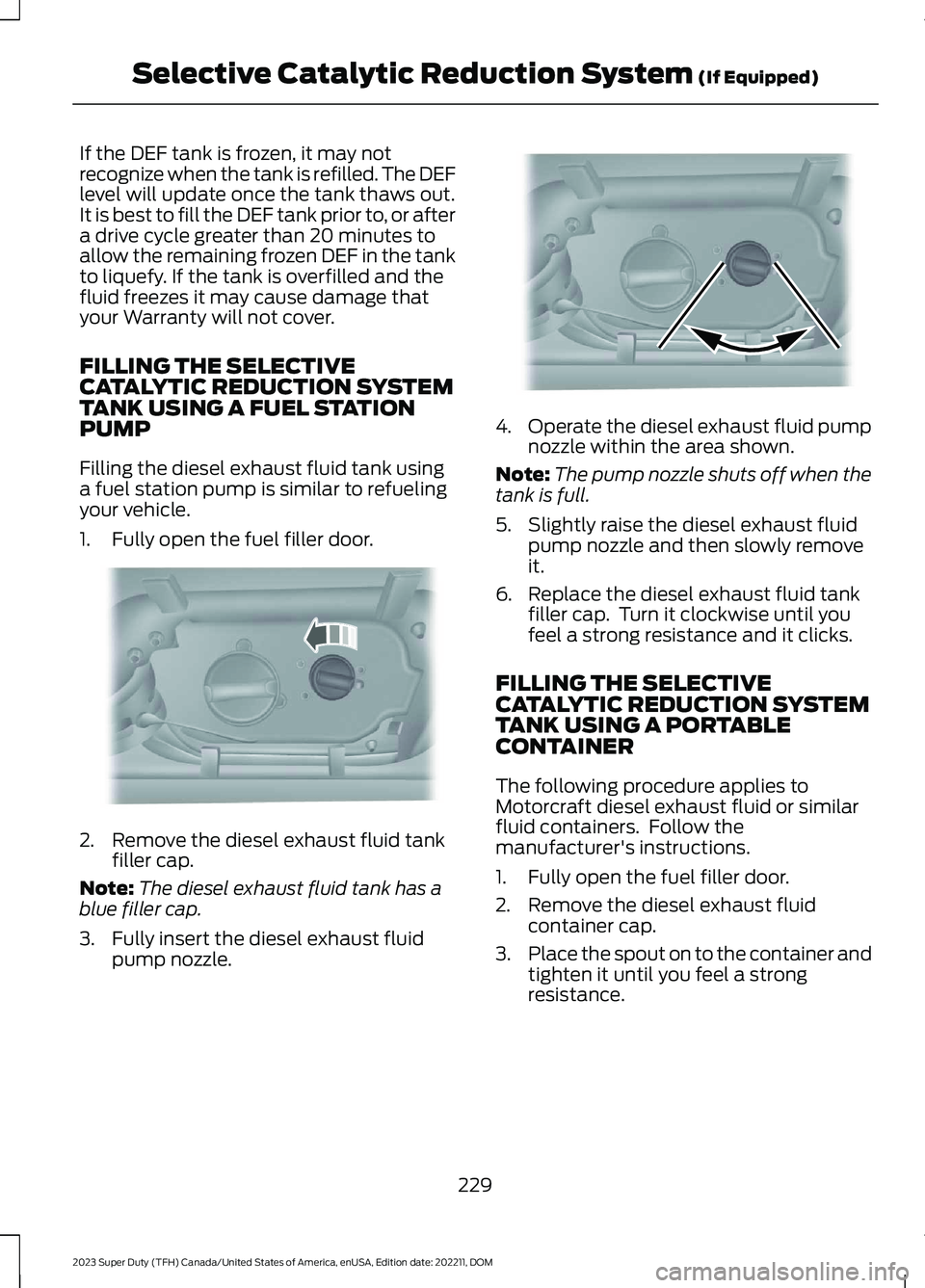
Filling the diesel exhaust fluid tank usinga fuel station pump is similar to refuelingyour vehicle.
1.Fully open the fuel filler door.
2.Remove the diesel exhaust fluid tankfiller cap.
Note:The diesel exhaust fluid tank has ablue filler cap.
3.Fully insert the diesel exhaust fluidpump nozzle.
4.Operate the diesel exhaust fluid pumpnozzle within the area shown.
Note:The pump nozzle shuts off when thetank is full.
5.Slightly raise the diesel exhaust fluidpump nozzle and then slowly removeit.
6.Replace the diesel exhaust fluid tankfiller cap. Turn it clockwise until youfeel a strong resistance and it clicks.
FILLING THE SELECTIVECATALYTIC REDUCTION SYSTEMTANK USING A PORTABLECONTAINER
The following procedure applies toMotorcraft diesel exhaust fluid or similarfluid containers. Follow themanufacturer's instructions.
1.Fully open the fuel filler door.
2.Remove the diesel exhaust fluidcontainer cap.
3.Place the spout on to the container andtighten it until you feel a strongresistance.
229
2023 Super Duty (TFH) Canada/United States of America, enUSA, Edition date: 202211, DOMSelective Catalytic Reduction System (If Equipped)E328788 E328783