seats FORD TAURUS 1997 User Guide
[x] Cancel search | Manufacturer: FORD, Model Year: 1997, Model line: TAURUS, Model: FORD TAURUS 1997Pages: 167, PDF Size: 1.48 MB
Page 66 of 167
IMPORTANT CHILD RESTRAINT PRECAUTIONS
You are required by law to use safety restraints for
children in the U.S. and Canada. If small children
ride in your vehicle (generally children who are four
years old or younger and who weigh 18 kg [40 lbs]
or less), you must put them in safety seats made
especially for children. Check your local and state or
provincial laws for specific requirements regarding
the safety of children in your vehicle.
Never let a passenger hold a child on his or
her lap while the vehicle is moving. The
passenger cannot protect the child from injury in a
collision.
Always follow the instructions and warnings that
come with any infant or child restraint you might
use.
When possible, place children in the rear seat of
your vehicle. Accident statistics suggest that
children are safer when properly restrained in the
rear seating positions than in the front seating
position.
CHILDREN AND SAFETY BELTS
Children who are too large for child safety seats (as
specified by your child safety seat manufacturer)
should always wear safety belts.
Follow all the important safety restraint and air bag
precautions that apply to adult passengers in your
vehicle.
If the shoulder belt portion of a combination lap and
shoulder belt can be positioned so it does not cross
or rest in front of the child's face or neck, the child
should wear the lap and shoulder belt. Moving the
child closer to the center of the vehicle may help
provide a good shoulder belt fit.
If the shoulder belt cannot be properly positioned:
Seating and safety restraints
67
ProCarManuals.com
Page 67 of 167
²move the child to one of the seats with a lap belt
only (if equipped)
OR
²if the child is the proper size, restrain the child in
a safety seat.
Do not leave children, unreliable adults, or
pets unattended in your vehicle.
To improve the fit of lap and shoulder belts on
children who have outgrown child safety seats, Ford
recommends use of a belt-positioning booster seat
that is labelled as conforming to all Federal motor
vehicle safety standards. Belt-positioning booster
seats raise the child and provide a shorter, firmer
seating cushion that encourages safer seating
posture and better fit of lap and shoulder belts on
the child. A belt-positioning booster should be used
if the shoulder belt rests in front of the child's face
or neck, or if the lap belt does not fit snugly on both
thighs, or if the thighs are too short to let the child
sit all the way back on the seat cushion when the
lower legs hang over the edge of the seat cushion.
You may wish to discuss the special needs of your
child with your pediatrician.
SAFETY SEATS FOR CHILDREN
Child and infant or child safety seats
Use a safety seat that is recommended for the size
and weight of the child. Carefully follow all of the
manufacturer's instructions with the cafety seat you
put in your vehicle. If you do not install and use the
safety seat properly, the child may be injured in a
sudden stop or collision.
When installing a child safety seat:
Seating and safety restraints
68
ProCarManuals.com
Page 68 of 167
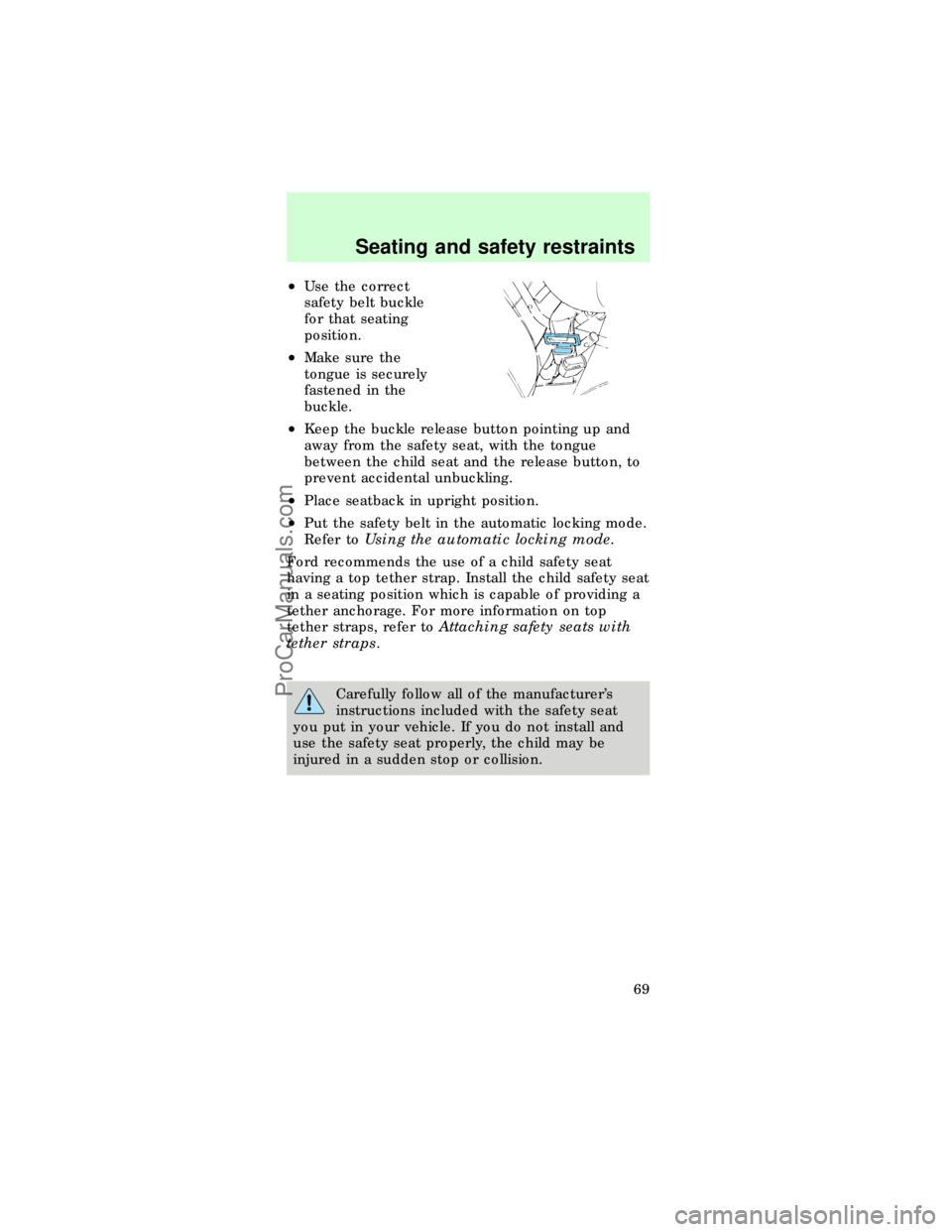
²Use the correct
safety belt buckle
for that seating
position.
²Make sure the
tongue is securely
fastened in the
buckle.
²Keep the buckle release button pointing up and
away from the safety seat, with the tongue
between the child seat and the release button, to
prevent accidental unbuckling.
²Place seatback in upright position.
²Put the safety belt in the automatic locking mode.
Refer toUsing the automatic locking mode.
Ford recommends the use of a child safety seat
having a top tether strap. Install the child safety seat
in a seating position which is capable of providing a
tether anchorage. For more information on top
tether straps, refer toAttaching safety seats with
tether straps.
Carefully follow all of the manufacturer's
instructions included with the safety seat
you put in your vehicle. If you do not install and
use the safety seat properly, the child may be
injured in a sudden stop or collision.
Seating and safety restraints
69
ProCarManuals.com
Page 69 of 167
Installing child safety seats in combination lap
and shoulder belt seating positions
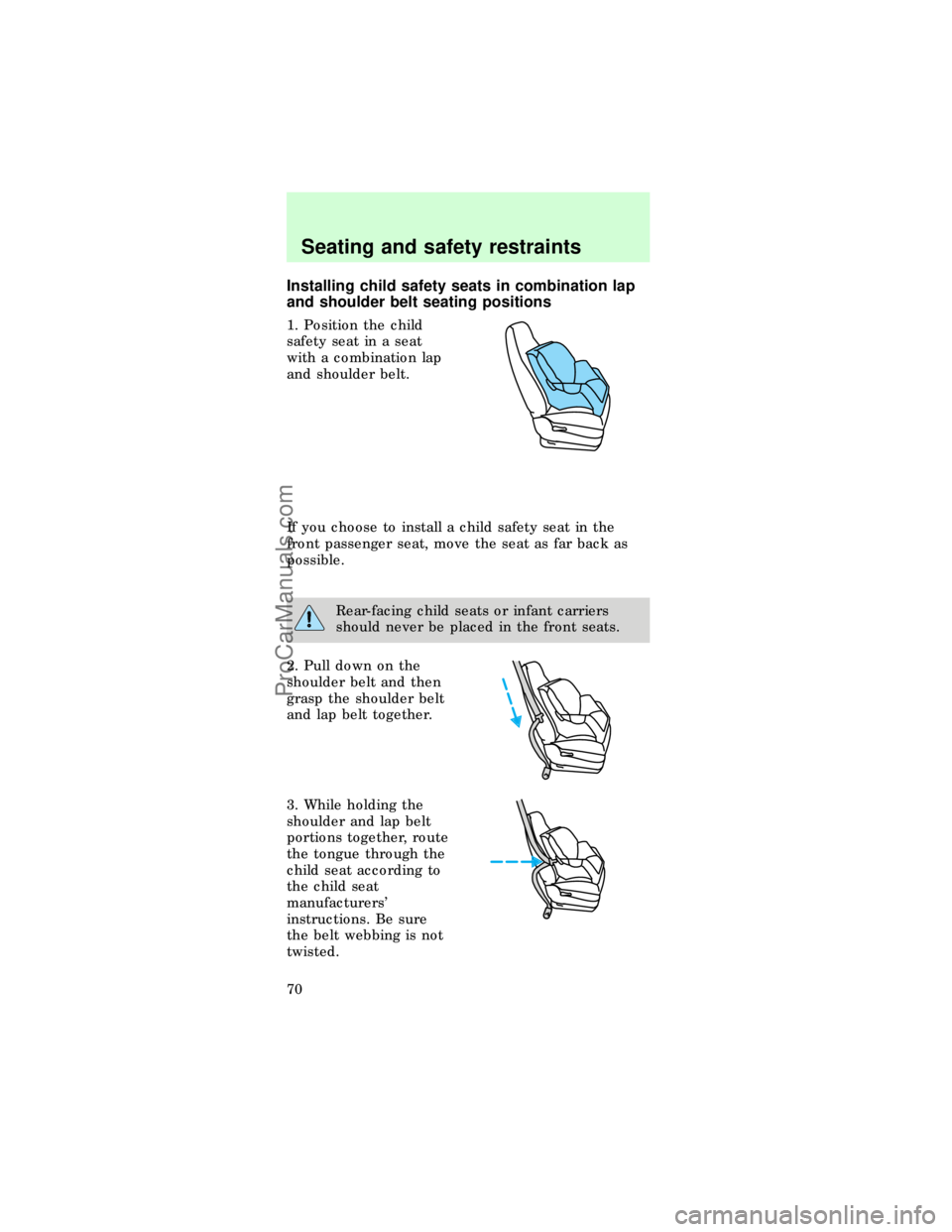
1. Position the child
safety seat in a seat
with a combination lap
and shoulder belt.
If you choose to install a child safety seat in the
front passenger seat, move the seat as far back as
possible.
Rear-facing child seats or infant carriers
should never be placed in the front seats.
2. Pull down on the
shoulder belt and then
grasp the shoulder belt
and lap belt together.
3. While holding the
shoulder and lap belt
portions together, route
the tongue through the
child seat according to
the child seat
manufacturers'
instructions. Be sure
the belt webbing is not
twisted.
Seating and safety restraints
70
ProCarManuals.com
Page 71 of 167
(you should not be able to pull more belt out). If the
retractor is not locked, unbuckle the belt and repeat
steps two through nine.
Check to make sure the child seat is properly
secured before each use.
Attaching safety seats with tether straps
Some manufacturers make safety seats that include
a tether strap that goes over the back of the vehicle
seat and attaches to an anchoring point. Other
manufacturers offer the tether strap as an accessory.
Contact the manufacturer of your child safety seat
for information about ordering a tether strap.
Front seats
To install a tether from a child safety seat in the
front seat:
1. Buckle the lap/shoulder belt (in the seat behind
the front passenger seat in which the child safety
seat will be installed).
2. Pull all the stored belt out of the rear seat
retractor to switch the retractor to automatic locking
mode.
3. Let the retractor wind up the slack from the
lap/shoulder belt.
4. Install the child safety seat in the front seat. Refer
toInstalling child safety seats in combination lap
and shoulder belt seating positions. Hook the
tether strap hook around the webbing near the
center of the shoulder portion of the locked
lap/shoulder belt.
5. Tighten the tether strap.
Rear seats
If you must use a tethered safety seat on one of the
rear seats, you can anchor the strap to the
appropriate tether anchor directly behind that seat
position.
Seating and safety restraints
72
ProCarManuals.com
Page 73 of 167
BUILT-IN CHILD SEATS
Built-in child safety seat (wagon - if equipped)
The second row bench seat may include a built-in
child seat. This child seat conforms to all Federal
and local motor vehicle safety standards. Read the
labels located on the child seat cushion and shoulder
belt for information on the built-in child seat.
Use the built-in child seatonlyif the child is at least
one year old, weighs 10±27 kg (22±60 lbs.) and the
child's shoulders fit below the shoulder harness slots
on the built-in child seat.
Children not meeting these requirements should be
secured in an approved aftermarket seat. Refer to
Children and infant or child safety seatsin this
chapter.
Built-in child seat retractors
The belts on built-in child seats are equipped with a
retractor that locks when both tongues are latched
into the crotch safety belt buckle. The retractor will
automatically snug the belts around the child. If the
belts do not remain snug, take the vehicle to the
dealer for child seat repair. The belts will not snug
during a collision.
Placing your child in the built-in child seat
Failure to follow all of the instructions on
the use of this child restraint system can
result in your child striking the vehicle's interior
during a sudden stop or crash.
Never use the Built-In Child Seat as a
booster cushion with the adult safety belts.
A child using the adult belts could slide forward
and out from under the safety belts.
Seating and safety restraints
74
ProCarManuals.com
Page 76 of 167
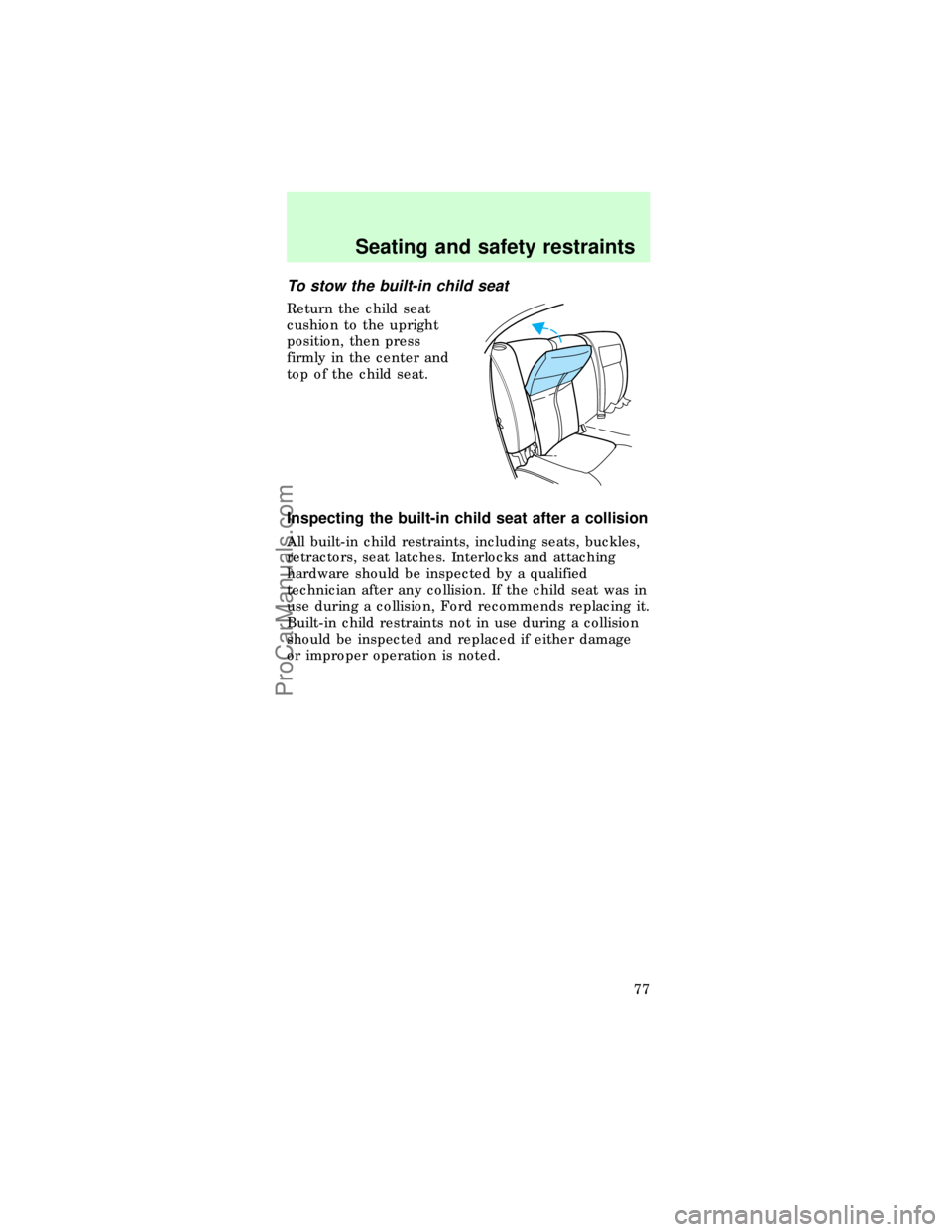
To stow the built-in child seat
Return the child seat
cushion to the upright
position, then press
firmly in the center and
top of the child seat.
Inspecting the built-in child seat after a collision
All built-in child restraints, including seats, buckles,
retractors, seat latches. Interlocks and attaching
hardware should be inspected by a qualified
technician after any collision. If the child seat was in
use during a collision, Ford recommends replacing it.
Built-in child restraints not in use during a collision
should be inspected and replaced if either damage
or improper operation is noted.
Seating and safety restraints
77
ProCarManuals.com
Page 105 of 167
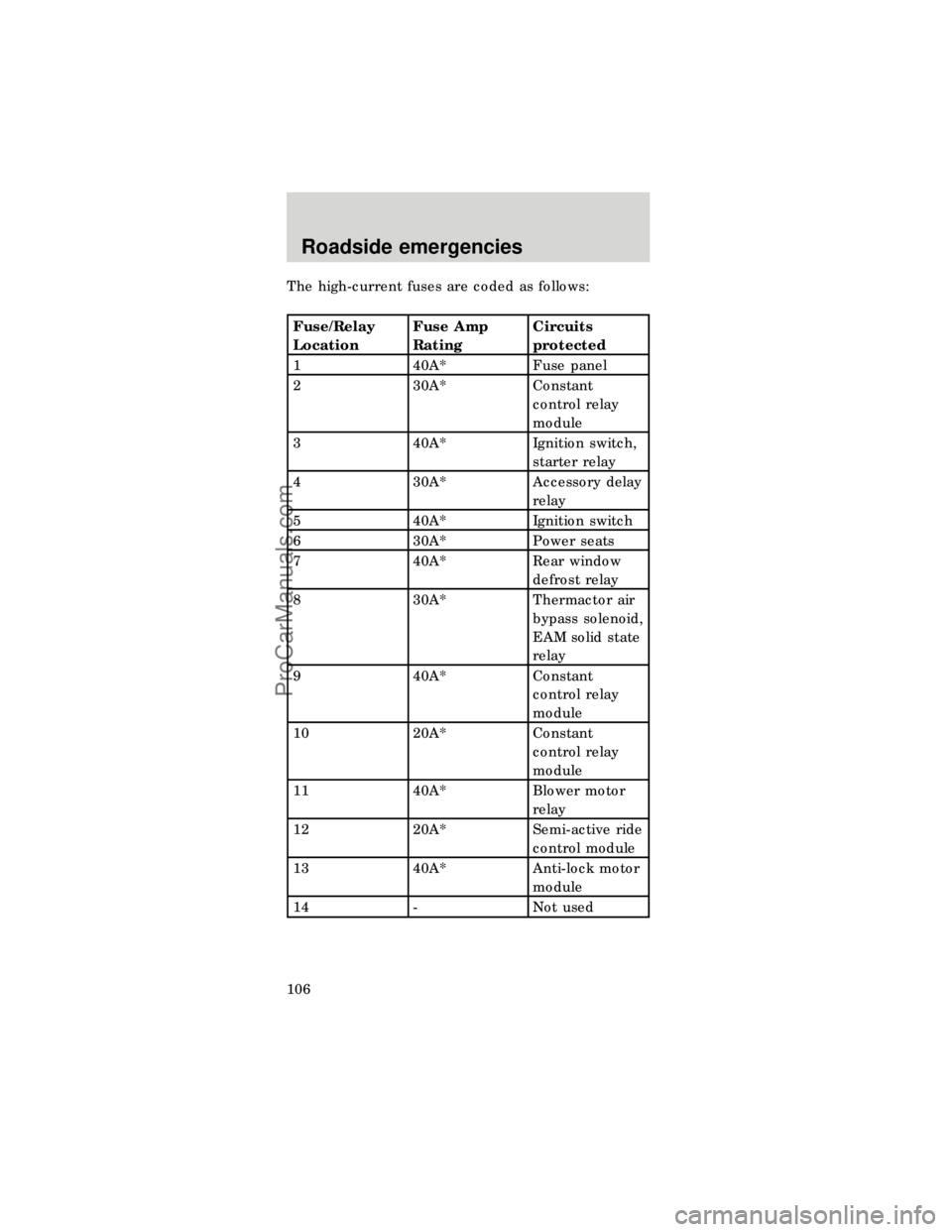
The high-current fuses are coded as follows:
Fuse/Relay
LocationFuse Amp
RatingCircuits
protected
1 40A* Fuse panel
2 30A* Constant
control relay
module
3 40A* Ignition switch,
starter relay
4 30A* Accessory delay
relay
5 40A* Ignition switch
6 30A* Power seats
7 40A* Rear window
defrost relay
8 30A* Thermactor air
bypass solenoid,
EAM solid state
relay
9 40A* Constant
control relay
module
10 20A* Constant
control relay
module
11 40A* Blower motor
relay
12 20A* Semi-active ride
control module
13 40A* Anti-lock motor
module
14 - Not used
Roadside emergencies
106
ProCarManuals.com
Page 154 of 167
Cleaning leather seats (if equipped)
For routine cleaning, wipe the surface with a soft,
damp cloth. For more thorough cleaning, wipe the
surface with a leather and vinyl cleaner or a mild
soap.
Cleaning and maintaining the safety belts
Clean the safety belts with a mild soap solution
recommended for cleaning upholstery or carpets. Do
not bleach or dye the belts, because these actions
may weaken the belt webbing.
Check the safety belt system periodically to make
sure there are no nicks, wear or cuts. If your vehicle
has been involved in an accident, have all the safety
restraints examined by a qualified technician.
Cleaning the built-in child seat (if equipped)
Clean the built-in child seat with mild soap and
water. Do not use household cleaning products
because they may weaken the safety belt webbing or
damage the vinyl parts of the seat.
The child seat liner is removable and may be
machine-washed and air dried.
Maintenance and care
155
ProCarManuals.com