fuel FORD TAURUS 1998 3.G User Guide
[x] Cancel search | Manufacturer: FORD, Model Year: 1998, Model line: TAURUS, Model: FORD TAURUS 1998 3.GPages: 192, PDF Size: 1.66 MB
Page 93 of 192

Pull the release lever
to release the brake.
Driving with the
parking brake on will
cause the brakes to
wear out quickly and
reduce fuel economy.
STEERING
Your vehicle is equipped with power steering. Power
steering uses energy from the engine to help steer
the vehicle.
To prevent damage to the power steering pump:
²Never hold the steering wheel to the extreme
right or the extreme left for more than a few
seconds when the engine is running.
²Do not operate the vehicle with a low power
steering pump fluid level.
If the power steering system breaks down (or if the
engine is turned off), you can steer the vehicle
manually, but it takes more effort.
If the steering wanders or pulls, the condition could
be caused by any of the following:
²underinflated tire(s) on any wheel(s)
²high crown in center of road
²high crosswinds
²wheels out of alignment
²loose or worn components in steering linkage
Driving
93
Page 95 of 192
Always set the parking brake fully and make
sure the gearshift is latched in P (Park).
Turn off the ignition whenever you leave your
vehicle.
Driving with an automatic overdrive transaxle
(column or console gearshift without O/D off
switch)
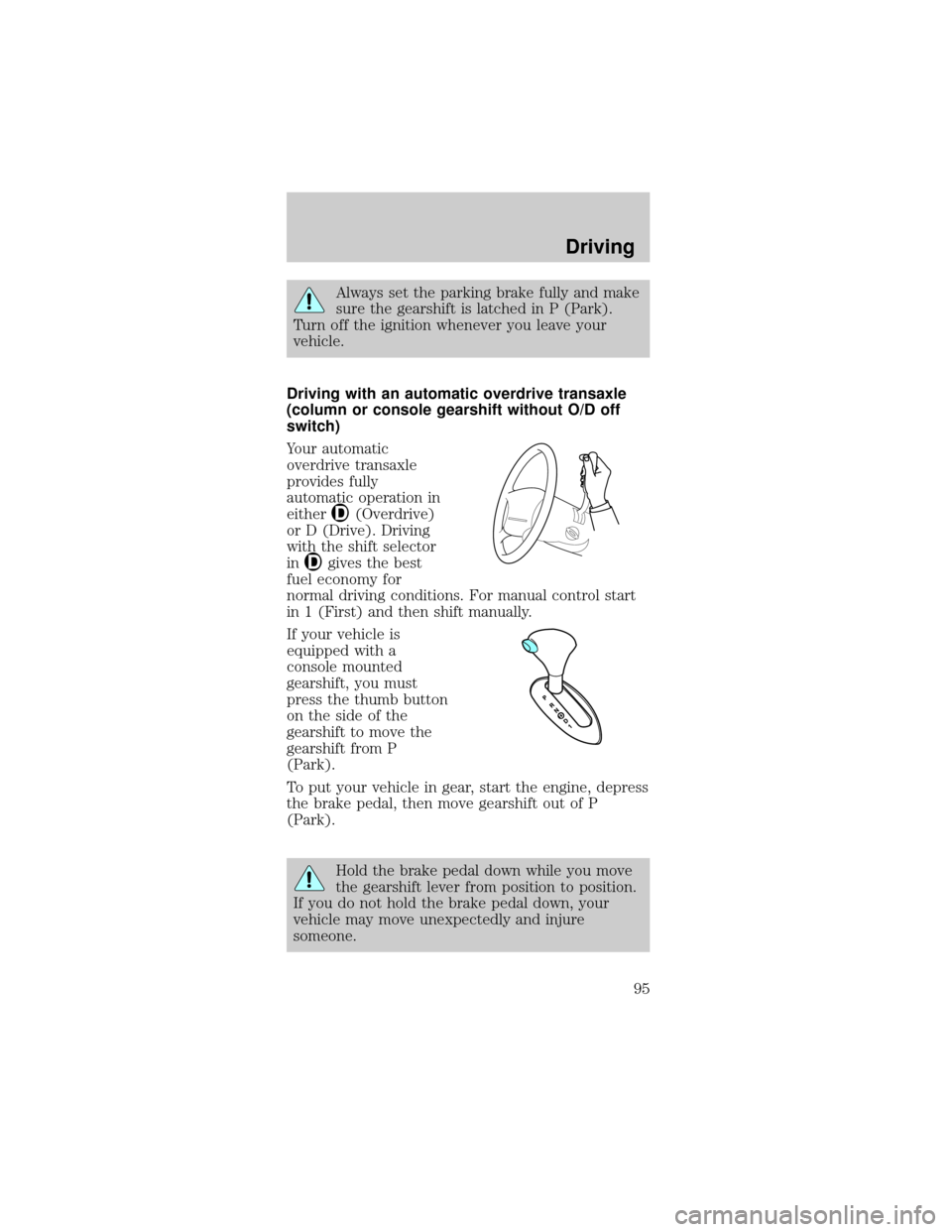
Your automatic
overdrive transaxle
provides fully
automatic operation in
either
(Overdrive)
or D (Drive). Driving
with the shift selector
in
gives the best
fuel economy for
normal driving conditions. For manual control start
in 1 (First) and then shift manually.
If your vehicle is
equipped with a
console mounted
gearshift, you must
press the thumb button
on the side of the
gearshift to move the
gearshift from P
(Park).
To put your vehicle in gear, start the engine, depress
the brake pedal, then move gearshift out of P
(Park).
Hold the brake pedal down while you move
the gearshift lever from position to position.
If you do not hold the brake pedal down, your
vehicle may move unexpectedly and injure
someone.
Driving
95
Page 96 of 192
Driving with an automatic overdrive transaxle
(column or console gearshift with O/D off
switch)
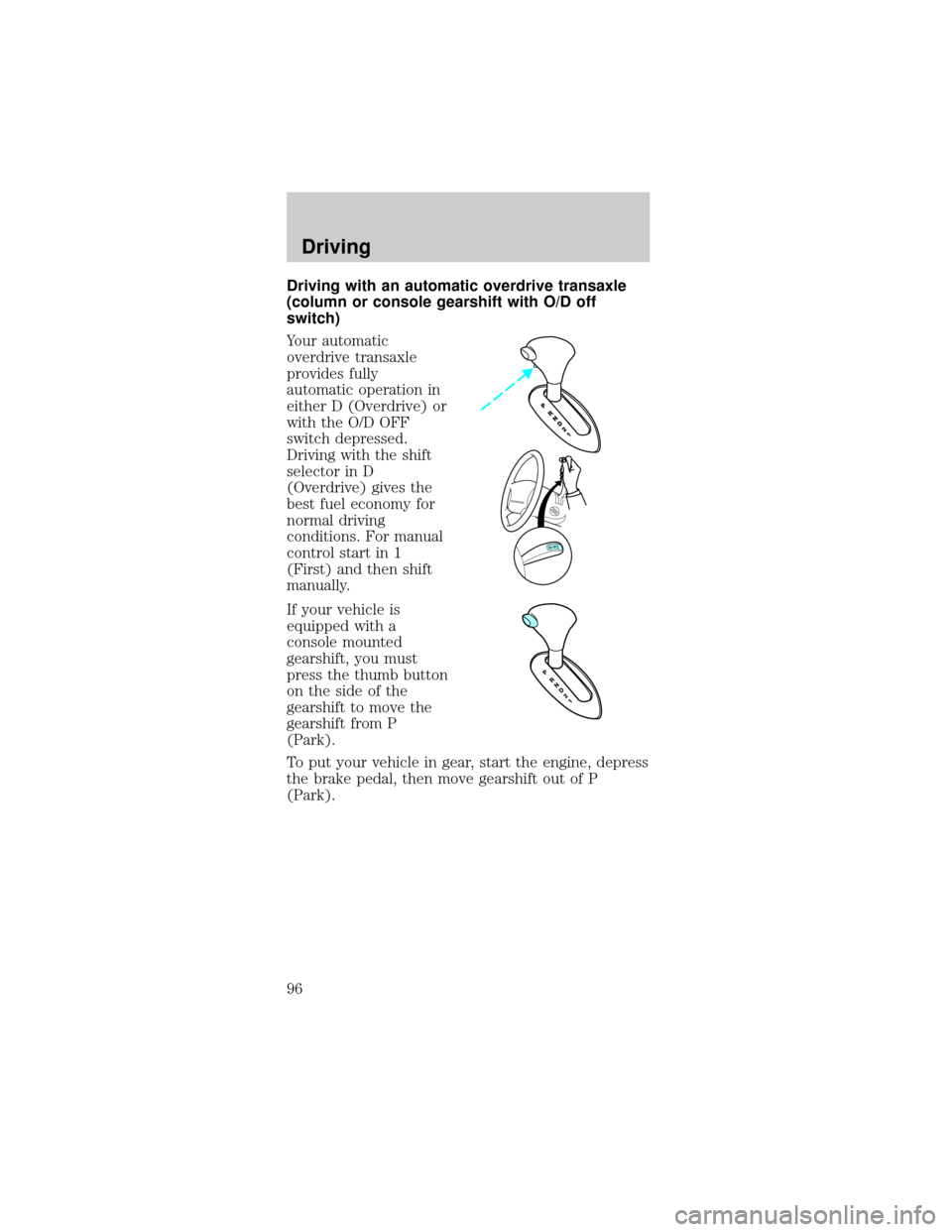
Your automatic
overdrive transaxle
provides fully
automatic operation in
either D (Overdrive) or
with the O/D OFF
switch depressed.
Driving with the shift
selector in D
(Overdrive) gives the
best fuel economy for
normal driving
conditions. For manual
control start in 1
(First) and then shift
manually.
If your vehicle is
equipped with a
console mounted
gearshift, you must
press the thumb button
on the side of the
gearshift to move the
gearshift from P
(Park).
To put your vehicle in gear, start the engine, depress
the brake pedal, then move gearshift out of P
(Park).
Driving
96
Page 98 of 192
N (Neutral)
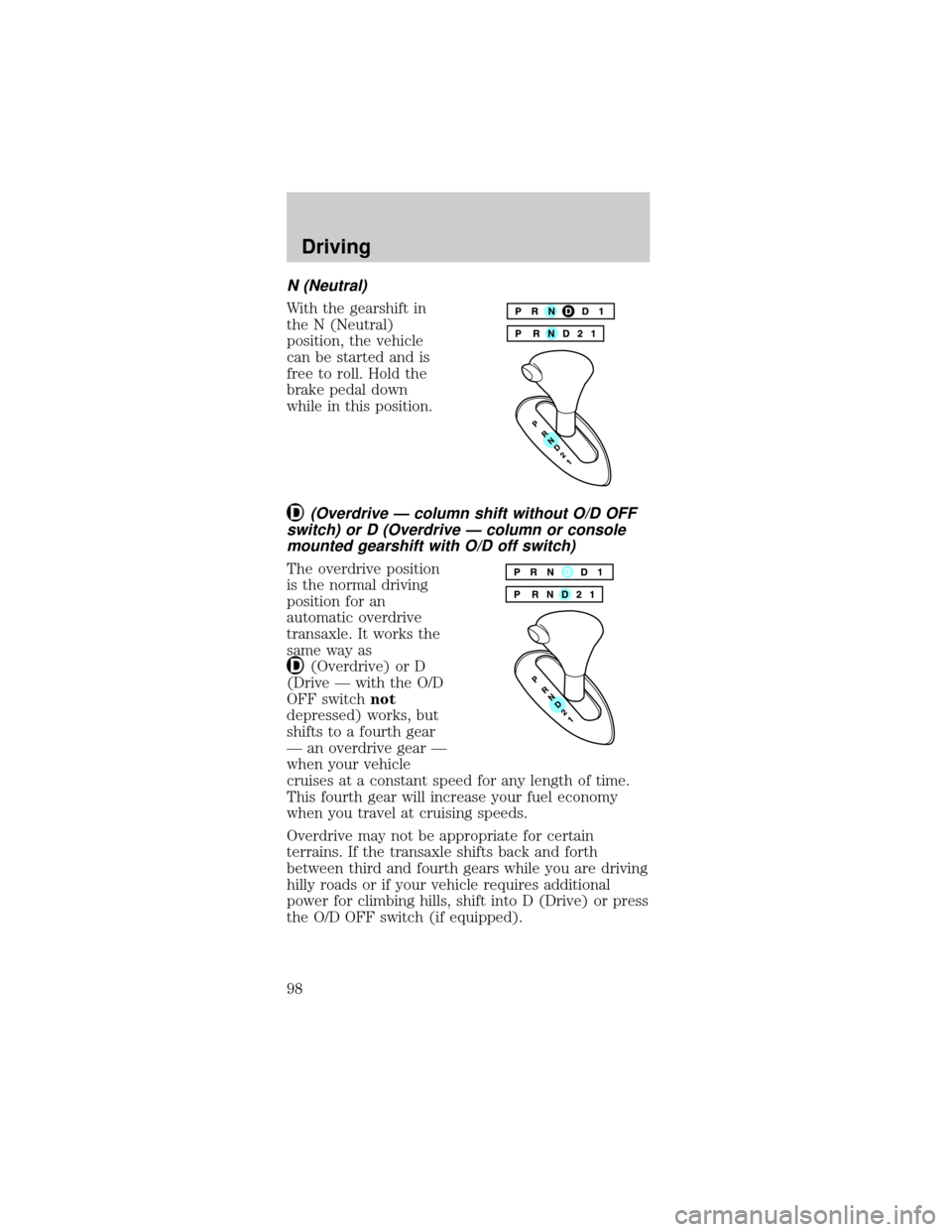
With the gearshift in
the N (Neutral)
position, the vehicle
can be started and is
free to roll. Hold the
brake pedal down
while in this position.
(Overdrive Ð column shift without O/D OFF
switch) or D (Overdrive Ð column or console
mounted gearshift with O/D off switch)
The overdrive position
is the normal driving
position for an
automatic overdrive
transaxle. It works the
same way as
(Overdrive) or D
(Drive Ð with the O/D
OFF switchnot
depressed) works, but
shifts to a fourth gear
Ð an overdrive gear Ð
when your vehicle
cruises at a constant speed for any length of time.
This fourth gear will increase your fuel economy
when you travel at cruising speeds.
Overdrive may not be appropriate for certain
terrains. If the transaxle shifts back and forth
between third and fourth gears while you are driving
hilly roads or if your vehicle requires additional
power for climbing hills, shift into D (Drive) or press
the O/D OFF switch (if equipped).
Driving
98
Page 106 of 192
Trailer brakes
Electric brakes and manual, automatic or surge-type
brakes are safe if installed properly and adjusted to
the manufacturer's specifications. The trailer brakes
must meet local and Federal regulations.
Do not connect a trailer's hydraulic brake
system directly to your vehicle's brake
system. Your vehicle may not have enough braking
power and your chances of having a collision
greatly increase.
The braking system of the tow vehicle is rated for
operation at the GVWR not GCWR.
Trailer lamps
Trailer lamps are required on most towed vehicles.
Make sure your trailer lamps conform to local and
Federal regulations. See your dealer or trailer rental
agency for proper instructions and equipment for
hooking up trailer lamps.
Driving while you tow
Do not drive faster than 88 km/h (55 mph) when
towing a trailer. Do not drive faster than 72 km/h
(45 mph) with any weight on the trailer while
towing on a hot day or in hilly country.
Speed control may shut off if you are towing on
long, steep grades.
When towing a trailer:
²Use D (Drive) or a lower gear when towing up or
down steep hills. This will eliminate excessive
downshifting and upshifting for optimum fuel
economy and transaxle cooling.
²Anticipate stops and brake gradually.
Driving
106
Page 109 of 192

HAZARD LIGHTS CONTROL
Use only in an emergency to warn traffic of vehicle
breakdown, approaching danger, etc. The hazard
flashers can be operated when the ignition is off.
²The hazard lights
control is located on
top of the steering
column.
²Depress hazard
lights control to
activate all hazard
flashers
simultaneously.
²Depress control again to turn the flashers off.
FUEL PUMP SHUT-OFF SWITCH
After a collision, if the engine cranks but does not
start, the fuel pump shut-off switch may have been
activated. The shut-off switch is a device intended to
stop the electric fuel pump when your vehicle has
been involved in a substantial jolt.
1. Turn the ignition to the OFF position.
2. Check the fuel system for leaks.
3. If no fuel leak is apparent, reset the fuel pump
shut-off switch by pushing in the button on the
switch.
4. Turn the ignition to the ON position. Pause for a
few seconds and return the key to the OFF position.
5. Make a further check for leaks in the fuel system.
Roadside emergencies
109
Page 110 of 192
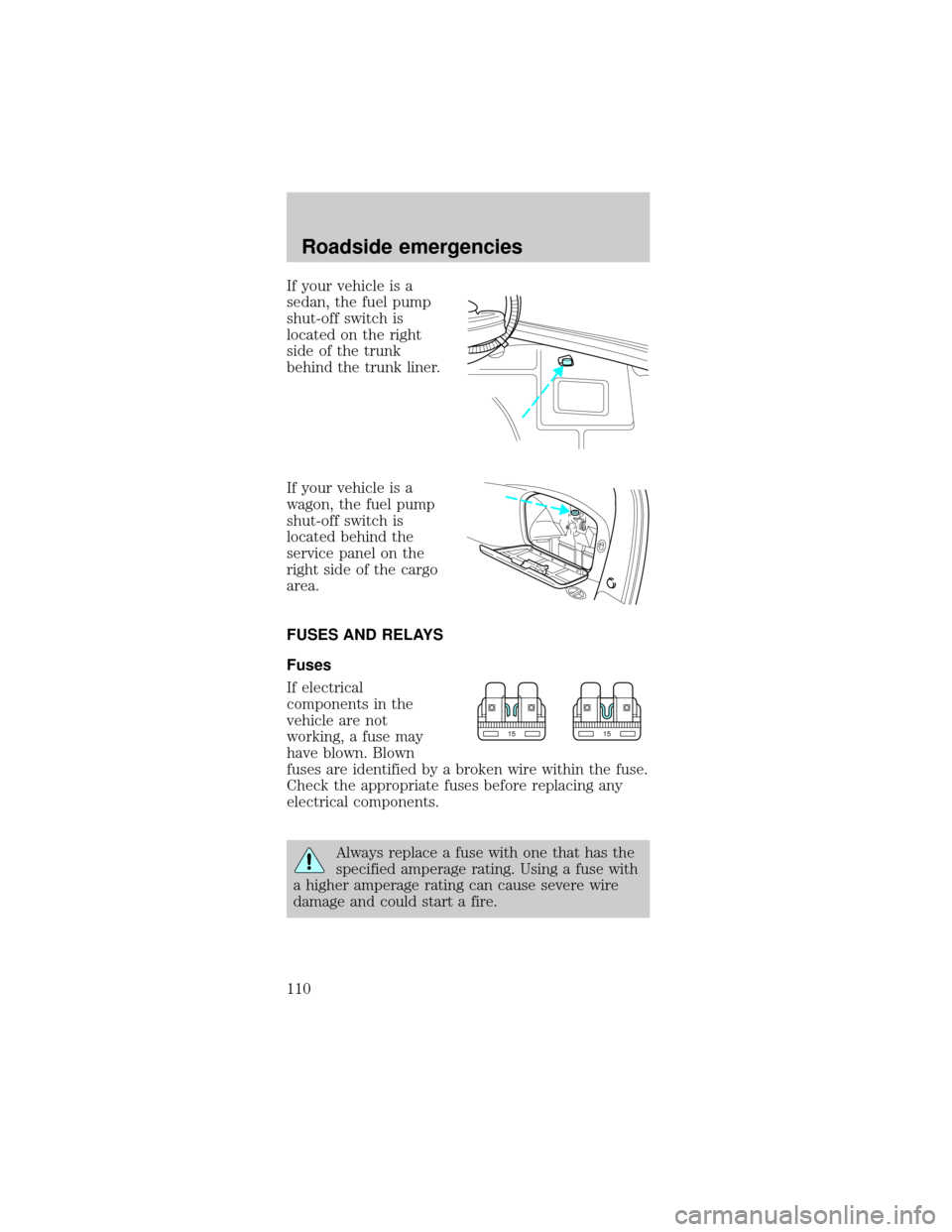
If your vehicle is a
sedan, the fuel pump
shut-off switch is
located on the right
side of the trunk
behind the trunk liner.
If your vehicle is a
wagon, the fuel pump
shut-off switch is
located behind the
service panel on the
right side of the cargo
area.
FUSES AND RELAYS
Fuses
If electrical
components in the
vehicle are not
working, a fuse may
have blown. Blown
fuses are identified by a broken wire within the fuse.
Check the appropriate fuses before replacing any
electrical components.
Always replace a fuse with one that has the
specified amperage rating. Using a fuse with
a higher amperage rating can cause severe wire
damage and could start a fire.
1515
Roadside emergencies
110
Page 115 of 192

Fuse/
Relay
LocationFuse
Amp
RatingDescription
7 40A** Rear Window Defrost Relay
8 30A** Thermactor Air ByPass
Solenoid, EAM Solid State
Relay
9 40A** High Speed Cooling Fan Relay,
Low Speed Cooling Fan Relay
10 20A** Fuel Pump Relay
11 40A** Blower Motor Relay
12 20A** Semi-Active Ride Control
Module
13 40A** Anti-Lock Brake Module
14 Ð Not Used
15 15A* Daytime Running Lamps
(DRL) Module
16 10A* Air Bag Diagnostic Monitor
17 20A* Rear Control Unit, CD Changer
18 30A* Anti-Lock Brake Module
19 15A* Horn Relay, Powertrain
Control Module (PCM)
20 15A* Headlamp Switch, Autolamp
Park Relay
21 Ð Not Used
22 30A* Autolamps Relay,
Multi-Function Switch,
Headlamp Switch
23 Ð Blower Motor Relay
24 Ð Starter Relay
25 Ð A/C Clutch Relay
26 30A* Generator/Voltage Regulator
27 10A* A/C Clutch Relay
28 15A* Heated Oxygen Sensors,
Canister Vent
Roadside emergencies
115
Page 116 of 192
Fuse/
Relay
LocationFuse
Amp
RatingDescription
29 Ð Fuel Pump Relay
30 Ð PCM Relay
31 Ð Low Speed Cooling Fan Relay
32 Ð PCM Diode
33 Ð A/C Clutch Diode
34 Ð Not Used
* Mini Fuses ** Maxi Fuses
1Fuses 4 and 6 will vary depending on date of
vehicle build.
Relays
Relays are located in the power distribution box and
should be replaced by qualified technicians.
CHANGING THE TIRES
If you get a flat tire while driving, do not apply the
brake heavily. Instead, gradually decrease your
speed. Hold the steering wheel firmly and slowly
move to a safe place on the side of the road.
Temporary spare tire information
The temporary spare tire for your vehicle is labeled
as such. It is smaller than a regular tire and is
designed for emergency use only.
If you use the temporary spare tire
continuously or do not follow these
precautions, the tire could fail, causing you to lose
control of the vehicle, possibly injuring yourself or
others.
Roadside emergencies
116
Page 124 of 192
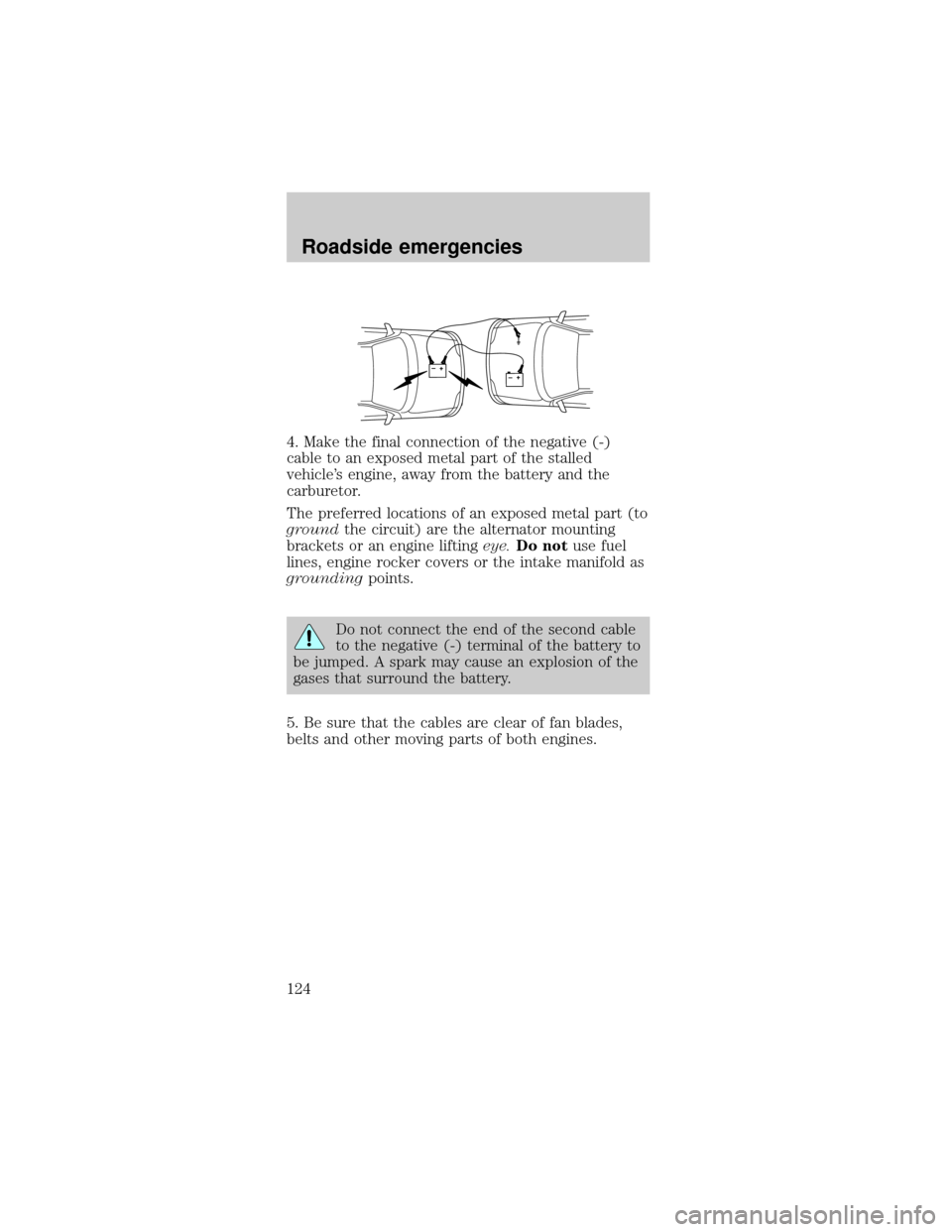
4. Make the final connection of the negative (-)
cable to an exposed metal part of the stalled
vehicle's engine, away from the battery and the
carburetor.
The preferred locations of an exposed metal part (to
groundthe circuit) are the alternator mounting
brackets or an engine liftingeye.Do notuse fuel
lines, engine rocker covers or the intake manifold as
groundingpoints.
Do not connect the end of the second cable
to the negative (-) terminal of the battery to
be jumped. A spark may cause an explosion of the
gases that surround the battery.
5. Be sure that the cables are clear of fan blades,
belts and other moving parts of both engines.
+–+–
Roadside emergencies
124