fuel FORD TAURUS 1998 3.G Owner's Manual
[x] Cancel search | Manufacturer: FORD, Model Year: 1998, Model line: TAURUS, Model: FORD TAURUS 1998 3.GPages: 192, PDF Size: 1.66 MB
Page 128 of 192
SERVICE RECOMMENDATIONS
To help you service your vehicle:
²We highlight do-it-yourself items in the engine
compartment for easy location.
²We provide a ªService Guideº which makes
tracking routine service easy.
If your vehicle requires professional service, your
dealership can provide necessary parts and service.
Check your ªWarranty Guideº to find out which parts
and services are covered.
Use only recommended fuels, lubricants, fluids and
service parts conforming to specifications. Motorcraft
parts are designed and built to provide the best
performance in your vehicle.
PRECAUTIONS WHEN SERVICING YOUR
VEHICLE
Be especially careful when inspecting or servicing
your vehicle.
²Do not work on a hot engine.
²When the engine is running, avoid wearing loose
clothing, jewelry or long hair that could get
caught up in moving parts.
²Do not work on a vehicle with the engine running
in an enclosed space, unless you are sure you
have enough ventilation.
²Keep all lit cigarettes, open flames and other lit
material away from the battery and all fuel related
parts.
If you disconnect the battery, the engine must
ªrelearnº its idle conditions before your vehicle will
drive properly, as explained in theBatterysection in
this chapter.
Working with the engine off
1. Set the parking brake, and ensure the gearshift is
securely latched in park.
Maintenance and care
128
Page 137 of 192
WINDSHIELD WASHER FLUID
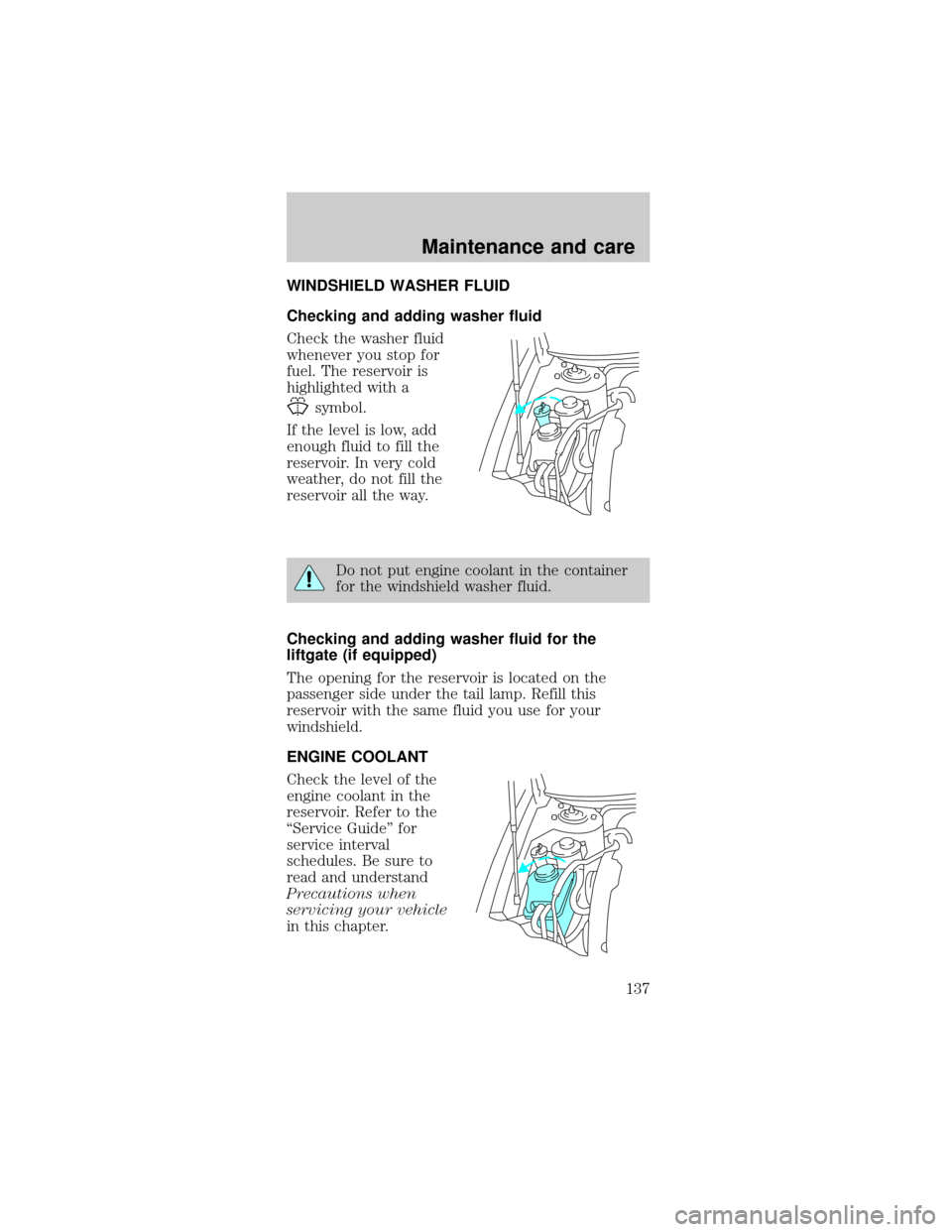
Checking and adding washer fluid
Check the washer fluid
whenever you stop for
fuel. The reservoir is
highlighted with a
symbol.
If the level is low, add
enough fluid to fill the
reservoir. In very cold
weather, do not fill the
reservoir all the way.
Do not put engine coolant in the container
for the windshield washer fluid.
Checking and adding washer fluid for the
liftgate (if equipped)
The opening for the reservoir is located on the
passenger side under the tail lamp. Refill this
reservoir with the same fluid you use for your
windshield.
ENGINE COOLANT
Check the level of the
engine coolant in the
reservoir. Refer to the
ªService Guideº for
service interval
schedules. Be sure to
read and understand
Precautions when
servicing your vehicle
in this chapter.
Maintenance and care
137
Page 149 of 192
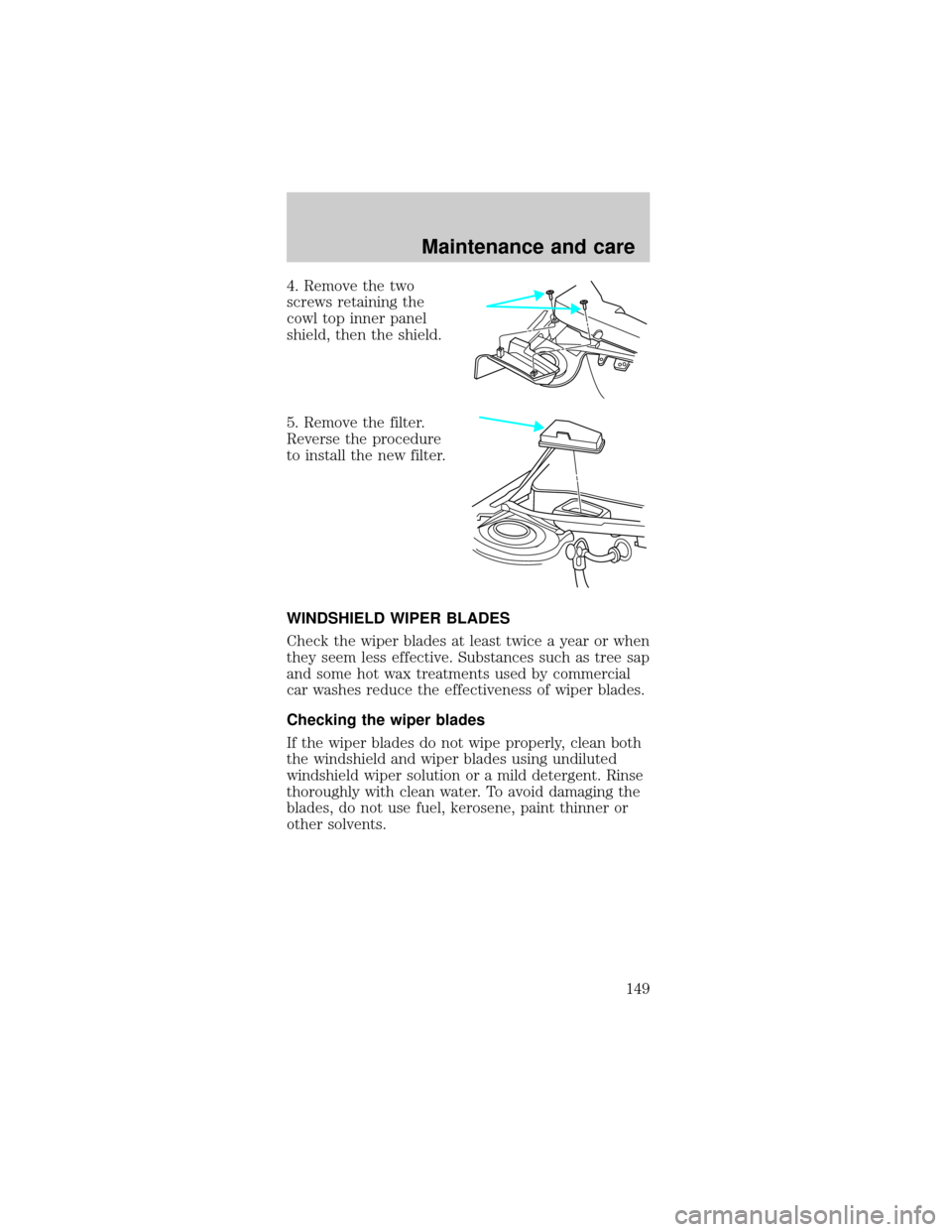
4. Remove the two
screws retaining the
cowl top inner panel
shield, then the shield.
5. Remove the filter.
Reverse the procedure
to install the new filter.
WINDSHIELD WIPER BLADES
Check the wiper blades at least twice a year or when
they seem less effective. Substances such as tree sap
and some hot wax treatments used by commercial
car washes reduce the effectiveness of wiper blades.
Checking the wiper blades
If the wiper blades do not wipe properly, clean both
the windshield and wiper blades using undiluted
windshield wiper solution or a mild detergent. Rinse
thoroughly with clean water. To avoid damaging the
blades, do not use fuel, kerosene, paint thinner or
other solvents.
Maintenance and care
149
Page 154 of 192
Tires that are larger or smaller than your vehicle's
original tires may also affect the accuracy of your
speedometer.
SNOW TIRES AND CHAINS
Snow tires must be the same size and grade
as the tires you currently have on your
vehicle.
The tires on your vehicle have all weather treads to
provide traction in rain and snow. However, in some
climates, you may need to use snow tires and
chains. If you need to use snow tires and chains, it is
recommended that steel wheels are used of the
same size and specifications as those originally
installed.
Follow these guidelines when using snow tires and
chains:
²Use only SAE Class S chains.
²Install chains securely, verifying that the chains do
not touch any wiring, brake lines or fuel lines.
²Drive cautiously. If you hear the chains rub or
bang against your vehicle, stop and re-tighten the
chains. If this does not work, remove the chains
to prevent damage to your vehicle.
²If possible, avoid fully loading your vehicle.
²Do not use tire chains if your vehicle is equipped
with P225/55ZR16 tires.
²Remove the tire chains when they are no longer
needed. Do not use tire chains on dry roads.
²The suspension insulation and bumpers will help
prevent vehicle damage. Do not remove these
components from your vehicle when using snow
tires and chains.
Maintenance and care
154
Page 155 of 192
WHAT YOU SHOULD KNOW ABOUT
AUTOMOTIVE FUELS
Important safety precautions
Do not overfill the fuel tank. The pressure in
an overfilled tank may cause leakage and
lead to fuel spray and fire.
If you do not use the proper fuel cap, the
pressure in the fuel tank can damage the
fuel system or cause it to work improperly in a
collision.
The fuel system may be under pressure. If
the fuel cap is venting vapor or if you hear a
hissing sound, wait until it stops before completely
removing the cap.
Automotive fuels can cause serious injury or
death if misused or mishandled.
Observe the following guidelines when handling
automotive fuel:
²Extinguish all
smoking materials
and any open flames
before fueling your
vehicle.
²Always turn off the
vehicle before
fueling.
Maintenance and care
155
Page 156 of 192
²Automotive fuels can be harmful or fatal if
swallowed. Fuel such as gasoline is highly toxic
and if swallowed can cause death or permanent
injury. If fuel is swallowed, call a physician
immediately, even if no symptoms are immediately
apparent. The toxic effects of fuel may not be
visible for hours.
²Avoid inhaling fuel vapors. Inhaling too much fuel
vapor of any kind can lead to eye and respiratory
tract irritation. In severe cases, excessive or
prolonged breathing of fuel vapor can cause
serious illness and permanent injury.
²Avoid getting fuel liquid in your eyes. If fuel is
splashed in the eyes, remove contact lenses (if
worn), flush with water for 15 minutes and seek
medical attention. Failure to seek proper medical
attention could lead to permanent injury.
²Fuels can also be harmful if absorbed through the
skin. If fuel is splashed on the skin and/or
clothing, promptly remove contaminated clothing
and wash skin thoroughly with soap and water.
Repeated or prolonged skin contact with fuel
liquid or vapor causes skin irritation.
²Be particularly careful if you are taking
ªAntabuseº or other forms of disulfiram for the
treatment of alcoholism. Breathing gasoline
vapors, or skin contact could cause an adverse
reaction. In sensitive individuals, serious personal
injury or sickness may result. If fuel is splashed
on the skin, promptly wash skin thoroughly with
soap and water. Consult a physician immediately
if you experience an adverse reaction.
Fuel Filler Cap
Your fuel tank filler cap has an indexed design with
a one-eighth turn on/off feature.
When fueling your vehicle:
1. Turn the engine off.
Maintenance and care
156
Page 157 of 192
2. Carefully turn the filler cap counterclockwise 1/8
of a turn until it stops.
3. Pull to remove the cap from the fuel filler pipe.
4. To install the cap, align the tabs on the cap with
the notches on the filler pipe.
5. Turn the filler cap clockwise 1/8 of a turn until it
stops.
If the ªService Engine Soon/Check Engine ª indicator
comes on and stays on when you start the engine,
the fuel filler cap may not be properly installed.
Turn off the engine, remove the fuel filler cap and
reinstall it being careful to align the cap properly.
If you must replace the fuel filler cap, replace
it with an authorized Motorcraft part. The
customer warranty may be void for any damage
to the fuel tank or fuel system if an authorized
Motorcraft fuel filler cap is not used.
The fuel system may be under pressure. If
the fuel filler cap is venting vapor or if you
hear a hissing sound, wait until it stops before
completely removing the fuel filler cap. Otherwise,
fuel may spray out and injure you or others.
If you do not use the proper fuel filler cap,
the pressure in the fuel tank can damage
the fuel system or cause it to work improperly in a
collision.
Maintenance and care
157
Page 158 of 192
Choosing the right fuel
Use only UNLEADED FUEL. The use of leaded fuel
is prohibited by law and could damage your vehicle.
Your vehicle was not designed to use fuel or fuel
additives with metallic compounds, including
manganese-based compounds containing (MMT).
Vehicles certified to meet California emission
standards (indicated on the underhood Vehicle
Emissions Control Information label) are designed to
operate on California reformulated gasolines. If
California reformulated gasoline is not available
when you refuel, your vehicle can be operated on
non-California fuels. However, even though your
engine will perform adequately on other gasolines,
the performance of the emission control devices and
systems may be adversely affected.
Repair of damage caused by using a fuel for which
your vehicle was not designed may not be covered
by your warranty.
Octane recommendations
3.0L V6 Vulcan and Duratec engines
Your vehicle is
designed to use
ªRegularº unleaded
gasoline with an
(R+M)/2 octane rating of 87. We do not recommend
the use of gasolines labeled as ªRegularº that are
sold with octane ratings of 86 or lower in high
altitude areas.
Do not be concerned if your engine sometimes
knocks lightly. However, if it knocks heavily under
most driving conditions while you are using fuel with
the recommended octane rating, see your dealer or
a qualified service technician to prevent any engine
damage.
87(R+M)/2 METHOD
Maintenance and care
158
Page 159 of 192
3.4L-32V V8 SHO engine
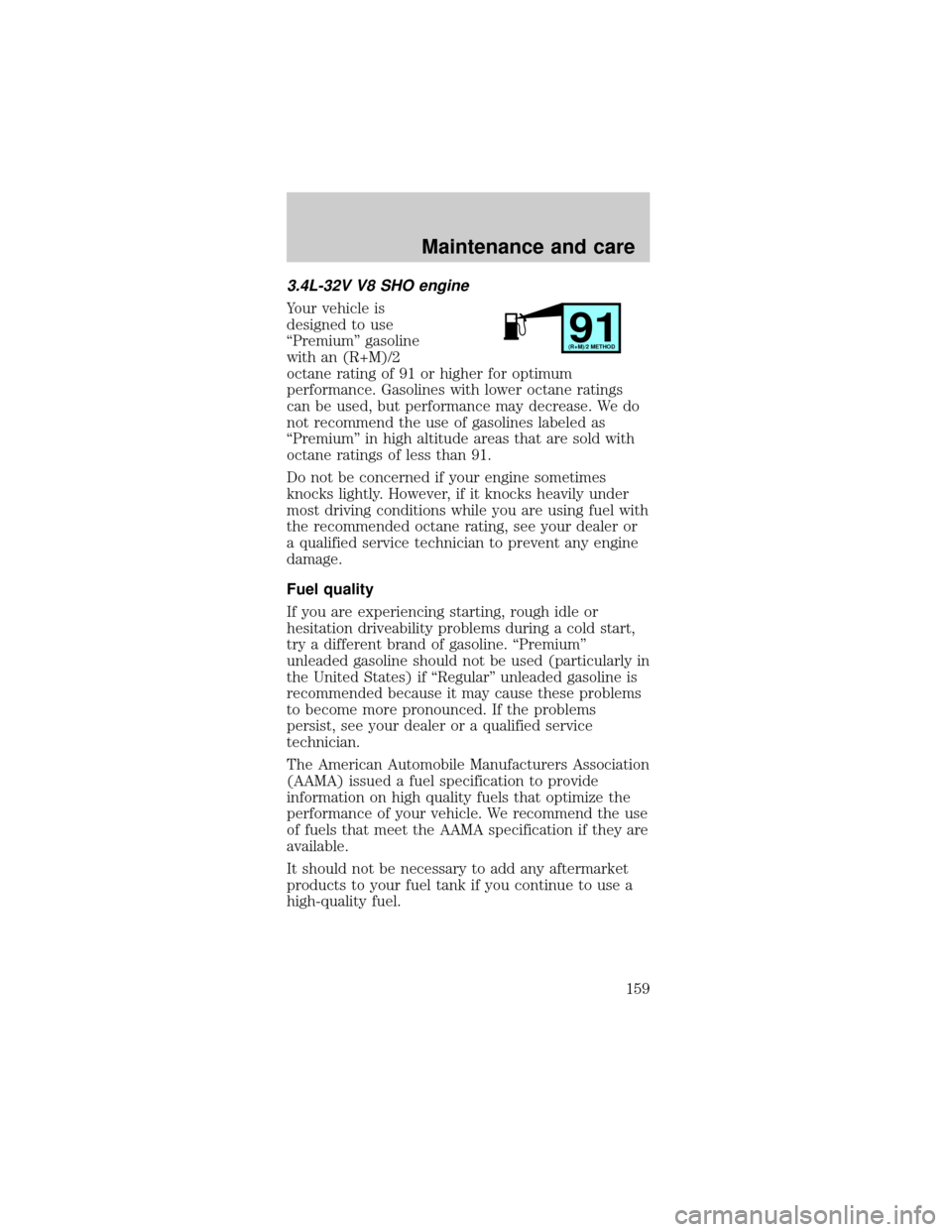
Your vehicle is
designed to use
ªPremiumº gasoline
with an (R+M)/2
octane rating of 91 or higher for optimum
performance. Gasolines with lower octane ratings
can be used, but performance may decrease. We do
not recommend the use of gasolines labeled as
ªPremiumº in high altitude areas that are sold with
octane ratings of less than 91.
Do not be concerned if your engine sometimes
knocks lightly. However, if it knocks heavily under
most driving conditions while you are using fuel with
the recommended octane rating, see your dealer or
a qualified service technician to prevent any engine
damage.
Fuel quality
If you are experiencing starting, rough idle or
hesitation driveability problems during a cold start,
try a different brand of gasoline. ªPremiumº
unleaded gasoline should not be used (particularly in
the United States) if ªRegularº unleaded gasoline is
recommended because it may cause these problems
to become more pronounced. If the problems
persist, see your dealer or a qualified service
technician.
The American Automobile Manufacturers Association
(AAMA) issued a fuel specification to provide
information on high quality fuels that optimize the
performance of your vehicle. We recommend the use
of fuels that meet the AAMA specification if they are
available.
It should not be necessary to add any aftermarket
products to your fuel tank if you continue to use a
high-quality fuel.
91(R+M)/2 METHOD
Maintenance and care
159
Page 160 of 192
Cleaner air
Ford approves the use of gasolines to improve air
quality, including reformulated gasolines that contain
oxygenates up to 10% ethanol or 15% MTBE.
Do not use gasolines containing methanol, which can
damage critical fuel system components. Damage
resulting from the use of methanol may not be
covered by your warranty.
Running out of fuel
Avoid running out fuel because this situation may
have an adverse affect on modern powertrain
components.
If you have run out of fuel:
²You may need to crank the engine several times
before the system starts to pump fuel from the
tank to the engine.
²Your ªService Engine Soonº light may come on.
For more information on the ªService Engine
Soonº light, refer to theInstrumentationchapter.
Fuel Filter
Your vehicle is equipped with a fuel filter that is
mounted on the underbody.
For fuel filter replacement, see your dealer or a
qualified service technician. Refer to the ªService
Guideº for the appropriate intervals for changing the
fuel filter.
If you replace the fuel filter, replace it with an
authorized Motorcraft part. The customer
warranty may be void for any damage to the
fuel system if an authorized Motorcraft fuel
filter is not used.
EMISSION CONTROL SYSTEM
Your vehicle is equipped with various emission
control components and a catalytic converter which
will enable your vehicle to comply with applicable
Maintenance and care
160