wheel FORD TAURUS 1998 3.G User Guide
[x] Cancel search | Manufacturer: FORD, Model Year: 1998, Model line: TAURUS, Model: FORD TAURUS 1998 3.GPages: 192, PDF Size: 1.66 MB
Page 116 of 192
Fuse/
Relay
LocationFuse
Amp
RatingDescription
29 Ð Fuel Pump Relay
30 Ð PCM Relay
31 Ð Low Speed Cooling Fan Relay
32 Ð PCM Diode
33 Ð A/C Clutch Diode
34 Ð Not Used
* Mini Fuses ** Maxi Fuses
1Fuses 4 and 6 will vary depending on date of
vehicle build.
Relays
Relays are located in the power distribution box and
should be replaced by qualified technicians.
CHANGING THE TIRES
If you get a flat tire while driving, do not apply the
brake heavily. Instead, gradually decrease your
speed. Hold the steering wheel firmly and slowly
move to a safe place on the side of the road.
Temporary spare tire information
The temporary spare tire for your vehicle is labeled
as such. It is smaller than a regular tire and is
designed for emergency use only.
If you use the temporary spare tire
continuously or do not follow these
precautions, the tire could fail, causing you to lose
control of the vehicle, possibly injuring yourself or
others.
Roadside emergencies
116
Page 117 of 192
When driving with the temporary spare tiredo not:
²exceed 80 km/h (50 mph) under any
circumstances
²load the vehicle beyond maximum vehicle load
rating listed on the Safety Compliance Label
²tow a trailer
²use tire chains
²drive through an automatic car wash, because of
the vehicle's reduced ground clearance
²try to repair the temporary spare tire or remove it
from its wheel
²use the wheel for any other type of vehicle
Removing and replacing wheel covers
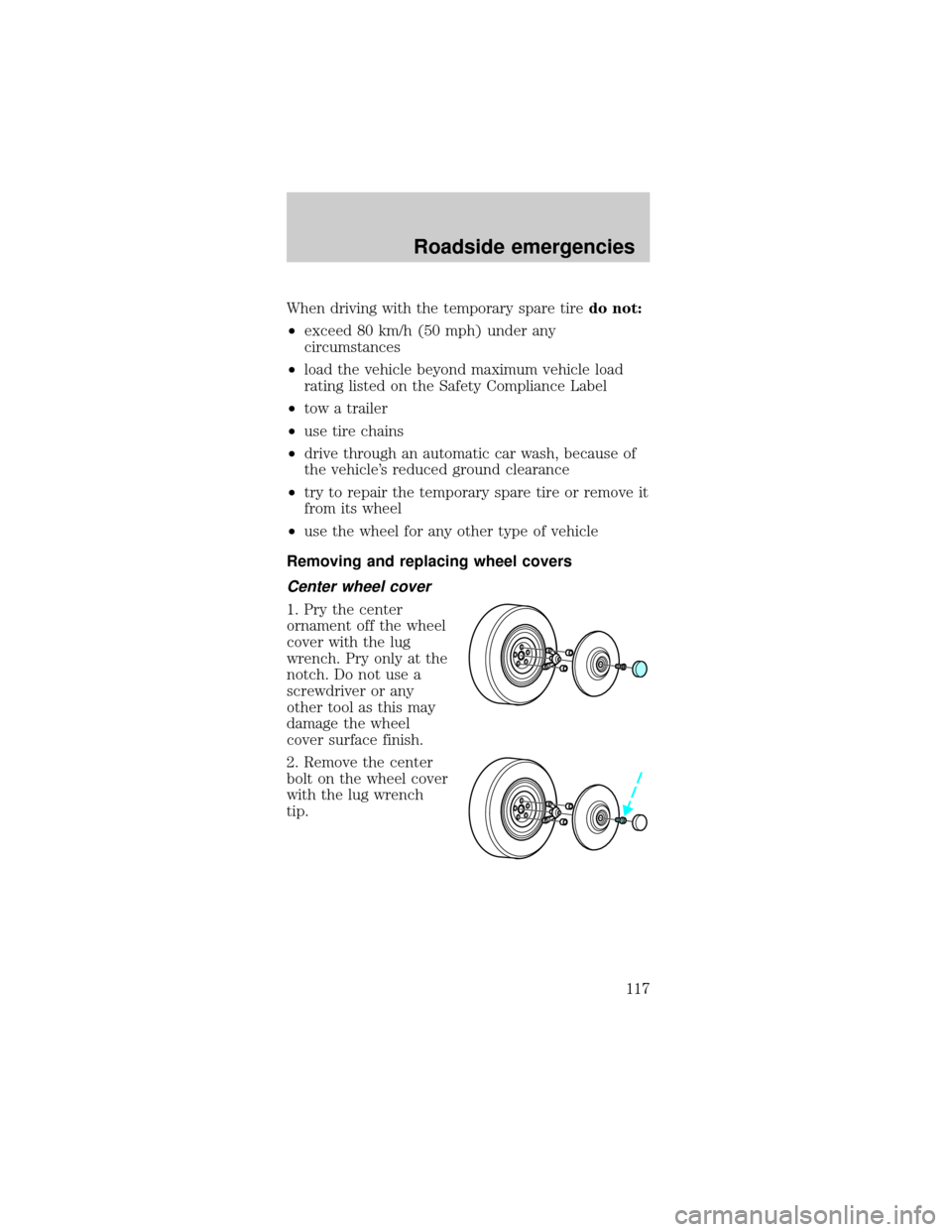
Center wheel cover
1. Pry the center
ornament off the wheel
cover with the lug
wrench. Pry only at the
notch. Do not use a
screwdriver or any
other tool as this may
damage the wheel
cover surface finish.
2. Remove the center
bolt on the wheel cover
with the lug wrench
tip.
Roadside emergencies
117
Page 118 of 192

3. To remove the wheel
cover, pry it loose by
inserting the tapered
end of the lug wrench
between the wheel
cover and wheel.
To replace the wheel cover:
1. One of the windows on the wheel cover is
identified with a valve stem logo on the back side of
the wheel cover. Install the wheel cover over the
wheel with the window at the valve stem.
2. Hold the wheel cover in this position and press
the cover onto the wheel with the palm of your
hand. Do not force or hammer the cover.
3. Attach the bolt to the pedestal through the center
hole on the cover with the lug wrench.
4. Align the legs of the center ornament with the
slots of the wheel cover. Reinstall the ornament by
pressing with the palm of your hand. Do not
hammer or force the cover.
Anti-theft lug nuts (if equipped)
If your vehicle is
equipped with this
feature, one of the lug
nuts on each wheel
must be removed and replaced with a special key.
The key and registration card are attached to the lug
wrench and stored with the spare tire. If you lose
the key, send the registration card to the
manufacturer (not the dealer) to get a replacement
key. If the lug wrench/lug nut key assembly is lost,
see your nearest Ford or Lincoln/Mercury dealer
who has access to the master set of keys.Do not
use an impact wrench with the anti-theft key.
Roadside emergencies
118
Page 119 of 192
Removing the anti-theft lug nut
1. Insert the key over the locking lug nut. Make sure
you hold the key square to the lug nut. If you hold
the key at an angle, you could damage the key and
the lug nut.
2. Place the lug nut wrench over the lug nut key and
apply pressure on the key with the wrench.
3. Turn the wrench in a counterclockwise direction
to remove the lug nut.
Reinstalling the anti-theft lug nut
1. Insert the key over the locking lug nut.
2. Place the lug nut wrench over the lug nut key and
apply pressure on the key with the wrench.
3. Install the lug nut.
Tire change procedure
1. Park on a level surface, activate hazard flashers
and set parking brake.
When one of the front wheels is off the
ground, the transaxle alone will not prevent
the vehicle from moving or slipping off the jack,
even if the vehicle is in P (Park).
To prevent the vehicle from moving when
you change a tire, be sure the parking brake
is set, then block (in both directions) the wheel
that is diagonally opposite (other side and end of
the vehicle) to the tire being changed.
Roadside emergencies
119
Page 120 of 192
If the vehicle slips off the jack, you or
someone else could be seriously injured.
2. Place gearshift lever
in P (Park), block the
diagonally opposite
wheel, then remove the
spare tire, jack and lug
wrench.
²In the sedan, these
are located in the
trunk cargo area
storage
compartment.
²In the wagon, they
are stored in the left
side rear trim panel
for the temporary
spare and in the
floor cargo area
storage compartment
for the full size
spare.
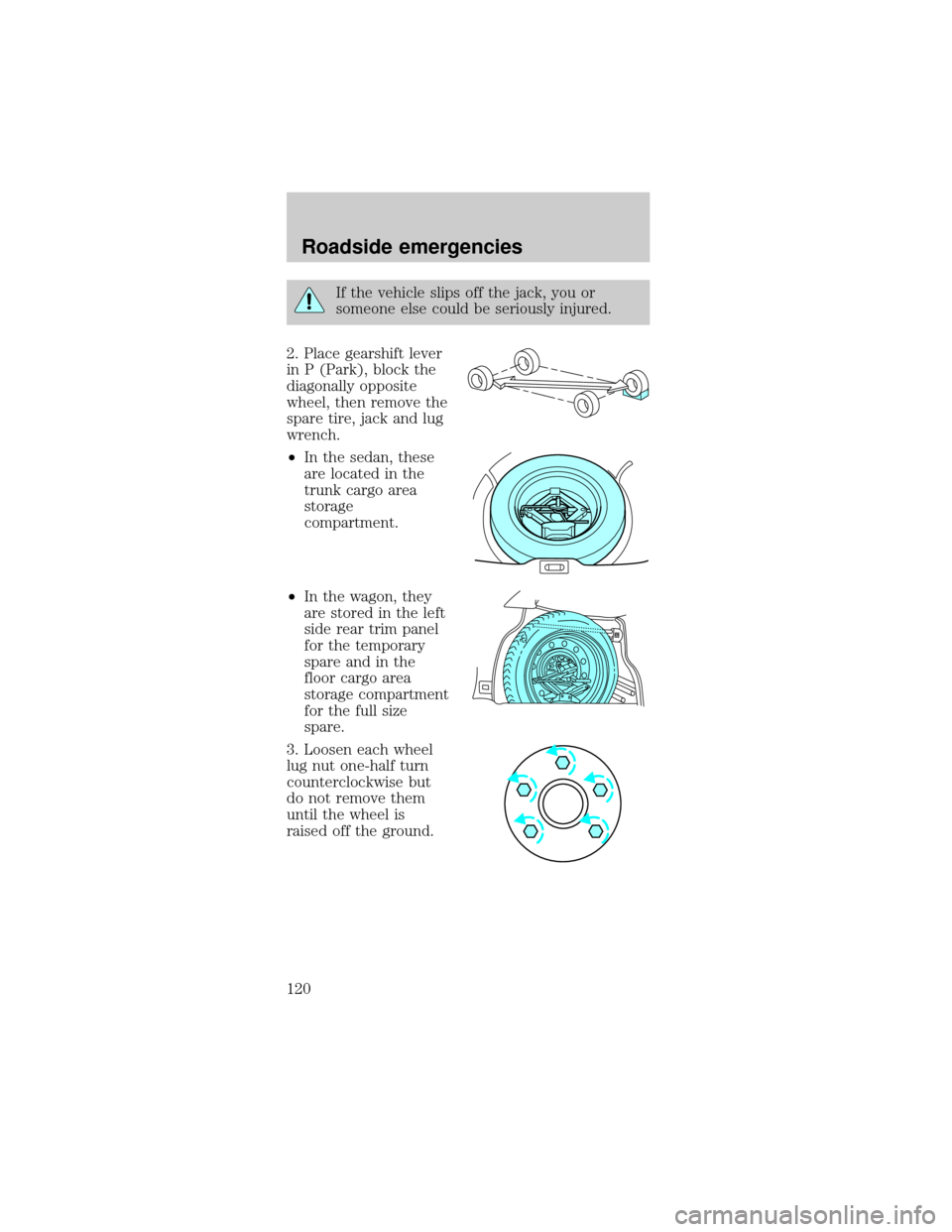
3. Loosen each wheel
lug nut one-half turn
counterclockwise but
do not remove them
until the wheel is
raised off the ground.
Roadside emergencies
120
Page 121 of 192
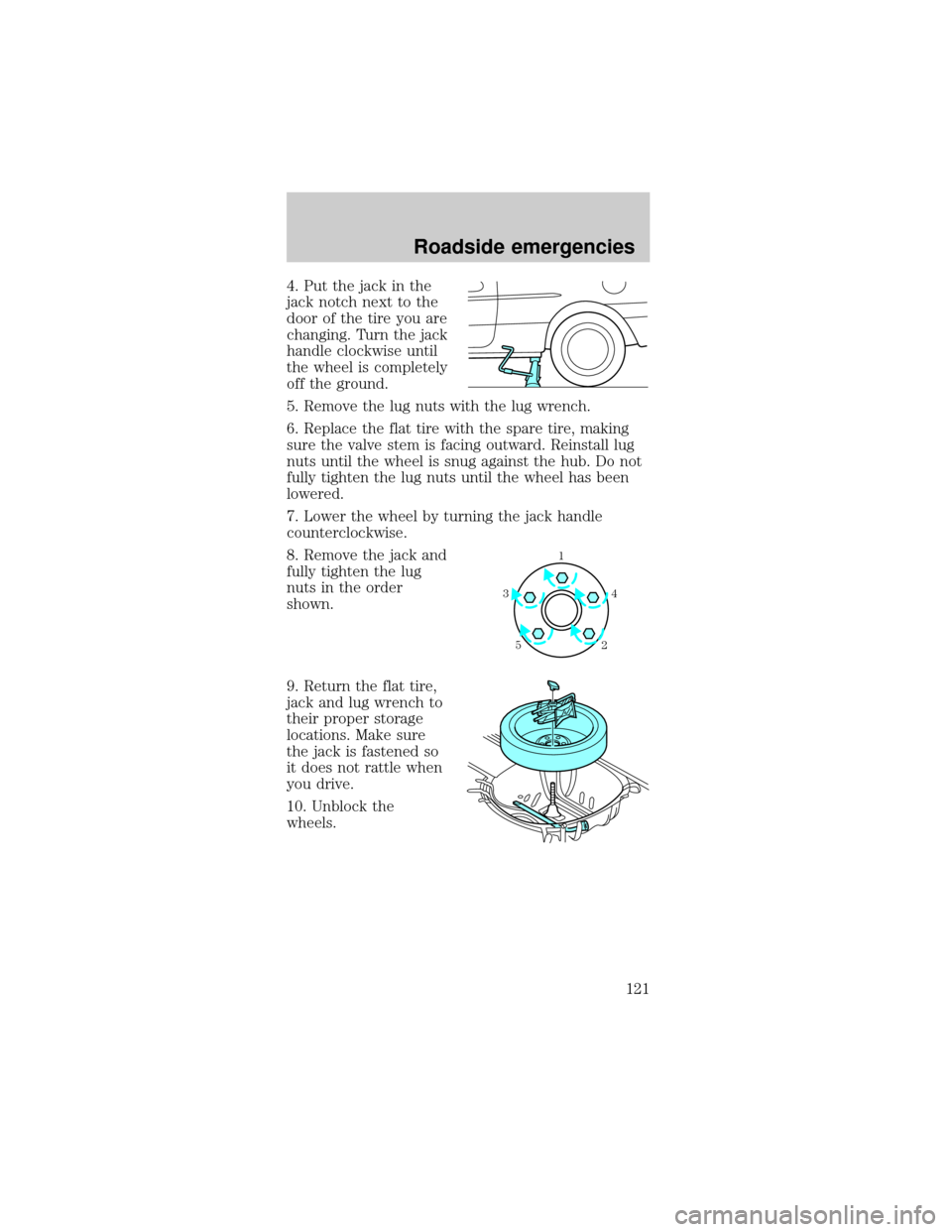
4. Put the jack in the
jack notch next to the
door of the tire you are
changing. Turn the jack
handle clockwise until
the wheel is completely
off the ground.
5. Remove the lug nuts with the lug wrench.
6. Replace the flat tire with the spare tire, making
sure the valve stem is facing outward. Reinstall lug
nuts until the wheel is snug against the hub. Do not
fully tighten the lug nuts until the wheel has been
lowered.
7. Lower the wheel by turning the jack handle
counterclockwise.
8. Remove the jack and
fully tighten the lug
nuts in the order
shown.
9. Return the flat tire,
jack and lug wrench to
their proper storage
locations. Make sure
the jack is fastened so
it does not rattle when
you drive.
10. Unblock the
wheels.
1
4 3
52
Roadside emergencies
121
Page 127 of 192

WRECKER TOWING
If you need to have your vehicle towed, contact a
professional towing service or, if you are a member,
your roadside assistance center.
It is recommended that your vehicle be towed with a
wheel lift or flatbed equipment.
A towing manual is available from Ford Motor
Company for all authorized tow truck operators.
Have your tow truck driver refer to this manual for
proper hook-up and towing procedures for your
vehicle.
Roadside emergencies
127
Page 129 of 192
2. Turn off the engine and remove the key.
3. Block the wheels to prevent the vehicle from
moving unexpectedly.
Working with the engine on
1. Set the parking brake and ensure the gearshift is
securely latched in P (Park).
2. Block the wheels to prevent the vehicle from
moving unexpectedly.
Do not start your engine with the air cleaner
removed and do not remove it while the
engine is running.
OPENING THE HOOD
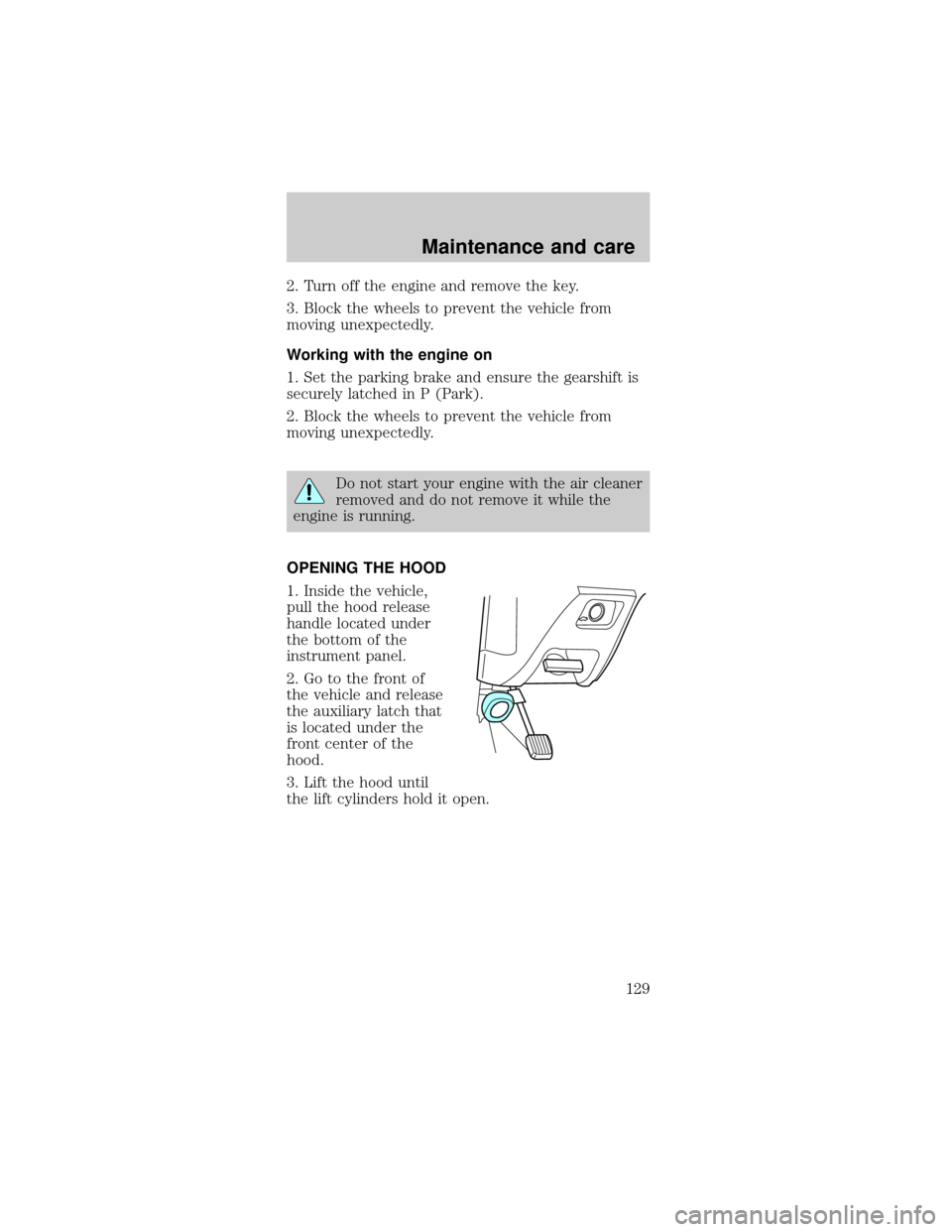
1. Inside the vehicle,
pull the hood release
handle located under
the bottom of the
instrument panel.
2. Go to the front of
the vehicle and release
the auxiliary latch that
is located under the
front center of the
hood.
3. Lift the hood until
the lift cylinders hold it open.
Maintenance and care
129
Page 141 of 192

increase the engine coolant concentration above
60%. Leave a 50/50 mixture of engine coolant and
water in your vehicle year-round in non-extreme
climates.
CHECKING AND ADDING POWER STEERING
FLUID
Check the power
steering fluid. Refer to
the ªService Guideº for
the service interval
schedules. If adding
fluid is necessary, use
only MERCONtAT F.
1. Start the engine and let it run until it reaches
normal operating temperature (the engine coolant
temperature gauge indicator will be near the center
of the normal area between H and C).
2. While the engine idles, turn the steering wheel
left and right several times.
3. Turn the engine off.
Perform steps 4 and 5 following the procedure for
your engine.
3.0L Vulcan engine
4. Check the fluid level
on the dipstick. It
should be between the
arrows in the FULL
HOT range. Do not add
fluid if the level is
within this range.
FULL HOT
Maintenance and care
141
Page 152 of 192
Temperature A B C
The temperature grades are A (the highest), B, and
C, representing the tire's resistance to the
generation of heat and its ability to dissipate heat
when tested under controlled conditions on a
specified indoor laboratory test wheel. Sustained
high temperature can cause the material of the tire
to degenerate and reduce tire life, and excessive
temperature can lead to sudden tire failure. The
grade C corresponds to a level of performance which
all passenger car tires must meet under the Federal
Motor Vehicle Safety Standard No. 109. Grades B
and A represent higher levels of performance on the
laboratory test wheel than the minimum required by
law.
The temperature grade for this tire is
established for a tire that is properly inflated
and not overloaded. Excessive speed,
underinflation, or excessive loading, either
separately or in combination, can cause heat
buildup and possible tire failure.
SERVICING YOUR TIRES
Checking the tire pressure
²Use an accurate tire pressure gauge.
²Check the tire pressure when tires are cold, after
the vehicle has been parked for at least one hour
or has been driven less than 5 km (3 miles).
²Adjust tire pressure to recommended
specifications found on the tire pressure label
inside the glove compartment door.
Maintenance and care
152