wheel FORD TAURUS 1999 3.G User Guide
[x] Cancel search | Manufacturer: FORD, Model Year: 1999, Model line: TAURUS, Model: FORD TAURUS 1999 3.GPages: 224, PDF Size: 1.42 MB
Page 132 of 224
Relays
Relays are located in the power distribution box and
should be replaced by qualified technicians.
CHANGING THE TIRES
If you get a flat tire while driving, do not apply the
brake heavily. Instead, gradually decrease your
speed. Hold the steering wheel firmly and slowly
move to a safe place on the side of the road.
Temporary spare tire information
The temporary spare tire for your vehicle is labeled
as such. It is smaller than a regular tire and is
designed for emergency use only.
If you use the temporary spare tire
continuously or do not follow these
precautions, the tire could fail, causing you to lose
control of the vehicle, possibly injuring yourself or
others.
When driving with the temporary spare tiredo not:
²exceed 80 km/h (50 mph) under any
circumstances
²load the vehicle beyond maximum vehicle load
rating listed on the Safety Compliance Label
²tow a trailer
²use tire chains
²drive through an automatic car wash, because of
the vehicle's reduced ground clearance
²try to repair the temporary spare tire or remove it
from its wheel
²use the wheel for any other type of vehicle
Tire change procedure
1. Park on a level surface, activate hazard flashers
and set parking brake.
Roadside emergencies
132
Page 133 of 224
When one of the front wheels is off the
ground, the transaxle alone will not prevent
the vehicle from moving or slipping off the jack,
even if the vehicle is in P (Park).
To prevent the vehicle from moving when
you change a tire, be sure the parking brake
is set, then block (in both directions) the wheel
that is diagonally opposite (other side and end of
the vehicle) to the tire being changed.
If the vehicle slips off the jack, you or
someone else could be seriously injured.
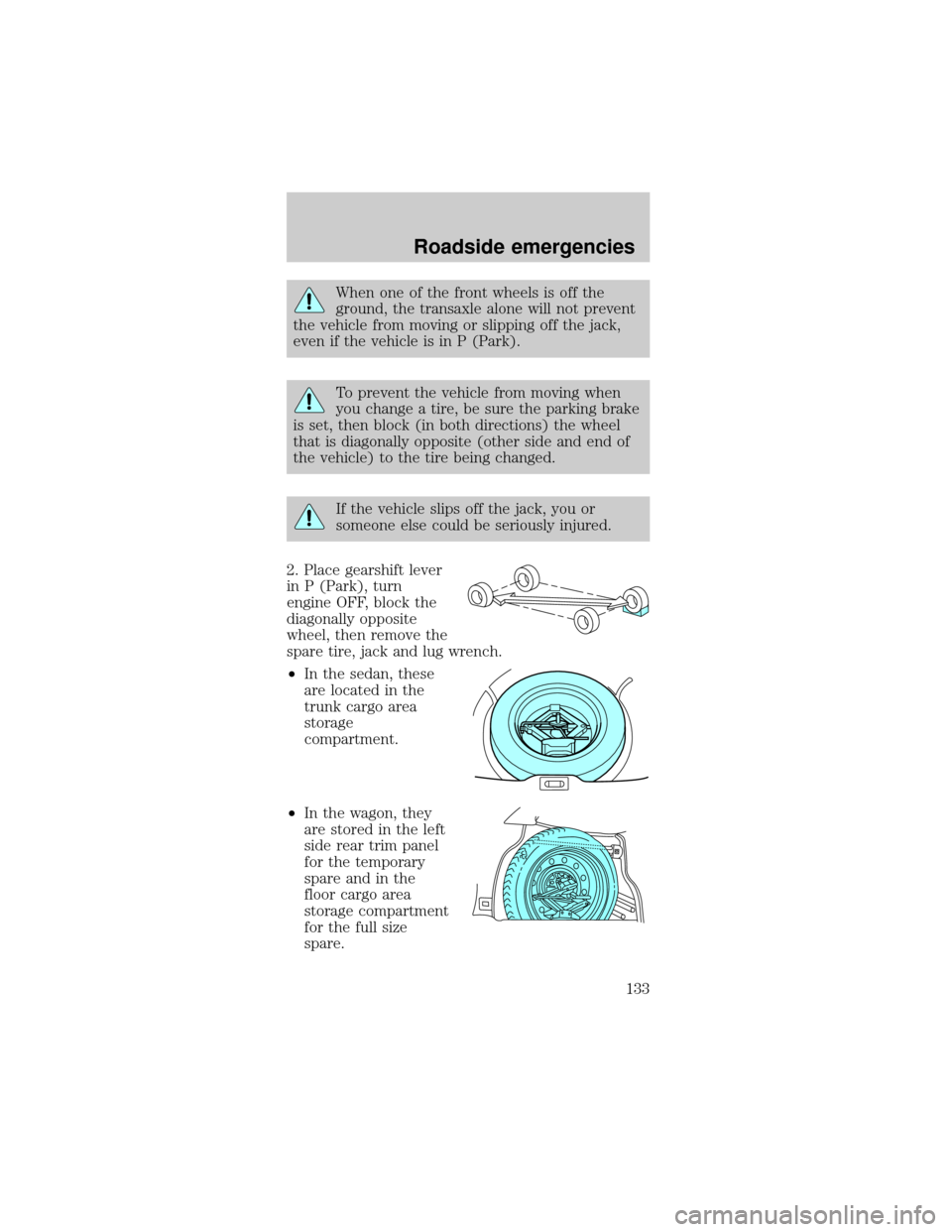
2. Place gearshift lever
in P (Park), turn
engine OFF, block the
diagonally opposite
wheel, then remove the
spare tire, jack and lug wrench.
²In the sedan, these
are located in the
trunk cargo area
storage
compartment.
²In the wagon, they
are stored in the left
side rear trim panel
for the temporary
spare and in the
floor cargo area
storage compartment
for the full size
spare.
Roadside emergencies
133
Page 134 of 224

3. Remove the center ornament or wheel cover from
the wheel with the tapered end of the wheel nut
wrench that came with your vehicle. Insert and twist
the handle, then pry against the wheel.
4. Loosen each wheel
lug nut one-half turn
counterclockwise but
do not remove them
until the wheel is
raised off the ground.
5. Put the jack in the
jack notch next to the
door of the tire you are
changing. Turn the jack
handle clockwise until
the wheel is completely
off the ground.
6. Remove the lug nuts with the lug wrench.
7. Replace the flat tire with the spare tire, making
sure the valve stem is facing outward. Reinstall lug
nuts until the wheel is snug against the hub. Do not
fully tighten the lug nuts until the wheel has been
lowered.
8. Lower the wheel by turning the jack handle
counterclockwise.
9. Remove the jack and
fully tighten the lug
nuts in the order
shown.
1
4 3
52
Roadside emergencies
134
Page 135 of 224
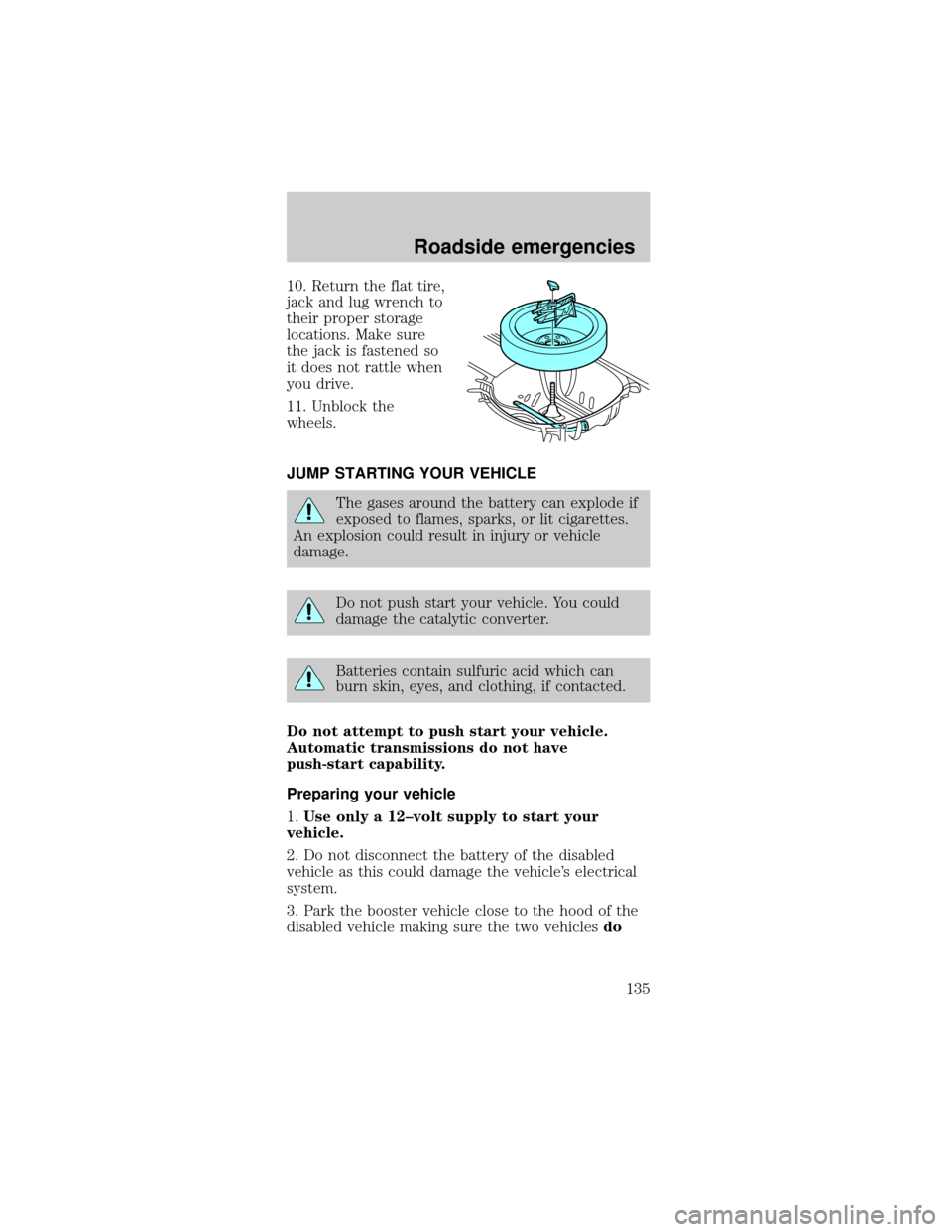
10. Return the flat tire,
jack and lug wrench to
their proper storage
locations. Make sure
the jack is fastened so
it does not rattle when
you drive.
11. Unblock the
wheels.
JUMP STARTING YOUR VEHICLE
The gases around the battery can explode if
exposed to flames, sparks, or lit cigarettes.
An explosion could result in injury or vehicle
damage.
Do not push start your vehicle. You could
damage the catalytic converter.
Batteries contain sulfuric acid which can
burn skin, eyes, and clothing, if contacted.
Do not attempt to push start your vehicle.
Automatic transmissions do not have
push-start capability.
Preparing your vehicle
1.Use only a 12±volt supply to start your
vehicle.
2. Do not disconnect the battery of the disabled
vehicle as this could damage the vehicle's electrical
system.
3. Park the booster vehicle close to the hood of the
disabled vehicle making sure the two vehiclesdo
Roadside emergencies
135
Page 140 of 224

WRECKER TOWING
If you need to have your vehicle towed, contact a
professional towing service or, if you are a member,
your roadside assistance center.
It is recommended that your vehicle be towed with a
wheel lift or flatbed equipment. Do not tow with a
slingbelt. Ford Motor Company has not approved a
slingbelt towing procedure.
If your vehicle is to be towed from the rear using
wheel lift equipment, the front wheels (drive
wheels) must be placed on a dolly to prevent
damage to the transaxle.
Ford Motor Company provides a towing manual for
all authorized tow truck operators. Have your tow
truck operator refer to this manual for proper
hook-up and towing procedures for your vehicle.
Roadside emergencies
140
Page 142 of 224
3. Block the wheels to prevent the vehicle from
moving unexpectedly.
Working with the engine on
1. Set the parking brake and ensure the gearshift is
securely latched in P (Park).
2. Block the wheels to prevent the vehicle from
moving unexpectedly.
Do not start your engine with the air cleaner
removed and do not remove it while the
engine is running.
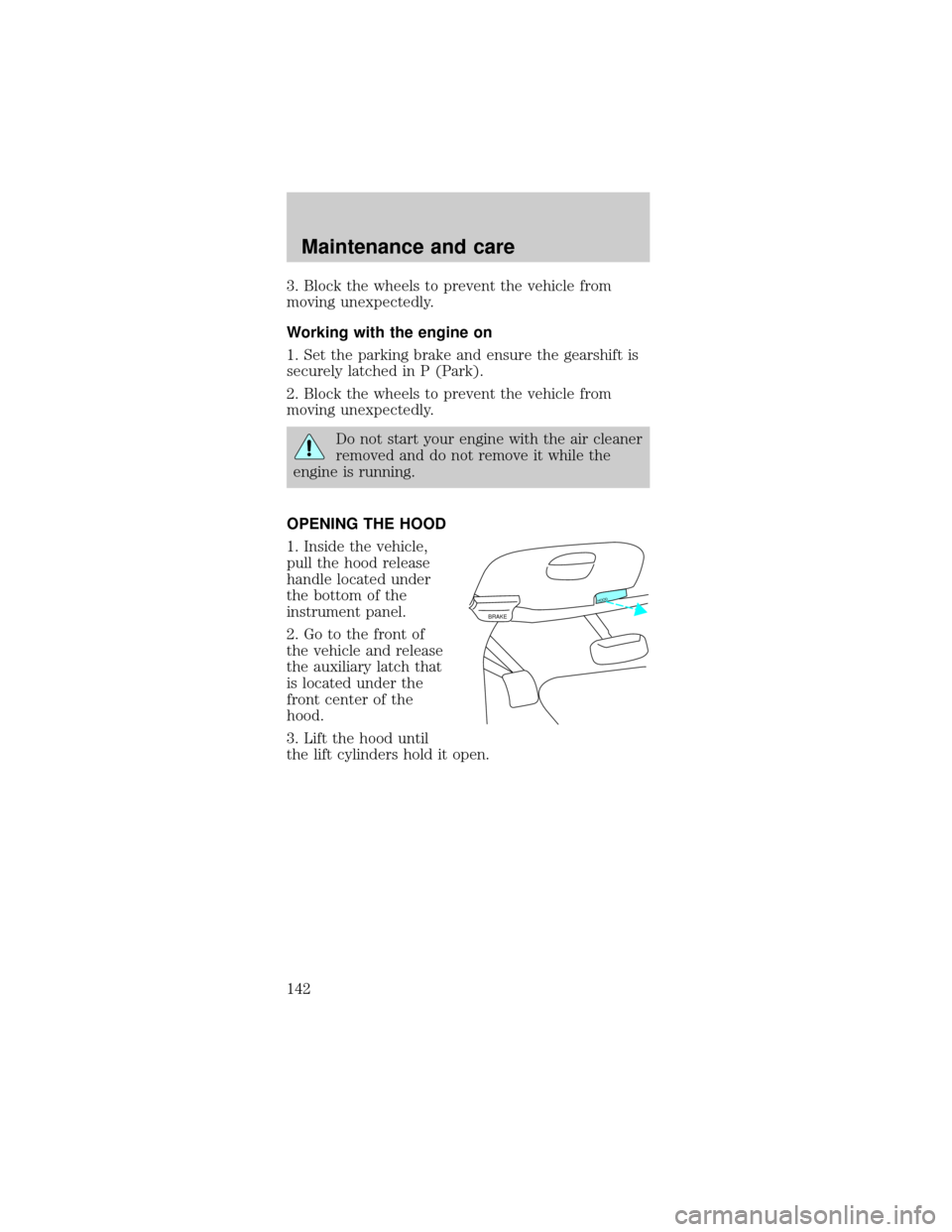
OPENING THE HOOD
1. Inside the vehicle,
pull the hood release
handle located under
the bottom of the
instrument panel.
2. Go to the front of
the vehicle and release
the auxiliary latch that
is located under the
front center of the
hood.
3. Lift the hood until
the lift cylinders hold it open.
BRAKE
HOOD
Maintenance and care
142
Page 154 of 224
temperature gauge indicator will be near the center
of the normal area between H and C).
2. While the engine idles, turn the steering wheel
left and right several times.
3. Turn the engine off.
Perform steps 4 and 5 following the procedure for
your engine.
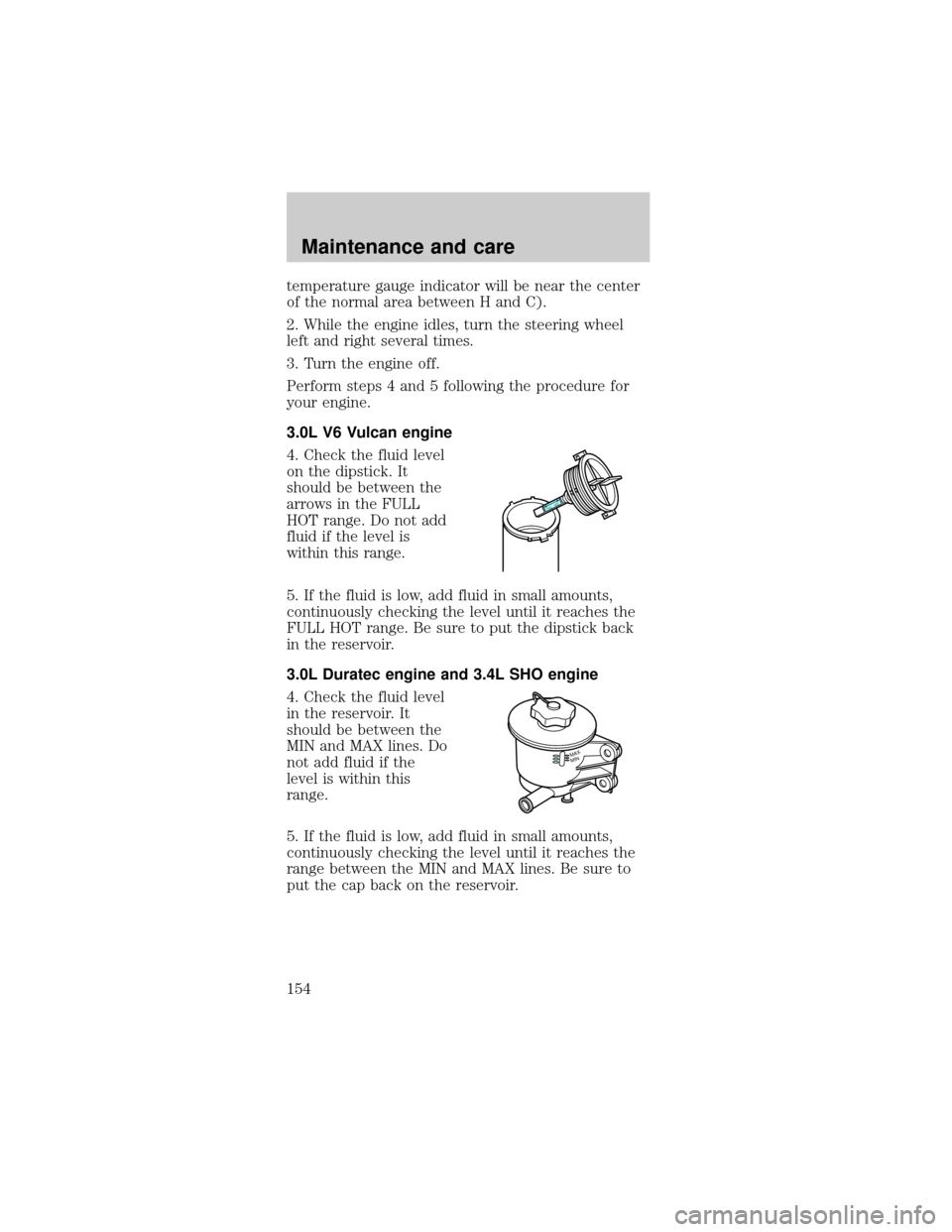
3.0L V6 Vulcan engine
4. Check the fluid level
on the dipstick. It
should be between the
arrows in the FULL
HOT range. Do not add
fluid if the level is
within this range.
5. If the fluid is low, add fluid in small amounts,
continuously checking the level until it reaches the
FULL HOT range. Be sure to put the dipstick back
in the reservoir.
3.0L Duratec engine and 3.4L SHO engine
4. Check the fluid level
in the reservoir. It
should be between the
MIN and MAX lines. Do
not add fluid if the
level is within this
range.
5. If the fluid is low, add fluid in small amounts,
continuously checking the level until it reaches the
range between the MIN and MAX lines. Be sure to
put the cap back on the reservoir.
FULL HOT
MINMAX
Maintenance and care
154
Page 161 of 224
U.S. Department of Transportation-Tire quality
grades:The U.S. Department of Transportation
requires Ford to give you the following information
about tire grades exactly as the government has
written it.
Treadwear
The treadwear grade is a comparative rating based
on the wear rate of the tire when tested under
controlled conditions on a specified government test
course. For example, a tire graded 150 would wear
one and one-half (1 1/2) times as well on the
government course as a tire graded 100. The relative
performance of tires depends upon the actual
conditions of their use, however, and may depart
significantly from the norm due to variations in
driving habits, service practices, and differences in
road characteristics and climate.
Traction AA A B C
The traction grades, from highest to lowest are AA,
A, B, and C. Those grades represent the tire's ability
to stop on wet pavement as measured under
controlled conditions on specified government test
surfaces of asphalt and concrete. A tire marked C
may have poor traction performance.
The traction grade assigned to this tire is
based on straight-ahead braking traction
tests, and does not include acceleration, cornering,
hydroplaning or peak traction characteristics.
Temperature A B C
The temperature grades are A (the highest), B, and
C, representing the tire's resistance to the
generation of heat and its ability to dissipate heat
when tested under controlled conditions on a
specified indoor laboratory test wheel. Sustained
high temperature can cause the material of the tire
to degenerate and reduce tire life, and excessive
Maintenance and care
161
Page 162 of 224
temperature can lead to sudden tire failure. The
grade C corresponds to a level of performance which
all passenger car tires must meet under the Federal
Motor Vehicle Safety Standard No. 109. Grades B
and A represent higher levels of performance on the
laboratory test wheel than the minimum required by
law.
The temperature grade for this tire is
established for a tire that is properly inflated
and not overloaded. Excessive speed,
underinflation, or excessive loading, either
separately or in combination, can cause heat
buildup and possible tire failure.
SERVICING YOUR TIRES
Checking the tire pressure
²Use an accurate tire pressure gauge.
²Check the tire pressure when tires are cold, after
the vehicle has been parked for at least one hour
or has been driven less than 5 km (3 miles).
²Adjust tire pressure to recommended
specifications found on the Certification Label.
Improperly inflated tires can affect vehicle
handling and can fail suddenly, possibly
resulting in loss of vehicle control.
Tire rotation
Because your vehicle's tires perform different jobs,
they often wear differently. To make sure your tires
wear evenly and last longer, rotate them as indicated
in the Scheduled Maintenance Guide. If you notice
that the tires wear unevenly, have them checked.
Maintenance and care
162
Page 164 of 224
Failure to follow these precautions may
adversely affect the handling of the vehicle
and make it easier for the driver to lose control
and roll over.
Tires that are larger or smaller than your vehicle's
original tires may also affect the accuracy of your
speedometer.
SNOW TIRES AND CHAINS
Snow tires must be the same size and grade
as the tires you currently have on your
vehicle.
The tires on your vehicle have all weather treads to
provide traction in rain and snow. However, in some
climates, you may need to use snow tires and
chains. If you need to use snow tires and chains, it is
recommended that steel wheels are used of the
same size and specifications as those originally
installed.
Follow these guidelines when using snow tires and
chains:
²Use only SAE Class S chains.
²Install chains securely, verifying that the chains do
not touch any wiring, brake lines or fuel lines.
²Drive cautiously. If you hear the chains rub or
bang against your vehicle, stop and re-tighten the
chains. If this does not work, remove the chains
to prevent damage to your vehicle.
²If possible, avoid fully loading your vehicle.
²Do not use tire chains if your vehicle is equipped
with P225/55ZR16 or P215/6OR16 tires.
²Remove the tire chains when they are no longer
needed. Do not use tire chains on dry roads.
Maintenance and care
164