lock FORD TAURUS 1999 3.G Workshop Manual
[x] Cancel search | Manufacturer: FORD, Model Year: 1999, Model line: TAURUS, Model: FORD TAURUS 1999 3.GPages: 224, PDF Size: 1.42 MB
Page 152 of 224
Plain water may be added in an emergency, but you
mustreplace it with a 50/50 mixture of coolant and
distilled water as soon as possible.
Check the coolant level in the coolant reservoir the
next few times you drive the vehicle. If necessary,
add enough of a 50/50 mixture of coolant and
distilled water to bring the liquid level into the cold
fill range on the reservoir.
Never remove the coolant reservoir cap
while the engine is running or hot.
If you must remove the coolant reservoir cap, follow
these steps to avoid personal injury:
1. Before you remove the cap, turn the engine off
and let it cool.
2. When the engine is cool, wrap a thick cloth
around the cap. Slowly turn cap counterclockwise
until pressure begins to release.
3. Step back while the pressure releases.
4. When you are sure that all the pressure has been
released, use the cloth to turn it counterclockwise
and remove the cap.
Change your engine coolant according to the
appropriate schedule listed in the Scheduled
Maintenance Guide.
Recycled engine coolant
Ford Motor Company recommends that Ford and
Lincoln-Mercury dealers use recycled engine coolant
produced by Ford-approved processes.
Not all coolant recycling processes produce coolant
which meets Ford specification ESE-M97B44±A, and
use of such coolant may harm engine and cooling
system components.
Always dispose of used automotive fluids in a
responsible manner. Follow your community's
regulations and standards for recycling and disposing
of automotive fluids.
Maintenance and care
152
Page 159 of 224

2. Put the gearshift in P (Park), turn off all
accessories and start the engine.
3. Let the engine idle for at least one minute.
4. The relearning process will automatically
complete as you drive the vehicle.
²The vehicle may need to be driven 16 km (10
miles) or more to relearn the idle and fuel trim
strategy.
²If you do not allow the engine to relearn its idle
trim, the idle quality of your vehicle may be
adversely affected until the idle trim is eventually
relearned.
If the battery has been disconnected or a new
battery has been installed, the clock and the preset
radio stations must be reset once the battery is
reconnected.
²Always dispose of
automotive batteries
in a responsible
manner. Follow your
local authorized
standards for
disposal. Call your
local authorized
recycling center to find out more about recycling
automotive batteries.
WINDSHIELD WIPER BLADES
Check the wiper blades at least twice a year or when
they seem less effective. Substances such as tree sap
and some hot wax treatments used by commercial
car washes reduce the effectiveness of wiper blades.
Checking the wiper blades
If the wiper blades do not wipe properly, clean both
the windshield and wiper blades using undiluted
windshield wiper solution or a mild detergent. Rinse
thoroughly with clean water. To avoid damaging the
LEAD
RETURN
RECYCLE
Maintenance and care
159
Page 160 of 224
blades, do not use fuel, kerosene, paint thinner or
other solvents.
Changing the wiper blades
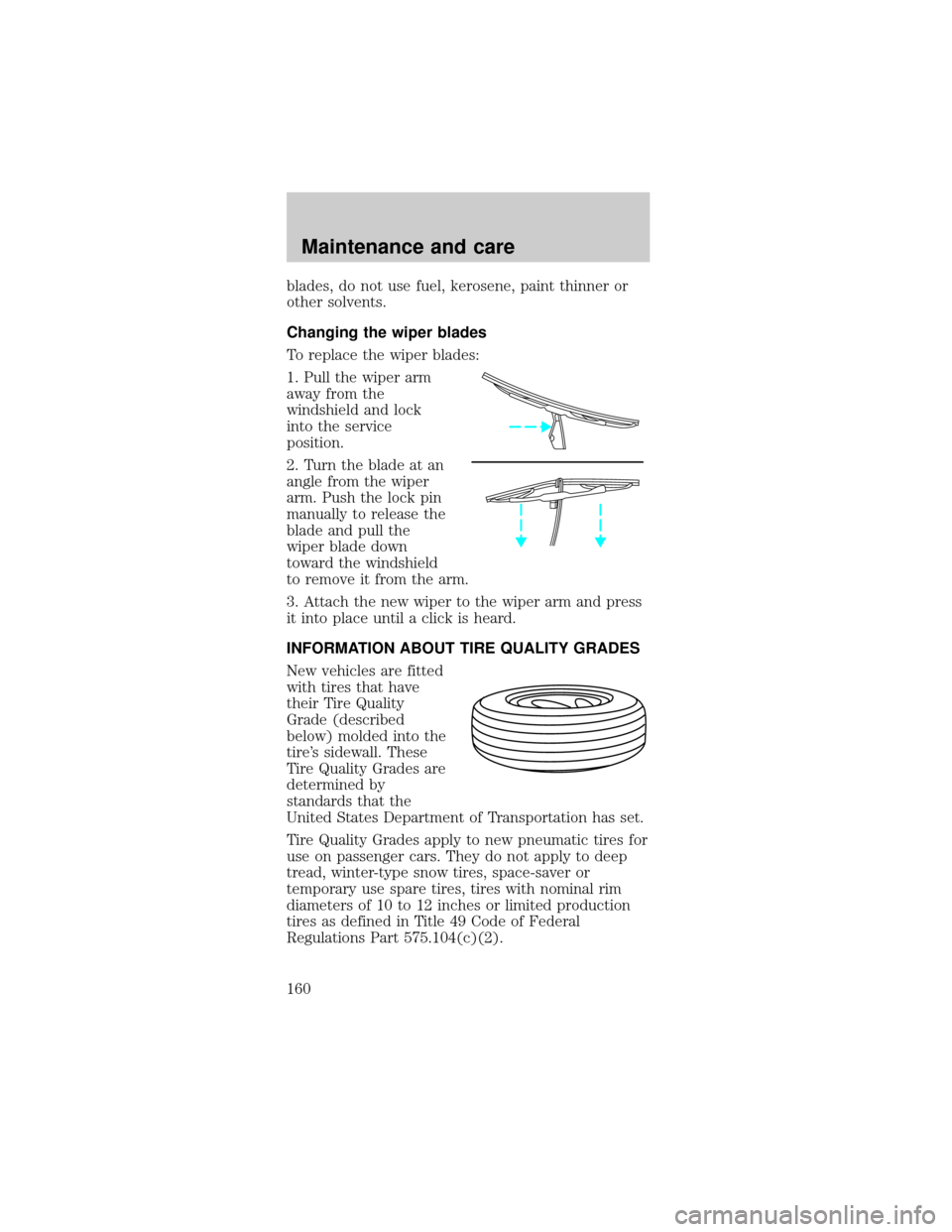
To replace the wiper blades:
1. Pull the wiper arm
away from the
windshield and lock
into the service
position.
2. Turn the blade at an
angle from the wiper
arm. Push the lock pin
manually to release the
blade and pull the
wiper blade down
toward the windshield
to remove it from the arm.
3. Attach the new wiper to the wiper arm and press
it into place until a click is heard.
INFORMATION ABOUT TIRE QUALITY GRADES
New vehicles are fitted
with tires that have
their Tire Quality
Grade (described
below) molded into the
tire's sidewall. These
Tire Quality Grades are
determined by
standards that the
United States Department of Transportation has set.
Tire Quality Grades apply to new pneumatic tires for
use on passenger cars. They do not apply to deep
tread, winter-type snow tires, space-saver or
temporary use spare tires, tires with nominal rim
diameters of 10 to 12 inches or limited production
tires as defined in Title 49 Code of Federal
Regulations Part 575.104(c)(2).
Maintenance and care
160
Page 167 of 224
on the skin, promptly wash skin thoroughly with
soap and water. Consult a physician immediately
if you experience an adverse reaction.
When refueling always shut the engine off
and never allow sparks or open flames near
the filler neck. Never smoke while refueling. Fuel
vapor is extremely hazardous under certain
conditions. Care should be taken to avoid inhaling
excess fumes.
The flow of fuel through a fuel pump nozzle
can produce static electricity, which can
cause a fire if fuel is pumped into an ungrounded
fuel container.
Use the following guidelines to avoid static build-up
when filling an ungrounded fuel container:
²Place approved fuel container on the ground.
²DO NOT fill a fuel container while it is in the
vehicle.
²Keep the fuel pump nozzle in contact with the
fuel container while filling.
²DO NOT use a device that would hold the fuel
pump handle in the fill position.
Fuel Filler Cap
Your fuel tank filler cap has an indexed design with
a 1/8 turn on/off feature.
When fueling your vehicle:
1. Turn the engine off.
2. Carefully turn the filler cap counterclockwise 1/8
of a turn until it stops.
3. Pull to remove the cap from the fuel filler pipe.
4. To install the cap, align the tabs on the cap with
the notches on the filler pipe.
Maintenance and care
167
Page 168 of 224
5. Turn the filler cap clockwise 1/8 of a turn until it
stops.
If the ªService Engine Soon/Check Engineº indicator
comes on and stays on when you start the engine,
the fuel filler cap may not be properly installed.
Turn off the engine, remove the fuel filler cap, align
the cap properly and reinstall it.
If you must replace the fuel filler cap, replace
it with a fuel filler cap that is designed for
your vehicle. The customer warranty may be
void for any damage to the fuel tank or fuel
system if the correct genuine Ford or
Motorcraft fuel filler cap is not used.
The fuel system may be under pressure. If
the fuel filler cap is venting vapor or if you
hear a hissing sound, wait until it stops before
completely removing the fuel filler cap. Otherwise,
fuel may spray out and injure you or others.
If you do not use the proper fuel filler cap,
excessive pressure or vacuum in the fuel
tank may damage the fuel system or cause the fuel
system to work improperly in a collision, which
may result in possible personal injury.
Choosing the right fuel
Use only UNLEADED FUEL. The use of leaded fuel
is prohibited by law and could damage your vehicle.
Do not use fuel containing methanol. It can damage
critical fuel system components.
Your vehicle was not designed to use fuel or fuel
additives with metallic compounds, including
manganese-based compounds containing MMT.
Repairs to correct the effects of using a fuel for
which your vehicle was not designed may not be
covered by your warranty.
Maintenance and care
168
Page 178 of 224
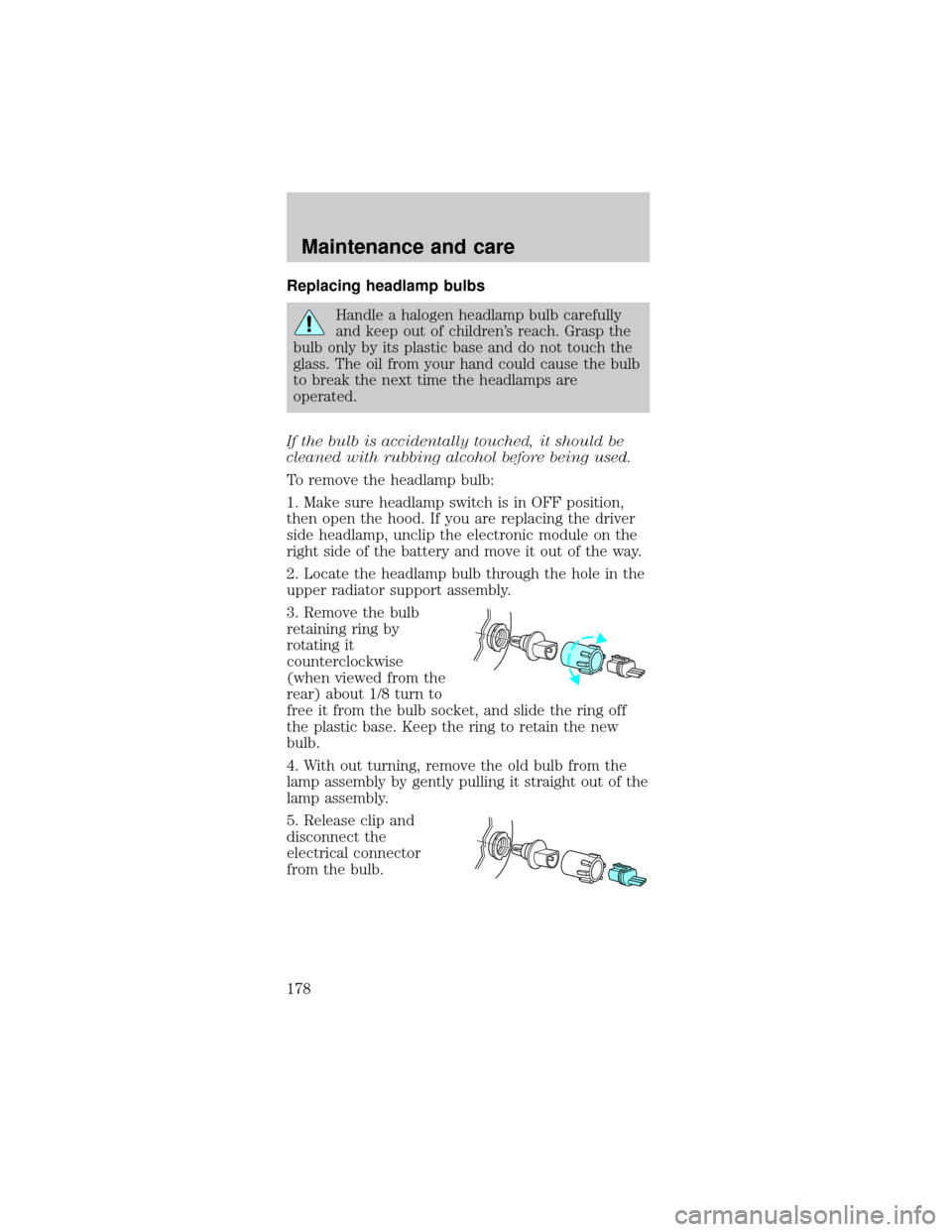
Replacing headlamp bulbs
Handle a halogen headlamp bulb carefully
and keep out of children's reach. Grasp the
bulb only by its plastic base and do not touch the
glass. The oil from your hand could cause the bulb
to break the next time the headlamps are
operated.
If the bulb is accidentally touched, it should be
cleaned with rubbing alcohol before being used.
To remove the headlamp bulb:
1. Make sure headlamp switch is in OFF position,
then open the hood. If you are replacing the driver
side headlamp, unclip the electronic module on the
right side of the battery and move it out of the way.
2. Locate the headlamp bulb through the hole in the
upper radiator support assembly.
3. Remove the bulb
retaining ring by
rotating it
counterclockwise
(when viewed from the
rear) about 1/8 turn to
free it from the bulb socket, and slide the ring off
the plastic base. Keep the ring to retain the new
bulb.
4. With out turning, remove the old bulb from the
lamp assembly by gently pulling it straight out of the
lamp assembly.
5. Release clip and
disconnect the
electrical connector
from the bulb.
Maintenance and care
178
Page 179 of 224
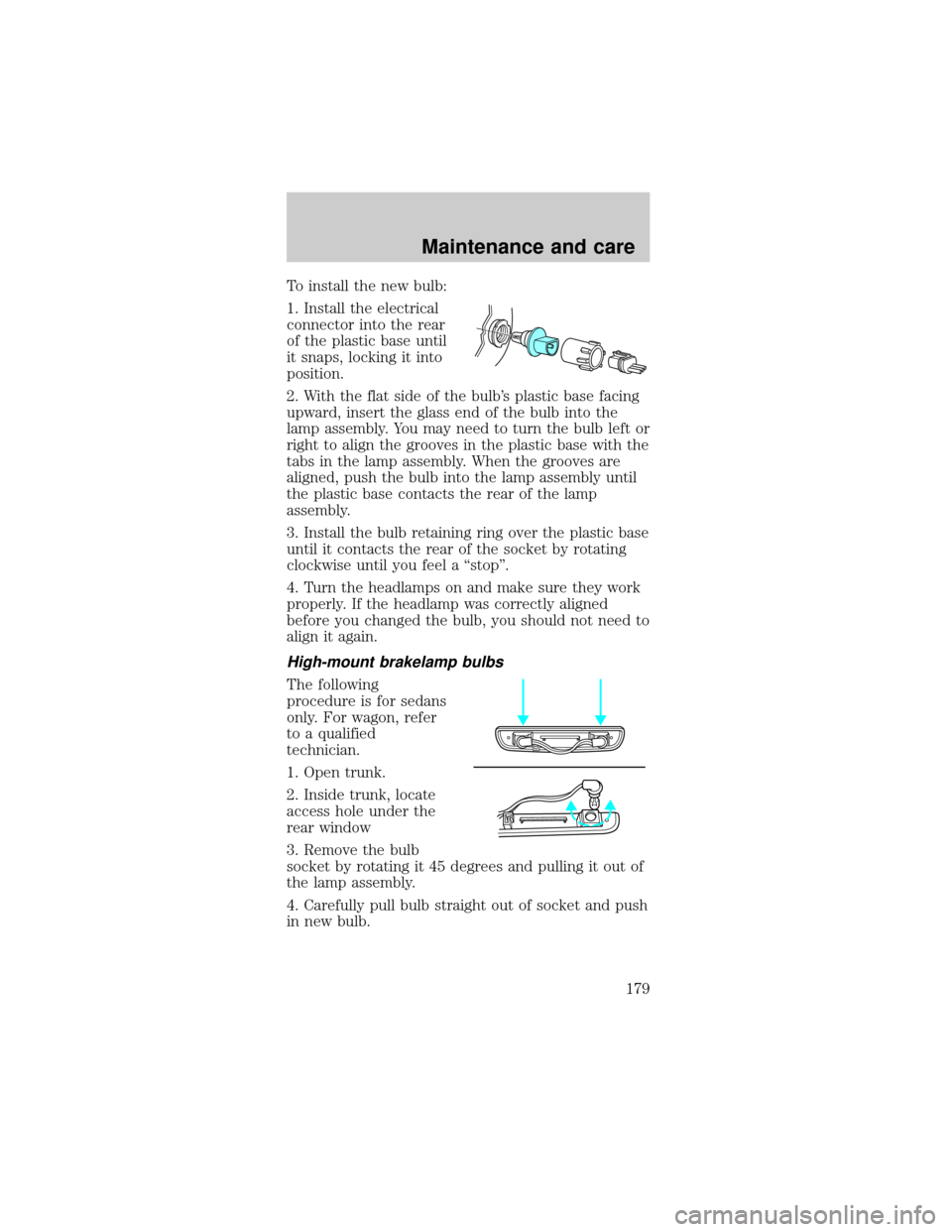
To install the new bulb:
1. Install the electrical
connector into the rear
of the plastic base until
it snaps, locking it into
position.
2. With the flat side of the bulb's plastic base facing
upward, insert the glass end of the bulb into the
lamp assembly. You may need to turn the bulb left or
right to align the grooves in the plastic base with the
tabs in the lamp assembly. When the grooves are
aligned, push the bulb into the lamp assembly until
the plastic base contacts the rear of the lamp
assembly.
3. Install the bulb retaining ring over the plastic base
until it contacts the rear of the socket by rotating
clockwise until you feel a ªstopº.
4. Turn the headlamps on and make sure they work
properly. If the headlamp was correctly aligned
before you changed the bulb, you should not need to
align it again.
High-mount brakelamp bulbs
The following
procedure is for sedans
only. For wagon, refer
to a qualified
technician.
1. Open trunk.
2. Inside trunk, locate
access hole under the
rear window
3. Remove the bulb
socket by rotating it 45 degrees and pulling it out of
the lamp assembly.
4. Carefully pull bulb straight out of socket and push
in new bulb.
Maintenance and care
179
Page 180 of 224
5. To complete installation, follow the removal
procedure in reverse order.
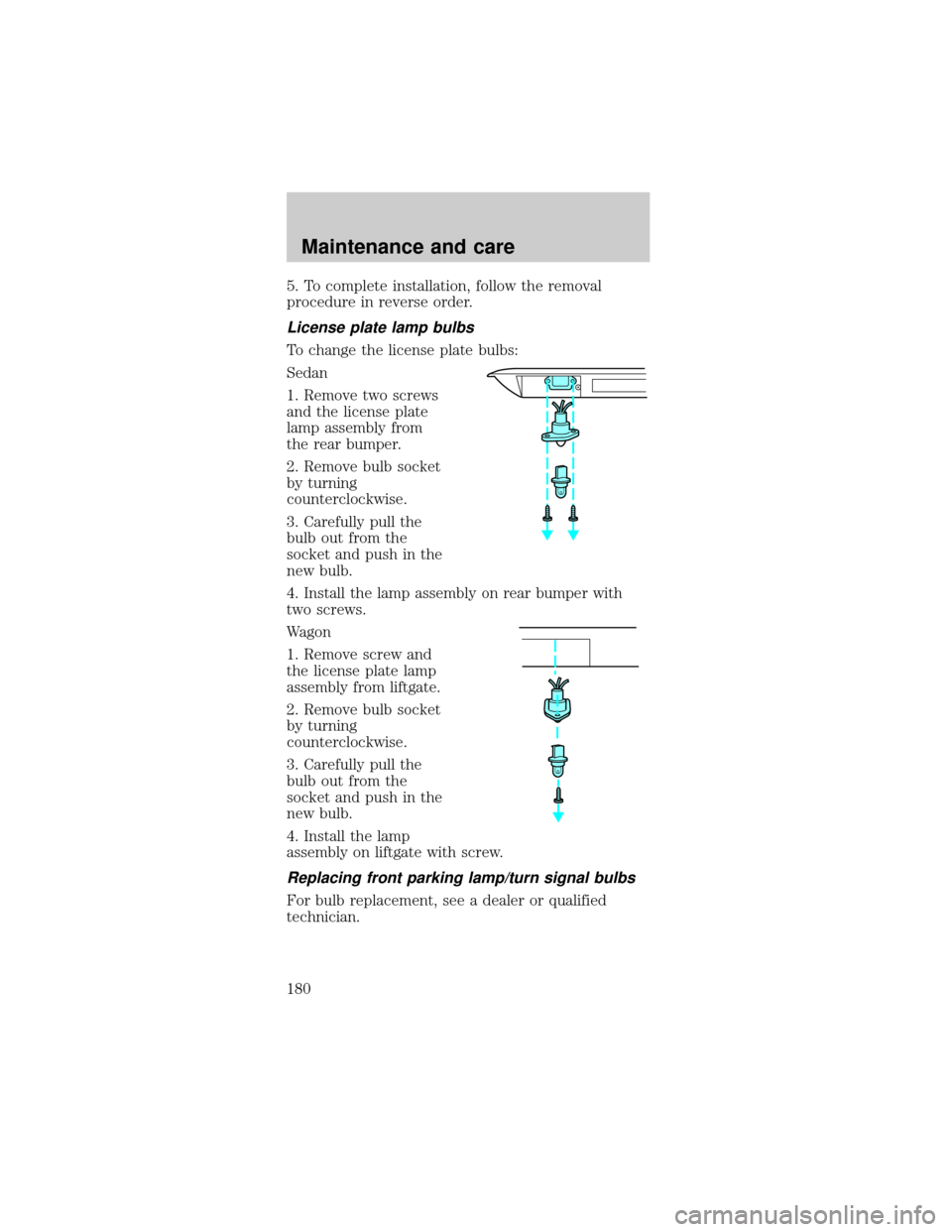
License plate lamp bulbs
To change the license plate bulbs:
Sedan
1. Remove two screws
and the license plate
lamp assembly from
the rear bumper.
2. Remove bulb socket
by turning
counterclockwise.
3. Carefully pull the
bulb out from the
socket and push in the
new bulb.
4. Install the lamp assembly on rear bumper with
two screws.
Wagon
1. Remove screw and
the license plate lamp
assembly from liftgate.
2. Remove bulb socket
by turning
counterclockwise.
3. Carefully pull the
bulb out from the
socket and push in the
new bulb.
4. Install the lamp
assembly on liftgate with screw.
Replacing front parking lamp/turn signal bulbs
For bulb replacement, see a dealer or qualified
technician.
Maintenance and care
180
Page 183 of 224
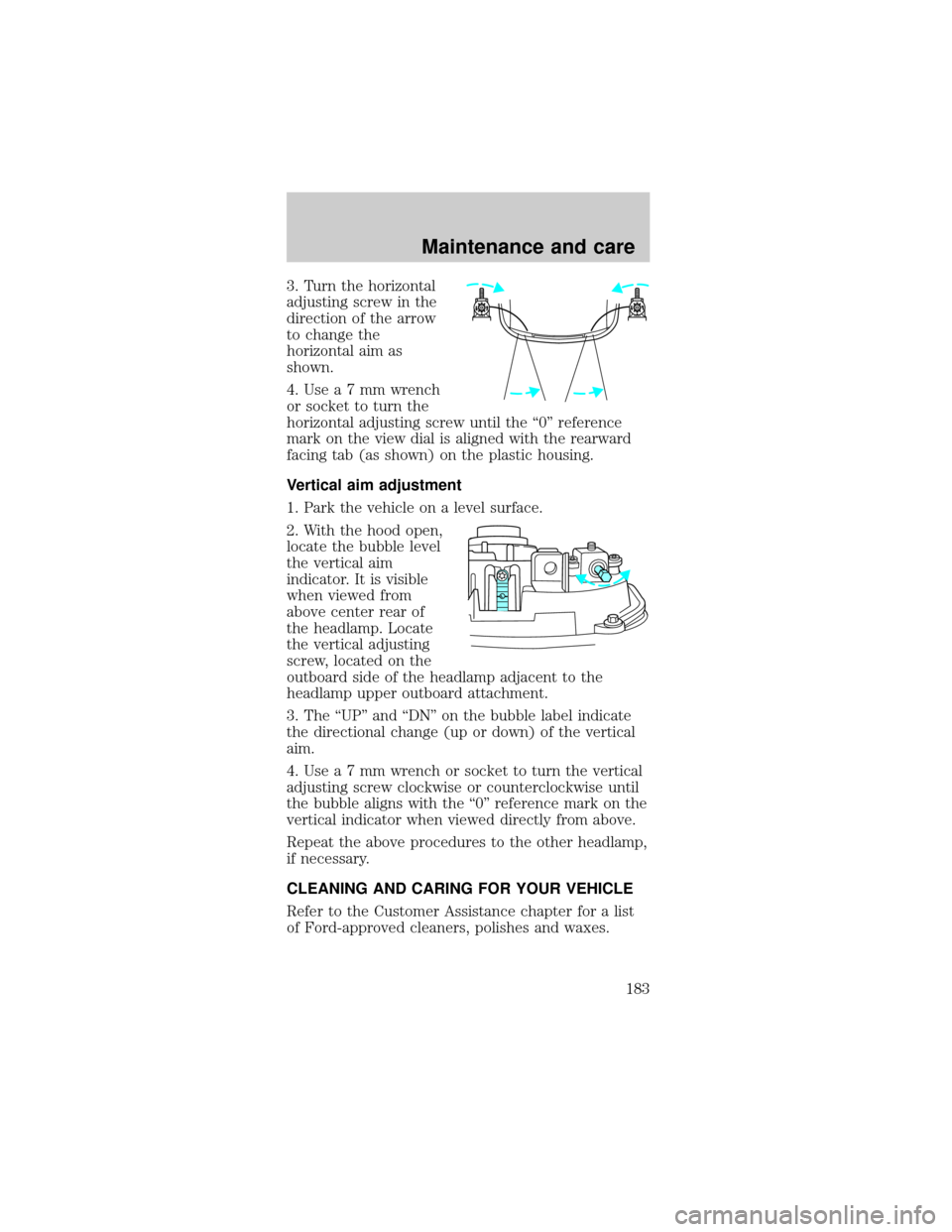
3. Turn the horizontal
adjusting screw in the
direction of the arrow
to change the
horizontal aim as
shown.
4.Usea7mmwrench
or socket to turn the
horizontal adjusting screw until the ª0º reference
mark on the view dial is aligned with the rearward
facing tab (as shown) on the plastic housing.
Vertical aim adjustment
1. Park the vehicle on a level surface.
2. With the hood open,
locate the bubble level
the vertical aim
indicator. It is visible
when viewed from
above center rear of
the headlamp. Locate
the vertical adjusting
screw, located on the
outboard side of the headlamp adjacent to the
headlamp upper outboard attachment.
3. The ªUPº and ªDNº on the bubble label indicate
the directional change (up or down) of the vertical
aim.
4.Usea7mmwrench or socket to turn the vertical
adjusting screw clockwise or counterclockwise until
the bubble aligns with the ª0º reference mark on the
vertical indicator when viewed directly from above.
Repeat the above procedures to the other headlamp,
if necessary.
CLEANING AND CARING FOR YOUR VEHICLE
Refer to the Customer Assistance chapter for a list
of Ford-approved cleaners, polishes and waxes.
Maintenance and care
183
Page 185 of 224

Repairing paint chips
Minor scratches or paint damage from road debris
may be repaired with the Ultra Touch Prep and
Finishing Kit (#F7AZ-19K507±BA), touch-up paint
(#ALBZ-19500±XXXXA), or aerosol paint spray
(#ALAZ-19500±XXXXA) from the Ford Car Care
Chemicals line. Please note that the part numbers
(shown as XXXX above) will vary with your vehicle's
specific coloring. Observe the application
instructions on the products.
Remove particles such as bird droppings, tree sap,
insect remains, tar spots, road salt and industrial
fallout immediately.
Cleaning the wheels
Wash with the same detergent as the body of your
vehicle. Do not use acid-based or alcohol-based
wheel cleaners, steel wool, fuel or strong detergents.
Never use abrasives that will damage the finish of
special wheel surfaces. Use a tar remover to remove
grease and tar.
The brushes used in some automatic car washes may
damage the finish on your wheels. Before going to a
car wash, find out if the brushes are abrasive.
Cleaning the engine
In order to identify your vehicle's engine, refer to
Identifying components in the engine
compartmentin the Maintenance and Care chapter.
Engines are more efficient when they are clean
because grease and dirt buildup keep the engine
warmer than normal. When washing:
²Take care when using a power washer to clean
the engine. The high pressure fluid could
penetrate the sealed parts and cause damage.
²Do not spray with cold water to avoid cracking
the engine block or other engine components.
Maintenance and care
185