fuel pump FORD TAURUS 2006 4.G User Guide
[x] Cancel search | Manufacturer: FORD, Model Year: 2006, Model line: TAURUS, Model: FORD TAURUS 2006 4.GPages: 232, PDF Size: 2.19 MB
Page 207 of 232
contains more metallic additives than regular fuel. We recommend using
regular grade fuel. In Canada, many fuels contain metallic additives, but
fuels free of such additives may be available; check with your local fuel
dealer.
Do not use fuel containing methanol. It can damage critical fuel system
components.
Repairs to correct the effects of using a fuel for which your vehicle was
not designed may not be covered by your warranty.
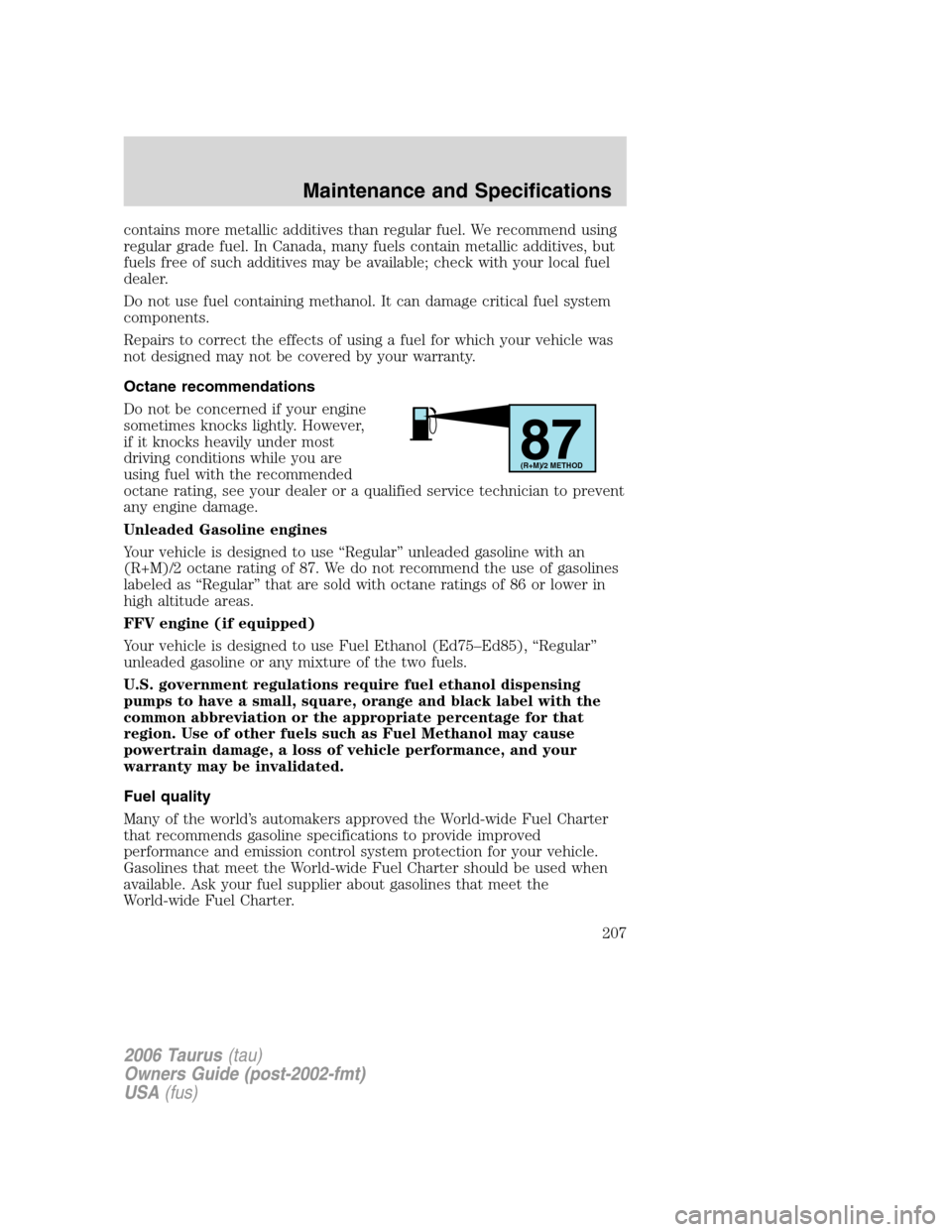
Octane recommendations
Do not be concerned if your engine
sometimes knocks lightly. However,
if it knocks heavily under most
driving conditions while you are
using fuel with the recommended
octane rating, see your dealer or a qualified service technician to prevent
any engine damage.
Unleaded Gasoline engines
Your vehicle is designed to use “Regular” unleaded gasoline with an
(R+M)/2 octane rating of 87. We do not recommend the use of gasolines
labeled as “Regular” that are sold with octane ratings of 86 or lower in
high altitude areas.
FFV engine (if equipped)
Your vehicle is designed to use Fuel Ethanol (Ed75–Ed85), “Regular”
unleaded gasoline or any mixture of the two fuels.
U.S. government regulations require fuel ethanol dispensing
pumps to have a small, square, orange and black label with the
common abbreviation or the appropriate percentage for that
region. Use of other fuels such as Fuel Methanol may cause
powertrain damage, a loss of vehicle performance, and your
warranty may be invalidated.
Fuel quality
Many of the world’s automakers approved the World-wide Fuel Charter
that recommends gasoline specifications to provide improved
performance and emission control system protection for your vehicle.
Gasolines that meet the World-wide Fuel Charter should be used when
available. Ask your fuel supplier about gasolines that meet the
World-wide Fuel Charter.
87(R+M)/2 METHOD
2006 Taurus(tau)
Owners Guide (post-2002-fmt)
USA(fus)
Maintenance and Specifications
207
Page 208 of 232
It should not be necessary to add any aftermarket products to your fuel
tank if you continue to use high quality fuel of the recommended octane
rating. Aftermarket products could cause damage to the fuel system.
Repairs to correct the effects of using an aftermarket product in your
fuel may not be covered by your warranty.
Unleaded Gasoline engines
If you are experiencing starting, rough idle or hesitation driveability
problems during a cold start, try a different brand of “Regular” unleaded
gasoline. “Premium” unleaded gasoline is not recommended (particularly
in the United States) because it may cause these problems to become
more pronounced. If the problems persist, see your dealer or a qualified
service technician.
FFV engine (if equipped)
Your FFV will operate well on ordinary “Regular” unleaded gasoline, but
only the highest quality fuel ethanol will provide the same level of
protection and performance. To identify if your vehicle is an FFV, check
your VIN or the label on the inside of your fuel filler door. When
checking the VIN, look for the engine type identifier (8th character). If
your vehicle is an FFV, then the character will be labeled as a “2”.
If you operate your vehicle 50% or more of the time on ethanol, you
should follow a different maintenance schedule. See thescheduled
maintenance informationfor more information.
If you are experiencing a rough or rolling idle after start-up with the
outside temperature above 27° C (80° F), the idle should improve within
10 to 30 seconds. If the problems persist below this temperature, see
your dealer or a qualified service technician.
Cleaner air
Ford endorses the use of reformulated “cleaner-burning” gasolines to
improve air quality.
Running out of fuel
Avoid running out of fuel because this situation may have an adverse
affect on powertrain components.
If you have run out of fuel:
•You may need to cycle the ignition from OFF to ON several times after
refueling, to allow the fuel system to pump the fuel from the tank to
the engine.
•
Theindicator may come on. For more information on theService
engine soonindicator, refer to theInstrument Clusterchapter.
2006 Taurus(tau)
Owners Guide (post-2002-fmt)
USA(fus)
Maintenance and Specifications
208
Page 210 of 232
•Always use fuel with the recommended octane rating.
•Use a known quality gasoline, preferably a national brand.
•Use the same side of the same pump and have the vehicle facing the
same direction each time you fill up.
•Have the vehicle loading and distribution the same every time.
Your results will be most accurate if your filling method is consistent.
Calculating fuel economy
1. Fill the fuel tank completely and record the initial odometer reading
(in miles or kilometers).
2. Each time you fill the tank, record the amount of fuel added (in
gallons or liters).
3. After at least three to five tank fill-ups, fill the fuel tank and record
the current odometer reading.
4. Subtract your initial odometer reading from the current odometer
reading.
5. Follow one of the simple calculations in order to determine fuel
economy:
Calculation 1:Divide total miles traveled by total gallons used.
Calculation 2:Multiply liters used by 100, then divide by total
kilometers traveled.
Keep a record for at least one month and record the type of driving (city
or highway). This will provide an accurate estimate of the vehicle’s fuel
economy under current driving conditions. Additionally, keeping records
during summer and winter will show how temperature impacts fuel
economy. In general, lower temperatures give lower fuel economy.
Driving style — good driving and fuel economy habits
Give consideration to the lists that follow and you may be able to change
a number of variables and improve your fuel economy.
Habits
•Smooth, moderate operation can yield up to 10% savings in fuel.
•Steady speeds without stopping will usually give the best fuel
economy.
•Idling for long periods of time (greater than one minute) may waste
fuel.
2006 Taurus(tau)
Owners Guide (post-2002-fmt)
USA(fus)
Maintenance and Specifications
210
Page 229 of 232
specifications ..................219–220
Exhaust fumes ..........................144
F
Flexible Fuel Vehicle (FFV) ....203
Floor mats ...................................62
Fluid capacities .........................218
Fuel ............................................203
calculating fuel
economy ............................54, 209
cap ...........................................206
capacity ...................................218
choosing the right fuel ...........206
comparisons with EPA fuel
economy estimates .................212
detergent in fuel .....................208
filling your vehicle
with fuel ..................203, 206, 209
filter, specifications ........209, 217
fuel pump shut-off switch .....155
improving fuel economy ........209
octane rating ...........207, 220–221
quality ......................................207
running out of fuel .................208
safety information relating to
automotive fuels .....................203
Fuel - flex fuel vehicle
(FFV) .........................203, 206–207
Fuses ..................................156–157
G
Garage Door Opener
(see Homelink wireless control
system) ........................................49
Gas cap (see Fuel cap) ............206
Gas mileage
(see Fuel economy) .................209
Gauges .........................................13H
Hazard flashers .........................155
Headlamps ...................................29
aiming ........................................30
autolamp system .......................29
bulb specifications ....................33
daytime running lights .............29
flash to pass ..............................30
high beam .................................30
replacing bulbs .........................35
turning on and off ....................29
Heating
heating and air
conditioning system ...........23, 25
Homelink wireless control
system ..........................................49
Hood ..........................................190
I
Ignition .......................140, 220–221
Infant seats
(see Safety seats) .....................107
Inspection/maintenance (I/M)
testing ........................................214
Instrument panel
cleaning ...................................186
cluster ........................................10
lighting up panel and
interior .......................................30
J
Jack ............................................162
positioning ...............................162
storage .....................................162
Jump-starting your vehicle ......168
K
Keyless entry system .................71
2006 Taurus(tau)
Owners Guide (post-2002-fmt)
USA(fus)
Index
229