check engine light FORD TAURUS 2014 6.G User Guide
[x] Cancel search | Manufacturer: FORD, Model Year: 2014, Model line: TAURUS, Model: FORD TAURUS 2014 6.GPages: 550, PDF Size: 7.21 MB
Page 285 of 550
WARNING:Do not add coolant further than the MAX mark.
Note:Do not use stop leak pellets, cooling system sealants or additives
as they can cause damage to the engine cooling and/or heating systems.
This damage would not be covered under your vehicle’s warranty.
Note:During normal vehicle operation, the engine coolant may change
color from orange to pink or light red. As long as the engine coolant is
clear and uncontaminated, this color change does not indicate the engine
coolant has degraded nor does it require the engine coolant to be
drained, the system to be flushed, or the engine coolant to be replaced.
•DO NOT MIX different colors or types of coolant in your vehicle. Make
sure the correct coolant is used. Mixing of engine coolants may harm
your engine’s cooling system. The use of an improper coolant may
harm engine and cooling system components and may void the
warranty.
•In case of emergency, a large amount of water without engine coolant
may be added in order to reach a vehicle service location. In this
instance, the cooling system must be drained, chemically cleaned with
Motorcraft Premium Cooling System Flush, and refilled with engine
coolant as soon as possible. Water alone (without engine coolant) can
cause engine damage from corrosion, overheating or freezing.
•Do not use alcohol, methanol, brine or any engine coolants mixed with
alcohol or methanol antifreeze (coolant). Alcohol and other liquids can
cause engine damage from overheating or freezing.
•Do not add extra inhibitors or additives to the coolant. These can be
harmful and compromise the corrosion protection of the engine
coolant.
Unscrew the cap slowly. Any pressure will escape as you unscrew the
cap.
Add prediluted engine coolant meeting the Ford specification.
SeeCapacities and Specificationsfor more information.
Whenever coolant has been added, the coolant level in the coolant
reservoir should be checked the next few times you drive the vehicle.
If necessary, add enough prediluted engine coolant to bring the coolant
level to the proper level.
284Maintenance
2014 Taurus
Owners Guide gf, 1st Printing, April 2013
USA(fus)
Page 287 of 550
You may notice a reduction in the vehicle’s speed caused by reduced
engine power. Your vehicle has been designed to enter this mode if
certain high temperature/high load conditions take place in order to
manage the engine’s fluid temperatures. The amount of speed reduction
will depend on the vehicle loading, towing, grade, ambient temperature,
and other factors. If this occurs, there is no need to pull off the road.
The vehicle can continue to be driven while this message is active.
The air conditioning may also cycle on and off during severe operating
conditions to protect overheating of the engine. When the engine coolant
temperature decreases to a more normal operating temperature, the air
conditioning will turn on once again.
If you notice any of the following:
•the engine coolant temperature gauge moves fully into the red (hot)
area
•the coolant temperature warning light illuminates
•the service engine soon indicator illuminates
1. Pull off the road as soon as safely possible and place the vehicle in P
(Park).
2. Leave the engine running until the coolant temperature gauge needle
moves away from the H range. After several minutes, if this does not
happen, follow the remaining steps.
3. Turn the engine off and wait for it to cool before checking the coolant
level.
WARNING:Never remove the coolant reservoir cap while the
engine is running or hot.
4. If the coolant level is normal, you may restart your engine and
continue on.
5. If the coolant is low, add coolant, restart the engine and take your
vehicle to an authorized dealer. SeeAdding engine coolantin this
chapter for more information.
Refer to fail-safe cooling for additional information.
What You Should Know About Fail-Safe Cooling
If the engine coolant supply is depleted, this feature allows the vehicle to
be driven temporarily before incremental component damage is incurred.
The fail-safe distance depends on ambient temperatures, vehicle load and
terrain.
286Maintenance
2014 Taurus
Owners Guide gf, 1st Printing, April 2013
USA(fus)
Page 288 of 550
How Fail-Safe Cooling Works
If the engine begins to overheat:
•The engine coolant temperature gauge will move to the red (hot)
area.
•The service engine soon indicator will illuminate.
•The coolant temperature warning light will illuminate.
If the engine reaches a preset over-temperature condition, the engine
will automatically switch to alternating cylinder operation. Each disabled
cylinder acts as an air pump and cools the engine.
When this occurs the vehicle will still operate. However:
•The engine power will be limited.
•The air conditioning system will be disabled.
Continued operation will increase the engine temperature and the engine
will completely shut down, causing steering and braking effort to
increase.
Once the engine temperature cools, the engine can be re-started. Take
your vehicle to an authorized dealer as soon as possible to minimize
engine damage.
When Fail-Safe Mode is Activated
You have limited engine power when in the fail-safe mode, so drive the
vehicle with caution. The vehicle will not be able to maintain high-speed
operation and the engine will run rough. Remember that the engine is
capable of completely shutting down automatically to prevent engine
damage, therefore:
1. Pull off the road as soon as safely possible and turn off the engine.
2. Arrange for the vehicle to be taken to an authorized dealer.
3. If this is not possible, wait a short period for the engine to cool.
4. Check the coolant level and replenish if low.
Maintenance287
2014 Taurus
Owners Guide gf, 1st Printing, April 2013
USA(fus)
Page 313 of 550
•Protect from sunlight, if possible.
•If vehicles are stored outside, they require regular maintenance to
protect against rust and damage.
Body
•Wash vehicle thoroughly to remove dirt, grease, oil, tar or mud from
exterior surfaces, rear-wheel housing and underside of front fenders.
•Periodically wash vehicles stored in exposed locations.
•Touch up raw or primed metal to prevent rust.
•
Cover chrome and stainless steel parts with a thick coat of auto wax to
prevent discoloration. Re-wax as necessary when the vehicle is washed.
•Lubricate hood latch, all door latches and trunk lid hinges with a light
grade oil.
•Cover interior trim to prevent fading.
•Keep all rubber parts free from oil and solvents.
Engine
•The engine oil and filter should be changed prior to storage, as used
engine oil contains contaminates that may cause engine damage.
•Start the engine every 15 days. Run at fast idle until it reaches normal
operating temperature.
•With your foot on the brake, shift through all the gears while the
engine is running.
Fuel system
•Fill the fuel tank with high-quality fuel until the first automatic shutoff
of the fuel pump nozzle.
Note:During extended periods of vehicle storage (30 days or more),
fuel may deteriorate due to oxidation. Add a quality gas stabilizer
product to the vehicle fuel system whenever actual or expected storage
periods exceed 30 days. Follow the instructions on the additive label.
The vehicle should then be operated at idle speed to circulate the
additive throughout the fuel system.
Cooling system
•Protect against freezing temperatures.
•When removing vehicle from storage, check coolant fluid level.
Confirm there are no cooling system leaks, and fluid is at the
recommended level.
312Vehicle Care
2014 Taurus
Owners Guide gf, 1st Printing, April 2013
USA(fus)
Page 528 of 550
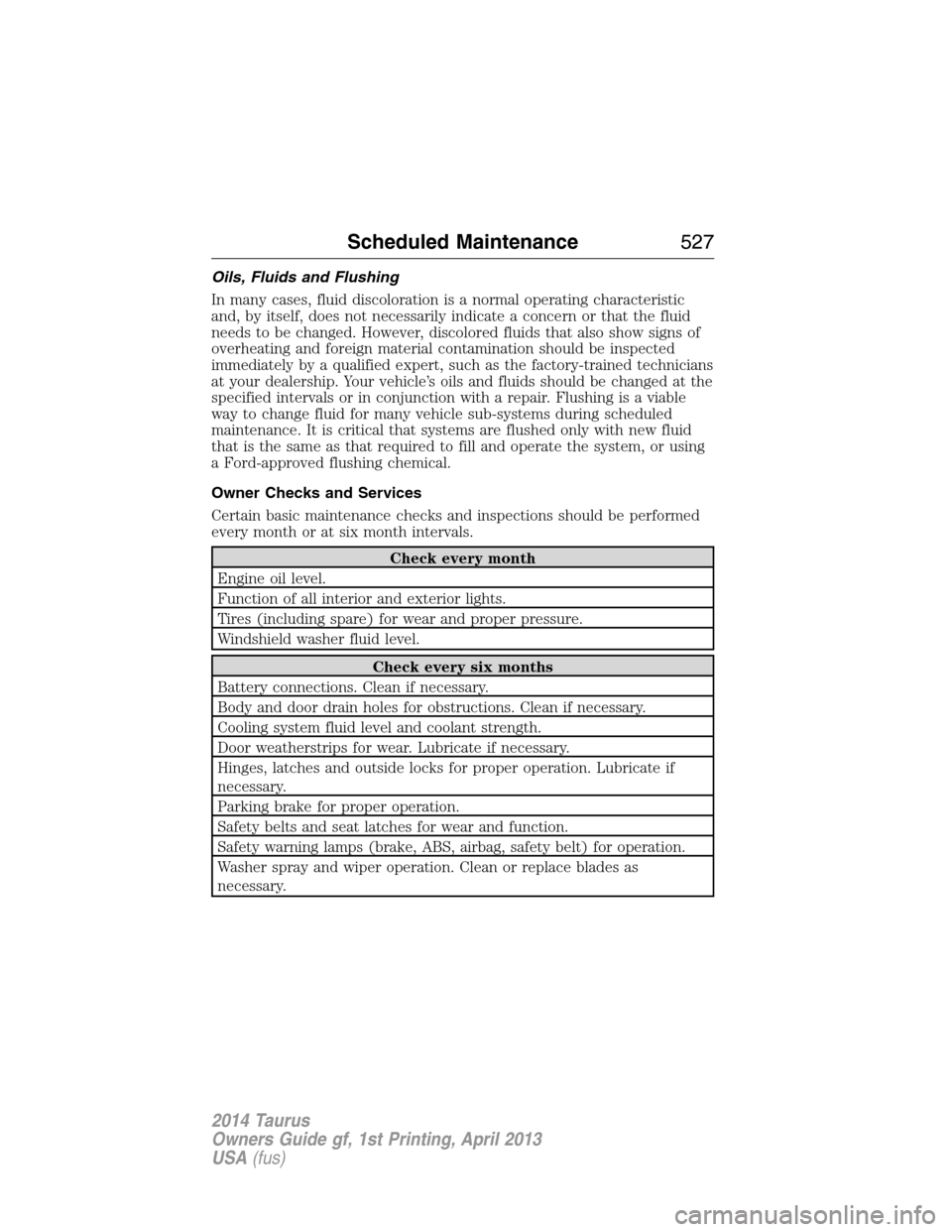
Oils, Fluids and Flushing
In many cases, fluid discoloration is a normal operating characteristic
and, by itself, does not necessarily indicate a concern or that the fluid
needs to be changed. However, discolored fluids that also show signs of
overheating and foreign material contamination should be inspected
immediately by a qualified expert, such as the factory-trained technicians
at your dealership. Your vehicle’s oils and fluids should be changed at the
specified intervals or in conjunction with a repair. Flushing is a viable
way to change fluid for many vehicle sub-systems during scheduled
maintenance. It is critical that systems are flushed only with new fluid
that is the same as that required to fill and operate the system, or using
a Ford-approved flushing chemical.
Owner Checks and Services
Certain basic maintenance checks and inspections should be performed
every month or at six month intervals.
Check every month
Engine oil level.
Function of all interior and exterior lights.
Tires (including spare) for wear and proper pressure.
Windshield washer fluid level.
Check every six months
Battery connections. Clean if necessary.
Body and door drain holes for obstructions. Clean if necessary.
Cooling system fluid level and coolant strength.
Door weatherstrips for wear. Lubricate if necessary.
Hinges, latches and outside locks for proper operation. Lubricate if
necessary.
Parking brake for proper operation.
Safety belts and seat latches for wear and function.
Safety warning lamps (brake, ABS, airbag, safety belt) for operation.
Washer spray and wiper operation. Clean or replace blades as
necessary.
Scheduled Maintenance527
2014 Taurus
Owners Guide gf, 1st Printing, April 2013
USA(fus)
Page 541 of 550
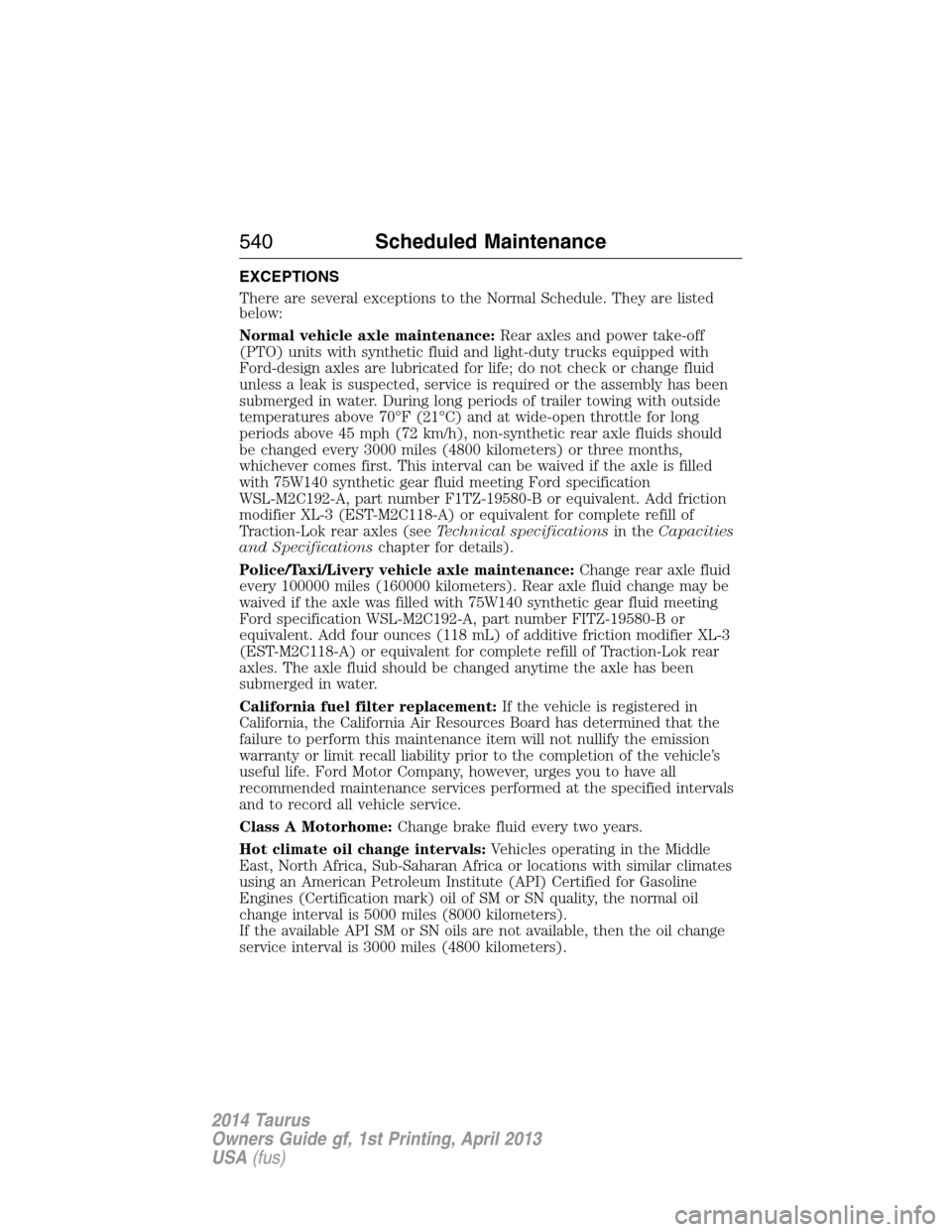
EXCEPTIONS
There are several exceptions to the Normal Schedule. They are listed
below:
Normal vehicle axle maintenance:Rear axles and power take-off
(PTO) units with synthetic fluid and light-duty trucks equipped with
Ford-design axles are lubricated for life; do not check or change fluid
unless a leak is suspected, service is required or the assembly has been
submerged in water. During long periods of trailer towing with outside
temperatures above 70°F (21°C) and at wide-open throttle for long
periods above 45 mph (72 km/h), non-synthetic rear axle fluids should
be changed every 3000 miles (4800 kilometers) or three months,
whichever comes first. This interval can be waived if the axle is filled
with 75W140 synthetic gear fluid meeting Ford specification
WSL-M2C192-A, part number F1TZ-19580-B or equivalent. Add friction
modifier XL-3 (EST-M2C118-A) or equivalent for complete refill of
Traction-Lok rear axles (seeTechnical specificationsin theCapacities
and Specificationschapter for details).
Police/Taxi/Livery vehicle axle maintenance:Change rear axle fluid
every 100000 miles (160000 kilometers). Rear axle fluid change may be
waived if the axle was filled with 75W140 synthetic gear fluid meeting
Ford specification WSL-M2C192-A, part number FITZ-19580-B or
equivalent. Add four ounces (118 mL) of additive friction modifier XL-3
(EST-M2C118-A) or equivalent for complete refill of Traction-Lok rear
axles. The axle fluid should be changed anytime the axle has been
submerged in water.
California fuel filter replacement:If the vehicle is registered in
California, the California Air Resources Board has determined that the
failure to perform this maintenance item will not nullify the emission
warranty or limit recall liability prior to the completion of the vehicle’s
useful life. Ford Motor Company, however, urges you to have all
recommended maintenance services performed at the specified intervals
and to record all vehicle service.
Class A Motorhome:Change brake fluid every two years.
Hot climate oil change intervals:Vehicles operating in the Middle
East, North Africa, Sub-Saharan Africa or locations with similar climates
using an American Petroleum Institute (API) Certified for Gasoline
Engines (Certification mark) oil of SM or SN quality, the normal oil
change interval is 5000 miles (8000 kilometers).
If the available API SM or SN oils are not available, then the oil change
service interval is 3000 miles (4800 kilometers).
540Scheduled Maintenance
2014 Taurus
Owners Guide gf, 1st Printing, April 2013
USA(fus)
Page 543 of 550
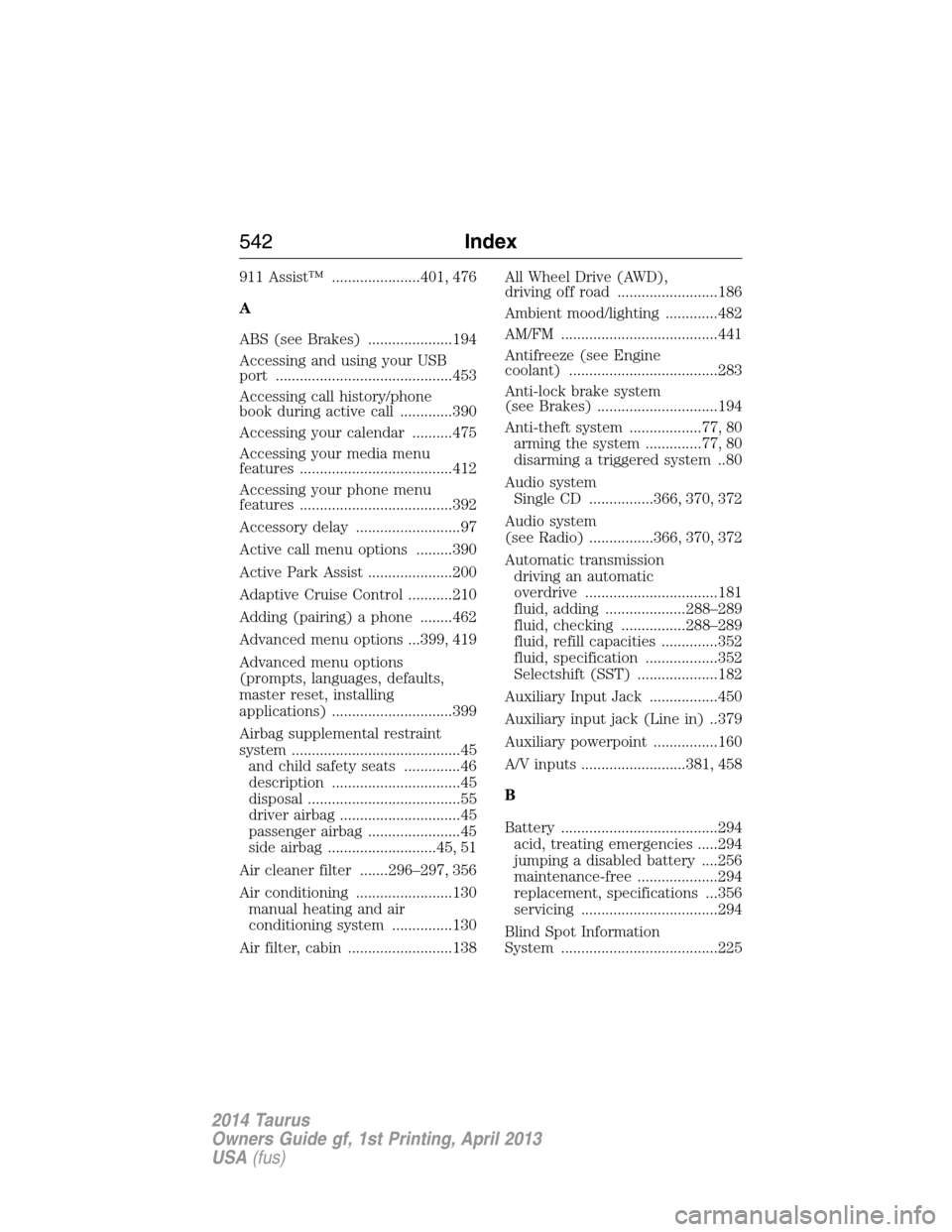
911 Assist™ ......................401, 476
A
ABS (see Brakes) .....................194
Accessing and using your USB
port ............................................453
Accessing call history/phone
book during active call .............390
Accessing your calendar ..........475
Accessing your media menu
features ......................................412
Accessing your phone menu
features ......................................392
Accessory delay ..........................97
Active call menu options .........390
Active Park Assist .....................200
Adaptive Cruise Control ...........210
Adding (pairing) a phone ........462
Advanced menu options ...399, 419
Advanced menu options
(prompts, languages, defaults,
master reset, installing
applications) ..............................399
Airbag supplemental restraint
system ..........................................45
and child safety seats ..............46
description ................................45
disposal ......................................55
driver airbag ..............................45
passenger airbag .......................45
side airbag ...........................45, 51
Air cleaner filter .......296–297, 356
Air conditioning ........................130
manual heating and air
conditioning system ...............130
Air filter, cabin ..........................138All Wheel Drive (AWD),
driving off road .........................186
Ambient mood/lighting .............482
AM/FM .......................................441
Antifreeze (see Engine
coolant) .....................................283
Anti-lock brake system
(see Brakes) ..............................194
Anti-theft system ..................77, 80
arming the system ..............77, 80
disarming a triggered system ..80
Audio system
Single CD ................366, 370, 372
Audio system
(see Radio) ................366, 370, 372
Automatic transmission
driving an automatic
overdrive .................................181
fluid, adding ....................288–289
fluid, checking ................288–289
fluid, refill capacities ..............352
fluid, specification ..................352
Selectshift (SST) ....................182
Auxiliary Input Jack .................450
Auxiliary input jack (Line in) ..379
Auxiliary powerpoint ................160
A/V inputs ..........................381, 458
B
Battery .......................................294
acid, treating emergencies .....294
jumping a disabled battery ....256
maintenance-free ....................294
replacement, specifications ...356
servicing ..................................294
Blind Spot Information
System .......................................225
542Index
2014 Taurus
Owners Guide gf, 1st Printing, April 2013
USA(fus)
Page 544 of 550
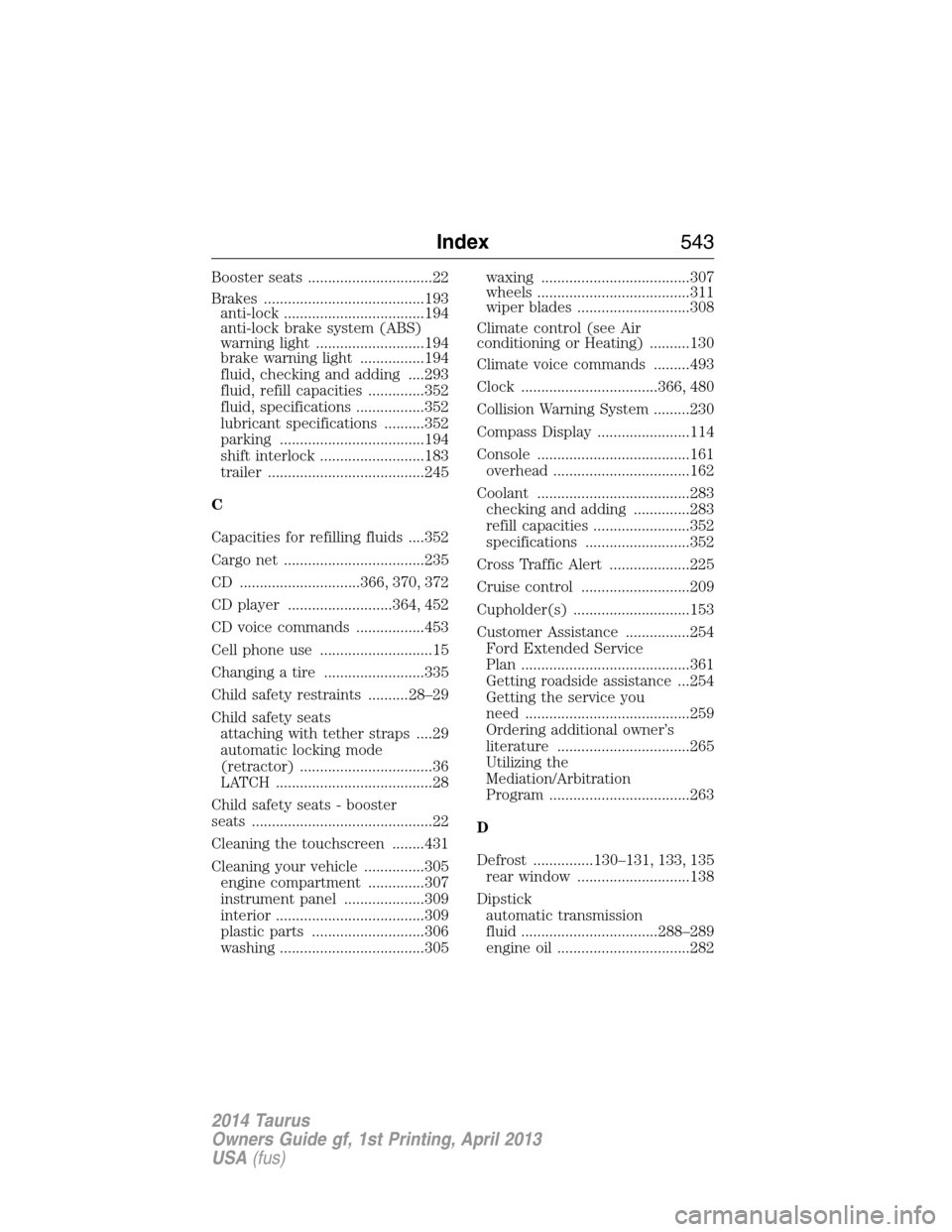
Booster seats ...............................22
Brakes ........................................193
anti-lock ...................................194
anti-lock brake system (ABS)
warning light ...........................194
brake warning light ................194
fluid, checking and adding ....293
fluid, refill capacities ..............352
fluid, specifications .................352
lubricant specifications ..........352
parking ....................................194
shift interlock ..........................183
trailer .......................................245
C
Capacities for refilling fluids ....352
Cargo net ...................................235
CD ..............................366, 370, 372
CD player ..........................364, 452
CD voice commands .................453
Cell phone use ............................15
Changing a tire .........................335
Child safety restraints ..........28–29
Child safety seats
attaching with tether straps ....29
automatic locking mode
(retractor) .................................36
LATCH .......................................28
Child safety seats - booster
seats .............................................22
Cleaning the touchscreen ........431
Cleaning your vehicle ...............305
engine compartment ..............307
instrument panel ....................309
interior .....................................309
plastic parts ............................306
washing ....................................305waxing .....................................307
wheels ......................................311
wiper blades ............................308
Climate control (see Air
conditioning or Heating) ..........130
Climate voice commands .........493
Clock ..................................366, 480
Collision Warning System .........230
Compass Display .......................114
Console ......................................161
overhead ..................................162
Coolant ......................................283
checking and adding ..............283
refill capacities ........................352
specifications ..........................352
Cross Traffic Alert ....................225
Cruise control ...........................209
Cupholder(s) .............................153
Customer Assistance ................254
Ford Extended Service
Plan ..........................................361
Getting roadside assistance ...254
Getting the service you
need .........................................259
Ordering additional owner’s
literature .................................265
Utilizing the
Mediation/Arbitration
Program ...................................263
D
Defrost ...............130–131, 133, 135
rear window ............................138
Dipstick
automatic transmission
fluid ..................................288–289
engine oil .................................282
Index543
2014 Taurus
Owners Guide gf, 1st Printing, April 2013
USA(fus)