cooling FORD TAURUS 2015 6.G Owners Manual
[x] Cancel search | Manufacturer: FORD, Model Year: 2015, Model line: TAURUS, Model: FORD TAURUS 2015 6.GPages: 558, PDF Size: 4.42 MB
Page 131 of 558
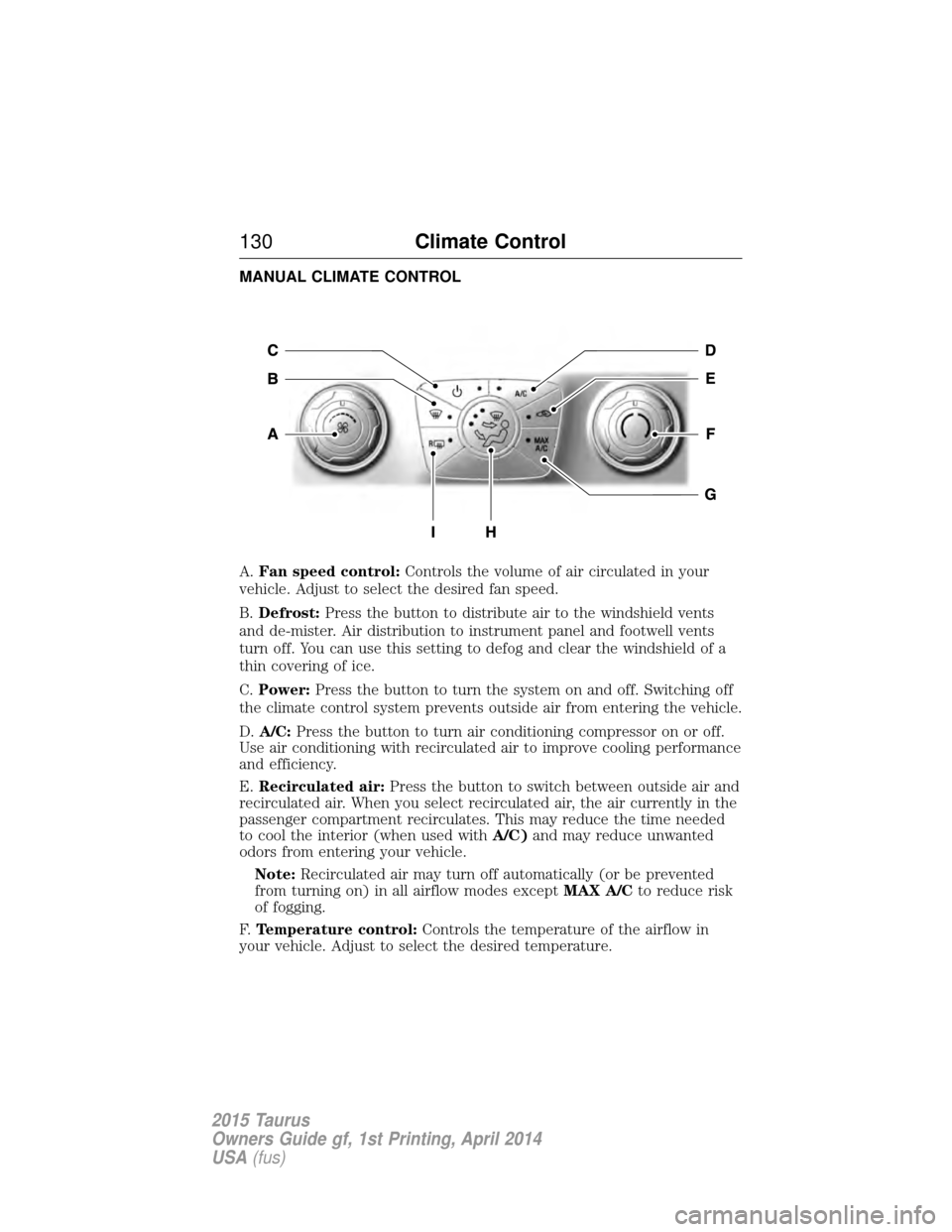
MANUAL CLIMATE CONTROL
A.Fan speed control: Controls the volume of air circulated in your
vehicle. Adjust to select the desired fan speed.
B. Defrost: Press the button to distribute air to the windshield vents
and de-mister. Air distribution to instrument panel and footwell vents
turn off. You can use this setting to defog and clear the windshield of a
thin covering of ice.
C. Power: Press the button to turn the system on and off. Switching off
the climate control system prevents outside air from entering the vehicle.
D. A/C: Press the button to turn air conditioning compressor on or off.
Use air conditioning with recirculated air to improve cooling performance
and efficiency.
E. Recirculated air: Press the button to switch between outside air and
recirculated air. When you select recirculated air, the air currently in the
passenger compartment recirculates. This may reduce the time needed
to cool the interior (when used with A/C)and may reduce unwanted
odors from entering your vehicle.
Note: Recirculated air may turn off automatically (or be prevented
from turning on) in all airflow modes except MAX A/Cto reduce risk
of fogging.
F. Temperature control: Controls the temperature of the airflow in
your vehicle. Adjust to select the desired temperature.
130 Climate Control
2015 Taurus
Owners Guide gf, 1st Printing, April 2014
USA(fus)
Page 132 of 558
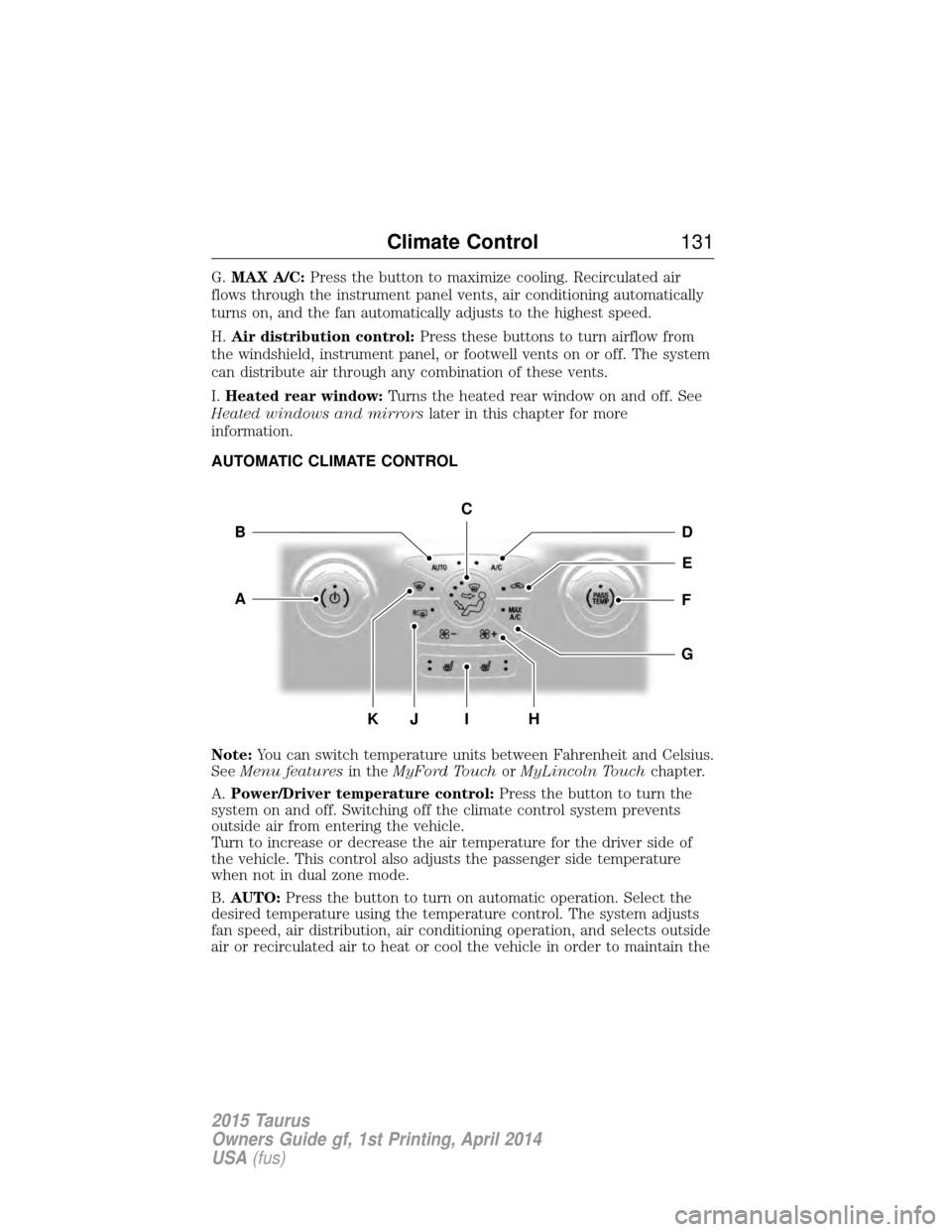
G.MAX A/C: Press the button to maximize cooling. Recirculated air
flows through the instrument panel vents, air conditioning automatically
turns on, and the fan automatically adjusts to the highest speed.
H. Air distribution control: Press these buttons to turn airflow from
the windshield, instrument panel, or footwell vents on or off. The system
can distribute air through any combination of these vents.
I. Heated rear window: Turns the heated rear window on and off. See
Heated windows and mirrors later in this chapter for more
information.
AUTOMATIC CLIMATE CONTROL
Note: You can switch temperature units between Fahrenheit and Celsius.
See Menu features in theMyFord Touch orMyLincoln Touch chapter.
A. Power/Driver temperature control: Press the button to turn the
system on and off. Switching off the climate control system prevents
outside air from entering the vehicle.
Turn to increase or decrease the air temperature for the driver side of
the vehicle. This control also adjusts the passenger side temperature
when not in dual zone mode.
B. AUTO: Press the button to turn on automatic operation. Select the
desired temperature using the temperature control. The system adjusts
fan speed, air distribution, air conditioning operation, and selects outside
air or recirculated air to heat or cool the vehicle in order to maintain the
G
HK
E
DB
FA
I
C
J
Climate Control 131
2015 Taurus
Owners Guide gf, 1st Printing, April 2014
USA(fus)
Page 133 of 558
desired temperature. You can also use theAUTObutton to turn off dual
zone operation by pressing and holding the button for more than two
seconds.
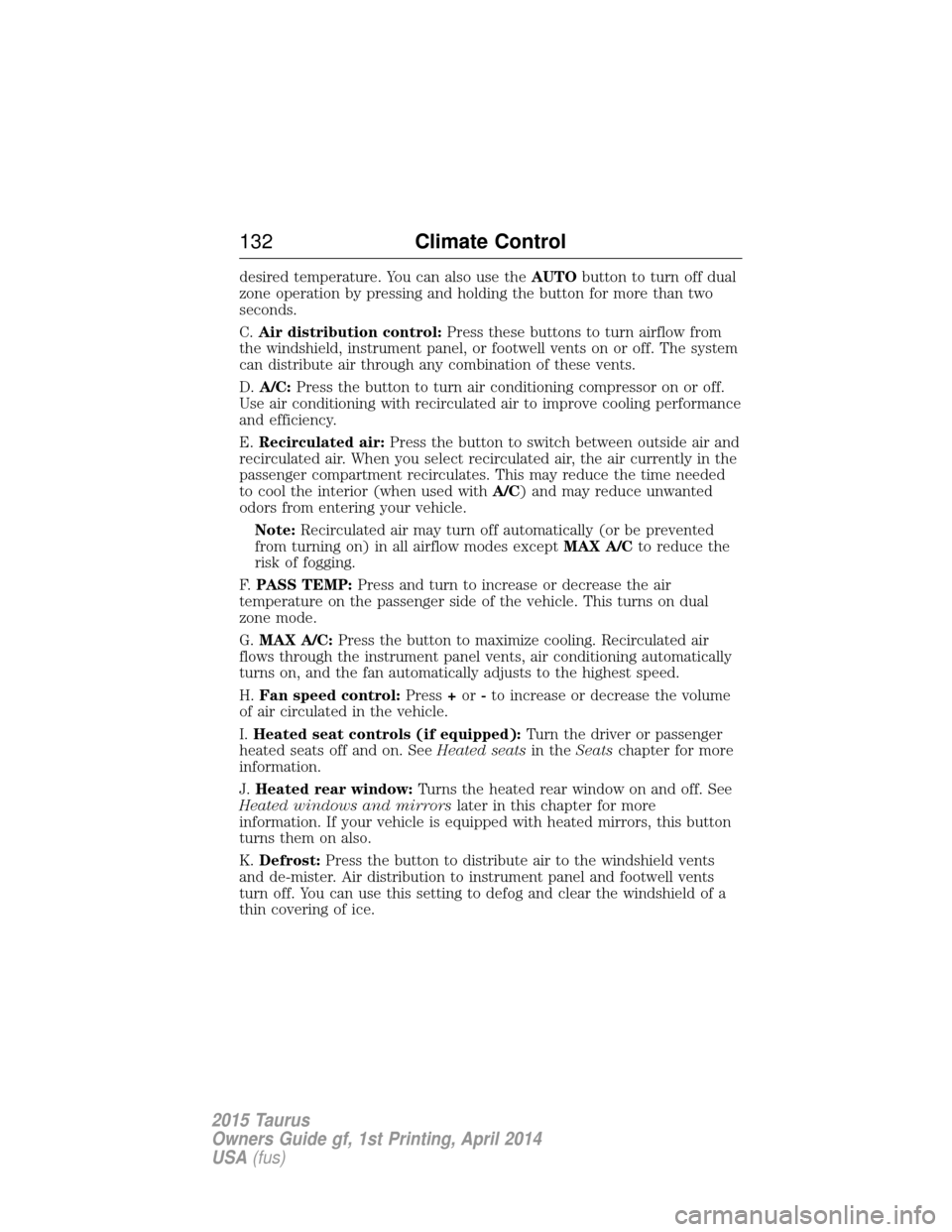
C. Air distribution control: Press these buttons to turn airflow from
the windshield, instrument panel, or footwell vents on or off. The system
can distribute air through any combination of these vents.
D. A/C: Press the button to turn air conditioning compressor on or off.
Use air conditioning with recirculated air to improve cooling performance
and efficiency.
E. Recirculated air: Press the button to switch between outside air and
recirculated air. When you select recirculated air, the air currently in the
passenger compartment recirculates. This may reduce the time needed
to cool the interior (when used with A/C) and may reduce unwanted
odors from entering your vehicle.
Note: Recirculated air may turn off automatically (or be prevented
from turning on) in all airflow modes except MAX A/Cto reduce the
risk of fogging.
F. PASS TEMP: Press and turn to increase or decrease the air
temperature on the passenger side of the vehicle. This turns on dual
zone mode.
G. MAX A/C: Press the button to maximize cooling. Recirculated air
flows through the instrument panel vents, air conditioning automatically
turns on, and the fan automatically adjusts to the highest speed.
H. Fan speed control: Press+or -to increase or decrease the volume
of air circulated in the vehicle.
I. Heated seat controls (if equipped): Turn the driver or passenger
heated seats off and on. See Heated seatsin theSeatschapter for more
information.
J. Heated rear window: Turns the heated rear window on and off. See
Heated windows and mirrors later in this chapter for more
information. If your vehicle is equipped with heated mirrors, this button
turns them on also.
K. Defrost: Press the button to distribute air to the windshield vents
and de-mister. Air distribution to instrument panel and footwell vents
turn off. You can use this setting to defog and clear the windshield of a
thin covering of ice.
132 Climate Control
2015 Taurus
Owners Guide gf, 1st Printing, April 2014
USA(fus)
Page 135 of 558
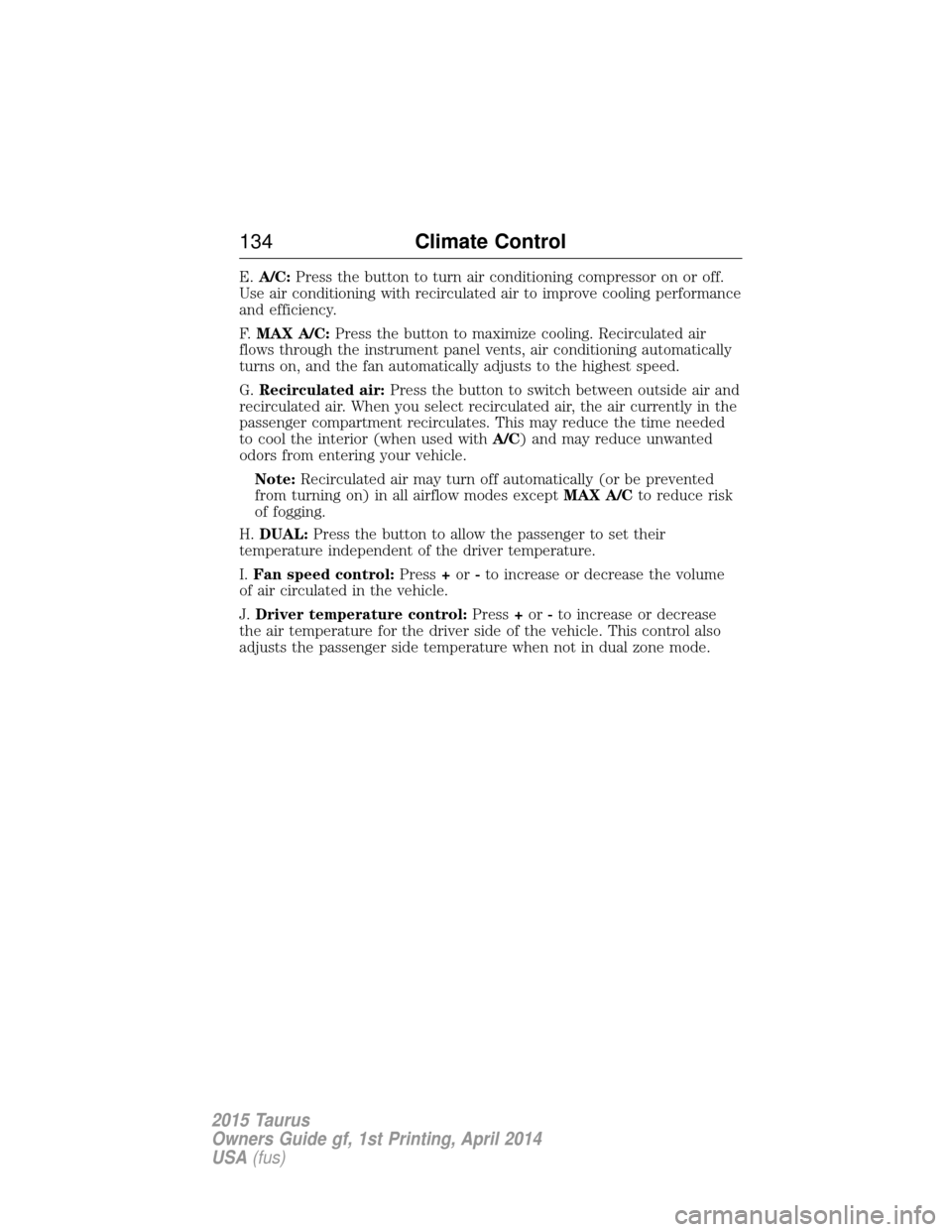
E.A/C: Press the button to turn air conditioning compressor on or off.
Use air conditioning with recirculated air to improve cooling performance
and efficiency.
F. MAX A/C: Press the button to maximize cooling. Recirculated air
flows through the instrument panel vents, air conditioning automatically
turns on, and the fan automatically adjusts to the highest speed.
G. Recirculated air: Press the button to switch between outside air and
recirculated air. When you select recirculated air, the air currently in the
passenger compartment recirculates. This may reduce the time needed
to cool the interior (when used with A/C) and may reduce unwanted
odors from entering your vehicle.
Note: Recirculated air may turn off automatically (or be prevented
from turning on) in all airflow modes except MAX A/Cto reduce risk
of fogging.
H. DUAL: Press the button to allow the passenger to set their
temperature independent of the driver temperature.
I. Fan speed control: Press+or -to increase or decrease the volume
of air circulated in the vehicle.
J. Driver temperature control: Press+or -to increase or decrease
the air temperature for the driver side of the vehicle. This control also
adjusts the passenger side temperature when not in dual zone mode.
134 Climate Control
2015 Taurus
Owners Guide gf, 1st Printing, April 2014
USA(fus)
Page 137 of 558
E.MAX A/C: Press the button to maximize cooling. Recirculated air
flows through the instrument panel vents, air conditioning automatically
turns on, and the fan automatically adjusts to the highest speed.
F. A/C: Press the button to turn air conditioning compressor on or off.
Use air conditioning with recirculated air to improve cooling performance
and efficiency.
G. AUTO: Press the button to turn on automatic operation. Select the
desired temperature using the temperature control. The system adjusts
fan speed, air distribution, air conditioning operation, and selects outside
air or recirculated air to heat or cool the vehicle in order to maintain the
desired temperature. You can also use the AUTObutton to turn off dual
zone operation by pressing and holding the button for more than two
seconds.
H. Heated rear window: Turns the heated rear window on and off. See
Heated windows and mirrors later in this chapter for more
information. If your vehicle is equipped with heated mirrors, this button
turns them on also.
I. Defrost: Press the button to distribute air to the windshield vents and
de-mister. Air distribution to instrument panel and footwell vents turn
off. You can use this setting to defog and clear the windshield of a thin
covering of ice.
GENERAL OPERATING TIPS
General Hints
Note: Prolonged use of recirculated air may cause the windows to fog
up.
Note: You may feel a small amount of air from the footwell air vents
regardless of the air distribution setting.
Note: To reduce humidity build-up inside your vehicle, do not drive with
the system switched off or with recirculated air always switched on.
Note: Do not place objects under the front seats as this may interfere
with the airflow to the rear seats.
Note: Remove any snow, ice or leaves from the air intake area at the
base of the windshield.
Note: To improve the time to reach comfort in hot weather, drive with
the windows slightly open for 2-3 minutes after start-up or until your
vehicle airs out.
136 Climate Control
2015 Taurus
Owners Guide gf, 1st Printing, April 2014
USA(fus)
Page 138 of 558
Manual Climate Control
Note:To reduce fogging of the windshield during humid weather, adjust
the air distribution control to the windshield air vents position.
Automatic Climate Control
Note: Adjusting the settings when your vehicle interior is extremely hot
or cold is not necessary. The system automatically adjusts to heat or cool
the cabin to your selected temperature as quickly as possible. For the
system to function efficiently, the instrument panel and side air vents
should be fully open.
Note: If you select AUTOduring cold outside temperatures, the system
directs airflow to the windshield and side window vents. In addition, the
fan may run at a slower speed until the engine warms up.
Note: If you select AUTOduring hot outside temperatures, or when the
inside of the vehicle is hot, the system automatically uses recirculated air
to maximize interior cooling. When the interior reaches the selected
temperature, the system automatically switches to using outside air.
Heating the Interior Quickly
Vehicles with manual climate
control Vehicles with automatic
climate control
1 Adjust the fan speed to the highest speed setting. Press the
AUTObutton.
2 Adjust the temperature control to the highest setting. Adjust the temperature control
to the desired setting.
3 Select the footwell air vents using the air distribution
buttons.
Climate Control 137
2015 Taurus
Owners Guide gf, 1st Printing, April 2014
USA(fus)
Page 139 of 558
Recommended Settings for Heating
Vehicles with manual climatecontrol Vehicles with automatic
climate control
1 Adjust the fan speed to the center setting. Press the
AUTObutton.
2 Adjust the temperature control to the midway point of the hot
settings. Adjust the temperature control
to the desired setting. Use 72°F
(22°C) as a starting point, then
adjust the setting as necessary.
3 Select the footwell air vents using the air distribution
buttons.
Cooling the Interior Quickly
Vehicles with manual climate control Vehicles with automatic
climate control
1 Adjust the temperature control to the MAX A/C position. Press the
MAX A/C button.
2 Drive with the windows open for 2-3 minutes.
Recommended Settings for Cooling
Vehicles with manual climate control Vehicles with automatic
climate control
1 Adjust the fan speed to the center setting. Press the
AUTObutton.
2 Adjust the temperature control to the midway point of the cold
settings. Adjust the temperature control
to the desired setting. Use 72°F
(22°C) as a starting point, then
adjust the setting as necessary.
3 Select the instrument panel air vents using the air distribution
buttons.
138 Climate Control
2015 Taurus
Owners Guide gf, 1st Printing, April 2014
USA(fus)
Page 154 of 558
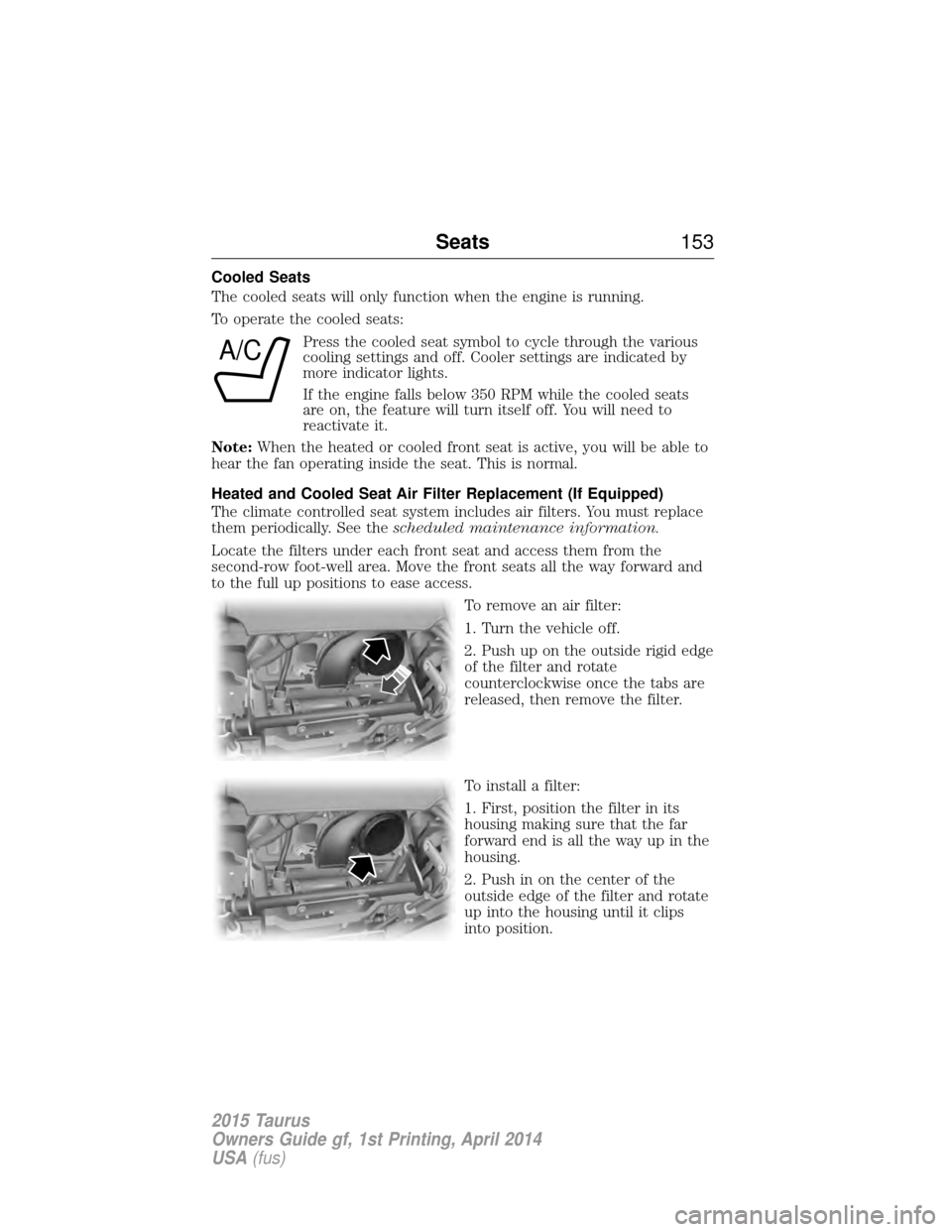
Cooled Seats
The cooled seats will only function when the engine is running.
To operate the cooled seats:Press the cooled seat symbol to cycle through the various
cooling settings and off. Cooler settings are indicated by
more indicator lights.
If the engine falls below 350 RPM while the cooled seats
are on, the feature will turn itself off. You will need to
reactivate it.
Note: When the heated or cooled front seat is active, you will be able to
hear the fan operating inside the seat. This is normal.
Heated and Cooled Seat Air Filter Replacement (If Equipped)
The climate controlled seat system includes air filters. You must replace
them periodically. See the scheduled maintenance information.
Locate the filters under each front seat and access them from the
second-row foot-well area. Move the front seats all the way forward and
to the full up positions to ease access. To remove an air filter:
1. Turn the vehicle off.
2. Push up on the outside rigid edge
of the filter and rotate
counterclockwise once the tabs are
released, then remove the filter.
To install a filter:
1. First, position the filter in its
housing making sure that the far
forward end is all the way up in the
housing.
2. Push in on the center of the
outside edge of the filter and rotate
up into the housing until it clips
into position.
A/C
Seats153
2015 Taurus
Owners Guide gf, 1st Printing, April 2014
USA(fus)
Page 190 of 558
components. This condition may be indicated by an AWD Off message in
the information display. If there is an AWD Off message in the
information display from using the spare tire, this indicator should turn
off after reinstalling the repaired or replaced normal road tire and cycling
the ignition off and on. It is recommended to reinstall the repaired or
replaced road tire as soon as possible. Major dissimilar tire sizes between
the front and rear axles could cause the AWD system to stop functioning
and default to front-wheel drive or damage the AWD system.
Driving In Special Conditions With All-Wheel Drive (AWD)
AWD vehicles are equipped for driving on sand, snow, mud and rough
roads and have operating characteristics that are somewhat different
from conventional vehicles, both on and off the highway.
When driving at slow speeds in deep sand under high outside
temperatures, use a low gear when possible. Lower gear operation will
maximize the engine and transmission cooling capability.
Under severe operating conditions, the A/C may cycle on and off to
protect overheating of the engine.
Basic operating principles in special conditions
•Drive slower in strong crosswinds which can affect the normal steering
characteristics of your vehicle.
• Be extremely careful when driving on pavement made slippery by
loose sand, water, gravel, snow or ice.
If Your Vehicle Goes Off the Edge of the Pavement
• If your vehicle goes off the edge of the pavement, slow down, but
avoid severe brake application, ease the vehicle back onto the
pavement only after reducing your speed. Do not turn the steering
wheel too sharply while returning to the road surface.
• It may be safer to stay on the apron or shoulder of the road and slow
down gradually before returning to the pavement. You may lose
control if you do not slow down or if you turn the steering wheel too
sharply or abruptly.
• It often may be less risky to strike small objects, such as highway
reflectors, with minor damage to your vehicle rather than attempt a
sudden return to the pavement which could cause the vehicle to slide
sideways out of control or rollover. Remember, your safety and the
safety of others should be your primary concern.
All-Wheel Drive (If Equipped) 189
2015 Taurus
Owners Guide gf, 1st Printing, April 2014
USA(fus)
Page 192 of 558
Sand
When driving over sand, try to keep all four wheels on the most solid
area of the trail. Avoid reducing the tire pressures but shift to a lower
gear and drive steadily through the terrain. Apply the accelerator slowly
and avoid excessive wheel slip.
Do not drive your vehicle in deep sand for an extended period of time.
This could cause the AWD system to overheat and default to front-wheel
drive. If this occurs AWD Off will be displayed in the Information Display.
To resume normal AWD function as soon as possible, stop the vehicle in
a safe location and stop the engine for at least 10 minutes. After the
engine has been restarted and the AWD system has adequately cooled,
the AWD Off message will turn off and normal AWD function will return.
In the event the engine is not stopped, the AWD Off message will turn
off when the system cools and normal AWD function returns.
When driving at slow speeds in deep sand under high outside
temperatures, use L (Low) gear when possible. L (Low) gear operation
will maximize the engine and transmission cooling capability.
Under severe operating conditions, the A/C may cycle on and off to
protect overheating of the engine.
Avoid driving at excessive speeds, this causes vehicle momentum to work
against you and your vehicle could become stuck to the point that
assistance may be required from another vehicle. Remember, you may be
able to back out the way you came if you proceed with caution.
Mud and Water
If you must drive through high water, drive slowly. Traction or brake
capability may be limited.
When driving through water, determine the depth; avoid water higher
than the bottom of the wheel rims (for cars) or the bottom of the hubs
(for trucks) (if possible) and proceed slowly. If the ignition system gets
wet, the vehicle may stall.
Once through water, always try the brakes. Wet brakes do not stop the
vehicle as effectively as dry brakes. Drying can be improved by moving
your vehicle slowly while applying light pressure on the brake pedal.
Be cautious of sudden changes in vehicle speed or direction when you
are driving in mud. Even AWD vehicles can lose traction in slick mud. As
when you are driving over sand, apply the accelerator slowly and avoid
spinning your wheels. If the vehicle does slide, steer in the direction of
the slide until you regain control of the vehicle.
All-Wheel Drive (If Equipped)191
2015 Taurus
Owners Guide gf, 1st Printing, April 2014
USA(fus)