tow FORD THUNDERBIRD 2002 11.G Owner's Guide
[x] Cancel search | Manufacturer: FORD, Model Year: 2002, Model line: THUNDERBIRD, Model: FORD THUNDERBIRD 2002 11.GPages: 248, PDF Size: 2.1 MB
Page 187 of 248
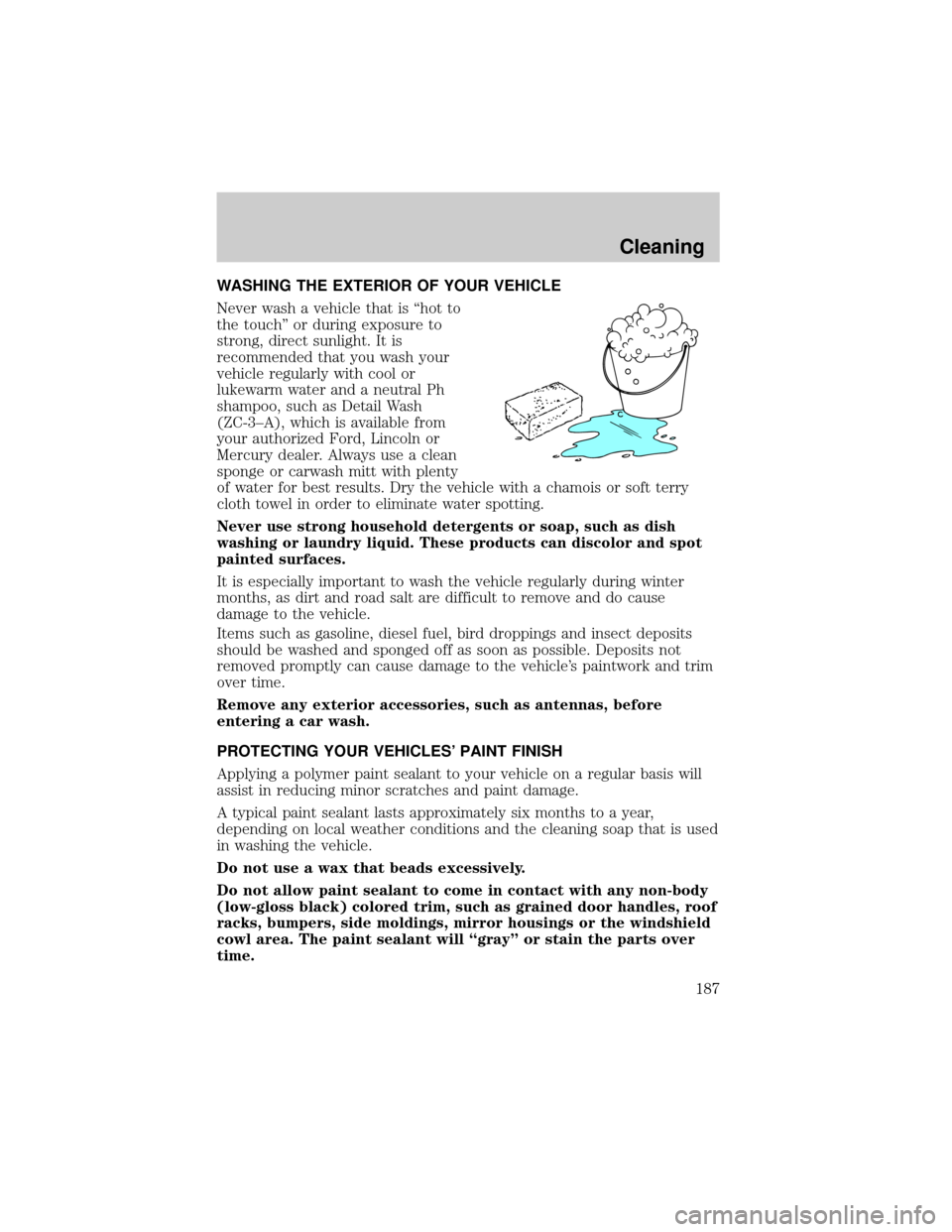
WASHING THE EXTERIOR OF YOUR VEHICLE
Never wash a vehicle that is ªhot to
the touchº or during exposure to
strong, direct sunlight. It is
recommended that you wash your
vehicle regularly with cool or
lukewarm water and a neutral Ph
shampoo, such as Detail Wash
(ZC-3±A), which is available from
your authorized Ford, Lincoln or
Mercury dealer. Always use a clean
sponge or carwash mitt with plenty
of water for best results. Dry the vehicle with a chamois or soft terry
cloth towel in order to eliminate water spotting.
Never use strong household detergents or soap, such as dish
washing or laundry liquid. These products can discolor and spot
painted surfaces.
It is especially important to wash the vehicle regularly during winter
months, as dirt and road salt are difficult to remove and do cause
damage to the vehicle.
Items such as gasoline, diesel fuel, bird droppings and insect deposits
should be washed and sponged off as soon as possible. Deposits not
removed promptly can cause damage to the vehicle's paintwork and trim
over time.
Remove any exterior accessories, such as antennas, before
entering a car wash.
PROTECTING YOUR VEHICLES' PAINT FINISH
Applying a polymer paint sealant to your vehicle on a regular basis will
assist in reducing minor scratches and paint damage.
A typical paint sealant lasts approximately six months to a year,
depending on local weather conditions and the cleaning soap that is used
in washing the vehicle.
Do not use a wax that beads excessively.
Do not allow paint sealant to come in contact with any non-body
(low-gloss black) colored trim, such as grained door handles, roof
racks, bumpers, side moldings, mirror housings or the windshield
cowl area. The paint sealant will ªgrayº or stain the parts over
time.
Cleaning
187
Page 190 of 248

If tar or grease spots are present, clean with Extra Strength Tar and
Road Oil Removal (B7A-19520±AA).
Use only approved products to clean plastic parts.These products
are available from your authorized Ford, Lincoln or Mercury dealer.
WASHING THE EXTERIOR LAMPS
In order to avoid scratching the plastic lamps, do not use dry
paper towels, non-approved chemical solvents or abrasive
cleaners.
Use a soft cloth and a solution of Triple Clean (EOAZ-19526±AA), mixed
properly with water, in order to remove bug residue. If tar or grease
spots are present, clean with Extra Strength Tar and Road Oil Removal
(B7A-19520±AA).
CLEANING THE WINDSHIELD, WIPER BLADES AND REAR
WINDOW
If the wiper does not wipe properly, substances on the windshield, rear
window or the wiper blades may be the cause. These may include hot
wax treatments used by commercial car washes, tree sap, or other
organic contamination.
Do not clean the windshield or rear window glass with abrasives,
as they may cause scratches.
Do not use fuel, kerosene, or paint thinner to clean the
windshield, rear window or the wiper blades as damage may
occur.
Clean the outside of the windshield or rear window with a non-abrasive
cleaner such as Ultra Clear Spray Glass Cleaner (E4AZ-19C507±AA),
available from your authorized Ford, Lincoln or Mercury dealer. If after
cleaning the glass surface, the water sheets from the glass (e.g., does not
bead), then the window is clean.
The windshield, rear window and wiper blades should be cleaned
regularly. Wiper blades can be cleaned with isopropyl (rubbing) alcohol
or windshield washer solution. Be sure to replace wiper blades when
they appear worn or do not function properly.
Cleaning
190
Page 191 of 248
CLEANING THE INSTRUMENT PANEL
Clean the instrument panel with a damp cloth, then dry with a dry cloth.
Avoid cleaners or polish that increase the gloss of the upper portion of
the instrument panel. The dull finish in this area helps protect the driver
from undesirable windshield reflection.
Do not use chemical solvents or strong detergents when cleaning
the steering wheel or instrument panel to avoid contamination of
the air bag system.
Cleaning the instrument cluster lens
Wipe the cluster area with a soft, damp cotton towel and Ultra Clear
Spray Glass Cleaner (E4AZ-19C507±AA). Dry the area with a clean, dry
towel.
CLEANING SEATS EQUIPPED WITH SIDE AIR BAGS
Remove dust and loose dirt with a vacuum cleaner. In order to remove
stains and soil, clean with Extra Strength Upholstery Cleaner
(E8AZ-19523±AA).
Never saturate the seat covers with any cleaning solution.
Do not use chemical solvents or strong detergents when cleaning
the seat where the side air bag is mounted. Such products could
contaminate the side air bag system and affect performance of the side
air bag in a collision. The air bag may not function correctly and not
provide injury reduction benefits.
CLEANING THE INTERIOR FABRIC, CARPETS AND CLOTH SEATS
Remove dust and loose dirt with a vacuum cleaner. Remove light stains
and soil with Extra Strength Upholstery Cleaner (E8AZ-19523±AA).
Never saturate the seat covers with cleaning solution.
Do not use household cleaning products or glass cleaners, which
can stain and discolor the fabric and affect the flame retardent
abilities of the seat materials.
If grease or tar is present on the material, spot-clean the area first with
Spot and Stain Remover (F3AZ-19521±WA). Follow up by recleaning the
area with Extra Strength Upholstery Cleaner (E8AZ-19523±AA).
Cleaning
191
Page 192 of 248

CLEANING LEATHER SEATS (IF EQUIPPED)
All Ford, Lincoln and Mercury vehicles with leather seating surfaces have
a clear, protective coating over the leather.
To clean the leather seats, simply use a soft cloth with Deluxe Leather
and Vinyl Cleaner (F2AZ-19521±WA). Dry the area with a soft cloth.
It is recommended that you use the Deluxe Leather Care Kit
(F8AZ-19G253±AA), available from your authorized Ford, Lincoln or
Mercury dealer. The mild cleaner and special pad available in the kit
cleans the leather and maintains its natural beauty. For best results,
follow the instructions printed on the cleaner label. Regular cleaning of
your leather upholstery helps maintain its resiliency and color.
Do not use household cleaning products, alcohol solutions,
solvents or cleaners intended for rubber, vinyl and plastics, or
oil/petroleum-based leather conditioners. These products may
cause premature wearing of the clear, protective coating.
CLEANING THE INSIDE WINDOWS
Use Ultra Clear Spray Glass Cleaner (E4AZ-19C507±AA) for the inside
windows if they become fogged.
To clean, use two lint-free, soft towels, folded into a pad-shape. Mist the
glass completely with cleaner, and use one of the towels to evenly agitate
the surface. Use the other towel to remove the residue.
CLEANING AND MAINTAINING THE SAFETY BELTS
Clean the safety belts with Extra Strength Upholstery Cleaner
(E8AZ-19523±AA), available from your authorized Ford, Lincoln or
Mercury dealer.
Do not use bleach, dye or any other solvent to clean the belts, as
these actions may weaken the belt webbing.
UNDERBODY
Flush the complete underside of your vehicle frequently. Keep body and
door drain holes free from packed dirt.
Cleaning
192
Page 196 of 248
OPENING THE HOOD
1. Inside the vehicle, pull the hood
release handle located at the bottom
left of the instrument panel.
2. Go to the front of the vehicle and
release the auxiliary latch that is
located under the front center of
the hood by pushing the handle
toward the passenger side of the
vehicle.
3. Lift the hood until the lift cylinders hold it open.
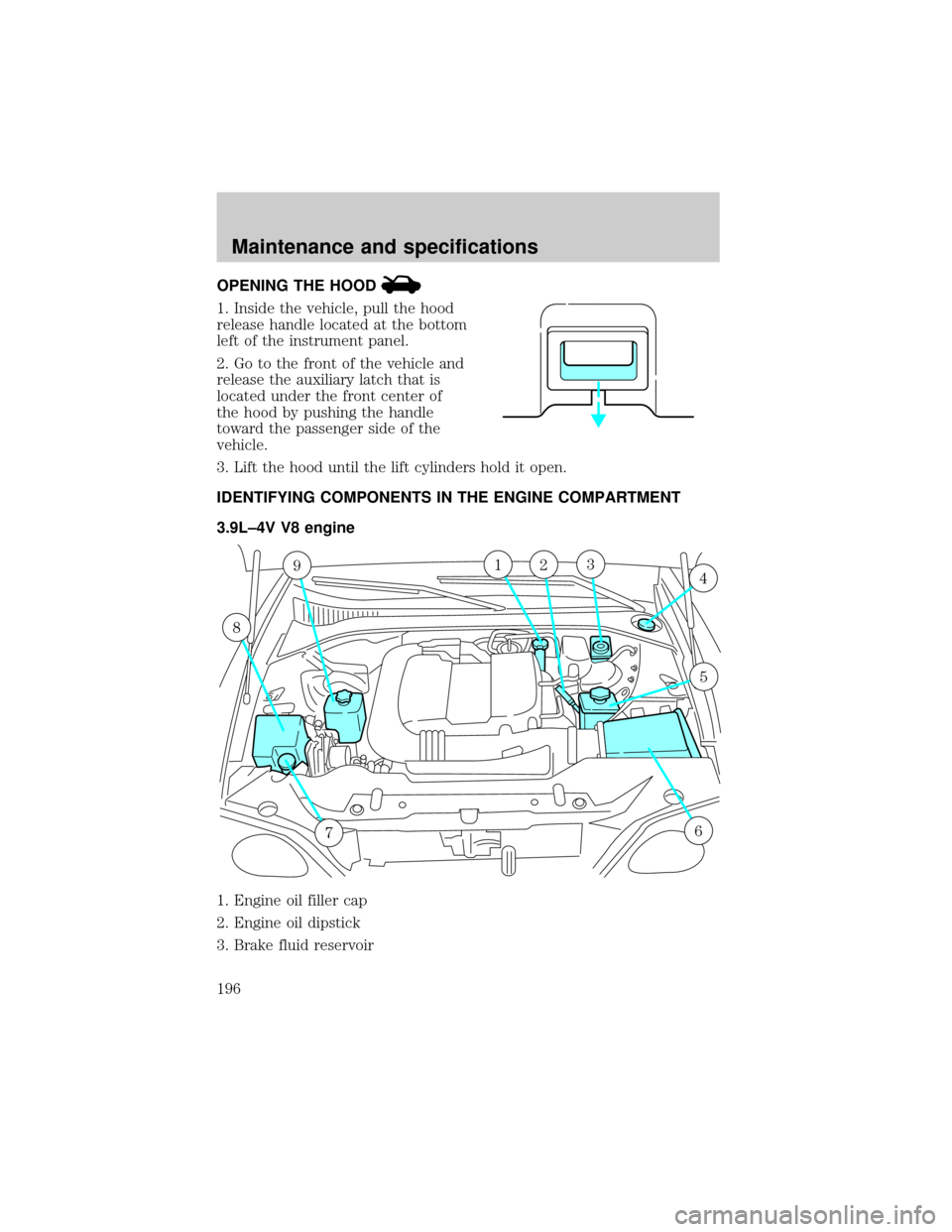
IDENTIFYING COMPONENTS IN THE ENGINE COMPARTMENT
3.9L±4V V8 engine
1. Engine oil filler cap
2. Engine oil dipstick
3. Brake fluid reservoir
9
8
76
4123
5
Maintenance and specifications
196
Page 216 of 248
²Idling for long periods of time (greater than one minute) may waste
fuel.
²Anticipate stopping; slowing down may eliminate the need to stop.
²Sudden or hard accelerations may reduce fuel economy.
²Slow down gradually.
²Driving at reasonable speeds (traveling at 88 km/h [55 mph] uses 15%
less fuel than traveling at 105 km/h [65 mph]).
²Revving the engine before turning it off may reduce fuel economy.
²Using the air conditioner or defroster may reduce fuel economy.
²You may want to turn off the speed control in hilly terrain if
unnecessary shifting between fourth and fifth gear occurs.
Unnecessary shifting of this type could result in reduced fuel
economy.
²Warming up a vehicle on cold mornings is not required and may
reduce fuel economy.
²Resting your foot on the brake pedal while driving may reduce fuel
economy.
²Combine errands and minimize stop-and-go driving.
Maintenance
²Keep tires properly inflated and use only recommended size.
²Operating a vehicle with the wheels out of alignment will reduce fuel
economy.
²Use recommended engine oil. Refer toLubricant specificationsin
this chapter.
²Perform all regularly scheduled maintenance items. Follow the
recommended maintenance schedule and owner maintenance checks
found in your vehicle scheduled maintenance guide.
Conditions
²Heavily loading a vehicle or towing a trailer may reduce fuel economy
at any speed.
²Carrying unnecessary weight may reduce fuel economy (approximately
0.4 km/L [1 mpg] is lost for every 180 kg [400 lb] of weight carried).
Maintenance and specifications
216
Page 240 of 248

turning on and off ....................49
warning chime ..........................15
Heating ........................................35
Hood ..........................................196
I
Ignition ...............................132, 231
Infant seats
(see Safety seats) .....................123
Inspection/maintenance (I/M)
testing ........................................218
Instrument panel
cleaning ...................................191
cluster ................................10, 191
lighting up panel and
interior .......................................50
J
Jack ............................................164
positioning ...............................164
storage .....................................164
Jump-starting your vehicle ......169
K
Keyless entry system
autolock .....................................90
Keys .......................................91, 93
key in ignition chime ...............15
positions of the ignition .........132
L
Lamps
autolamp system .......................49
bulb replacement
specifications chart ..................53cargo lamps ...............................50
daytime running light ...............49
headlamps .................................49
headlamps, flash to pass ..........50
instrument panel, dimming .....50
interior lamps .....................52, 54
replacing bulbs ....... 53±54, 56±59
Lane change indicator
(see Turn signal) ........................52
Lights, warning and indicator ....10
air bag ........................................12
anti-lock brakes (ABS) ....12, 137
brake ..........................................12
bulb warning .............................15
charging system ........................13
check engine .............................10
cruise indicator .........................14
door ajar ....................................15
fuel cap light .............................11
high beam .................................15
low coolant ................................13
low fuel ......................................14
low washer fluid .......................14
oil pressure ...............................13
safety belt .................................13
speed control ............................70
traction control active ..............14
transmission PRNDL
indicator ....................................12
turn signal indicator .................14
Load limits .................................146
GAWR ......................................146
GVWR ......................................146
trailer towing ..........................146
Locks
autolock .....................................90
doors ..........................................84
Lubricant specifications ...229, 231
Lug nuts, anti-theft ...................169
Index
240
Page 242 of 248

Starting your vehicle ........132±134
jump starting ..........................169
Steering
speed sensitive .......................140
Steering wheel
controls ......................................70
tilting .........................................62
T
Tachometer .................................18
Tires ...........................164, 223±225
changing ..........................164±165
checking the pressure ............225
replacing ..................................226
rotating ....................................225
snow tires and chains ............227
tire grades ...............................224
treadwear ................................224
Towing .......................................148
recreational towing .................152
trailer towing ..........................148
wrecker ....................................176
Traction control ........................138
active light ................................14
Transmission .......................12, 140
fluid, checking and adding
(automatic) .............................221
fluid, refill capacities ..............228
lubricant specifications ..229, 231manual operation ......................12
Trip odometer .............................18
Trunk ...........................................84
remote release ....................65, 87
Turn signal ......................14, 16, 52
V
Vehicle dimensions ...................231
Vehicle Identification Number
(VIN) ..........................................233
Vehicle loading ..........................146
Ventilating your vehicle ...........136
W
Warning chimes .....................15±16
Warning lights (see Lights) .......10
Water, Driving through .............146
Windows
power .........................................63
Windshield washer fluid and
wipers
checking and cleaning ........60±61
operation ...................................60
replacing wiper blades .............61
Wrecker towing .........................176
Index
242