light FORD THUNDERBIRD 2005 11.G Manual PDF
[x] Cancel search | Manufacturer: FORD, Model Year: 2005, Model line: THUNDERBIRD, Model: FORD THUNDERBIRD 2005 11.GPages: 224, PDF Size: 1.91 MB
Page 193 of 224
remove the coolant pressure relief cap on the radiator of a vehicle with
an overflow system, follow these steps to add engine coolant.
To reduce the risk of personal injury, make sure the engine is
cool before unscrewing the coolant pressure relief cap. The
cooling system is under pressure; steam and hot liquid can come out
forcefully when the cap is loosened slightly.
1. Before you begin, turn the engine off and let it cool.
2. When the engine is cool, wrap a thick cloth around the coolant
pressure relief cap on the coolant reservoir (a translucent plastic bottle).
Slowly turn cap counterclockwise (left) until pressure begins to release.
3. Step back while the pressure releases.
4. When you are sure that all the pressure has been released, use the
cloth to turn it counterclockwise and remove the cap.
5. Fill the coolant reservoir slowly with the proper coolant mixture (see
above), to within the“COLD FILL RANGE”or the“FULL COLD”level on
the reservoir. If you removed the radiator cap in an overflow system, fill
the radiator until the coolant is visible and radiator is almost full.
6. Replace the cap. Turn until tightly installed. (Cap must be tightly
installed to prevent coolant loss.)
After any coolant has been added, check the coolant concentration (refer
toChecking engine coolant). If the concentration is not 50/50
(protection to–34°F/–36°C), drain some coolant and adjust the
concentration. It may take several drains and additions to obtain a 50/50
coolant concentration.
Whenever coolant has been added, the coolant level in the coolant
reservoir should be checked the next few times you drive the vehicle. If
necessary, add enough 50/50 concentration of engine coolant and
distilled water to bring the liquid level to the proper level.
If you have to add more than 1.0 quart (1.0 liter) of engine coolant per
month, have your dealer check the engine cooling system. Your cooling
system may have a leak. Operating an engine with a low level of coolant
can result in engine overheating and possible engine damage.
Recycled engine coolant
Ford Motor Company does NOT recommend the use of recycled engine
coolant in vehicles originally equipped with Motorcraft Premium Gold
Engine Coolant since a Ford-approved recycling process is not yet
available.
REVIEW COPY
2005 Thunderbird(tbr), Owners Guide (post-2002-fmt)(own2002),
Market:USA_English(fus)
Maintenance and Specifications
193
Page 199 of 224
Choosing the right fuel
Use only UNLEADED FUEL. The use of leaded fuel is prohibited by law
and could damage your vehicle.
Your vehicle was not designed to use fuel or fuel additives with metallic
compounds, including manganese-based additives. Studies indicate that
these additives can cause your vehicle’s emission control system to
deteriorate more rapidly. In Canada, premium grade fuel generally
contains more metallic additives than regular fuel. We recommend using
regular grade fuel. In Canada, many fuels contain metallic additives, but
fuels free of such additives may be available; check with your local fuel
dealer.
Do not use fuel containing methanol. It can damage critical fuel system
components.
Repairs to correct the effects of using a fuel for which your vehicle was
not designed may not be covered by your warranty.
Octane recommendations
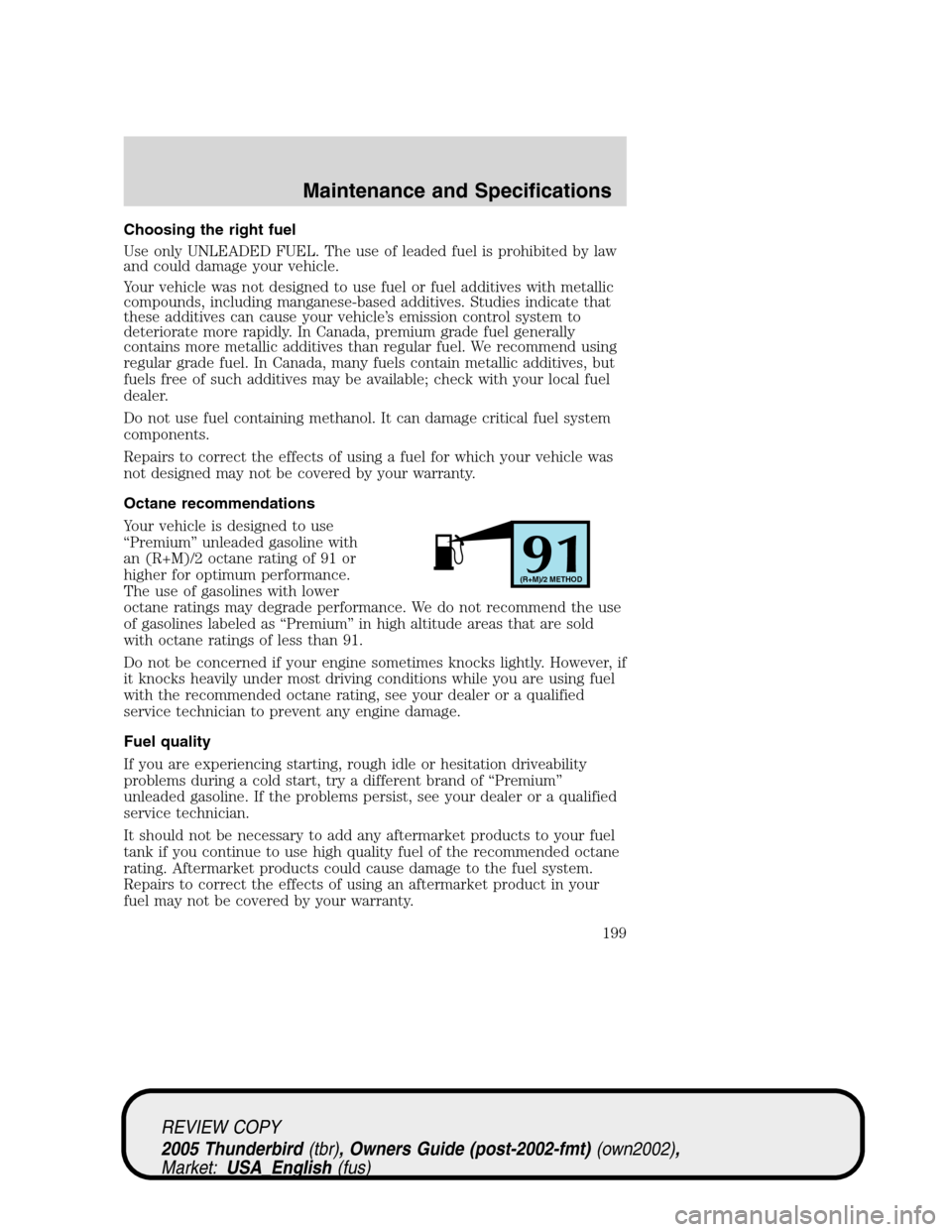
Your vehicle is designed to use
“Premium”unleaded gasoline with
an (R+M)/2 octane rating of 91 or
higher for optimum performance.
The use of gasolines with lower
octane ratings may degrade performance. We do not recommend the use
of gasolines labeled as“Premium”in high altitude areas that are sold
with octane ratings of less than 91.
Do not be concerned if your engine sometimes knocks lightly. However, if
it knocks heavily under most driving conditions while you are using fuel
with the recommended octane rating, see your dealer or a qualified
service technician to prevent any engine damage.
Fuel quality
If you are experiencing starting, rough idle or hesitation driveability
problems during a cold start, try a different brand of“Premium”
unleaded gasoline. If the problems persist, see your dealer or a qualified
service technician.
It should not be necessary to add any aftermarket products to your fuel
tank if you continue to use high quality fuel of the recommended octane
rating. Aftermarket products could cause damage to the fuel system.
Repairs to correct the effects of using an aftermarket product in your
fuel may not be covered by your warranty.
91(R+M)/2 METHOD
REVIEW COPY
2005 Thunderbird(tbr), Owners Guide (post-2002-fmt)(own2002),
Market:USA_English(fus)
Maintenance and Specifications
199
Page 203 of 224
Maintenance
•Keep tires properly inflated and use only recommended size.
•Operating a vehicle with the wheels out of alignment will reduce fuel
economy.
•Use recommended engine oil. Refer toLubricant specificationsin
this chapter.
•Perform all regularly scheduled maintenance items. Follow the
recommended maintenance schedule and owner maintenance checks
found in your vehicle scheduled maintenance guide.
Conditions
•Heavily loading a vehicle or towing a trailer may reduce fuel economy
at any speed.
•Carrying unnecessary weight may reduce fuel economy (approximately
1 mpg [0.4 km/L] is lost for every 400 lb [180 kg] of weight carried).
•Adding certain accessories to your vehicle (for example bug
deflectors, rollbars/light bars, running boards, ski/luggage racks) may
reduce fuel economy.
•Using fuel blended with alcohol may lower fuel economy.
•Fuel economy may decrease with lower temperatures during the first
8–10 miles (12–16 km) of driving.
•Driving on flat terrain offers improved fuel economy as compared to
driving on hilly terrain.
•Transmissions give their best fuel economy when operated in the top
cruise gear and with steady pressure on the gas pedal.
•Four-wheel-drive operation (if equipped) is less fuel efficient than
two-wheel-drive operation.
•Close windows for high speed driving.
EPA window sticker
Every new vehicle should have the EPA window sticker. Contact your
dealer if the window sticker is not supplied with your vehicle. The EPA
window sticker should be your guide for the fuel economy comparisons
with other vehicles.
It is important to note the box in the lower left corner of the window
sticker. These numbers represent the Range of MPG (L/100 km)
expected on the vehicle under optimum conditions. Your fuel economy
may vary depending upon the method of operation and conditions.
REVIEW COPY
2005 Thunderbird(tbr), Owners Guide (post-2002-fmt)(own2002),
Market:USA_English(fus)
Maintenance and Specifications
203
Page 204 of 224
EMISSION CONTROL SYSTEM
Your vehicle is equipped with various emission control components and a
catalytic converter which will enable your vehicle to comply with
applicable exhaust emission standards. To make sure that the catalytic
converter and other emission control components continue to work
properly:
•Use only the specified fuel listed.
•Avoid running out of fuel.
•Do not turn off the ignition while your vehicle is moving, especially at
high speeds.
•Have the items listed in yourScheduled Maintenance Guide
performed according to the specified schedule.
The scheduled maintenance items listed in theScheduled Maintenance
Guideare essential to the life and performance of your vehicle and to its
emissions system.
If other than Ford, Motorcraft or Ford-authorized parts are used for
maintenance replacements or for service of components affecting
emission control, such non-Ford parts should be equivalent to genuine
Ford Motor Company parts in performance and durability.
Do not park, idle, or drive your vehicle in dry grass or other dry
ground cover. The emission system heats up the engine
compartment and exhaust system, which can start a fire.
Illumination of the“Check Engine”light, charging system warning light
or the temperature warning light, fluid leaks, strange odors, smoke or
loss of engine power, could indicate that the emission control system is
not working properly.
Exhaust leaks may result in entry of harmful and potentially
lethal fumes into the passenger compartment.
Do not make any unauthorized changes to your vehicle or engine. By
law, vehicle owners and anyone who manufactures, repairs, services,
sells, leases, trades vehicles, or supervises a fleet of vehicles are not
permitted to intentionally remove an emission control device or prevent
it from working. Information about your vehicle’s emission system is on
the Vehicle Emission Control Information Decal located on or near the
engine. This decal identifies engine displacement and gives some tune up
specifications.
REVIEW COPY
2005 Thunderbird(tbr), Owners Guide (post-2002-fmt)(own2002),
Market:USA_English(fus)
Maintenance and Specifications
204
Page 205 of 224
Please consult yourWarranty Guidefor complete emission warranty
information.
On board diagnostics (OBD-II)
Your vehicle is equipped with a computer that monitors the engine’s
emission control system. This system is commonly known as the On
Board Diagnostics System (OBD-II). This OBD-II system protects the
environment by ensuring that your vehicle continues to meet
government emission standards. The OBD-II system also assists the
service technician in properly servicing your vehicle. When theCheck
engine/Service engine soonlight illuminates, the OBD-II system has
detected a malfunction. Temporary malfunctions may cause yourCheck
engine/Service engine soonlight to illuminate. Examples are:
1. The vehicle has run out of fuel. (The engine may misfire or run
poorly.)
2. Poor fuel quality or water in the fuel.
3. The fuel cap may not have been securely tightened.
These temporary malfunctions can be corrected by filling the fuel tank
with good quality fuel and/or properly tightening the fuel cap. After three
driving cycles without these or any other temporary malfunctions
present, theCheck engine/Service engine soonlight should turn off. (A
driving cycle consists of a cold engine startup followed by mixed
city/highway driving.) No additional vehicle service is required.
If theCheck engine/Service engine soonlight remains on, have your
vehicle serviced at the first available opportunity.
Readiness for Inspection/Maintenance (I/M) testing
In some localities, it may be a legal requirement to pass an I/M test of
the on-board diagnostics system. If yourCheck engine/Service engine
soonlight is on, refer to the description in theWarning lights and
chimessection of theInstrument Clusterchapter. Your vehicle may not
pass the I/M test with theCheck engine/Service engine soonlight on.
If the vehicle’s powertrain system or its battery has just been serviced,
the on-board diagnostics system is reset to a“not ready for I/M test”
condition. To ready the on-board diagnostics system for I/M testing, a
minimum of 30 minutes of city and highway driving is necessary as
described below:
•First, at least 10 minutes of driving on an expressway or highway.
•Next, at least 20 minutes driving in stop-and-go, city-type traffic with
at least four idle periods.
REVIEW COPY
2005 Thunderbird(tbr), Owners Guide (post-2002-fmt)(own2002),
Market:USA_English(fus)
Maintenance and Specifications
205
Page 217 of 224
GENUINE FORD ACCESSORIES FOR YOUR VEHICLE
A wide selection of Genuine Ford Accessories are available for your
vehicle through your local authorized Ford or Ford of Canada dealer.
These quality accessories have been specifically engineered to fulfill your
automotive needs; they are custom designed to complement the style
and aerodynamic appearance of your vehicle. In addition, each accessory
is made from high quality materials and meets or exceeds Ford’s rigorous
engineering and safety specifications. Ford Motor Company will repair or
replace any properly dealer-installed Genuine Ford Accessory found to
be defective in factory-supplied materials or workmanship during the
warranty period, as well as any component damaged by the defective
accessory. The accessory will be warranted for whichever provides you
the greatest benefit:
•12 months or 12,000 miles (20,000 km) (whichever occurs first), or
•the remainder of your new vehicle limited warranty.
This means that Genuine Ford Accessories purchased along with your new
vehicle and installed by the dealer are covered for the full length of your
New Vehicle’s Limited Warranty—3 years or 36,000 miles (60,000 km)
(whichever occurs first). Contact your dealer for details and a copy of the
warranty.
Not all accessories are available for all models.
The following is a list of several Genuine Ford Accessory products for
your vehicle. Not all accessories are available for all models. For a
complete listing of the accessories that are available for your vehicle,
please contact your dealer or visit our online store at:
www.fordaccessoriesstore.com.
Exterior style
Bug shields
Deflectors
Front end covers
Grille inserts
Headlamps, fog lights and Daytime Running Lamps (DRLs)
Splash guards
Wheels
Interior style
Electrochromatic compass/temperature interior mirrors
Floor mats
REVIEW COPY
2005 Thunderbird(tbr), Owners Guide (post-2002-fmt)(own2002),
Market:USA_English(fus)
Accessories
217
Page 219 of 224
A
Accessory delay ..........................40
Air bag supplemental restraint
system ....................................87, 95
and child safety seats ..............88
description ..........................87, 95
disposal ......................................97
driver air bag ......................89, 96
indicator light .....................90, 97
operation .............................89, 96
passenger air bag ...............89, 96
passenger deactivation
switch ........................................91
side air bag ................................95
Air cleaner filter ...............207–209
Air conditioning ..........................22
Antifreeze
(see Engine coolant) ................190
Anti-lock brake system
(see Brakes) ..............................140
Anti-theft system ........................73
arming the system ....................73
disarming a triggered system ..73
Audio system (see Radio) .........16
Automatic transmission
driving an automatic
overdrive .................................144
fluid, adding ............................207
fluid, checking ........................207
fluid, refill capacities ..............210
fluid, specification ..................213
Auxiliary power point .................39
Axle
lubricant specifications ..212–213
refill capacities ........................210
B
Battery .......................................188acid, treating emergencies .....188
jumping a disabled battery ....160
maintenance-free ....................188
replacement, specifications ...209
servicing ..................................188
BeltMinder ...................................82
Brakes ........................................139
anti-lock ...................................140
anti-lock brake system (ABS)
warning light ...........................140
fluid, checking and adding ....206
fluid, refill capacities ..............210
fluid, specifications .........212–213
lubricant specifications ..212–213
parking ....................................141
shift interlock ..........................143
Break-in period .............................5
Bulbs ............................................31
C
Capacities for refilling fluids ....210
Cell phone use ............................60
Certification Label ....................215
Changing a tire .........................114
Child safety restraints ................98
child safety belts ......................98
Child safety seats ......................100
attaching with tether straps ..104
in front seat ............................102
in rear seat ..............................102
LATCH .....................................107
Cleaning your vehicle
engine compartment ..............177
instrument panel ....................179
interior .....................................180
interior trim ............................179
REVIEW COPY
2005 Thunderbird(tbr), Owners Guide (post-2002-fmt)(own2002),
Market:USA_English(fus)
Index
Index
219
Page 221 of 224
Engine oil ..................................185
checking and adding ..............185
dipstick ....................................185
filter, specifications ........187, 209
recommendations ...................187
refill capacities ........................210
specifications ..................212–213
Exhaust fumes ..........................139
F
Fail safe cooling ........................195
Floor mats ...................................61
Fluid capacities .........................210
Fuel ............................................196
calculating fuel economy .......200
cap ...........................................198
capacity ...................................210
choosing the right fuel ...........199
comparisons with EPA fuel
economy estimates .................203
detergent in fuel .....................200
filling your vehicle with
fuel ...........................196, 198, 201
filter, specifications ........200, 209
improving fuel economy ........200
octane rating ...........199, 213–214
quality ......................................199
running out of fuel .................200
safety information relating to
automotive fuels .....................196
Fuses ..................................151–152
G
Garage Door Opener
(see Homelink wireless control
system) ........................................46Gas cap (see Fuel cap) ............198
Gas mileage
(see Fuel economy) .................200
Gauges .........................................14
H
Hazard flashers .........................150
Head restraints ...........................74
Headlamps ...................................27
aiming ........................................29
autolamp system .......................27
bulb specifications ....................31
daytime running lights .............27
flash to pass ..............................28
replacing bulbs .........................32
turning on and off ....................27
Heating
heating and air conditioning
system .......................................22
Homelink wireless control
system ..........................................46
Hood ..........................................183
I
Ignition .......................136, 213–214
Infant seats
(see Safety seats) .....................100
Inspection/maintenance (I/M)
testing ........................................205
Instrument panel
cleaning ...................................179
cluster ........................................10
lighting up panel and
interior .......................................28
REVIEW COPY
2005 Thunderbird(tbr), Owners Guide (post-2002-fmt)(own2002),
Market:USA_English(fus)
Index
221
Page 222 of 224
J
Jack ............................................114
positioning ...............................114
storage .....................................114
Jump-starting your vehicle ......160
K
Keyless entry system
autolock .....................................69
Keys
positions of the ignition .........136
L
Lamps
autolamp system .......................27
bulb replacement
specifications chart ..................31
daytime running light ...............27
headlamps .................................27
headlamps, flash to pass ..........28
instrument panel, dimming .....28
interior lamps .....................30–31
replacing bulbs ....... 31–32, 34–37
Lane change indicator
(see Turn signal) ........................30
Lights, warning and indicator ....10
anti-lock brakes (ABS) ..........140
Load limits .................................130
Locks
autolock .....................................69
doors ..........................................62
Lubricant specifications ...212–213
Lug nuts ....................................120
Lumbar support, seats ...............75M
Manual transmission
fluid capacities ........................210
lubricant specifications ..........213
Master lighting switch ................27
Mirrors .........................................41
side view mirrors (power) .......41
Motorcraft parts ................200, 209
O
Octane rating ............................199
Oil (see Engine oil) ..................185
P
Parking brake ............................141
Parts (see Motorcraft parts) ....209
Power distribution box
(see Fuses) .......................155, 158
Power door locks ........................62
Power mirrors .............................41
Power point .................................39
Power steering ..................142–143
fluid, checking and adding ....206
fluid, refill capacity ................210
fluid, specifications .........212–213
Power Windows ...........................40
R
Radio ............................................16
Rear window defroster ...............25
Relays ........................................151
REVIEW COPY
2005 Thunderbird(tbr), Owners Guide (post-2002-fmt)(own2002),
Market:USA_English(fus)
Index
222
Page 223 of 224
Remote entry system .................65
illuminated entry ......................68
locking/unlocking doors ...........62
opening the trunk .....................66
Roadside assistance ..................149
S
Safety Belt Maintenance ............86
Safety belts
(see Safety restraints) .........77–81
Safety Canopy .............................95
Safety defects, reporting ..........175
Safety restraints ....................77–81
belt minder ...............................82
extension assembly ..................86
for adults .............................78–81
for children .........................97–98
safety belt maintenance ...........86
warning light and chime ..........82
Safety seats for children ..........100
Seat belts
(see Safety restraints) ...............77
Seats ............................................74
child safety seats ....................100
Select Shift Transmission
(SST) shifter .............................146
Servicing your vehicle ..............182
Setting the clock
AM/FM/In-dash 6 CD ................18
Spark plugs,
specifications .............209, 213–214
Specification chart,
lubricants ...........................212–213
Speed control ..............................42
Starting your vehicle ........136–138
jump starting ..........................160Steering
speed sensitive .......................143
Steering wheel
controls ......................................45
tilting .........................................39
T
Tilt steering wheel ......................39
Tires ...........................109–110, 114
alignment ................................127
care ..........................................126
changing ..........................114, 116
checking the pressure ............112
inspecting and inflating .........111
label .........................................125
replacing ..................................114
rotating ....................................128
safety practices .......................127
sidewall information ...............120
snow tires and chains ............129
spare tire .........................114–115
terminology .............................110
tire grades ...............................110
treadwear ........................109, 126
Towing .......................................134
recreational towing .................135
trailer towing ..........................134
wrecker ....................................166
Traction control ........................141
Transmission .............................143
brake-shift interlock (BSI) ....143
fluid, checking and adding
(automatic) .............................207
fluid, refill capacities ..............210
lubricant specifications ..212–213
Trunk ...........................................63
remote release ....................42, 66
Turn signal ..................................30
REVIEW COPY
2005 Thunderbird(tbr), Owners Guide (post-2002-fmt)(own2002),
Market:USA_English(fus)
Index
223