battery FORD TRANSIT 2015 5.G Owner's Manual
[x] Cancel search | Manufacturer: FORD, Model Year: 2015, Model line: TRANSIT, Model: FORD TRANSIT 2015 5.GPages: 461, PDF Size: 5.82 MB
Page 183 of 461
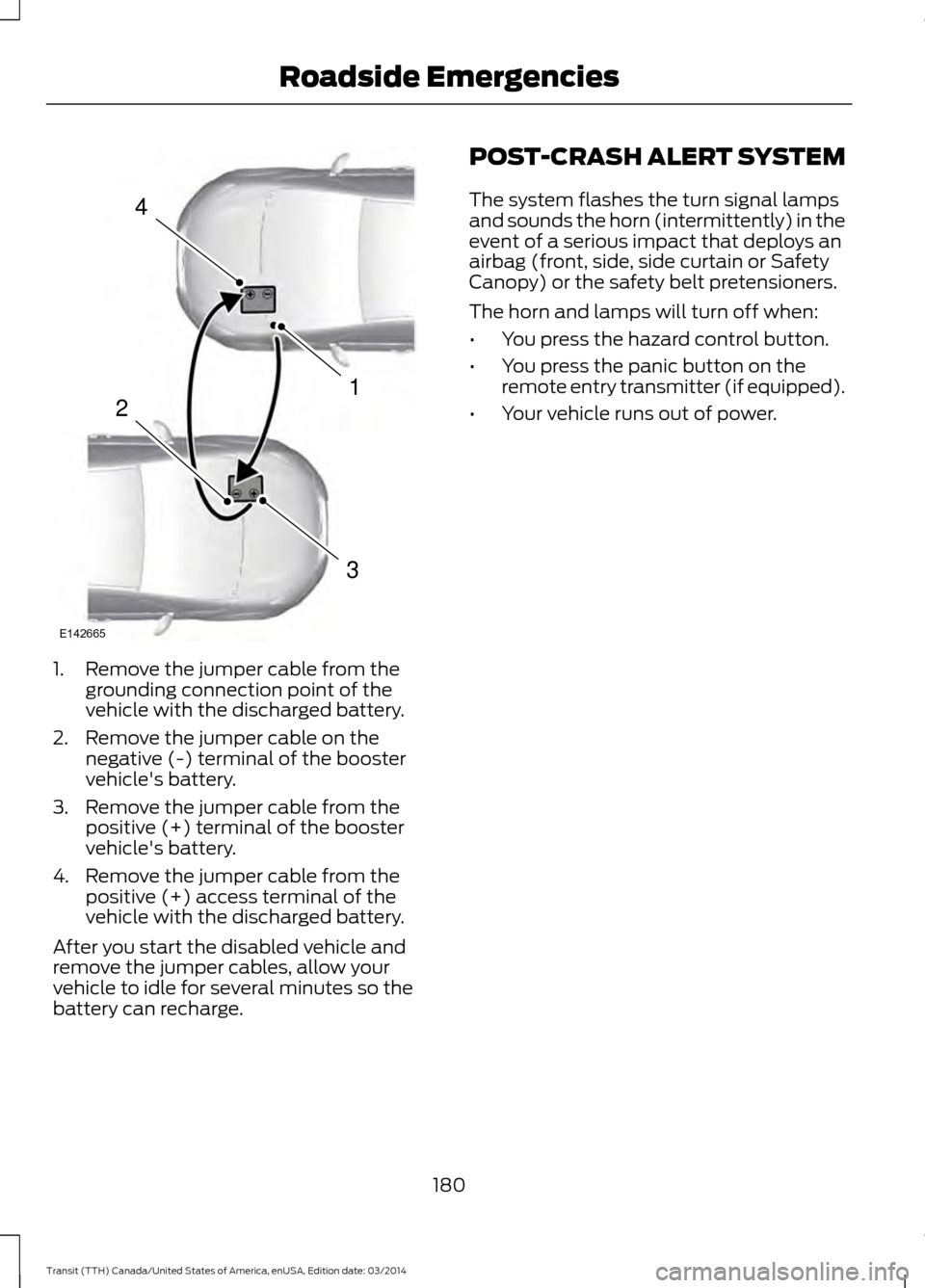
1. Remove the jumper cable from the
grounding connection point of the
vehicle with the discharged battery.
2. Remove the jumper cable on the negative (-) terminal of the booster
vehicle's battery.
3. Remove the jumper cable from the positive (+) terminal of the booster
vehicle's battery.
4. Remove the jumper cable from the positive (+) access terminal of the
vehicle with the discharged battery.
After you start the disabled vehicle and
remove the jumper cables, allow your
vehicle to idle for several minutes so the
battery can recharge. POST-CRASH ALERT SYSTEM
The system flashes the turn signal lamps
and sounds the horn (intermittently) in the
event of a serious impact that deploys an
airbag (front, side, side curtain or Safety
Canopy) or the safety belt pretensioners.
The horn and lamps will turn off when:
•
You press the hazard control button.
• You press the panic button on the
remote entry transmitter (if equipped).
• Your vehicle runs out of power.
180 Transit (TTH) Canada/United States of America, enUSA, Edition date: 03/2014 Roadside Emergencies4
1
3
2
E142665
Page 197 of 461
Circuits protected
Fuse rating
Fuse
Blower motor.
5A
F38 Horn relay.
Windshield wiper relay.
Remote keyless entry.
7.5A
F39 Battery.
Power windows.
Rear heating, ventilation and air conditioning.
Front blower motor.
40A
F40
Rear blower motor.
40A
F41
Heated rear window.
40A
F42
Trailer socket.
30A
F43
Auxiliary power points.
60A
F44
Trailer connectors B+ supply.
40A
F45
Power windows.
30A
F46
Cigar lighter socket.
20A
F47
Rear auxiliary power points.
20A
F48
Front auxiliary power points.
20A
F49
Ignition relay 1.
60A
F50
Ignition relay 2.
60A
F51
Modified vehicle connections.
40A
F52
Modified vehicle connections.
40A
F53 Circuits switched
Relay
Not used (spare).
R1
Auxiliary power points.
R2
Trailer tow parking lamp.
R3
Ignition 2.
R4
Power windows.
R5
Ignition 1.
R6
194Transit (TTH) Canada/United States of America, enUSA, Edition date: 03/2014 Fuses
Page 201 of 461
Circuits protected
Fuse rating
Fuse
Not used.
-
F8
Right-hand high beam.
10A
F9
Left-hand high beam.
10A
F10
Right-hand exterior lamps.
25A
F11
Left-hand position lamps.
Not used.
-
F12
On-board diagnostic.
15A
F13
Battery saver.
Turn signal indicator.
25A
F14 Power windows delayed accessory.
Lane departure sensor heated windshield pad.
Left-hand exterior lamps.
25A
F15 Right-hand position lamps.
High mounted stoplamp.
Audio unit.
20A
F16
Navigation unit.
Instrument panel cluster.
7.5A
F17
Heater control.
Headlamp switch module.
10A
F18 Steering wheel module.
Stoplamp switch supply.
Front control/display interface module.
5A
F19
Ignition passive anti-theft system.
5A
F20
Accessory relay, customer access feed.
3A
F21
CHANGING A FUSE WARNINGS
Do not modify the electrical system
of your vehicle in any way. Have
repairs to the electrical system and
the replacement of relays and high current
fuses carried out by an authorized dealer. WARNINGS
Switch the ignition and all electrical
equipment off before attempting to
change a fuse.
Always replace a fuse with one that
has the specified amperage rating.
Using a fuse with a higher amperage
rating can cause severe wire damage and
could start a fire. 198
Transit (TTH) Canada/United States of America, enUSA, Edition date: 03/2014 Fuses
Page 203 of 461
GENERAL INFORMATION
Have your vehicle serviced regularly to help
maintain its roadworthiness and resale
value. There is a large network of Ford
authorized dealers that are there to help
you with their professional servicing
expertise. We believe that their specially
trained technicians are best qualified to
service your vehicle properly and expertly.
They are supported by a wide range of
highly specialized tools developed
specifically for servicing your vehicle.
To help you service your vehicle, we
provide scheduled maintenance
information which makes tracking routine
service easy. See Scheduled
Maintenance (page 433).
If your vehicle requires professional service,
your authorized dealer can provide the
necessary parts and service. Check your
warranty information to find out which
parts and services are covered.
Use only recommended fuels, lubricants,
fluids and service parts conforming to
specifications. Motorcraft® parts are
designed and built to provide the best
performance in your vehicle.
Precautions
• Do not work on a hot engine.
• Make sure that nothing gets caught in
moving parts.
• Do not work on a vehicle with the
engine running in an enclosed space,
unless you are sure you have enough
ventilation.
• Keep all open flames and other burning
material (such as cigarettes) away
from the battery and all fuel related
parts. Working with the Engine Off
1. Set the parking brake and shift to
P
(Park).
2. Turn off the engine and remove the key
(if equipped).
3. Block the wheels.
Working with the Engine On WARNING
To reduce the risk of vehicle damage
and/or personal burn injuries, do not
start your engine with the air cleaner
removed and do not remove it while the
engine is running. 1. Set the parking brake and shift to
P
(Park).
2. Block the wheels
OPENING AND CLOSING THE
HOOD
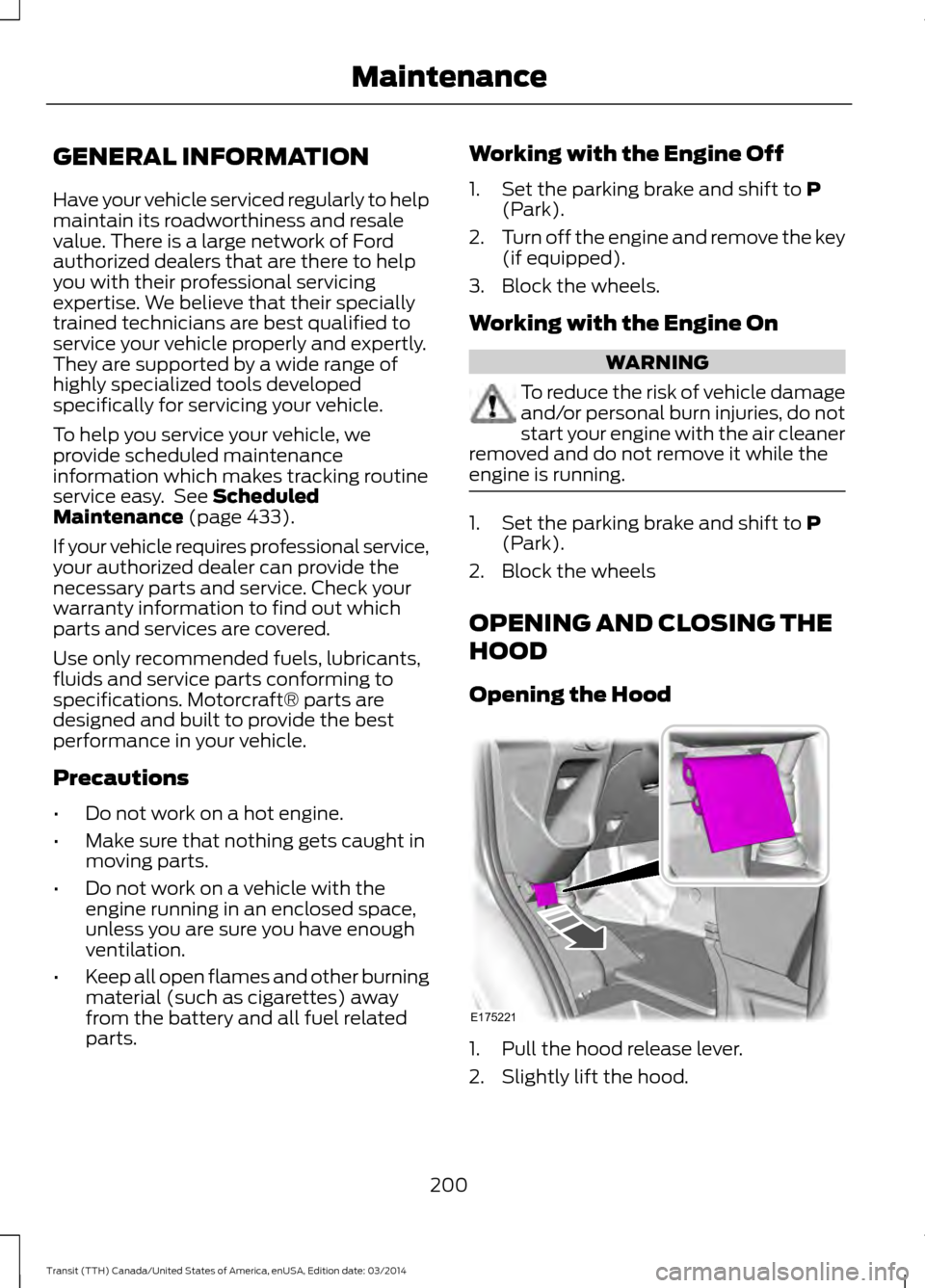
Opening the Hood 1. Pull the hood release lever.
2. Slightly lift the hood.
200 Transit (TTH) Canada/United States of America, enUSA, Edition date: 03/2014 MaintenanceE175221
Page 209 of 461
•
Sustained high-speed driving at Gross
Vehicle Weight Rating (maximum
loaded weight for vehicle operation).
• Sustained use of diesel fuel other than
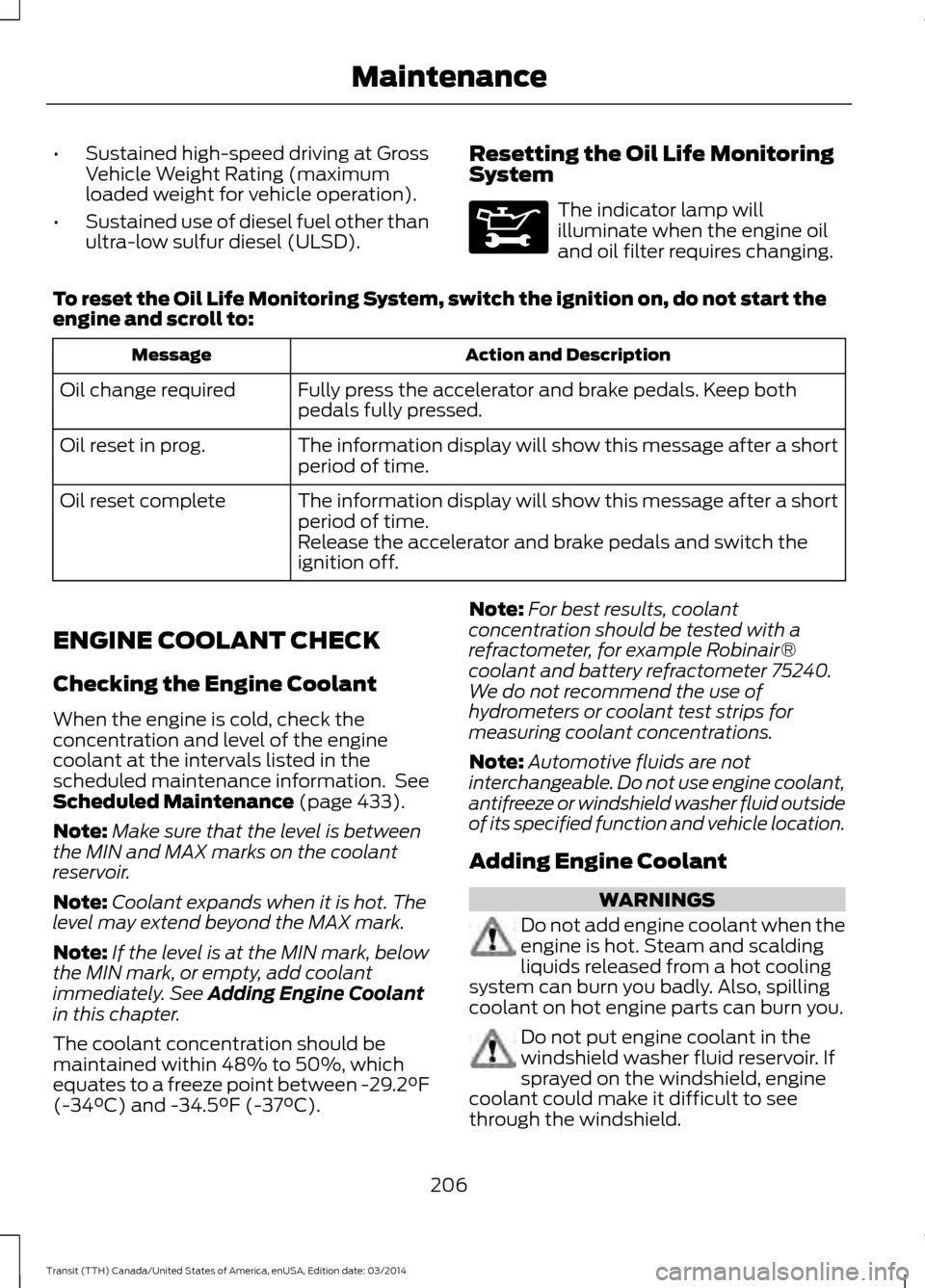
ultra-low sulfur diesel (ULSD). Resetting the Oil Life Monitoring
System The indicator lamp will
illuminate when the engine oil
and oil filter requires changing.
To reset the Oil Life Monitoring System, switch the ignition on, do not start the
engine and scroll to: Action and Description
Message
Fully press the accelerator and brake pedals. Keep both
pedals fully pressed.
Oil change required
The information display will show this message after a short
period of time.
Oil reset in prog.
The information display will show this message after a short
period of time.
Oil reset complete
Release the accelerator and brake pedals and switch the
ignition off.
ENGINE COOLANT CHECK
Checking the Engine Coolant
When the engine is cold, check the
concentration and level of the engine
coolant at the intervals listed in the
scheduled maintenance information. See
Scheduled Maintenance (page 433).
Note: Make sure that the level is between
the MIN and MAX marks on the coolant
reservoir.
Note: Coolant expands when it is hot. The
level may extend beyond the MAX mark.
Note: If the level is at the MIN mark, below
the MIN mark, or empty, add coolant
immediately. See
Adding Engine Coolant
in this chapter.
The coolant concentration should be
maintained within 48% to 50%, which
equates to a freeze point between -29.2°F
(-34°C)
and -34.5°F (-37°C). Note:
For best results, coolant
concentration should be tested with a
refractometer, for example Robinair®
coolant and battery refractometer 75240.
We do not recommend the use of
hydrometers or coolant test strips for
measuring coolant concentrations.
Note: Automotive fluids are not
interchangeable. Do not use engine coolant,
antifreeze or windshield washer fluid outside
of its specified function and vehicle location.
Adding Engine Coolant WARNINGS
Do not add engine coolant when the
engine is hot. Steam and scalding
liquids released from a hot cooling
system can burn you badly. Also, spilling
coolant on hot engine parts can burn you. Do not put engine coolant in the
windshield washer fluid reservoir. If
sprayed on the windshield, engine
coolant could make it difficult to see
through the windshield.
206 Transit (TTH) Canada/United States of America, enUSA, Edition date: 03/2014 Maintenance
Page 216 of 461
CHANGING THE 12V BATTERY
Removing the Battery
WARNINGS
You must replace your vehicle
battery with one of exactly the same
specification.
Make sure the battery box is correctly
sealed.
Your vehicle battery is heavy; take
care when lifting and removing.
Note:
If you have power seats and the
battery has no charge, jump-start your
vehicle to move the seat. See Jump
Starting the Vehicle (page 178).
Note: Where applicable you must
reprogram the audio system using the
keycode.
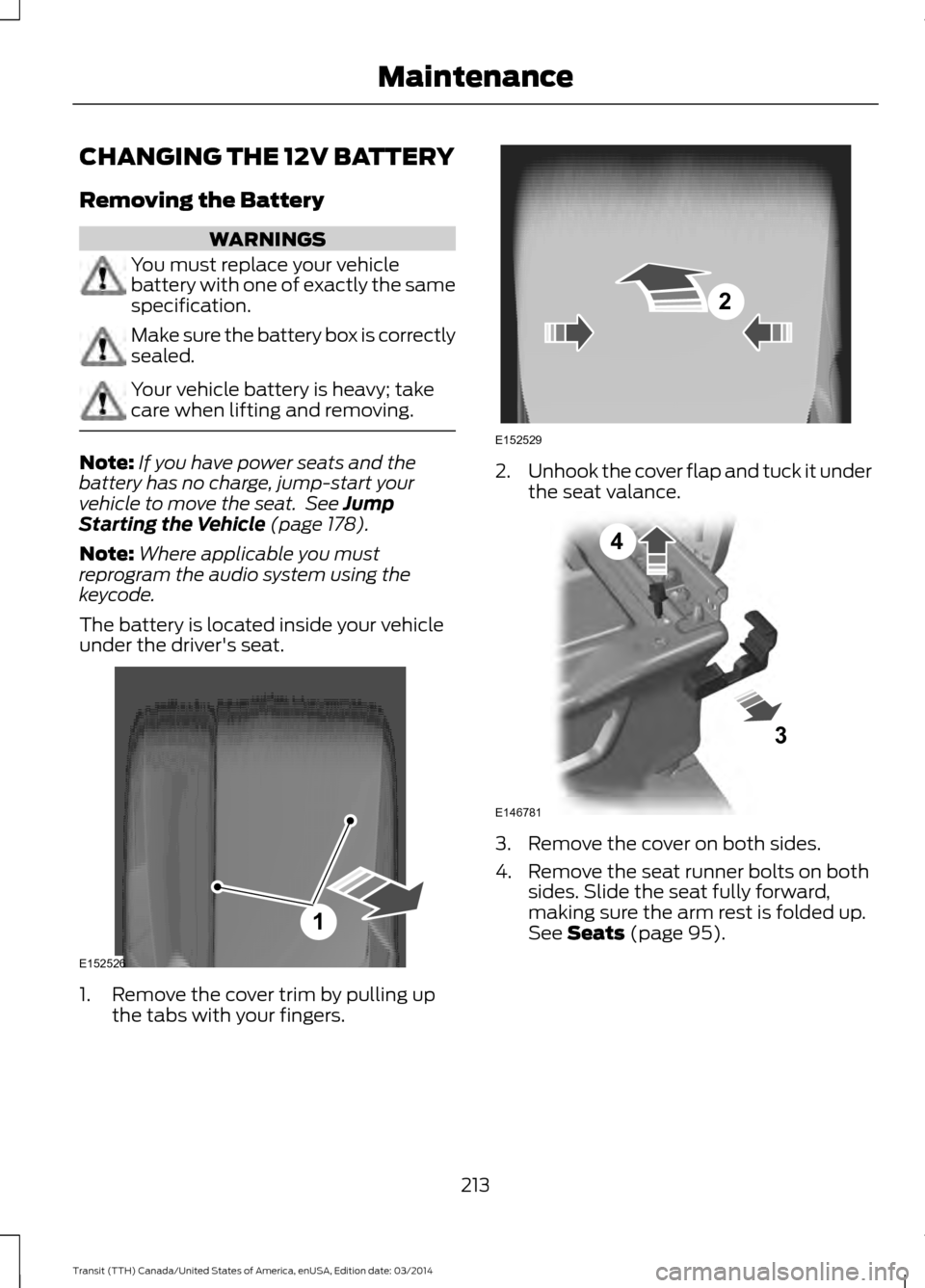
The battery is located inside your vehicle
under the driver's seat. 1. Remove the cover trim by pulling up
the tabs with your fingers. 2.
Unhook the cover flap and tuck it under
the seat valance. 3. Remove the cover on both sides.
4. Remove the seat runner bolts on both
sides. Slide the seat fully forward,
making sure the arm rest is folded up.
See Seats (page 95).
213 Transit (TTH) Canada/United States of America, enUSA, Edition date: 03/2014 MaintenanceE152526
1 2
E152529 E146781
3
4
Page 217 of 461
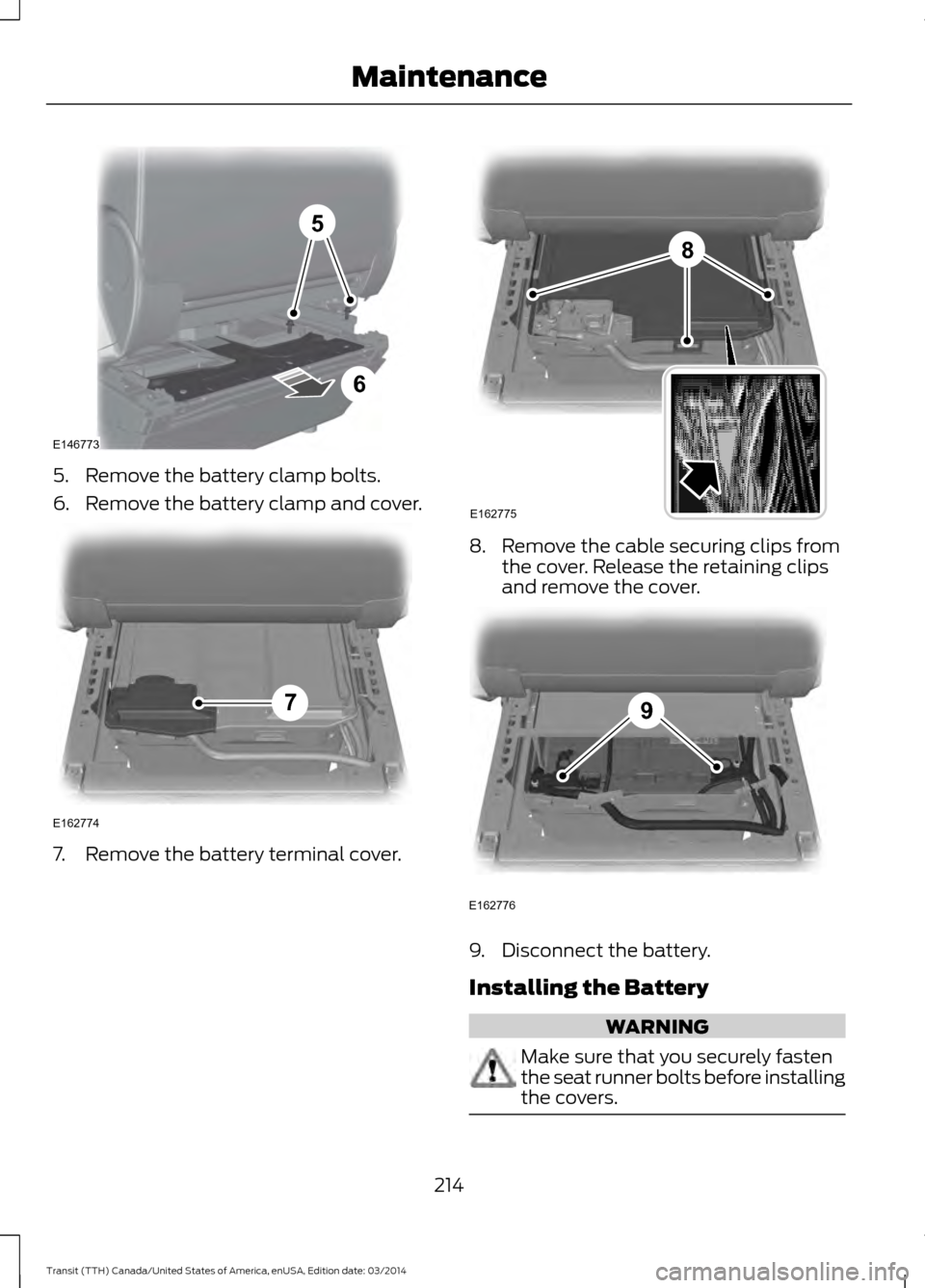
5. Remove the battery clamp bolts.
6. Remove the battery clamp and cover.
7. Remove the battery terminal cover. 8. Remove the cable securing clips from
the cover. Release the retaining clips
and remove the cover. 9. Disconnect the battery.
Installing the Battery
WARNING
Make sure that you securely fasten
the seat runner bolts before installing
the covers.
214
Transit (TTH) Canada/United States of America, enUSA, Edition date: 03/2014 Maintenance5
6
E146773 E162774
7 8
E162775 E162776
9
Page 232 of 461
•
Never wash or rinse any ignition coil,
spark plug wire or spark plug well, or
the area in and around these locations.
• Cover the battery, power distribution
box, and air filter assembly to prevent
water damage when cleaning the
engine.
CLEANING THE WINDOWS AND
WIPER BLADES
Car wash chemicals and environmental
fallout can result in windshield and wiper
blade contamination. Dirty windshield and
wipers will result in poor windshield wiper
operation. Keep the windshield and wiper
blades clean to maintain windshield wiper
performance.
To clean the windshield and wiper blades:
• Clean the windshield with a
non-abrasive glass cleaner.
• For windshields contaminated with
tree sap, chemicals, wax or bugs, clean
the entire windshield using steel wool
(no greater than 0000 grade) in a
circular motion and rinse with water.
• Clean the wiper blades with isopropyl
rubbing alcohol or windshield washer
fluid.
Note: Do not use razor blades or other
sharp objects to clean or remove decals
from the inside of the heated rear window.
The vehicle warranty does not cover
damage caused to the heated rear window
grid lines.
CLEANING THE INTERIOR
Note: Do not allow air fresheners and hand
sanitizers to spill on interior surfaces. If a
spill occurs, wipe off immediately. Damage
may not be covered by your warranty. Safety Belts WARNINGS
Do not use abrasives, or chemical
solvents to clean them.
Do not allow moisture to penetrate
the safety belt retractor mechanism.
Clean them with interior cleaner or water
applied with a soft sponge. Let them dry
naturally, away from artificial heat.
Instrument Cluster Screens, LCD
Screens and Radio Screens
WARNING
Do not use abrasives, alcoholic
solvents or chemical solvents to
clean them.
Rear Windows
WARNING
Do not use any abrasive materials to
clean the interior of the rear
windows.
Note:
Do not install stickers or labels to the
interior of the rear windows.
CLEANING THE INSTRUMENT
PANEL AND INSTRUMENT
CLUSTER LENS WARNING
Do not use chemical solvents or
strong detergents when cleaning the
steering wheel or instrument panel
to avoid contamination of the airbag
system. 229
Transit (TTH) Canada/United States of America, enUSA, Edition date: 03/2014 Vehicle Care
Page 235 of 461
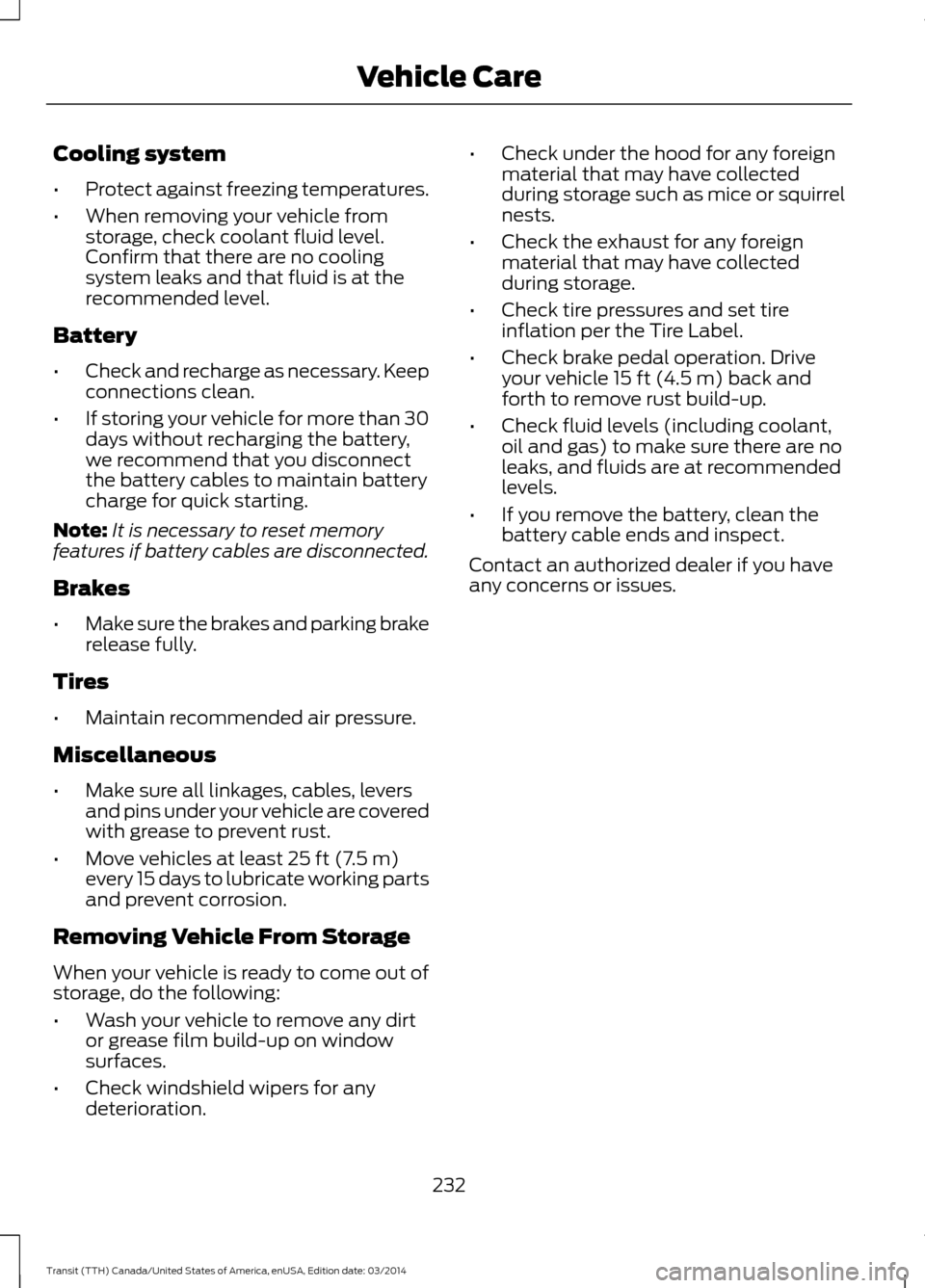
Cooling system
•
Protect against freezing temperatures.
• When removing your vehicle from
storage, check coolant fluid level.
Confirm that there are no cooling
system leaks and that fluid is at the
recommended level.
Battery
• Check and recharge as necessary. Keep
connections clean.
• If storing your vehicle for more than 30
days without recharging the battery,
we recommend that you disconnect
the battery cables to maintain battery
charge for quick starting.
Note: It is necessary to reset memory
features if battery cables are disconnected.
Brakes
• Make sure the brakes and parking brake
release fully.
Tires
• Maintain recommended air pressure.
Miscellaneous
• Make sure all linkages, cables, levers
and pins under your vehicle are covered
with grease to prevent rust.
• Move vehicles at least 25 ft (7.5 m)
every 15 days to lubricate working parts
and prevent corrosion.
Removing Vehicle From Storage
When your vehicle is ready to come out of
storage, do the following:
• Wash your vehicle to remove any dirt
or grease film build-up on window
surfaces.
• Check windshield wipers for any
deterioration. •
Check under the hood for any foreign
material that may have collected
during storage such as mice or squirrel
nests.
• Check the exhaust for any foreign
material that may have collected
during storage.
• Check tire pressures and set tire
inflation per the Tire Label.
• Check brake pedal operation. Drive
your vehicle
15 ft (4.5 m) back and
forth to remove rust build-up.
• Check fluid levels (including coolant,
oil and gas) to make sure there are no
leaks, and fluids are at recommended
levels.
• If you remove the battery, clean the
battery cable ends and inspect.
Contact an authorized dealer if you have
any concerns or issues.
232 Transit (TTH) Canada/United States of America, enUSA, Edition date: 03/2014 Vehicle Care
Page 270 of 461
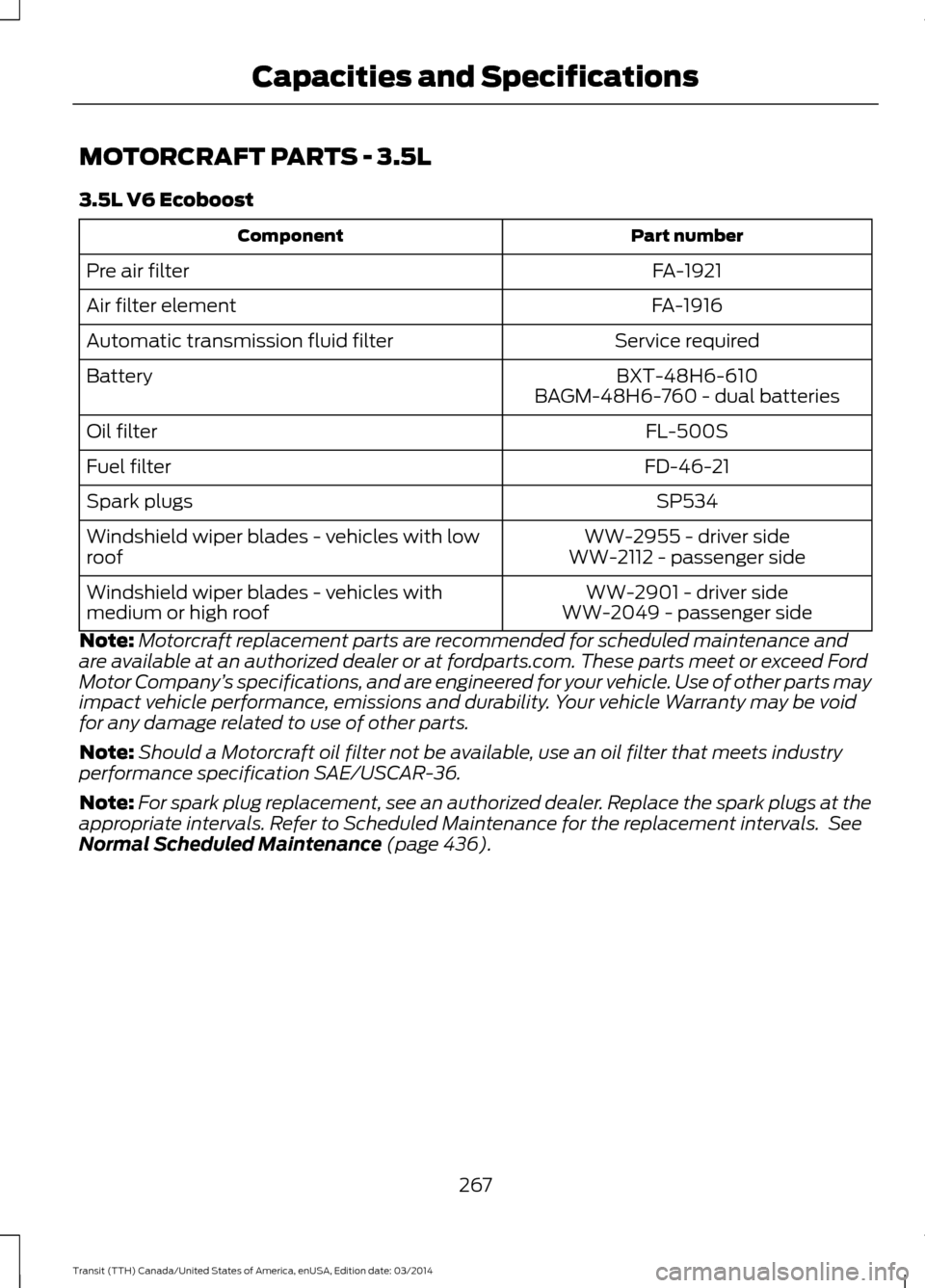
MOTORCRAFT PARTS - 3.5L
3.5L V6 Ecoboost
Part number
Component
FA-1921
Pre air filter
FA-1916
Air filter element
Service required
Automatic transmission fluid filter
BXT-48H6-610
Battery
BAGM-48H6-760 - dual batteries
FL-500S
Oil filter
FD-46-21
Fuel filter
SP534
Spark plugs
WW-2955 - driver side
Windshield wiper blades - vehicles with low
roof WW-2112 - passenger side
WW-2901 - driver side
Windshield wiper blades - vehicles with
medium or high roof WW-2049 - passenger side
Note: Motorcraft replacement parts are recommended for scheduled maintenance and
are available at an authorized dealer or at fordparts.com. These parts meet or exceed Ford
Motor Company ’s specifications, and are engineered for your vehicle. Use of other parts may
impact vehicle performance, emissions and durability. Your vehicle Warranty may be void
for any damage related to use of other parts.
Note: Should a Motorcraft oil filter not be available, use an oil filter that meets industry
performance specification SAE/USCAR-36.
Note: For spark plug replacement, see an authorized dealer. Replace the spark plugs at the
appropriate intervals. Refer to Scheduled Maintenance for the replacement intervals. See
Normal Scheduled Maintenance (page 436).
267Transit (TTH) Canada/United States of America, enUSA, Edition date: 03/2014 Capacities and Specifications