coolant temperature FORD TRANSIT 2016 5.G User Guide
[x] Cancel search | Manufacturer: FORD, Model Year: 2016, Model line: TRANSIT, Model: FORD TRANSIT 2016 5.GPages: 411, PDF Size: 5.65 MB
Page 181 of 411
BREAKING-IN
You need to break in new tires for
approximately 300 miles (480
kilometers). During this time, your vehicle
may exhibit some unusual driving
characteristics. The engine also needs to
break in. Avoid hard accelerations and
driving too fast for the first 1000 miles
(1600 kilometers). If possible, avoid
carrying heavy loads up steep grades
during the break-in period.
REDUCED ENGINE
PERFORMANCE
WARNING
Continued operation will increase the
engine temperature and cause the
engine to shut down completely.
If the engine coolant temperature gauge
needle moves to the upper limit position,
the engine is overheating. See Gauges
(page 76).
You must only drive your vehicle for a short
distance if the engine overheats. The
distance you can travel depends on
ambient temperature, vehicle load and
terrain. The engine will continue to operate
with limited power for a short time.
If the engine temperature continues to rise,
the fuel supply to the engine will reduce.
The air conditioning will switch off and the
engine cooling fan will operate continually.
1. Reduce your speed gradually and stop
your vehicle as soon as it is safe to do
so.
2. Switch the engine off immediately to prevent severe engine damage.
3. Wait for the engine to cool down.
4. Check the coolant level. See
Engine
Coolant Check (page 214). 5. Have your vehicle checked by an
authorized dealer as soon as possible.
ECONOMICAL DRIVING
Fuel economy is affected by several things
such as how you drive, the conditions you
drive under and how you maintain your
vehicle.
There are some things to keep in mind that
may improve your fuel economy:
• Accelerate and slow down in a smooth,
moderate fashion.
• Drive at steady speeds.
• Anticipate stops; slowing down may
eliminate the need to stop.
• Combine errands and minimize
stop-and-go driving(When running
errands, go to the furthest destination
first and then work your way back
home).
• Close the windows for high-speed
driving.
• Drive at reasonable speeds.
• Keep the tires properly inflated and use
only the recommended size.
• Use the recommended engine oil.
• Perform all regularly scheduled
maintenance.
There are also some things you may want
to avoid doing because they reduce your
fuel economy:
• Avoid sudden or hard accelerations.
• Avoid revving the engine before turning
off the car.
• Avoid long idle periods.
• Do not warm up your vehicle on cold
mornings.
• Reduce the use of air conditioning and
heat.
• Avoid using speed control in hilly
terrain.
178
Transit (TTH) Canada/United States of America, enUSA, First Printing Driving Hints
Page 219 of 411
Used engine coolant should be disposed
of in an appropriate manner. Follow your
community
’s regulations and standards
for recycling and disposing of automotive
fluids.
Severe Climates
If you drive in extremely cold climates:
• It may be necessary to have a Ford
authorized dealer increase the coolant
concentration above 50%.
• A coolant concentration of 60% will
provide improved freeze point
protection. Engine coolant
concentrations above 60% will
decrease the overheat protection
characteristics of the engine coolant
and may cause engine damage.
If you drive in extremely hot climates:
• It may be necessary to have a Ford
authorized dealer decrease the coolant
concentration to 40%.
• A coolant concentration of 40% will
provide improved overheat protection.
Engine coolant concentrations below
40% will decrease the corrosion and
freeze protection characteristics of the
engine coolant and may cause engine
damage.
Vehicles driven year-round in non-extreme
climates should use prediluted engine
coolant for optimum cooling system and
engine protection.
What You Should Know About Fail-
Safe Cooling
If you deplete the engine coolant supply,
this feature allows you to temporarily drive
your vehicle before you incur incremental
component damage. The fail-safe distance
depends on ambient temperatures, vehicle
load and terrain. How Fail-Safe Cooling Works
If the engine begins to overheat, the engine
coolant temperature gauge will move to
the red area and: The coolant temperature
warning light will illuminate.
The service engine soon
indicator will illuminate.
If the engine reaches a preset
over-temperature condition, the engine
will automatically switch to alternating
cylinder operation. Each disabled cylinder
acts as an air pump and cools the engine.
When this occurs the vehicle will still
operate. However:
• The engine power will be limited.
• This will disable the air conditioning
system.
Continued operation will increase the
engine temperature and the engine will
completely shut down, causing steering
and braking effort to increase.
Once the engine temperature cools, the
engine can be re-started. Take your vehicle
to an authorized dealer as soon as possible
to minimize engine damage.
When Fail-Safe Mode Is Turned On WARNING
Fail-safe mode is for use during
emergencies only. Operate the
vehicle in fail-safe mode only as long
as necessary to bring the vehicle to rest in
a safe location and seek immediate repairs.
When in fail-safe mode, the vehicle will
have limited power, will not be able to
maintain high-speed operation, and may
completely shut down and lose power
steering assist, and power brake assist,
which may increase the possibility of a
crash resulting in serious injury. 216
Transit (TTH) Canada/United States of America, enUSA, First Printing Maintenance
Page 220 of 411
The engine is capable of completely
shutting down automatically to prevent
engine damage, if this situation occurs:
1. Stop your vehicle as soon as it is safe
to do so and switch the ignition off.
2. Have your vehicle towed to an authorized dealer.
3. If this is not possible, wait a short period for the engine to cool.
4. Check the coolant level and replenish if low.
5. Re-start the engine and take your vehicle to an authorized dealer.
Note: Driving the vehicle without repairing
the engine problem increases the chance of
engine damage. Take your vehicle to an
authorized dealer as soon as possible.
Engine Fluid Temperature
Management (If Equipped) WARNING
To reduce the risk of a crash and
injury, be prepared that the vehicle
speed may reduce and the vehicle
may not be able to accelerate with full
power until the fluid temperature reduces. When towing a trailer the vehicle
’s engine
may temporarily reach a higher
temperature during severe operating
conditions, for example ascending a long
or steep grade in hot ambient
temperatures.
You may notice a reduction in vehicle
speed caused by reduced engine power.
The design of your vehicle allows it to enter
this mode if certain high-temperature and
high-load conditions take place in order to
manage the engine fluid temperatures. The amount of speed reduction will depend on
the vehicle loading, towing, grade, ambient
temperature and other factors. If this
occurs, there is no need to pull off the road.
You can continue to drive your vehicle
while this message is active.
The air conditioning may also cycle on and
off during severe operating conditions to
protect overheating of the engine. When
the engine coolant temperature decreases
normal operating temperature, the air
conditioning will turn on. If you notice any
of the following:
•
The engine coolant temperature gauge
moves fully into the red area.
• The coolant temperature warning light
illuminates.
• The service engine soon indicator
illuminates.
1. Stop your vehicle as soon as it is safe to do so and place the vehicle in park
(P).
2. Leave the engine running until the coolant temperature gauge needle
moves away from the red area. After
several minutes, if this does not
happen, follow the remaining steps.
3. Switch the engine off and wait for it to
cool before checking the coolant level.
4. If the coolant level is normal, you may restart the engine and continue on.
5. If the coolant is low, add coolant, restart the engine and take your vehicle
to an authorized dealer.
AUTOMATIC TRANSMISSION
FLUID CHECK
The automatic transmission does not have
a transmission fluid dipstick.
217
Transit (TTH) Canada/United States of America, enUSA, First Printing Maintenance
Page 242 of 411
Engine
•
Change the engine oil and filter prior to
storage because used engine oil
contains contaminates which may
cause engine damage.
• Start the engine every 15 days for a
minimum of 15 minutes. Run at fast idle
with the climate controls set to defrost
until the engine reaches normal
operating temperature.
• With your foot on the brake, shift
through all the gears while the engine
is running.
• We recommend that you change the
engine oil before you use your vehicle
again.
Fuel system
• Fill the fuel tank with high-quality fuel
until the first automatic shutoff of the
fuel pump nozzle.
Cooling system
• Protect against freezing temperatures.
• When removing your vehicle from
storage, check coolant fluid level.
Confirm that there are no cooling
system leaks and that fluid is at the
recommended level.
Battery
• Check and recharge as necessary. Keep
connections clean.
• If storing your vehicle for more than 30
days without recharging the battery,
we recommend that you disconnect
the battery cables to maintain battery
charge for quick starting.
Note: It is necessary to reset memory
features if battery cables are disconnected. Brakes
•
Make sure the brakes and parking brake
release fully.
Tires
• Maintain recommended air pressure.
Miscellaneous
• Make sure all linkages, cables, levers
and pins under your vehicle are covered
with grease to prevent rust.
• Move vehicles at least 25 ft (7.5 m)
every 15 days to lubricate working parts
and prevent corrosion.
Removing Vehicle From Storage
When your vehicle is ready to come out of
storage, do the following:
• Wash your vehicle to remove any dirt
or grease film build-up on window
surfaces.
• Check windshield wipers for any
deterioration.
• Check under the hood for any foreign
material that may have collected
during storage such as mice or squirrel
nests.
• Check the exhaust for any foreign
material that may have collected
during storage.
• Check tire pressures and set tire
inflation per the Tire Label.
• Check brake pedal operation. Drive
your vehicle
15 ft (4.5 m) back and
forth to remove rust build-up.
• Check fluid levels (including coolant,
oil and gas) to make sure there are no
leaks, and fluids are at recommended
levels.
• If you remove the battery, clean the
battery cable ends and check for
damage.
239
Transit (TTH) Canada/United States of America, enUSA, First Printing Vehicle Care
Page 405 of 411
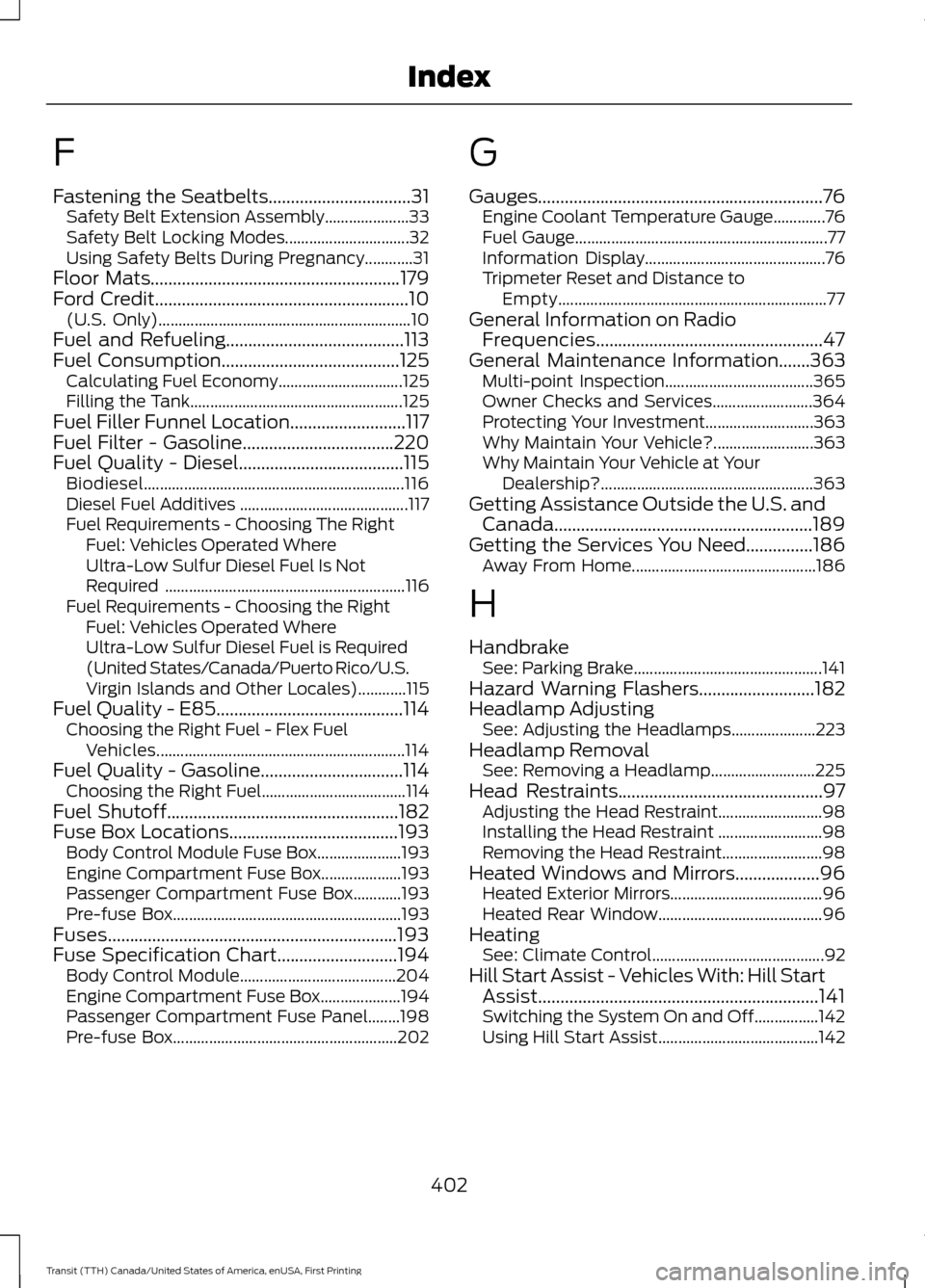
F
Fastening the Seatbelts................................31
Safety Belt Extension Assembly..................... 33
Safety Belt Locking Modes............................... 32
Using Safety Belts During Pregnancy............31
Floor Mats
........................................................179
Ford Credit.........................................................10
(U.S. Only)............................................................... 10
Fuel and Refueling
........................................113
Fuel Consumption........................................125 Calculating Fuel Economy............................... 125
Filling the Tank..................................................... 125
Fuel Filler Funnel Location..........................117
Fuel Filter - Gasoline
..................................220
Fuel Quality - Diesel.....................................115 Biodiesel................................................................. 116
Diesel Fuel Additives .......................................... 117
Fuel Requirements - Choosing The Right Fuel: Vehicles Operated Where
Ultra-Low Sulfur Diesel Fuel Is Not
Required ............................................................ 116
Fuel Requirements - Choosing the Right Fuel: Vehicles Operated Where
Ultra-Low Sulfur Diesel Fuel is Required
(United States/Canada/Puerto Rico/U.S.
Virgin Islands and Other Locales)............115
Fuel Quality - E85..........................................114 Choosing the Right Fuel - Flex Fuel
Vehicles.............................................................. 114
Fuel Quality - Gasoline................................114 Choosing the Right Fuel.................................... 114
Fuel Shutoff....................................................182
Fuse Box Locations......................................193 Body Control Module Fuse Box..................... 193
Engine Compartment Fuse Box.................... 193
Passenger Compartment Fuse Box............193
Pre-fuse Box......................................................... 193
Fuses.................................................................193
Fuse Specification Chart...........................194 Body Control Module....................................... 204
Engine Compartment Fuse Box.................... 194
Passenger Compartment Fuse Panel........198
Pre-fuse Box........................................................ 202G
Gauges................................................................76
Engine Coolant Temperature Gauge.............76
Fuel Gauge............................................................... 77
Information Display............................................. 76
Tripmeter Reset and Distance to Empty................................................................... 77
General Information on Radio Frequencies...................................................47
General Maintenance Information
.......363
Multi-point Inspection..................................... 365
Owner Checks and Services......................... 364
Protecting Your Investment........................... 363
Why Maintain Your Vehicle?......................... 363
Why Maintain Your Vehicle at Your Dealership?..................................................... 363
Getting Assistance Outside the U.S. and Canada..........................................................189
Getting the Services You Need...............186 Away From Home.............................................. 186
H
Handbrake See: Parking Brake............................................... 141
Hazard Warning Flashers..........................182
Headlamp Adjusting See: Adjusting the Headlamps..................... 223
Headlamp Removal See: Removing a Headlamp.......................... 225
Head Restraints
..............................................97
Adjusting the Head Restraint.......................... 98
Installing the Head Restraint .......................... 98
Removing the Head Restraint......................... 98
Heated Windows and Mirrors...................96 Heated Exterior Mirrors...................................... 96
Heated Rear Window......................................... 96
Heating See: Climate Control........................................... 92
Hill Start Assist - Vehicles With: Hill Start Assist...............................................................141
Switching the System On and Off................142
Using Hill Start Assist........................................ 142
402
Transit (TTH) Canada/United States of America, enUSA, First Printing Index
Page 411 of 411
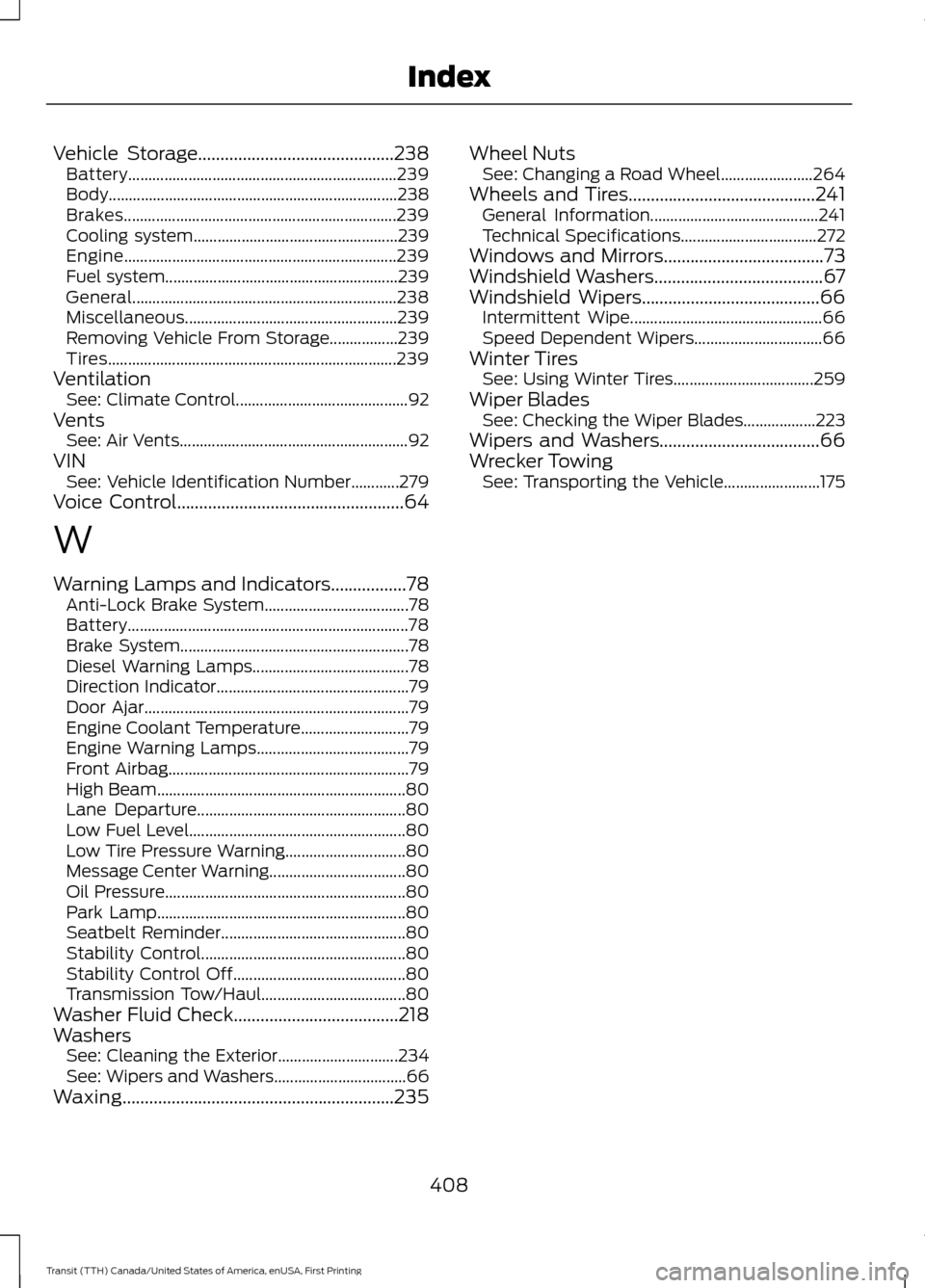
Vehicle Storage............................................238
Battery................................................................... 239
Body........................................................................\
238
Brakes.................................................................... 239
Cooling system................................................... 239
Engine.................................................................... 239
Fuel system.......................................................... 239
General.................................................................. 238
Miscellaneous..................................................... 239
Removing Vehicle From Storage.................239
Tires........................................................................\
239
Ventilation See: Climate Control........................................... 92
Vents See: Air Vents......................................................... 92
VIN See: Vehicle Identification Number............279
Voice Control
...................................................64
W
Warning Lamps and Indicators.................78 Anti-Lock Brake System.................................... 78
Battery...................................................................... 78
Brake System......................................................... 78
Diesel Warning Lamps....................................... 78
Direction Indicator................................................ 79
Door Ajar.................................................................. 79
Engine Coolant Temperature........................... 79
Engine Warning Lamps...................................... 79
Front Airbag............................................................ 79
High Beam.............................................................. 80
Lane Departure.................................................... 80
Low Fuel Level...................................................... 80
Low Tire Pressure Warning.............................. 80
Message Center Warning.................................. 80
Oil Pressure............................................................ 80
Park Lamp.............................................................. 80
Seatbelt Reminder.............................................. 80
Stability Control................................................... 80
Stability Control Off........................................... 80
Transmission Tow/Haul.................................... 80
Washer Fluid Check
.....................................218
Washers See: Cleaning the Exterior.............................. 234
See: Wipers and Washers................................. 66
Waxing.............................................................235 Wheel Nuts
See: Changing a Road Wheel....................... 264
Wheels and Tires..........................................241 General Information.......................................... 241
Technical Specifications.................................. 272
Windows and Mirrors
....................................73
Windshield Washers......................................67
Windshield Wipers........................................66
Intermittent Wipe................................................ 66
Speed Dependent Wipers................................ 66
Winter Tires See: Using Winter Tires................................... 259
Wiper Blades See: Checking the Wiper Blades.................. 223
Wipers and Washers....................................66
Wrecker Towing See: Transporting the Vehicle........................ 175
408
Transit (TTH) Canada/United States of America, enUSA, First Printing Index