fuse FORD TRANSIT 2016 5.G Owner's Manual
[x] Cancel search | Manufacturer: FORD, Model Year: 2016, Model line: TRANSIT, Model: FORD TRANSIT 2016 5.GPages: 411, PDF Size: 5.65 MB
Page 207 of 411
Circuits switched
Relay
Not used.
R5
Not used.
R6
Not used.
R7
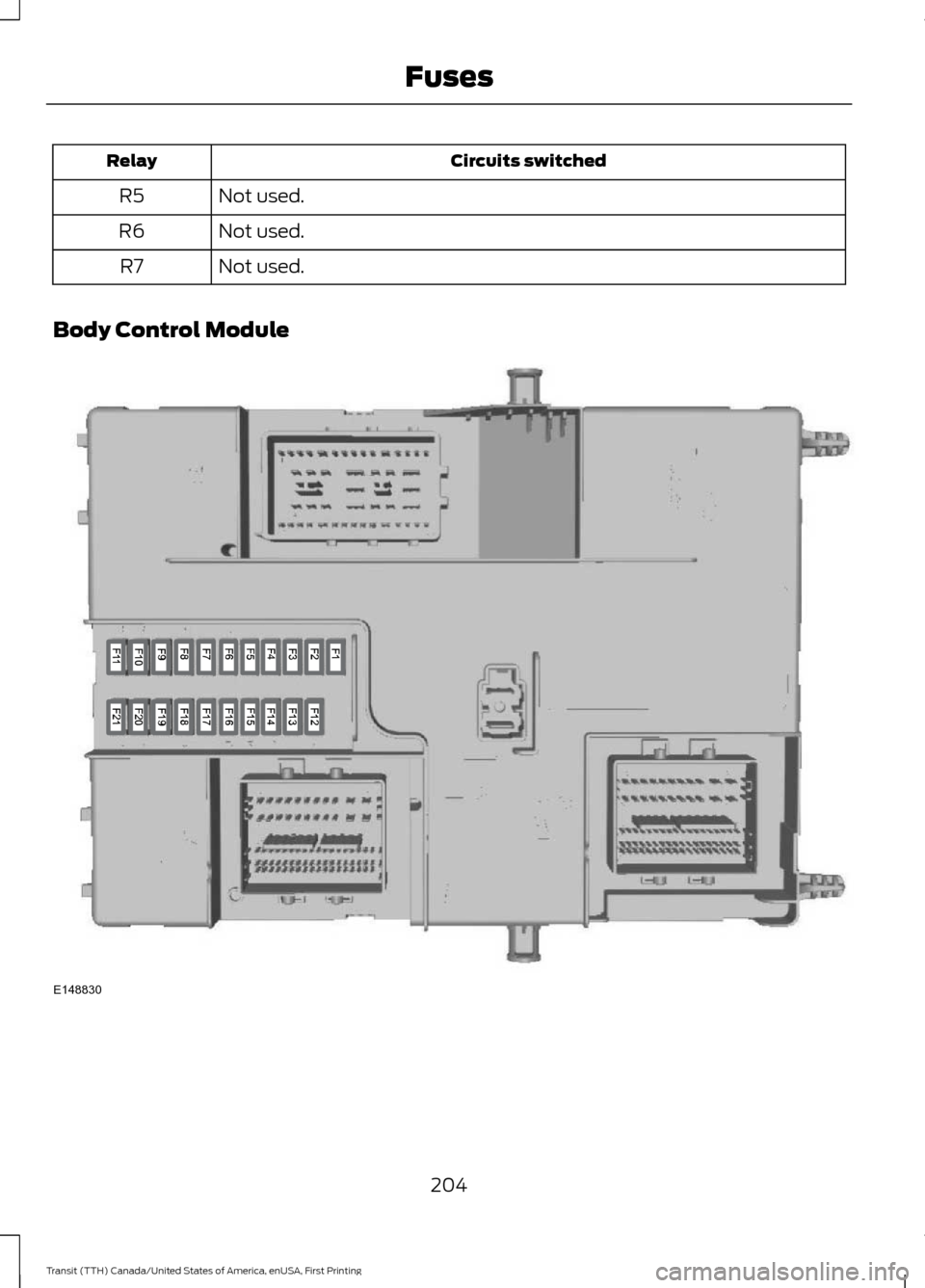
Body Control Module 204
Transit (TTH) Canada/United States of America, enUSA, First Printing FusesE148830
Page 208 of 411
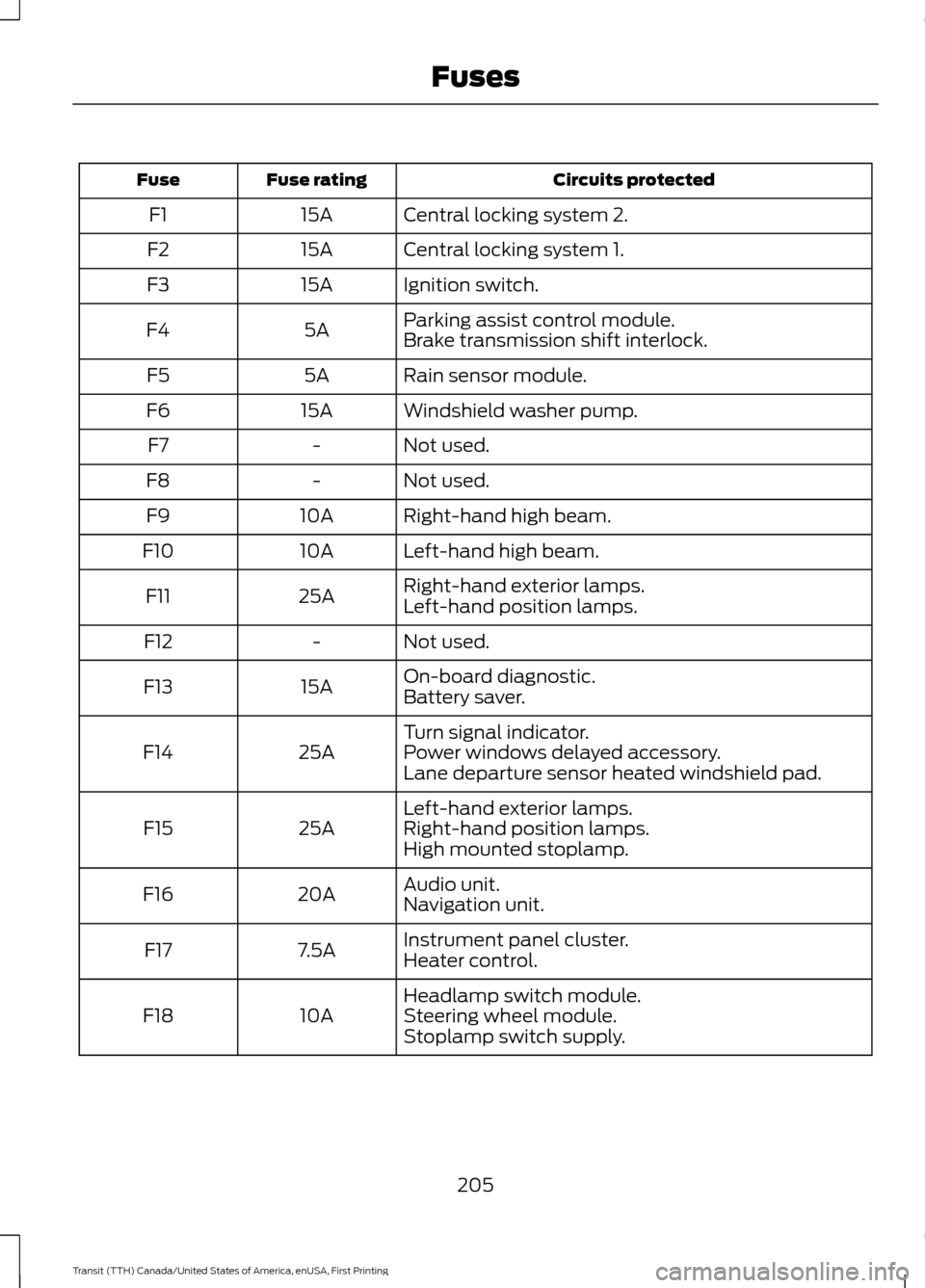
Circuits protected
Fuse rating
Fuse
Central locking system 2.
15A
F1
Central locking system 1.
15A
F2
Ignition switch.
15A
F3
Parking assist control module.
5A
F4
Brake transmission shift interlock.
Rain sensor module.
5A
F5
Windshield washer pump.
15A
F6
Not used.
-
F7
Not used.
-
F8
Right-hand high beam.
10A
F9
Left-hand high beam.
10A
F10
Right-hand exterior lamps.
25A
F11
Left-hand position lamps.
Not used.
-
F12
On-board diagnostic.
15A
F13
Battery saver.
Turn signal indicator.
25A
F14 Power windows delayed accessory.
Lane departure sensor heated windshield pad.
Left-hand exterior lamps.
25A
F15 Right-hand position lamps.
High mounted stoplamp.
Audio unit.
20A
F16
Navigation unit.
Instrument panel cluster.
7.5A
F17
Heater control.
Headlamp switch module.
10A
F18 Steering wheel module.
Stoplamp switch supply.
205
Transit (TTH) Canada/United States of America, enUSA, First Printing Fuses
Page 209 of 411
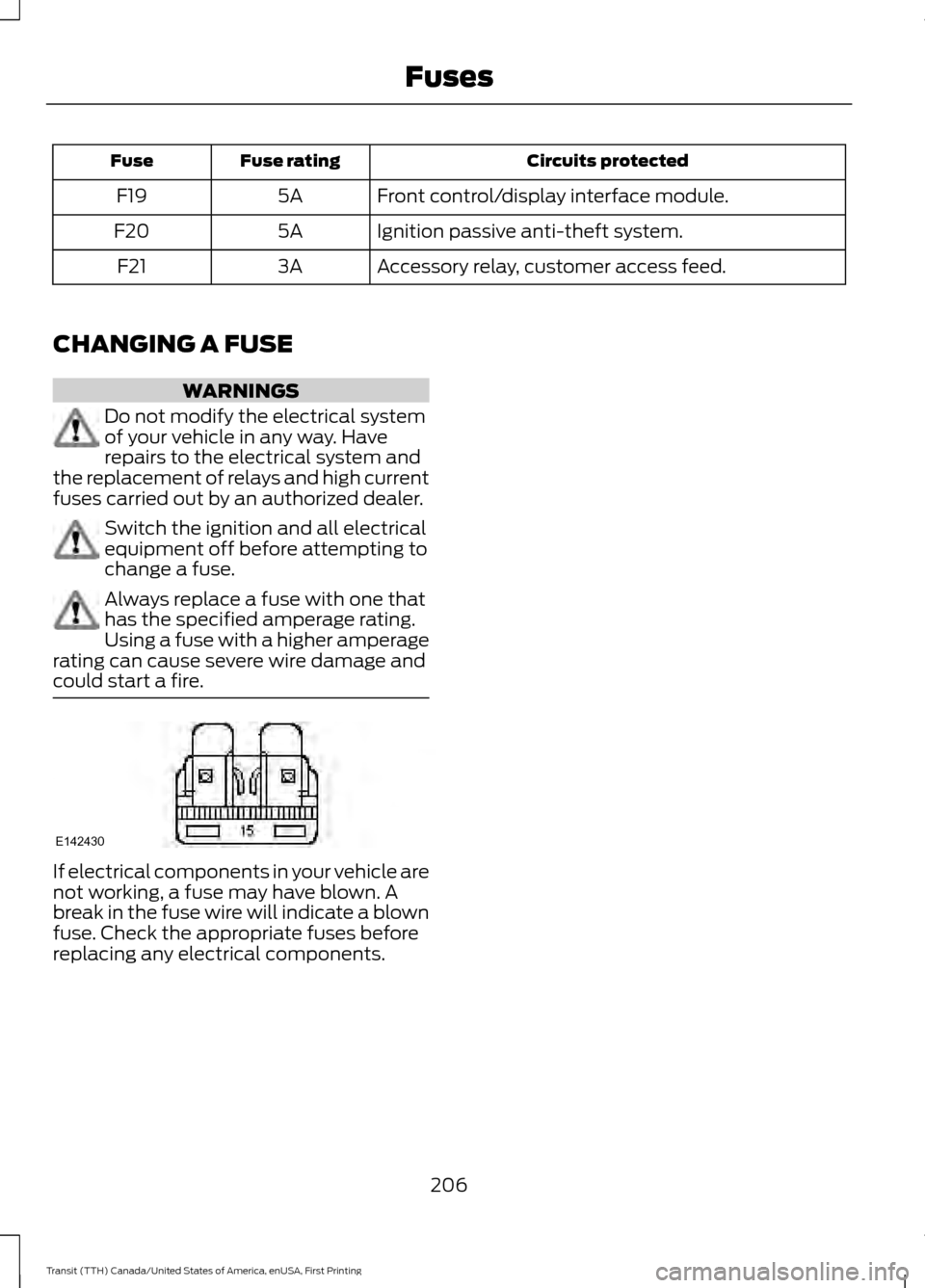
Circuits protected
Fuse rating
Fuse
Front control/display interface module.
5A
F19
Ignition passive anti-theft system.
5A
F20
Accessory relay, customer access feed.
3A
F21
CHANGING A FUSE WARNINGS
Do not modify the electrical system
of your vehicle in any way. Have
repairs to the electrical system and
the replacement of relays and high current
fuses carried out by an authorized dealer. Switch the ignition and all electrical
equipment off before attempting to
change a fuse.
Always replace a fuse with one that
has the specified amperage rating.
Using a fuse with a higher amperage
rating can cause severe wire damage and
could start a fire. If electrical components in your vehicle are
not working, a fuse may have blown. A
break in the fuse wire will indicate a blown
fuse. Check the appropriate fuses before
replacing any electrical components.
206
Transit (TTH) Canada/United States of America, enUSA, First Printing FusesE142430
Page 212 of 411
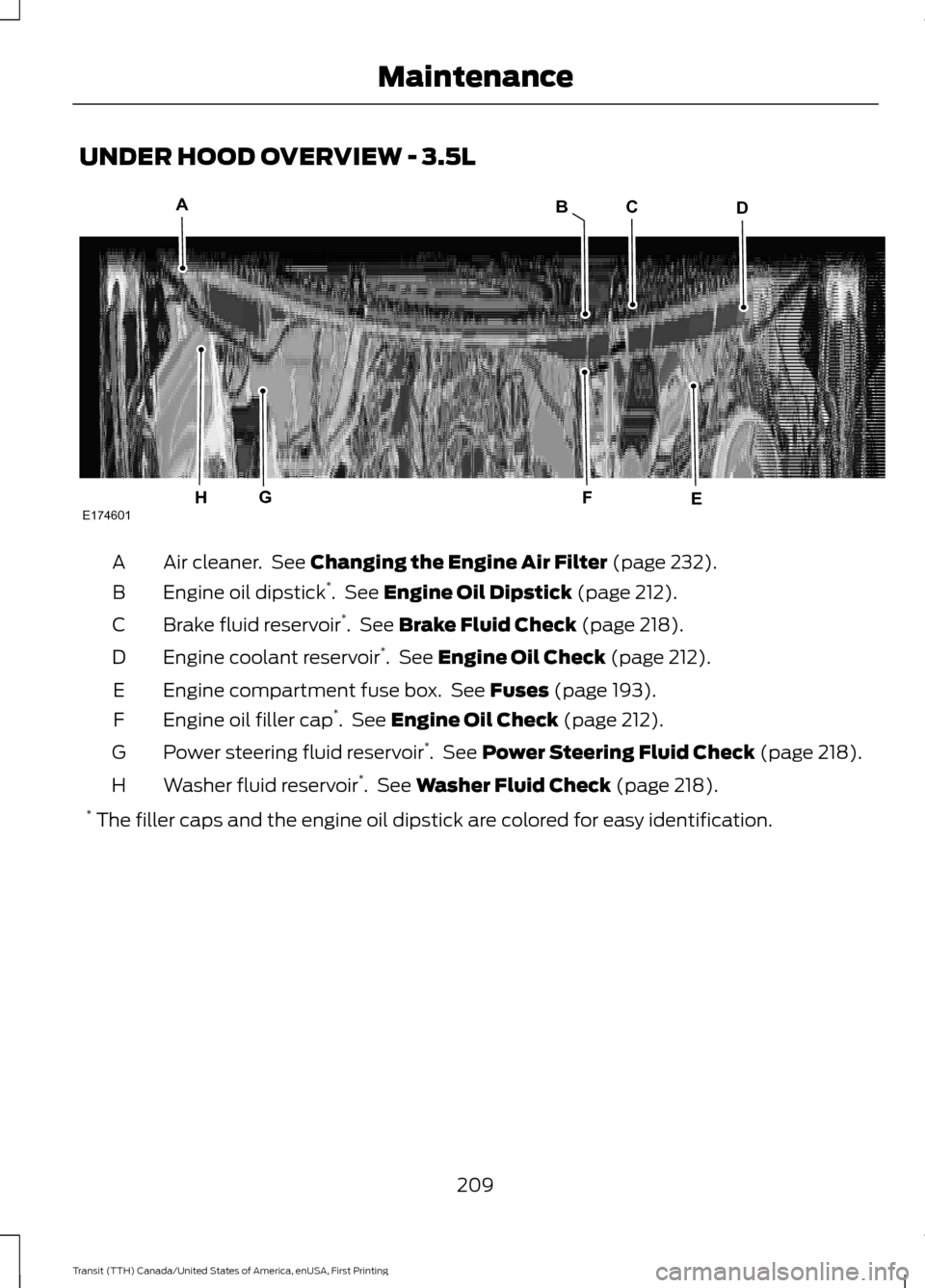
UNDER HOOD OVERVIEW - 3.5L
Air cleaner. See Changing the Engine Air Filter (page 232).
A
Engine oil dipstick *
. See
Engine Oil Dipstick (page 212).
B
Brake fluid reservoir *
. See
Brake Fluid Check (page 218).
C
Engine coolant reservoir *
. See
Engine Oil Check (page 212).
D
Engine compartment fuse box. See
Fuses (page 193).
E
Engine oil filler cap *
. See
Engine Oil Check (page 212).
F
Power steering fluid reservoir *
. See
Power Steering Fluid Check (page 218).
G
Washer fluid reservoir *
. See
Washer Fluid Check (page 218).
H
* The filler caps and the engine oil dipstick are colored for easy identification.
209
Transit (TTH) Canada/United States of America, enUSA, First Printing MaintenanceE174601
ACD
EGH
B
F
Page 213 of 411
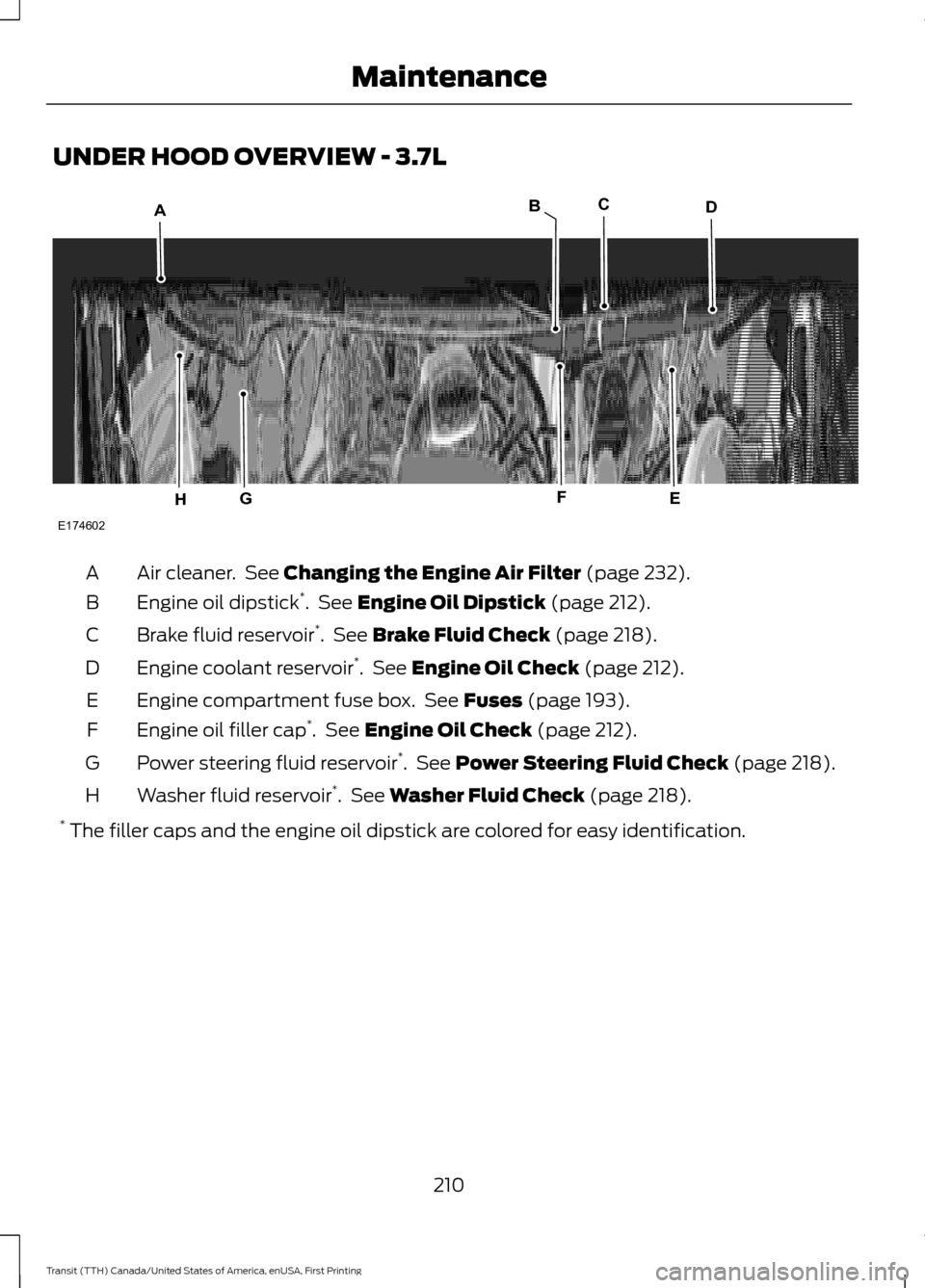
UNDER HOOD OVERVIEW - 3.7L
Air cleaner. See Changing the Engine Air Filter (page 232).
A
Engine oil dipstick *
. See
Engine Oil Dipstick (page 212).
B
Brake fluid reservoir *
. See
Brake Fluid Check (page 218).
C
Engine coolant reservoir *
. See
Engine Oil Check (page 212).
D
Engine compartment fuse box. See
Fuses (page 193).
E
Engine oil filler cap *
. See
Engine Oil Check (page 212).
F
Power steering fluid reservoir *
. See
Power Steering Fluid Check (page 218).
G
Washer fluid reservoir *
. See
Washer Fluid Check (page 218).
H
* The filler caps and the engine oil dipstick are colored for easy identification.
210
Transit (TTH) Canada/United States of America, enUSA, First Printing MaintenanceE174602
ACD
EGH
B
F
Page 214 of 411
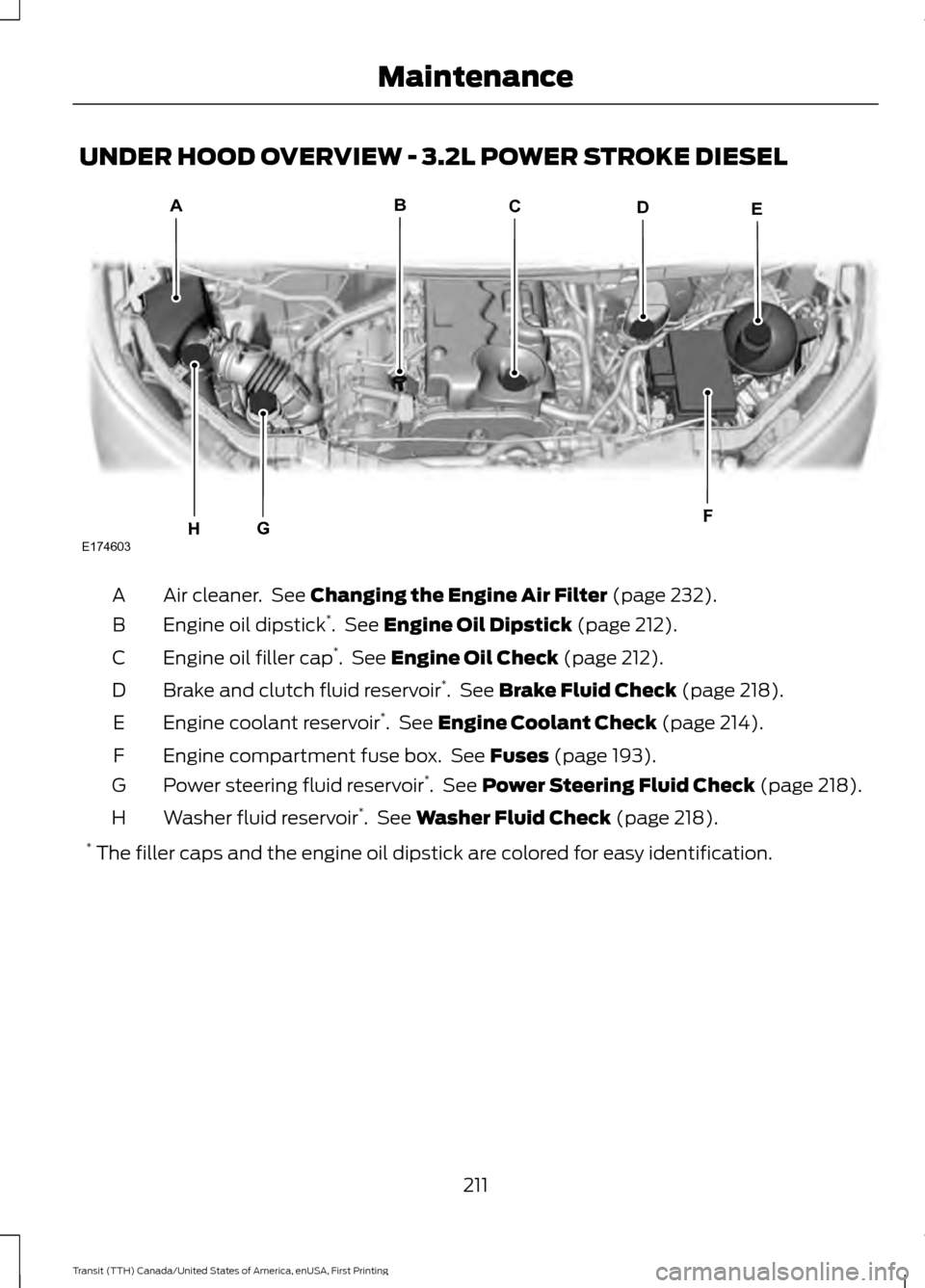
UNDER HOOD OVERVIEW - 3.2L POWER STROKE DIESEL
Air cleaner. See Changing the Engine Air Filter (page 232).
A
Engine oil dipstick *
. See
Engine Oil Dipstick (page 212).
B
Engine oil filler cap *
. See
Engine Oil Check (page 212).
C
Brake and clutch fluid reservoir *
. See
Brake Fluid Check (page 218).
D
Engine coolant reservoir *
. See
Engine Coolant Check (page 214).
E
Engine compartment fuse box. See
Fuses (page 193).
F
Power steering fluid reservoir *
. See
Power Steering Fluid Check (page 218).
G
Washer fluid reservoir *
. See
Washer Fluid Check (page 218).
H
* The filler caps and the engine oil dipstick are colored for easy identification.
211
Transit (TTH) Canada/United States of America, enUSA, First Printing MaintenanceE174603
ABCDE
FGH
Page 216 of 411
Adding Engine Oil
WARNINGS
Only add oil when the engine is cold.
If the engine is hot, wait 10 minutes
for the engine to cool down.
Do not remove the filler cap when
the engine is running.
1. Remove the engine oil filler cap.
2. Add engine oil that meets Ford
specifications. See Capacities and
Specifications (page 274).
3. Replace the engine oil filler cap. Turn it until you feel a strong resistance.
Note: Do not add oil further than the
maximum mark. Oil levels above the
maximum mark may cause engine damage.
Note: Soak up any spillage with an
absorbent cloth immediately.
CHANGING THE ENGINE OIL
AND OIL FILTER WARNINGS
Prolonged and repeated skin contact
with mineral oil will result in the
removal of natural fats from the skin,
leading to dryness, irritation and dermatitis.
In addition, used engine oil contains
potentially harmful contaminants, which
may cause skin cancer. If skin contact
occurs, wash the area thoroughly with
soap or skin cleanser and water
immediately. Do not dispose of engine oils or oil
filters in the household refuse or the
public sewage system. Use an
authorized waste disposal facility. Do not remove the oil pan drain plug
when the engine is running. WARNINGS
Do not remove the oil filter when the
engine is running.
1.
Remove the oil pan drain plug and wait
for the oil to drain into a suitable
container.
2. Renew the oil filter.
3. Reinstall the oil pan drain plug.
4. Refill the engine with new oil that meets Ford specifications. See
Capacities and Specifications (page
274).
Note: Do not add oil further than the
maximum mark. Oil levels above the
maximum mark may cause engine damage.
Note: Soak up any spillage with an
absorbent cloth immediately.
5. Reset the Intelligent Oil Life Monitor. See
Oil Change Indicator Reset
(page 214).
Engine Lubrication for Severe
Service Operation
The following conditions define severe
service operation. The Intelligent Oil Life
Monitor will determine engine oil and oil
filter change intervals.
• Frequent or extended idling.
• Frequent low-speed operation at
25 mph (40 km/h)
or less.
• Frequent severe dust condition
operation.
• Frequent off-road operation.
• Sustained ambient temperatures of
-9°F (-23°C)
or below.
• Sustained ambient temperatures of
100°F (38°C)
or above.
• Sustained towing operation above
1,000 mi (1,600 km)
.
213
Transit (TTH) Canada/United States of America, enUSA, First Printing Maintenance
Page 221 of 411
Have an authorized dealer check and
change the transmission fluid at the
correct service interval. See Scheduled
Maintenance (page 363). Your
transmission does not consume fluid.
However, if the transmission slips, shifts
slowly or if you notice a sign of leaking
fluid, contact an authorized dealer.
Do not use supplemental transmission
fluid additives, treatments or cleaning
agents. The use of these materials may
affect transmission operation and result
in damage to internal transmission
components.
BRAKE FLUID CHECK
Fluid levels between the MIN and MAX
lines are within the normal operating range;
there is no need to add fluid. If the fluid
levels are outside of the normal operating
range, the performance of the system
could be compromised; seek service from
your authorized dealer immediately.
POWER STEERING FLUID
CHECK WARNING
Do not allow the fluid to touch your
skin or eyes. This could cause serious
personal injury. Rinse the affected
areas immediately with plenty of water
and consult a physician. If the power steering fluid level is not
between the
MAX and MIN marks, add
power steering fluid that meets the correct
specification. See
Capacities and
Specifications (page 281).
Adding Power Steering Fluid
1. Remove the filler cap. 2. Add power steering fluid to the
MAX
mark. Do not overfill.
3. Replace the filler cap. Turn it until you feel a strong resistance.
WASHER FLUID CHECK
Note: The reservoir supplies the front and
rear washer systems.
When adding fluid, use a mixture of washer
fluid and water to help prevent freezing in
cold weather and improve the cleaning
capability. We recommend that you use
only high quality washer fluid.
For information on fluid dilution, refer to
the product instructions.
DRAINING THE FUEL FILTER
WATER TRAP WARNING
Do not dispose of fuel in the
household refuse or the public
sewage system. Use an authorized
waste disposal facility. Your vehicle is fitted with a diesel fuel
conditioner module located behind the fuel
tank.
A warning lamp will illuminate
and a message will be displayed
when approximately
3.38 fl oz
(100 ml) of water accumulates in the
module. If you allow the water level to
exceed this level, the water may pass
through to the engine and may cause fuel
injection equipment damage.
Note: To drain the fuel filter water trap,
access the underside of your vehicle.
218
Transit (TTH) Canada/United States of America, enUSA, First Printing Maintenance
Page 362 of 411
•
When adding accessories, equipment,
passengers and luggage to your
vehicle, do not exceed the total weight
capacity of the vehicle or of the front
or rear axle (GVWR or GAWR as
indicated on the Safety Compliance
Certification label). Ask an authorized
dealer for specific weight information.
• The Federal Communications
Commission (FCC) and Canadian
Radio Telecommunications
Commission (CRTC) regulate the use
of mobile communications systems
that are equipped with radio
transmitters, for example, two-way
radios, telephones and theft alarms.
Any such equipment installed in your
vehicle should comply with Federal
Communications Commission (FCC)
and Canadian Radio
Telecommunications Commission
(CRTC) regulations and should be
installed only by an authorized dealer.
• Mobile communications systems may
harm the operation of your vehicle,
particularly if they are not properly
designed for automotive use.
• If you or an authorized Ford dealer add
any non-Ford electrical or electronic
accessories or components to your
vehicle, you may adversely affect
battery performance and durability,
and may adversely affect the
performance of other electrical
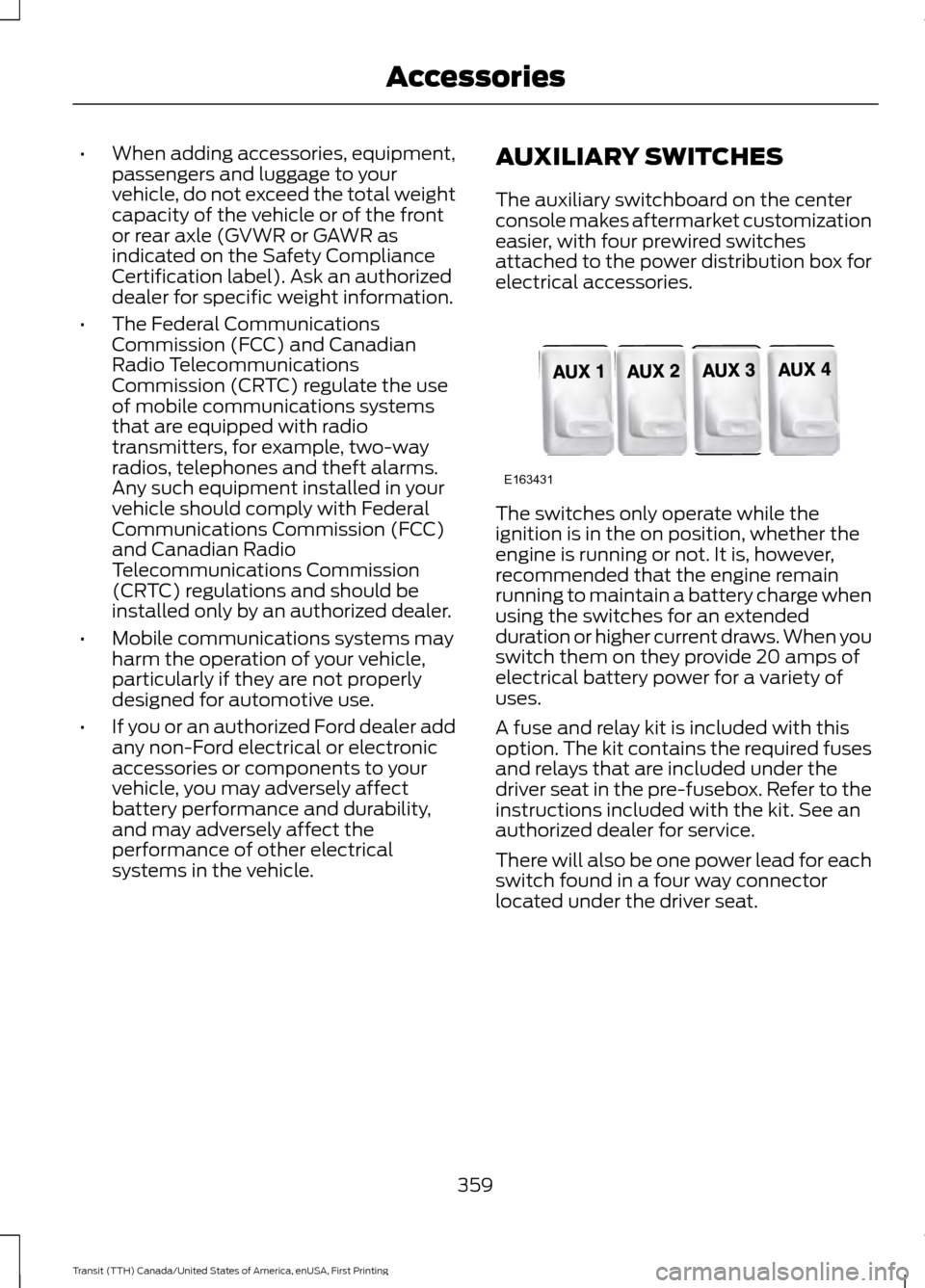
systems in the vehicle. AUXILIARY SWITCHES
The auxiliary switchboard on the center
console makes aftermarket customization
easier, with four prewired switches
attached to the power distribution box for
electrical accessories. The switches only operate while the
ignition is in the on position, whether the
engine is running or not. It is, however,
recommended that the engine remain
running to maintain a battery charge when
using the switches for an extended
duration or higher current draws. When you
switch them on they provide 20 amps of
electrical battery power for a variety of
uses.
A fuse and relay kit is included with this
option. The kit contains the required fuses
and relays that are included under the
driver seat in the pre-fusebox. Refer to the
instructions included with the kit. See an
authorized dealer for service.
There will also be one power lead for each
switch found in a four way connector
located under the driver seat.
359
Transit (TTH) Canada/United States of America, enUSA, First Printing AccessoriesE163431
Page 363 of 411
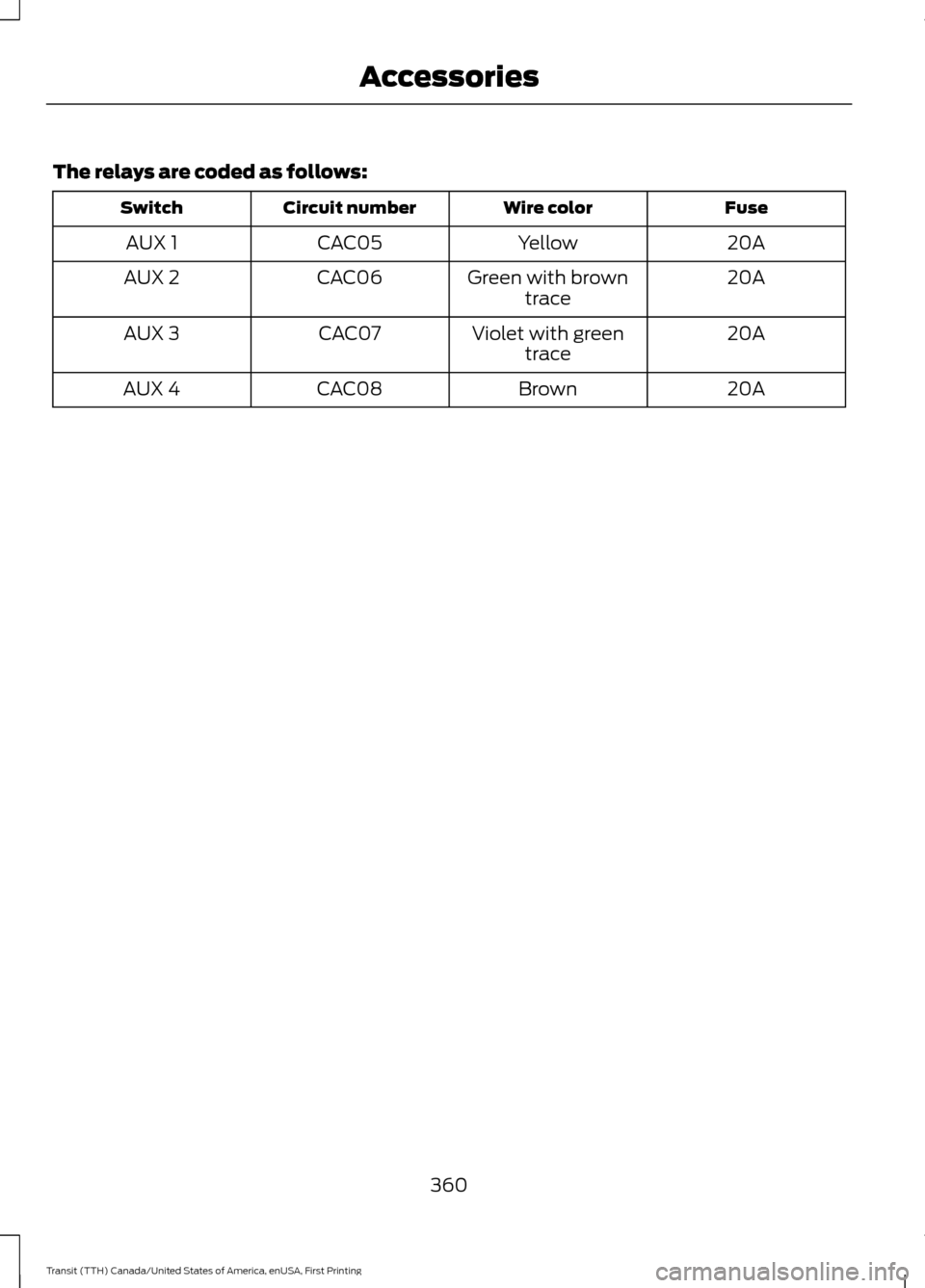
The relays are coded as follows:
Fuse
Wire color
Circuit number
Switch
20A
Yellow
CAC05
AUX 1
20A
Green with brown
trace
CAC06
AUX 2
20A
Violet with green
trace
CAC07
AUX 3
20A
Brown
CAC08
AUX 4
360
Transit (TTH) Canada/United States of America, enUSA, First Printing Accessories