maintenance FORD TRANSIT 2016 5.G Service Manual
[x] Cancel search | Manufacturer: FORD, Model Year: 2016, Model line: TRANSIT, Model: FORD TRANSIT 2016 5.GPages: 411, PDF Size: 5.65 MB
Page 228 of 411
5. Locate the vertical adjuster on each
headlamp. Use a suitable tool, for
example a screwdriver or hexagonal
socket, to turn the adjuster clockwise
or counterclockwise to adjust the
vertical aim of the headlamp. The
horizontal edge of the brighter light
should touch the horizontal reference
line.
6. Close the hood and switch off the lamps.
Horizontal Aim Adjustment
The horizontal aim of the headlamp beam
on your vehicle is not adjustable.
REMOVING A HEADLAMP WARNING
Switch all of the lamps and the
ignition off. Failure to follow this
warning could result in serious
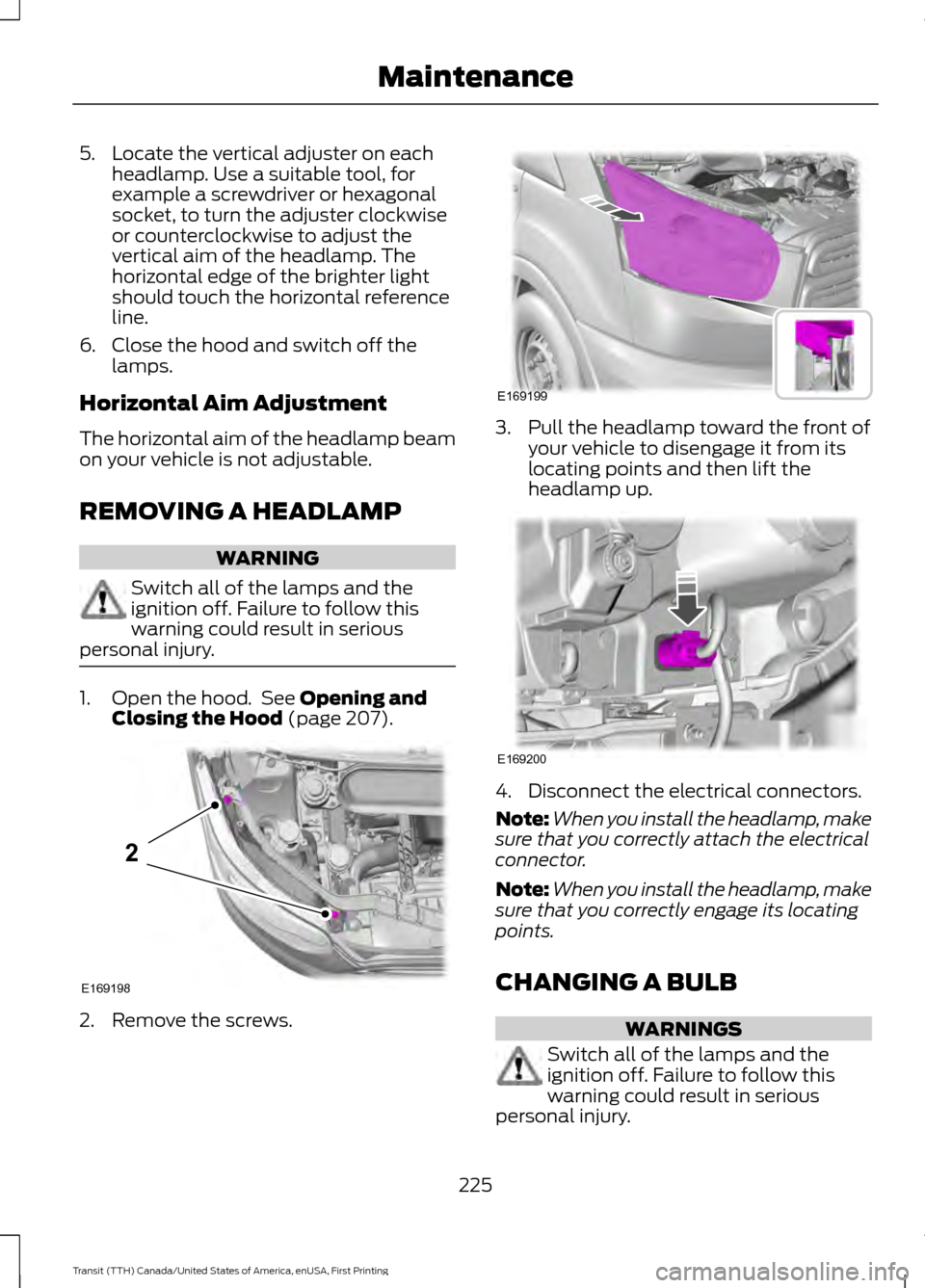
personal injury. 1. Open the hood. See Opening and
Closing the Hood (page 207). 2. Remove the screws. 3. Pull the headlamp toward the front of
your vehicle to disengage it from its
locating points and then lift the
headlamp up. 4. Disconnect the electrical connectors.
Note:
When you install the headlamp, make
sure that you correctly attach the electrical
connector.
Note: When you install the headlamp, make
sure that you correctly engage its locating
points.
CHANGING A BULB WARNINGS
Switch all of the lamps and the
ignition off. Failure to follow this
warning could result in serious
personal injury.
225
Transit (TTH) Canada/United States of America, enUSA, First Printing MaintenanceE169198
2 E169199 E169200
Page 229 of 411
WARNINGS
Bulbs become hot when in use. Let
them cool down before you remove
them.
Use the correct specification bulb. See
Bulb Specification Chart (page 230).
The following instructions describe how to
remove the bulbs. Install in the reverse
order unless otherwise stated.
Note: LED lamps are not serviceable. See
an authorized dealer.
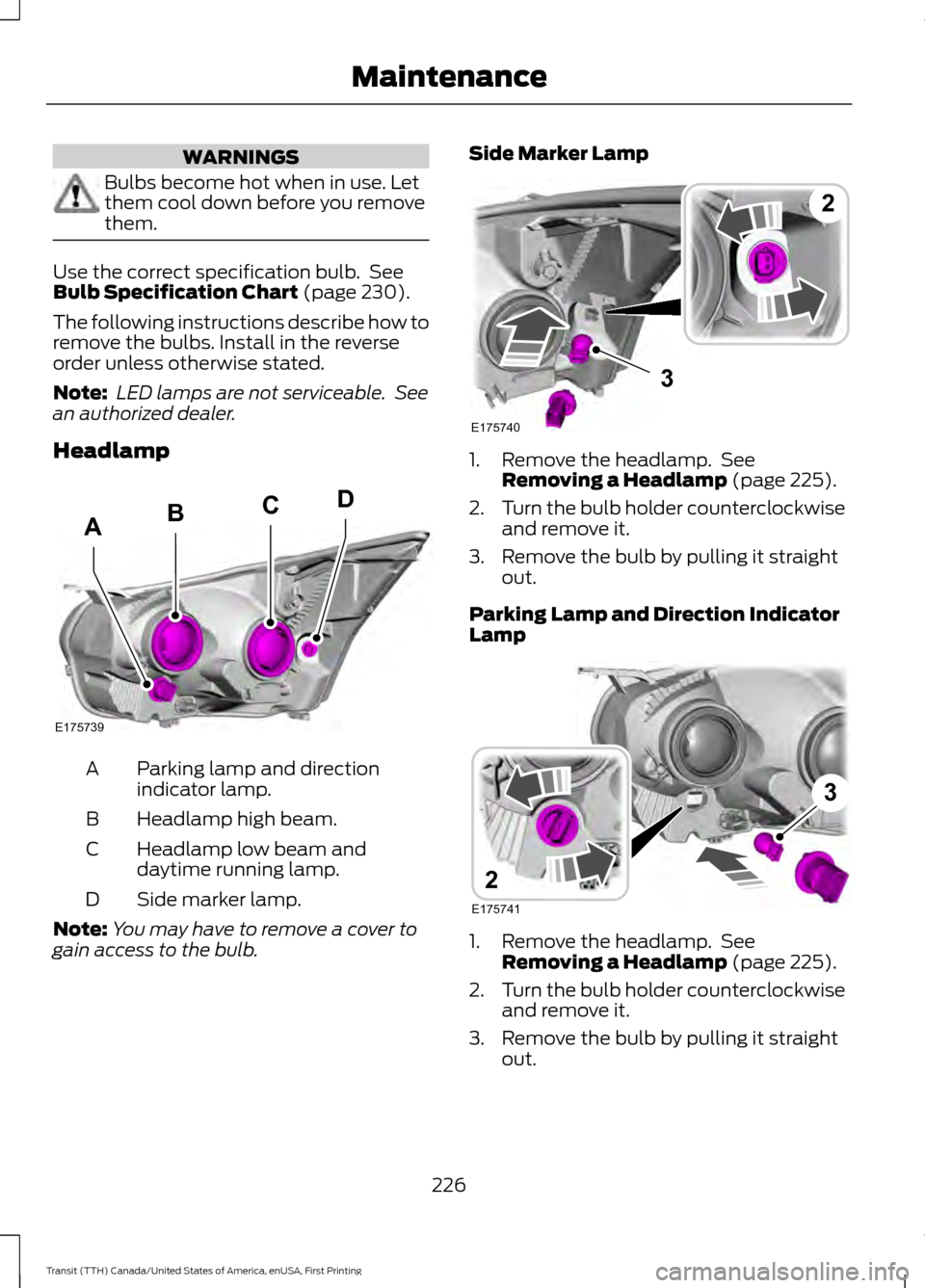
Headlamp Parking lamp and direction
indicator lamp.
A
Headlamp high beam.
B
Headlamp low beam and
daytime running lamp.
C
Side marker lamp.
D
Note: You may have to remove a cover to
gain access to the bulb. Side Marker Lamp
1. Remove the headlamp. See
Removing a Headlamp
(page 225).
2. Turn the bulb holder counterclockwise
and remove it.
3. Remove the bulb by pulling it straight out.
Parking Lamp and Direction Indicator
Lamp 1. Remove the headlamp. See
Removing a Headlamp
(page 225).
2. Turn the bulb holder counterclockwise
and remove it.
3. Remove the bulb by pulling it straight out.
226
Transit (TTH) Canada/United States of America, enUSA, First Printing MaintenanceE175739
BCD
A 3
E175740
2 3
E175741
2
Page 230 of 411
Headlamp Low Beam and Daytime
Running Lamp
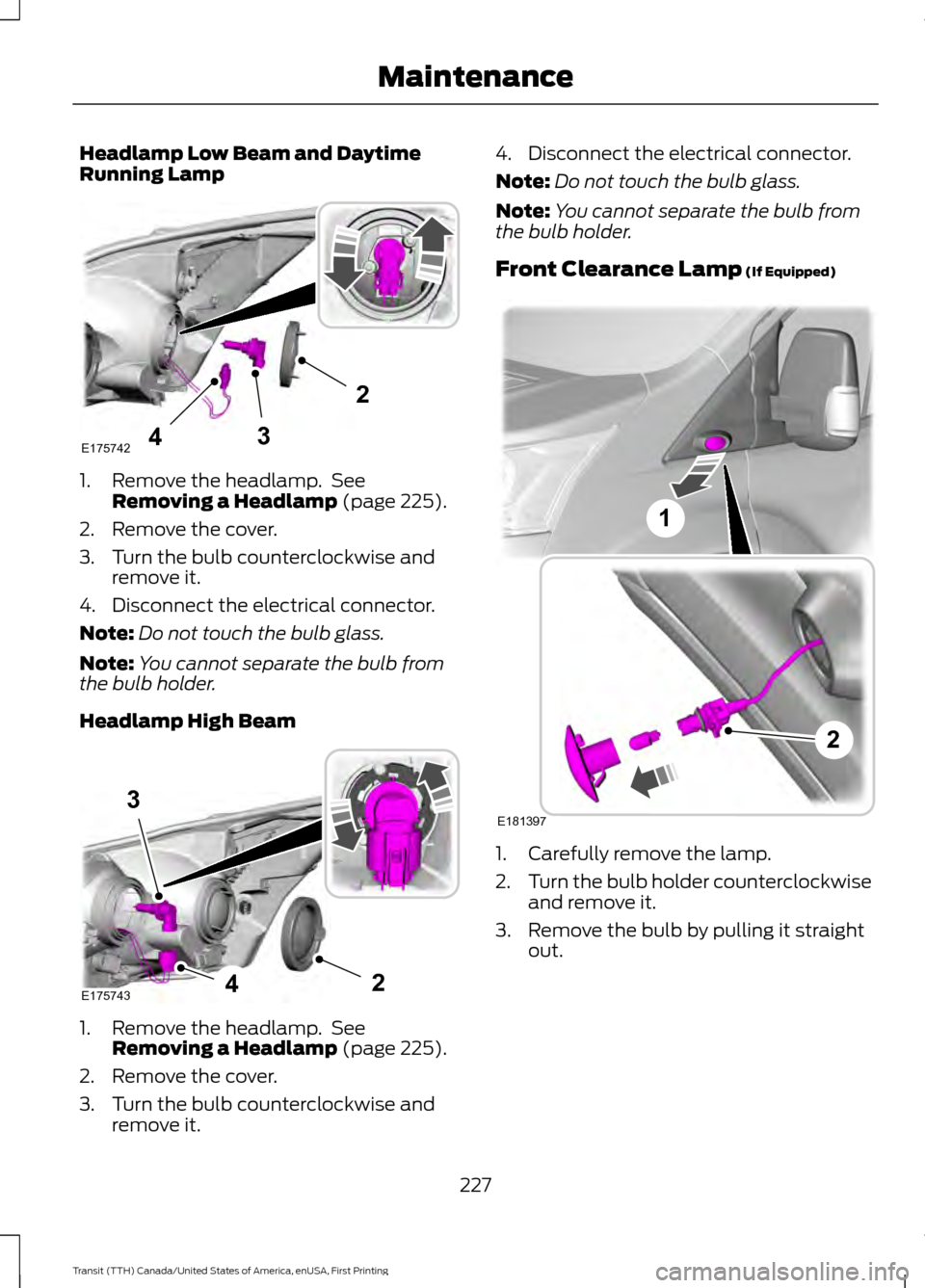
1. Remove the headlamp. See
Removing a Headlamp (page 225).
2. Remove the cover.
3. Turn the bulb counterclockwise and remove it.
4. Disconnect the electrical connector.
Note: Do not touch the bulb glass.
Note: You cannot separate the bulb from
the bulb holder.
Headlamp High Beam 1. Remove the headlamp. See
Removing a Headlamp
(page 225).
2. Remove the cover.
3. Turn the bulb counterclockwise and remove it. 4. Disconnect the electrical connector.
Note:
Do not touch the bulb glass.
Note: You cannot separate the bulb from
the bulb holder.
Front Clearance Lamp
(If Equipped) 1. Carefully remove the lamp.
2.
Turn the bulb holder counterclockwise
and remove it.
3. Remove the bulb by pulling it straight out.
227
Transit (TTH) Canada/United States of America, enUSA, First Printing Maintenance43
2
E175742 4
3
2E175743 E181397
2
1
Page 231 of 411
Side Direction Indicator (If Equipped)
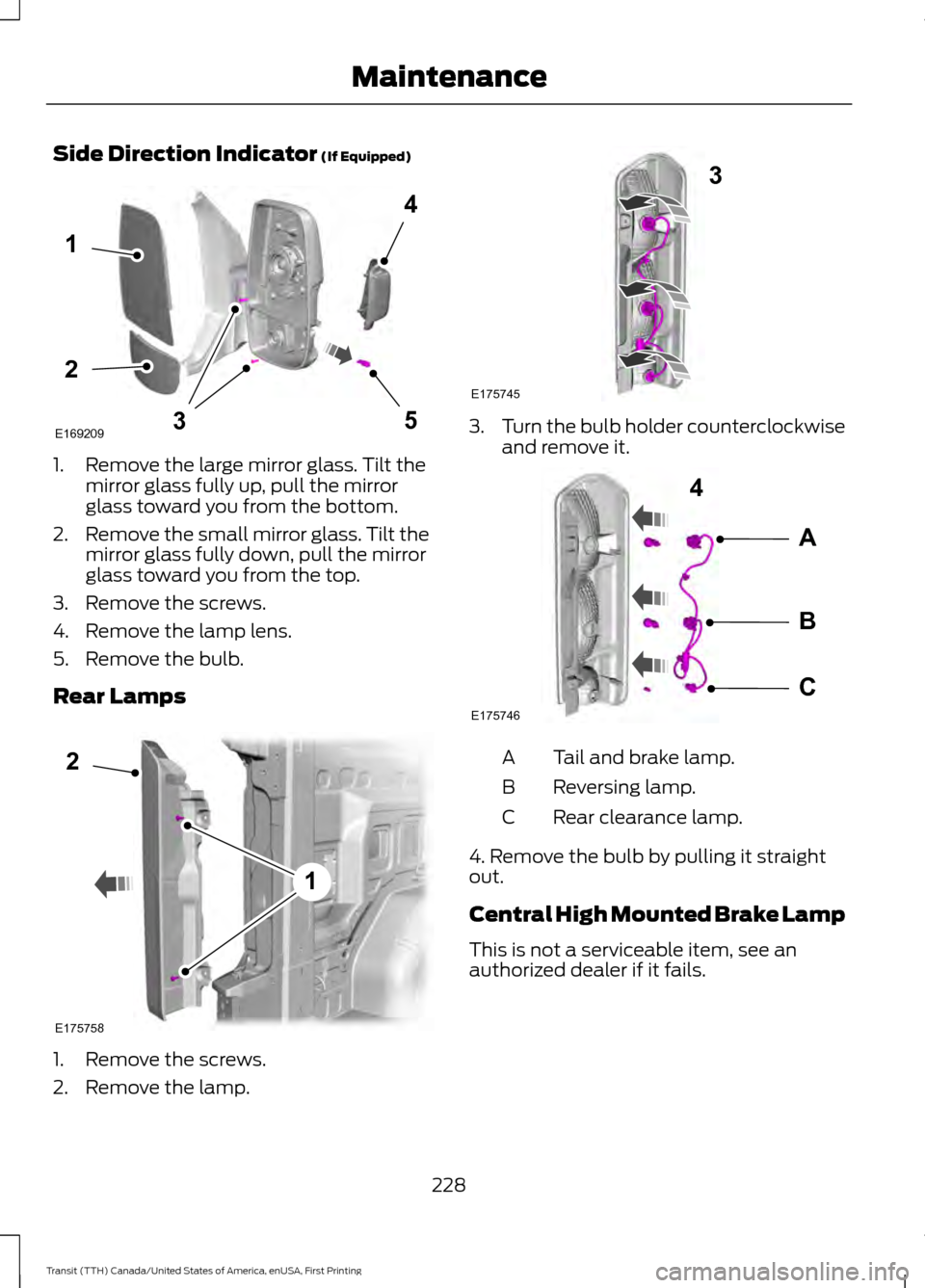
1. Remove the large mirror glass. Tilt the
mirror glass fully up, pull the mirror
glass toward you from the bottom.
2. Remove the small mirror glass. Tilt the
mirror glass fully down, pull the mirror
glass toward you from the top.
3. Remove the screws.
4. Remove the lamp lens.
5. Remove the bulb.
Rear Lamps 1. Remove the screws.
2. Remove the lamp. 3.
Turn the bulb holder counterclockwise
and remove it. Tail and brake lamp.
A
Reversing lamp.
B
Rear clearance lamp.
C
4. Remove the bulb by pulling it straight
out.
Central High Mounted Brake Lamp
This is not a serviceable item, see an
authorized dealer if it fails.
228
Transit (TTH) Canada/United States of America, enUSA, First Printing MaintenanceE1692093
1
4
5
2 E175758
2
1 3
E175745 A
B
C
4
E175746
Page 232 of 411
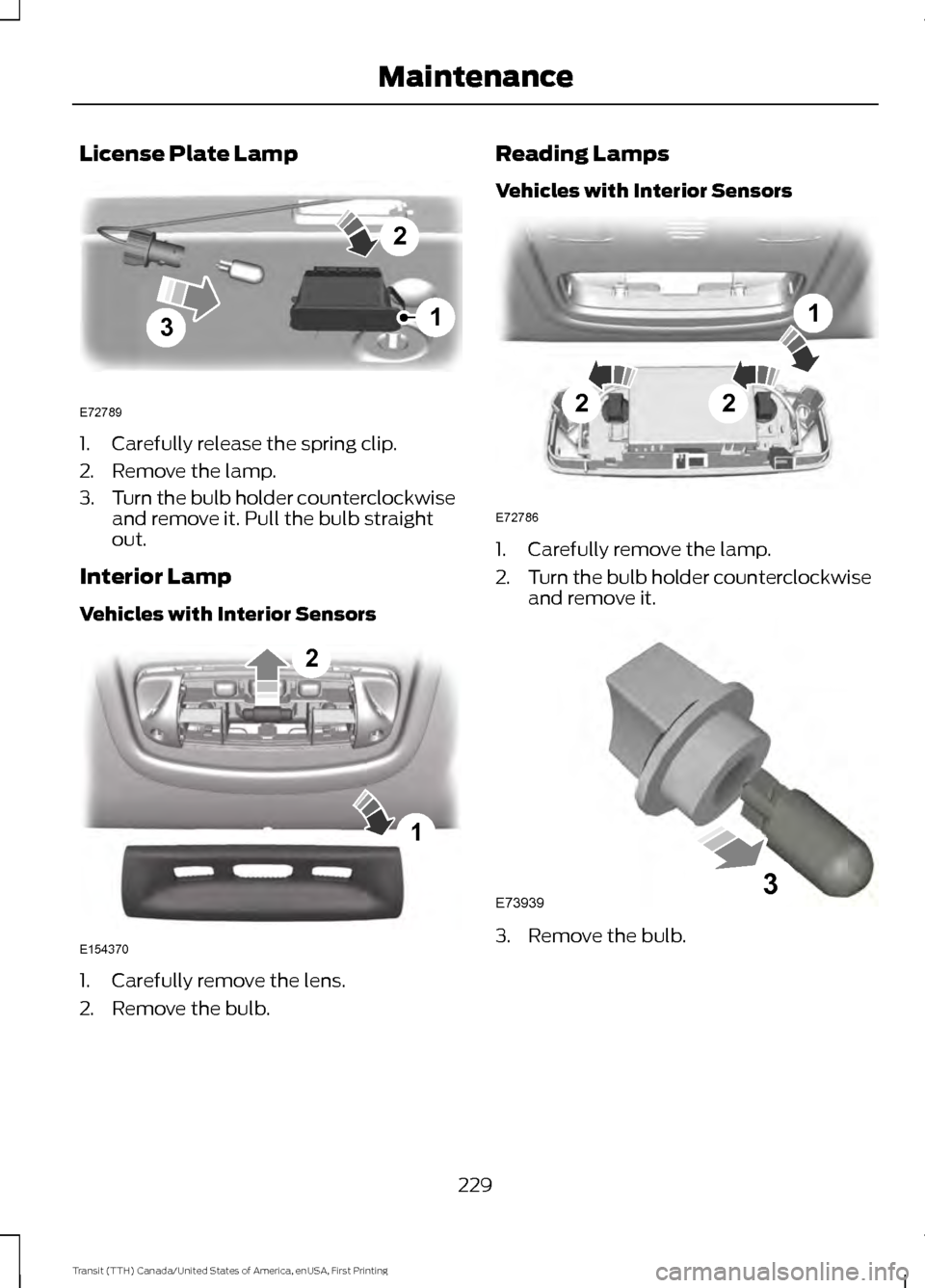
License Plate Lamp
1. Carefully release the spring clip.
2. Remove the lamp.
3.
Turn the bulb holder counterclockwise
and remove it. Pull the bulb straight
out.
Interior Lamp
Vehicles with Interior Sensors 1. Carefully remove the lens.
2. Remove the bulb. Reading Lamps
Vehicles with Interior Sensors
1. Carefully remove the lamp.
2.
Turn the bulb holder counterclockwise
and remove it. 3. Remove the bulb.
229
Transit (TTH) Canada/United States of America, enUSA, First Printing Maintenance3
2
1
E72789 1
2
E154370 22
1
E72786 E739393
Page 233 of 411
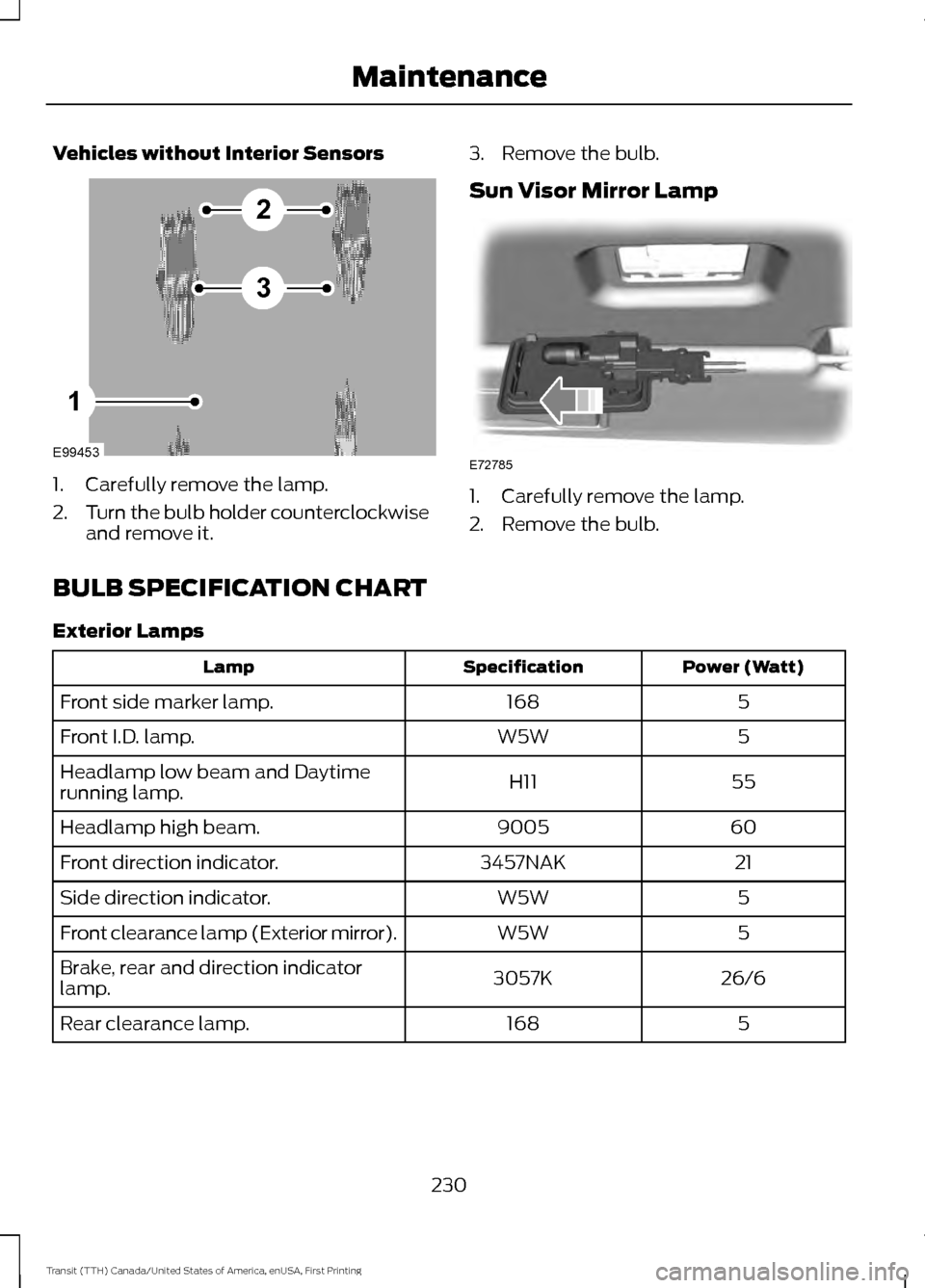
Vehicles without Interior Sensors
1. Carefully remove the lamp.
2.
Turn the bulb holder counterclockwise
and remove it. 3. Remove the bulb.
Sun Visor Mirror Lamp 1. Carefully remove the lamp.
2. Remove the bulb.
BULB SPECIFICATION CHART
Exterior Lamps Power (Watt)
Specification
Lamp
5
168
Front side marker lamp.
5
W5W
Front I.D. lamp.
55
H11
Headlamp low beam and Daytime
running lamp.
60
9005
Headlamp high beam.
21
3457NAK
Front direction indicator.
5
W5W
Side direction indicator.
5
W5W
Front clearance lamp (Exterior mirror).
26/6
3057K
Brake, rear and direction indicator
lamp.
5
168
Rear clearance lamp.
230
Transit (TTH) Canada/United States of America, enUSA, First Printing MaintenanceE99453
2
3
1 E72785
Page 234 of 411
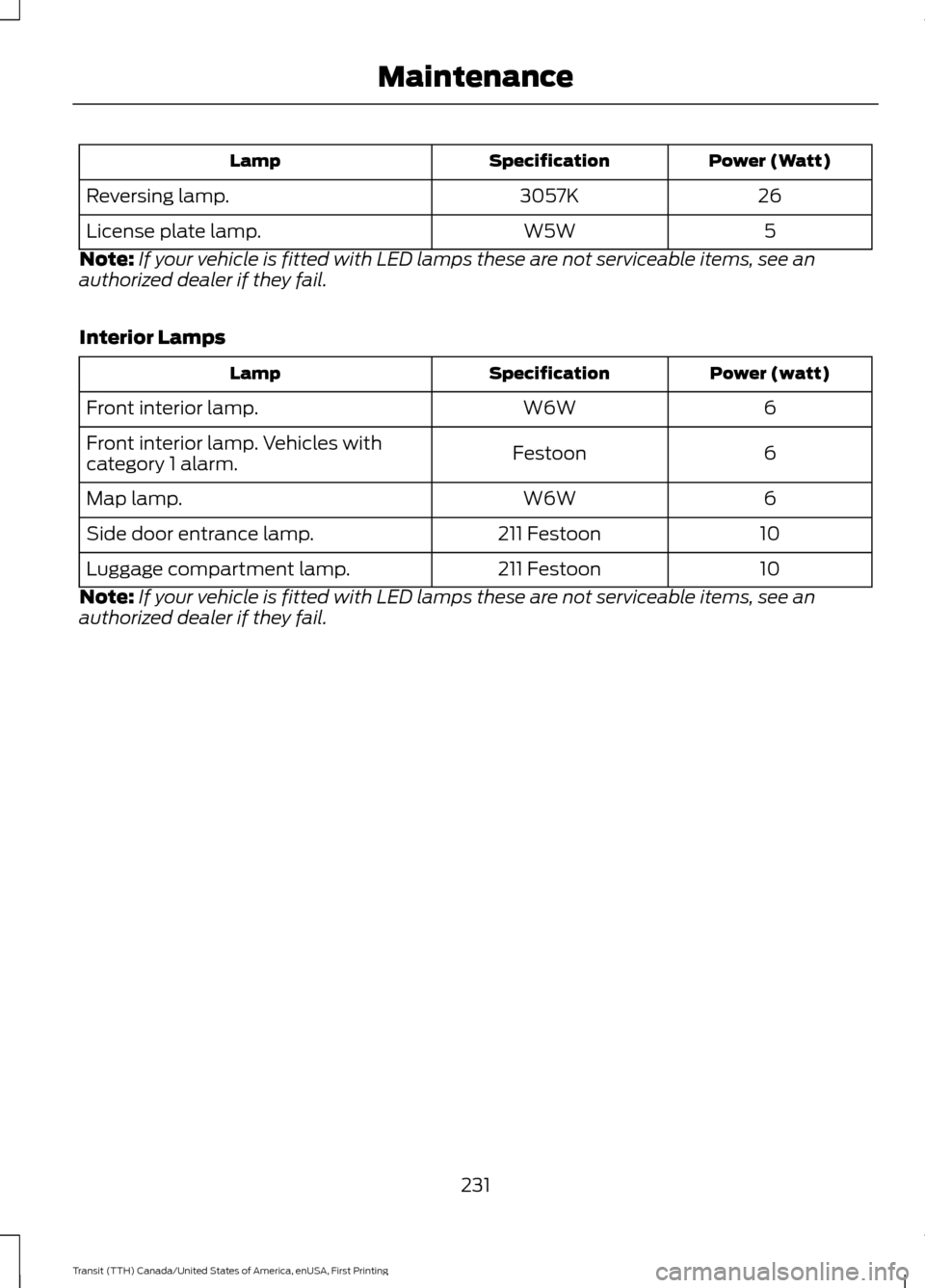
Power (Watt)
Specification
Lamp
26
3057K
Reversing lamp.
5
W5W
License plate lamp.
Note: If your vehicle is fitted with LED lamps these are not serviceable items, see an
authorized dealer if they fail.
Interior Lamps Power (watt)
Specification
Lamp
6
W6W
Front interior lamp.
6
Festoon
Front interior lamp. Vehicles with
category 1 alarm.
6
W6W
Map lamp.
10
211 Festoon
Side door entrance lamp.
10
211 Festoon
Luggage compartment lamp.
Note: If your vehicle is fitted with LED lamps these are not serviceable items, see an
authorized dealer if they fail.
231
Transit (TTH) Canada/United States of America, enUSA, First Printing Maintenance
Page 235 of 411
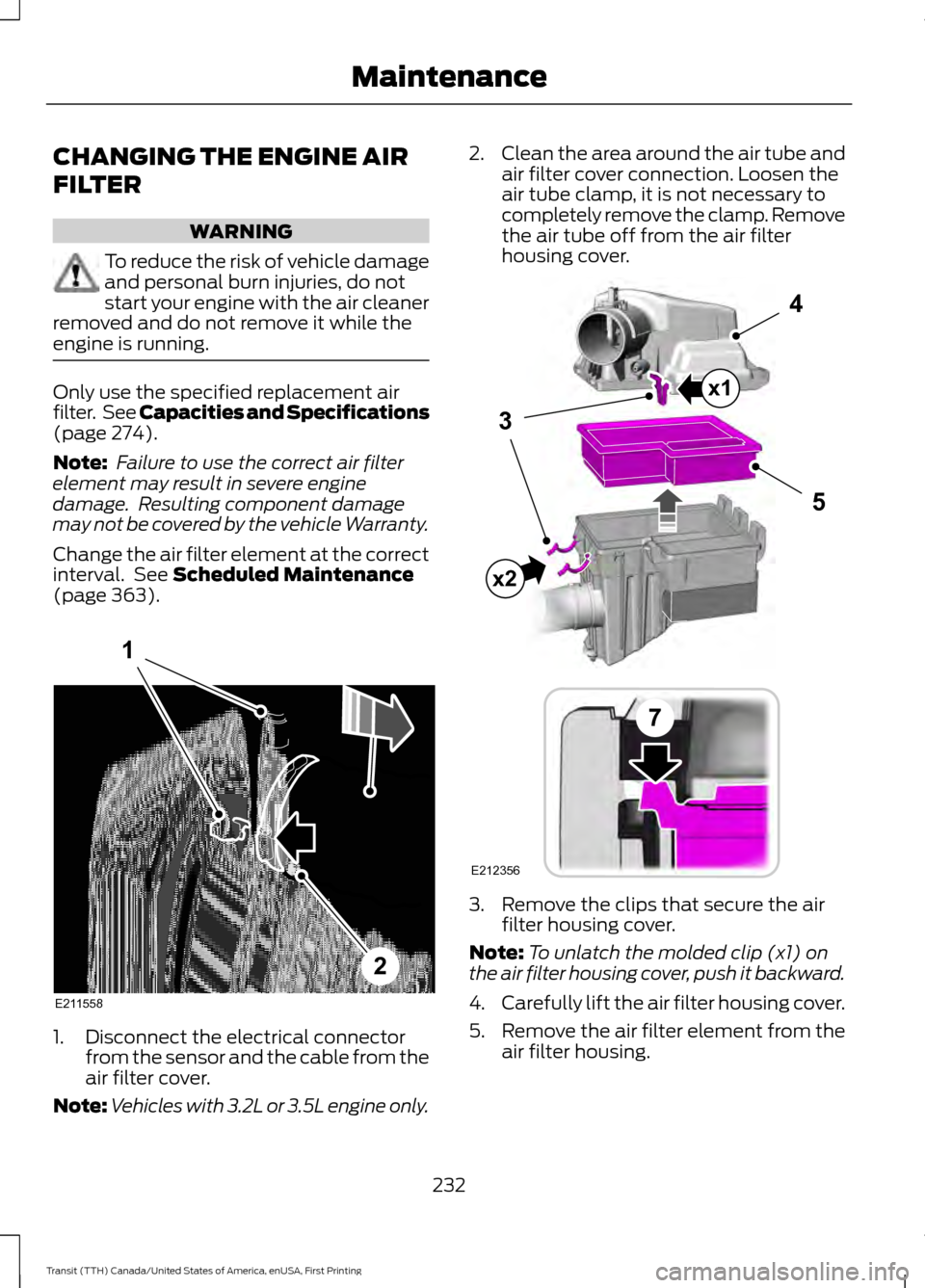
CHANGING THE ENGINE AIR
FILTER
WARNING
To reduce the risk of vehicle damage
and personal burn injuries, do not
start your engine with the air cleaner
removed and do not remove it while the
engine is running. Only use the specified replacement air
filter. See Capacities and Specifications
(page 274).
Note: Failure to use the correct air filter
element may result in severe engine
damage. Resulting component damage
may not be covered by the vehicle Warranty.
Change the air filter element at the correct
interval. See
Scheduled Maintenance
(page 363). 1. Disconnect the electrical connector
from the sensor and the cable from the
air filter cover.
Note: Vehicles with 3.2L or 3.5L engine only. 2.
Clean the area around the air tube and
air filter cover connection. Loosen the
air tube clamp, it is not necessary to
completely remove the clamp. Remove
the air tube off from the air filter
housing cover. 3. Remove the clips that secure the air
filter housing cover.
Note: To unlatch the molded clip (x1) on
the air filter housing cover, push it backward.
4. Carefully lift the air filter housing cover.
5. Remove the air filter element from the
air filter housing.
232
Transit (TTH) Canada/United States of America, enUSA, First Printing MaintenanceE211558
1
2 E212356
5
4
7
3
x1
x2
Page 236 of 411
6.
Wipe any dirt or debris from the air filter
housing and cover to make sure no dirt
gets in the engine and that you have a
good seal.
7. Install a new air filter element. Be careful not to crimp the filter element
edges between the air filter housing
and cover.
8. Install the air filter housing cover.
Note: Make sure the front clips are fully
engaged and the molded clip on the air filter
housing cover is fully pushed down and
securely clicks into place.
9. Install the air tube onto the air filter cover. Tighten the air tube clamp until
you feel a strong resistance.
10. Reconnect the electrical connector to the sensor and the cable to the air
filter cover.
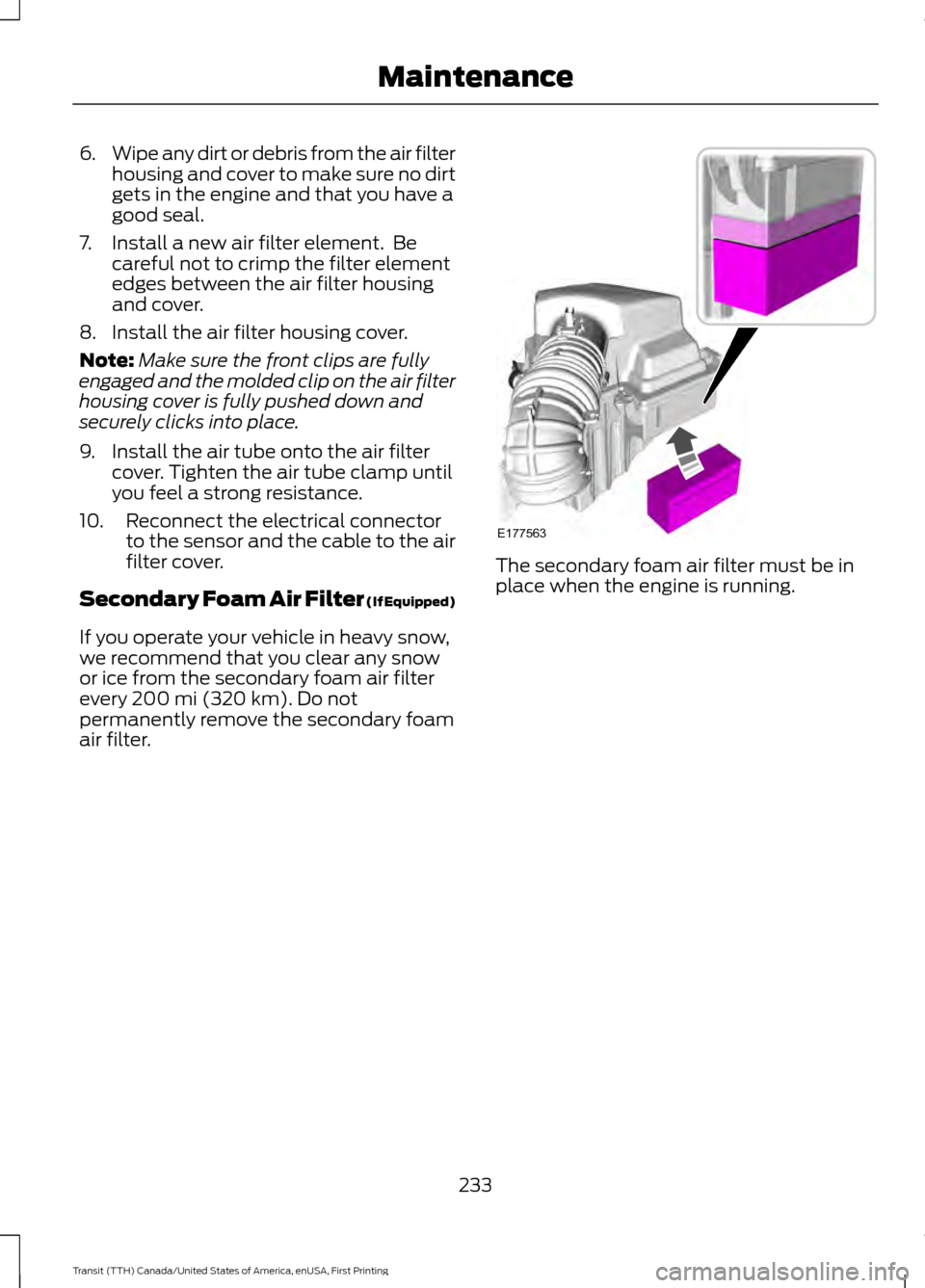
Secondary Foam Air Filter (If Equipped)
If you operate your vehicle in heavy snow,
we recommend that you clear any snow
or ice from the secondary foam air filter
every
200 mi (320 km). Do not
permanently remove the secondary foam
air filter. The secondary foam air filter must be in
place when the engine is running.
233
Transit (TTH) Canada/United States of America, enUSA, First Printing MaintenanceE177563
Page 241 of 411
Note:
Some automatic car washes may
cause damage to the finish on your wheel
rims and covers.
Note: Industrial-strength or heavy-duty
cleaners in combination with brush agitation
to remove brake dust and dirt, could wear
away the clear coat finish over a period time.
Note: Do not use hydrofluoric acid-based
or high caustic-based wheel cleaners, steel
wool, fuels or strong household detergents.
Note: If you intend parking your vehicle for
an extended period after cleaning the
wheels with a wheel cleaner, drive your
vehicle for a few minutes before doing so.
This will reduce the risk of increased
corrosion of the brake discs.
Alloy wheels and wheel covers are coated
with a clear coat paint finish. To maintain
their condition we recommend that you:
• Clean the wheels weekly using
Motorcraft Wheel and Tire Cleaner.
Apply using manufacturer's
instructions.
• Use a sponge to remove heavy
deposits of dirt and brake dust
accumulation.
• Rinse thoroughly with a strong stream
of water when you have completed the
cleaning process.
• To remove tar and grease, use
Motorcraft Bug and Tar Remover.
VEHICLE STORAGE
If you plan on storing your vehicle for 30
days or more, read the following
maintenance recommendations to make
sure your vehicle stays in good operating
condition. We engineer and test all motor vehicles
and their components for reliable, regular
driving. Under various conditions,
long-term storage may lead to degraded
engine performance or failure unless you
use specific precautions to preserve engine
components.
General
•
Store all vehicles in a dry, ventilated
place.
• Protect from sunlight, if possible.
• If vehicles are stored outside, they
require regular maintenance to protect
against rust and damage.
Body
• Wash your vehicle thoroughly to
remove dirt, grease, oil, tar or mud from
exterior surfaces, rear-wheel housing
and the underside of front fenders.
• Periodically wash your vehicle if it is
stored in exposed locations.
• Touch-up exposed or primed metal to
prevent rust.
• Cover chrome and stainless steel parts
with a thick coat of auto wax to prevent
discoloration. Re-wax as necessary
when you wash your vehicle.
• Lubricate all hood, door and luggage
compartment hinges and latches with
a light grade oil.
• Cover interior trim to prevent fading.
• Keep all rubber parts free from oil and
solvents.
238
Transit (TTH) Canada/United States of America, enUSA, First Printing Vehicle Care