heating FORD TRANSIT 2017 5.G User Guide
[x] Cancel search | Manufacturer: FORD, Model Year: 2017, Model line: TRANSIT, Model: FORD TRANSIT 2017 5.GPages: 484, PDF Size: 11.45 MB
Page 225 of 484
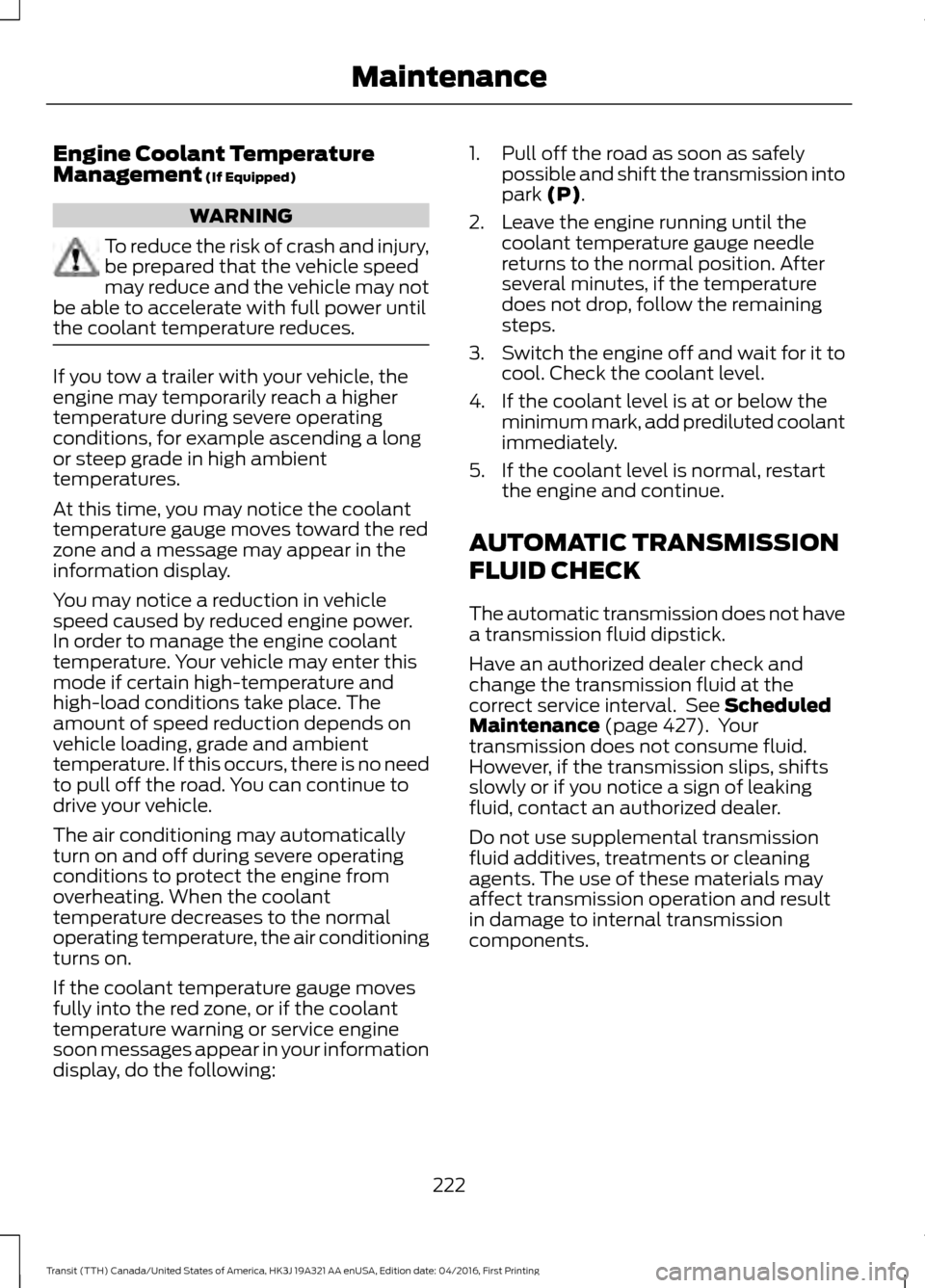
Engine Coolant Temperature
Management (If Equipped)
WARNING
To reduce the risk of crash and injury,
be prepared that the vehicle speed
may reduce and the vehicle may not
be able to accelerate with full power until
the coolant temperature reduces. If you tow a trailer with your vehicle, the
engine may temporarily reach a higher
temperature during severe operating
conditions, for example ascending a long
or steep grade in high ambient
temperatures.
At this time, you may notice the coolant
temperature gauge moves toward the red
zone and a message may appear in the
information display.
You may notice a reduction in vehicle
speed caused by reduced engine power.
In order to manage the engine coolant
temperature. Your vehicle may enter this
mode if certain high-temperature and
high-load conditions take place. The
amount of speed reduction depends on
vehicle loading, grade and ambient
temperature. If this occurs, there is no need
to pull off the road. You can continue to
drive your vehicle.
The air conditioning may automatically
turn on and off during severe operating
conditions to protect the engine from
overheating. When the coolant
temperature decreases to the normal
operating temperature, the air conditioning
turns on.
If the coolant temperature gauge moves
fully into the red zone, or if the coolant
temperature warning or service engine
soon messages appear in your information
display, do the following: 1. Pull off the road as soon as safely
possible and shift the transmission into
park (P).
2. Leave the engine running until the coolant temperature gauge needle
returns to the normal position. After
several minutes, if the temperature
does not drop, follow the remaining
steps.
3. Switch the engine off and wait for it to
cool. Check the coolant level.
4. If the coolant level is at or below the minimum mark, add prediluted coolant
immediately.
5. If the coolant level is normal, restart the engine and continue.
AUTOMATIC TRANSMISSION
FLUID CHECK
The automatic transmission does not have
a transmission fluid dipstick.
Have an authorized dealer check and
change the transmission fluid at the
correct service interval. See
Scheduled
Maintenance (page 427). Your
transmission does not consume fluid.
However, if the transmission slips, shifts
slowly or if you notice a sign of leaking
fluid, contact an authorized dealer.
Do not use supplemental transmission
fluid additives, treatments or cleaning
agents. The use of these materials may
affect transmission operation and result
in damage to internal transmission
components.
222
Transit (TTH) Canada/United States of America, HK3J 19A321 AA enUSA, Edition date: 04/2016, First Printing Maintenance
Page 291 of 484
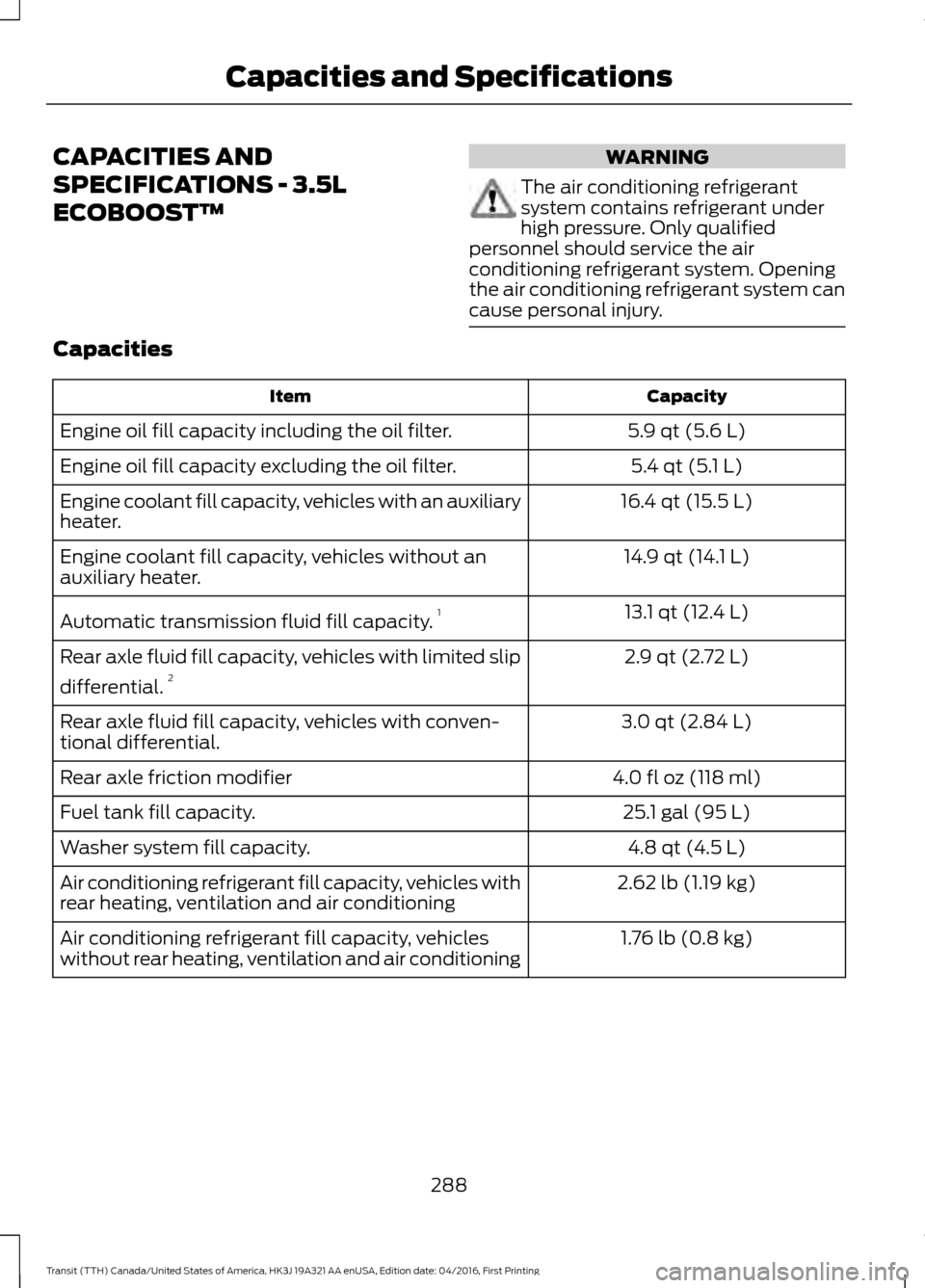
CAPACITIES AND
SPECIFICATIONS - 3.5L
ECOBOOST™ WARNING
The air conditioning refrigerant
system contains refrigerant under
high pressure. Only qualified
personnel should service the air
conditioning refrigerant system. Opening
the air conditioning refrigerant system can
cause personal injury. Capacities
Capacity
Item
5.9 qt (5.6 L)
Engine oil fill capacity including the oil filter.
5.4 qt (5.1 L)
Engine oil fill capacity excluding the oil filter.
16.4 qt (15.5 L)
Engine coolant fill capacity, vehicles with an auxiliary
heater.
14.9 qt (14.1 L)
Engine coolant fill capacity, vehicles without an
auxiliary heater.
13.1 qt (12.4 L)
Automatic transmission fluid fill capacity. 1
2.9 qt (2.72 L)
Rear axle fluid fill capacity, vehicles with limited slip
differential. 2
3.0 qt (2.84 L)
Rear axle fluid fill capacity, vehicles with conven-
tional differential.
4.0 fl oz (118 ml)
Rear axle friction modifier
25.1 gal (95 L)
Fuel tank fill capacity.
4.8 qt (4.5 L)
Washer system fill capacity.
2.62 lb (1.19 kg)
Air conditioning refrigerant fill capacity, vehicles with
rear heating, ventilation and air conditioning
1.76 lb (0.8 kg)
Air conditioning refrigerant fill capacity, vehicles
without rear heating, ventilation and air conditioning
288
Transit (TTH) Canada/United States of America, HK3J 19A321 AA enUSA, Edition date: 04/2016, First Printing Capacities and Specifications
Page 292 of 484
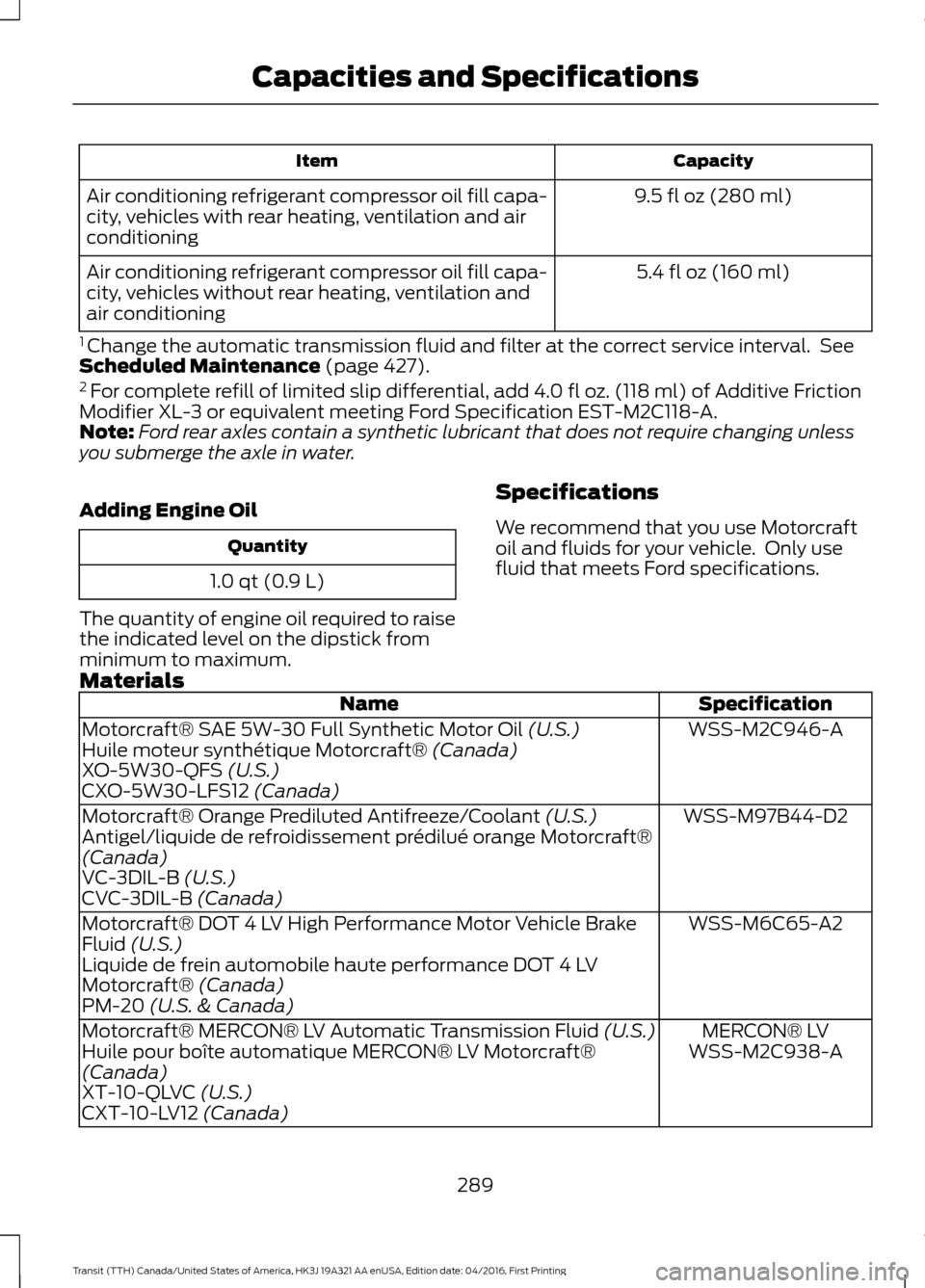
Capacity
Item
9.5 fl oz (280 ml)
Air conditioning refrigerant compressor oil fill capa-
city, vehicles with rear heating, ventilation and air
conditioning
5.4 fl oz (160 ml)
Air conditioning refrigerant compressor oil fill capa-
city, vehicles without rear heating, ventilation and
air conditioning
1 Change the automatic transmission fluid and filter at the correct service interval. See
Scheduled Maintenance (page 427).
2 For complete refill of limited slip differential, add 4.0 fl oz. (118 ml) of Additive Friction
Modifier XL-3 or equivalent meeting Ford Specification EST-M2C118-A.
Note: Ford rear axles contain a synthetic lubricant that does not require changing unless
you submerge the axle in water.
Adding Engine Oil Quantity
1.0 qt (0.9 L)
The quantity of engine oil required to raise
the indicated level on the dipstick from
minimum to maximum. Specifications
We recommend that you use Motorcraft
oil and fluids for your vehicle. Only use
fluid that meets Ford specifications.
Materials Specification
Name
WSS-M2C946-A
Motorcraft® SAE 5W-30 Full Synthetic Motor Oil
(U.S.)
Huile moteur synthétique Motorcraft® (Canada)
XO-5W30-QFS (U.S.)
CXO-5W30-LFS12 (Canada)
WSS-M97B44-D2
Motorcraft® Orange Prediluted Antifreeze/Coolant
(U.S.)
Antigel/liquide de refroidissement prédilué orange Motorcraft®
(Canada)
VC-3DIL-B
(U.S.)
CVC-3DIL-B (Canada)
WSS-M6C65-A2
Motorcraft® DOT 4 LV High Performance Motor Vehicle Brake
Fluid
(U.S.)
Liquide de frein automobile haute performance DOT 4 LV
Motorcraft®
(Canada)
PM-20 (U.S. & Canada)
MERCON® LV
Motorcraft® MERCON® LV Automatic Transmission Fluid
(U.S.)
WSS-M2C938-A
Huile pour boîte automatique MERCON® LV Motorcraft®
(Canada)
XT-10-QLVC
(U.S.)
CXT-10-LV12 (Canada)
289
Transit (TTH) Canada/United States of America, HK3J 19A321 AA enUSA, Edition date: 04/2016, First Printing Capacities and Specifications
Page 297 of 484
•
Reduced fuel economy.
• Degraded brake performance.
Do not use supplemental engine oil
additives because they are unnecessary
and could lead to engine damage that may
not be covered by the vehicle Warranty. CAPACITIES AND
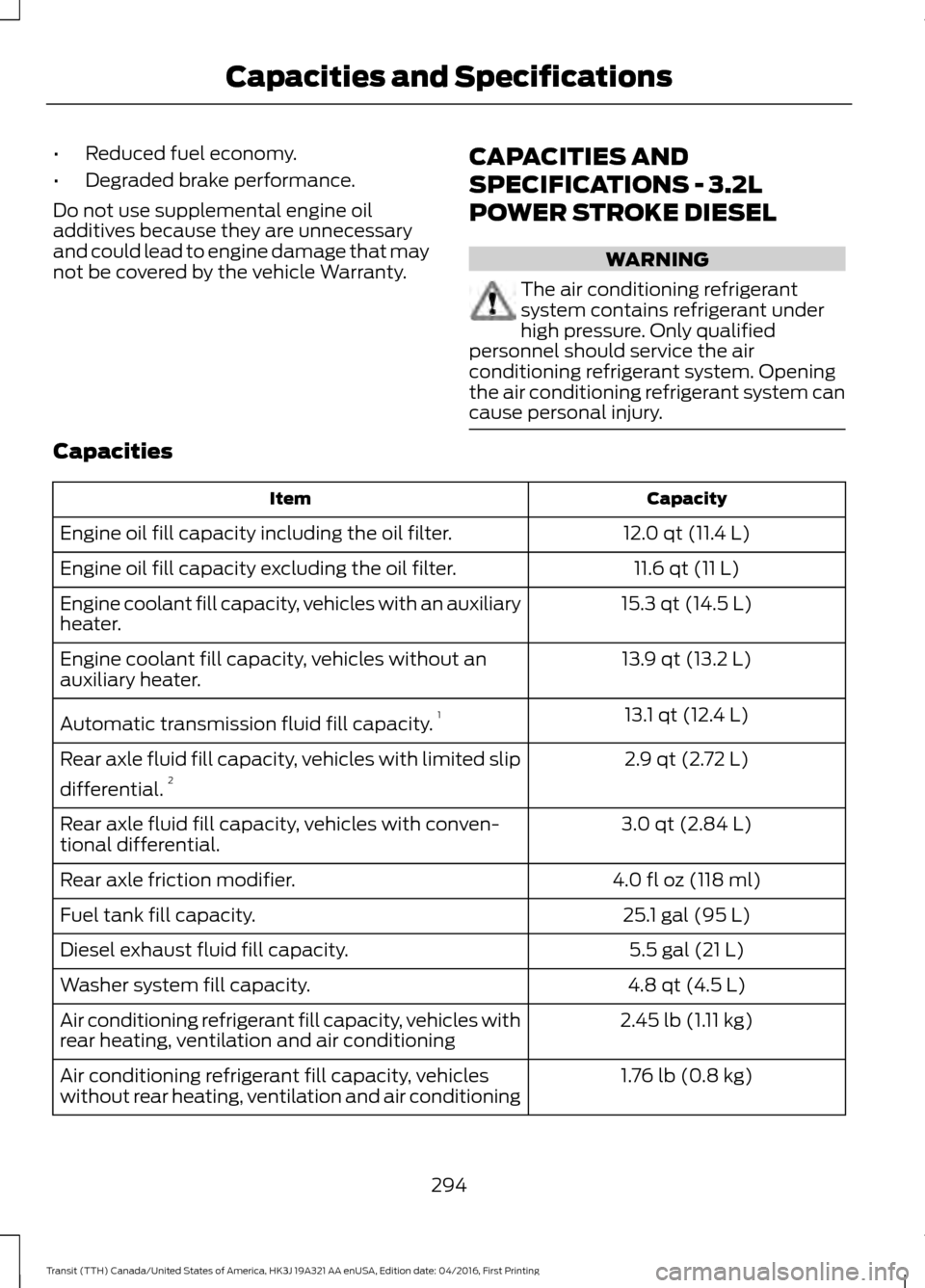
SPECIFICATIONS - 3.2L
POWER STROKE DIESEL WARNING
The air conditioning refrigerant
system contains refrigerant under
high pressure. Only qualified
personnel should service the air
conditioning refrigerant system. Opening
the air conditioning refrigerant system can
cause personal injury. Capacities
Capacity
Item
12.0 qt (11.4 L)
Engine oil fill capacity including the oil filter.
11.6 qt (11 L)
Engine oil fill capacity excluding the oil filter.
15.3 qt (14.5 L)
Engine coolant fill capacity, vehicles with an auxiliary
heater.
13.9 qt (13.2 L)
Engine coolant fill capacity, vehicles without an
auxiliary heater.
13.1 qt (12.4 L)
Automatic transmission fluid fill capacity. 1
2.9 qt (2.72 L)
Rear axle fluid fill capacity, vehicles with limited slip
differential. 2
3.0 qt (2.84 L)
Rear axle fluid fill capacity, vehicles with conven-
tional differential.
4.0 fl oz (118 ml)
Rear axle friction modifier.
25.1 gal (95 L)
Fuel tank fill capacity.
5.5 gal (21 L)
Diesel exhaust fluid fill capacity.
4.8 qt (4.5 L)
Washer system fill capacity.
2.45 lb (1.11 kg)
Air conditioning refrigerant fill capacity, vehicles with
rear heating, ventilation and air conditioning
1.76 lb (0.8 kg)
Air conditioning refrigerant fill capacity, vehicles
without rear heating, ventilation and air conditioning
294
Transit (TTH) Canada/United States of America, HK3J 19A321 AA enUSA, Edition date: 04/2016, First Printing Capacities and Specifications
Page 298 of 484
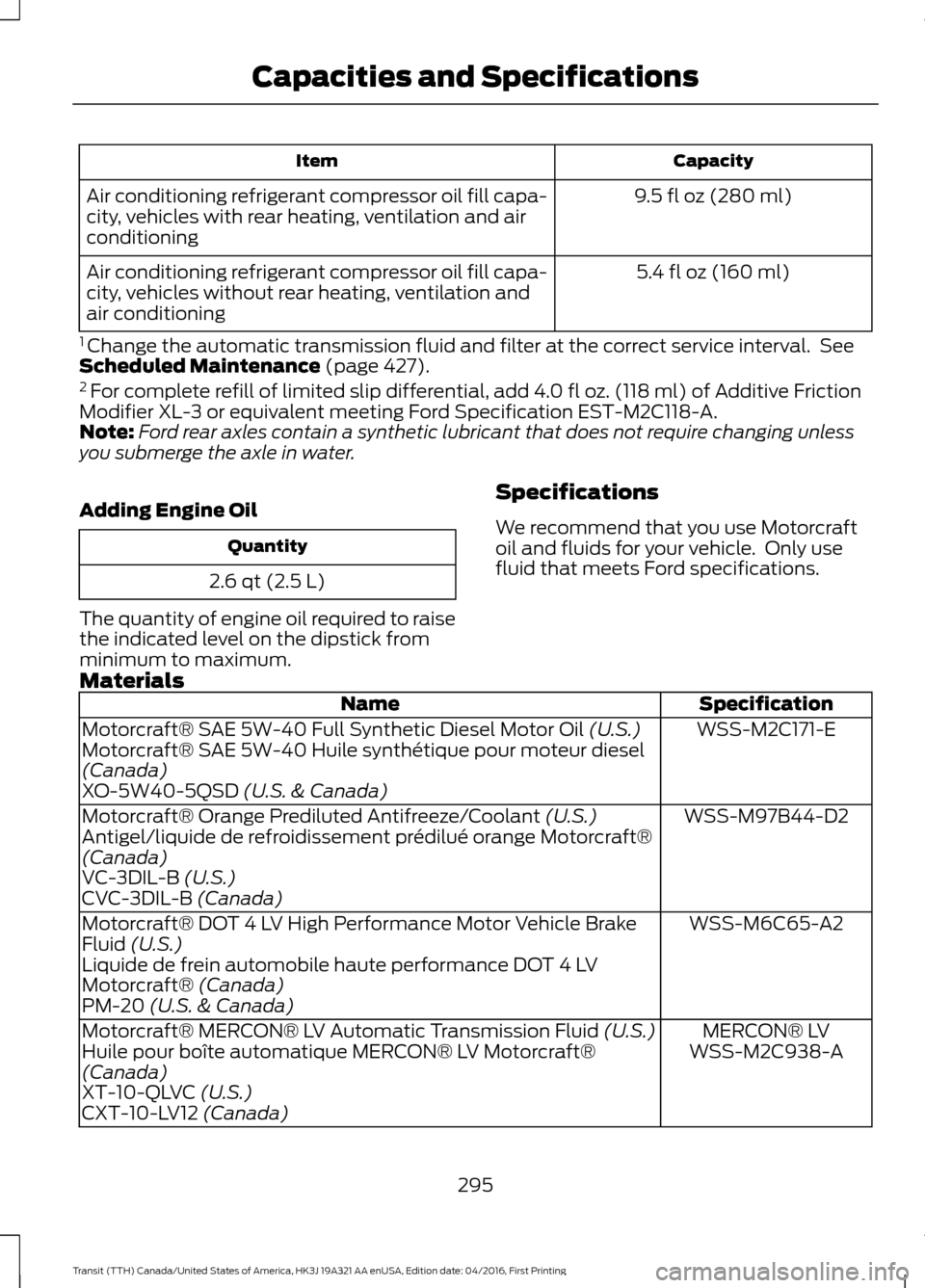
Capacity
Item
9.5 fl oz (280 ml)
Air conditioning refrigerant compressor oil fill capa-
city, vehicles with rear heating, ventilation and air
conditioning
5.4 fl oz (160 ml)
Air conditioning refrigerant compressor oil fill capa-
city, vehicles without rear heating, ventilation and
air conditioning
1 Change the automatic transmission fluid and filter at the correct service interval. See
Scheduled Maintenance (page 427).
2 For complete refill of limited slip differential, add 4.0 fl oz. (118 ml) of Additive Friction
Modifier XL-3 or equivalent meeting Ford Specification EST-M2C118-A.
Note: Ford rear axles contain a synthetic lubricant that does not require changing unless
you submerge the axle in water.
Adding Engine Oil Quantity
2.6 qt (2.5 L)
The quantity of engine oil required to raise
the indicated level on the dipstick from
minimum to maximum. Specifications
We recommend that you use Motorcraft
oil and fluids for your vehicle. Only use
fluid that meets Ford specifications.
Materials Specification
Name
WSS-M2C171-E
Motorcraft® SAE 5W-40 Full Synthetic Diesel Motor Oil
(U.S.)
Motorcraft® SAE 5W-40 Huile synthétique pour moteur diesel
(Canada)
XO-5W40-5QSD
(U.S. & Canada)
WSS-M97B44-D2
Motorcraft® Orange Prediluted Antifreeze/Coolant
(U.S.)
Antigel/liquide de refroidissement prédilué orange Motorcraft®
(Canada)
VC-3DIL-B
(U.S.)
CVC-3DIL-B (Canada)
WSS-M6C65-A2
Motorcraft® DOT 4 LV High Performance Motor Vehicle Brake
Fluid
(U.S.)
Liquide de frein automobile haute performance DOT 4 LV
Motorcraft®
(Canada)
PM-20 (U.S. & Canada)
MERCON® LV
Motorcraft® MERCON® LV Automatic Transmission Fluid
(U.S.)
WSS-M2C938-A
Huile pour boîte automatique MERCON® LV Motorcraft®
(Canada)
XT-10-QLVC
(U.S.)
CXT-10-LV12 (Canada)
295
Transit (TTH) Canada/United States of America, HK3J 19A321 AA enUSA, Edition date: 04/2016, First Printing Capacities and Specifications
Page 431 of 484
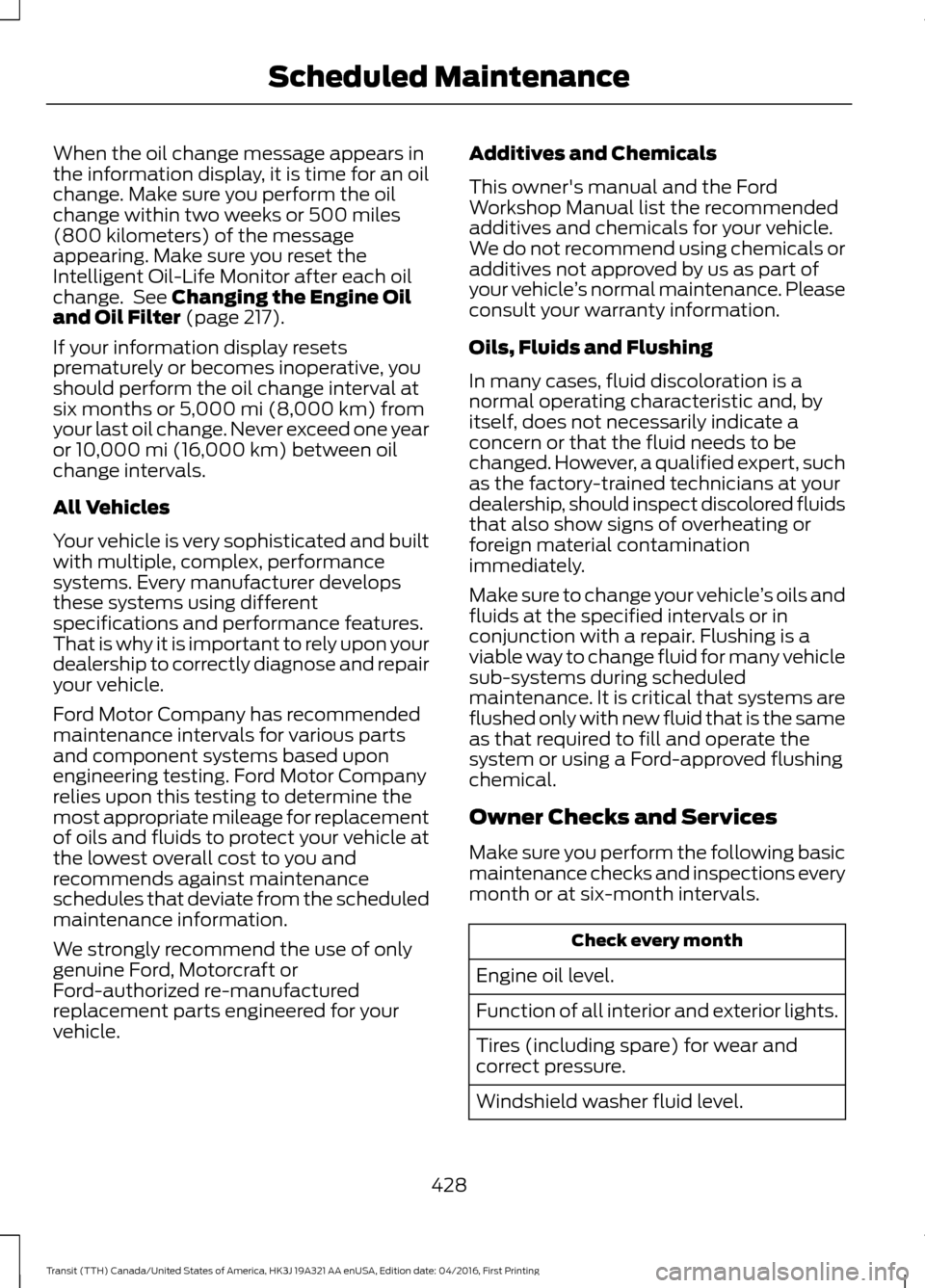
When the oil change message appears in
the information display, it is time for an oil
change. Make sure you perform the oil
change within two weeks or 500 miles
(800 kilometers) of the message
appearing. Make sure you reset the
Intelligent Oil-Life Monitor after each oil
change. See Changing the Engine Oil
and Oil Filter (page 217).
If your information display resets
prematurely or becomes inoperative, you
should perform the oil change interval at
six months or
5,000 mi (8,000 km) from
your last oil change. Never exceed one year
or
10,000 mi (16,000 km) between oil
change intervals.
All Vehicles
Your vehicle is very sophisticated and built
with multiple, complex, performance
systems. Every manufacturer develops
these systems using different
specifications and performance features.
That is why it is important to rely upon your
dealership to correctly diagnose and repair
your vehicle.
Ford Motor Company has recommended
maintenance intervals for various parts
and component systems based upon
engineering testing. Ford Motor Company
relies upon this testing to determine the
most appropriate mileage for replacement
of oils and fluids to protect your vehicle at
the lowest overall cost to you and
recommends against maintenance
schedules that deviate from the scheduled
maintenance information.
We strongly recommend the use of only
genuine Ford, Motorcraft or
Ford-authorized re-manufactured
replacement parts engineered for your
vehicle. Additives and Chemicals
This owner's manual and the Ford
Workshop Manual list the recommended
additives and chemicals for your vehicle.
We do not recommend using chemicals or
additives not approved by us as part of
your vehicle
’s normal maintenance. Please
consult your warranty information.
Oils, Fluids and Flushing
In many cases, fluid discoloration is a
normal operating characteristic and, by
itself, does not necessarily indicate a
concern or that the fluid needs to be
changed. However, a qualified expert, such
as the factory-trained technicians at your
dealership, should inspect discolored fluids
that also show signs of overheating or
foreign material contamination
immediately.
Make sure to change your vehicle ’s oils and
fluids at the specified intervals or in
conjunction with a repair. Flushing is a
viable way to change fluid for many vehicle
sub-systems during scheduled
maintenance. It is critical that systems are
flushed only with new fluid that is the same
as that required to fill and operate the
system or using a Ford-approved flushing
chemical.
Owner Checks and Services
Make sure you perform the following basic
maintenance checks and inspections every
month or at six-month intervals. Check every month
Engine oil level.
Function of all interior and exterior lights.
Tires (including spare) for wear and
correct pressure.
Windshield washer fluid level.
428
Transit (TTH) Canada/United States of America, HK3J 19A321 AA enUSA, Edition date: 04/2016, First Printing Scheduled Maintenance
Page 478 of 484
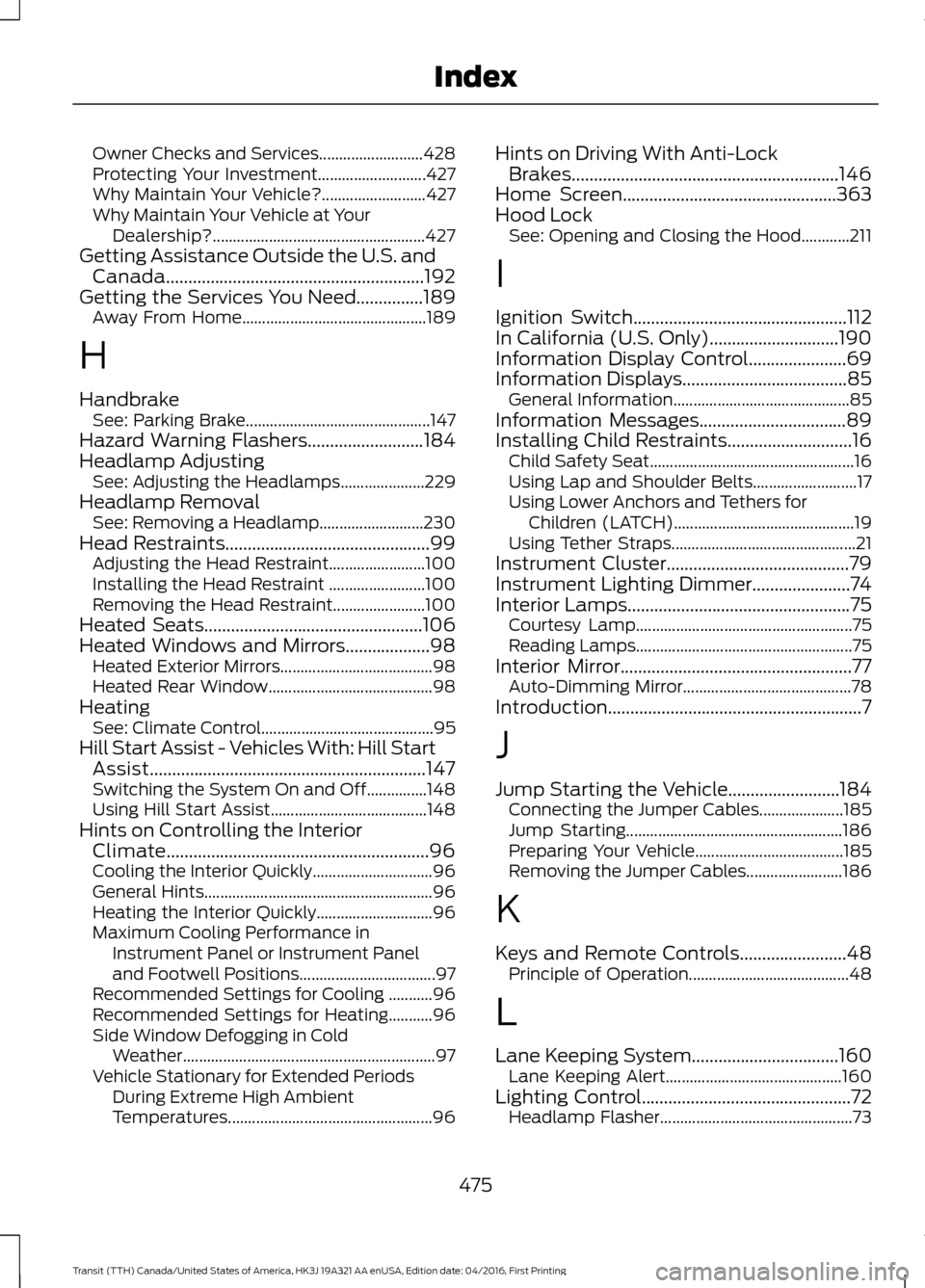
Owner Checks and Services..........................
428
Protecting Your Investment........................... 427
Why Maintain Your Vehicle?.......................... 427
Why Maintain Your Vehicle at Your Dealership?..................................................... 427
Getting Assistance Outside the U.S. and Canada..........................................................192
Getting the Services You Need...............189
Away From Home.............................................. 189
H
Handbrake See: Parking Brake.............................................. 147
Hazard Warning Flashers
..........................184
Headlamp Adjusting See: Adjusting the Headlamps..................... 229
Headlamp Removal See: Removing a Headlamp.......................... 230
Head Restraints..............................................99 Adjusting the Head Restraint........................ 100
Installing the Head Restraint ........................ 100
Removing the Head Restraint....................... 100
Heated Seats.................................................106
Heated Windows and Mirrors...................98 Heated Exterior Mirrors...................................... 98
Heated Rear Window......................................... 98
Heating See: Climate Control........................................... 95
Hill Start Assist - Vehicles With: Hill Start Assist..............................................................147
Switching the System On and Off...............148
Using Hill Start Assist....................................... 148
Hints on Controlling the Interior Climate...........................................................96
Cooling the Interior Quickly.............................. 96
General Hints......................................................... 96
Heating the Interior Quickly............................. 96
Maximum Cooling Performance in Instrument Panel or Instrument Panel
and Footwell Positions.................................. 97
Recommended Settings for Cooling ...........96
Recommended Settings for Heating...........96
Side Window Defogging in Cold Weather............................................................... 97
Vehicle Stationary for Extended Periods During Extreme High Ambient
Temperatures................................................... 96Hints on Driving With Anti-Lock
Brakes............................................................146
Home Screen
................................................363
Hood Lock See: Opening and Closing the Hood............211
I
Ignition Switch
................................................112
In California (U.S. Only).............................190
Information Display Control
......................69
Information Displays.....................................85 General Information............................................ 85
Information Messages
.................................89
Installing Child Restraints............................16
Child Safety Seat................................................... 16
Using Lap and Shoulder Belts.......................... 17
Using Lower Anchors and Tethers for Children (LATCH)............................................. 19
Using Tether Straps.............................................. 21
Instrument Cluster
.........................................79
Instrument Lighting Dimmer......................74
Interior Lamps..................................................75
Courtesy Lamp...................................................... 75
Reading Lamps...................................................... 75
Interior Mirror....................................................77 Auto-Dimming Mirror.......................................... 78
Introduction.........................................................7
J
Jump Starting the Vehicle.........................184 Connecting the Jumper Cables..................... 185
Jump Starting...................................................... 186
Preparing Your Vehicle..................................... 185
Removing the Jumper Cables........................ 186
K
Keys and Remote Controls
........................48
Principle of Operation........................................ 48
L
Lane Keeping System.................................160 Lane Keeping Alert............................................ 160
Lighting Control
...............................................72
Headlamp Flasher................................................ 73
475
Transit (TTH) Canada/United States of America, HK3J 19A321 AA enUSA, Edition date: 04/2016, First Printing Index