fuel cap FORD TRANSIT 2018 User Guide
[x] Cancel search | Manufacturer: FORD, Model Year: 2018, Model line: TRANSIT, Model: FORD TRANSIT 2018Pages: 521, PDF Size: 8.65 MB
Page 238 of 521
CHANGING THE ENGINE OIL
AND OIL FILTER
WARNING: Prolonged and repeated
skin contact with mineral oil will result in
the removal of natural fats from the skin,
leading to dryness, irritation and dermatitis.
In addition, used engine oil contains
potentially harmful contaminants, which
may cause skin cancer. If skin contact
occurs, wash the area thoroughly with
soap or skin cleanser and water
immediately. WARNING: Do not dispose of engine
oils or oil filters in the household refuse or
the public sewage system. Use an
authorized waste disposal facility. WARNING:
Do not remove the oil
pan drain plug when the engine is running. WARNING:
Do not remove the oil
filter when the engine is running.
1. Remove the oil pan drain plug and wait
for the oil to drain into a suitable
container.
2. Renew the oil filter.
3. Reinstall the oil pan drain plug.
4. Refill the engine with new oil that meets Ford specifications. See
Capacities and Specifications (page
305
).
Note: Do not add oil further than the
maximum mark. Oil levels above the
maximum mark may cause engine damage.
Note: Soak up any spillage with an
absorbent cloth immediately.
5. Reset the Intelligent Oil Life Monitor. See
Oil Change Indicator Reset
(page 235). Engine Lubrication for Severe
Service Operation
The following conditions define severe
service operation. The Intelligent Oil Life
Monitor will determine engine oil and oil
filter change intervals.
•
Frequent or extended idling.
• Frequent low-speed operation at
25 mph (40 km/h)
or less.
• Frequent severe dust condition
operation.
• Frequent off-road operation.
• Sustained ambient temperatures of
-9°F (-23°C)
or below.
• Sustained ambient temperatures of
100°F (38°C)
or above.
• Sustained towing operation above
1,000 mi (1,600 km)
.
• Sustained high-speed driving at Gross
Vehicle Weight Rating (maximum
loaded weight for vehicle operation).
• Sustained use of diesel fuel other than
ultra-low sulfur diesel (ULSD).
OIL CHANGE INDICATOR
RESET
Only reset the system after changing the
engine oil and oil filter.
Resetting the Oil Life Monitoring
System
1. Switch the ignition on. Do not start the
engine.
2. Fully press the accelerator and brake pedals at the same time.
3. Keep the accelerator and brake pedals
fully pressed.
4. After three seconds, a message appears confirming that the reset is in
progress.
235
2018 Transit (TTH) Canada/United States of America, JK3J 19A321 AA enUSA, Edition date: 201705, Third-Printing- Maintenance
Page 245 of 521
2. Add power steering fluid to the MAX
mark. Do not overfill.
3. Replace the filler cap. Turn it until you feel a strong resistance.
WASHER FLUID CHECK
When adding fluid, use a mixture of washer
fluid and water to help prevent freezing in
cold weather and improve the cleaning
capability. For information on fluid dilution,
refer to the product instructions. We
recommend that you only use high quality
washer fluid.
Note: The reservoir supplies the front and
rear washer systems.
DRAINING THE FUEL FILTER
WATER TRAP - 3.2L POWER
STROKE DIESEL WARNING:
Do not dispose of fuel
in the household refuse or the public
sewage system. Use an authorized waste
disposal facility.
Your vehicle is fitted with a diesel fuel
conditioner module located behind the fuel
tank. A warning lamp will illuminate
and a message will be displayed
when approximately
3.38 fl oz
(100 ml) of water accumulates in the
module. If you allow the water level to
exceed this level, the water may pass
through to the engine and may cause fuel
injection equipment damage.
Note: To drain the fuel filter water trap,
access the underside of your vehicle. 1. Attach a tube to the drain plug and
place the end of the tube into a
suitable container.
2. Loosen the drain plug by turning counterclockwise one to two turns and
allow the water to drain.
Note: The drain plug will rise when opening.
3. Tighten the drain plug by turning clockwise until you feel a strong
resistance.
Note: The drain plug will lower when
closing.
When you start the engine the water in fuel
indicator lamp turns off after a short period
of time.
Changing the Fuel Filter
Note: To drain the fuel filter, access the
underside of your vehicle.
1. Drain the fuel from the filter housing.
242
2018 Transit (TTH) Canada/United States of America, JK3J 19A321 AA enUSA, Edition date: 201705, Third-Printing- Maintenance E177378
2
1
Page 247 of 521
If the Engine Does Not Start or Runs
Rough
1. Remove the Schrader valve cap.
2. Attach suitable tool with a tube to the
Schrader valve and place the end of
the tube into a suitable container.
3. Open the Schrader valve.
4. Switch the ignition on until a steady stream of fuel can be seen coming out
of the tube.
5. Switch the ignition off.
6. Remove the tool from the Schrader valve.
7. Refit the Schrader valve cap.
8. Switch the ignition on for at least 30 seconds then switch the ignition off.
9. Repeat this process three times.
10. Start the engine.
FUEL FILTER - GASOLINE
Your vehicle is equipped with a lifetime
fuel filter that is integrated with the fuel
tank. Regular maintenance or replacement
is not needed. CHANGING THE 12V BATTERY
The battery is under the driver seat.
Note:
If you have power seats and the
battery has no charge, jump-start your
vehicle to move the seat. See Jump
Starting the Vehicle (page 196).
Removing the Battery 1. Fully raise the driver seat and move it
fully forward. Pull the tabs upward and
remove the cover.
Note: Your vehicle may not have this cover. 244
2018 Transit (TTH) Canada/United States of America, JK3J 19A321 AA enUSA, Edition date: 201705, Third-Printing- MaintenanceE177379
1 E152526
1 2
E152529
Page 308 of 521
ENGINE SPECIFICATIONS - 3.2L POWER STROKE DIESEL
3.2L Power Stroke Diesel
Engine
195
Cubic inches
No. 2 Diesel
Required fuel
1-2-4-5-3
Firing order
15.4:1
Compression ratio
305
2018 Transit (TTH) Canada/United States of America, JK3J 19A321 AA enUSA, Edition date: 201705, Third-Printing- Capacities and Specifications
Page 309 of 521
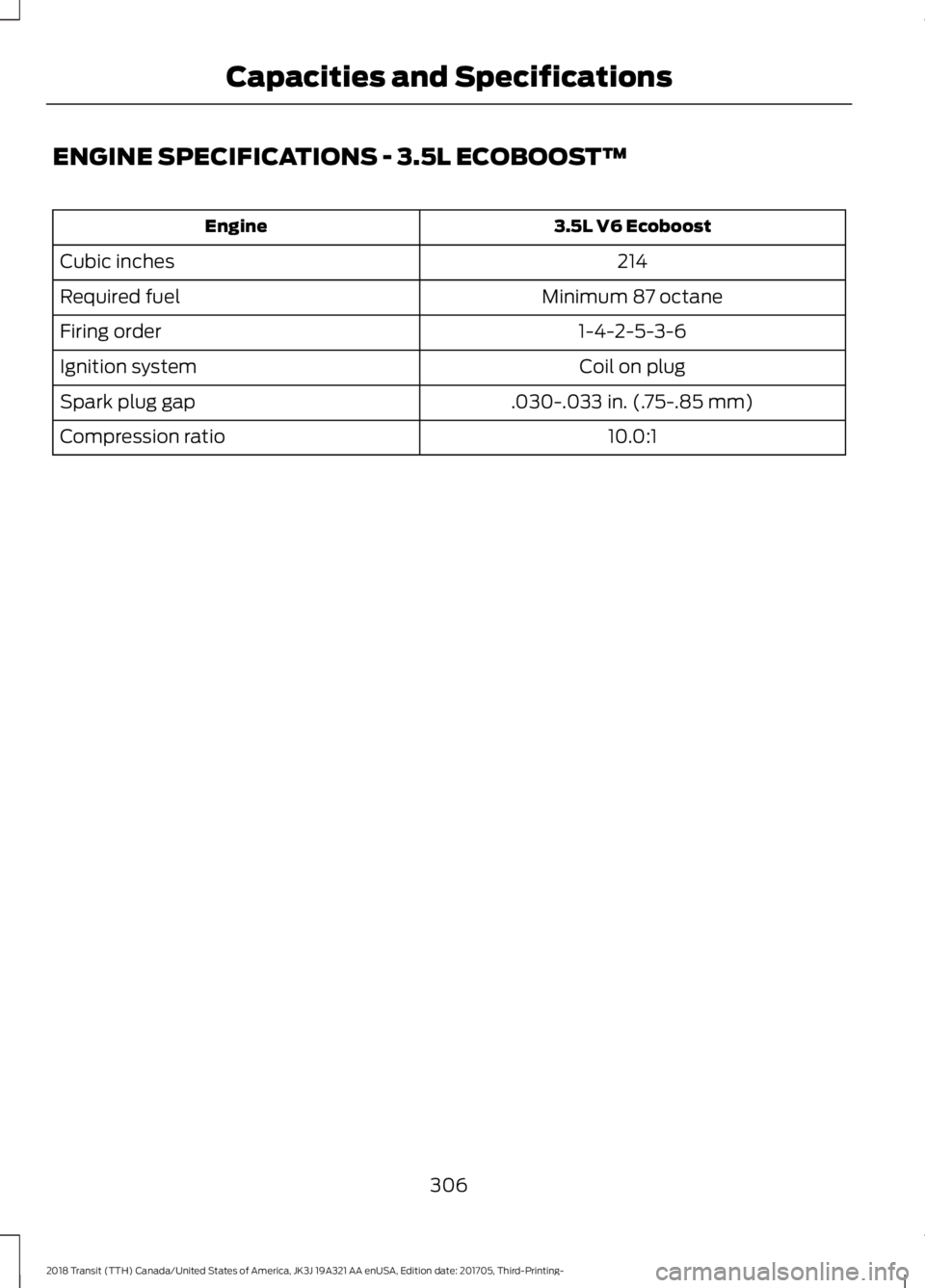
ENGINE SPECIFICATIONS - 3.5L ECOBOOST™
3.5L V6 Ecoboost
Engine
214
Cubic inches
Minimum 87 octane
Required fuel
1-4-2-5-3-6
Firing order
Coil on plug
Ignition system
.030-.033 in. (.75-.85 mm)
Spark plug gap
10.0:1
Compression ratio
306
2018 Transit (TTH) Canada/United States of America, JK3J 19A321 AA enUSA, Edition date: 201705, Third-Printing- Capacities and Specifications
Page 311 of 521
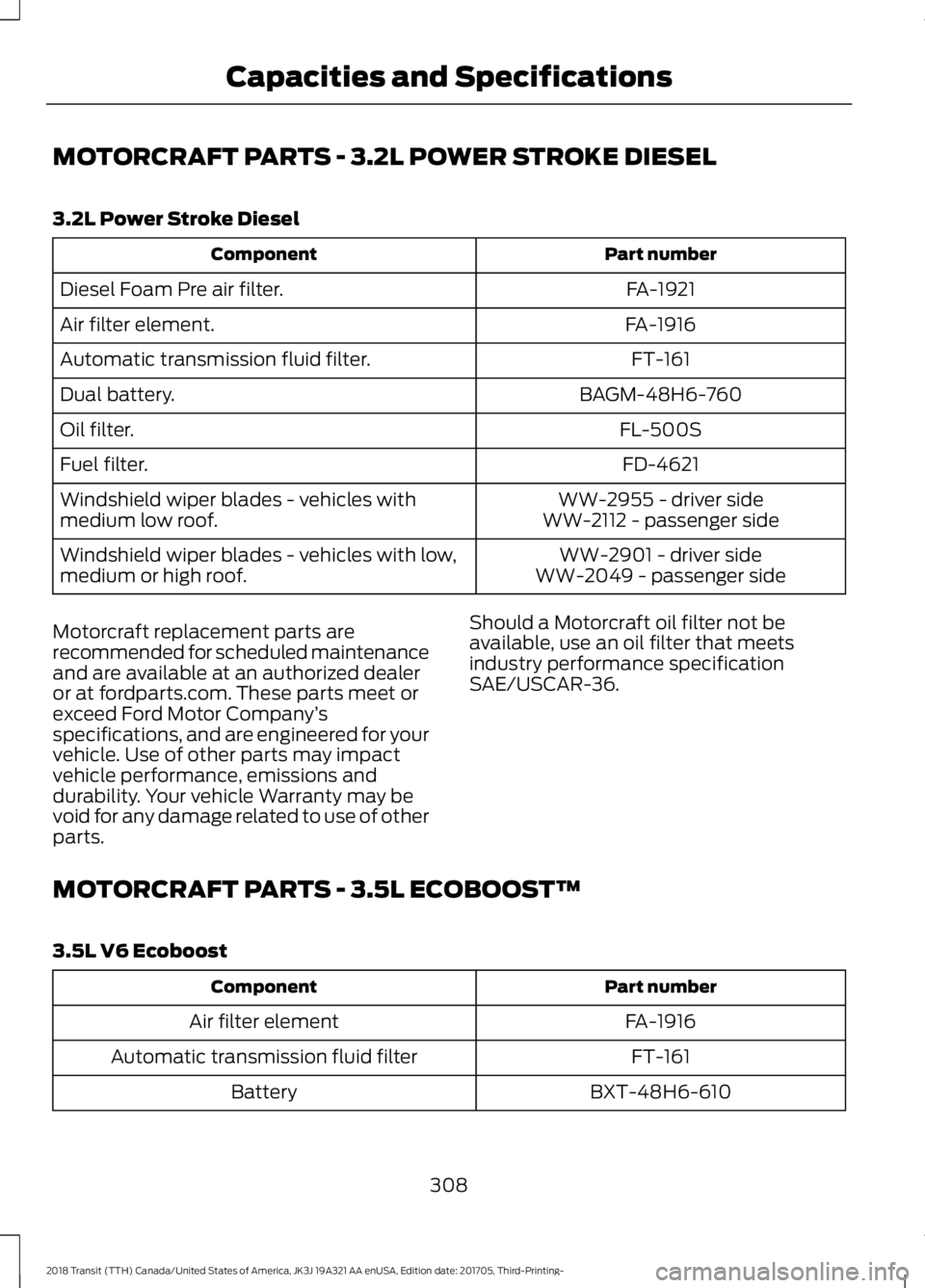
MOTORCRAFT PARTS - 3.2L POWER STROKE DIESEL
3.2L Power Stroke Diesel
Part number
Component
FA-1921
Diesel Foam Pre air filter.
FA-1916
Air filter element.
FT-161
Automatic transmission fluid filter.
BAGM-48H6-760
Dual battery.
FL-500S
Oil filter.
FD-4621
Fuel filter.
WW-2955 - driver side
Windshield wiper blades - vehicles with
medium low roof. WW-2112 - passenger side
WW-2901 - driver side
Windshield wiper blades - vehicles with low,
medium or high roof. WW-2049 - passenger side
Motorcraft replacement parts are
recommended for scheduled maintenance
and are available at an authorized dealer
or at fordparts.com. These parts meet or
exceed Ford Motor Company ’s
specifications, and are engineered for your
vehicle. Use of other parts may impact
vehicle performance, emissions and
durability. Your vehicle Warranty may be
void for any damage related to use of other
parts. Should a Motorcraft oil filter not be
available, use an oil filter that meets
industry performance specification
SAE/USCAR-36.
MOTORCRAFT PARTS - 3.5L ECOBOOST™
3.5L V6 Ecoboost Part number
Component
FA-1916
Air filter element
FT-161
Automatic transmission fluid filter
BXT-48H6-610
Battery
308
2018 Transit (TTH) Canada/United States of America, JK3J 19A321 AA enUSA, Edition date: 201705, Third-Printing- Capacities and Specifications
Page 316 of 521
CAPACITIES AND
SPECIFICATIONS - 3.2L
POWER STROKE DIESEL
WARNING: The air conditioning refrigerant system contains refrigerant
under high pressure. Only qualified
personnel should service the air
conditioning refrigerant system. Opening
the air conditioning refrigerant system can
cause personal injury.
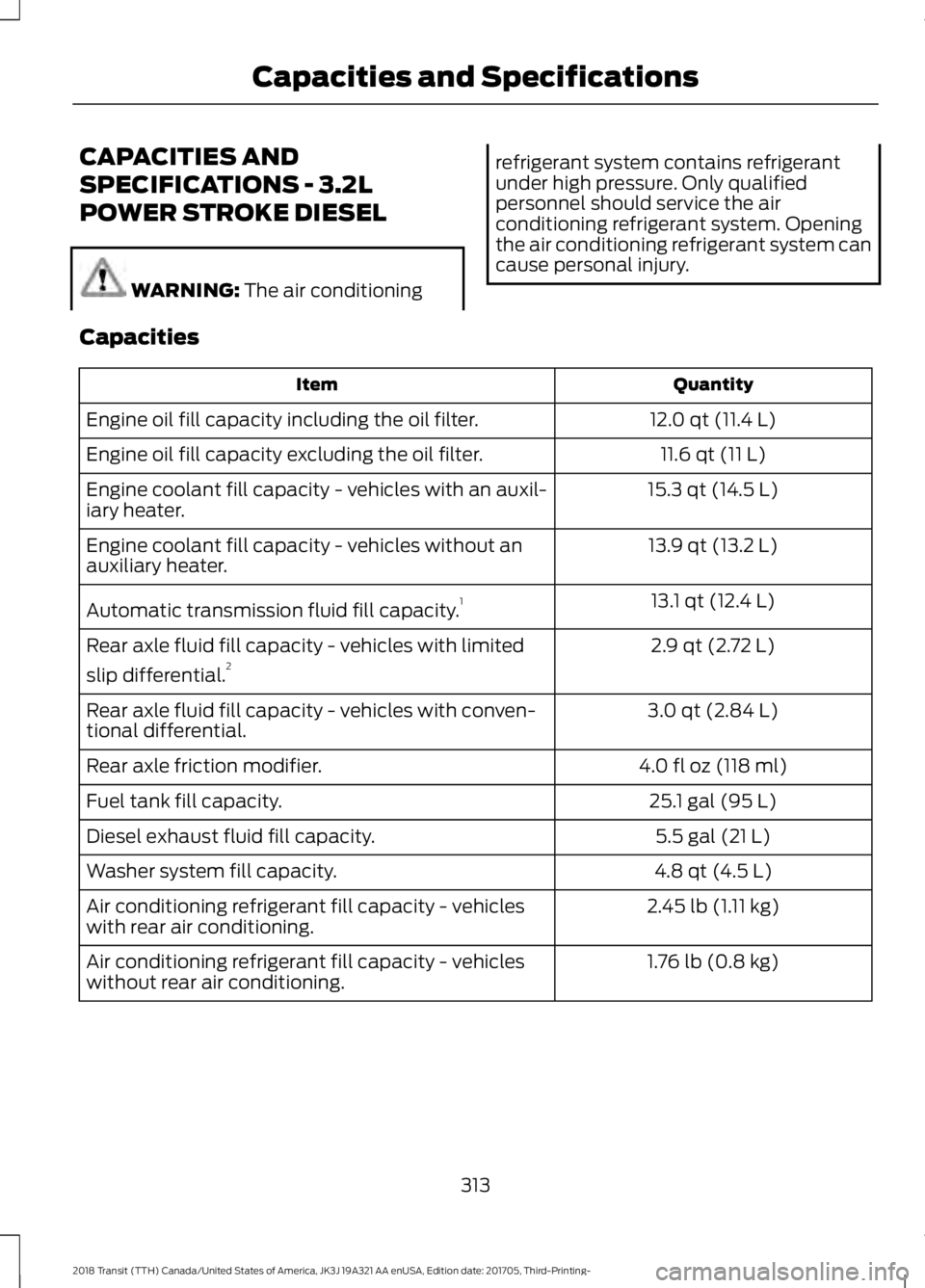
Capacities Quantity
Item
12.0 qt (11.4 L)
Engine oil fill capacity including the oil filter.
11.6 qt (11 L)
Engine oil fill capacity excluding the oil filter.
15.3 qt (14.5 L)
Engine coolant fill capacity - vehicles with an auxil-
iary heater.
13.9 qt (13.2 L)
Engine coolant fill capacity - vehicles without an
auxiliary heater.
13.1 qt (12.4 L)
Automatic transmission fluid fill capacity. 1
2.9 qt (2.72 L)
Rear axle fluid fill capacity - vehicles with limited
slip differential. 2
3.0 qt (2.84 L)
Rear axle fluid fill capacity - vehicles with conven-
tional differential.
4.0 fl oz (118 ml)
Rear axle friction modifier.
25.1 gal (95 L)
Fuel tank fill capacity.
5.5 gal (21 L)
Diesel exhaust fluid fill capacity.
4.8 qt (4.5 L)
Washer system fill capacity.
2.45 lb (1.11 kg)
Air conditioning refrigerant fill capacity - vehicles
with rear air conditioning.
1.76 lb (0.8 kg)
Air conditioning refrigerant fill capacity - vehicles
without rear air conditioning.
313
2018 Transit (TTH) Canada/United States of America, JK3J 19A321 AA enUSA, Edition date: 201705, Third-Printing- Capacities and Specifications
Page 319 of 521
Note:
Automatic transmissions that require
MERCON® LV transmission fluid should
only use MERCON® LV transmission fluid. If you are unable to find an engine oil that
meets the specification defined by
WSS-M2C171-E, it is acceptable to use a
SAE 5W-40 engine oil that meets API CJ-4
requirements.
The American Petroleum Institute (API)
service symbol is used to identify the
proper engine oil for your engine. The API
service symbol will be displayed on the oil
container you purchase. The API symbol
displays the oil performance category in
the top half of the symbol and the viscosity
grade in the center of the symbol.
Note:
Do not use more than 1.1 qt (1 L) of
the alternative engine oil between
scheduled service intervals.
Using oil and fluids that do not meet the
defined specification and viscosity grade
may lead to:
• Component damage which may not be
covered by the vehicle Warranty.
• Longer engine cranking periods.
• Increased emission levels.
• Reduced engine performance. •
Reduced fuel economy.
• Reduced brake performance.
Do not use supplemental engine oil
additives because they are unnecessary
and could lead to engine damage that may
not be covered by the vehicle Warranty.
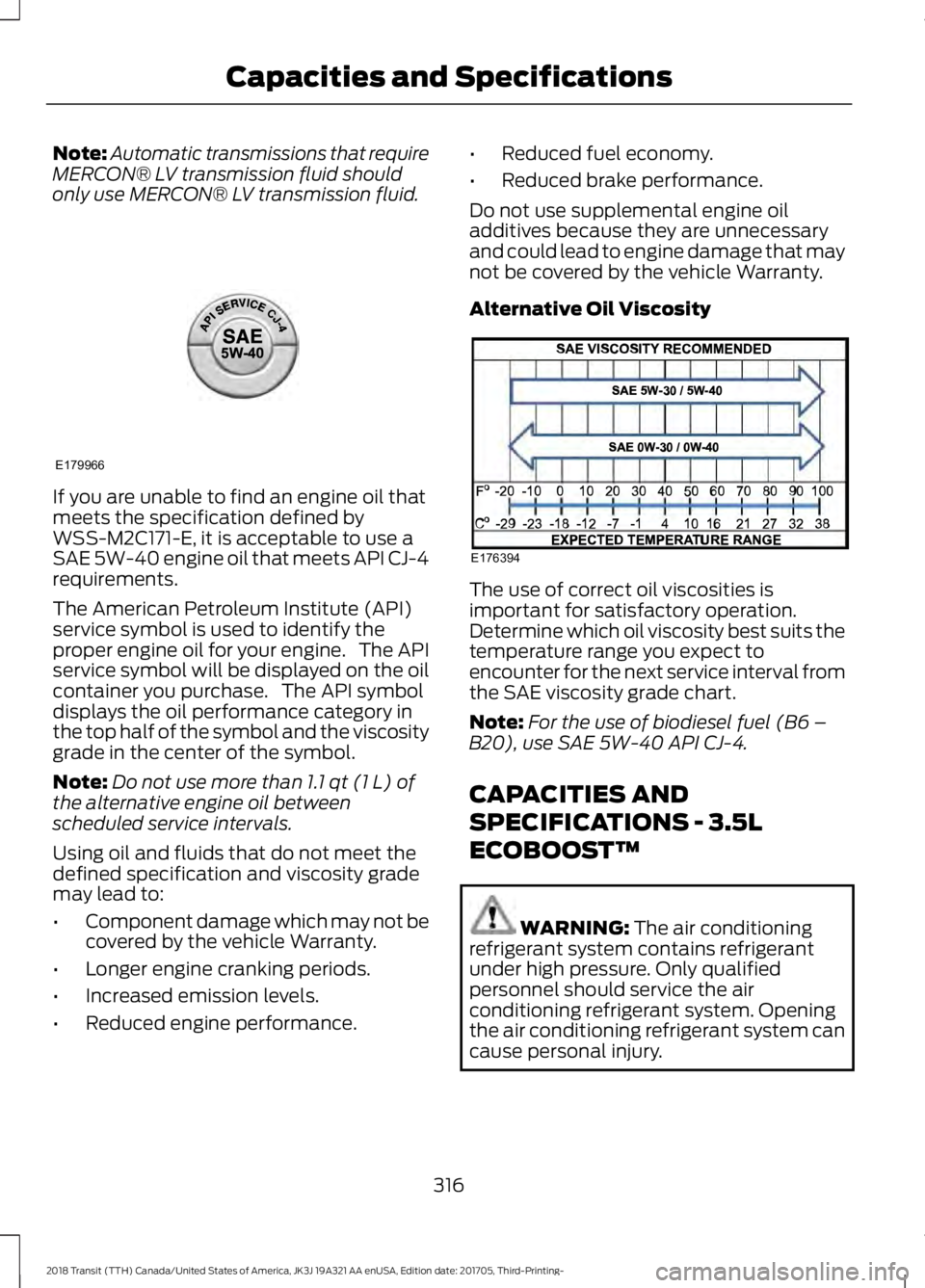
Alternative Oil Viscosity The use of correct oil viscosities is
important for satisfactory operation.
Determine which oil viscosity best suits the
temperature range you expect to
encounter for the next service interval from
the SAE viscosity grade chart.
Note:
For the use of biodiesel fuel (B6 –
B20), use SAE 5W-40 API CJ-4.
CAPACITIES AND
SPECIFICATIONS - 3.5L
ECOBOOST™ WARNING:
The air conditioning
refrigerant system contains refrigerant
under high pressure. Only qualified
personnel should service the air
conditioning refrigerant system. Opening
the air conditioning refrigerant system can
cause personal injury.
316
2018 Transit (TTH) Canada/United States of America, JK3J 19A321 AA enUSA, Edition date: 201705, Third-Printing- Capacities and SpecificationsE179966 E176394
Page 320 of 521
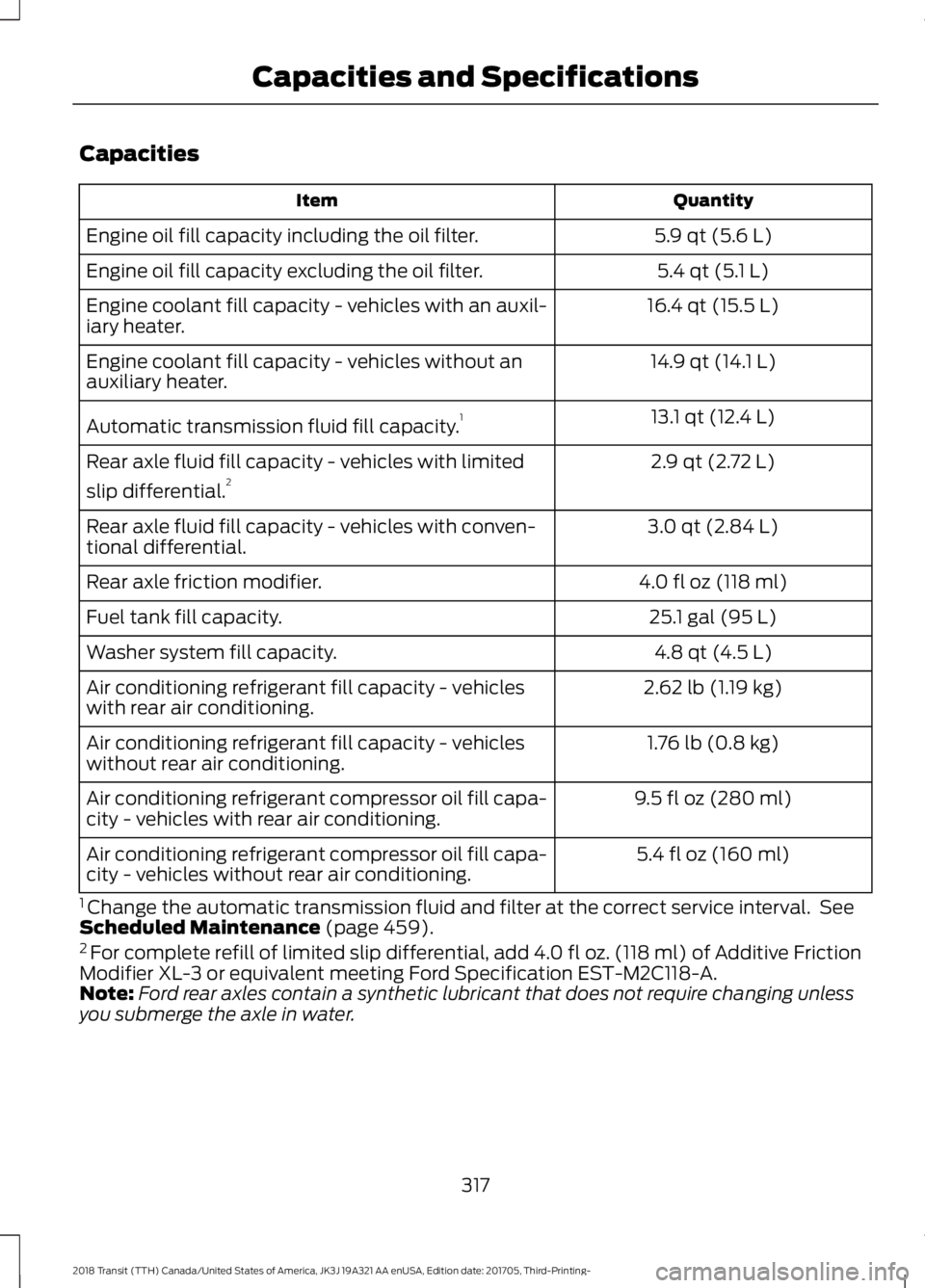
Capacities
Quantity
Item
5.9 qt (5.6 L)
Engine oil fill capacity including the oil filter.
5.4 qt (5.1 L)
Engine oil fill capacity excluding the oil filter.
16.4 qt (15.5 L)
Engine coolant fill capacity - vehicles with an auxil-
iary heater.
14.9 qt (14.1 L)
Engine coolant fill capacity - vehicles without an
auxiliary heater.
13.1 qt (12.4 L)
Automatic transmission fluid fill capacity. 1
2.9 qt (2.72 L)
Rear axle fluid fill capacity - vehicles with limited
slip differential. 2
3.0 qt (2.84 L)
Rear axle fluid fill capacity - vehicles with conven-
tional differential.
4.0 fl oz (118 ml)
Rear axle friction modifier.
25.1 gal (95 L)
Fuel tank fill capacity.
4.8 qt (4.5 L)
Washer system fill capacity.
2.62 lb (1.19 kg)
Air conditioning refrigerant fill capacity - vehicles
with rear air conditioning.
1.76 lb (0.8 kg)
Air conditioning refrigerant fill capacity - vehicles
without rear air conditioning.
9.5 fl oz (280 ml)
Air conditioning refrigerant compressor oil fill capa-
city - vehicles with rear air conditioning.
5.4 fl oz (160 ml)
Air conditioning refrigerant compressor oil fill capa-
city - vehicles without rear air conditioning.
1 Change the automatic transmission fluid and filter at the correct service interval. See
Scheduled Maintenance (page 459).
2 For complete refill of limited slip differential, add 4.0 fl oz. (118 ml) of Additive Friction
Modifier XL-3 or equivalent meeting Ford Specification EST-M2C118-A.
Note: Ford rear axles contain a synthetic lubricant that does not require changing unless
you submerge the axle in water.
317
2018 Transit (TTH) Canada/United States of America, JK3J 19A321 AA enUSA, Edition date: 201705, Third-Printing- Capacities and Specifications
Page 323 of 521
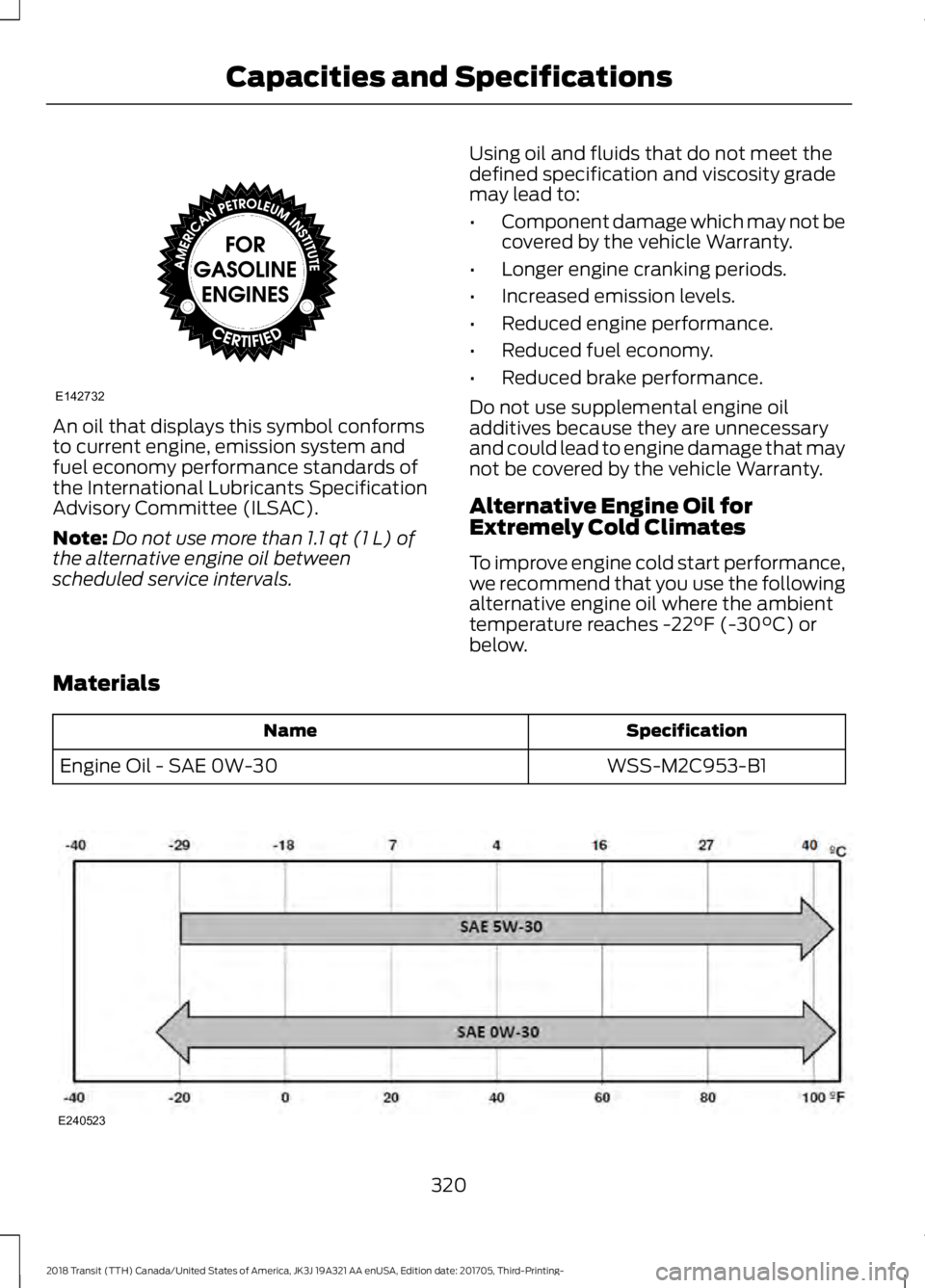
An oil that displays this symbol conforms
to current engine, emission system and
fuel economy performance standards of
the International Lubricants Specification
Advisory Committee (ILSAC).
Note:
Do not use more than 1.1 qt (1 L) of
the alternative engine oil between
scheduled service intervals. Using oil and fluids that do not meet the
defined specification and viscosity grade
may lead to:
•
Component damage which may not be
covered by the vehicle Warranty.
• Longer engine cranking periods.
• Increased emission levels.
• Reduced engine performance.
• Reduced fuel economy.
• Reduced brake performance.
Do not use supplemental engine oil
additives because they are unnecessary
and could lead to engine damage that may
not be covered by the vehicle Warranty.
Alternative Engine Oil for
Extremely Cold Climates
To improve engine cold start performance,
we recommend that you use the following
alternative engine oil where the ambient
temperature reaches
-22°F (-30°C) or
below.
Materials Specification
Name
WSS-M2C953-B1
Engine Oil - SAE 0W-30 320
2018 Transit (TTH) Canada/United States of America, JK3J 19A321 AA enUSA, Edition date: 201705, Third-Printing- Capacities and SpecificationsE142732 E240523