fuel cap FORD TRANSIT 2018 Owner's Manual
[x] Cancel search | Manufacturer: FORD, Model Year: 2018, Model line: TRANSIT, Model: FORD TRANSIT 2018Pages: 521, PDF Size: 8.65 MB
Page 324 of 521
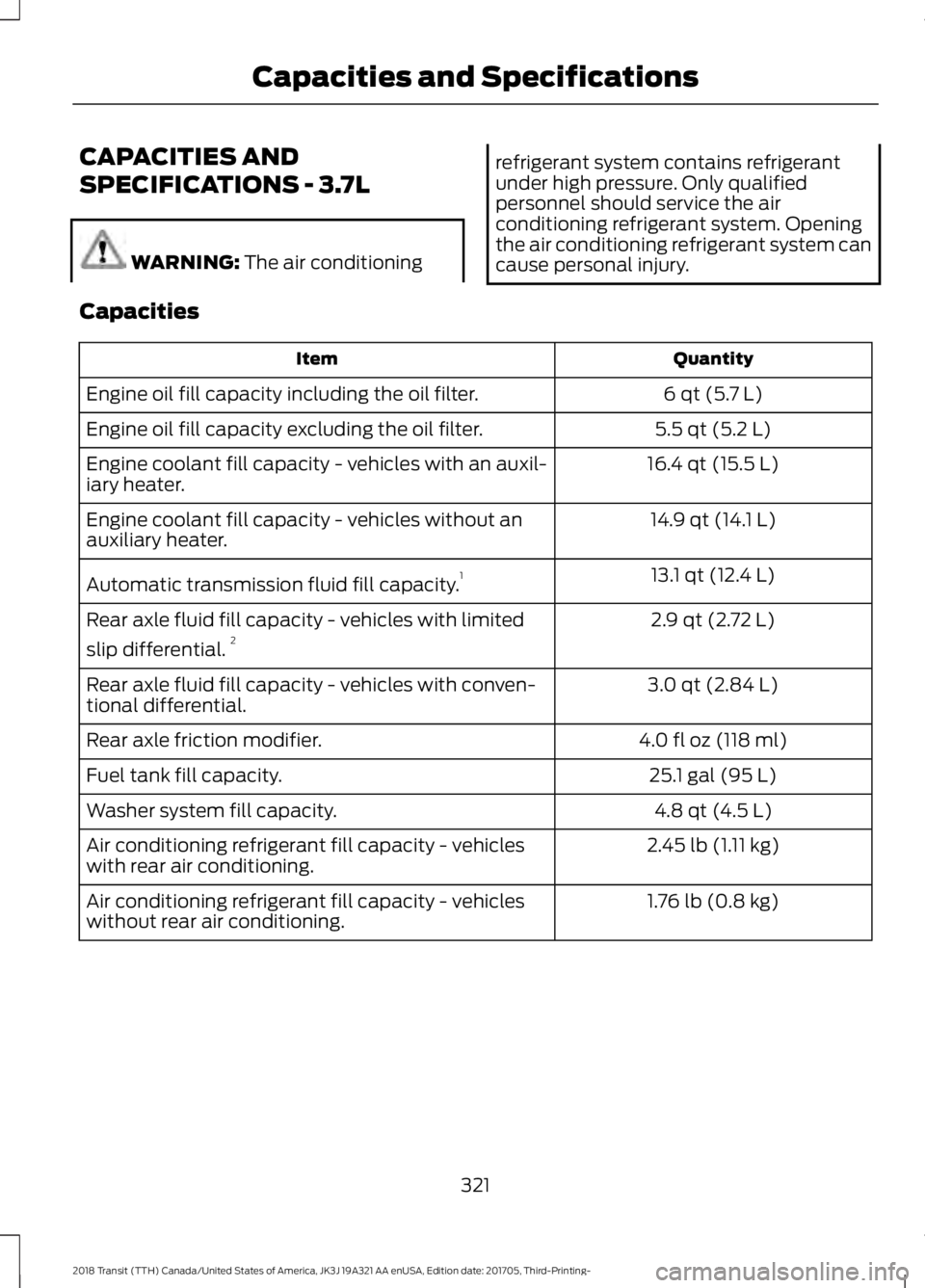
CAPACITIES AND
SPECIFICATIONS - 3.7L
WARNING: The air conditioning refrigerant system contains refrigerant
under high pressure. Only qualified
personnel should service the air
conditioning refrigerant system. Opening
the air conditioning refrigerant system can
cause personal injury.
Capacities Quantity
Item
6 qt (5.7 L)
Engine oil fill capacity including the oil filter.
5.5 qt (5.2 L)
Engine oil fill capacity excluding the oil filter.
16.4 qt (15.5 L)
Engine coolant fill capacity - vehicles with an auxil-
iary heater.
14.9 qt (14.1 L)
Engine coolant fill capacity - vehicles without an
auxiliary heater.
13.1 qt (12.4 L)
Automatic transmission fluid fill capacity. 1
2.9 qt (2.72 L)
Rear axle fluid fill capacity - vehicles with limited
slip differential. 2
3.0 qt (2.84 L)
Rear axle fluid fill capacity - vehicles with conven-
tional differential.
4.0 fl oz (118 ml)
Rear axle friction modifier.
25.1 gal (95 L)
Fuel tank fill capacity.
4.8 qt (4.5 L)
Washer system fill capacity.
2.45 lb (1.11 kg)
Air conditioning refrigerant fill capacity - vehicles
with rear air conditioning.
1.76 lb (0.8 kg)
Air conditioning refrigerant fill capacity - vehicles
without rear air conditioning.
321
2018 Transit (TTH) Canada/United States of America, JK3J 19A321 AA enUSA, Edition date: 201705, Third-Printing- Capacities and Specifications
Page 327 of 521
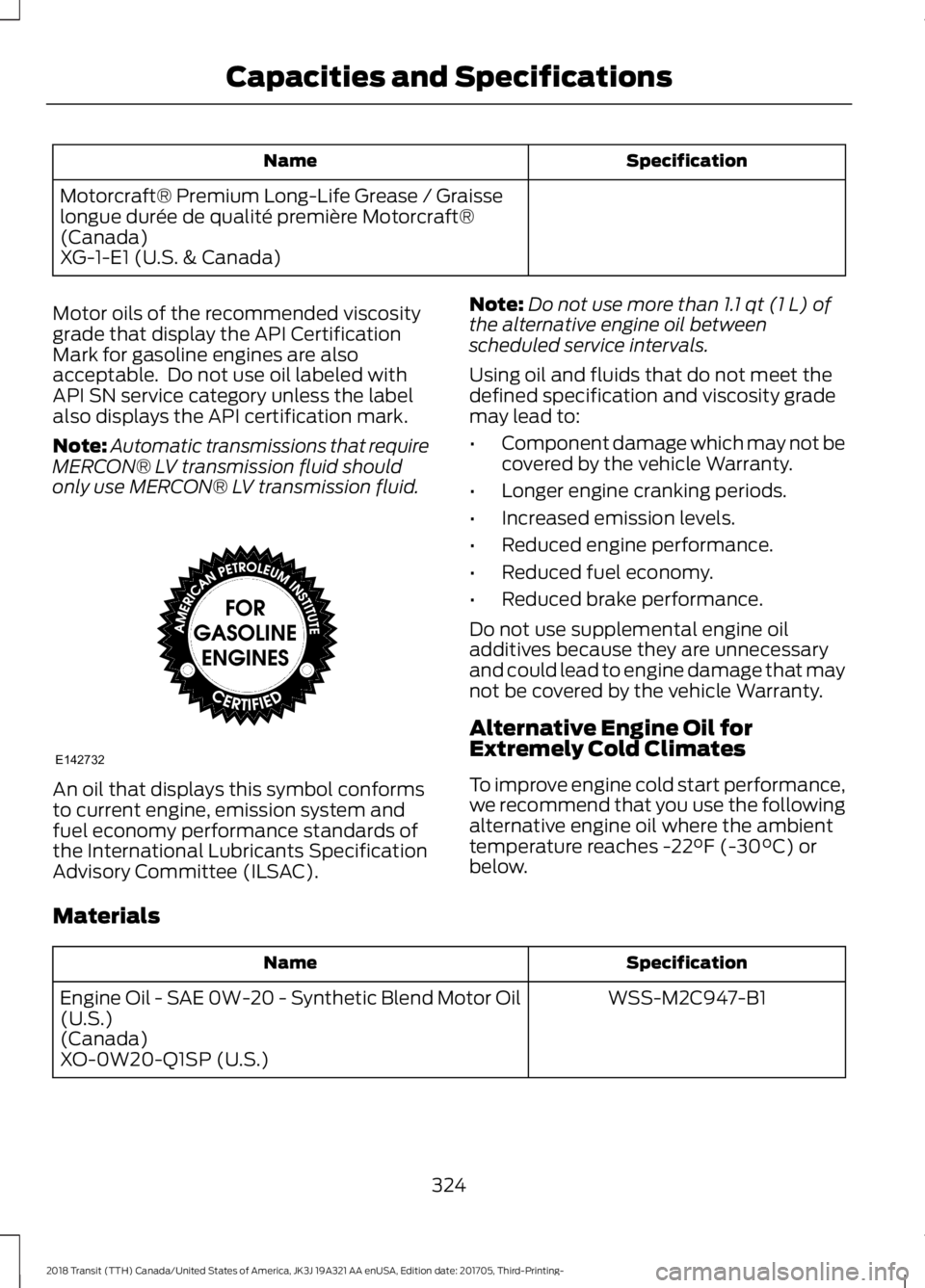
Specification
Name
Motorcraft® Premium Long-Life Grease / Graisse
longue durée de qualité première Motorcraft®
(Canada)
XG-1-E1 (U.S. & Canada)
Motor oils of the recommended viscosity
grade that display the API Certification
Mark for gasoline engines are also
acceptable. Do not use oil labeled with
API SN service category unless the label
also displays the API certification mark.
Note: Automatic transmissions that require
MERCON® LV transmission fluid should
only use MERCON® LV transmission fluid. An oil that displays this symbol conforms
to current engine, emission system and
fuel economy performance standards of
the International Lubricants Specification
Advisory Committee (ILSAC). Note:
Do not use more than 1.1 qt (1 L) of
the alternative engine oil between
scheduled service intervals.
Using oil and fluids that do not meet the
defined specification and viscosity grade
may lead to:
• Component damage which may not be
covered by the vehicle Warranty.
• Longer engine cranking periods.
• Increased emission levels.
• Reduced engine performance.
• Reduced fuel economy.
• Reduced brake performance.
Do not use supplemental engine oil
additives because they are unnecessary
and could lead to engine damage that may
not be covered by the vehicle Warranty.
Alternative Engine Oil for
Extremely Cold Climates
To improve engine cold start performance,
we recommend that you use the following
alternative engine oil where the ambient
temperature reaches
-22°F (-30°C) or
below.
Materials Specification
Name
WSS-M2C947-B1
Engine Oil - SAE 0W-20 - Synthetic Blend Motor Oil
(U.S.)
(Canada)
XO-0W20-Q1SP (U.S.)
324
2018 Transit (TTH) Canada/United States of America, JK3J 19A321 AA enUSA, Edition date: 201705, Third-Printing- Capacities and SpecificationsE142732
Page 369 of 521
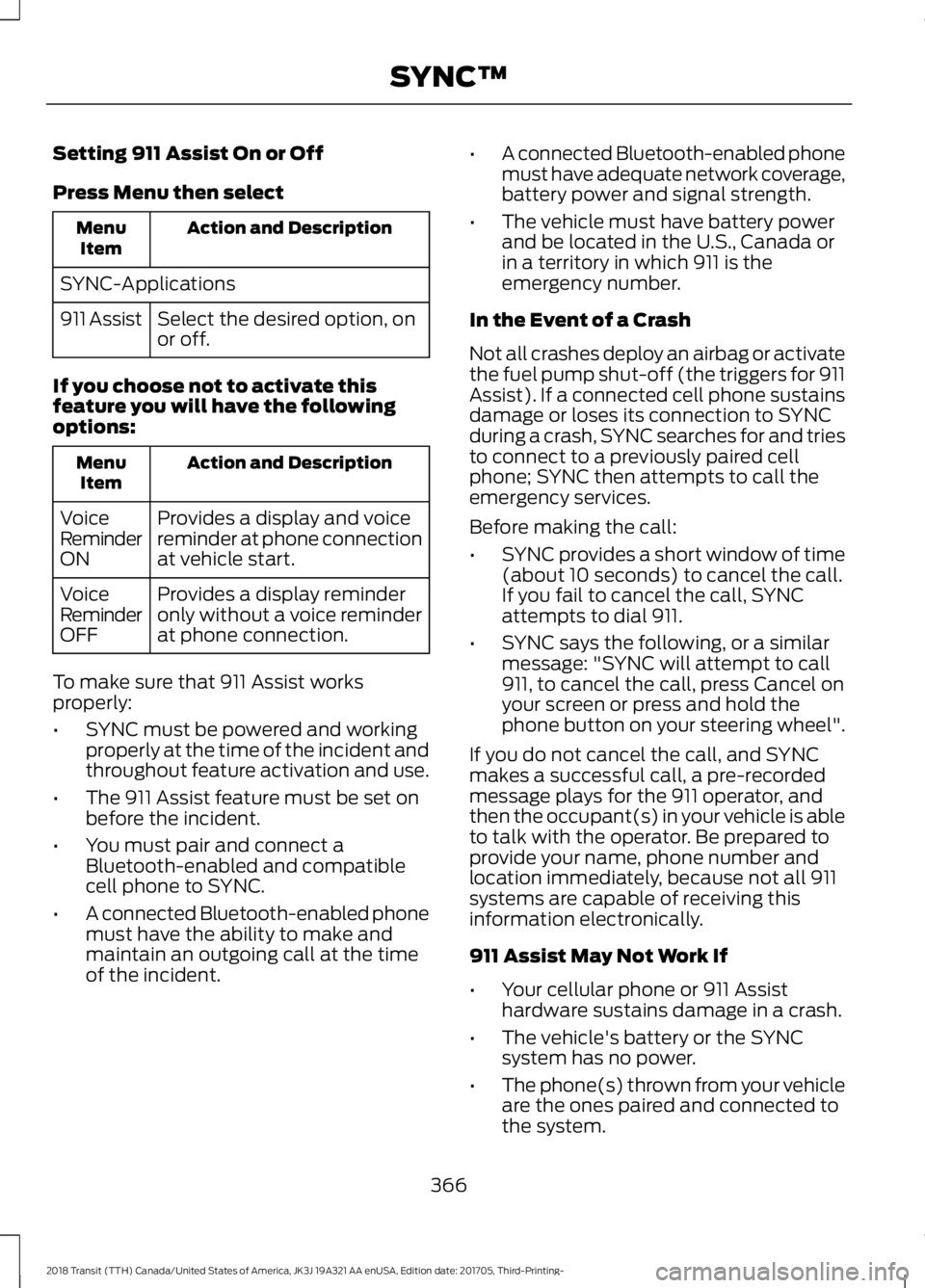
Setting 911 Assist On or Off
Press Menu then select
Action and Description
Menu
Item
SYNC-Applications Select the desired option, on
or off.
911 Assist
If you choose not to activate this
feature you will have the following
options: Action and Description
Menu
Item
Provides a display and voice
reminder at phone connection
at vehicle start.
Voice
Reminder
ON
Provides a display reminder
only without a voice reminder
at phone connection.
Voice
Reminder
OFF
To make sure that 911 Assist works
properly:
• SYNC must be powered and working
properly at the time of the incident and
throughout feature activation and use.
• The 911 Assist feature must be set on
before the incident.
• You must pair and connect a
Bluetooth-enabled and compatible
cell phone to SYNC.
• A connected Bluetooth-enabled phone
must have the ability to make and
maintain an outgoing call at the time
of the incident. •
A connected Bluetooth-enabled phone
must have adequate network coverage,
battery power and signal strength.
• The vehicle must have battery power
and be located in the U.S., Canada or
in a territory in which 911 is the
emergency number.
In the Event of a Crash
Not all crashes deploy an airbag or activate
the fuel pump shut-off (the triggers for 911
Assist). If a connected cell phone sustains
damage or loses its connection to SYNC
during a crash, SYNC searches for and tries
to connect to a previously paired cell
phone; SYNC then attempts to call the
emergency services.
Before making the call:
• SYNC provides a short window of time
(about 10 seconds) to cancel the call.
If you fail to cancel the call, SYNC
attempts to dial 911.
• SYNC says the following, or a similar
message: "SYNC will attempt to call
911, to cancel the call, press Cancel on
your screen or press and hold the
phone button on your steering wheel".
If you do not cancel the call, and SYNC
makes a successful call, a pre-recorded
message plays for the 911 operator, and
then the occupant(s) in your vehicle is able
to talk with the operator. Be prepared to
provide your name, phone number and
location immediately, because not all 911
systems are capable of receiving this
information electronically.
911 Assist May Not Work If
• Your cellular phone or 911 Assist
hardware sustains damage in a crash.
• The vehicle's battery or the SYNC
system has no power.
• The phone(s) thrown from your vehicle
are the ones paired and connected to
the system.
366
2018 Transit (TTH) Canada/United States of America, JK3J 19A321 AA enUSA, Edition date: 201705, Third-Printing- SYNC™
Page 370 of 521
911 Assist Privacy Notice
When you switch on 911 Assist, it may
disclose to emergency services that your
vehicle has been in a crash involving the
deployment of an airbag or activation of
the fuel pump shut-off. Certain versions or
updates to 911 Assist may also be capable
of electronically or verbally disclosing to
911 operators your vehicle location or other
details about your vehicle or crash to assist
911 operators to provide the most
appropriate emergency services. If you do
not want to disclose this information, do
not switch the feature on.
SYNC Mobile Apps
The system enables voice and steering
wheel control of SYNC AppLink enabled
smartphone apps. When an app is running
through AppLink, you can control main
features of the app through voice
commands and steering wheel controls.
Note:
You must pair and connect your
smartphone to SYNC to access AppLink.
Note: iPhone users need to connect the
phone to the USB port.
Note: Android users need to connect the
phone to SYNC using Bluetooth.
Note: For information on available apps,
supported smartphone devices and
troubleshooting tips please visit the Ford
website.
Availability of SYNC AppLink enabled Apps
will vary by region. Note:
Make sure you have an active account
for the app that you have downloaded.
Some apps work automatically with no
setup. Other apps want you to configure
your personal settings and personalize your
experience by creating stations or favorites.
We recommend you do this at home or
outside of your vehicle.
Note: AppLink is not available if your
vehicle is equipped with the MyFordTouch
system.
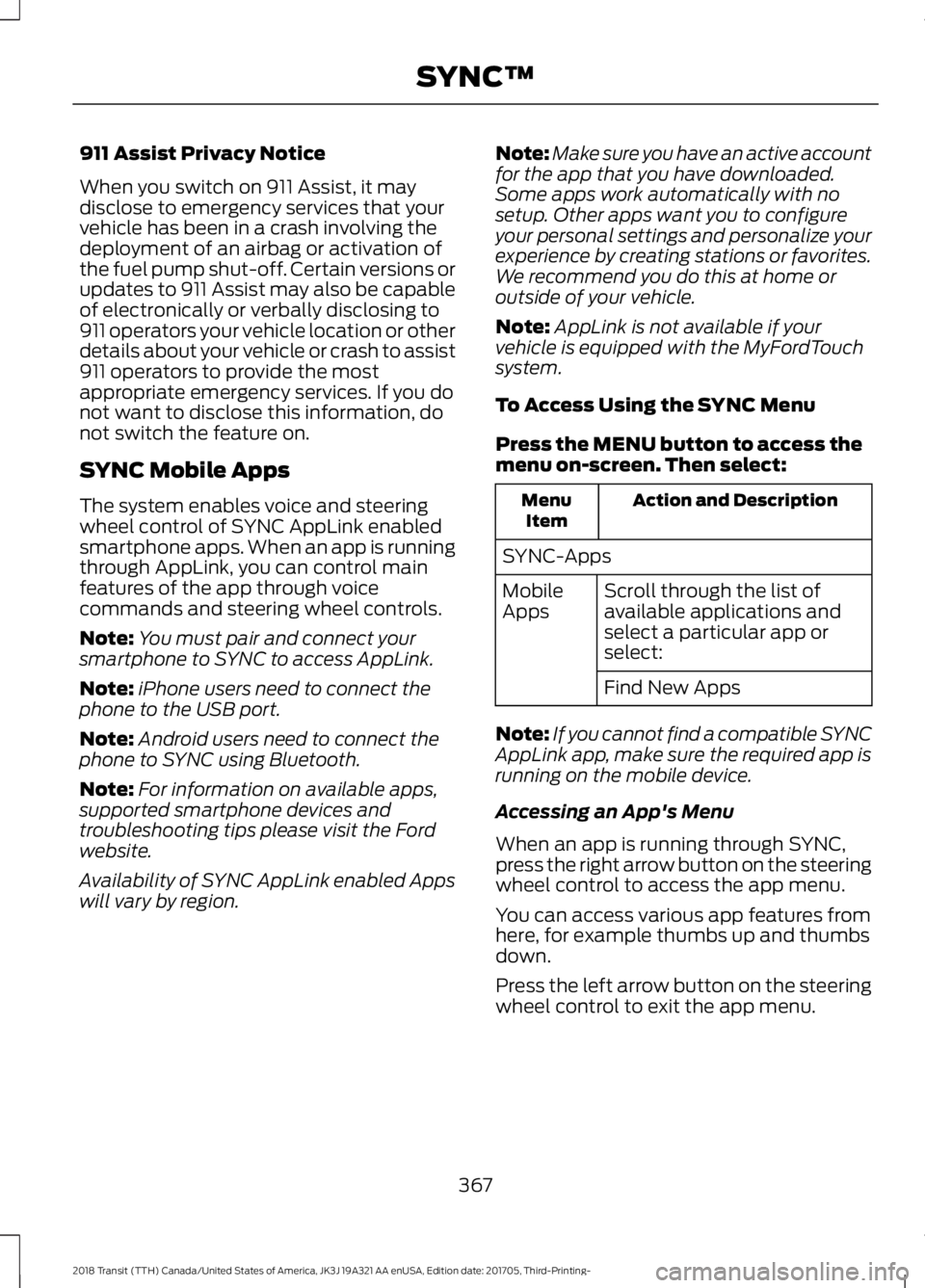
To Access Using the SYNC Menu
Press the MENU button to access the
menu on-screen. Then select: Action and Description
Menu
Item
SYNC-Apps Scroll through the list of
available applications and
select a particular app or
select:
Mobile
Apps
Find New Apps
Note: If you cannot find a compatible SYNC
AppLink app, make sure the required app is
running on the mobile device.
Accessing an App's Menu
When an app is running through SYNC,
press the right arrow button on the steering
wheel control to access the app menu.
You can access various app features from
here, for example thumbs up and thumbs
down.
Press the left arrow button on the steering
wheel control to exit the app menu.
367
2018 Transit (TTH) Canada/United States of America, JK3J 19A321 AA enUSA, Edition date: 201705, Third-Printing- SYNC™
Page 421 of 521
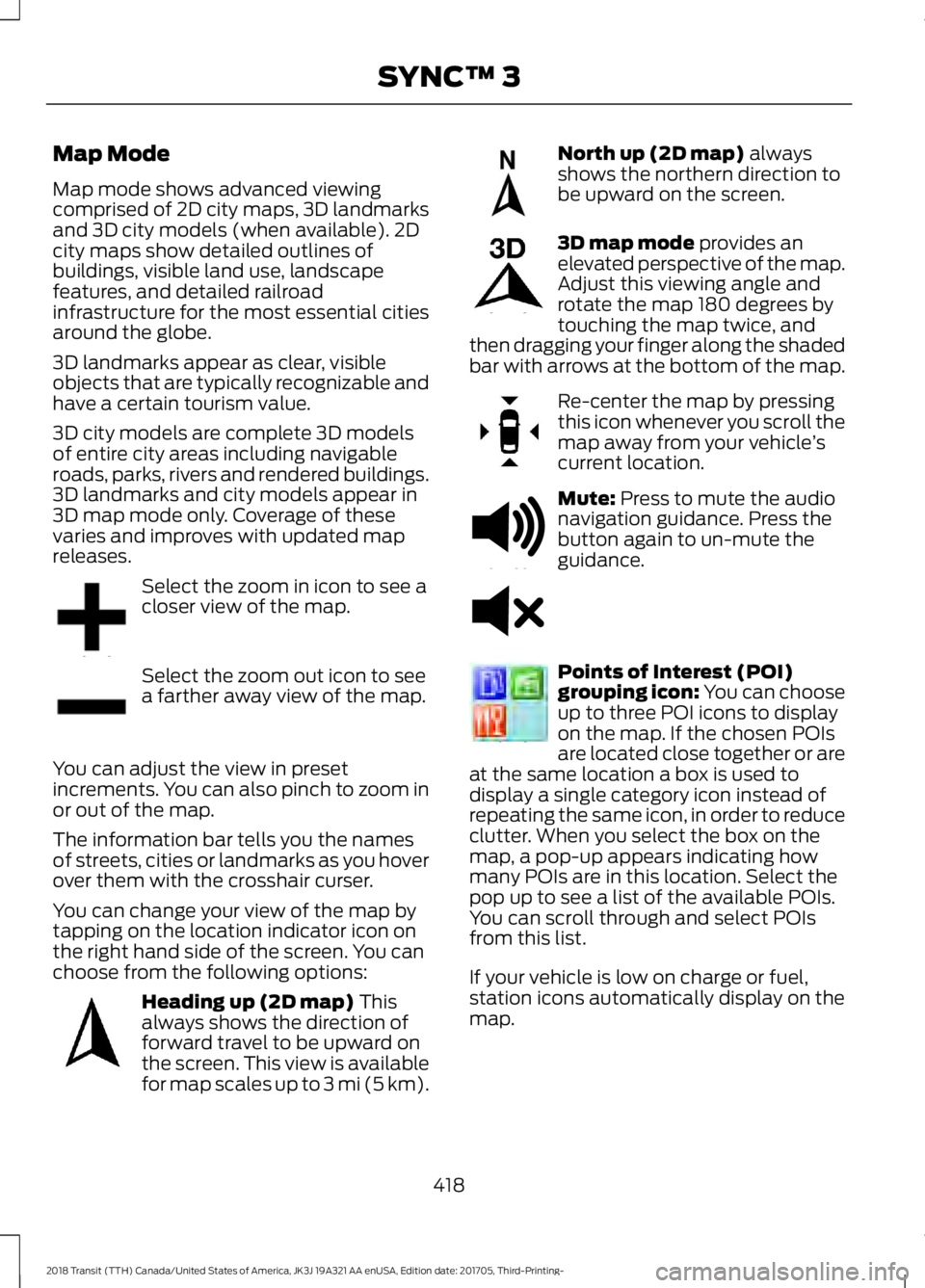
Map Mode
Map mode shows advanced viewing
comprised of 2D city maps, 3D landmarks
and 3D city models (when available). 2D
city maps show detailed outlines of
buildings, visible land use, landscape
features, and detailed railroad
infrastructure for the most essential cities
around the globe.
3D landmarks appear as clear, visible
objects that are typically recognizable and
have a certain tourism value.
3D city models are complete 3D models
of entire city areas including navigable
roads, parks, rivers and rendered buildings.
3D landmarks and city models appear in
3D map mode only. Coverage of these
varies and improves with updated map
releases.
Select the zoom in icon to see a
closer view of the map.
Select the zoom out icon to see
a farther away view of the map.
You can adjust the view in preset
increments. You can also pinch to zoom in
or out of the map.
The information bar tells you the names
of streets, cities or landmarks as you hover
over them with the crosshair curser.
You can change your view of the map by
tapping on the location indicator icon on
the right hand side of the screen. You can
choose from the following options: Heading up (2D map) This
always shows the direction of
forward travel to be upward on
the screen. This view is available
for map scales up to
3 mi (5 km). North up (2D map)
always
shows the northern direction to
be upward on the screen. 3D map mode
provides an
elevated perspective of the map.
Adjust this viewing angle and
rotate the map 180 degrees by
touching the map twice, and
then dragging your finger along the shaded
bar with arrows at the bottom of the map. Re-center the map by pressing
this icon whenever you scroll the
map away from your vehicle
’s
current location. Mute:
Press to mute the audio
navigation guidance. Press the
button again to un-mute the
guidance. Points of Interest (POI)
grouping icon: You can choose
up to three POI icons to display
on the map. If the chosen POIs
are located close together or are
at the same location a box is used to
display a single category icon instead of
repeating the same icon, in order to reduce
clutter. When you select the box on the
map, a pop-up appears indicating how
many POIs are in this location. Select the
pop up to see a list of the available POIs.
You can scroll through and select POIs
from this list.
If your vehicle is low on charge or fuel,
station icons automatically display on the
map.
418
2018 Transit (TTH) Canada/United States of America, JK3J 19A321 AA enUSA, Edition date: 201705, Third-Printing- SYNC™ 3E207752 E207753 E207750 E207749 E207748 E207751 E251780 E251779 E207754
Page 512 of 521
Front Wiper Blades
See: Changing the Front Wiper Blades......246
Fuel and Refueling........................................131
Fuel Consumption........................................139
Advertised Capacity.......................................... 139
Calculating Fuel Economy.............................. 140
Filling the Fuel Tank.......................................... 140
Fuel Filler Funnel Location........................136
Fuel Filter - Gasoline..................................244
Fuel Quality - Diesel.....................................132 Biodiesel................................................................. 133
Diesel Fuel Additives ........................................ 134
Fuel Requirements - Choosing The Right Fuel: Vehicles Operated Where
Ultra-Low Sulfur Diesel Fuel Is Not
Required ........................................................... 132
Fuel Requirements - Choosing the Right Fuel: Vehicles Operated Where
Ultra-Low Sulfur Diesel Fuel is Required
(United States/Canada/Puerto Rico/U.S.
Virgin Islands and Other Locales)...........132
Fuel Quality - E85
.........................................135
Choosing the Right Fuel - Flex Fuel
Vehicles............................................................. 135
Switching Between E85 and Gasoline............................................................ 136
Fuel Quality - Gasoline...............................134 Choosing the Right Fuel................................... 134
Fuel Shutoff
....................................................195
Ignition Switch..................................................... 195
Fuse Box Locations....................................208 Body Control Module....................................... 208
Engine Compartment Fuse Box.................. 208
Passenger Compartment Fuse Box...........208
Pre-fuse Box....................................................... 208
Fuses................................................................208
Fuse Specification Chart - 3.2L Power Stroke Diesel..............................................208
Body Control Module........................................ 216
Engine Compartment Fuse Box.................. 209
Passenger Compartment Fuse Box.............212
Fuse Specification Chart - 3.5L Ecoboost™/3.7L.........................................217
Body Control Module........................................ 225
Engine Compartment Fuse Box.................... 218
Passenger Compartment Fuse Box.............221 G
Gauges...............................................................93
Engine Coolant Temperature Gauge............93
Fuel Gauge............................................................. 94
Information Display............................................. 93
Tripmeter Reset and Distance to Empty.................................................................. 94
Gearbox See: Transmission............................................... 151
General Information on Radio Frequencies...................................................59
General Maintenance Information.......459 Multi-point Inspection...................................... 461
Owner Checks and Services......................... 460
Protecting Your Investment.......................... 459
Why Maintain Your Vehicle?......................... 459
Why Maintain Your Vehicle at Your Dealership?..................................................... 459
Getting Assistance Outside the U.S. and Canada.........................................................204
Getting the Services You Need...............201 Away From Home............................................... 201
H
Handbrake See: Parking Brake - Vehicles With:
Mechanical Parking Brake.......................... 157
See: Parking Brake - Vehicles With: Push Down Parking Brake...................................... 157
Hazard Flashers............................................195
Headlamp Adjusting See: Adjusting the Headlamps..................... 247
Headlamp Removal See: Removing a Headlamp.......................... 248
Headrest See: Head Restraints.......................................... 113
Head Restraints..............................................113 Adjusting the Head Restraint.......................... 114
Installing the Head Restraint ......................... 114
Removing the Head Restraint......................... 114
Heated Seats
.................................................120
Heated Windows and Mirrors....................111 Heated Exterior Mirrors....................................... 111
Heated Rear Window.......................................... 111
Heating See: Climate Control......................................... 109
509
2018 Transit (TTH) Canada/United States of America, JK3J 19A321 AA enUSA, Edition date: 201705, Third-Printing- Index
Page 517 of 521
T
Technical Specifications
See: Capacities and Specifications............305
The Better Business Bureau (BBB) Auto Line Program (U.S. Only).......................203
Tire Care..........................................................269 Glossary of Tire Terminology.......................... 271
Inflating the Tires............................................... 278
Information About Uniform Tire Quality Grades.............................................................. 269
Information Contained on the Tire Sidewall............................................................ 272
Inspecting the Tires and Wheel Valve Stems................................................................. 281
Location of the Tire Label............................... 278
Tire Age.................................................................. 282
Tire and Wheel Alignment............................. 284
Tire Damage......................................................... 281
Tire Pressure Monitoring System.................283
Tire Replacement Requirements.................282
Tire Rotation........................................................ 285
Tire Safety Practices......................................... 283
Tire Wear................................................................ 281
United States Department of Transportation Tire Quality
Grades............................................................... 270
Tire Pressure Monitoring System...........287 Changing Tires With a Tire Pressure
Monitoring System....................................... 289
Tire Pressure Monitoring System Reset Procedure......................................................... 291
Understanding the Tire Pressure Monitoring System.............................................................. 289
Tires See: Wheels and Tires..................................... 268
Tow/Haul.........................................................154
Towing a Trailer.............................................180 Load Placement................................................. 180
Towing Points................................................199
Front Towing Point............................................. 199
Rear Towing Point.............................................. 199
Towing Eye Location........................................ 200
Towing the Vehicle on Four Wheels..........................................................189
Emergency Towing............................................ 189
Recreational Towing......................................... 190
Towing..............................................................180 Traction Control
............................................160
Principle of Operation...................................... 160
Trailer Sway Control.....................................181
Transmission Code Designation.............312
Transmission...................................................151
Transporting the Vehicle
...........................198
Trip Computer................................................102 All Values............................................................... 102
Average Fuel Consumption............................ 102
Digital Speedometer......................................... 102
Distance to Empty............................................. 102
Outside Air Temperature................................. 102
Resetting the Trip Computer.......................... 102
Trip Odometer..................................................... 102
Trip Timer.............................................................. 102
U
Under Hood Overview - 3.2L Power Stroke Diesel
..............................................230
Under Hood Overview - 3.5L Ecoboost™..................................................231
Under Hood Overview - 3.7L....................232
USB Port
..........................................................347
Using Cruise Control...................................168 Switching Cruise Control Off......................... 168
Switching Cruise Control On.......................... 168
Using MyKey With Remote Start Systems..........................................................68
Using Power Running Boards.....................77 Automatic Power Deploy................................... 77
Automatic Power Stow....................................... 77
Bounce-back.......................................................... 78
Enabling and Disabling...................................... 78
Manual Operation................................................ 78
Manual Power Deploy......................................... 77
Resetting the System.......................................... 79
Using Snow Chains
.....................................286
Using Stability Control................................162
Using SYNC™ With Your Media Player.............................................................370
Accessing Your USB Song Library................374
Bluetooth Devices and System Settings............................................................. 376
Connecting Your Digital Media Player to the USB Port........................................................... 370
Media Menu Features....................................... 373
Media Voice Commands.................................. 371
514
2018 Transit (TTH) Canada/United States of America, JK3J 19A321 AA enUSA, Edition date: 201705, Third-Printing- Index