seats FORD TRANSIT 2020 Owner's Manual
[x] Cancel search | Manufacturer: FORD, Model Year: 2020, Model line: TRANSIT, Model: FORD TRANSIT 2020Pages: 529, PDF Size: 8.3 MB
Page 132 of 529
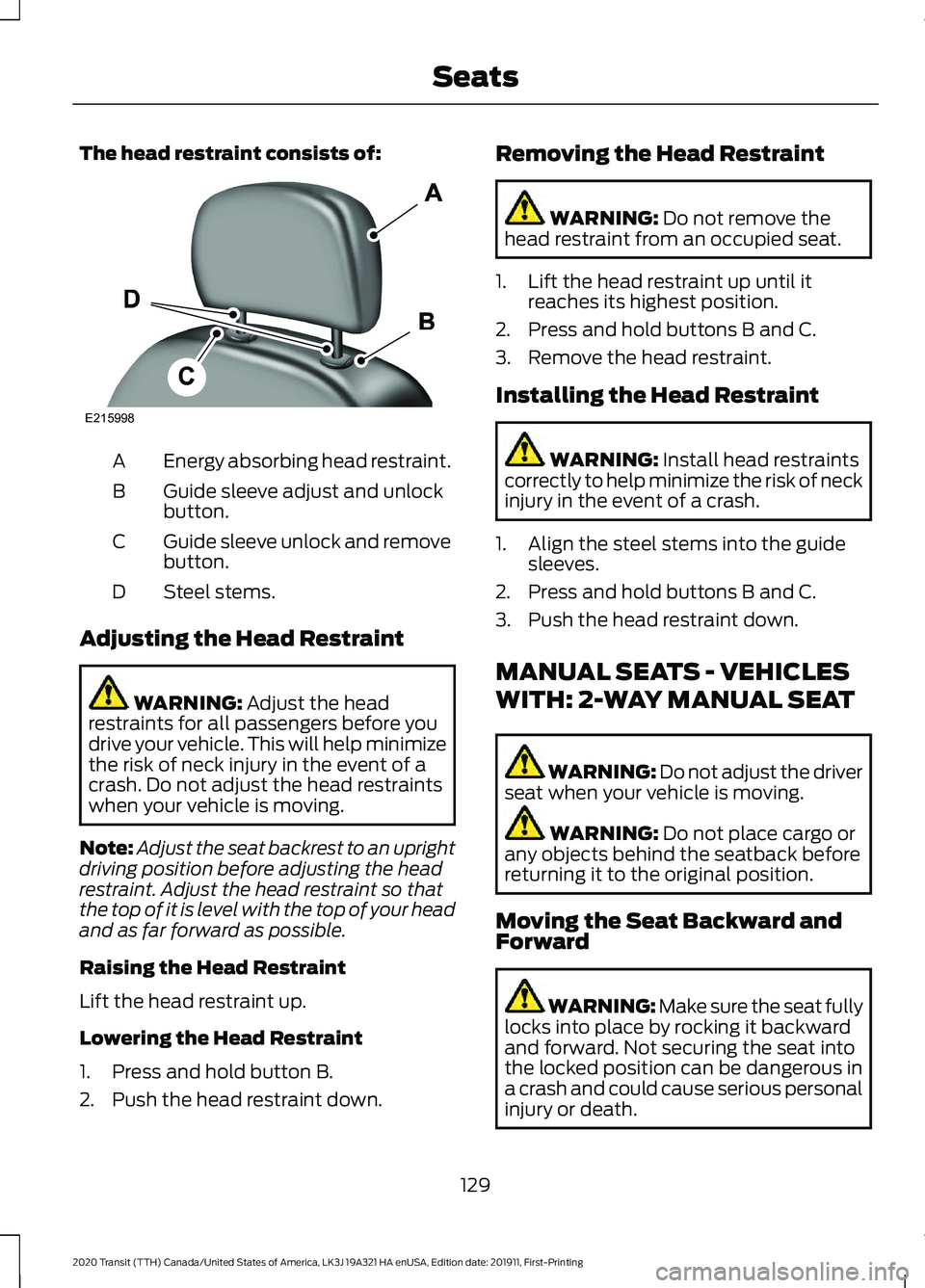
The head restraint consists of:
Energy absorbing head restraint.
A
Guide sleeve adjust and unlock
button.
B
Guide sleeve unlock and remove
button.
C
Steel stems.
D
Adjusting the Head Restraint WARNING: Adjust the head
restraints for all passengers before you
drive your vehicle. This will help minimize
the risk of neck injury in the event of a
crash. Do not adjust the head restraints
when your vehicle is moving.
Note: Adjust the seat backrest to an upright
driving position before adjusting the head
restraint. Adjust the head restraint so that
the top of it is level with the top of your head
and as far forward as possible.
Raising the Head Restraint
Lift the head restraint up.
Lowering the Head Restraint
1. Press and hold button B.
2. Push the head restraint down. Removing the Head Restraint WARNING:
Do not remove the
head restraint from an occupied seat.
1. Lift the head restraint up until it reaches its highest position.
2. Press and hold buttons B and C.
3. Remove the head restraint.
Installing the Head Restraint WARNING:
Install head restraints
correctly to help minimize the risk of neck
injury in the event of a crash.
1. Align the steel stems into the guide sleeves.
2. Press and hold buttons B and C.
3. Push the head restraint down.
MANUAL SEATS - VEHICLES
WITH: 2-WAY MANUAL SEAT WARNING: Do not adjust the driver
seat when your vehicle is moving. WARNING:
Do not place cargo or
any objects behind the seatback before
returning it to the original position.
Moving the Seat Backward and
Forward WARNING: Make sure the seat fully
locks into place by rocking it backward
and forward. Not securing the seat into
the locked position can be dangerous in
a crash and could cause serious personal
injury or death.
129
2020 Transit (TTH) Canada/United States of America, LK3J 19A321 HA enUSA, Edition date: 201911, First-Printing SeatsE215998
Page 133 of 529
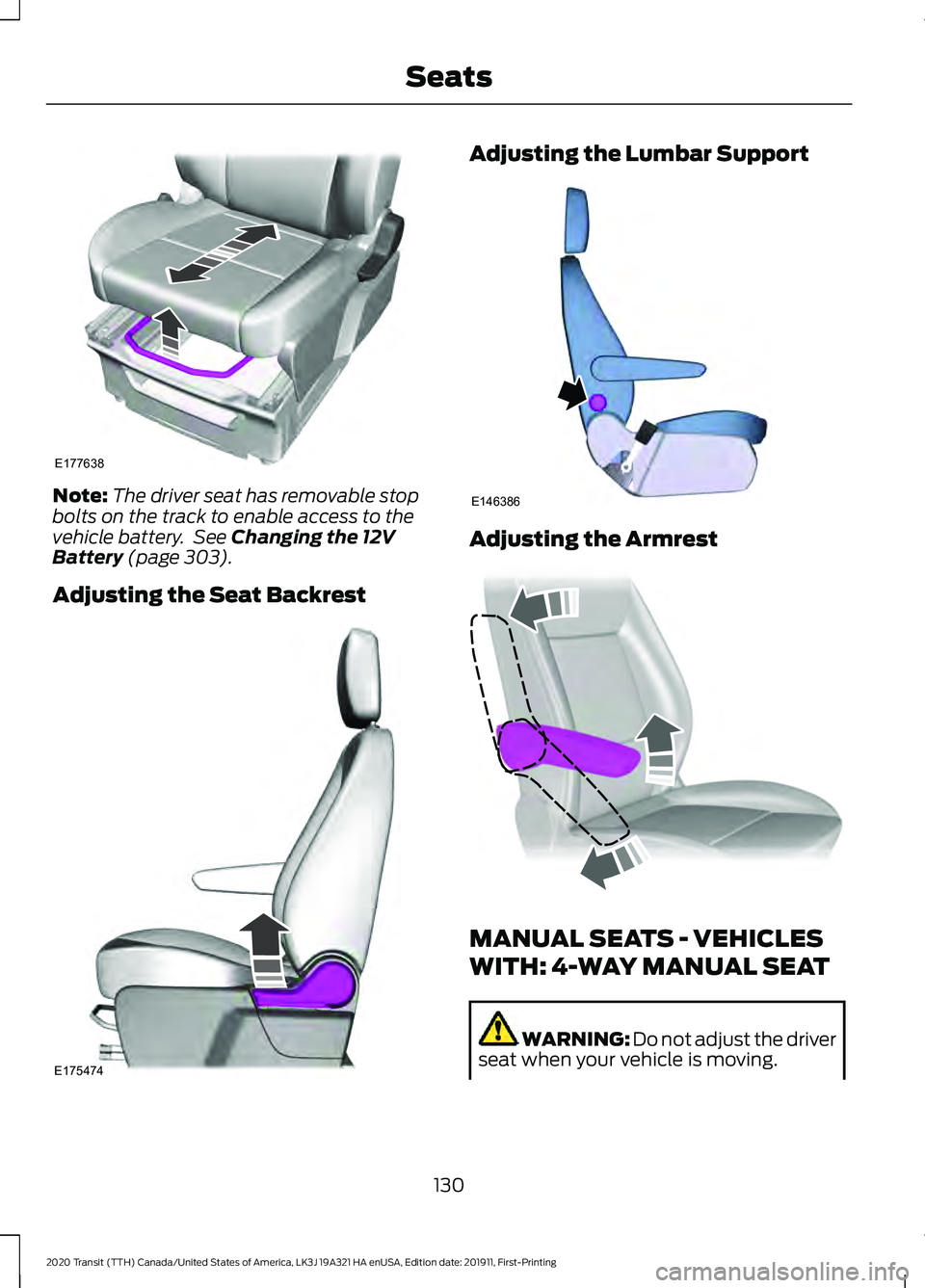
Note:
The driver seat has removable stop
bolts on the track to enable access to the
vehicle battery. See Changing the 12V
Battery (page 303).
Adjusting the Seat Backrest Adjusting the Lumbar Support
Adjusting the Armrest
MANUAL SEATS - VEHICLES
WITH: 4-WAY MANUAL SEAT
WARNING: Do not adjust the driver
seat when your vehicle is moving.
130
2020 Transit (TTH) Canada/United States of America, LK3J 19A321 HA enUSA, Edition date: 201911, First-Printing SeatsE177638 E175474 E146386 E315192
Page 134 of 529

WARNING: Do not place cargo or
any objects behind the seatback before
returning it to the original position.
Moving the Seat Backward and
Forward WARNING: Make sure the seat fully
locks into place by rocking it backward
and forward. Not securing the seat into
the locked position can be dangerous in
a crash and could cause serious personal
injury or death. Note:
The driver seat has removable stop
bolts on the track to enable access to the
vehicle battery. See
Changing the 12V
Battery (page 303). Adjusting the Seat Backrest
Adjusting the Seat Height
131
2020 Transit (TTH) Canada/United States of America, LK3J 19A321 HA enUSA, Edition date: 201911, First-Printing SeatsE130249 E146385 E146384
Page 135 of 529
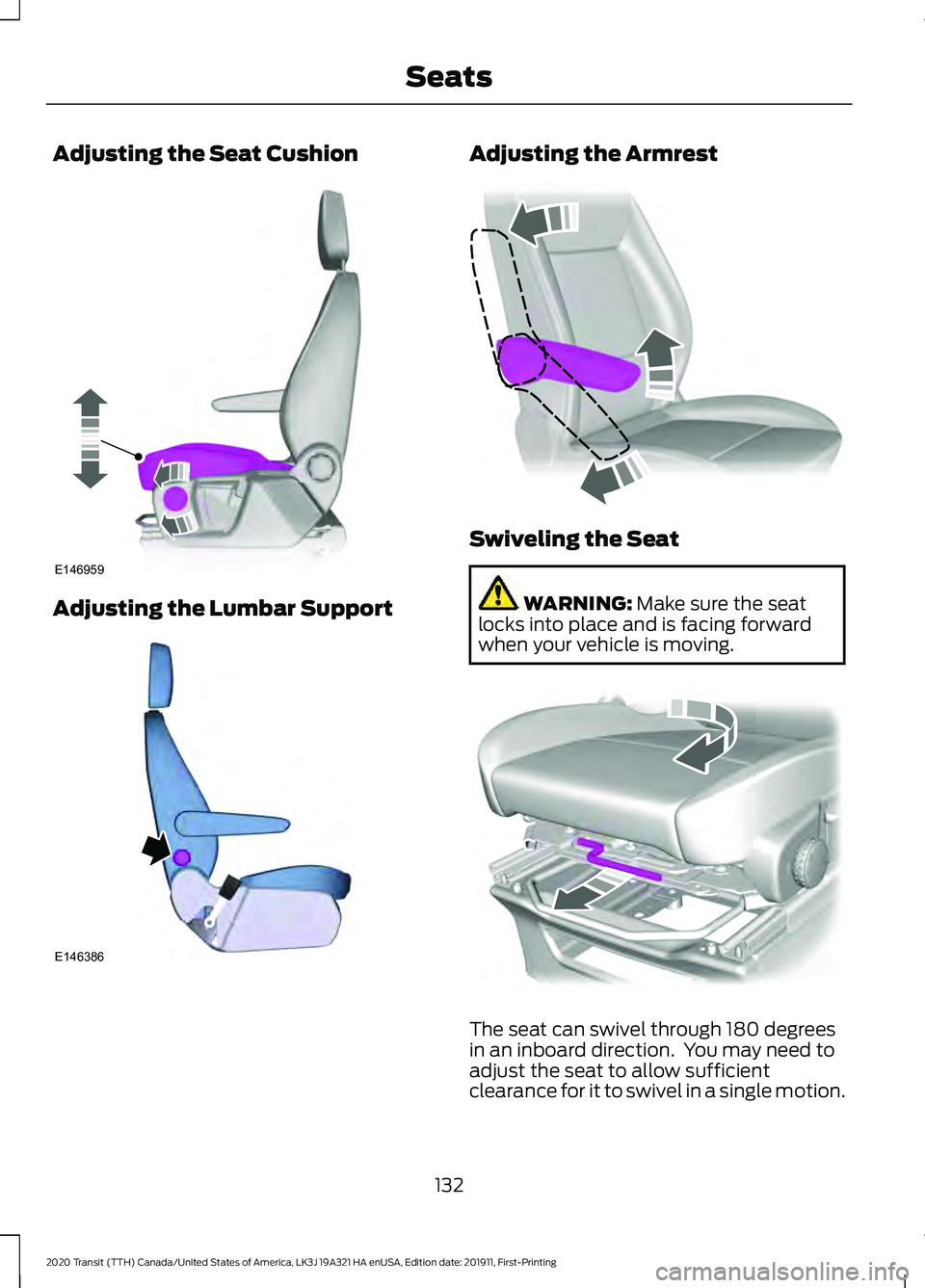
Adjusting the Seat Cushion
Adjusting the Lumbar Support Adjusting the Armrest
Swiveling the Seat
WARNING: Make sure the seat
locks into place and is facing forward
when your vehicle is moving. The seat can swivel through 180 degrees
in an inboard direction. You may need to
adjust the seat to allow sufficient
clearance for it to swivel in a single motion.
132
2020 Transit (TTH) Canada/United States of America, LK3J 19A321 HA enUSA, Edition date: 201911, First-Printing SeatsE146959 E146386 E315192 E315195
Page 136 of 529
Note:
We recommend that the seat is
unoccupied.
Swivel Seat Audible Warning
Sounds when the driver or passenger seat
is not locked into place, and the ignition is
on.
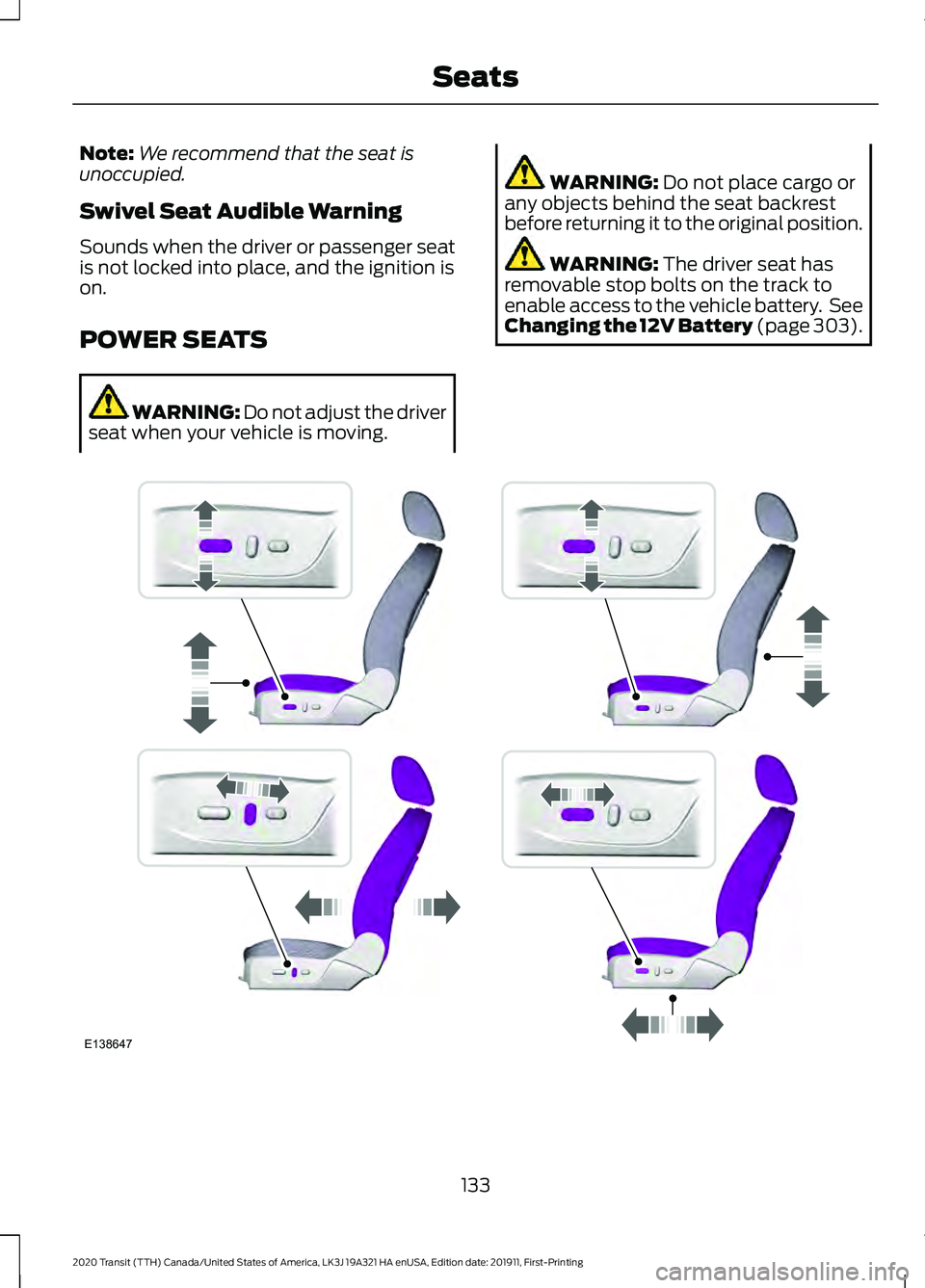
POWER SEATS WARNING: Do not adjust the driver
seat when your vehicle is moving. WARNING: Do not place cargo or
any objects behind the seat backrest
before returning it to the original position. WARNING:
The driver seat has
removable stop bolts on the track to
enable access to the vehicle battery. See
Changing the 12V Battery (page 303). 133
2020 Transit (TTH) Canada/United States of America, LK3J 19A321 HA enUSA, Edition date: 201911, First-Printing SeatsE138647
Page 137 of 529
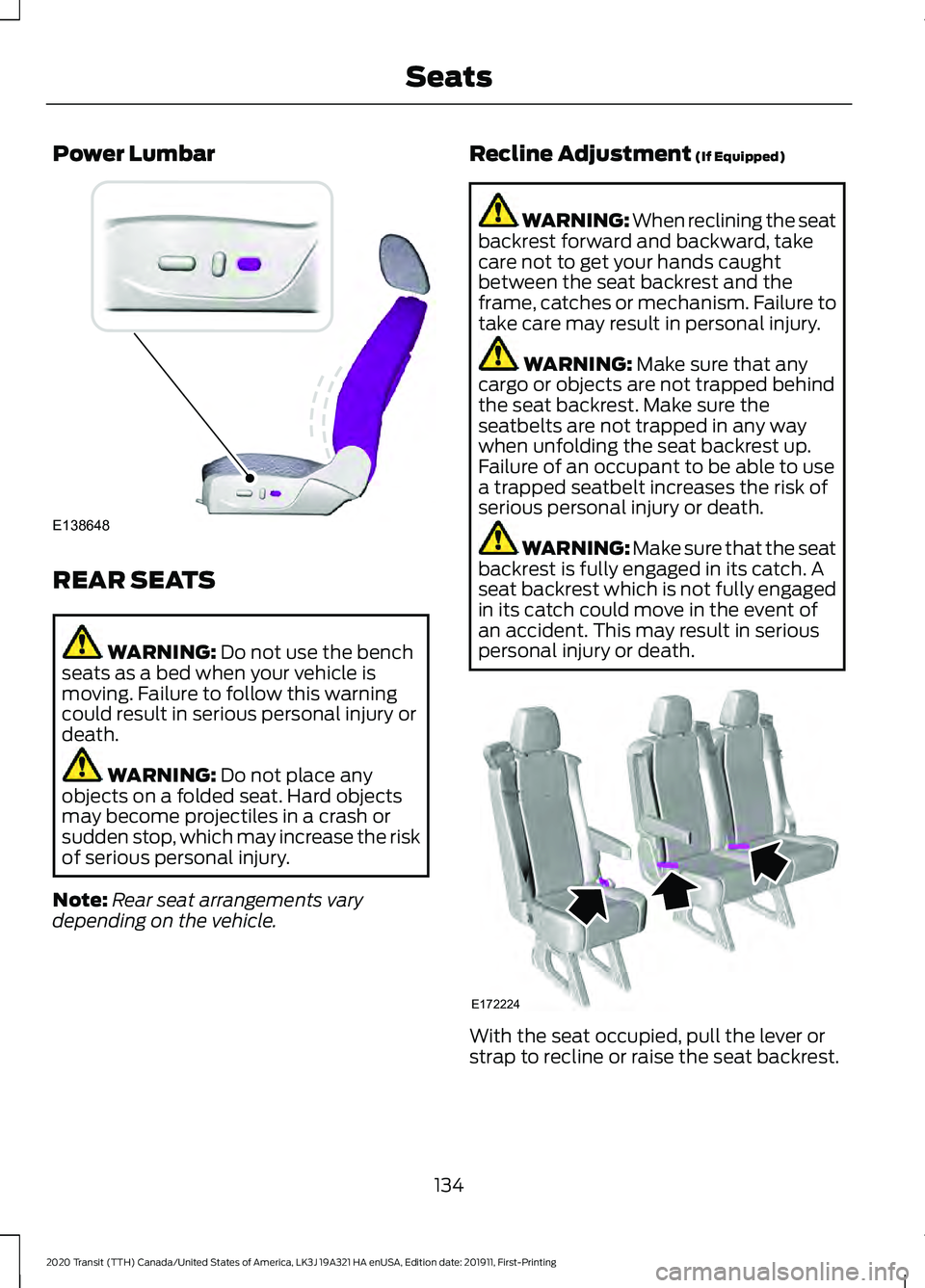
Power Lumbar
REAR SEATS
WARNING: Do not use the bench
seats as a bed when your vehicle is
moving. Failure to follow this warning
could result in serious personal injury or
death. WARNING:
Do not place any
objects on a folded seat. Hard objects
may become projectiles in a crash or
sudden stop, which may increase the risk
of serious personal injury.
Note: Rear seat arrangements vary
depending on the vehicle. Recline Adjustment
(If Equipped) WARNING: When reclining the seat
backrest forward and backward, take
care not to get your hands caught
between the seat backrest and the
frame, catches or mechanism. Failure to
take care may result in personal injury. WARNING:
Make sure that any
cargo or objects are not trapped behind
the seat backrest. Make sure the
seatbelts are not trapped in any way
when unfolding the seat backrest up.
Failure of an occupant to be able to use
a trapped seatbelt increases the risk of
serious personal injury or death. WARNING: Make sure that the seat
backrest is fully engaged in its catch. A
seat backrest which is not fully engaged
in its catch could move in the event of
an accident. This may result in serious
personal injury or death. With the seat occupied, pull the lever or
strap to recline or raise the seat backrest.
134
2020 Transit (TTH) Canada/United States of America, LK3J 19A321 HA enUSA, Edition date: 201911, First-Printing SeatsE138648 E172224
Page 138 of 529
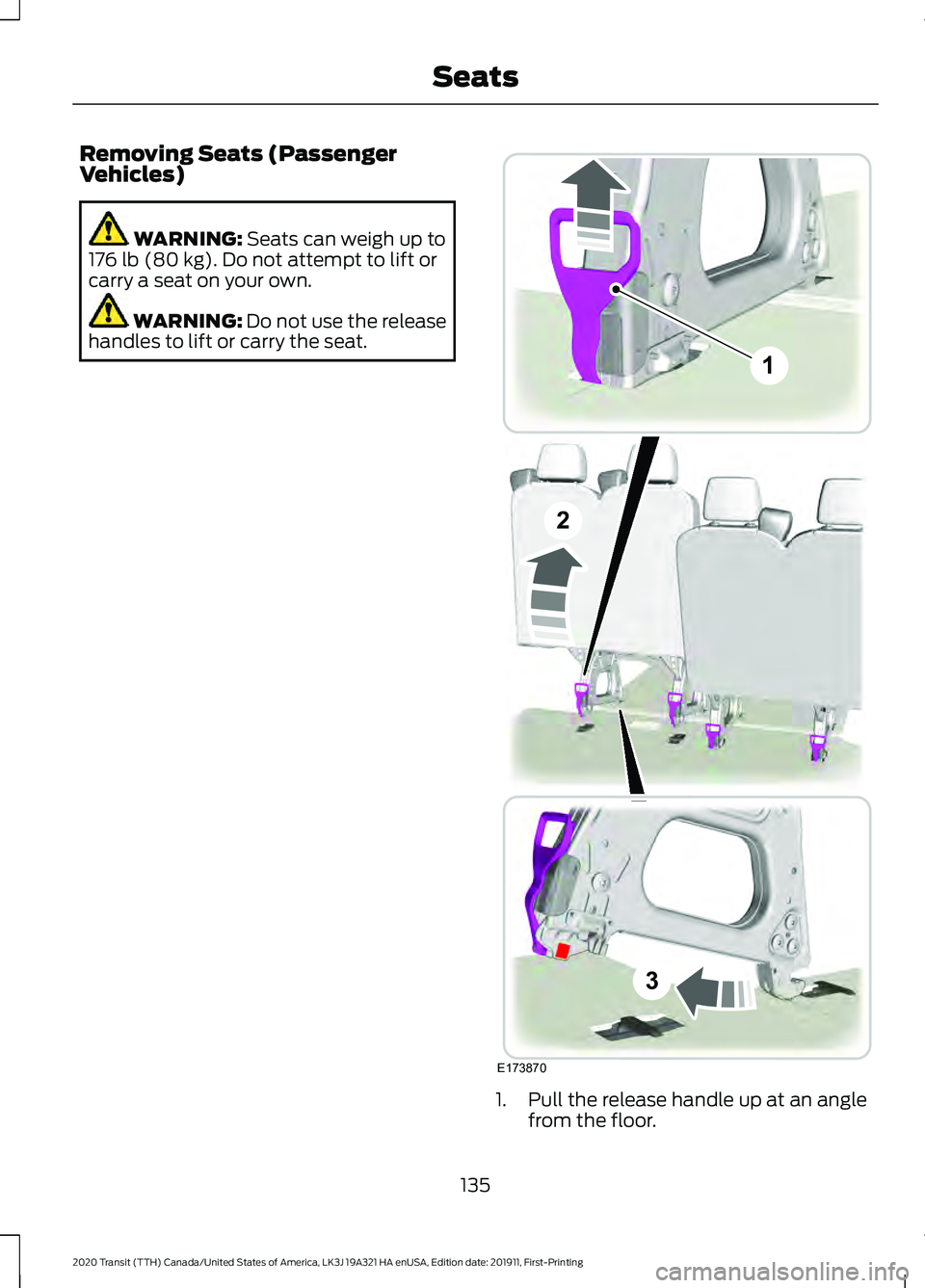
Removing Seats (Passenger
Vehicles)
WARNING: Seats can weigh up to
176 lb (80 kg). Do not attempt to lift or
carry a seat on your own. WARNING:
Do not use the release
handles to lift or carry the seat. 1. Pull the release handle up at an angle
from the floor.
135
2020 Transit (TTH) Canada/United States of America, LK3J 19A321 HA enUSA, Edition date: 201911, First-Printing SeatsE173870
1
2
3
Page 139 of 529
2. While holding the handle in this
position, tilt the top of the seat forward
to release the seat frame rear catches
from the floor.
3. When the rear seat latches are clear of
the floor, release the handle.
4. Pull the seat backward to release the seat frame front catches.
5. Remove the seat from the vehicle.
Note: Two persons are required to release
the seat handles and remove the seat.
Note: You can only remove seats that have
integral release handles.
Note: The seatback does not fold forward.
Installing the Seats WARNING: Make sure that the
floor catches are free from foreign
material before installing the seats. WARNING:
Make sure that you
securely fasten the seat catches when
installing. Check the latches are correctly
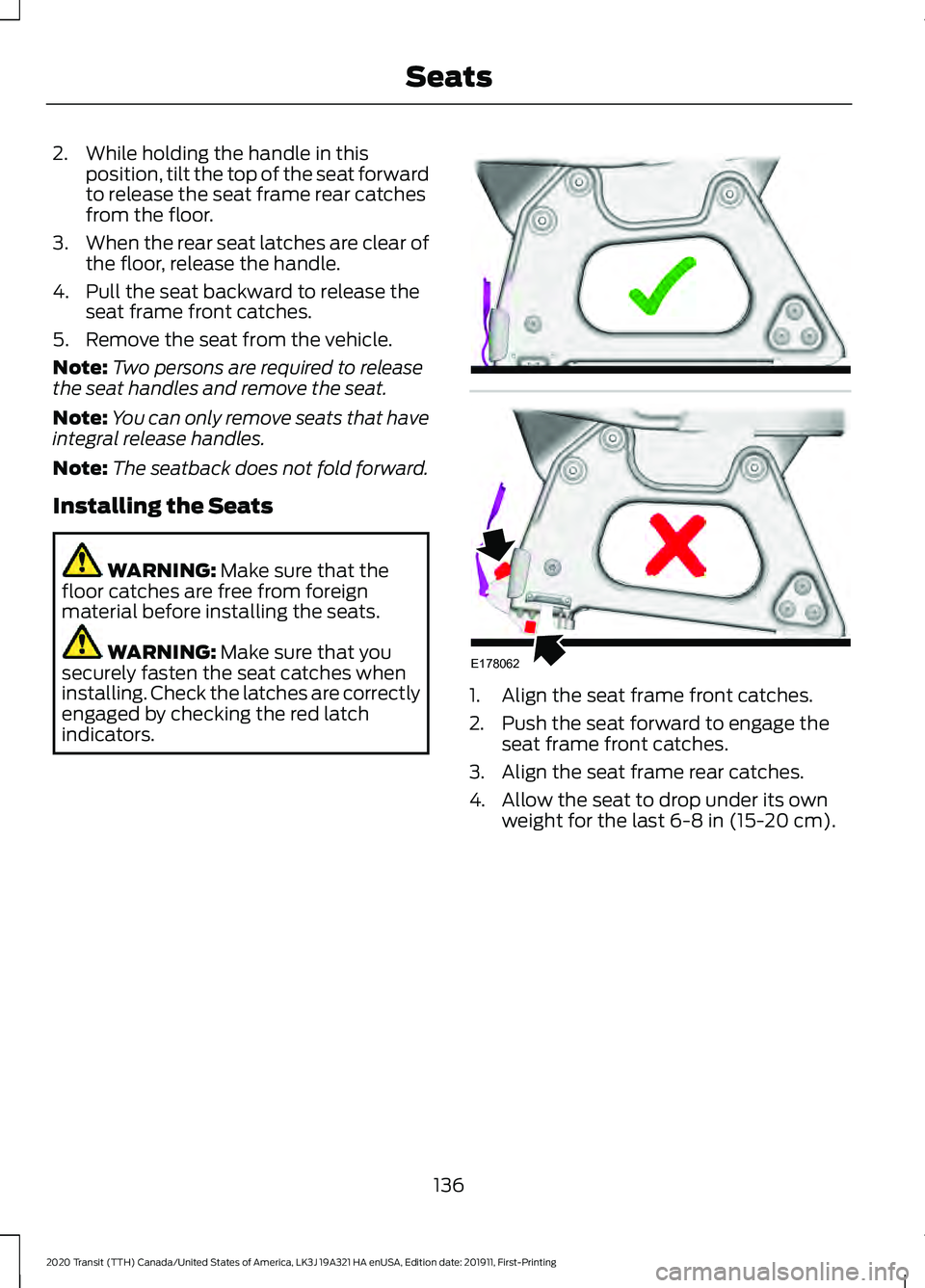
engaged by checking the red latch
indicators. 1. Align the seat frame front catches.
2. Push the seat forward to engage the
seat frame front catches.
3. Align the seat frame rear catches.
4. Allow the seat to drop under its own weight for the last 6-8 in (15-20 cm).
136
2020 Transit (TTH) Canada/United States of America, LK3J 19A321 HA enUSA, Edition date: 201911, First-Printing SeatsE178062
Page 140 of 529
HEATED SEATS
WARNING: Use caution when using
the heated seat if you are unable to feel
pain to your skin because of advanced
age, chronic illness, diabetes, spinal cord
injury, medication, alcohol use,
exhaustion or other physical conditions.
The heated seat could cause burns even
at low temperatures, especially if used
for long periods of time. Failure to follow
this instruction could result in personal
injury. WARNING: Do not place anything
on the seat that blocks the heat, for
example a seat cover or a cushion. This
could cause the seat to overheat. Failure
to follow this instruction could result in
personal injury. WARNING:
Do not poke sharp
objects into the seat cushion or seat
backrest. This could damage the heated
seat element and cause it to overheat.
Failure to follow this instruction could
result in personal injury.
Do not switch the heated seat on if the
seat is wet.
The heated seat button is on the climate
control assembly. Repeatedly press the button to
adjust the temperature.
137
2020 Transit (TTH) Canada/United States of America, LK3J 19A321 HA enUSA, Edition date: 201911, First-Printing Seats
Page 170 of 529
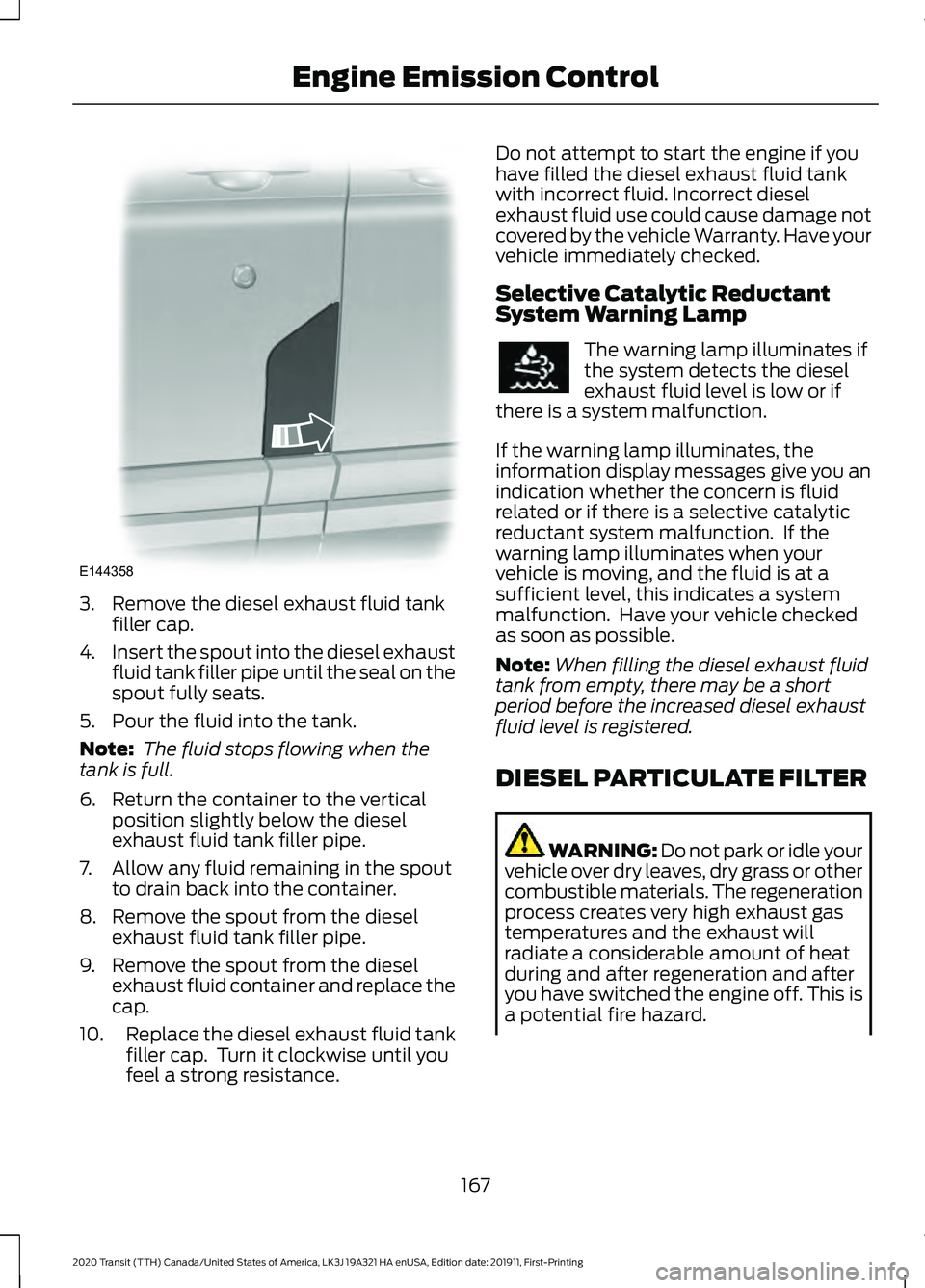
3. Remove the diesel exhaust fluid tank
filler cap.
4. Insert the spout into the diesel exhaust
fluid tank filler pipe until the seal on the
spout fully seats.
5. Pour the fluid into the tank.
Note: The fluid stops flowing when the
tank is full.
6. Return the container to the vertical position slightly below the diesel
exhaust fluid tank filler pipe.
7. Allow any fluid remaining in the spout to drain back into the container.
8. Remove the spout from the diesel exhaust fluid tank filler pipe.
9. Remove the spout from the diesel exhaust fluid container and replace the
cap.
10. Replace the diesel exhaust fluid tank
filler cap. Turn it clockwise until you
feel a strong resistance. Do not attempt to start the engine if you
have filled the diesel exhaust fluid tank
with incorrect fluid. Incorrect diesel
exhaust fluid use could cause damage not
covered by the vehicle Warranty. Have your
vehicle immediately checked.
Selective Catalytic Reductant
System Warning Lamp
The warning lamp illuminates if
the system detects the diesel
exhaust fluid level is low or if
there is a system malfunction.
If the warning lamp illuminates, the
information display messages give you an
indication whether the concern is fluid
related or if there is a selective catalytic
reductant system malfunction. If the
warning lamp illuminates when your
vehicle is moving, and the fluid is at a
sufficient level, this indicates a system
malfunction. Have your vehicle checked
as soon as possible.
Note: When filling the diesel exhaust fluid
tank from empty, there may be a short
period before the increased diesel exhaust
fluid level is registered.
DIESEL PARTICULATE FILTER WARNING: Do not park or idle your
vehicle over dry leaves, dry grass or other
combustible materials. The regeneration
process creates very high exhaust gas
temperatures and the exhaust will
radiate a considerable amount of heat
during and after regeneration and after
you have switched the engine off. This is
a potential fire hazard.
167
2020 Transit (TTH) Canada/United States of America, LK3J 19A321 HA enUSA, Edition date: 201911, First-Printing Engine Emission ControlE144358