passenger FORD TRANSIT 2020 Workshop Manual
[x] Cancel search | Manufacturer: FORD, Model Year: 2020, Model line: TRANSIT, Model: FORD TRANSIT 2020Pages: 529, PDF Size: 8.3 MB
Page 250 of 529
Calculating the Maximum
Loaded Trailer Weight for Your
Vehicle
1. Start with the gross combined
weight rating for your vehicle
model and axle ratio. See the
previous charts.
2. Subtract all of the following
that apply to your vehicle:
• Vehicle curb weight
• Hitch hardware weight, such as
a draw bar, ball, locks or weight
distributing hardware
• Driver weight
• Passenger(s) weight
• Payload, cargo and luggage
weight
• Aftermarket equipment weight.
This equals the maximum loaded
trailer weight for this combination.
Note: The trailer tongue load is
considered part of the payload for
your vehicle. Reduce the total
payload by the final trailer tongue
weight.
Note: Consult an authorized dealer
to determine the maximum trailer
weight allowed for your vehicle if
you are not sure. ESSENTIAL TOWING CHECKS
Follow these guidelines for safe towing:
•
Do not tow a trailer until your vehicle
has covered at least 1,000 mi
(1,600 km). See Breaking-In (page
255).
• Consult your local motor vehicle laws
for towing a trailer.
• See the instructions included with
towing accessories for the correct
installation and adjustment
specifications.
• Service your vehicle more frequently if
you tow a trailer. See
Scheduled
Maintenance (page 462).
• If you use a rental trailer, follow the
instructions the rental agency gives
you.
Refer to
Load Carrying for load
specification terms found on the tire label,
Safety Compliance label and instructions
on calculating your vehicle's maximum
load. See
Load Limit (page 237).
Remember to account for the trailer
tongue weight as part of your vehicle load
when calculating the total vehicle weight.
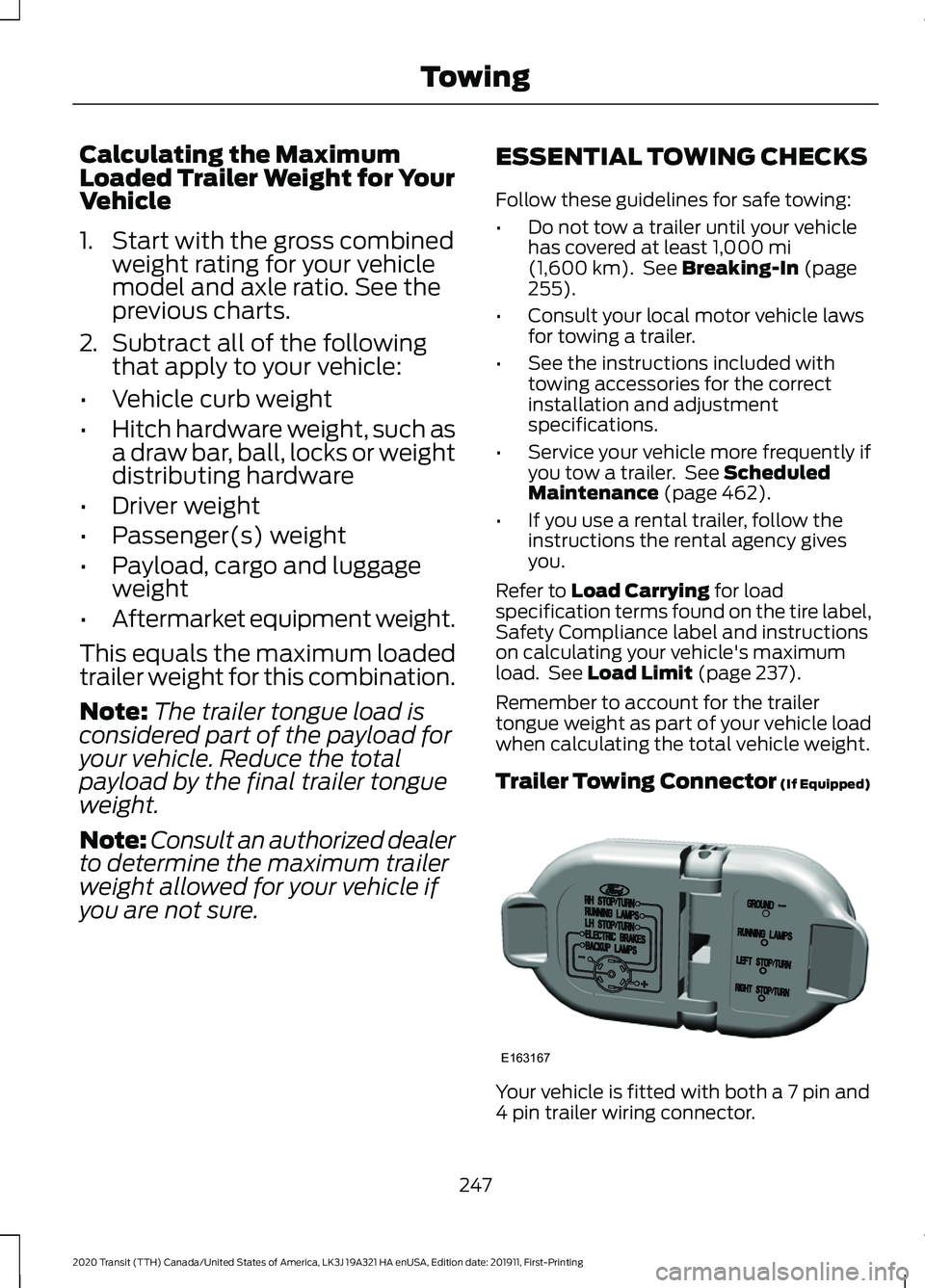
Trailer Towing Connector
(If Equipped) Your vehicle is fitted with both a 7 pin and
4 pin trailer wiring connector.
247
2020 Transit (TTH) Canada/United States of America, LK3J 19A321 HA enUSA, Edition date: 201911, First-Printing TowingE163167
Page 276 of 529
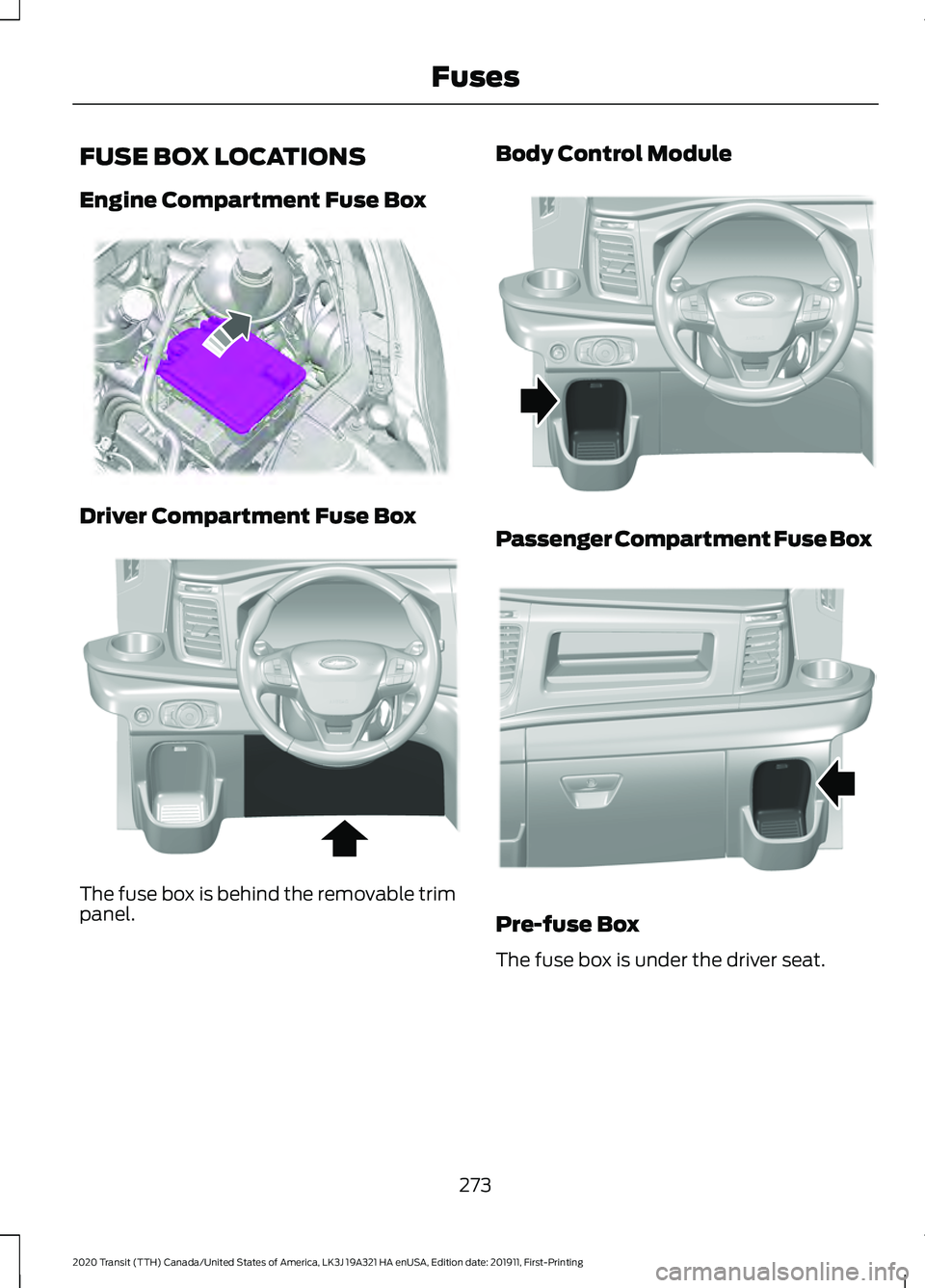
FUSE BOX LOCATIONS
Engine Compartment Fuse Box
Driver Compartment Fuse Box
The fuse box is behind the removable trim
panel. Body Control Module
Passenger Compartment Fuse Box
Pre-fuse Box
The fuse box is under the driver seat.
273
2020 Transit (TTH) Canada/United States of America, LK3J 19A321 HA enUSA, Edition date: 201911, First-Printing FusesE319023 E296247 E296246 E296255
Page 282 of 529
Protected Component
Fuse Rating
Item
Not used.
-
40
Load shed relay.
25 A
41
Starter relay.
40 A
42
Upfitter relay.
40 A
43
Starter relay.
40 A
44
Upfitter interface module.
10 A
45
Not used.
-
46
Not used.
-
47
Modified vehicle connections.
5 A
48
Brake pedal switch.
10 A
49
Passenger power seat.
30 A
50
Modified vehicle connections.
40 A
51
Driver power seat.
30 A
52
Battery.
60 A
53
Power inverter.
60 A
54
Body control module.
50 A
55
Modified vehicle connections.
10 A
56
Not used.
-
57
Connector camper body interface.
10 A
58 Upfitter interface.
Secondary junction box.
Rear climate control.
10 A
59 Front view camera.
Rear view camera.
Adaptive cruise control module.
Blind spot information system.
Trailer brake control module.
10 A
60
Not used.
-
61
Enhanced cut off relay system module.
15 A
62
279
2020 Transit (TTH) Canada/United States of America, LK3J 19A321 HA enUSA, Edition date: 201911, First-Printing Fuses
Page 283 of 529
Protected Component
Fuse Rating
Item
Auxiliary power point.
20 A
63
Modified vehicle connections.
40 A
64
Not used.
-
65
Enhanced cut off relay system.
10 A
66 Camper.
Load shed relay.
Not used.
-
67
Trailer tow module.
5 A
68
Steering wheel module.
5 A
69
Not used.
-
70
Passenger heated seat.
10 A
71
Driver heated seat.
10 A
72
Adaptive front lighting module.
20 A
73
Headlamp leveling.
Not used.
-
74
Engine compartment fuse box.
20 A
75
Power sliding door control switch.
10 A
76
Headlamp switch.
5 A
77
Modified vehicle connections.
7.5 A
78
Driver compartment fuse box relay.
5 A
79
Not used.
-
80
Trailer tow module.
40 A
81
Power sliding door.
30 A
82
Trailer brake control module.
30 A
83
Body control module.
50 A
84
Power sliding door.
30 A
85
Body control module.
50 A
86
280
2020 Transit (TTH) Canada/United States of America, LK3J 19A321 HA enUSA, Edition date: 201911, First-Printing Fuses
Page 286 of 529
Protected Component
Fuse Rating
Item
Not used.
5 A
35
Parking aid.
15 A
36 Lane keeping system camera.
Steering column control module.
Not used.
20 A
37
Power windows.
30 A
38
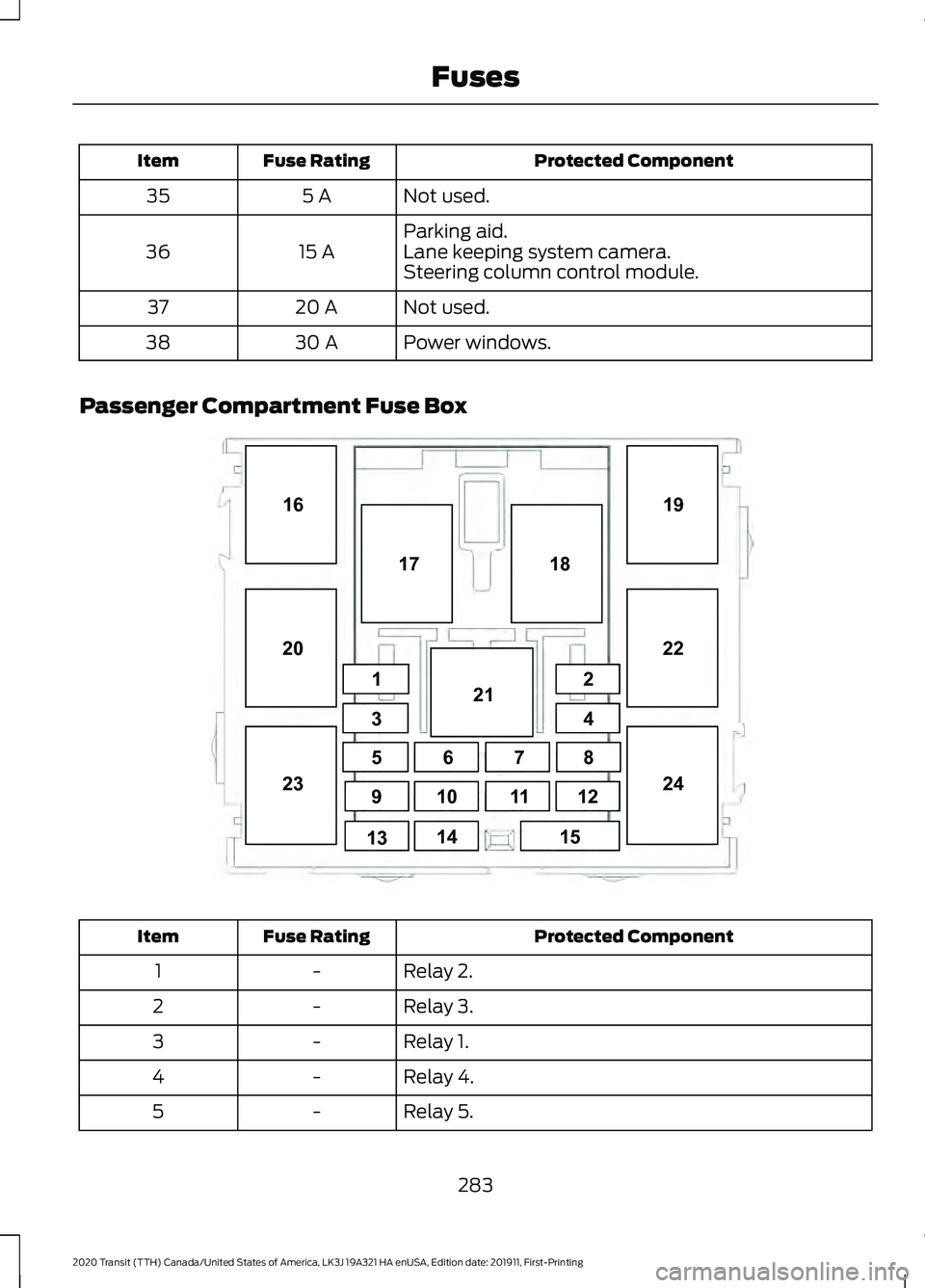
Passenger Compartment Fuse Box Protected Component
Fuse Rating
Item
Relay 2.
-
1
Relay 3.
-
2
Relay 1.
-
3
Relay 4.
-
4
Relay 5.
-
5
283
2020 Transit (TTH) Canada/United States of America, LK3J 19A321 HA enUSA, Edition date: 201911, First-Printing Fuses1
34
5 8
9 12
10
14 18
19
20 2122
23 24
15
16
67
11
13 17
2E296792
Page 288 of 529
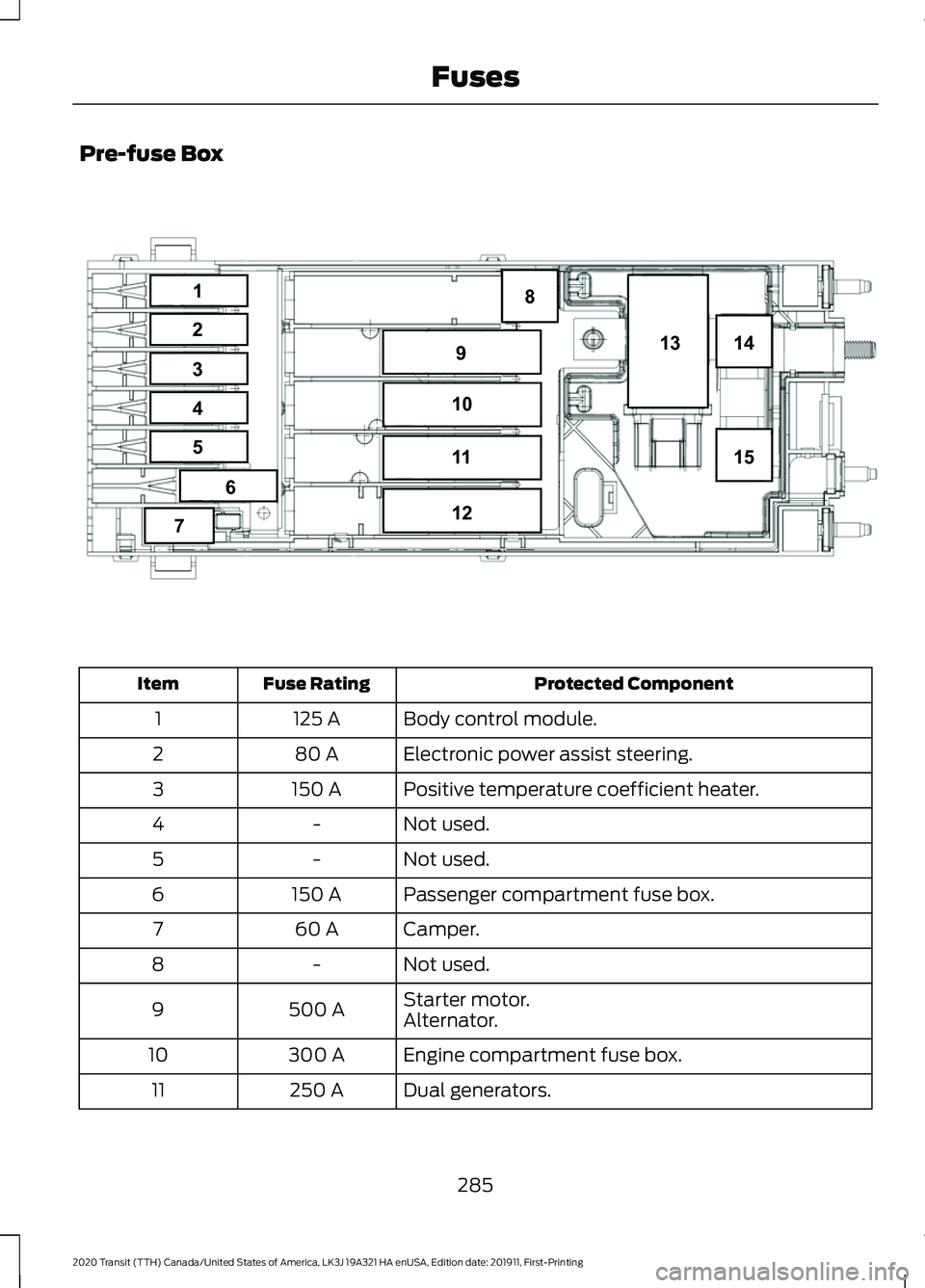
Pre-fuse Box
Protected Component
Fuse Rating
Item
Body control module.
125 A
1
Electronic power assist steering.
80 A
2
Positive temperature coefficient heater.
150 A
3
Not used.
-
4
Not used.
-
5
Passenger compartment fuse box.
150 A
6
Camper.
60 A
7
Not used.
-
8
Starter motor.
500 A
9
Alternator.
Engine compartment fuse box.
300 A
10
Dual generators.
250 A
11
285
2020 Transit (TTH) Canada/United States of America, LK3J 19A321 HA enUSA, Edition date: 201911, First-Printing Fuses8
14
15
13
9
10
11
12
1
2
3
4
5
6
7E296043
Page 327 of 529
GENERAL INFORMATION
Notice to Utility Vehicle, Van and
Truck Owners
WARNING: Utility vehicles have a
significantly higher rollover rate than
other types of vehicles. To reduce the
risk of serious injury or death from a
rollover or other crash you must avoid
sharp turns and abrupt maneuvers, drive
at safe speeds for the conditions, keep
tires properly inflated, never overload or
improperly load your vehicle, and make
sure every passenger is properly
restrained. WARNING:
In a rollover crash, an
unbelted person is significantly more
likely to die than a person wearing a seat
belt. All occupants must wear seat belts.
Children and infants must use
appropriate restraints to minimize the
risk of injury or ejection. Utility vehicles and trucks handle
differently than passenger cars in the
various driving conditions that are
encountered on streets, highways and
off-road. Utility vehicles and trucks are not
designed for cornering at speeds as high
as passenger cars any more than low-slung
sports cars are designed to perform
satisfactorily under off-road conditions.
How Your Vehicle Differs from
Other Vehicles
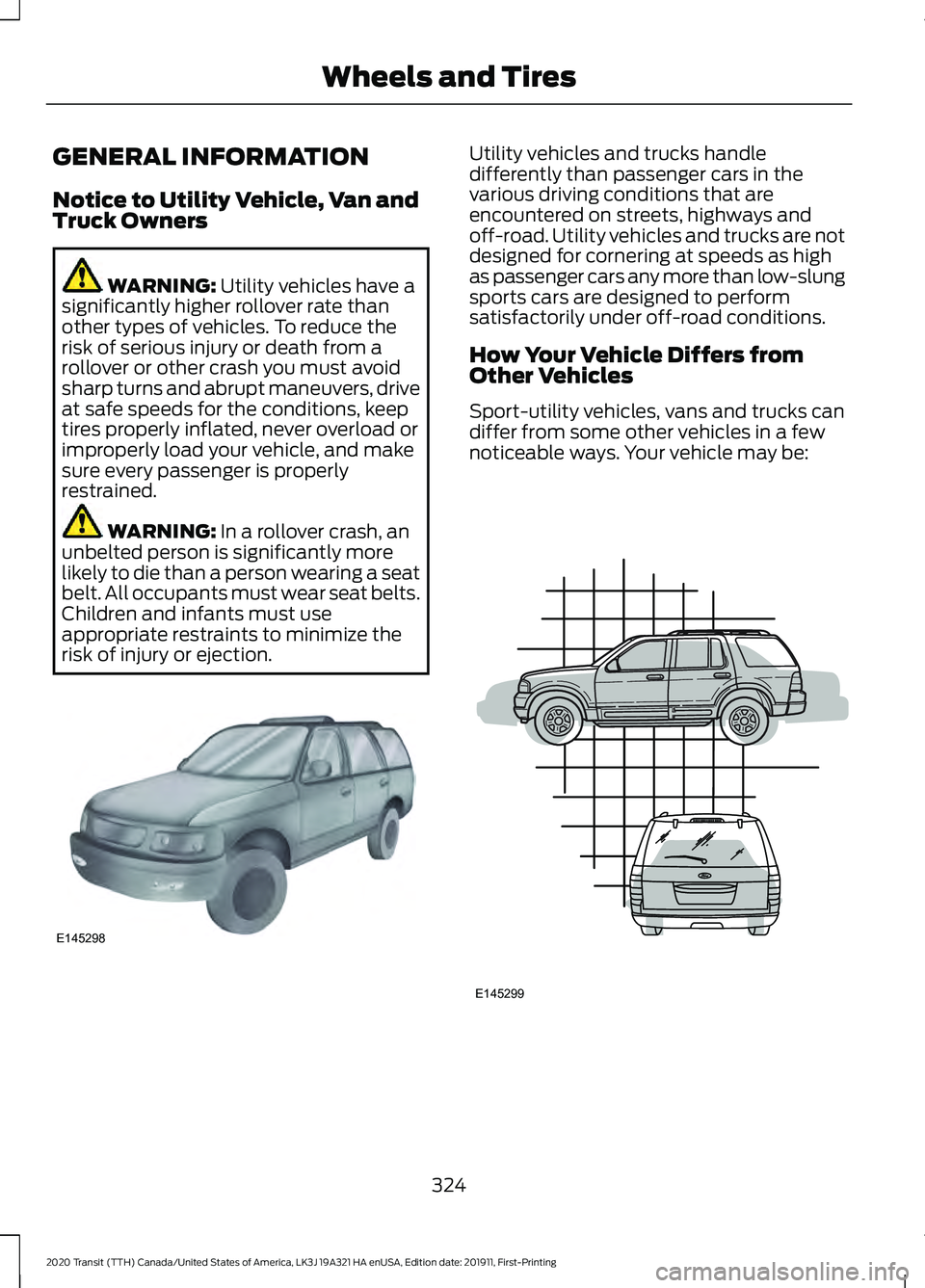
Sport-utility vehicles, vans and trucks can
differ from some other vehicles in a few
noticeable ways. Your vehicle may be:
324
2020 Transit (TTH) Canada/United States of America, LK3J 19A321 HA enUSA, Edition date: 201911, First-Printing Wheels and TiresE145298 E145299
Page 328 of 529
•
Higher - to allow higher load carrying
capacity and to allow it to travel over
rough terrain without getting hung up
or damaging underbody components.
• Shorter - to give it the capability to
approach inclines and drive over the
crest of a hill without getting hung up
or damaging underbody components.
All other things held equal, a shorter
wheelbase may make your vehicle
quicker to respond to steering inputs
than a vehicle with a longer wheelbase.
• Narrower - to provide greater
maneuverability in tight spaces,
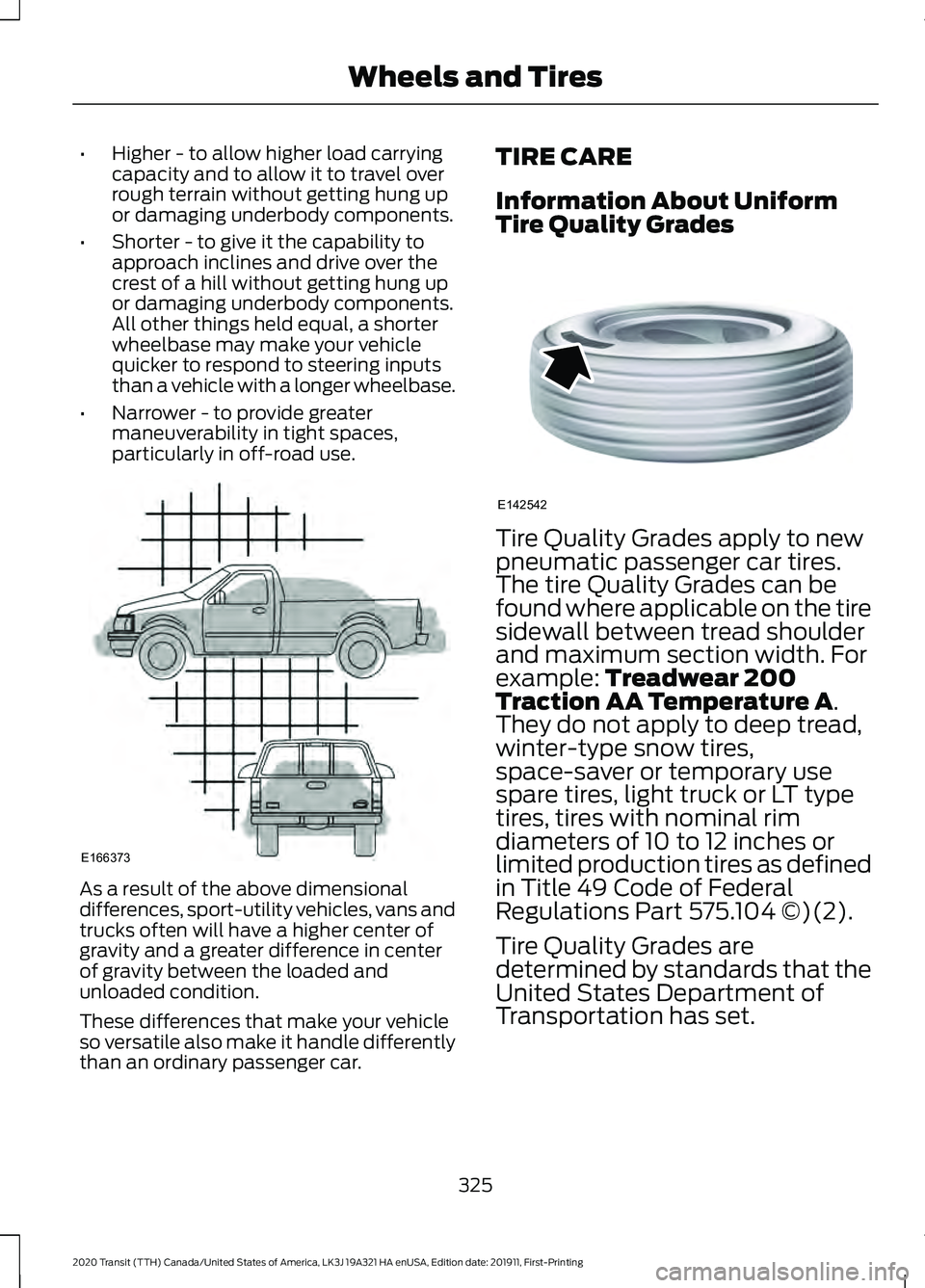
particularly in off-road use. As a result of the above dimensional
differences, sport-utility vehicles, vans and
trucks often will have a higher center of
gravity and a greater difference in center
of gravity between the loaded and
unloaded condition.
These differences that make your vehicle
so versatile also make it handle differently
than an ordinary passenger car. TIRE CARE
Information About Uniform
Tire Quality Grades
Tire Quality Grades apply to new
pneumatic passenger car tires.
The tire Quality Grades can be
found where applicable on the tire
sidewall between tread shoulder
and maximum section width. For
example: Treadwear 200
Traction AA Temperature A.
They do not apply to deep tread,
winter-type snow tires,
space-saver or temporary use
spare tires, light truck or LT type
tires, tires with nominal rim
diameters of 10 to 12 inches or
limited production tires as defined
in Title 49 Code of Federal
Regulations Part 575.104 ©)(2).
Tire Quality Grades are
determined by standards that the
United States Department of
Transportation has set.
325
2020 Transit (TTH) Canada/United States of America, LK3J 19A321 HA enUSA, Edition date: 201911, First-Printing Wheels and TiresE166373 E142542
Page 329 of 529
United States Department of
Transportation Tire Quality
Grades
The United States of America
Department of Transportation
requires Ford Motor Company to
give you the following information
about tire grades exactly as the
government has written it.
Treadwear
The treadwear grade is a
comparative rating based on the
wear rate of the tire when tested
under controlled conditions on a
specified government test course.
For example, a tire graded 150
would wear 1½ times as well on
the government course as a tire
graded 100. The relative
performance of tires depends
upon the actual conditions of their
use, however, and may depart
significantly from the norm due to
variations in driving habits, service
practices, and differences in road
characteristics and climate.
Traction AA A B C
WARNING: The traction
grade assigned to this tire is
based on straight-ahead braking
traction tests, and does not
include acceleration, cornering,
hydroplaning or peak traction
characteristics. The traction grades, from highest
to lowest are AA, A, B, and C. The
grades represent the tire
’s ability
to stop on wet pavement as
measured under controlled
conditions on specified
government test surfaces of
asphalt and concrete. A tire
marked C may have poor traction
performance.
Temperature A B C WARNING:
The
temperature grade for this tire is
established for a tire that is
properly inflated and not
overloaded. Excessive speed,
underinflation, or excessive
loading, either separately or in
combination, can cause heat
buildup and possible tire failure.
The temperature grades are A
(the highest), B and C,
representing the tire ’s resistance
to the generation of heat and its
ability to dissipate heat when
tested under controlled conditions
on a specified indoor laboratory
test wheel. Sustained high
temperature can cause the
material of the tire to degenerate
and reduce tire life, and excessive
temperature can lead to sudden
tire failure. The grade C
corresponds to a level of
performance which all passenger
car tires must meet under the
326
2020 Transit (TTH) Canada/United States of America, LK3J 19A321 HA enUSA, Edition date: 201911, First-Printing Wheels and Tires
Page 343 of 529
WARNING: Do not spin the
wheels at over 34 mph
(55 km/h). The tires may fail and
injure a passenger or bystander.
Driving habits have a great deal to
do with your tire mileage and
safety:
• Observe posted speed limits.
• Avoid fast starts, stops and
turns.
• Avoid potholes and objects on
the road.
• Do not run over curbs or hit the
tire against a curb when
parking.
Highway Hazards
No matter how carefully you drive
there is always the possibility that
you may eventually have a flat tire
on the highway. Drive slowly to the
closest safe area out of traffic.
This may further damage the flat
tire, but your safety is more
important.
If you feel a sudden vibration or
ride disturbance while driving, or
you suspect a tire or your vehicle
has been damaged, immediately
reduce your speed. Drive with
caution until you can safely pull
off the road. Stop and inspect the
tires for damage. If a tire is
under-inflated or damaged,
deflate it, remove wheel and replace it with the spare tire and
wheel. If you cannot detect a
cause, have the vehicle towed to
the nearest repair facility or tire
dealer to have the vehicle
inspected.
Tire and Wheel Alignment
A bad jolt from hitting a curb or
pothole can cause the front end
of your vehicle to become
misaligned or cause damage to
the tires. If your vehicle seems to
pull to one side when you are
driving, the wheels may be out of
alignment. Have an authorized
dealer check the wheel alignment
periodically.
Wheel misalignment in the front
or the rear can cause uneven and
rapid treadwear of the tires and
should be corrected by an
authorized dealer. Front-wheel
drive vehicles and those with an
independent rear suspension may
require alignment of all four
wheels.
The tires should also be balanced
periodically. An unbalanced tire
and wheel assembly may result in
irregular tire wear.
340
2020 Transit (TTH) Canada/United States of America, LK3J 19A321 HA enUSA, Edition date: 201911, First-Printing Wheels and Tires