Chart FORD TRANSIT 2020 Owners Manual
[x] Cancel search | Manufacturer: FORD, Model Year: 2020, Model line: TRANSIT, Model: FORD TRANSIT 2020Pages: 529, PDF Size: 8.3 MB
Page 8 of 529
Emergency Exit
............................................258
Fuel Shutoff ..................................................
258
Jump Starting the Vehicle - 2.0L EcoBlue ........................................................................\
259
Jump Starting the Vehicle - 3.5L Duratec/3.5L Ecoboost™ ....................
261
Post-Crash Alert System .........................
264
Transporting the Vehicle .........................
264
Towing Points ..............................................
265
Customer Assistance
Ford Credit ....................................................
266
Getting the Services You Need .............
266
In California (U.S. Only) ............................
267
The Better Business Bureau (BBB) Auto Line Program (U.S. Only) ....................
268
Utilizing the Mediation/Arbitration Program (Canada Only) ......................
269
Getting Assistance Outside the U.S. and Canada .......................................................
269
Ordering Additional Owner's Literature ........................................................................\
..
271
Reporting Safety Defects (U.S. Only) ........................................................................\
..
271
Reporting Safety Defects (Canada Only) ........................................................................\
.
272
Fuses
Fuse Box Locations ....................................
273
Fuse Specification Chart ..........................
274
Changing a Fuse .........................................
286
Maintenance
General Information ..................................
288
Opening and Closing the Hood .............
288
Under Hood Overview - 2.0L EcoBlue .......................................................................
290
Under Hood Overview - 3.5L Duratec ........................................................................\
.
291
Under Hood Overview - 3.5L Ecoboost™ ........................................................................\
292
Engine Oil Dipstick - 2.0L EcoBlue .......
293Engine Oil Dipstick - 3.5L Duratec
........
293
Engine Oil Dipstick - 3.5L Ecoboost™ ........................................................................\
293
Engine Oil Check .........................................
293
Changing the Engine Oil and Oil Filter ........................................................................\
294
Oil Change Indicator Reset - Diesel ......
295
Oil Change Indicator Reset - Gasoline ........................................................................\
296
Changing the Engine Air Filter ...............
296
Draining the Fuel Filter Water Trap - Diesel ...........................................................
297
Engine Cooling Fan - Diesel ....................
298
Engine Cooling Fan - Gasoline ..............
298
Engine Coolant Check ..............................
298
Automatic Transmission Fluid Check ........................................................................\
302
Brake Fluid Check .......................................
302
Changing the 12V Battery ........................
303
Adjusting the Headlamps .......................
305
Fuel Filter Service Indicator Check - Diesel ..........................................................
306
Washer Fluid Check ...................................
307
Fuel Filter - Gasoline ..................................
307
Checking the Wiper Blades .....................
307
Changing the Front Wiper Blades ........
307
Removing a Headlamp .............................
307
Changing a Bulb .........................................
308
Drive Belt Routing - 2.0L EcoBlue ..........
313
Drive Belt Routing - 3.5L Duratec/3.5L Ecoboost™, Vehicles With: Dual
Generators .................................................
314
Drive Belt Routing - 3.5L Duratec/3.5L Ecoboost™, Vehicles With: Single
Generator ...................................................
314
Vehicle Care
Cleaning Products .......................................
315
Cleaning the Exterior ..................................
316
Waxing ..............................................................
317
Cleaning the Engine ....................................
317
5
2020 Transit (TTH) Canada/United States of America, LK3J 19A321 HA enUSA, Edition date: 201911, First-Printing Table of Contents
Page 9 of 529

Cleaning the Windows and Wiper Blades
........................................................................\
.318
Cleaning the Interior ...................................
318
Cleaning the Instrument Panel and Instrument Cluster Lens ......................
320
Repairing Minor Paint Damage ...............
321
Cleaning the Wheels ...................................
321
Vehicle Storage .............................................
321
Body Styling Kits .........................................
323
Wheels and Tires
General Information ..................................
324
Tire Care .........................................................
325
Using Winter Tires ......................................
342
Using Snow Chains ....................................
343
Tire Pressure Monitoring System .........
344
Changing a Road Wheel ..........................
349
Lug Nuts ........................................................
360
Capacities and Specifications
Engine Specifications - 2.0L EcoBlue ........................................................................\
362
Engine Specifications - 3.5L Duratec ........................................................................\
363
Engine Specifications - 3.5L Ecoboost™ ........................................................................\
364
Motorcraft Parts - 2.0L EcoBlue ...........
365
Motorcraft Parts - 3.5L Duratec ............
366
Motorcraft Parts - 3.5L Ecoboost™ .....
367
Vehicle Identification Number ..............
368
Transmission Code Designation ...........
369
Capacities and Specifications - 2.0L EcoBlue ......................................................
370
Capacities and Specifications - 3.5L Duratec .......................................................
374
Capacities and Specifications - 3.5L Ecoboost™ ..............................................
380
Bulb Specification Chart .........................
386Connected Vehicle
Connected Vehicle Requirements
.......
388
Connected Vehicle Limitations .............
388
Connecting the Vehicle to a Mobile Network .....................................................
388
Connecting the Vehicle to a Wi-Fi Network .....................................................
388
Connected Vehicle – Troubleshooting - Vehicles With: Modem .........................
389
Connected Vehicle – Troubleshooting - Vehicles With: SYNC 3 .........................
390
Wi-Fi Hotspot
Creating a Wi-Fi Hotspot .........................
392
Changing the Wi-Fi Hotspot Name or Password ...................................................
392
Audio System
General Information ..................................
393
Audio Unit - Vehicles Without: SYNC ........................................................................\
393
Audio Unit - Vehicles With: SYNC 3 .....
395
AM/FM Radio - Vehicles Without: SYNC .......................................................................
396
Audio Unit Clock and Date Displays - Vehicles Without: SYNC .......................
397
Connecting a Bluetooth® Device - Vehicles Without: SYNC .......................
397
Streaming Bluetooth Audio - Vehicles Without: SYNC ........................................
397
Playing Media From a USB Device - Vehicles Without: SYNC .......................
397
USB Port ........................................................
398
Using Voice Recognition ..........................
398
SYNC™
General Information ..................................
399
Using Voice Recognition .........................
400
Using SYNC™ With Your Phone ...........
402
SYNC™ Applications and Services ......
403
Using SYNC™ With Your Media Player .......................................................................
406
6
2020 Transit (TTH) Canada/United States of America, LK3J 19A321 HA enUSA, Edition date: 201911, First-Printing Table of Contents
Page 177 of 529
Press the – button again to lock out gears
beginning with the highest gear. For
example, press the
– button twice to lock
out 10th and 9th gears.
Note: The instrument cluster only displays
the available gears and the transmission
automatically shifts between the available
gears.
Press the + button to unlock gears to allow
the transmission to shift to higher gears.
Note: The transmission automatically shifts
within the gear range you select.
Brake Shift Interlock WARNING:
Do not drive your
vehicle until you verify that the
stoplamps are working. WARNING:
When doing this
procedure, you need to take the
transmission out of park (P) which
means your vehicle can roll freely. To
avoid unwanted vehicle movement,
always fully apply the parking brake prior
to doing this procedure. Use wheels
chocks if appropriate. WARNING:
If the parking brake is
fully released, but the brake warning
lamp remains illuminated, the brakes
may not be working properly. Have your
vehicle checked as soon as possible.
Brake shift interlock prevents you from
shifting out of park (P) when you have
switched the ignition on and not pressed
the brake pedal.
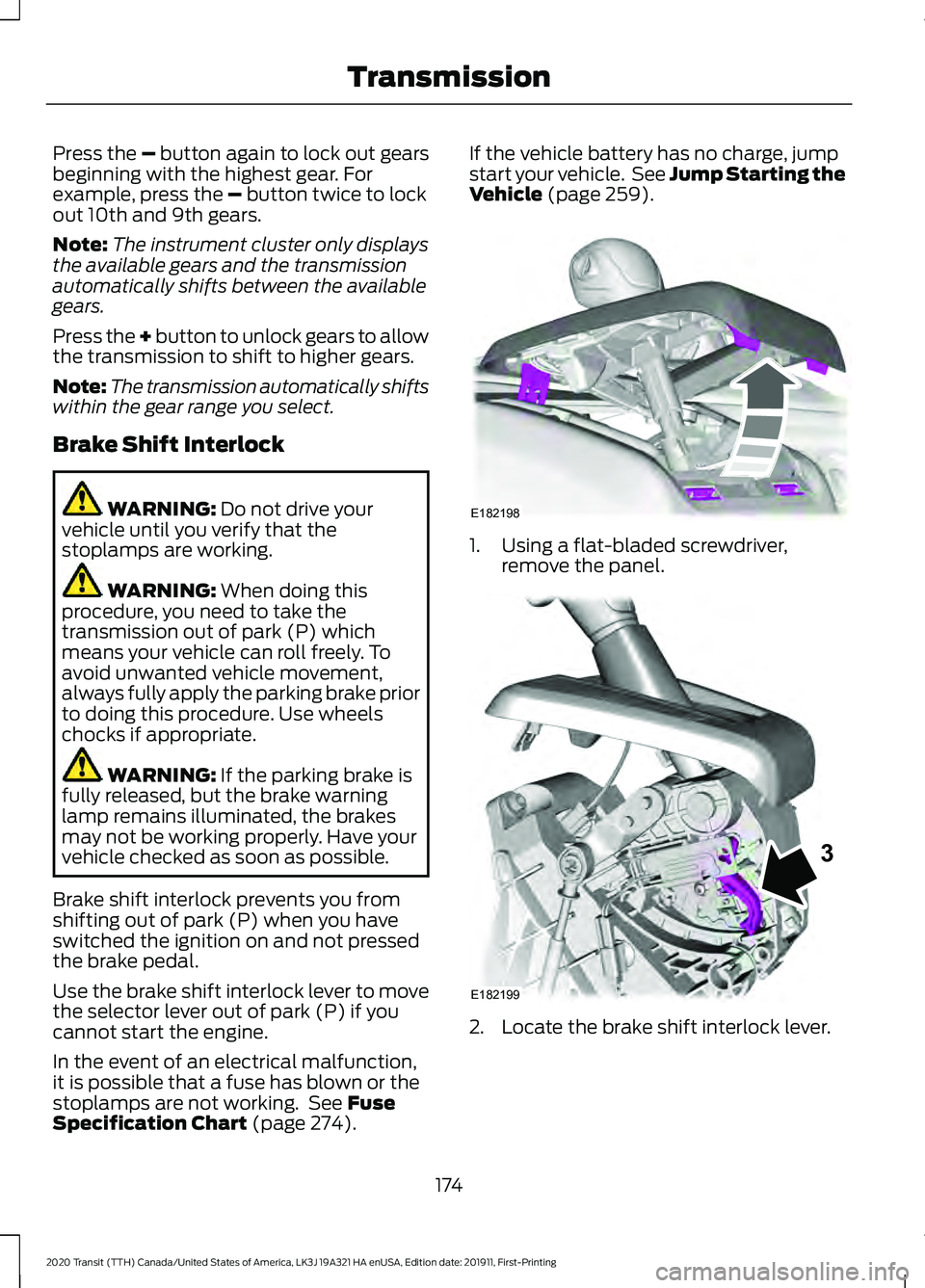
Use the brake shift interlock lever to move
the selector lever out of park (P) if you
cannot start the engine.
In the event of an electrical malfunction,
it is possible that a fuse has blown or the
stoplamps are not working. See
Fuse
Specification Chart (page 274). If the vehicle battery has no charge, jump
start your vehicle. See Jump Starting the
Vehicle
(page 259).
1. Using a flat-bladed screwdriver,
remove the panel. 2. Locate the brake shift interlock lever.
174
2020 Transit (TTH) Canada/United States of America, LK3J 19A321 HA enUSA, Edition date: 201911, First-Printing TransmissionE182198 E182199
3
Page 246 of 529

RV & Trailer Towing Guide Online
http://www.fleet.ford.com/towing-guides/
Website
RECOMMENDED TOWING
WEIGHTS - CHASSIS CAB/
CREW VAN/CUTAWAY/VAN
Note: Make sure to take into
consideration trailer frontal area.
Vehicles equipped with the Trailer
Tow Package or the Heavy Duty
Payload Package should not
exceed 55 ft² (5.1 m²) trailer frontal
area.
Note: Exceeding this limitation
may significantly reduce the
performance of your towing
vehicle. Selecting a trailer with a
low aerodynamic drag and rounded
front design helps optimize
performance and fuel economy. Note:
For high altitude operation,
reduce the gross combined weight
by 2% per 1,000 ft (300 m)
starting at the 1,000 ft (300 m)
elevation point.
Note: Certain states require
electric trailer brakes for trailers
over a specified weight. Be sure to
check state regulations for this
specified weight. The maximum
trailer weights listed may be limited
to this specified weight, as your
vehicle's electrical system may not
include the wiring connector
needed to use electric trailer
brakes.
Your vehicle may tow a trailer
provided the maximum trailer
weight is less than or equal to the
maximum trailer weight listed for
your vehicle configuration on the
following charts.
243
2020 Transit (TTH) Canada/United States of America, LK3J 19A321 HA enUSA, Edition date: 201911, First-Printing Towing
Page 248 of 529
Calculating the Maximum
Loaded Trailer Weight for Your
Vehicle
1. Start with the gross combined
weight rating for your vehicle
model and axle ratio. See the
previous charts.
2. Subtract all of the following
that apply to your vehicle:
• Vehicle curb weight
• Hitch hardware weight, such as
a draw bar, ball, locks or weight
distributing hardware
• Driver weight
• Passenger(s) weight
• Payload, cargo and luggage
weight
• Aftermarket equipment weight.
This equals the maximum loaded
trailer weight for this combination.
Note: The trailer tongue load is
considered part of the payload for
your vehicle. Reduce the total
payload by the final trailer tongue
weight.
Note: Consult an authorized dealer
to determine the maximum trailer
weight allowed for your vehicle if
you are not sure. RECOMMENDED TOWING
WEIGHTS - M2 BUS
Note:
Make sure to take into
consideration trailer frontal area.
Vehicles equipped with the Trailer
Tow Package or the Heavy Duty
Payload Package should not
exceed 55 ft² (5.1 m²) trailer frontal
area.
Note: Exceeding this limitation
may significantly reduce the
performance of your towing
vehicle. Selecting a trailer with a
low aerodynamic drag and rounded
front design helps optimize
performance and fuel economy.
Note: For high altitude operation,
reduce the gross combined weight
by 2% per 1,000 ft (300 m)
starting at the 1,000 ft (300 m)
elevation point.
Note: Certain states require
electric trailer brakes for trailers
over a specified weight. Be sure to
check state regulations for this
specified weight. The maximum
trailer weights listed may be limited
to this specified weight, as your
vehicle's electrical system may not
include the wiring connector
needed to use electric trailer
brakes.
Your vehicle may tow a trailer
provided the maximum trailer
weight is less than or equal to the
maximum trailer weight listed for
your vehicle configuration on the
following charts.
245
2020 Transit (TTH) Canada/United States of America, LK3J 19A321 HA enUSA, Edition date: 201911, First-Printing Towing
Page 250 of 529
Calculating the Maximum
Loaded Trailer Weight for Your
Vehicle
1. Start with the gross combined
weight rating for your vehicle
model and axle ratio. See the
previous charts.
2. Subtract all of the following
that apply to your vehicle:
• Vehicle curb weight
• Hitch hardware weight, such as
a draw bar, ball, locks or weight
distributing hardware
• Driver weight
• Passenger(s) weight
• Payload, cargo and luggage
weight
• Aftermarket equipment weight.
This equals the maximum loaded
trailer weight for this combination.
Note: The trailer tongue load is
considered part of the payload for
your vehicle. Reduce the total
payload by the final trailer tongue
weight.
Note: Consult an authorized dealer
to determine the maximum trailer
weight allowed for your vehicle if
you are not sure. ESSENTIAL TOWING CHECKS
Follow these guidelines for safe towing:
•
Do not tow a trailer until your vehicle
has covered at least 1,000 mi
(1,600 km). See Breaking-In (page
255).
• Consult your local motor vehicle laws
for towing a trailer.
• See the instructions included with
towing accessories for the correct
installation and adjustment
specifications.
• Service your vehicle more frequently if
you tow a trailer. See
Scheduled
Maintenance (page 462).
• If you use a rental trailer, follow the
instructions the rental agency gives
you.
Refer to
Load Carrying for load
specification terms found on the tire label,
Safety Compliance label and instructions
on calculating your vehicle's maximum
load. See
Load Limit (page 237).
Remember to account for the trailer
tongue weight as part of your vehicle load
when calculating the total vehicle weight.
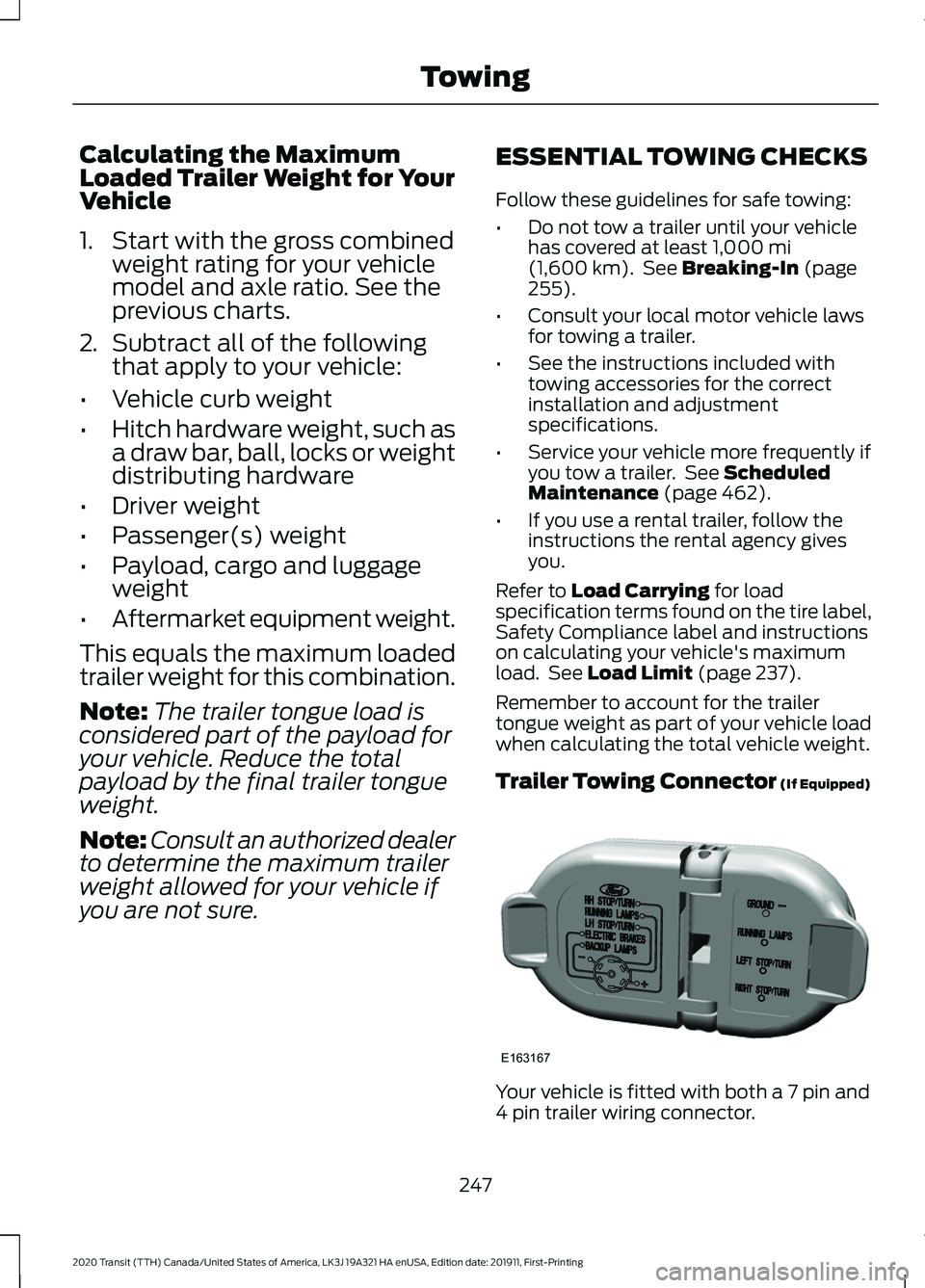
Trailer Towing Connector
(If Equipped) Your vehicle is fitted with both a 7 pin and
4 pin trailer wiring connector.
247
2020 Transit (TTH) Canada/United States of America, LK3J 19A321 HA enUSA, Edition date: 201911, First-Printing TowingE163167
Page 277 of 529
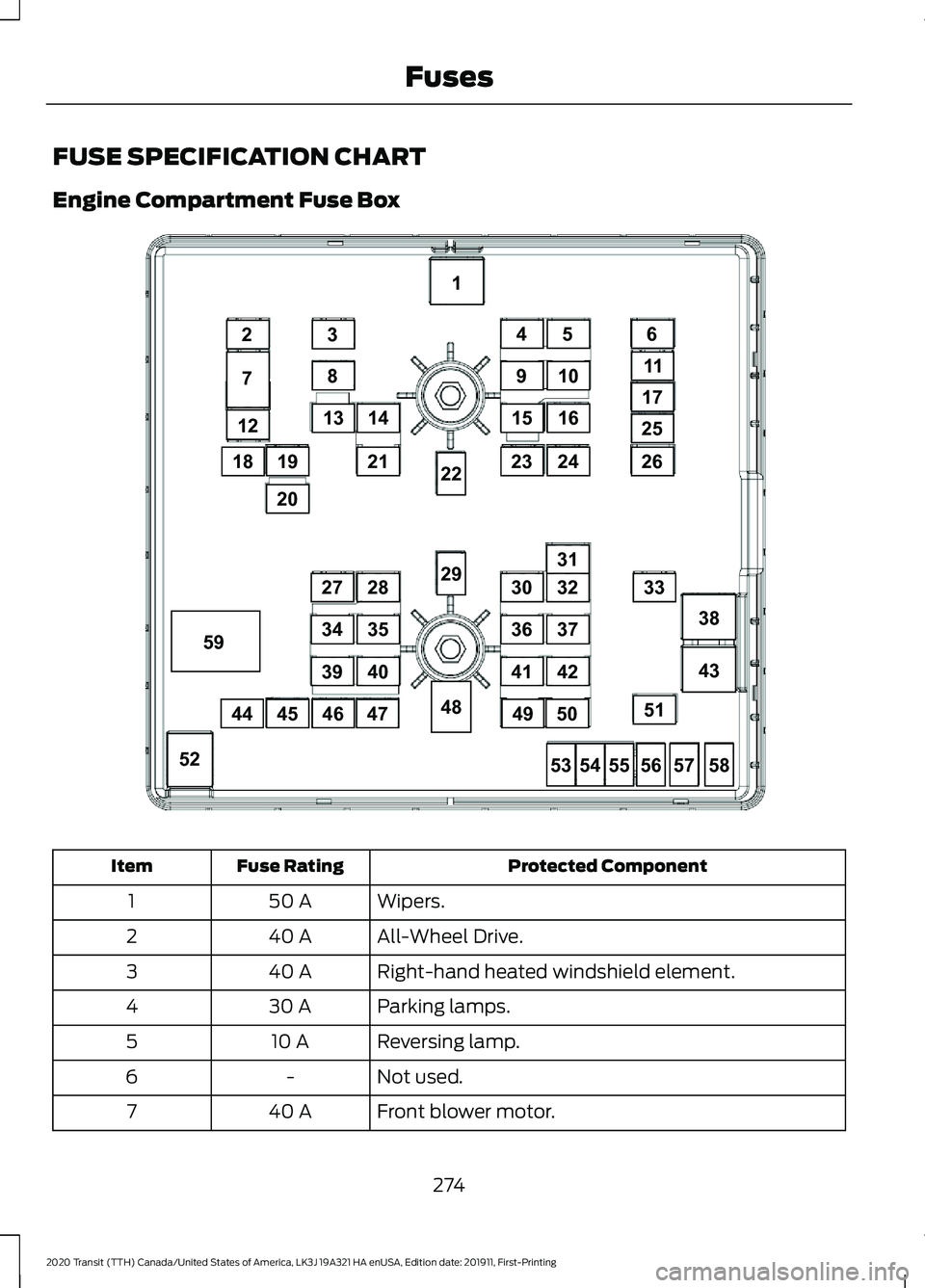
FUSE SPECIFICATION CHART
Engine Compartment Fuse Box
Protected Component
Fuse Rating
Item
Wipers.
50 A
1
All-Wheel Drive.
40 A
2
Right-hand heated windshield element.
40 A
3
Parking lamps.
30 A
4
Reversing lamp.
10 A
5
Not used.
-
6
Front blower motor.
40 A
7
274
2020 Transit (TTH) Canada/United States of America, LK3J 19A321 HA enUSA, Edition date: 201911, First-Printing Fuses12
18
7
23
8
13
1
38
43
52
21
28
35
4039
34
27
31
33
51
26
25
17
11
6
14
910
45
1516
2324
53
48
29
22
5455565758
19
20
45444647
32
37
4241
36
30
4950
59E308021
Page 311 of 529
2. Remove the screws.
3. Pull the headlamp toward the front of
your vehicle to disengage it from its
locating points and then lift the
headlamp up. 4. Disconnect the electrical connectors. Note:
When you install the headlamp, make
sure that you correctly attach the electrical
connector.
Note: When you install the headlamp, make
sure that you correctly engage its locating
points.
CHANGING A BULB WARNING: Switch the lamps and
the ignition off. Failure to do so could
result in serious personal injury. WARNING:
Lamps and associated
components become hot when in use.
Let them cool down before you remove
them.
Use the correct specification bulb. See
Bulb Specification Chart
(page 386).
The following instructions describe how to
remove the bulbs. To install, reverse the
removal procedure.
Note: LED lamps are not serviceable.
Contact an authorized dealer.
308
2020 Transit (TTH) Canada/United States of America, LK3J 19A321 HA enUSA, Edition date: 201911, First-Printing MaintenanceE169198
2 E169199 E169200
Page 332 of 529
15: Indicates the wheel or
rim diameter in inches. If
you change the wheel
size, you will have to
purchase new tires to
match the new wheel
diameter.
E
95:
Indicates the tire's
load index. It is an index
that relates to how much
weight a tire can carry.
You may find this
information in the Owner ’s
Guide. If not, contact a
local tire dealer.
F
H:
Indicates the tire's
speed rating. The speed
rating denotes the speed
at which a tire is designed
to be driven for extended
periods of time under a
G
standard condition of load
and inflation pressure.
The tires on your vehicle
may operate at different
conditions for load and
inflation pressure. These
speed ratings may need
to be adjusted for the
difference in conditions.
The ratings range from 81
mph (130 kph) to 186 mph
(299 kph). These ratings
are listed in the following
chart. United States of
America DOT Tire
Identification Number
(TIN):
This begins with
the letters DOT and
indicates that the tire
H
meets all federal
standards. The next two
numbers or letters are the
plant code designating
where it was
manufactured, the next
two are the tire size code
and the last four numbers
represent the week and
year the tire was built. For
example, the numbers 317
mean the 31st week of
1997. After 2000 the
numbers go to four digits.
For example, 2501 means
the 25th week of 2001.
The numbers in between
are identification codes
used for traceability. This
information is used to
contact customers if a tire
defect requires a recall.
M+S or M/S:
Mud and
Snow, AT: All Terrain, AS:
All Season.
I
Tire Ply Composition
and Material Used:
Indicates the number of
plies or the number of
layers of rubber-coated
fabric in the tire tread and
J
sidewall. Tire
329
2020 Transit (TTH) Canada/United States of America, LK3J 19A321 HA enUSA, Edition date: 201911, First-Printing Wheels and Tires
Page 350 of 529
Understanding the Tire Pressure
Monitoring System
The system measures the pressure in the
four road tires and displays the readings in
the instrument cluster.
The system detects this lower pressure as
being significantly below the correct
inflation pressure and the warning lamp
illuminates. You must inflate the tires to
the correct pressure.
When the Temporary Spare Tire is
Installed
If you need to replace a road wheel and
tire with the temporary spare wheel, the
system will continue to identify a defect.
This is to remind you to repair the damaged
road wheel and tire and refit the repaired
road wheel and tire assembly to your
vehicle. To restore the correct operation
of the system, you must have the repaired
road wheel and tire assembly refitted to
your vehicle.
When You Believe the System is Not
Operating Correctly
The main function of the system is to warn
you when the tire pressures are low. It can
also warn you in the event the system is
no longer capable of operating correctly.
See the following chart for information
concerning the system:
347
2020 Transit (TTH) Canada/United States of America, LK3J 19A321 HA enUSA, Edition date: 201911, First-Printing Wheels and Tires