seats FORD TRANSIT CONNECT 2015 2.G Owner's Manual
[x] Cancel search | Manufacturer: FORD, Model Year: 2015, Model line: TRANSIT CONNECT, Model: FORD TRANSIT CONNECT 2015 2.GPages: 428, PDF Size: 6.27 MB
Page 48 of 428
Children 12 years old and under should
always be properly restrained in the rear
seats. The Safety Canopy will not interfere
with children restrained using a properly
installed child or booster seat because it
is designed to inflate downward from the
headliner above the doors along the side
window opening.
The design and development of the Safety
Canopy included recommended testing
procedures that were developed by a
group of automotive safety experts known
as the Side Airbag Technical Working
Group. These recommended testing
procedures help reduce the risk of injuries
related to the deployment of side airbags
(including the Safety Canopy).
CRASH SENSORS AND
AIRBAG INDICATOR
WARNING
Modifying or adding equipment to
the front end of your vehicle
(including frame, bumper, front end
body structure and tow hooks) may affect
the performance of the airbag system,
increasing the risk of injury. Do not modify
the front end of your vehicle. Your vehicle has a collection of crash and
occupant sensors which provide
information to the restraints control
module which deploys (activates) the
front safety belt pretensioners, driver
airbag, passenger airbag, seat mounted
side airbags, and the Safety Canopy. Based
on the type of accident (frontal impact,
side impact or rollover) the restraints
control module will deploy the appropriate
safety devices. The restraints control module also
monitors the readiness of the above safety
devices plus the crash and occupant
sensors. A warning indicator light in the
instrument cluster indicates the readiness
of the safety system. If this warning
indicator light is not functioning and there
is another fault within the system, the
message cluster may display an airbag
failure warning. See Information
Displays (page 84). You will hear five
tones that repeat periodically until you
repair the problem, the warning indicator
light or both. Routine maintenance of the
airbag is not required.
A difficulty with the system is indicated by
one or more of the following: •
The readiness light will not illuminate
immediately after the ignition is turned
on.
• The readiness light will either flash or
stay lit.
• A series of five beeps will be heard. The
tone pattern will repeat periodically
until the problem, the light or both are
repaired.
If any of these things happen, even
intermittently, have the supplemental
restraint system serviced at an authorized
dealer immediately. Unless serviced, the
system may not function properly in the
event of a crash.
The safety belt pretensioners and the
airbag supplemental restraint system is
designed to activate when your vehicle
sustains frontal or sideways deceleration
sufficient to cause the restraints control
module to deploy a safety device or when
a certain likelihood of a rollover event is
detected by the rollover sensor.
45
Transit Connect (CHC) Canada/United States of America, enUSA, First Printing Supplementary Restraints System
Page 61 of 428
MANUAL LIFTGATE
WARNINGS
It is extremely dangerous to ride in a
cargo area, inside or outside of your
vehicle. In a crash, people riding in
these areas are more likely to be seriously
injured or killed. Do not allow people to ride
in any area of your vehicle that is not
equipped with seats and safety belts. Make
sure everyone in your vehicle is in a seat
and properly using a safety belt. Failure to
follow this warning could result in serious
personal injury or death. Make sure to close and latch the
liftgate to prevent drawing exhaust
fumes into your vehicle. This will also
prevent passengers and cargo from falling
out. If you must drive with the liftgate open,
keep the vents or windows open so outside
air comes into your vehicle. Failure to
follow this warning could result in serious
personal injury. Note:
Be careful when opening or closing
the liftgate in a garage or other enclosed
area to avoid damaging the liftgate.
Note: Do not hang anything from the
spoiler, rear window or liftgate, for example
a bike rack. This could damage the liftgate
and its components.
Opening and Closing the Liftgate
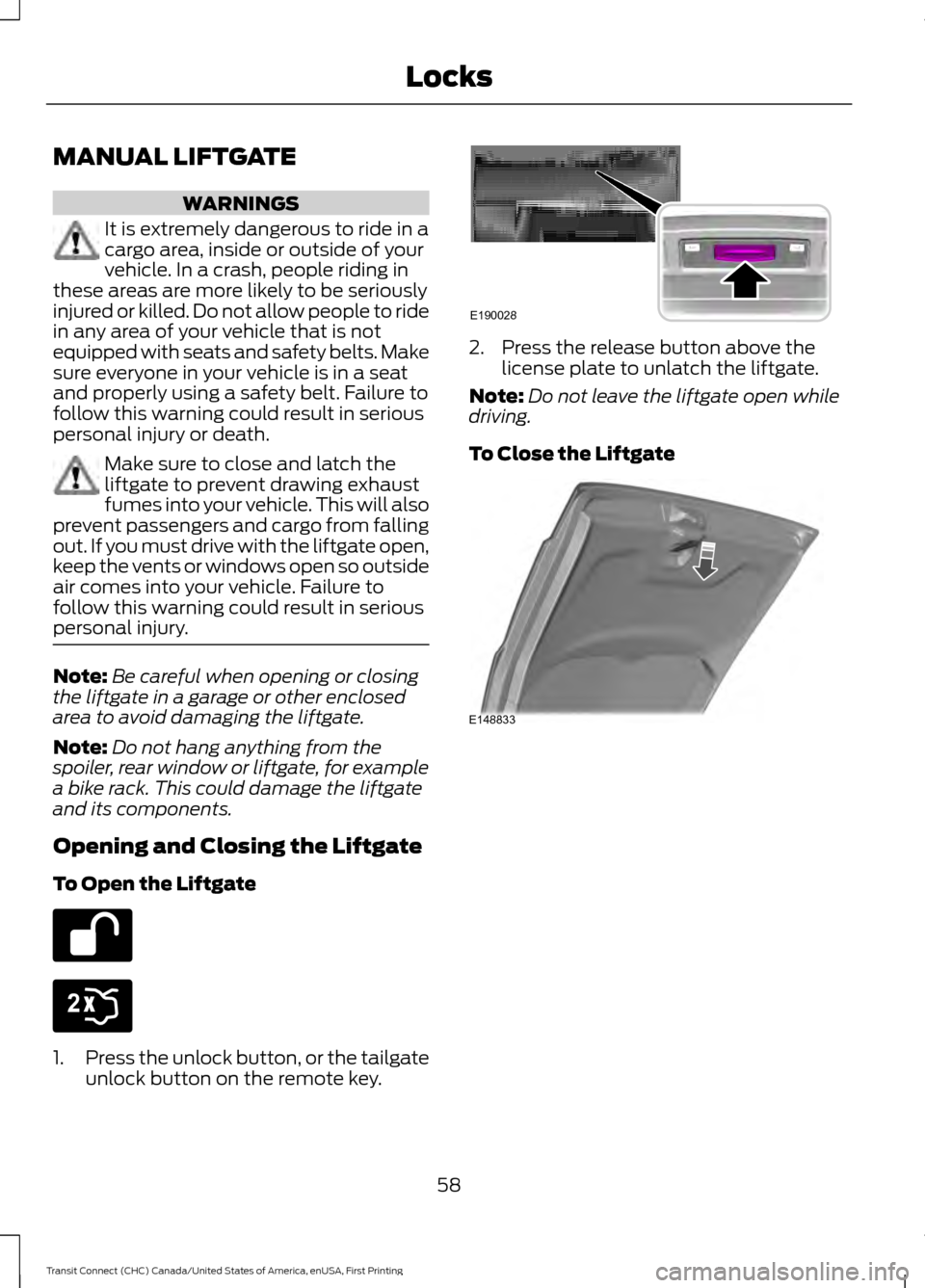
To Open the Liftgate 1.
Press the unlock button, or the tailgate
unlock button on the remote key. 2. Press the release button above the
license plate to unlatch the liftgate.
Note: Do not leave the liftgate open while
driving.
To Close the Liftgate 58
Transit Connect (CHC) Canada/United States of America, enUSA, First Printing Locks E190028 E148833
Page 102 of 428
Mono Mode
In this mode, the temperature settings for
both the driver side and passenger side are
linked. If you adjust the setting using the
rotary control on the driver side, the system
adjusts the temperature to the same
setting on the passenger side.
Switching Mono Mode Off
Select a temperature for the passenger
side using the rotary control on the
passenger side. Mono mode automatically
switches off. The temperature on the driver
side remains unchanged. You can now
adjust the driver side and passenger side
temperatures independently. The
temperature settings for each side are
shown in the display.
Switching Mono Mode Back On
Press and hold the AUTO button. The
passenger side temperature is adjusted to
the driver side temperature setting.
HINTS ON CONTROLLING THE
INTERIOR CLIMATE
General Hints
Note: Prolonged use of recirculated air may
cause the windows to fog up.
Note: A small amount of air may be felt
from the footwell air vents regardless of the
air distribution setting.
Note: To reduce humidity build-up inside
your vehicle, do not drive with the system
switched off or with recirculated air always
switched on.
Note: Do not place objects under the front
seats as this may interfere with the airflow
to the rear seats. Note:
Keep the air intakes in front of the
windshield free from obstruction (such as
snow or leaves) to allow the climate control
system to function effectively.
Note: To reduce fogging of the windshield
during humid weather, adjust the air
distribution control to the windshield air
vents position. Increase the temperature
and fan speed and press the A/C button to
improve clearing, if required.
Heating the Interior Quickly
• Adjust the fan speed to the highest
speed setting.
• Adjust the temperature control to the
highest setting.
• Adjust the air distribution control to the
footwell air vents position.
Recommended Settings for
Heating
• Adjust the fan speed to the second
speed setting.
• Adjust the temperature control to the
midway point of the hot settings.
• Adjust the air distribution control to the
footwell and windshield air vents
position.
Cooling the Interior Quickly
• Adjust the fan speed to the highest
speed setting.
• Adjust the temperature control to the
MAX A/C
position.
• Adjust the air distribution control to the
instrument panel air vents position.
99
Transit Connect (CHC) Canada/United States of America, enUSA, First Printing Climate Control
Page 106 of 428
SITTING IN THE CORRECT
POSITION
WARNINGS
Do not recline the seat backrest too
far as this can cause the occupant
to slide under the safety belt,
resulting in serious injury in the event of a
crash. Sitting improperly, out of position or
with the seat backrest reclined too
far, can result in serious injury or
death in the event of a crash. Always sit
upright against your seat backrest, with
your feet on the floor. Do not place objects higher than the
seat backrest to reduce the risk of
serious injury in the event of a crash
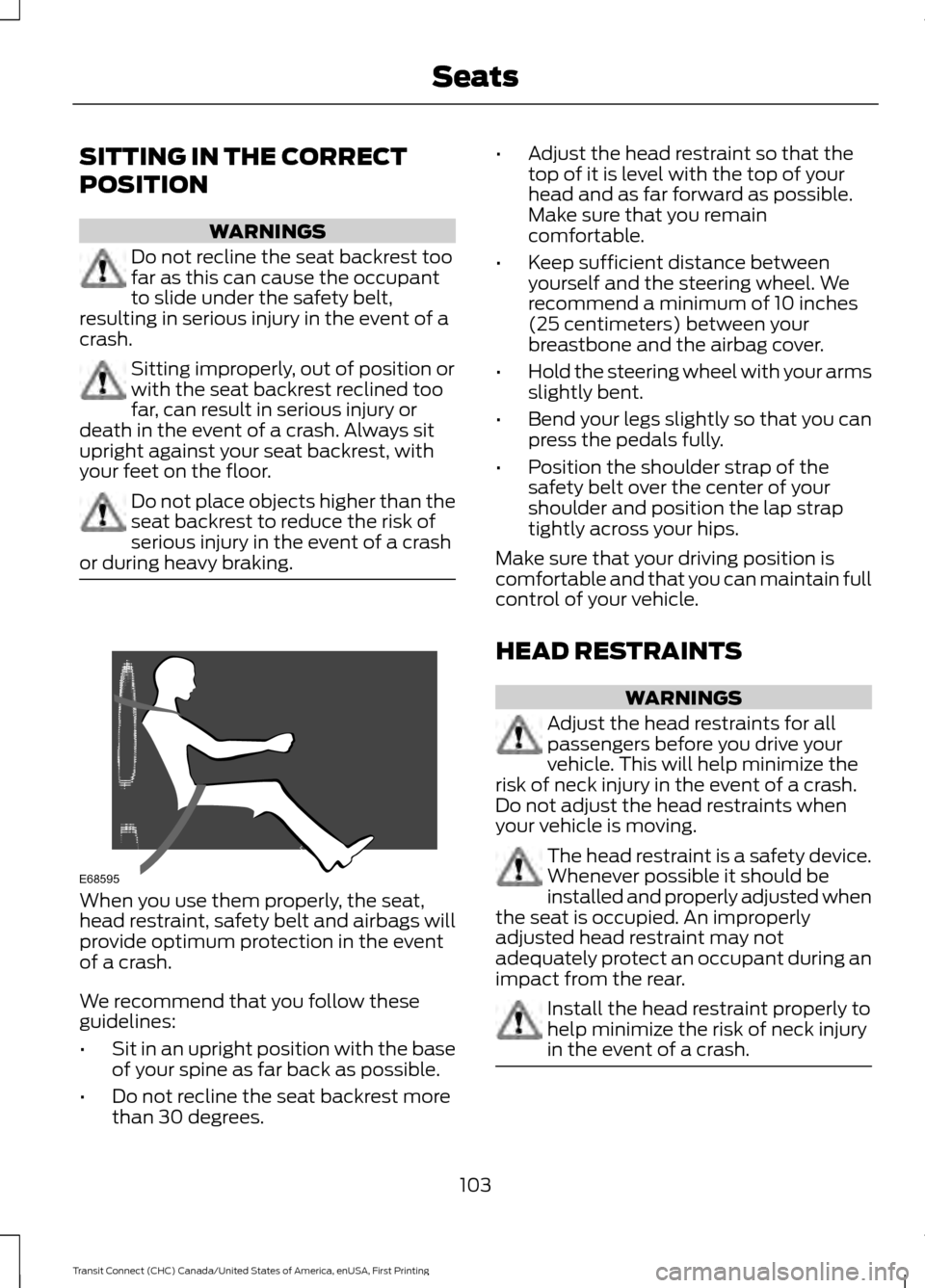
or during heavy braking. When you use them properly, the seat,
head restraint, safety belt and airbags will
provide optimum protection in the event
of a crash.
We recommend that you follow these
guidelines:
•
Sit in an upright position with the base
of your spine as far back as possible.
• Do not recline the seat backrest more
than 30 degrees. •
Adjust the head restraint so that the
top of it is level with the top of your
head and as far forward as possible.
Make sure that you remain
comfortable.
• Keep sufficient distance between
yourself and the steering wheel. We
recommend a minimum of 10 inches
(25 centimeters) between your
breastbone and the airbag cover.
• Hold the steering wheel with your arms
slightly bent.
• Bend your legs slightly so that you can
press the pedals fully.
• Position the shoulder strap of the
safety belt over the center of your
shoulder and position the lap strap
tightly across your hips.
Make sure that your driving position is
comfortable and that you can maintain full
control of your vehicle.
HEAD RESTRAINTS WARNINGS
Adjust the head restraints for all
passengers before you drive your
vehicle. This will help minimize the
risk of neck injury in the event of a crash.
Do not adjust the head restraints when
your vehicle is moving. The head restraint is a safety device.
Whenever possible it should be
installed and properly adjusted when
the seat is occupied. An improperly
adjusted head restraint may not
adequately protect an occupant during an
impact from the rear. Install the head restraint properly to
help minimize the risk of neck injury
in the event of a crash.
103
Transit Connect (CHC) Canada/United States of America, enUSA, First Printing SeatsE68595
Page 107 of 428
Note:
Adjust the seat backrest to an upright
driving position before adjusting the head
restraint. Adjust the head restraint so that
the top of it is level with the top of your head
and as far forward as possible. Make sure
that you remain comfortable. If you are
extremely tall, adjust the head restraint to
its highest position.
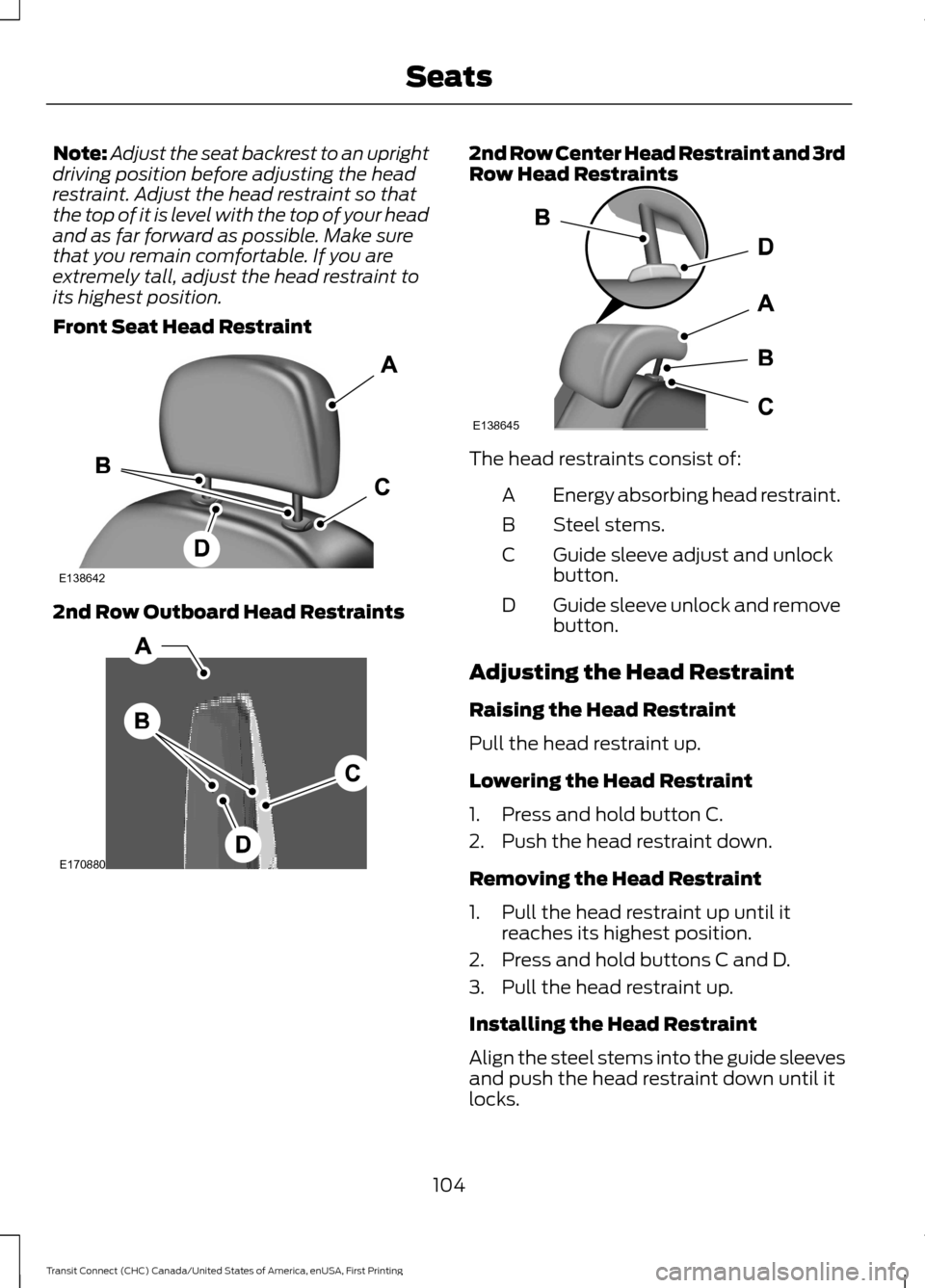
Front Seat Head Restraint 2nd Row Outboard Head Restraints 2nd Row Center Head Restraint and 3rd
Row Head Restraints
The head restraints consist of:
Energy absorbing head restraint.
A
Steel stems.
B
Guide sleeve adjust and unlock
button.
C
Guide sleeve unlock and remove
button.
D
Adjusting the Head Restraint
Raising the Head Restraint
Pull the head restraint up.
Lowering the Head Restraint
1. Press and hold button C.
2. Push the head restraint down.
Removing the Head Restraint
1. Pull the head restraint up until it reaches its highest position.
2. Press and hold buttons C and D.
3. Pull the head restraint up.
Installing the Head Restraint
Align the steel stems into the guide sleeves
and push the head restraint down until it
locks.
104
Transit Connect (CHC) Canada/United States of America, enUSA, First Printing SeatsE138642 E170880 E138645
Page 108 of 428
Tilting Head Restraints (If Equipped)
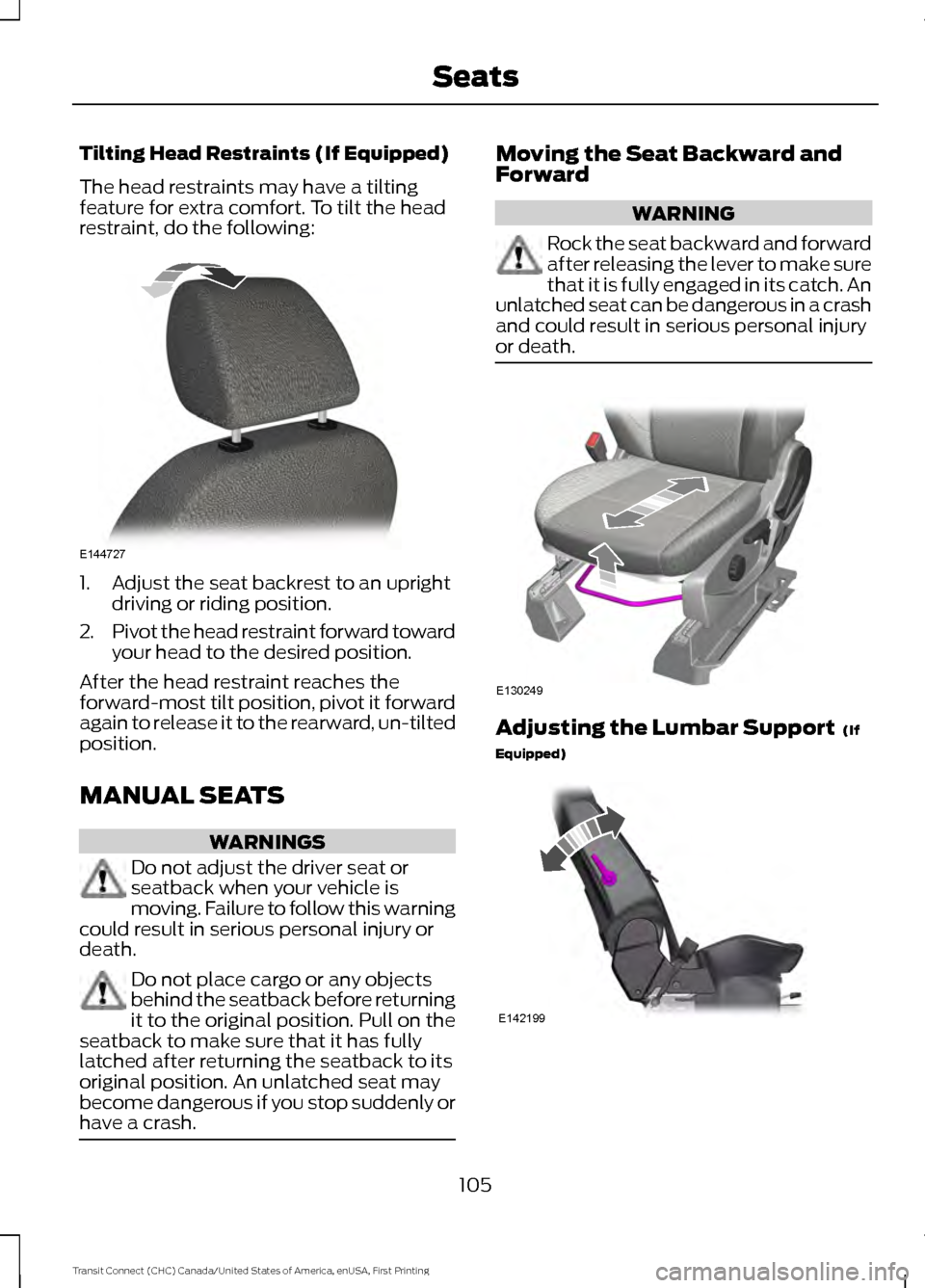
The head restraints may have a tilting
feature for extra comfort. To tilt the head
restraint, do the following:
1. Adjust the seat backrest to an upright
driving or riding position.
2. Pivot the head restraint forward toward
your head to the desired position.
After the head restraint reaches the
forward-most tilt position, pivot it forward
again to release it to the rearward, un-tilted
position.
MANUAL SEATS WARNINGS
Do not adjust the driver seat or
seatback when your vehicle is
moving. Failure to follow this warning
could result in serious personal injury or
death. Do not place cargo or any objects
behind the seatback before returning
it to the original position. Pull on the
seatback to make sure that it has fully
latched after returning the seatback to its
original position. An unlatched seat may
become dangerous if you stop suddenly or
have a crash. Moving the Seat Backward and
Forward
WARNING
Rock the seat backward and forward
after releasing the lever to make sure
that it is fully engaged in its catch. An
unlatched seat can be dangerous in a crash
and could result in serious personal injury
or death. Adjusting the Lumbar Support (If
Equipped) 105
Transit Connect (CHC) Canada/United States of America, enUSA, First Printing SeatsE144727 E130249 E142199
Page 109 of 428
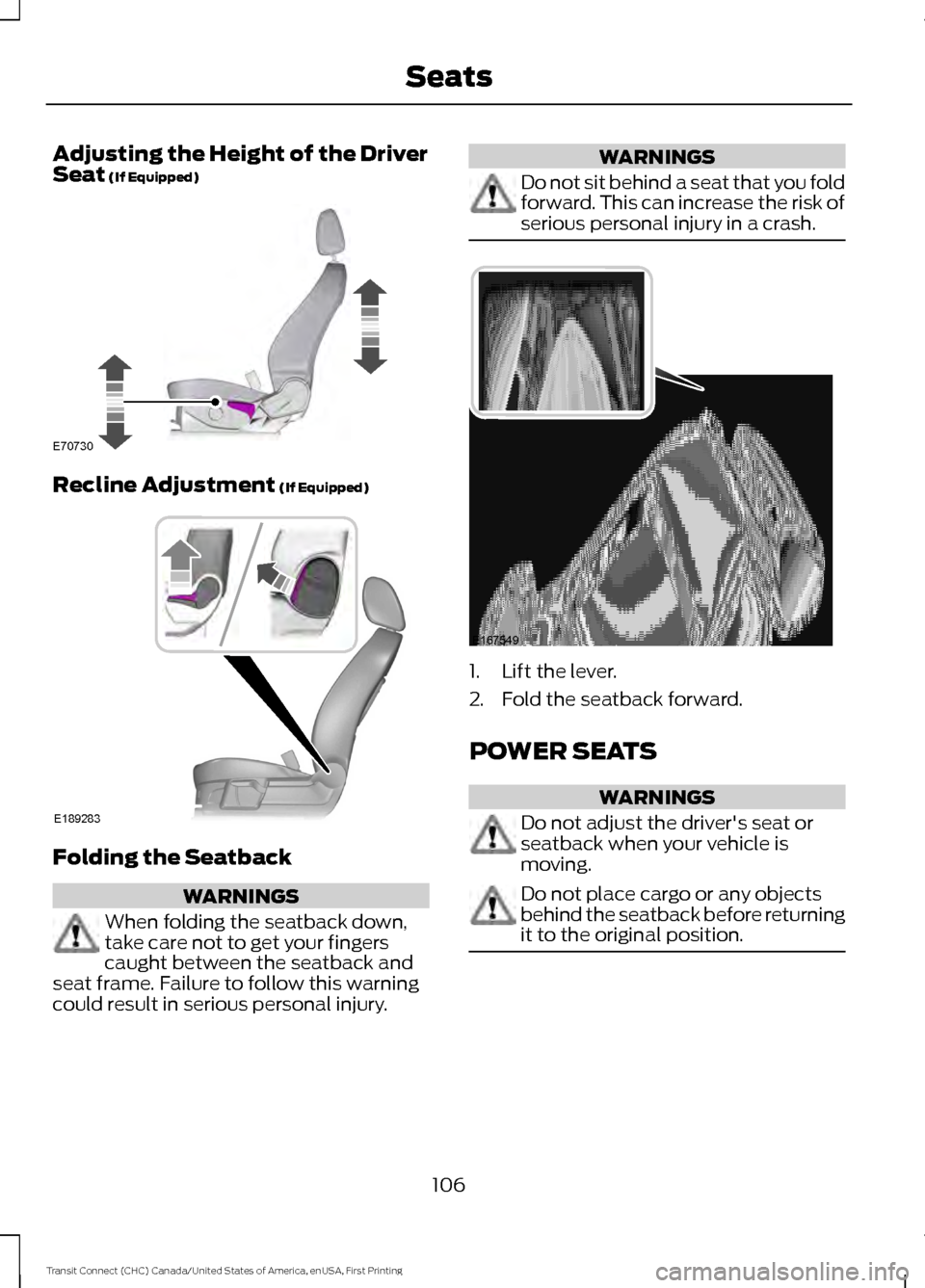
Adjusting the Height of the Driver
Seat (If Equipped)
Recline Adjustment
(If Equipped)
Folding the Seatback
WARNINGS
When folding the seatback down,
take care not to get your fingers
caught between the seatback and
seat frame. Failure to follow this warning
could result in serious personal injury. WARNINGS
Do not sit behind a seat that you fold
forward. This can increase the risk of
serious personal injury in a crash.
1. Lift the lever.
2. Fold the seatback forward.
POWER SEATS
WARNINGS
Do not adjust the driver's seat or
seatback when your vehicle is
moving.
Do not place cargo or any objects
behind the seatback before returning
it to the original position.
106
Transit Connect (CHC) Canada/United States of America, enUSA, First Printing SeatsE70730 E189283 E167549
Page 110 of 428
REAR SEATS
WARNINGS
Do not use the bench seats as a bed
when your vehicle is moving. Failure
to follow this warning could result in
serious personal injury or death. When folding or unfolding the seats
take care not to get your fingers
caught between the seatback and
seat frame. Failure to follow this warning
could result in serious personal injury. Do not place objects on a folded
seat. Hard objects may become
projectiles in a crash or sudden stop,
which may increase the risk of serious
personal injury. Note:
Fully lower the head restraint when
folding the seats. See Head Restraints
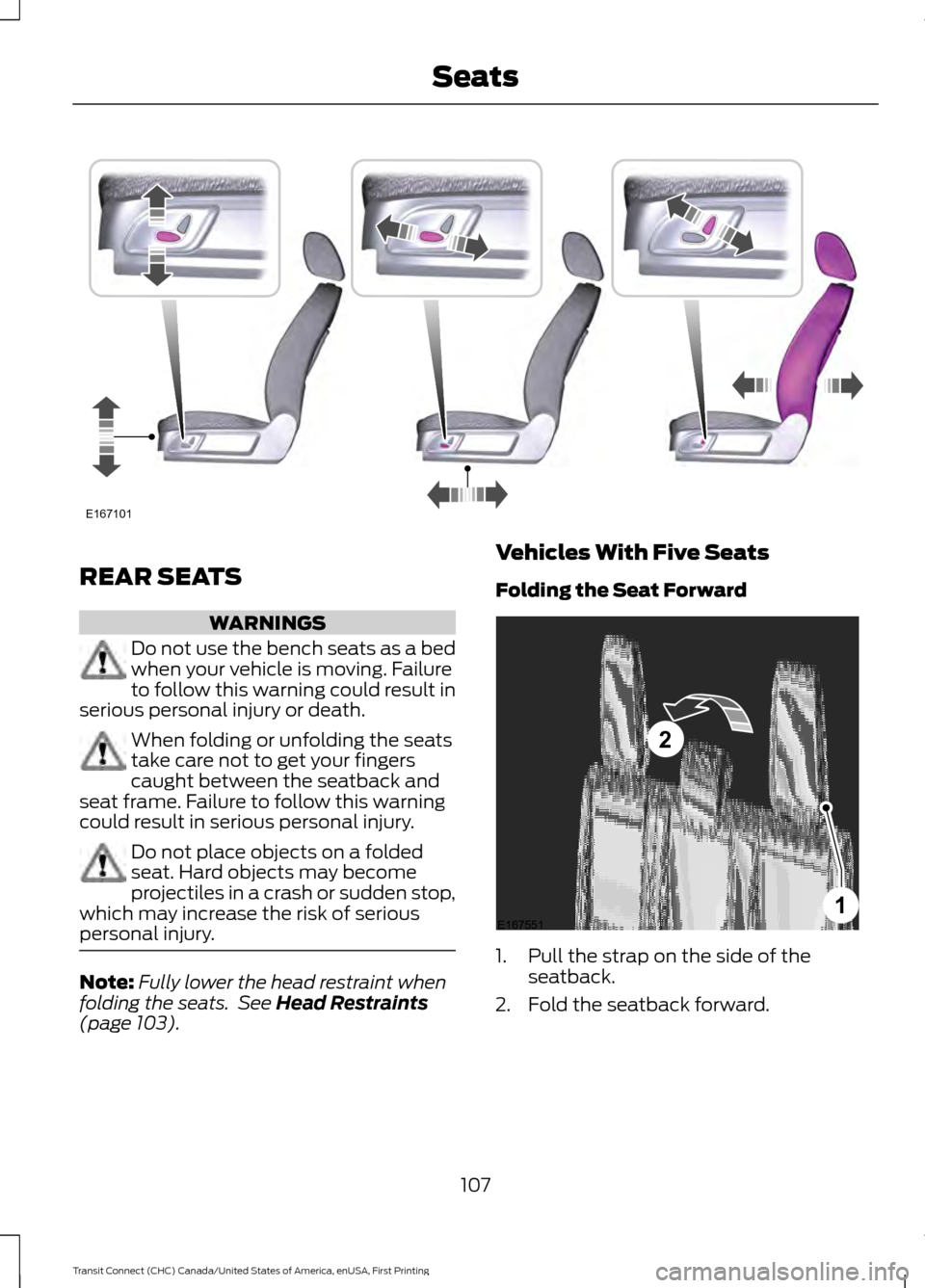
(page 103). Vehicles With Five Seats
Folding the Seat Forward
1. Pull the strap on the side of the
seatback.
2. Fold the seatback forward.
107
Transit Connect (CHC) Canada/United States of America, enUSA, First Printing SeatsE167101 E167551
2
1
Page 111 of 428
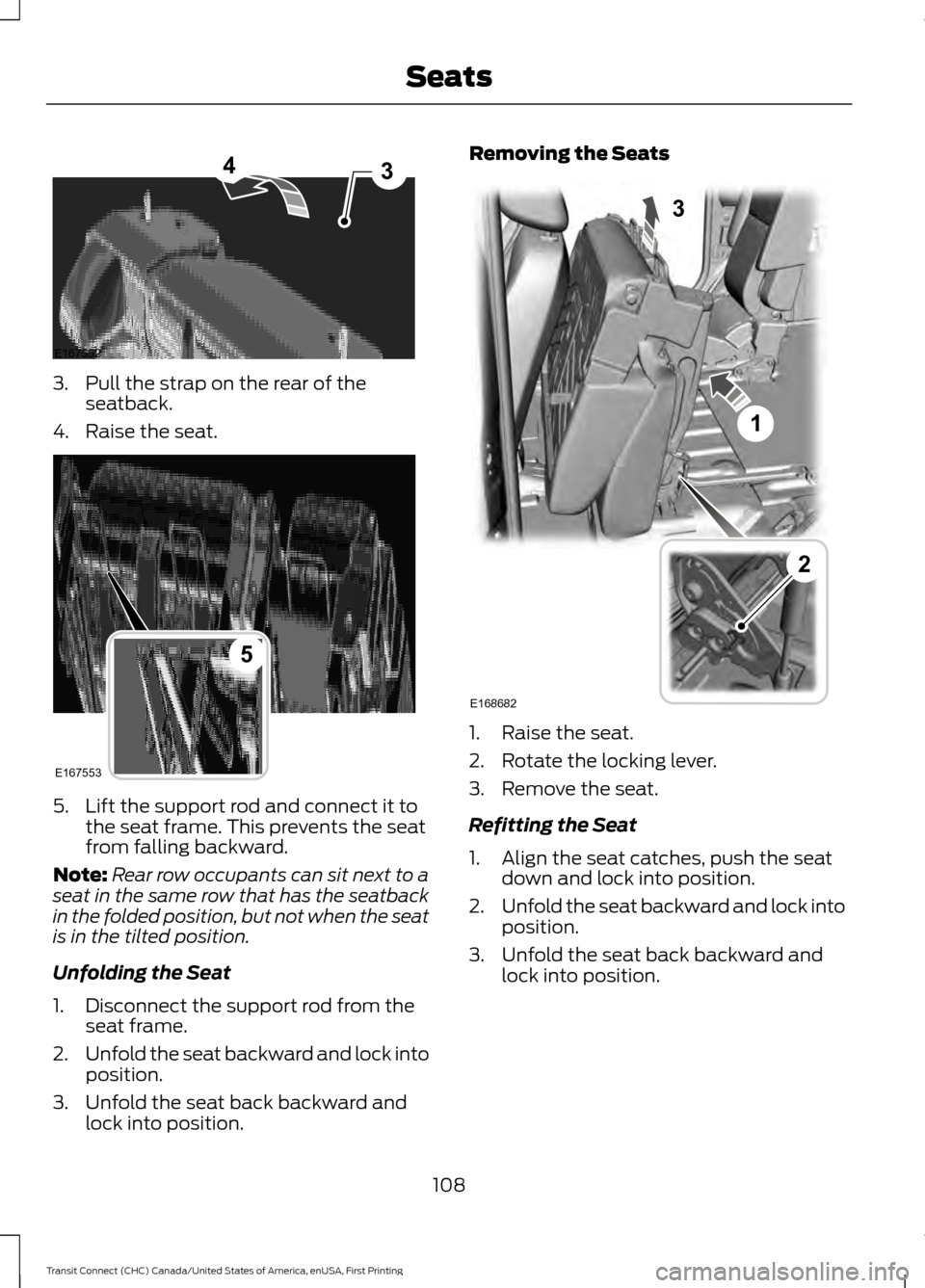
3. Pull the strap on the rear of the
seatback.
4. Raise the seat. 5. Lift the support rod and connect it to
the seat frame. This prevents the seat
from falling backward.
Note: Rear row occupants can sit next to a
seat in the same row that has the seatback
in the folded position, but not when the seat
is in the tilted position.
Unfolding the Seat
1. Disconnect the support rod from the seat frame.
2. Unfold the seat backward and lock into
position.
3. Unfold the seat back backward and lock into position. Removing the Seats
1. Raise the seat.
2. Rotate the locking lever.
3. Remove the seat.
Refitting the Seat
1. Align the seat catches, push the seat
down and lock into position.
2. Unfold the seat backward and lock into
position.
3. Unfold the seat back backward and lock into position.
108
Transit Connect (CHC) Canada/United States of America, enUSA, First Printing SeatsE167552
43 E167553
5 E168682
1
3
2
Page 112 of 428
Vehicles With Seven Seats
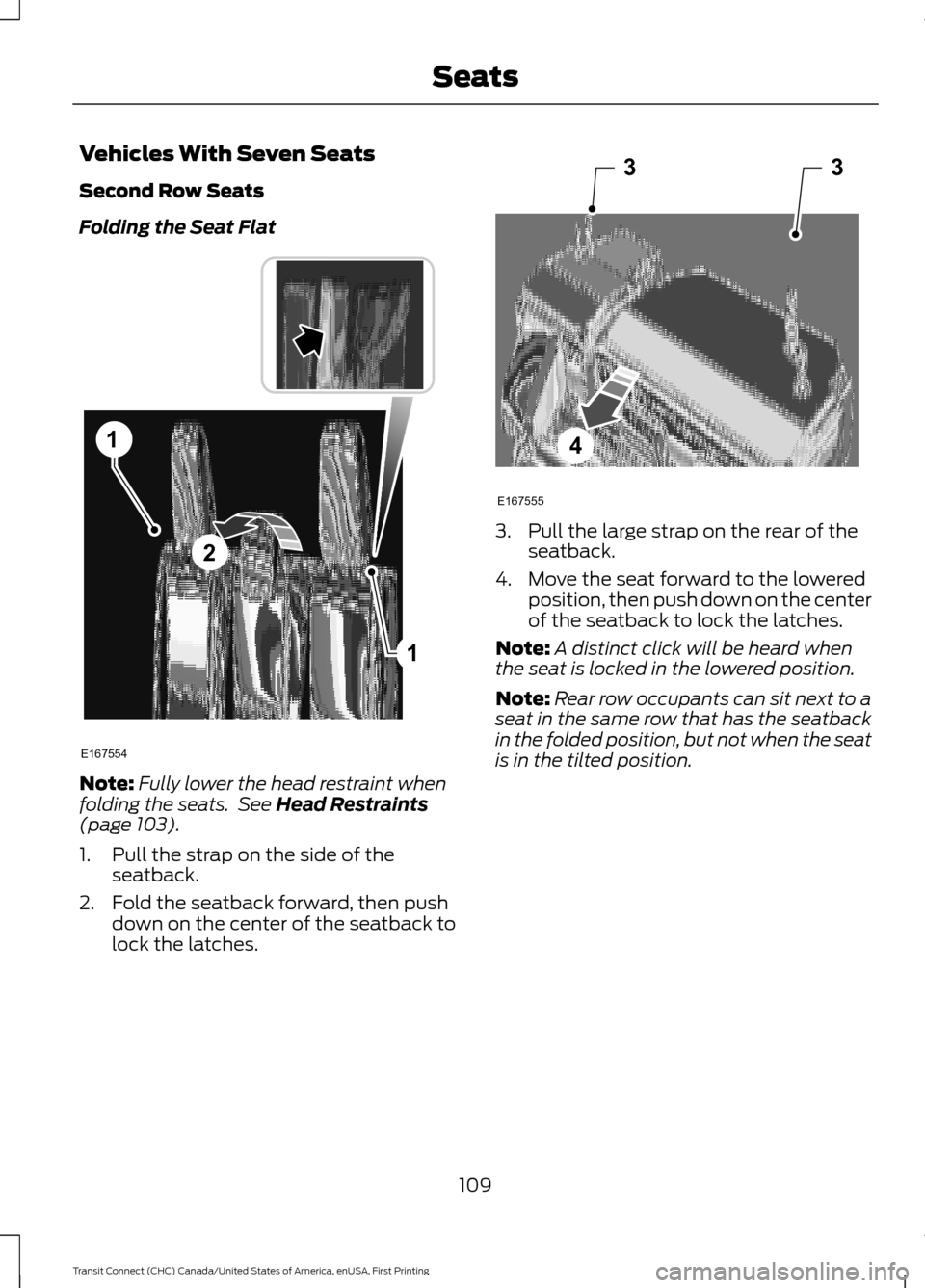
Second Row Seats
Folding the Seat Flat
Note:
Fully lower the head restraint when
folding the seats. See Head Restraints
(page 103).
1. Pull the strap on the side of the seatback.
2. Fold the seatback forward, then push down on the center of the seatback to
lock the latches. 3. Pull the large strap on the rear of the
seatback.
4. Move the seat forward to the lowered position, then push down on the center
of the seatback to lock the latches.
Note: A distinct click will be heard when
the seat is locked in the lowered position.
Note: Rear row occupants can sit next to a
seat in the same row that has the seatback
in the folded position, but not when the seat
is in the tilted position.
109
Transit Connect (CHC) Canada/United States of America, enUSA, First Printing Seats1
1
2
E167554 33
4
E167555