coolant temperature FORD TRANSIT CONNECT 2019 User Guide
[x] Cancel search | Manufacturer: FORD, Model Year: 2019, Model line: TRANSIT CONNECT, Model: FORD TRANSIT CONNECT 2019Pages: 493, PDF Size: 7.43 MB
Page 242 of 493
BREAKING-IN
You need to break in new tires for
approximately 300 mi (480 km). During
this time, your vehicle may exhibit some
unusual driving characteristics.
Avoid driving too fast during the first
1,000 mi (1,600 km)
. Vary your speed
frequently and change up through the
gears early. Do not labor the engine.
Do not tow during the first
1,000 mi
(1,600 km).
REDUCED ENGINE
PERFORMANCE WARNING:
If you continue to drive
your vehicle when the engine is
overheating, the engine could stop without
warning. Failure to follow this instruction
could result in the loss of control of your
vehicle.
If the engine coolant temperature gauge
needle moves to the upper limit position,
the engine is overheating. See
Gauges
(page 87).
You must only drive your vehicle for a short
distance if the engine overheats. The
distance you can travel depends on
ambient temperature, vehicle load and
terrain. The engine continues to operate
with limited power for a short period of
time.
If the engine temperature continues to rise,
the fuel supply to the engine reduces. The
air conditioning switches off and the engine
cooling fan operates continually.
1. Gradually reduce your speed and stop your vehicle as soon as it is safe to do
so. 2. Immediately switch the engine off to
prevent severe engine damage.
3. Wait for the engine to cool down.
4. Check the coolant level. See
Engine
Coolant Check (page 268).
5. Have your vehicle checked as soon as possible.
ECONOMICAL DRIVING
Fuel economy is affected by several things
such as how you drive, the conditions you
drive under and how you maintain your
vehicle.
There are some things to keep in mind that
may improve your fuel economy:
• Accelerate and slow down in a smooth,
moderate fashion.
• Drive at steady speeds.
• Anticipate stops; slowing down may
eliminate the need to stop.
• Combine errands and minimize
stop-and-go driving (When running
errands, go to the furthest destination
first and then work your way back
home).
• Close the windows for high-speed
driving.
• Drive at reasonable speeds.
• Keep the tires properly inflated and use
only the recommended size.
• Use the recommended engine oil.
• Perform all regularly scheduled
maintenance.
There are also some things you may want
to avoid doing because they reduce your
fuel economy:
• Avoid sudden or hard accelerations.
• Avoid revving the engine before turning
off the car.
• Avoid long idle periods.
238
2019 Transit Connect (CHC) Canada/United States of America, CG3739en enUSA, Edition date: 201804, First-Printing Driving Hints
Page 272 of 493
ENGINE COOLING FAN -
DIESEL
WARNING: Keep your hands and
clothing clear of the engine cooling fan.
Under certain conditions, the engine
cooling fan may continue to run for several
minutes after you switch your vehicle off.
This could happen in low ambient
temperatures and independent of the
engine coolant temperature, for example
short journeys or low coolant temperature.
See
Diesel Particulate Filter (page 163).
ENGINE COOLANT CHECK WARNING:
Do not remove the
coolant reservoir cap when the cooling
system is hot. Wait 10 minutes for the
cooling system to cool down. Cover the
coolant reservoir cap with a thick cloth to
prevent the possibility of scalding and
slowly remove the cap. Failure to follow
this instruction could result in personal
injury. WARNING: Do not put coolant in the
windshield washer reservoir. If sprayed on
the windshield, coolant could make it
difficult to see through the windshield. WARNING:
To reduce the risk of
personal injury, make sure the engine is
cool before unscrewing the coolant
pressure relief cap. The cooling system is
under pressure. Steam and hot liquid can
come out forcefully when you loosen the
cap slightly. WARNING:
Do not add coolant
further than the MAX mark. When the engine is cold, check the
concentration and level of the coolant at
the intervals listed in the scheduled
maintenance information. See Scheduled
Maintenance
(page 416).
Note: Make sure that the coolant level is
between the
MIN and MAX marks on the
coolant reservoir.
Note: Coolant expands when it is hot. The
level may extend beyond the
MAX mark.
Maintain coolant concentration within
48% to 50%, which equates to a freeze
point between
-29°F (-34°C) and -35°F
(-37°C). Coolant concentration should be
checked using a refractometer. We do not
recommend the use of hydrometers or
coolant test strips for measuring coolant
concentration.
Adding Coolant WARNING:
Do not add engine
coolant when the engine is hot. Failure to
follow this instruction could result in
personal injury. WARNING:
Do not remove the
coolant reservoir cap when the cooling
system is hot. Wait 10 minutes for the
cooling system to cool down. Cover the
coolant reservoir cap with a thick cloth to
prevent the possibility of scalding and
slowly remove the cap. Failure to follow
this instruction could result in personal
injury.
Note: Automotive fluids are not
interchangeable. Take care not to put
engine coolant in the windshield washer
fluid reservoir or windshield washer fluid in
the engine coolant reservoir.
268
2019 Transit Connect (CHC) Canada/United States of America, CG3739en enUSA, Edition date: 201804, First-Printing Maintenance
Page 274 of 493
Do not add extra inhibitors or additives to
the coolant. These can be harmful and
compromise the corrosion protection of
the coolant.
Recycled Coolant
We do not recommend the use of recycled
coolant as an approved recycling process
is not yet available.
Dispose of used engine coolant in an
appropriate manner. Follow your
community's regulations and standards
for recycling and disposing of automotive
fluids.
Severe Climates
If you drive in extremely cold climates:
•
It may be necessary to increase the
coolant concentration above 50%.
• A coolant concentration of 60%
provides improved freeze point
protection. Coolant concentrations
above 60% decrease the overheat
protection characteristics of the
coolant and may cause engine
damage.
If you drive in extremely hot climates:
• You can decrease the coolant
concentration to 40%.
• Coolant concentrations below 40%
decrease the freeze and corrosion
protection characteristics of the
coolant and may cause engine
damage.
Vehicles driven year-round in non-extreme
climates should use prediluted coolant for
optimum cooling system and engine
protection. Coolant Change
At specific mileage intervals, as listed in
the scheduled maintenance information,
the coolant should be changed. Add
prediluted coolant approved to the correct
specification.
Fail-Safe Cooling
Fail-safe cooling allows you to temporarily
drive your vehicle before any incremental
component damage occurs. The fail-safe
distance depends on ambient
temperature, vehicle load and terrain.
How Fail-Safe Cooling Works
If the engine begins to overheat,
the coolant temperature gauge
moves toward the red zone:
A warning lamp illuminates and
a message may appear in the
information display.
If the engine reaches a preset
over-temperature condition, the engine
automatically switches to alternating
cylinder operation. Each disabled cylinder
acts as an air pump and cools the engine.
When this occurs, your vehicle still
operates, however:
• Engine power is limited.
• The air conditioning system turns off.
Continued operation increases the engine
temperature, causing the engine to
completely shut down. Your steering and
braking effort increases in this situation.
When the engine temperature cools, you
can re-start the engine. Have your vehicle
checked as soon as possible to minimize
engine damage.
270
2019 Transit Connect (CHC) Canada/United States of America, CG3739en enUSA, Edition date: 201804, First-Printing Maintenance
Page 275 of 493
When Fail-Safe Mode Is Activated
WARNING: Fail-safe mode is for use
during emergencies only. Operate your
vehicle in fail-safe mode only as long as
necessary to bring your vehicle to rest in a
safe location and seek immediate repairs.
When in fail-safe mode, your vehicle will
have limited power, will not be able to
maintain high-speed operation, and may
completely shut down without warning,
potentially losing engine power, power
steering assist, and power brake assist,
which may increase the possibility of a
crash resulting in serious injury. WARNING:
Do not remove the
coolant reservoir cap when the cooling
system is hot. Wait 10 minutes for the
cooling system to cool down. Cover the
coolant reservoir cap with a thick cloth to
prevent the possibility of scalding and
slowly remove the cap. Failure to follow
this instruction could result in personal
injury.
Your vehicle has limited engine power
when in the fail-safe mode, drive your
vehicle with caution. Your vehicle does not
maintain high-speed operation and the
engine may operate poorly.
Remember that the engine is capable of
automatically shutting down to prevent
engine damage. In this situation:
1. Pull off the road as soon as safely possible and switch the engine off.
2. If you are a member of a roadside assistance program, we recommend
that you contact your roadside
assistance service provider.
3. If this is not possible, wait a short period for the engine to cool. 4. Check the coolant level. If the coolant
level is at or below the minimum mark,
add prediluted coolant immediately.
5. When the engine temperature cools, you can re-start the engine. Have your
vehicle checked as soon as possible to
minimize engine damage.
Note: Driving your vehicle without repair
increases the chance of engine damage.
Engine Coolant Temperature
Management
(If Equipped) WARNING:
To reduce the risk of
crash and injury, be prepared that the
vehicle speed may reduce and the vehicle
may not be able to accelerate with full
power until the coolant temperature
reduces.
If you tow a trailer with your vehicle, the
engine may temporarily reach a higher
temperature during severe operating
conditions, for example ascending a long
or steep grade in high ambient
temperatures.
At this time, you may notice the coolant
temperature gauge moves toward the red
zone and a message may appear in the
information display.
You may notice a reduction in vehicle
speed caused by reduced engine power in
order to manage the engine coolant
temperature. Your vehicle may enter this
mode if certain high-temperature and
high-load conditions take place. The
amount of speed reduction depends on
vehicle loading, grade and ambient
temperature. If this occurs, there is no
need to stop your vehicle. You can
continue to drive.
271
2019 Transit Connect (CHC) Canada/United States of America, CG3739en enUSA, Edition date: 201804, First-Printing Maintenance
Page 276 of 493
The air conditioning may automatically
turn on and off during severe operating
conditions to protect the engine from
overheating. When the coolant
temperature decreases to the normal
operating temperature, the air conditioning
turns on.
If the coolant temperature gauge moves
fully into the red zone, or if the coolant
temperature warning or service engine
soon messages appear in your information
display, do the following:
1. Stop your vehicle as soon as it is safe
to do so. Fully apply the parking brake,
shift into park (P) or neutral (N).
2. Leave the engine running until the coolant temperature gauge needle
returns to the normal position. After
several minutes, if the temperature
does not drop, follow the remaining
steps.
3. Switch the engine off and wait for it to
cool. Check the coolant level.
4. If the coolant level is at or below the minimum mark, add prediluted coolant
immediately.
5. If the coolant level is normal, restart the engine and continue.
AUTOMATIC TRANSMISSION
FLUID CHECK
The automatic transmission does not have
a transmission fluid dipstick.
Have an authorized dealer check and
change the transmission fluid at the
correct service interval. See Scheduled
Maintenance (page 416). Your
transmission does not consume fluid.
However, if the transmission slips, shifts
slowly or if you notice a sign of leaking
fluid, contact an authorized dealer. Do not use supplemental transmission
fluid additives, treatments or cleaning
agents. The use of these materials may
affect transmission operation and result
in damage to internal transmission
components.
BRAKE FLUID CHECK
WARNING:
Do not use any fluid
other than the recommended brake fluid
as this will reduce brake efficiency. Use of
incorrect fluid could result in the loss of
vehicle control, serious personal injury or
death. WARNING: Only use brake fluid from
a sealed container. Contamination with
dirt, water, petroleum products or other
materials may result in brake system
damage or failure. Failure to adhere to this
warning could result in the loss of vehicle
control, serious personal injury or death. WARNING: Do not allow the fluid to
touch your skin or eyes. If this happens,
rinse the affected areas immediately with
plenty of water and contact your physician. WARNING: A fluid level between the
MAX
and MIN lines is within the normal
operating range and there is no need to
add fluid. A fluid level not in the normal
operating range could compromise the
performance of the system. Have your
vehicle checked immediately.
272
2019 Transit Connect (CHC) Canada/United States of America, CG3739en enUSA, Edition date: 201804, First-Printing Maintenance
Page 297 of 493
Engine
•
Change the engine oil and filter prior to
storage because used engine oil
contains contaminates which may
cause engine damage.
• Start the engine every 15 days for a
minimum of 15 minutes. Run at fast idle
with the climate controls set to defrost
until the engine reaches normal
operating temperature.
• With your foot on the brake, shift
through all the gears while the engine
is running.
• We recommend that you change the
engine oil before you use your vehicle
again.
Fuel system
• Fill the fuel tank with high-quality fuel
until the first automatic shutoff of the
fuel pump nozzle.
Cooling system
• Protect against freezing temperatures.
• When removing your vehicle from
storage, check coolant fluid level.
Confirm that there are no cooling
system leaks and that fluid is at the
recommended level.
Battery
• Check and recharge as necessary. Keep
connections clean.
• If storing your vehicle for more than 30
days without recharging the battery,
we recommend that you disconnect
the battery cables to maintain battery
charge for quick starting.
Note: It is necessary to reset memory
features if battery cables are disconnected. Brakes
•
Make sure the brakes and parking brake
release fully.
Tires
• Maintain recommended air pressure.
Miscellaneous
• Make sure all linkages, cables, levers
and pins under your vehicle are covered
with grease to prevent rust.
• Move vehicles at least 25 ft (7.5 m)
every 15 days to lubricate working parts
and prevent corrosion.
Removing Vehicle From Storage
When your vehicle is ready to come out of
storage, do the following:
• Wash your vehicle to remove any dirt
or grease film build-up on window
surfaces.
• Check windshield wipers for any
deterioration.
• Check under the hood for any foreign
material that may have collected
during storage such as mice or squirrel
nests.
• Check the exhaust for any foreign
material that may have collected
during storage.
• Check tire pressures and set tire
inflation per the Tire Label.
• Check brake pedal operation. Drive
your vehicle
15 ft (4.5 m) back and
forth to remove rust build-up.
• Check fluid levels (including coolant,
oil and gas) to make sure there are no
leaks, and fluids are at recommended
levels.
• If you remove the battery, clean the
battery cable ends and check for
damage.
293
2019 Transit Connect (CHC) Canada/United States of America, CG3739en enUSA, Edition date: 201804, First-Printing Vehicle Care
Page 351 of 493
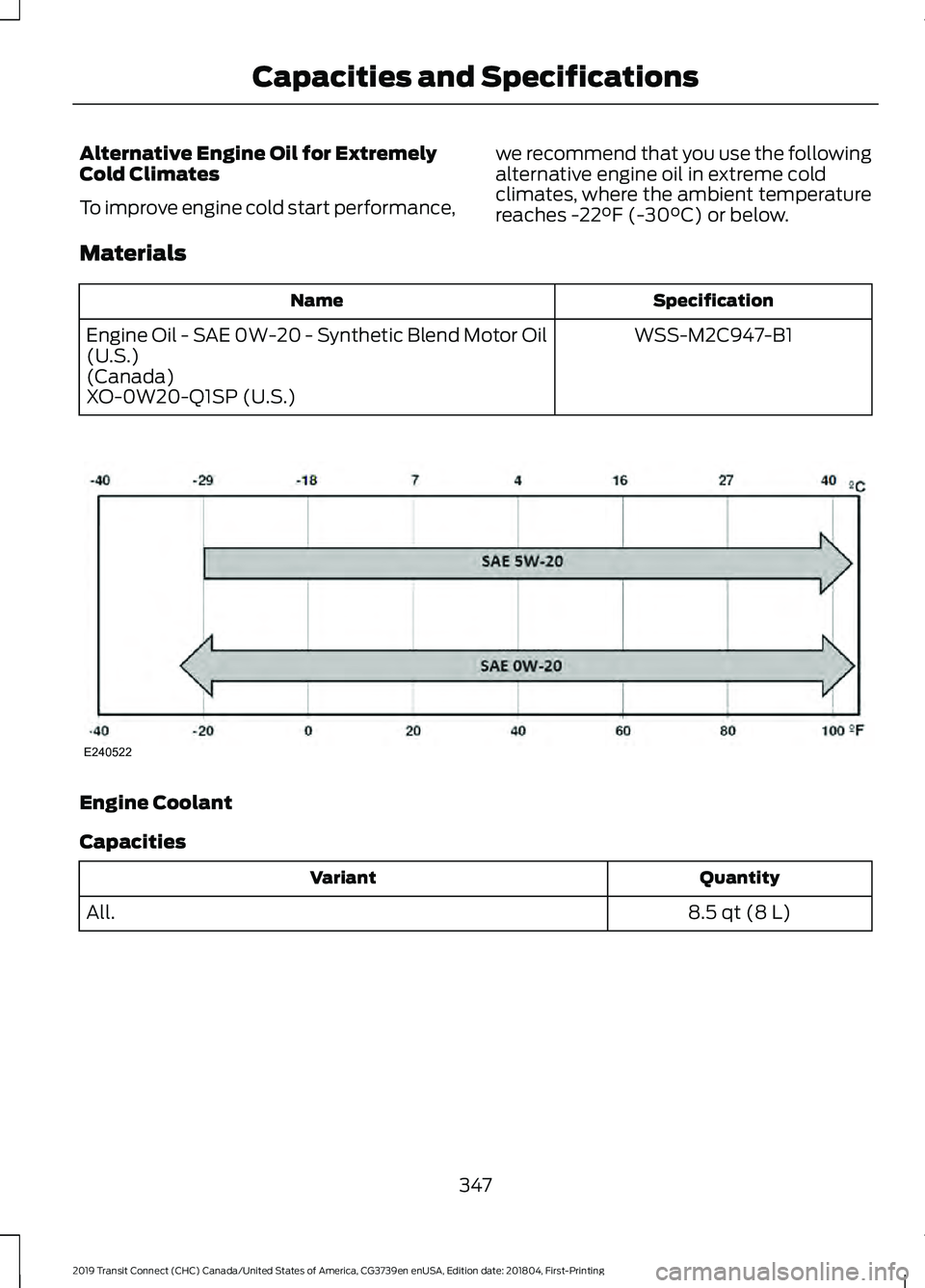
Alternative Engine Oil for Extremely
Cold Climates
To improve engine cold start performance,
we recommend that you use the following
alternative engine oil in extreme cold
climates, where the ambient temperature
reaches -22°F (-30°C) or below.
Materials Specification
Name
WSS-M2C947-B1
Engine Oil - SAE 0W-20 - Synthetic Blend Motor Oil
(U.S.)
(Canada)
XO-0W20-Q1SP (U.S.) Engine Coolant
Capacities
Quantity
Variant
8.5 qt (8 L)
All.
347
2019 Transit Connect (CHC) Canada/United States of America, CG3739en enUSA, Edition date: 201804, First-Printing Capacities and SpecificationsE240522
Page 483 of 493
Engine Block Heater....................................144
Using the Engine Block Heater...................... 145
Engine Coolant Check...............................268
Adding Coolant.................................................. 268
Coolant Change................................................. 270
Engine Coolant Temperature Management....................................................271
Fail-Safe Cooling............................................... 270
Recycled Coolant............................................... 270
Severe Climates................................................. 270
Engine Cooling Fan - Diesel.....................268
Engine Cooling Fan - Gasoline................267
Engine Emission Control...........................158
Engine Immobilizer See: Passive Anti-Theft System..................... 70
Engine Oil Check..........................................266 Adding Engine Oil.............................................. 266
Engine Oil Dipstick - 1.5L Duratorq-TDCi Diesel.............................................................265
Engine Oil Dipstick - 2.0L Duratec-HE (MI4)/2.0L Flex Fuel/2.5L....................266
Engine Specifications - 1.5L Duratorq-TDCi Diesel..............................327
Engine Specifications - 2.0L Duratec-HE (MI4)/2.0L Flex Fuel
...............................328
Engine Specifications - 2.5L....................329
Entertainment...............................................377 Playing Music From a USB or Media
Player................................................................. 378
Streaming Music From a Bluetooth Device................................................................ 378
Using the Radio................................................... 377
Environment.....................................................16
Essential Towing Checks..........................233 Before Towing a Trailer.................................... 235
Hitches................................................................... 234
Launching or Retrieving a Boat or Personal Watercraft....................................................... 236
Safety Chains...................................................... 234
Trailer Brakes....................................................... 234
Trailer Lamps....................................................... 235
Trailer Towing Connector................................ 234
When Towing a Trailer..................................... 235
Event Data Recording See: Data Recording.............................................. 9
Export Unique Options.................................15
Exterior Mirrors
................................................84
Adjusting the Mirrors.......................................... 84Folding the Mirrors...............................................
84
F
Fan See: Engine Cooling Fan - Diesel.................268
See: Engine Cooling Fan - Gasoline............267
Fastening the Seatbelts...............................33 Seatbelt Locking Modes.................................... 34
Using Seatbelts During Pregnancy................34
Flat Tire See: Changing a Road Wheel....................... 320
Flat Tire Inflation See: Tire Sealant and Inflator Kit................296
Floor Mats.......................................................239
Fog Lamps - Front See: Front Fog Lamps......................................... 81
Ford Credit
.........................................................13
US Only..................................................................... 13
Ford Protect....................................................414 Ford Protect Extended Service Plan
(CANADA ONLY)........................................... 415
Ford Protect Extended Service Plans (U.S. Only)................................................................... 414
Front Fog Lamps.............................................81
Front Parking Aid...........................................181 Front Parking Aid Information
Messages.......................................................... 183
Object Distance Indicator................................ 182
Front Passenger Sensing System............42
Front Wiper Blades See: Changing the Front Wiper Blades.......275
Fuel and Refueling.......................................148
Fuel Consumption
........................................157
Advertised Capacity........................................... 157
Fuel Economy....................................................... 157
Fuel Filler Funnel Location........................153
Fuel Quality - Diesel....................................148 Biodiesel................................................................ 149
Diesel Fuel Additives ........................................ 150
Fuel Requirements - Choosing The Right Fuel: Vehicles Operated Where Ultra Low
Sulfur Diesel Fuel Is Not Required ..........149
Fuel Requirements - Choosing The Right Fuel: Vehicles Operated Where Ultra Low
Sulfur Diesel Fuel Is Required (United
States/Canada/Puerto Rico/U.S. Virgin
Islands And Other Locales) ...................... 148
479
2019 Transit Connect (CHC) Canada/United States of America, CG3739en enUSA, Edition date: 201804, First-Printing Index
Page 484 of 493
Fuel Quality - E85.........................................152
Choosing the Right Fuel - Flex Fuel
Vehicles.............................................................. 152
Switching Between E85 and Gasoline............................................................. 153
Fuel Quality - Gasoline................................151 Choosing the Right Fuel.................................... 151
Fuel Shutoff
...................................................242
Ignition Switch.................................................... 242
Keyless Starting.................................................. 243
Fuse Box Locations.....................................254 Engine Compartment Fuse Box................... 254
Passenger Compartment Fuse Box............254
Fuses................................................................254
Fuse Specification Chart
..........................254
Engine Compartment Fuse Box................... 255
Passenger Compartment Fuse Box...........258
G
Gauges................................................................87 Engine Coolant Temperature Gauge............88
Fuel Gauge.............................................................. 87
Information Display............................................. 87
Gearbox See: Transmission.............................................. 169
General Information on Radio Frequencies....................................................51
General Maintenance Information........416 Multi-Point Inspection...................................... 418
Owner Checks and Services........................... 417
Protecting Your Investment........................... 416
Why Maintain Your Vehicle?.......................... 416
Why Maintain Your Vehicle at Your Dealership?...................................................... 416
Getting Assistance Outside the U.S. and Canada.........................................................250
Getting the Services You Need...............247 Away From Home.............................................. 247
Global Opening
..............................................84
H
Handbrake See: Parking Brake.............................................. 174
Hazard Flashers............................................242
Headlamp Adjusting See: Adjusting the Headlamps..................... 276Headlamp Exit Delay
...................................80
Headrest See: Head Restraints.......................................... 115
Head Restraints
..............................................115
Adjusting the Head Restraint.......................... 116
Heated Exterior Mirrors
................................113
Heated Rear Window...................................113
Heated Seats.................................................130
Heated Windshield........................................113
Heating See: Climate Control......................................... 108
Hill Start Assist..............................................174 Switching the System On and Off................175
Using Hill Start Assist........................................ 175
Hints on Controlling the Interior Climate - Vehicles With: Automatic
Temperature Control
..................................111
Defogging or Clearing the Windshield of
Thin Ice................................................................. 111
Defogging the Side Windows in Cold Weather............................................................... 111
General Hints.......................................................... 111
Quickly Cooling the Interior............................... 111
Recommended Settings for Cooling.............111
Recommended Settings for Heating.............111
Hints on Controlling the Interior Climate - Vehicles With: Manual Temperature
Control............................................................112
Defogging or Clearing the Windshield of Thin Ice................................................................ 112
Defogging the Side Windows in Cold Weather.............................................................. 112
General Hints......................................................... 112
Quickly Cooling the Interior.............................. 112
Quickly Heating the Interior............................. 112
Recommended Settings for Cooling............112
Recommended Settings for Heating............112
Hints on Driving With Anti-Lock Brakes.............................................................174
Home Screen
.................................................372
Hood Lock See: Opening and Closing the Hood...........261
I
Ignition Switch
...............................................134
In California (U.S. Only)............................248
480
2019 Transit Connect (CHC) Canada/United States of America, CG3739en enUSA, Edition date: 201804, First-Printing Index
Page 492 of 493
V
Vehicle Care...................................................286
Vehicle Certification Label.......................334
Vehicle Identification Number................333
Vehicle Storage.............................................292
Battery................................................................... 293
Body........................................................................\
292
Brakes.................................................................... 293
Cooling system................................................... 293
Engine.................................................................... 293
Fuel system.......................................................... 293
General.................................................................. 292
Miscellaneous..................................................... 293
Removing Vehicle From Storage.................293
Tires........................................................................\
293
Ventilation See: Climate Control......................................... 108
VIN See: Vehicle Identification Number............333
W
Warning Lamps and Indicators................88 Adaptive Cruise Control Indicator.................88
Airbag Warning Lamp........................................ 88
Anti-Lock Brake System Warning Lamp
................................................................... 88
Blind Spot Information System Indicator............................................................. 88
Brake System Warning Lamp.......................... 89
Cruise Control Indicator..................................... 89
Direction Indicator............................................... 89
Engine Coolant Temperature Warning Lamp................................................................... 89
Engine Warning Lamps..................................... 89
Fasten Seatbelt Warning Lamp..................... 89
Front Fog Lamp Indicator................................. 89
Hazard Flashers Warning Lamp..................... 90
High Beam Headlamp Indicator.................... 90
Ignition Warning Lamp...................................... 90
Information Message Indicator...................... 90
Lamps on Indicator............................................. 90
Low Fuel Level Warning Lamp....................... 90
Low Tire Pressure Warning Lamp.................90
Oil Pressure Warning Lamp............................. 90
Stability Control and Traction Control Indicator............................................................. 90Stability Control and Traction Control Off
Warning Lamp................................................. 90
Washer Fluid Check.....................................273
Washers See: Cleaning the Exterior............................... 287
Waxing.............................................................288
Wheel Nuts See: Changing a Road Wheel....................... 320
Wheels and Tires.........................................295 General Information......................................... 295
Windows and Mirrors
....................................83
Windshield Washers......................................76
Windshield Wipers.........................................75
Intermittent Wipe................................................. 75
Speed Dependent Wipers................................. 75
Winter Tires See: Using Winter Tires.................................... 315
Wiper Blades See: Checking the Wiper Blades.................. 275
Wipers and Washers.....................................75
Wireless Accessory Charging...................132
Wrecker Towing See: Transporting the Vehicle....................... 236
488
2019 Transit Connect (CHC) Canada/United States of America, CG3739en enUSA, Edition date: 201804, First-Printing Index