service FORD WINDSTAR 1999 2.G Owner's Guide
[x] Cancel search | Manufacturer: FORD, Model Year: 1999, Model line: WINDSTAR, Model: FORD WINDSTAR 1999 2.GPages: 248, PDF Size: 2.28 MB
Page 210 of 248
Treadwear
The treadwear grade is a comparative rating based on the wear rate of
the tire when tested under controlled conditions on a specified
government test course. For example, a tire graded 150 would wear one
and one-half (1 1/2) times as well on the government course as a tire
graded 100. The relative performance of tires depends upon the actual
conditions of their use, however, and may depart significantly from the
norm due to variations in driving habits, service practices, and
differences in road characteristics and climate.
Traction AA A B C
The traction grades, from highest to lowest are AA, A, B, and C. Those
grades represent the tire's ability to stop on wet pavement as measured
under controlled conditions on specified government test surfaces of
asphalt and concrete. A tire marked C may have poor traction
performance.
The traction grade assigned to this tire is based on
straight-ahead braking traction tests, and does not include
acceleration, cornering, hydroplaning or peak traction characteristics.
Temperature A B C
The temperature grades are A (the highest), B, and C, representing the
tire's resistance to the generation of heat and its ability to dissipate heat
when tested under controlled conditions on a specified indoor laboratory
test wheel. Sustained high temperature can cause the material of the tire
to degenerate and reduce tire life, and excessive temperature can lead to
sudden tire failure. The grade C corresponds to a level of performance
which all passenger car tires must meet under the Federal Motor Vehicle
Safety Standard No. 109. Grades B and A represent higher levels of
performance on the laboratory test wheel than the minimum required by
law.
The temperature grade for this tire is established for a tire that
is properly inflated and not overloaded. Excessive speed,
underinflation, or excessive loading, either separately or in
combination, can cause heat buildup and possible tire failure.
Maintenance and care
210
Page 215 of 248
²Avoid getting fuel liquid in your eyes. If fuel is splashed in the eyes,
remove contact lenses (if worn), flush with water for 15 minutes and
seek medical attention. Failure to seek proper medical attention could
lead to permanent injury.
²Fuels can also be harmful if absorbed through the skin. If fuel is
splashed on the skin and/or clothing, promptly remove contaminated
clothing and wash skin thoroughly with soap and water. Repeated or
prolonged skin contact with fuel liquid or vapor causes skin irritation.
²Be particularly careful if you are taking ªAntabuseº or other forms of
disulfiram for the treatment of alcoholism. Breathing gasoline vapors,
or skin contact could cause an adverse reaction. In sensitive
individuals, serious personal injury or sickness may result. If fuel is
splashed on the skin, promptly wash skin thoroughly with soap and
water. Consult a physician immediately if you experience an adverse
reaction.
Fuel Filler Cap
Your fuel tank filler cap has an indexed design with a one-eighth turn
on/off feature.
When fueling your vehicle:
1. Turn the engine off.
2. Carefully turn the filler cap counterclockwise 1/8 of a turn until it
stops.
3. Pull to remove the cap from the fuel filler pipe.
4. To install the cap, align the tabs on the cap with the notches on the
filler pipe.
5. Turn the filler cap clockwise 1/8 of a turn until it stops.
If the ªService Engine Soon/Check Engineº indicator comes on and stays
on when you start the engine, the fuel filler cap may not be properly
installed. Turn off the engine, remove the fuel filler cap and reinstall it
being careful to align the cap properly.
If you must replace the fuel filler cap, replace it with a genuine
Ford or Motorcraft part. The customer warranty may be void for
any damage to the fuel tank or fuel system if a genuine Ford or
Motorcraft fuel filler cap is not used.
Maintenance and care
215
Page 217 of 248
Octane recommendations
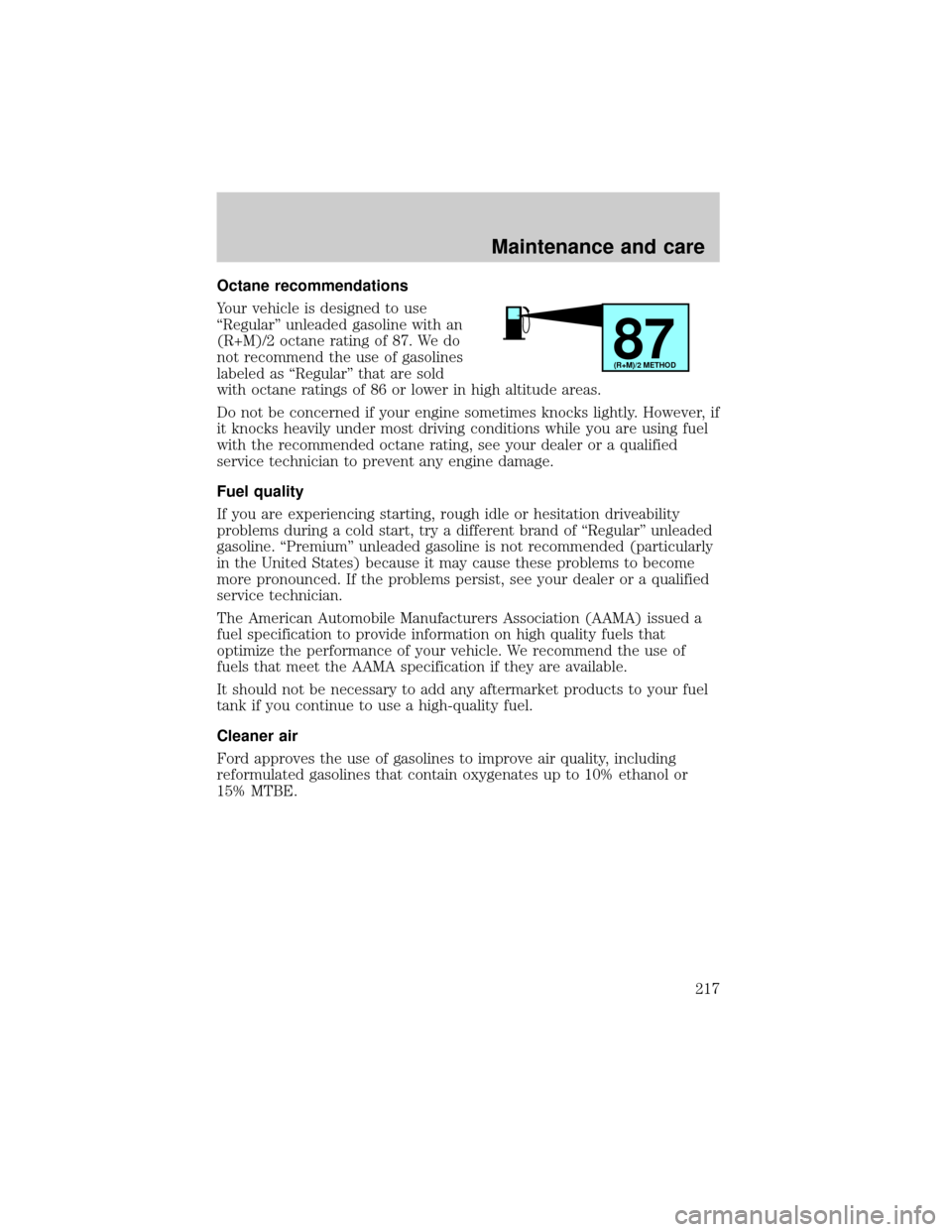
Your vehicle is designed to use
ªRegularº unleaded gasoline with an
(R+M)/2 octane rating of 87. We do
not recommend the use of gasolines
labeled as ªRegularº that are sold
with octane ratings of 86 or lower in high altitude areas.
Do not be concerned if your engine sometimes knocks lightly. However, if
it knocks heavily under most driving conditions while you are using fuel
with the recommended octane rating, see your dealer or a qualified
service technician to prevent any engine damage.
Fuel quality
If you are experiencing starting, rough idle or hesitation driveability
problems during a cold start, try a different brand of ªRegularº unleaded
gasoline. ªPremiumº unleaded gasoline is not recommended (particularly
in the United States) because it may cause these problems to become
more pronounced. If the problems persist, see your dealer or a qualified
service technician.
The American Automobile Manufacturers Association (AAMA) issued a
fuel specification to provide information on high quality fuels that
optimize the performance of your vehicle. We recommend the use of
fuels that meet the AAMA specification if they are available.
It should not be necessary to add any aftermarket products to your fuel
tank if you continue to use a high-quality fuel.
Cleaner air
Ford approves the use of gasolines to improve air quality, including
reformulated gasolines that contain oxygenates up to 10% ethanol or
15% MTBE.
87(R+M)/2 METHOD
Maintenance and care
217
Page 218 of 248

Running out of fuel
Avoid running out fuel because this situation may have an adverse affect
on powertrain components.
If you have run out of fuel:
²You may need to crank the engine several times before the system
starts to pump fuel from the tank to the engine.
²Your ªCheck Engineº light may come on. For more information on the
ªCheck Engineº light, refer to theInstrumentationchapter.
Fuel Filter
Your vehicle is equipped with a fuel filter that is mounted on the
underbody.
For fuel filter replacement, see your dealer or a qualified service
technician. Refer to the Scheduled Maintenance Guide for the
appropriate intervals for changing the fuel filter.
If you replace the fuel filter, replace it with an authorized
Motorcraft part. The customer warranty may be void for any
damage to the fuel system if an authorized Motorcraft fuel filter
is not used.
ESSENTIALS OF GOOD FUEL ECONOMY
Measuring techniques
Your best source of information about actual fuel economy is you, the
driver. You must gather information as accurately and consistently as
possible. Fuel expense, frequency of fillups or fuel gauge readings are
NOT accurate as a measure of fuel economy. We do not recommend taking
fuel economy measurements during the first 1 600 km (1 000 miles) of
driving (engine break-in period). You will get a more accurate
measurement after 3 000 km±5 000 km (2 000 miles±3 000 miles).
The advertised fuel capacity of the fuel tank on your vehicle is equal to
the rated refill capacity of the fuel tank as listed in the Refill Capacities
chart in this ªOwner Guide.º The advertised capacity is the amount of
the Indicated Capacity and the Empty Reserve combined. Indicated
Capacity is the difference in the amount of fuel in a full tank and a tank
when the fuel gauge indicates empty. Empty Reserve is the small amount
of usable fuel remaining in the fuel tank after the fuel gauge indicates
empty.
Maintenance and care
218
Page 222 of 248
EMISSION CONTROL SYSTEM
Your vehicle is equipped with various emission control components and a
catalytic converter which will enable your vehicle to comply with
applicable exhaust emission standards. To make sure that the catalytic
converter and other emission control components continue to work
properly:
²Use only unleaded fuel.
²Avoid running out of fuel.
²Do not turn off the ignition while your vehicle is moving, especially at
high speeds.
²Have the items listed in your Scheduled Maintenance Guide performed
according to the specified schedule.
The scheduled maintenance items listed in the Scheduled Maintenance
Guide are essential to the life and performance of your vehicle and to its
emissions system.
If other than Ford, Motorcraft or Ford-authorized parts are used for
maintenance replacements or for service of components affecting
emission control, such non-Ford parts should be equivalent to genuine
Ford Motor Company parts in performance and durability.
Do not park, idle, or drive your vehicle in dry grass or other dry
ground cover. The emission system heats up the engine
compartment and exhaust system, which can start a fire.
Illumination of the charging system warning light,Check Engine
indicator light or the temperature warning light, fluid leaks, strange
odors, smoke or loss of oil pressure, could indicate that the emission
control system is not working properly.
Exhaust leaks may result in entry of harmful and potentially
lethal fumes into the passenger compartment.
Maintenance and care
222
Page 223 of 248
Do not make any unauthorized changes to your vehicle or engine. By
law, vehicle owners and anyone who manufactures, repairs, items, sells,
leases, trades vehicles, or supervises a fleet of vehicles are not permitted
to intentionally remove an emission control device or prevent it from
working. Information about your vehicle's emission system is on the
Vehicle Emission Control Information Decal located on or near the
engine. This decal identifies engine displacement and gives some tune up
specifications.
Please consult your ªWarranty Guideº for complete emission warranty
information.
Readiness for inspection/maintenance (I/M) testing
In some localities, it may be a legal requirement to pass an I/M test of
the on-board diagnostic (OBD-II) system. If your ªCheck Engine/Service
Engine Soonº light is on, refer to the description in theWarning Lights
and Chimessection of theInstrumentationchapter. Your vehicle may
not pass the I/M test with the ªCheck Engine/Service Engine Soonº light
on.
If the vehicle's powertrain system or its battery has just been serviced,
the OBD-II system is reset to a ªnot ready for I/M testº condition. To
ready the OBD-II system for I/M testing, a minimum of 30 minutes of city
and highway driving is necessary as described below:
²First, at least 10 minutes of driving on an expressway or highway.
²Next, at least 20 minutes driving in stop-and-go, city-type traffic with
at least four idle periods.
Allow the vehicle to sit for at least eight hours without starting the
engine. Then, start the engine and complete the above driving cycle. The
engine must warm up to its normal operating temperature. Once started,
do not turn off the engine until the above driving cycle is complete.
Maintenance and care
223
Page 236 of 248
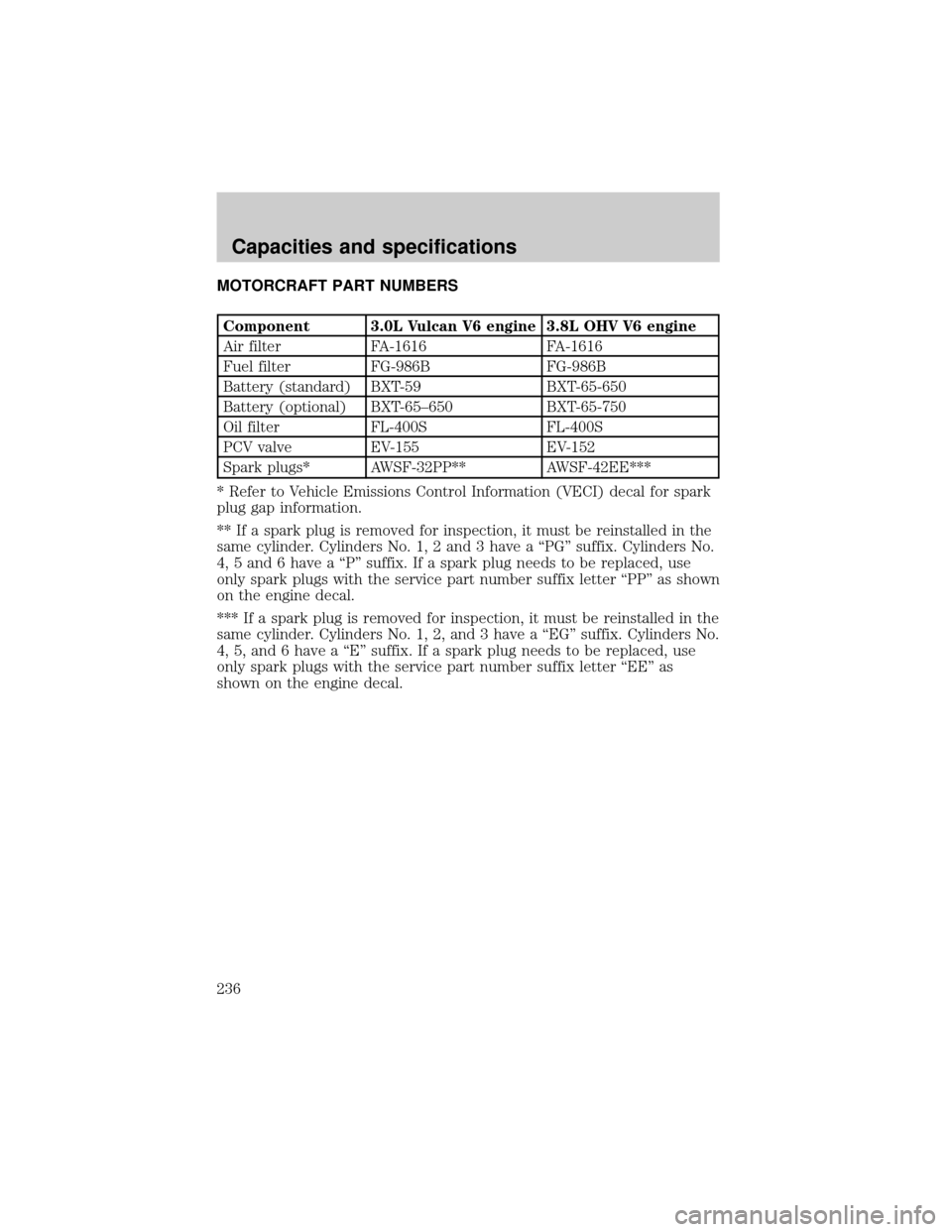
MOTORCRAFT PART NUMBERS
Component 3.0L Vulcan V6 engine 3.8L OHV V6 engine
Air filter FA-1616 FA-1616
Fuel filter FG-986B FG-986B
Battery (standard) BXT-59 BXT-65-650
Battery (optional) BXT-65±650 BXT-65-750
Oil filter FL-400S FL-400S
PCV valve EV-155 EV-152
Spark plugs* AWSF-32PP** AWSF-42EE***
* Refer to Vehicle Emissions Control Information (VECI) decal for spark
plug gap information.
** If a spark plug is removed for inspection, it must be reinstalled in the
same cylinder. Cylinders No. 1, 2 and 3 have a ªPGº suffix. Cylinders No.
4, 5 and 6 have a ªPº suffix. If a spark plug needs to be replaced, use
only spark plugs with the service part number suffix letter ªPPº as shown
on the engine decal.
*** If a spark plug is removed for inspection, it must be reinstalled in the
same cylinder. Cylinders No. 1, 2, and 3 have a ªEGº suffix. Cylinders No.
4, 5, and 6 have a ªEº suffix. If a spark plug needs to be replaced, use
only spark plugs with the service part number suffix letter ªEEº as
shown on the engine decal.
Capacities and specifications
236
Page 243 of 248

Accessory delay ..........................78
Air bag supplemental restraint
system ........................................124
and child safety seats ............126
description .......................125,128
disposal ....................................131
indicator light ..................128,130
passenger air bag ............126,129
Air filter, cabin ..........................203
Anti-theft system ...99,100,101,102
,103
arming the system ..................100
disarming a triggered system 100
Automatic transaxle .................155
driving with ...............156,157,158
Brakes ........................................151
anti-lock ............................151,152
anti-lock brake system (ABS)
warning light ...........................152
fluid, checking and adding ....195
shift interlock ..........................155
Break-in period .............................3
Cargo net ...................................104
CD player .....................64,65,66,67
Child safety seats
attaching with tether straps ..136
in rear seat .......................133,136
tether anchorage
hardware ...................137,138,140
Cleaning your vehicle ...............230
built-in child seat ...........141,142,
145,146
engine compartment ..............232
exterior .............................231,234
exterior lamps .........................233
interior .....................................234
plastic parts ............................232
washing ....................................231
waxing .....................................231
wheels ......................................232
windows ..................................235
wiper blades ............................233Compass, electronic
set zone adjustment .......22,23,24
Console ........................................90
overhead ....................................86
Controls
power seat ...............................108
Coolant ......................................199
checking and adding ..............197
refill capacities ........................199
Cupholder(s) .110,112,113,115,117
Defrost
rear window ..............................37
Doors
power sliding .............87,88,89,90
Emission control system ..........222
Engine
check engine/service engine
soon light ...............................9,10
coolant .....................................197
idle speed control ...................206
service points ...................190,191
starting after a collision .........167
Engine block heater .................149
Engine oil
checking and adding ..............193
dipstick ....................................192
specifications ...................192,194
Exhaust fumes ..........................150
Floor mats ...................................91
Fuel
choosing the right fuel ...........216
comparisons with EPA fuel
economy estimates .................221
detergent in fuel .....................217
filling your vehicle
with fuel ...........................214,215
gauge .........................................12
quality ......................................217
running out of fuel .................218
safety information relating to
automotive fuels .....................214
Fuses ...................................168,169
Index
243
Page 248 of 248
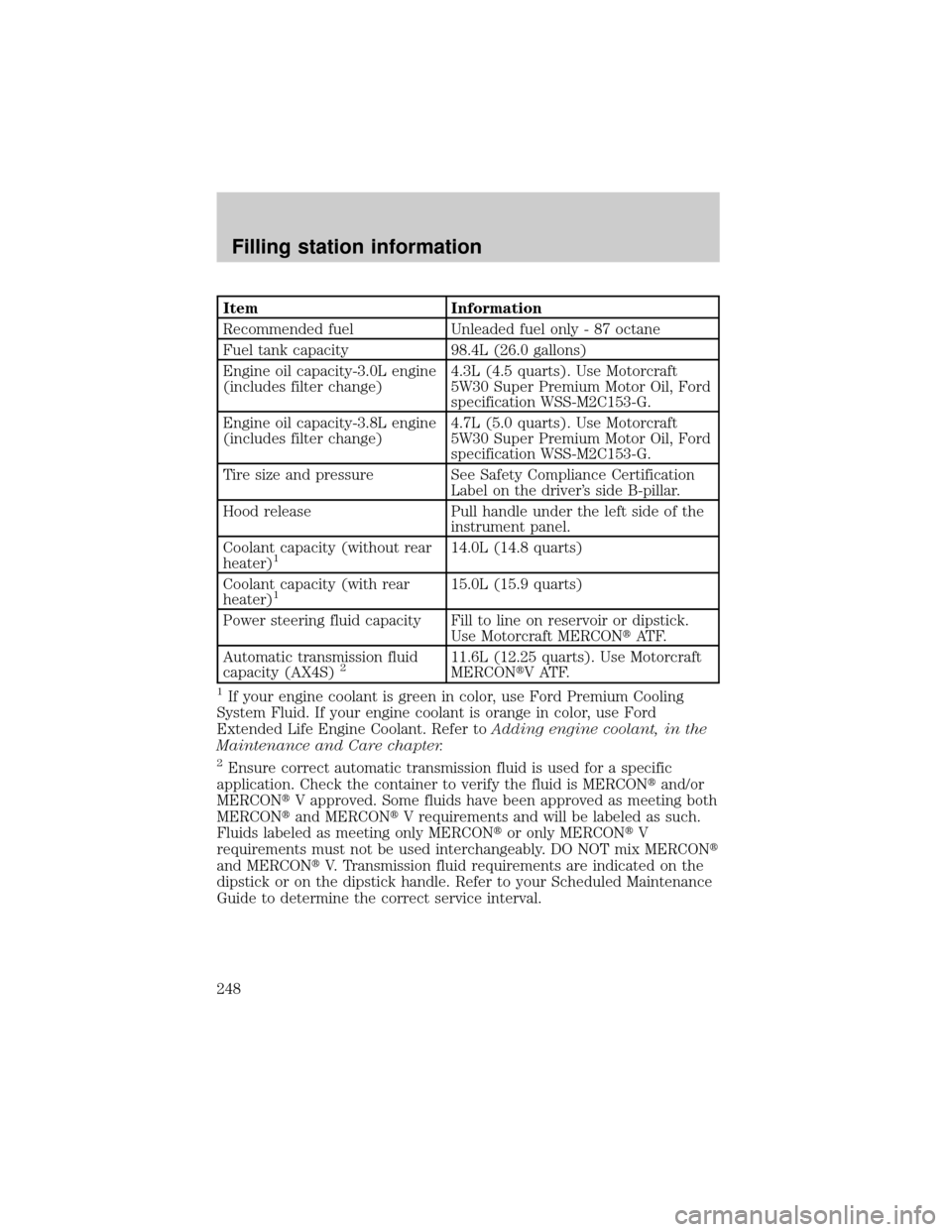
Item Information
Recommended fuel Unleaded fuel only - 87 octane
Fuel tank capacity 98.4L (26.0 gallons)
Engine oil capacity-3.0L engine
(includes filter change)4.3L (4.5 quarts). Use Motorcraft
5W30 Super Premium Motor Oil, Ford
specification WSS-M2C153-G.
Engine oil capacity-3.8L engine
(includes filter change)4.7L (5.0 quarts). Use Motorcraft
5W30 Super Premium Motor Oil, Ford
specification WSS-M2C153-G.
Tire size and pressure See Safety Compliance Certification
Label on the driver's side B-pillar.
Hood release Pull handle under the left side of the
instrument panel.
Coolant capacity (without rear
heater)
114.0L (14.8 quarts)
Coolant capacity (with rear
heater)
115.0L (15.9 quarts)
Power steering fluid capacity Fill to line on reservoir or dipstick.
Use Motorcraft MERCONtAT F.
Automatic transmission fluid
capacity (AX4S)
211.6L (12.25 quarts). Use Motorcraft
MERCONtV ATF.
1If your engine coolant is green in color, use Ford Premium Cooling
System Fluid. If your engine coolant is orange in color, use Ford
Extended Life Engine Coolant. Refer toAdding engine coolant, in the
Maintenance and Care chapter.
2Ensure correct automatic transmission fluid is used for a specific
application. Check the container to verify the fluid is MERCONtand/or
MERCONtV approved. Some fluids have been approved as meeting both
MERCONtand MERCONtV requirements and will be labeled as such.
Fluids labeled as meeting only MERCONtor only MERCONtV
requirements must not be used interchangeably. DO NOT mix MERCONt
and MERCONtV. Transmission fluid requirements are indicated on the
dipstick or on the dipstick handle. Refer to your Scheduled Maintenance
Guide to determine the correct service interval.
Filling station information
248