wheel FORD WINDSTAR 2000 2.G Owner's Manual
[x] Cancel search | Manufacturer: FORD, Model Year: 2000, Model line: WINDSTAR, Model: FORD WINDSTAR 2000 2.GPages: 280, PDF Size: 2.49 MB
Page 227 of 280
U.S. Department of Transportation-Tire quality grades:The U.S.
Department of Transportation requires Ford to give you the following
information about tire grades exactly as the government has written it.
Treadwear
The treadwear grade is a comparative rating based on the wear rate of
the tire when tested under controlled conditions on a specified
government test course. For example, a tire graded 150 would wear one
and one-half (1 1/2) times as well on the government course as a tire
graded 100. The relative performance of tires depends upon the actual
conditions of their use, however, and may depart significantly from the
norm due to variations in driving habits, service practices, and
differences in road characteristics and climate.
Traction AA A B C
The traction grades, from highest to lowest are AA, A, B, and C. Those
grades represent the tire's ability to stop on wet pavement as measured
under controlled conditions on specified government test surfaces of
asphalt and concrete. A tire marked C may have poor traction
performance.
The traction grade assigned to this tire is based on
straight-ahead braking traction tests, and does not include
acceleration, cornering, hydroplaning or peak traction characteristics.
Temperature A B C
The temperature grades are A (the highest), B, and C, representing the
tire's resistance to the generation of heat and its ability to dissipate heat
when tested under controlled conditions on a specified indoor laboratory
test wheel. Sustained high temperature can cause the material of the tire
to degenerate and reduce tire life, and excessive temperature can lead to
sudden tire failure. The grade C corresponds to a level of performance
which all passenger car tires must meet under the Federal Motor Vehicle
Safety Standard No. 109. Grades B and A represent higher levels of
performance on the laboratory test wheel than the minimum required by
law.
Maintenance and care
227
Page 230 of 280
SNOW TIRES AND CHAINS
Driving too fast for conditions creates the possibility of loss of
vehicle control. Driving at very high speeds for extended periods
of time may result in damage to vehicle components.
Snow tires must be the same size and grade as the tires you
currently have on your vehicle.
The tires on your vehicle have all weather treads to provide traction in
rain and snow. However, in some climates, you may need to use snow
tires and chains. If you need to use chains, it is recommended that steel
wheels (of the same size and specifications) be used as chains may chip
aluminum wheels.
Follow these guidelines when using snow tires and chains:
²Do not use tire chains with size P225/60R16 or P215/70R15 tires.
²Use only SAE Class S chains.
²Install chains securely, verifying that the chains do not touch any
wiring, brake lines or fuel lines.
²Drive cautiously. If you hear the chains rub or bang against your
vehicle, stop and re-tighten the chains. If this does not work, remove
the chains to prevent damage to your vehicle.
²If possible, avoid fully loading your vehicle.
²Remove the tire chains when they are no longer needed. Do not use
tire chains on dry roads.
²The suspension insulation and bumpers will help prevent vehicle
damage. Do not remove these components from your vehicle when
using snow tires and chains.
WHAT YOU SHOULD KNOW ABOUT AUTOMOTIVE FUELS
Important safety precautions
Do not overfill the fuel tank. The pressure in an overfilled tank
may cause leakage and lead to fuel spray and fire.
Maintenance and care
230
Page 237 of 280

Keep a record for at least one month and record the type of driving (city
or highway). This will provide an accurate estimate of the vehicle's fuel
economy under current driving conditions. Additionally, keeping records
during summer and winter will show how temperature impacts fuel
economy. In general, lower temperatures give lower fuel economy.
Driving style Ð good driving and fuel economy habits
Give consideration to the lists that follow and you may be able to change
a number of variables and improve your fuel economy.
Habits
²Smooth, moderate operation can yield up to 10% savings in fuel.
²Steady speeds without stopping will usually give the best fuel
economy.
²Idling for long periods of time (greater than one minute) may waste
fuel.
²Anticipate stopping; slowing down may eliminate the need to stop.
²Sudden or hard accelerations may reduce fuel economy.
²Slow down gradually.
²Driving at reasonable speeds (traveling at 88 km/h [55 mph] uses 15%
less fuel than traveling at 105 km/h [65 mph]).
²Revving the engine before turning it off may reduce fuel economy.
²Using the air conditioner or defroster may reduce fuel economy.
²You may want to turn off the speed control in hilly terrain if
unnecessary shifting between third and fourth gear occurs.
Unnecessary shifting of this type could result in reduced fuel
economy.
²Warming up a vehicle on cold mornings is not required and may
reduce fuel economy.
²Resting your foot on the brake pedal while driving may reduce fuel
economy.
²Combine errands and minimize stop-and-go driving.
Maintenance
²Keep tires properly inflated and use only recommended size.
²Operating a vehicle with the wheels out of alignment will reduce fuel
economy.
Maintenance and care
237
Page 249 of 280

recommended that you clean the wiper blades and windshield as
described inCleaning the wiper blades and windshield.
Repairing paint chips
Minor scratches or paint damage from road debris may be repaired with
the Ultra Touch Prep and Finishing Kit (#F7AZ-19K507±BA), Lacquer
Touch-up Paint (#ALBZ-19500±XXXXA), or Exterior Acrylic Spray
Lacquer (#ALAZ-19500±XXXXA) from the Ford Car Care Chemicals line.
Please note that the part numbers (shown as XXXX above) will vary with
your vehicle's specific coloring. Observe the application instructions on
the products.
Remove particles such as bird droppings, tree sap, insect remains, tar
spots, road salt and industrial fallout immediately.
Cleaning the wheels
Wash with the same detergent as the body of your vehicle. Do not use
acid-based or alcohol-based wheel cleaners, steel wool, fuel or strong
detergents. Never use abrasives that will damage the finish of special
wheel surfaces. Use a tar remover to remove grease and tar.
The brushes used in some automatic car washes may damage the finish
on your wheels. Before going to a car wash, find out if the brushes are
abrasive.
Cleaning non-painted plastic exterior parts
Use vinyl cleaner for routine cleaning. Clean with a tar remover if
necessary. Do not clean plastic parts with thinners, solvents or
petroleum-based cleaners.
Underbody
Flush the complete underside of vehicle frequently. Keep body drain
holes unplugged. Inspect for road damage.
Cleaning mirrors
Do not clean your mirrors with a dry cloth or abrasive materials. Use a
soft cloth and mild detergent and water. Be careful when removing ice
from outside mirrors because you may damage the reflective surface.
Maintenance and care
249
Page 251 of 280
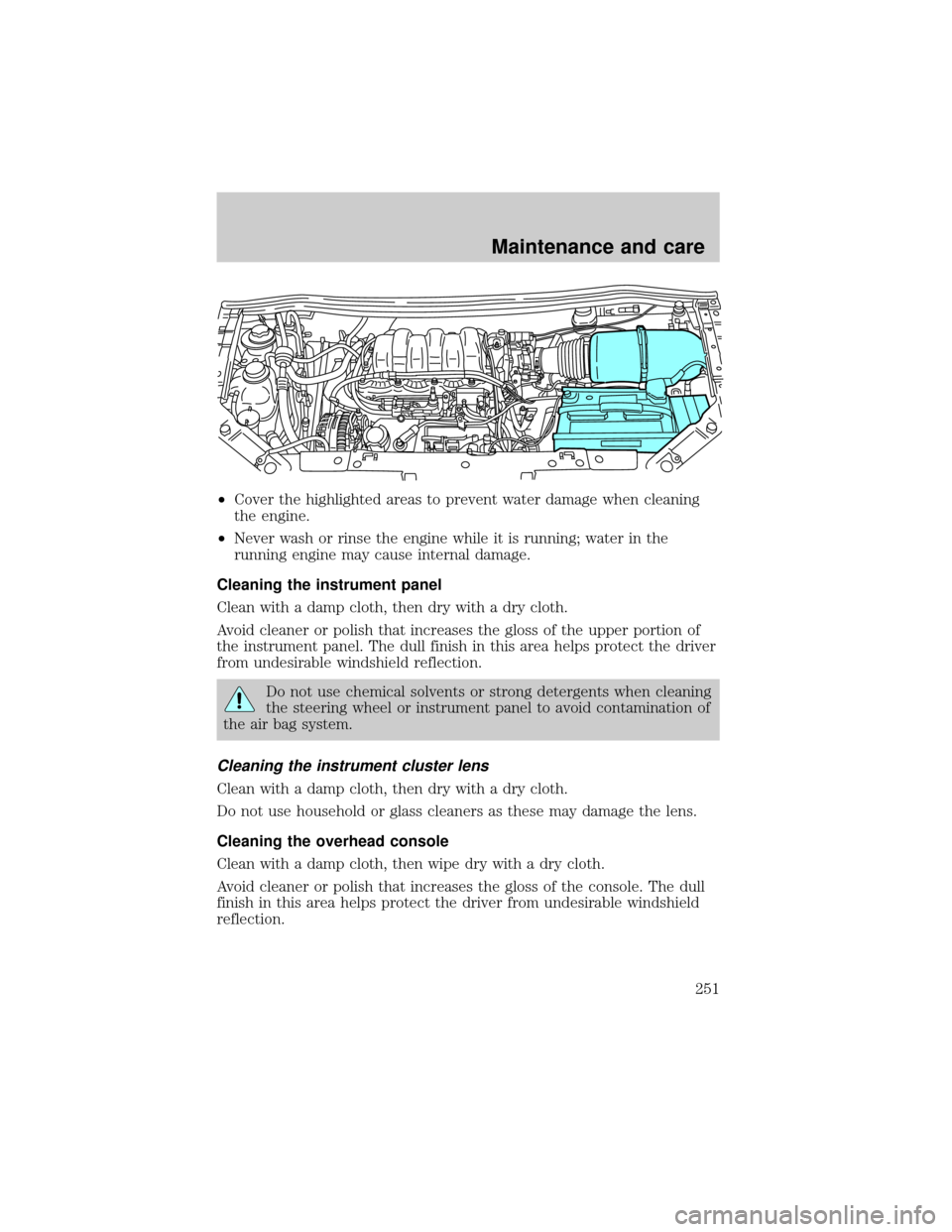
²Cover the highlighted areas to prevent water damage when cleaning
the engine.
²Never wash or rinse the engine while it is running; water in the
running engine may cause internal damage.
Cleaning the instrument panel
Clean with a damp cloth, then dry with a dry cloth.
Avoid cleaner or polish that increases the gloss of the upper portion of
the instrument panel. The dull finish in this area helps protect the driver
from undesirable windshield reflection.
Do not use chemical solvents or strong detergents when cleaning
the steering wheel or instrument panel to avoid contamination of
the air bag system.
Cleaning the instrument cluster lens
Clean with a damp cloth, then dry with a dry cloth.
Do not use household or glass cleaners as these may damage the lens.
Cleaning the overhead console
Clean with a damp cloth, then wipe dry with a dry cloth.
Avoid cleaner or polish that increases the gloss of the console. The dull
finish in this area helps protect the driver from undesirable windshield
reflection.
Maintenance and care
251
Page 257 of 280
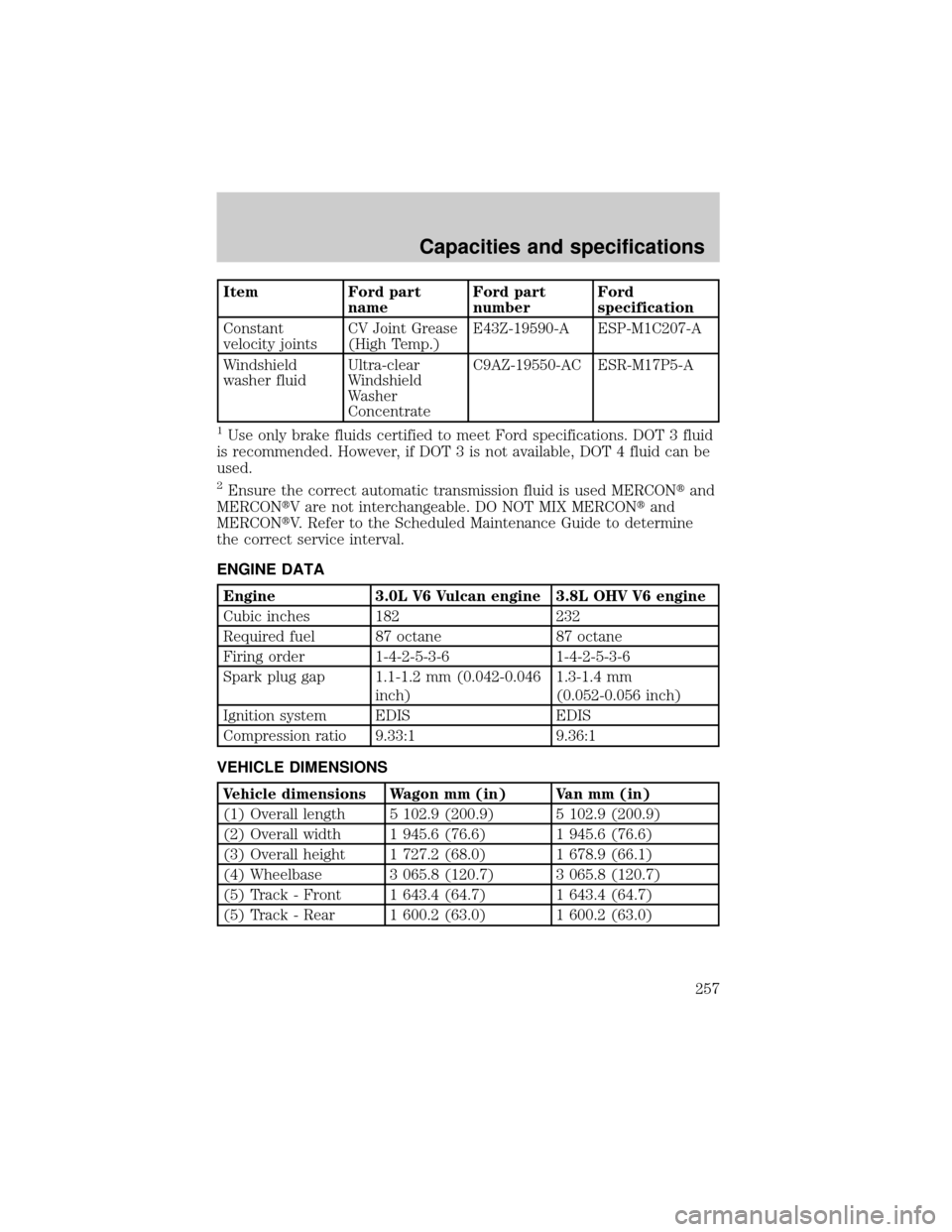
Item Ford part
nameFord part
numberFord
specification
Constant
velocity jointsCV Joint Grease
(High Temp.)E43Z-19590-A ESP-M1C207-A
Windshield
washer fluidUltra-clear
Windshield
Washer
ConcentrateC9AZ-19550-AC ESR-M17P5-A
1Use only brake fluids certified to meet Ford specifications. DOT 3 fluid
is recommended. However, if DOT 3 is not available, DOT 4 fluid can be
used.
2Ensure the correct automatic transmission fluid is used MERCONtand
MERCONtV are not interchangeable. DO NOT MIX MERCONtand
MERCONtV. Refer to the Scheduled Maintenance Guide to determine
the correct service interval.
ENGINE DATA
Engine 3.0L V6 Vulcan engine 3.8L OHV V6 engine
Cubic inches 182 232
Required fuel 87 octane 87 octane
Firing order 1-4-2-5-3-6 1-4-2-5-3-6
Spark plug gap 1.1-1.2 mm (0.042-0.046
inch)1.3-1.4 mm
(0.052-0.056 inch)
Ignition system EDIS EDIS
Compression ratio 9.33:1 9.36:1
VEHICLE DIMENSIONS
Vehicle dimensions Wagon mm (in) Van mm (in)
(1) Overall length 5 102.9 (200.9) 5 102.9 (200.9)
(2) Overall width 1 945.6 (76.6) 1 945.6 (76.6)
(3) Overall height 1 727.2 (68.0) 1 678.9 (66.1)
(4) Wheelbase 3 065.8 (120.7) 3 065.8 (120.7)
(5) Track - Front 1 643.4 (64.7) 1 643.4 (64.7)
(5) Track - Rear 1 600.2 (63.0) 1 600.2 (63.0)
Capacities and specifications
257
Page 268 of 280

Ford Deluxe Leather and Vinyl Cleaner (not available in Canada)
Motorcraft Vinyl Cleaner (Canada only)
Ford Extra Strength Tar and Road Oil Remover* (not available in
Canada)
Ford Extra Strength Upholstery Cleaner (Canada only)
Ford Extra Strength Upholstery Cleaner (not available in Canada)
Ford Metal Surface Cleaner
Ford Multi-Purpose Cleaner*
Motorcraft Car Wash Concentrate
Motorcraft Carlite Glass Cleaner
Ford Spot and Stain Remover*
Ford Super Premium Tire and Trim Dressing
Ford Triple Clean
Ford Ultra-Clear Spray Glass Cleaner (not available in Canada)
* May be sold with the Motorcraft name
FORD ACCESSORIES FOR YOUR VEHICLE
A wide selection of Ford accessories are available for your vehicle
through your local authorized Ford, Lincoln Mercury or Ford of Canada
dealer. These quality accessories have been specifically engineered to
fulfill your automotive needs; they are custom designed to complement
the style and aerodynamic appearance of your vehicle. In addition, each
accessory is made from high quality materials and meets or exceeds
Ford's rigid engineering and safety specifications. Ford accessories are
warranted for up to 12 months or 20 000 km (12 000 miles) on all cars
and light trucks and 12 months with unlimited distance on medium/heavy
duty trucks unless the accessory is installed on a new vehicle, then the
warranty becomes the balance of the new vehicle's warranty or the
accessories warranty, whichever is greater. See your dealer for complete
warranty information and availability.
Not all accessories are available for all models.
Vehicle Security
Remote keyless entry
Styled wheel protector locks
Customer assistance
268
Page 273 of 280

Accessory delay ..........................90
Air bag supplemental
restraint system ..........140,141,145
and child safety seats ............142
description .......................141,145
disposal ....................................148
driver air bag ...................143,146
indicator light .............10,144,147
operation ..........................143,146
passenger air bag ............143,146
side air bag ..............................145
Air cleaner filter .......................254
Air conditioning ..........................28
Air filter, cabin ..........................220
Antifreeze
(see Engine coolant) ................211
Anti-lock brake system
(see Brakes) .......................165,166
Anti-theft system ......................113
arming the system ..................113
disarming a
triggered system .....................114
warning light ...............................9
Audio system (see Radio) .........38
Automatic transaxle .................169
driving with .............................170
fluid, adding ............................218
fluid, checking ........................218
fluid, refill capacities ..............255
fluid, specification ..................257
Auxiliary power point ...............116
Axle
lubricant specifications ..........256
Battery .......................................223
acid, treating emergencies .....223
charging system warning light ..8
jumping a disabled battery ....197
maintenance-free ....................223
replacement, specifications ...254
servicing ..................................223
Belt minder ...............................136
Brakes ........................................165anti-lock ............................165,166
anti-lock brake system
(ABS) warning light ..........10,166
brake warning light ..................10
fluid, checking and adding ....210
fluid, refill capacities ..............255
fluid, specifications ..........256,257
lubricant specifications ...256,257
parking ....................................166
pedals (see Power
adjustable foot pedals) ............81
shift interlock ..........................169
Break-in period .............................3
Capacities for refilling fluids ....255
Cargo net ...................................118
Cassette tape player ...................63
CD changer .................................74
Certification Label ....................259
Child safety restraints ..............148
child safety belts ....................148
Child safety seats ......................149
in front seat ............................150
in rear seat .......................150,153
tether anchorage hardware ...154
Cleaning your vehicle ...............248
engine compartment ..............250
exterior ....................................249
exterior lamps .........................250
instrument panel ....................251
instrument panel lens ............251
interior .......................251,252,253
mirrors .....................................249
plastic parts ............................249
safety belts ..............................252
washing ....................................248
waxing .....................................248
wheels ......................................249
windows ..................................252
wiper blades ............................250
woodtone trim ........................252
Climate control (see Air
conditioning or Heating) ............28
Index
273
Page 277 of 280

Seats ..........................................119
child safety seats ....................149
cleaning ............................252,253
SecuriLock passive anti-theft
system ..........................114,115,116
Servicing your vehicle ..............203
Spark plugs,
specifications ......................254,257
Specification chart,
lubricants ............................256,257
Speed control ..............................82
Speedometer ...............................15
Starting your vehicle .........161,163
jump starting ..........................197
Steering wheel
tilting .........................................88
Tachometer .................................14
Tilt steering wheel ......................88
Tires ......................191,226,227,228
changing ....................191,192,194
checking the pressure ............228
replacing ..................................229
rotating ....................................228
snow tires and chains ............230
tire grades ...............................227
treadwear ................................227
Towing ................................175,228
trailer towing ..........................175
wrecker ....................................202
Traction control ...................81,167
active light ..................................8off light ........................................9
Transaxle
automatic operation ...............169
fluid, refill capacities ..............255
lubricant specifications ..........257
Transmission
fluid, checking and adding
(automatic) .............................218
lubricant specifications ..........256
Trip odometer .............................16
Turn signal ..........................9,13,85
Vehicle dimensions ...................257
Vehicle Identification
Number (VIN) ...........................259
Vehicle loading ..........................173
Ventilating your vehicle ...........164
Warning chimes ...........................13
Warning lights (see Lights) .........8
Washer fluid ..............................211
Water, Driving through .............173
Windows
power .........................................89
rear wiper/washer .....................86
Windshield washer
fluid and wipers
checking and adding fluid .....211
checking and cleaning .....225,226
liftgate reservoir .....................211
operation ...................................86
replacing wiper blades ...........226
Wrecker towing .........................202
Index
277