instrument panel FORD WINDSTAR 2002 2.G User Guide
[x] Cancel search | Manufacturer: FORD, Model Year: 2002, Model line: WINDSTAR, Model: FORD WINDSTAR 2002 2.GPages: 296, PDF Size: 2.45 MB
Page 185 of 296
During AdvanceTracyoperation you may experience the following:
²A rumble or clicking sound much like ABS or Traction Controly
²A slight deceleration or a reduction in the acceleration of the vehicle
²The ªTRAC ACTIVEº indicator light will illuminate
²If your foot is on the brake pedal, you will feel a vibration in the pedal
much like ABS. As with any vehicle equipped with four-wheel ABS, do
not pump the brakes, but instead, press firmly on the pedal.
²If your foot is not on the brake, the brake pedal will move to apply
higher brake forces. You may also hear a whoosh of air from under the
instrument panel during this kind of braking.
All these conditions are normal during AdvanceTracyoperation.
Aggressive driving in any road conditions can cause you to lose
control of your vehicle increasing the risk of severe personal
injury or property damage. The occurrence of an AdvanceTracyevent
is an indication that at least some of the tires have exceeded their
ability to grip the road and that you may lose control of the vehicle. If
you experience a severe road event, SLOW DOWN.
If you find yourself regularly experiencing AdvanceTracyevents,
you are driving too fast for conditions, you should reduce your
speed, and drive less aggressively. Speed Control should NOT be used
under these conditions. AdvanceTrac is limited by the laws of physics.
It is always possible to lose control of a vehicle due to inappropriate
driver inputs for the conditions. The occurrence of an AdvanceTracy
event is an indication that at least some of the tires have exceeded
their ability to grip the road; this may cause you to lose control of the
vehicle increasing the risk of severe personal injury or property
damage.
STEERING
Your vehicle is equipped with power steering. Power steering uses energy
from the engine to help steer the vehicle.
To prevent damage to the power steering pump:
²Never hold the steering wheel to the extreme right or the extreme left
for more than a few seconds when the engine is running.
Driving
185
Page 195 of 296

TRAILER TOWING
Trailer towing with your vehicle requires the optional trailer tow
electrical package and may require the use of an additional medium duty
trailer tow option package.
Trailer towing puts additional loads on your vehicle's engine,
transmission, axle, brakes, tires, and suspension. For your safety and to
maximize vehicle performance, be sure to use the proper equipment
while towing.
Follow these guidelines to ensure safe towing procedure:
²Stay within your vehicle's load limits. If exceeded, cargo should be
removed from the trailer and/or the vehicle until all weights are within
specified limits.
²Thoroughly prepare your vehicle for towing. Refer toPreparing to
towin this chapter.
²Use extra caution when driving while trailer towing. Refer toDriving
while you towin this chapter.
²Service your vehicle more frequently if you tow a trailer. Refer to
Special Operating Conditions in the scheduled maintenance guide.
²Do not tow a trailer until your vehicle has been driven at least 800 km
(500 miles).
²Refer to the instructions included with towing accessories for the
proper installation and adjustment specifications.
If your vehicle is equipped with the optional heavy duty trailer tow
wiring, it is pre-wired for trailer towing. An electrical connector is
provided under the instrument panel for installing a customer-supplied
electric brake controller. Another electrical connector is provided at the
hitch. This connector provides power to the trailer for taillamps, stop
and turn lamps, back up lamps, battery charge, electric brakes (when a
customer provided controller is installed) and ground. The kit included
with your vehicle provides you with adaptors to attach the brake
controller and convert the hitch connector for Class I trailer usage.
Driving
195
Page 204 of 296

Passenger compartment fuse panel
The fuse panel is located below and to the left of the steering wheel by
the brake pedal. Remove the panel cover to access the fuses.
To remove a fuse use the fuse puller tool provided on the fuse panel
cover.
Your vehicle is equipped with a Pull Fuse feature that when used, can
extend the duration of your battery life while your vehicle is parked for
long periods of time. This time will be increased from 31 days to 45 ± 55
days (based on option content). You should use this feature when your
vehicle will be parked for long periods of times to ensure the vehicle
starts upon your return.
The pull fuse is located under the instrument panel and is visible from
the exterior of the fuse panel cover.
The fuse holder is designed to allow you to pull the fuse (#6) from the
fuse panel circuit without having to completely remove it from the fuse
panel. The fuse and fuse holder will remain in the fuse panel.
If the fuse (#6) must be replaced, the fuse and fuse holder can be
removed by pulling it completely out from the fuse panel cover.
With the fuse (#6) removed, the following systems will not be functional:
²radio
²power sliding door(s) ± (if equipped)
²keyless entry system± (if equipped)
When the pull fuse is reinstalled, the following features will need to be
reset.
²radio pre-sets
²power sliding door(s) ± (if equipped)
Please refer to theEntertainmentchapter andPower Sliding Door
section in theDriver controlschapter for instructions to reset these
features.
Roadside Emergencies
204
Page 239 of 296
CLEANING THE INSTRUMENT PANEL
Clean the instrument panel with a damp cloth, then dry with a dry cloth.
Avoid cleaners or polish that increase the gloss of the upper portion of
the instrument panel. The dull finish in this area helps protect the driver
from undesirable windshield reflection.
Do not use chemical solvents or strong detergents when cleaning
the steering wheel or instrument panel to avoid contamination of
the air bag system.
Cleaning the instrument cluster lens
Wipe the cluster area with a soft, damp cotton towel. Dry the area with a
clean, dry towel.
CLEANING SEATS EQUIPPED WITH SIDE AIR BAGS
Remove dust and loose dirt with a vacuum cleaner. In order to remove
stains and soil, clean with Extra Strength Upholstery Cleaner
(E8AZ-19523±AA).
Never saturate the seat covers with any cleaning solution.
Do not use chemical solvents or strong detergents when cleaning
the seat where the side air bag is mounted. Such products could
contaminate the side air bag system and affect performance of the side
air bag in a collision. The air bag may not function correctly and not
provide injury reduction benefits.
CLEANING THE INTERIOR FABRIC, CARPETS AND CLOTH SEATS
Remove dust and loose dirt with a vacuum cleaner. Remove light stains
and soil with Extra Strength Upholstery Cleaner (E8AZ-19523±AA).
Never saturate the seat covers with cleaning solution.
Do not use household cleaning products or glass cleaners, which
can stain and discolor the fabric and affect the flame retardent
abilities of the seat materials.
If grease or tar is present on the material, spot-clean the area first with
Spot and Stain Remover (F3AZ-19521±WA). Follow up by recleaning the
area with Extra Strength Upholstery Cleaner (E8AZ-19523±AA).
Cleaning
239
Page 243 of 296
Note:Do not start your engine with the air cleaner removed and do not
remove it while the engine is running.
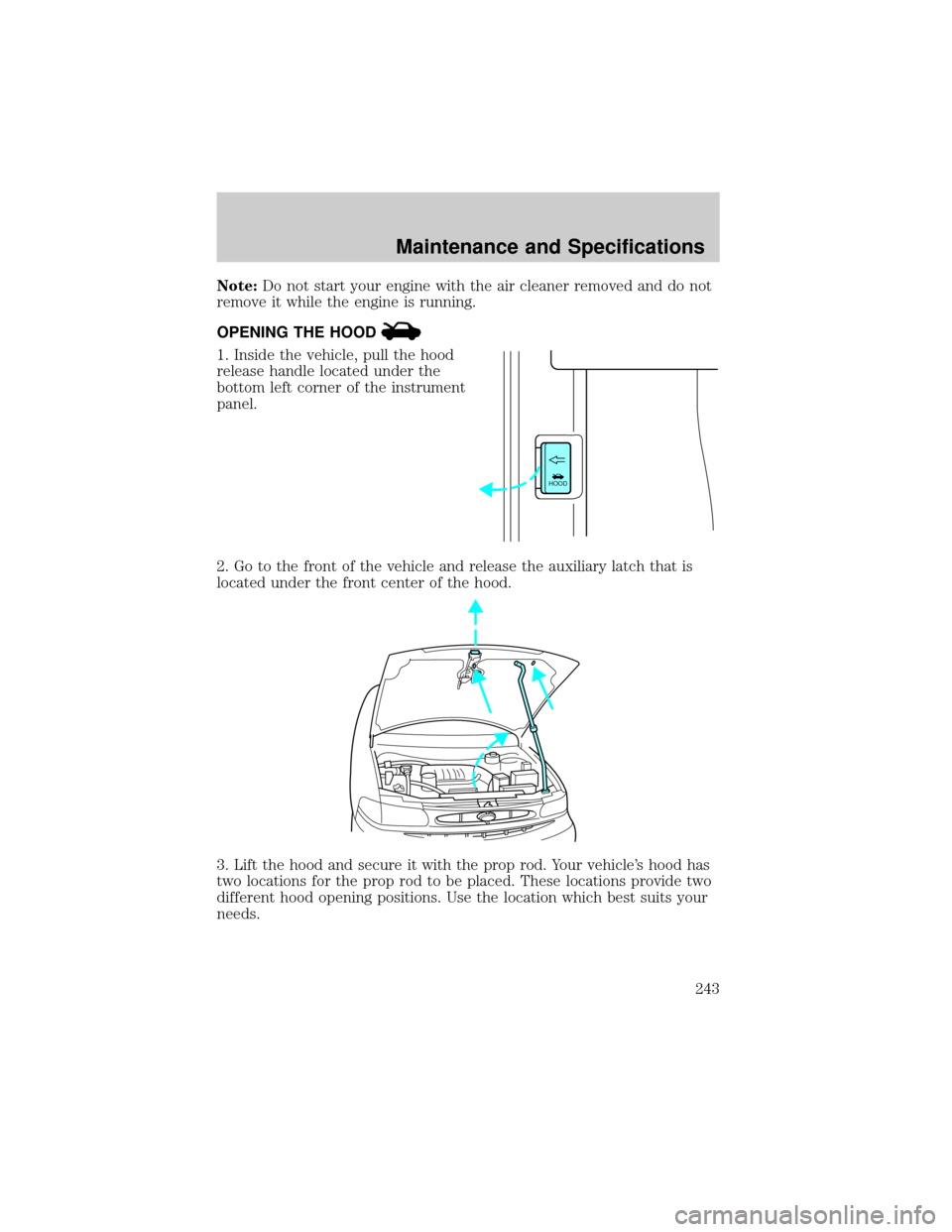
OPENING THE HOOD
1. Inside the vehicle, pull the hood
release handle located under the
bottom left corner of the instrument
panel.
2. Go to the front of the vehicle and release the auxiliary latch that is
located under the front center of the hood.
3. Lift the hood and secure it with the prop rod. Your vehicle's hood has
two locations for the prop rod to be placed. These locations provide two
different hood opening positions. Use the location which best suits your
needs.
HOOD
Maintenance and Specifications
243
Page 273 of 296
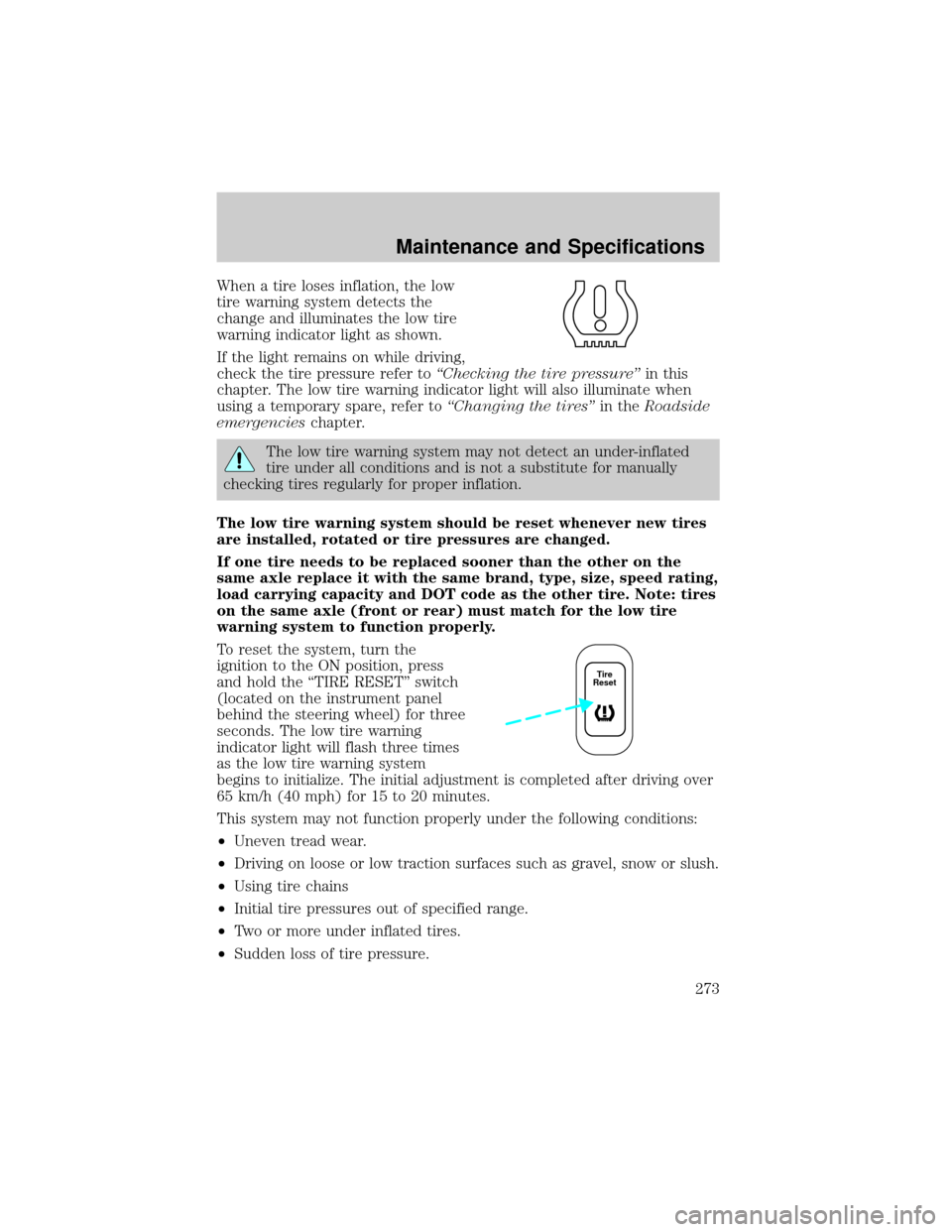
When a tire loses inflation, the low
tire warning system detects the
change and illuminates the low tire
warning indicator light as shown.
If the light remains on while driving,
check the tire pressure refer toªChecking the tire pressureºin this
chapter. The low tire warning indicator light will also illuminate when
using a temporary spare, refer toªChanging the tiresºin theRoadside
emergencieschapter.
The low tire warning system may not detect an under-inflated
tire under all conditions and is not a substitute for manually
checking tires regularly for proper inflation.
The low tire warning system should be reset whenever new tires
are installed, rotated or tire pressures are changed.
If one tire needs to be replaced sooner than the other on the
same axle replace it with the same brand, type, size, speed rating,
load carrying capacity and DOT code as the other tire. Note: tires
on the same axle (front or rear) must match for the low tire
warning system to function properly.
To reset the system, turn the
ignition to the ON position, press
and hold the ªTIRE RESETº switch
(located on the instrument panel
behind the steering wheel) for three
seconds. The low tire warning
indicator light will flash three times
as the low tire warning system
begins to initialize. The initial adjustment is completed after driving over
65 km/h (40 mph) for 15 to 20 minutes.
This system may not function properly under the following conditions:
²Uneven tread wear.
²Driving on loose or low traction surfaces such as gravel, snow or slush.
²Using tire chains
²Initial tire pressures out of specified range.
²Two or more under inflated tires.
²Sudden loss of tire pressure.
Tire
Reset
Maintenance and Specifications
273
Page 283 of 296
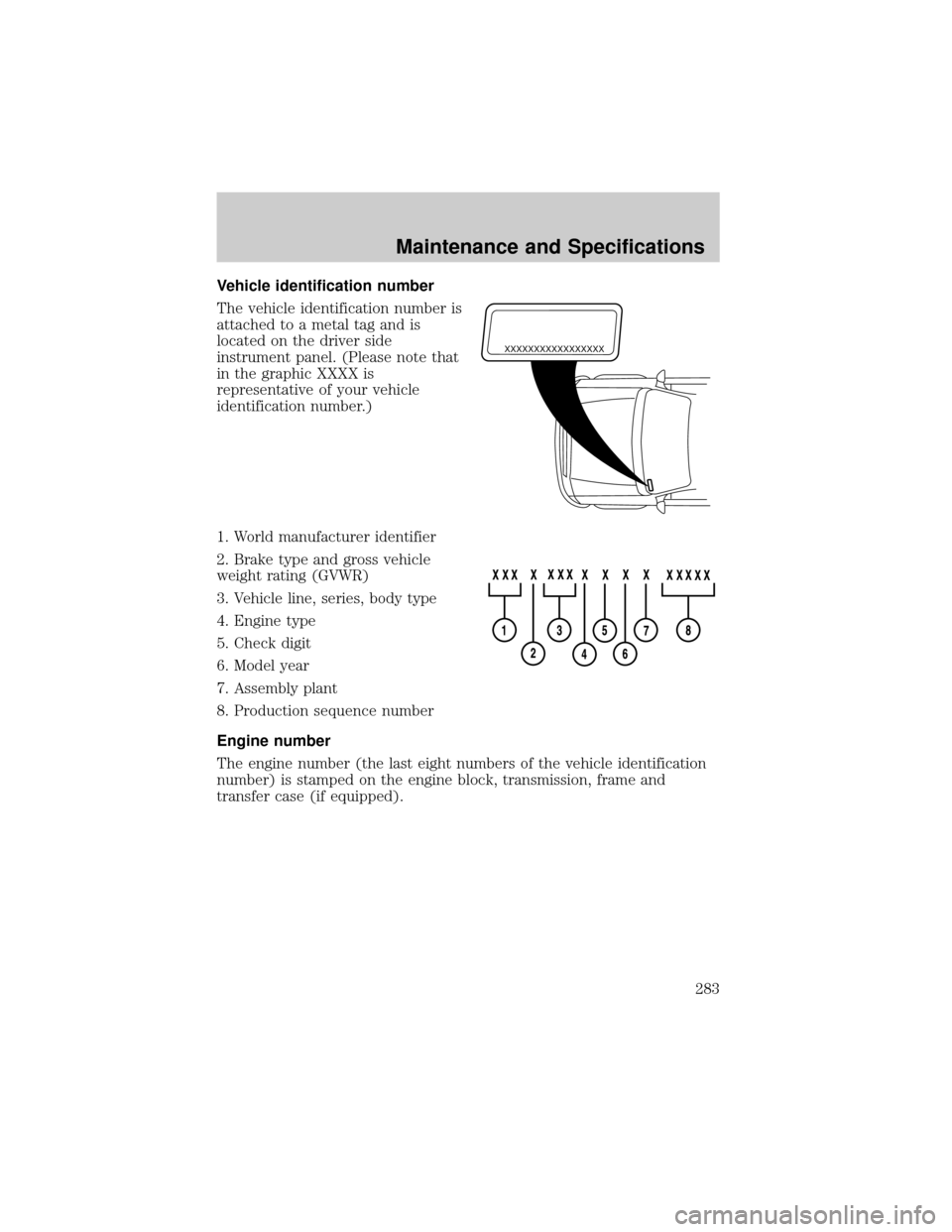
Vehicle identification number
The vehicle identification number is
attached to a metal tag and is
located on the driver side
instrument panel. (Please note that
in the graphic XXXX is
representative of your vehicle
identification number.)
1. World manufacturer identifier
2. Brake type and gross vehicle
weight rating (GVWR)
3. Vehicle line, series, body type
4. Engine type
5. Check digit
6. Model year
7. Assembly plant
8. Production sequence number
Engine number
The engine number (the last eight numbers of the vehicle identification
number) is stamped on the engine block, transmission, frame and
transfer case (if equipped).
XXXXXXXXXXXXXXXXX
Maintenance and Specifications
283
Page 288 of 296

in rear seat ......................165, 167
tether anchorage
hardware .................................168
Cleaning your vehicle
engine compartment ..............237
exterior ....................................241
instrument cluster lens ..........239
instrument panel ....................239
interior .....................................239
plastic parts ............237±238, 240
safety belts ..............................240
washing ....................................235
waxing .....................................235
wheels ......................................236
windows ..................................240
wiper blades ............................238
woodtone trim ........................238
Clock ..........................22, 31, 37, 48
Compass, electronic ............88, 107
Console ........................................94
overhead ....................................82
Controls
power seat ...............................130
Coolant
checking and adding ..............252
refill capacities ................256, 278
specifications ..................279±280
Cruise control
(see Speed control) ....................90
Cupholder(s) .............................134
Customer Assistance ................200
Ford accessories for your
vehicle .....................................241
Ford Extended Service
Plan ..........................................227
Getting assistance outside
the U.S. and Canada ..............231Getting roadside
assistance ................................200
Getting the service
you need .................................225
Ordering additional
owner's literature ...................232
The Dispute Settlement
Board .......................................228
Utilizing the Mediation/
Arbitration Program ...............231
D
Daytime running lamps
(see Lamps) ................................67
Defrost
rear window ..............................66
Dipstick
automatic transmission
fluid ..........................................269
engine oil .................................246
Doors
door ajar warning .....................14
lubricant specifications ..........279
power sliding ............................83
Driving under special
conditions
through water .........................192
E
Emergencies, roadside
jump-starting ..........................218
Emission control system ..........265
Engine ................................280±281
check engine/service engine
soon light ..................................10
cleaning ...................................237
coolant .....................................252
Index
288
Page 290 of 296

daytime running lights .............67
flash to pass ..............................68
high beam ...........................15, 68
replacing bulbs .........................74
turning on and off ....................67
warning chime ..........................15
Heating
heater only system ...................58
heating and air conditioning
system .......................................60
rear seat controls .....................64
HomeLink universal
transceiver
(see Garage door opener) ...96±99
Hood ..........................................243
I
Ignition .......................175, 280±281
Infant seats
(see Safety seats) .....................164
Inspection/maintenance
(I/M) testing ..............................266
Instrument panel
cleaning ...................................239
cluster ................................10, 239
lighting up panel
and interior ...............................69
J
Jack ............................................212
positioning ...............................212
storage .....................................212
Jump-starting your vehicle ......218K
Keyless entry system
autolock ...................................121
locking and unlocking doors ..123
programming entry code .......122
Keys ...................................124±126
key in ignition chime ...............15
positions of the ignition .........175
L
Lamps
autolamp system .......................67
bulb replacement
specifications chart ..................73
cargo lamps ...............................69
daytime running light ...............67
headlamps .................................67
headlamps, flash to pass ..........68
instrument panel, dimming .....69
interior lamps .....................71±73
replacing bulbs ....... 73±74, 76±78
Lane change indicator
(see Turn signal) ........................71
Liftgate ..............................110, 112
Lights, warning and indicator ....10
air bag ........................................12
anti-lock brakes (ABS) ....12, 181
anti-theft ...................................14
brake ..........................................12
charging system ........................12
check engine .............................10
door ajar ....................................14
fuel cap light .............................11
fuel reset ...................................13
high beam ...........................13, 15
low fuel ......................................14
low washer fluid .......................14
oil pressure ...............................13
Index
290