brake FORD WINDSTAR 2002 2.G Workshop Manual
[x] Cancel search | Manufacturer: FORD, Model Year: 2002, Model line: WINDSTAR, Model: FORD WINDSTAR 2002 2.GPages: 296, PDF Size: 2.45 MB
Page 264 of 296
²Idling for long periods of time (greater than one minute) may waste
fuel.
²Anticipate stopping; slowing down may eliminate the need to stop.
²Sudden or hard accelerations may reduce fuel economy.
²Slow down gradually.
²Driving at reasonable speeds (traveling at 88 km/h [55 mph] uses 15%
less fuel than traveling at 105 km/h [65 mph]).
²Revving the engine before turning it off may reduce fuel economy.
²Using the air conditioner or defroster may reduce fuel economy.
²You may want to turn off the speed control in hilly terrain if
unnecessary shifting between third and fourth gear occurs.
Unnecessary shifting of this type could result in reduced fuel
economy.
²Warming up a vehicle on cold mornings is not required and may
reduce fuel economy.
²Resting your foot on the brake pedal while driving may reduce fuel
economy.
²Combine errands and minimize stop-and-go driving.
Maintenance
²Keep tires properly inflated and use only recommended size.
²Operating a vehicle with the wheels out of alignment will reduce fuel
economy.
²Use recommended engine oil. Refer toLubricant specificationsin
this chapter.
²Perform all regularly scheduled maintenance items. Follow the
recommended maintenance schedule and owner maintenance checks
found in your vehicle scheduled maintenance guide.
Conditions
²Heavily loading a vehicle or towing a trailer may reduce fuel economy
at any speed.
²Carrying unnecessary weight may reduce fuel economy (approximately
0.4 km/L [1 mpg] is lost for every 180 kg [400 lb] of weight carried).
Maintenance and Specifications
264
Page 268 of 296
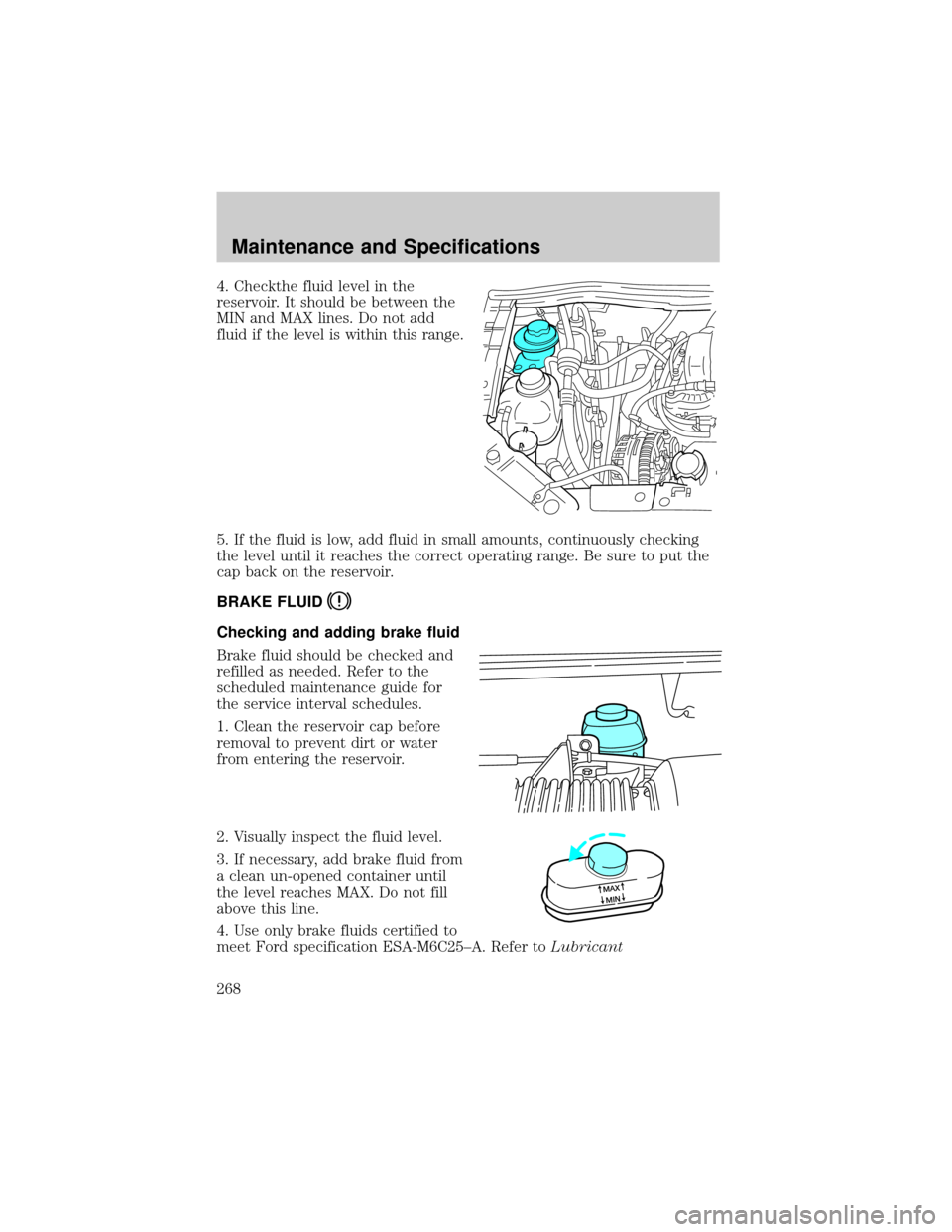
4. Checkthe fluid level in the
reservoir. It should be between the
MIN and MAX lines. Do not add
fluid if the level is within this range.
5. If the fluid is low, add fluid in small amounts, continuously checking
the level until it reaches the correct operating range. Be sure to put the
cap back on the reservoir.
BRAKE FLUID
Checking and adding brake fluid
Brake fluid should be checked and
refilled as needed. Refer to the
scheduled maintenance guide for
the service interval schedules.
1. Clean the reservoir cap before
removal to prevent dirt or water
from entering the reservoir.
2. Visually inspect the fluid level.
3. If necessary, add brake fluid from
a clean un-opened container until
the level reaches MAX. Do not fill
above this line.
4. Use only brake fluids certified to
meet Ford specification ESA-M6C25±A. Refer toLubricant
MAX
MIN
Maintenance and Specifications
268
Page 269 of 296
specificationsin this chapter.DOT 3 fluid is recommended.
However, if DOT 3 is not available, DOT 4 fluid can be used.
Brake fluid is toxic. If brake fluid contacts the eyes, flush eyes
with running water for 15 minutes. Seek medical attention if
irritation persists. If taken internally, drink water and induce vomiting.
Seek medical attention immediately.
If you use DOT 5 or any other brake fluid that is not DOT 3 or
DOT 4, you will cause permanent damage to your brakes.
Do not let the fluid level in the reservoir for the master cylinder
fall below the MIN mark. If master cylinder runs dry, this may
cause the brakes to fail.
TRANSMISSION FLUID
Checking automatic transmission fluid
Refer to your scheduled maintenance guide for scheduled intervals for
fluid checks and changes. Your transaxle does not consume fluid.
However, the fluid level should be checked if the transaxle is not working
properly, i.e., if the transaxle slips or shifts slowly or if you notice some
sign of fluid leakage.
Automatic transmission fluid expands when warmed. To obtain an
accurate fluid check, drive the vehicle until it is warmed up
(approximately 30 km [20 miles]). If your vehicle has been
operated for an extended period at high speeds, in city traffic
during hot weather or pulling a trailer, the vehicle should be
turned off for about 30 minutes to allow fluid to cool before
checking.
1. Drive the vehicle 30 km (20 miles) or until it reaches normal operating
temperature.
2. Park the vehicle on a level surface and engage the parking brake.
3. With the parking brake engaged and your foot on the brake pedal,
start the engine and move the gearshift lever through all of the gear
ranges. Allow sufficient time for each gear to engage.
4. Latch the gearshift lever in P (Park) and leave the engine running.
Maintenance and Specifications
269
Page 272 of 296
Traction AA A B C
The traction grades, from highest to lowest are AA, A, B, and C. The
grades represent the tire's ability to stop on wet pavement as measured
under controlled conditions on specified government test surfaces of
asphalt and concrete. A tire marked C may have poor traction
performance.
The traction grade assigned to this tire is based on
straight-ahead braking traction tests, and does not include
acceleration, cornering, hydroplaning or peak traction characteristics.
Temperature A B C
The temperature grades are A (the highest), B, and C, representing the
tire's resistance to the generation of heat and its ability to dissipate heat
when tested under controlled conditions on a specified indoor laboratory
test wheel. Sustained high temperature can cause the material of the tire
to degenerate and reduce tire life, and excessive temperature can lead to
sudden tire failure. The grade C corresponds to a level of performance
which all passenger car tires must meet under the Federal Motor Vehicle
Safety Standard No. 109. Grades B and A represent higher levels of
performance on the laboratory test wheel than the minimum required by
law.
The temperature grade for this tire is established for a tire that
is properly inflated and not overloaded. Excessive speed,
underinflation, or excessive loading, either separately or in
combination, can cause heat buildup and possible tire failure.
SERVICING YOUR TIRES
Low tire warning
The low tire warning system is designed to detect a significant loss of
inflation inany one of your tireson your vehicle. The system uses the
Anti-lock brake wheel speed sensors to detect a change in wheel speed
due to tire deflation.
Maintenance and Specifications
272
Page 276 of 296
Make sure that all replacement tires are of the same size, type,
load-carrying capacity and tread design (e.g., ªAll Terrainº, etc.),
as originally offered by Ford.
Do not replace your tires with ªhigh performanceº tires or larger
size tires.
Failure to follow these precautions may adversely affect the
handling of the vehicle and make it easier for the driver to lose
control and roll over.
Tires that are larger or smaller than your vehicle's original tires may also
affect the accuracy of your speedometer.
SNOW TIRES AND CHAINS
Driving too fast for conditions creates the possibility of loss of
vehicle control. Driving at very high speeds for extended periods
of time may result in damage to vehicle components.
Snow tires must be the same size and grade as the tires you
currently have on your vehicle.
The tires on your vehicle have all weather treads to provide traction in
rain and snow. However, in some climates, you may need to use snow
tires and chains. If you need to use chains, it is recommended that steel
wheels (of the same size and specifications) be used as chains may chip
aluminum wheels.
Follow these guidelines when using snow tires and chains:
²Do not use tire chains with 215/65R16 and P225/60R16 size tires.
²Use only SAE Class S chains.
²Install chains securely, verifying that the chains do not touch any
wiring, brake lines or fuel lines.
²Drive cautiously. If you hear the chains rub or bang against your
vehicle, stop and re-tighten the chains. If this does not work, remove
the chains to prevent damage to your vehicle.
Maintenance and Specifications
276
Page 278 of 296
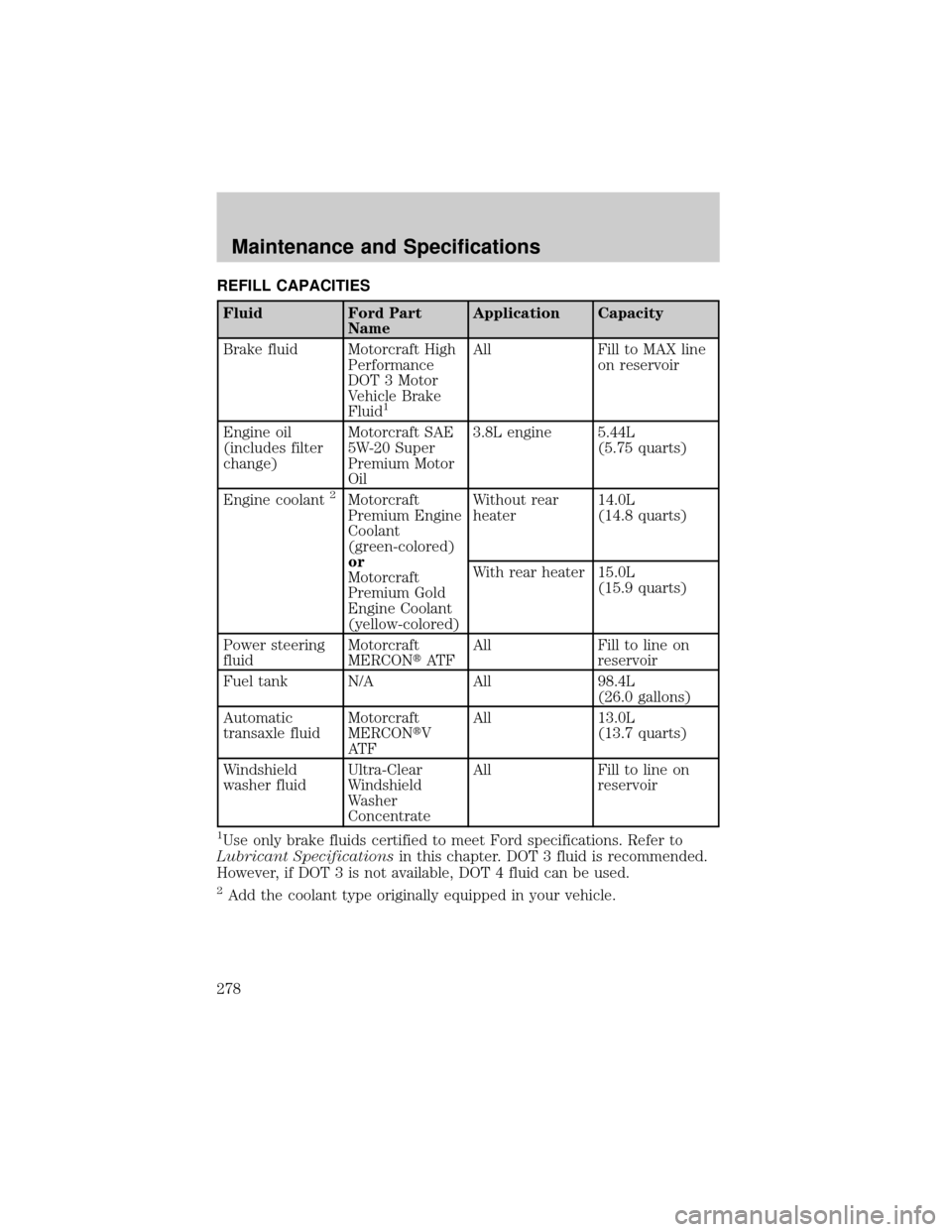
REFILL CAPACITIES
Fluid Ford Part
NameApplication Capacity
Brake fluid Motorcraft High
Performance
DOT 3 Motor
Vehicle Brake
Fluid
1
All Fill to MAX line
on reservoir
Engine oil
(includes filter
change)Motorcraft SAE
5W-20 Super
Premium Motor
Oil3.8L engine 5.44L
(5.75 quarts)
Engine coolant
2Motorcraft
Premium Engine
Coolant
(green-colored)
or
Motorcraft
Premium Gold
Engine Coolant
(yellow-colored)Without rear
heater14.0L
(14.8 quarts)
With rear heater 15.0L
(15.9 quarts)
Power steering
fluidMotorcraft
MERCONtAT FAll Fill to line on
reservoir
Fuel tank N/A All 98.4L
(26.0 gallons)
Automatic
transaxle fluidMotorcraft
MERCONtV
AT FAll 13.0L
(13.7 quarts)
Windshield
washer fluidUltra-Clear
Windshield
Washer
ConcentrateAll Fill to line on
reservoir
1Use only brake fluids certified to meet Ford specifications. Refer to
Lubricant Specificationsin this chapter. DOT 3 fluid is recommended.
However, if DOT 3 is not available, DOT 4 fluid can be used.
2Add the coolant type originally equipped in your vehicle.
Maintenance and Specifications
278
Page 279 of 296
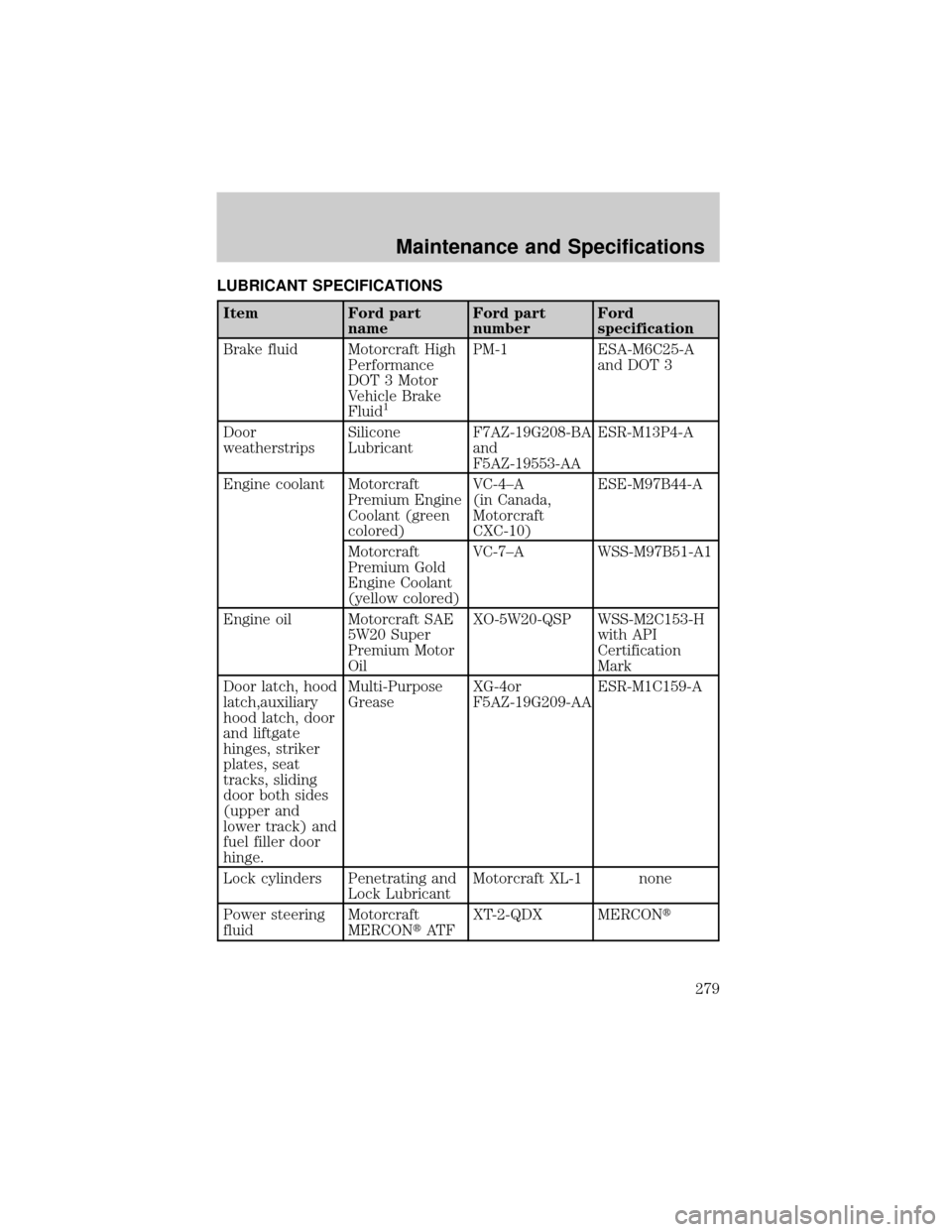
LUBRICANT SPECIFICATIONS
Item Ford part
nameFord part
numberFord
specification
Brake fluid Motorcraft High
Performance
DOT 3 Motor
Vehicle Brake
Fluid
1
PM-1 ESA-M6C25-A
and DOT 3
Door
weatherstripsSilicone
LubricantF7AZ-19G208-BA
and
F5AZ-19553-AAESR-M13P4-A
Engine coolant Motorcraft
Premium Engine
Coolant (green
colored)VC-4±A
(in Canada,
Motorcraft
CXC-10)ESE-M97B44-A
Motorcraft
Premium Gold
Engine Coolant
(yellow colored)VC-7±A WSS-M97B51-A1
Engine oil Motorcraft SAE
5W20 Super
Premium Motor
OilXO-5W20-QSP WSS-M2C153-H
with API
Certification
Mark
Door latch, hood
latch,auxiliary
hood latch, door
and liftgate
hinges, striker
plates, seat
tracks, sliding
door both sides
(upper and
lower track) and
fuel filler door
hinge.Multi-Purpose
GreaseXG-4or
F5AZ-19G209-AAESR-M1C159-A
Lock cylinders Penetrating and
Lock LubricantMotorcraft XL-1 none
Power steering
fluidMotorcraft
MERCONtAT FXT-2-QDX MERCONt
Maintenance and Specifications
279
Page 280 of 296
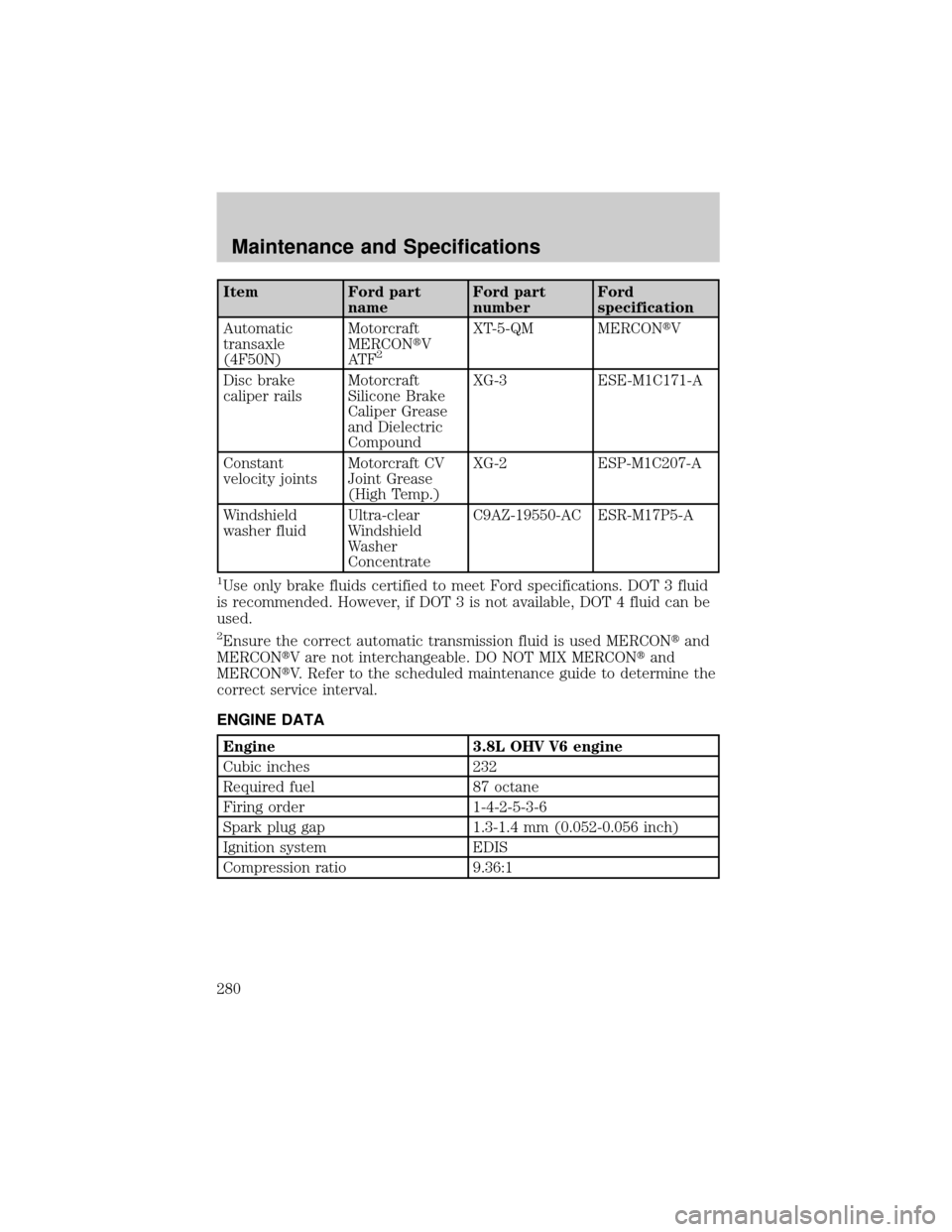
Item Ford part
nameFord part
numberFord
specification
Automatic
transaxle
(4F50N)Motorcraft
MERCONtV
AT F
2
XT-5-QM MERCONtV
Disc brake
caliper railsMotorcraft
Silicone Brake
Caliper Grease
and Dielectric
CompoundXG-3 ESE-M1C171-A
Constant
velocity jointsMotorcraft CV
Joint Grease
(High Temp.)XG-2 ESP-M1C207-A
Windshield
washer fluidUltra-clear
Windshield
Washer
ConcentrateC9AZ-19550-AC ESR-M17P5-A
1Use only brake fluids certified to meet Ford specifications. DOT 3 fluid
is recommended. However, if DOT 3 is not available, DOT 4 fluid can be
used.
2Ensure the correct automatic transmission fluid is used MERCONtand
MERCONtV are not interchangeable. DO NOT MIX MERCONtand
MERCONtV. Refer to the scheduled maintenance guide to determine the
correct service interval.
ENGINE DATA
Engine 3.8L OHV V6 engine
Cubic inches 232
Required fuel 87 octane
Firing order 1-4-2-5-3-6
Spark plug gap 1.3-1.4 mm (0.052-0.056 inch)
Ignition system EDIS
Compression ratio 9.36:1
Maintenance and Specifications
280
Page 283 of 296
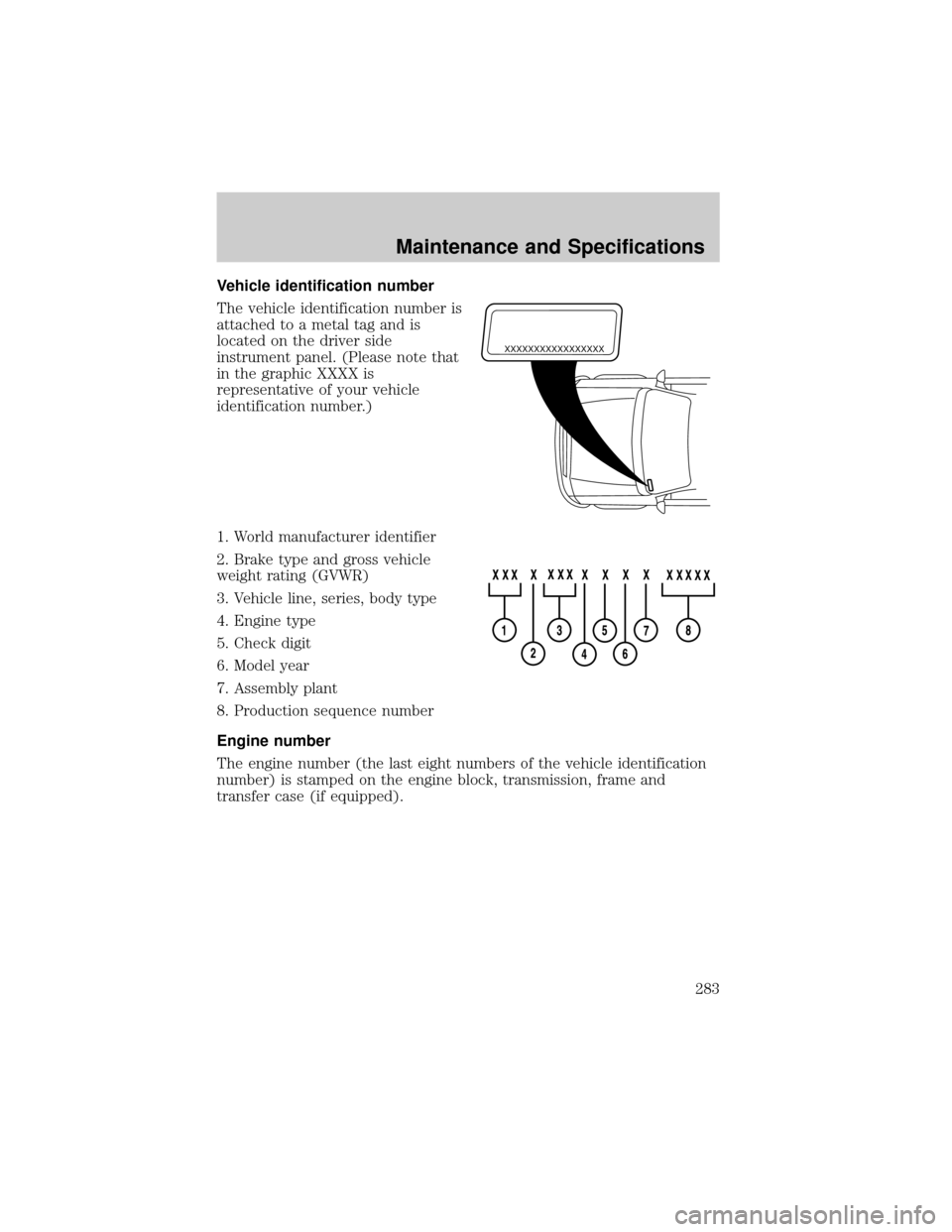
Vehicle identification number
The vehicle identification number is
attached to a metal tag and is
located on the driver side
instrument panel. (Please note that
in the graphic XXXX is
representative of your vehicle
identification number.)
1. World manufacturer identifier
2. Brake type and gross vehicle
weight rating (GVWR)
3. Vehicle line, series, body type
4. Engine type
5. Check digit
6. Model year
7. Assembly plant
8. Production sequence number
Engine number
The engine number (the last eight numbers of the vehicle identification
number) is stamped on the engine block, transmission, frame and
transfer case (if equipped).
XXXXXXXXXXXXXXXXX
Maintenance and Specifications
283
Page 287 of 296

A
Accessory delay ..........................87
AdvanceTrac ..............................183
Air bag supplemental
restraint system ........155±156, 160
and child safety seats ............157
description ......................156, 160
disposal ....................................162
driver air bag ..................158, 161
indicator light ...................12, 158
operation .........................158, 161
passenger air bag ...........158, 161
side air bag ..............................160
Air cleaner filter .......................277
Air conditioning
manual heating and air
conditioning system .................60
Air filter, cabin ............................66
Antifreeze
(see Engine coolant) ................252
Anti-lock brake system
(see Brakes) ..............................180
Anti-theft system ......................127
arming the system ..................128
disarming a triggered
system .....................................128
warning light .............................14
Audio system (see Radio) .........44
Automatic transaxle .................186
driving with .............................187
fluid, adding ............................269
fluid, checking ........................269
fluid, refill capacities ..............278
fluid, specification ..................280
Auxiliary power point ...........86, 94
Axle
lubricant specifications ..........279B
Battery .......................................249
acid, treating emergencies .....249
charging system
warning light .............................12
jumping a disabled battery ....218
maintenance-free ....................249
replacement,
specifications ..........................277
servicing ..................................249
Belt minder ...............................150
Brakes ........................................179
anti-lock ...................................180
anti-lock brake system
(ABS) warning light .........12, 181
brake warning light ..................12
fluid, checking and adding ....268
fluid, refill capacities ..............278
fluid, specifications .........279±280
lubricant
specifications ..................279±280
parking ....................................181
pedals (see Power
adjustable foot pedals) ............90
shift interlock ..........................186
Break-in period .............................6
C
Capacities for refilling fluids ....278
Cargo net ...................................111
Cellular telephone (see your
Cellular Phone Guide) ................94
Certification Label ....................282
Child safety restraints ..............163
child safety belts ....................163
Child safety seats ......................164
in front seat ............................165
Index
287