lock FORD WINDSTAR 2002 2.G Repair Manual
[x] Cancel search | Manufacturer: FORD, Model Year: 2002, Model line: WINDSTAR, Model: FORD WINDSTAR 2002 2.GPages: 296, PDF Size: 2.45 MB
Page 186 of 296
²Do not operate the vehicle with a low power steering pump fluid level
(below the MIN mark on the reservoir).
If the power steering system breaks down (or if the engine is turned
off), you can steer the vehicle manually, but it takes more effort.
If the steering wanders or pulls, the condition could be caused by any of
the following:
²underinflated tire(s) on any wheel(s)
²uneven vehicle loading
²high crown in center of road
²high crosswinds
²wheels out of alignment
²loose or worn suspension components
AUTOMATIC TRANSAXLE OPERATION
Brake-shift interlock
This vehicle is equipped with a brake-shift interlock feature that prevents
the gearshift lever from being moved from P (Park) unless the brake
pedal is depressed.
If the gearshift lever cannot be moved from P (Park) with the brake
pedal depressed, it is possible that a fuse has blown or the vehicle's
brakelamps are not operating properly. Refer toFuses and relaysin the
Roadside emergencieschapter.
Do not drive your vehicle until you verify that the brakelamps
are working.
If your vehicle gets stuck in mud or snow it may be rocked out by
shifting between forward and reverse gears, stopping between shifts, in a
steady pattern. Press lightly on the accelerator in each gear.
Do not rock the vehicle if the engine is not at normal operating
temperature or damage to the transaxle may occur.
Do not rock the vehicle for more than a few minutes or damage
to the transaxle and tires may occur or the engine may overheat.
Driving
186
Page 188 of 296
has been learned. The adaptive learning strategy is maintained by power
from the battery. When the battery is disconnected or a new battery is
installed, the transaxle must relearn its adaptive strategy. Optimal
shifting will resume within a few hundred kilometers (miles) of
operation.
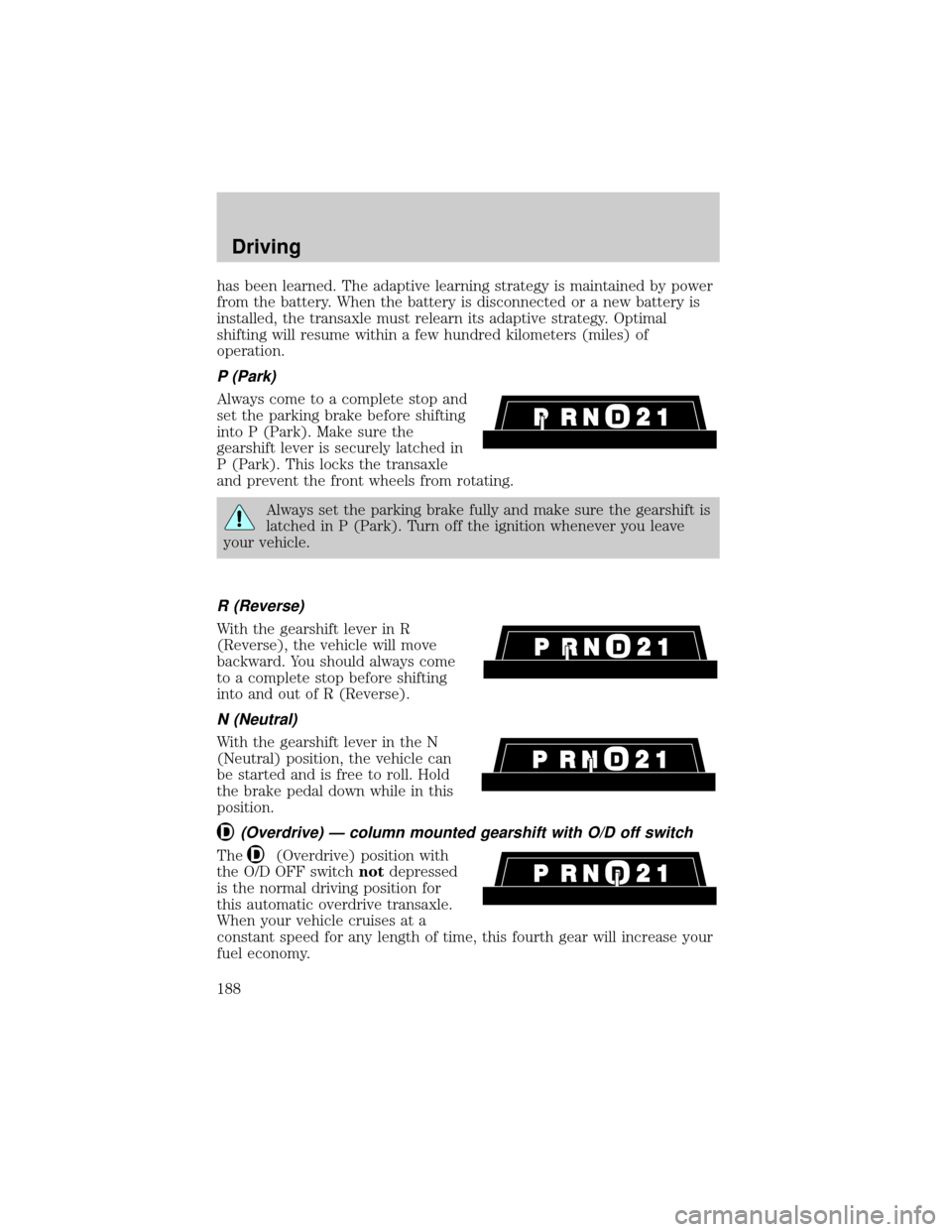
P (Park)
Always come to a complete stop and
set the parking brake before shifting
into P (Park). Make sure the
gearshift lever is securely latched in
P (Park). This locks the transaxle
and prevent the front wheels from rotating.
Always set the parking brake fully and make sure the gearshift is
latched in P (Park). Turn off the ignition whenever you leave
your vehicle.
R (Reverse)
With the gearshift lever in R
(Reverse), the vehicle will move
backward. You should always come
to a complete stop before shifting
into and out of R (Reverse).
N (Neutral)
With the gearshift lever in the N
(Neutral) position, the vehicle can
be started and is free to roll. Hold
the brake pedal down while in this
position.
(Overdrive) Ð column mounted gearshift with O/D off switch
The(Overdrive) position with
the O/D OFF switchnotdepressed
is the normal driving position for
this automatic overdrive transaxle.
When your vehicle cruises at a
constant speed for any length of time, this fourth gear will increase your
fuel economy.
Driving
188
Page 200 of 296

GETTING ROADSIDE ASSISTANCE
To fully assist if you should have a vehicle concern, Ford Motor Company
offers a complimentary roadside assistance program. This program is
separate from the New Vehicle Limited Warranty. The service is available:
²24±hours, seven days a week
²for the Basic warranty period (Canada) or New Vehicle Limited
Warranty period (U.S.) of three years or 60 000 km (36 000 miles),
whichever comes first on Ford and Mercury vehicles, and four years or
80 000 km (50 000 miles) on Lincoln vehicles
Roadside assistance will cover:
²changing a flat tire
²jump-starts
²lock-out assistance
²limited fuel delivery*
²towing of your disabled vehicle to the nearest Ford Motor Company
dealership, or your selling dealer if within 25 kms (15.5 miles) of the
nearest Ford Motor Company dealership (one tow per disablement).
Even non-warranty related tows, like accidents or getting stuck in the
mud or snow, are covered (some exclusions apply, such as impound
towing or repossession).
* Canadian customers refer to yourRoadside Assistance supplement
for exact fuel amounts.
USING ROADSIDE ASSISTANCE
Complete the roadside assistance identification card and place it in your
wallet for quick reference. In the United States, this card is found in the
Owner Guide portfolio in the glove compartment in Ford vehicles and is
mailed to you if you own a Mercury or Lincoln. In Canada, the card is
found in the Roadside Assistance book in the glove compartment.
U.S. Ford or Mercury vehicle customers who require roadside assistance,
call 1±800±241±3673; Lincoln vehicle customers call 1±800±521±4140.
Canadian customers who require roadside assistance, call
1±800±665±2006.
Roadside Emergencies
200
Page 206 of 296
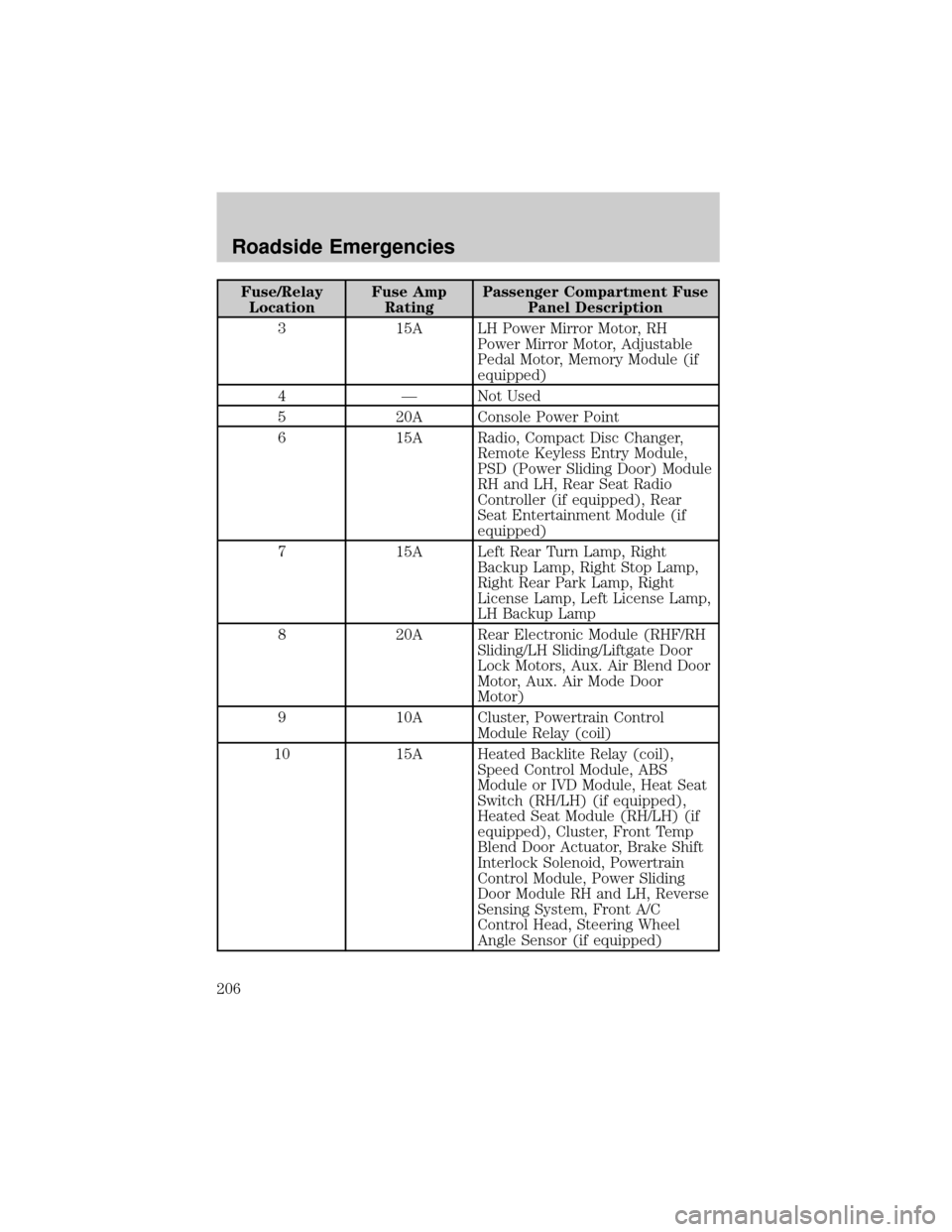
Fuse/Relay
LocationFuse Amp
RatingPassenger Compartment Fuse
Panel Description
3 15A LH Power Mirror Motor, RH
Power Mirror Motor, Adjustable
Pedal Motor, Memory Module (if
equipped)
4 Ð Not Used
5 20A Console Power Point
6 15A Radio, Compact Disc Changer,
Remote Keyless Entry Module,
PSD (Power Sliding Door) Module
RH and LH, Rear Seat Radio
Controller (if equipped), Rear
Seat Entertainment Module (if
equipped)
7 15A Left Rear Turn Lamp, Right
Backup Lamp, Right Stop Lamp,
Right Rear Park Lamp, Right
License Lamp, Left License Lamp,
LH Backup Lamp
8 20A Rear Electronic Module (RHF/RH
Sliding/LH Sliding/Liftgate Door
Lock Motors, Aux. Air Blend Door
Motor, Aux. Air Mode Door
Motor)
9 10A Cluster, Powertrain Control
Module Relay (coil)
10 15A Heated Backlite Relay (coil),
Speed Control Module, ABS
Module or IVD Module, Heat Seat
Switch (RH/LH) (if equipped),
Heated Seat Module (RH/LH) (if
equipped), Cluster, Front Temp
Blend Door Actuator, Brake Shift
Interlock Solenoid, Powertrain
Control Module, Power Sliding
Door Module RH and LH, Reverse
Sensing System, Front A/C
Control Head, Steering Wheel
Angle Sensor (if equipped)
Roadside Emergencies
206
Page 207 of 296
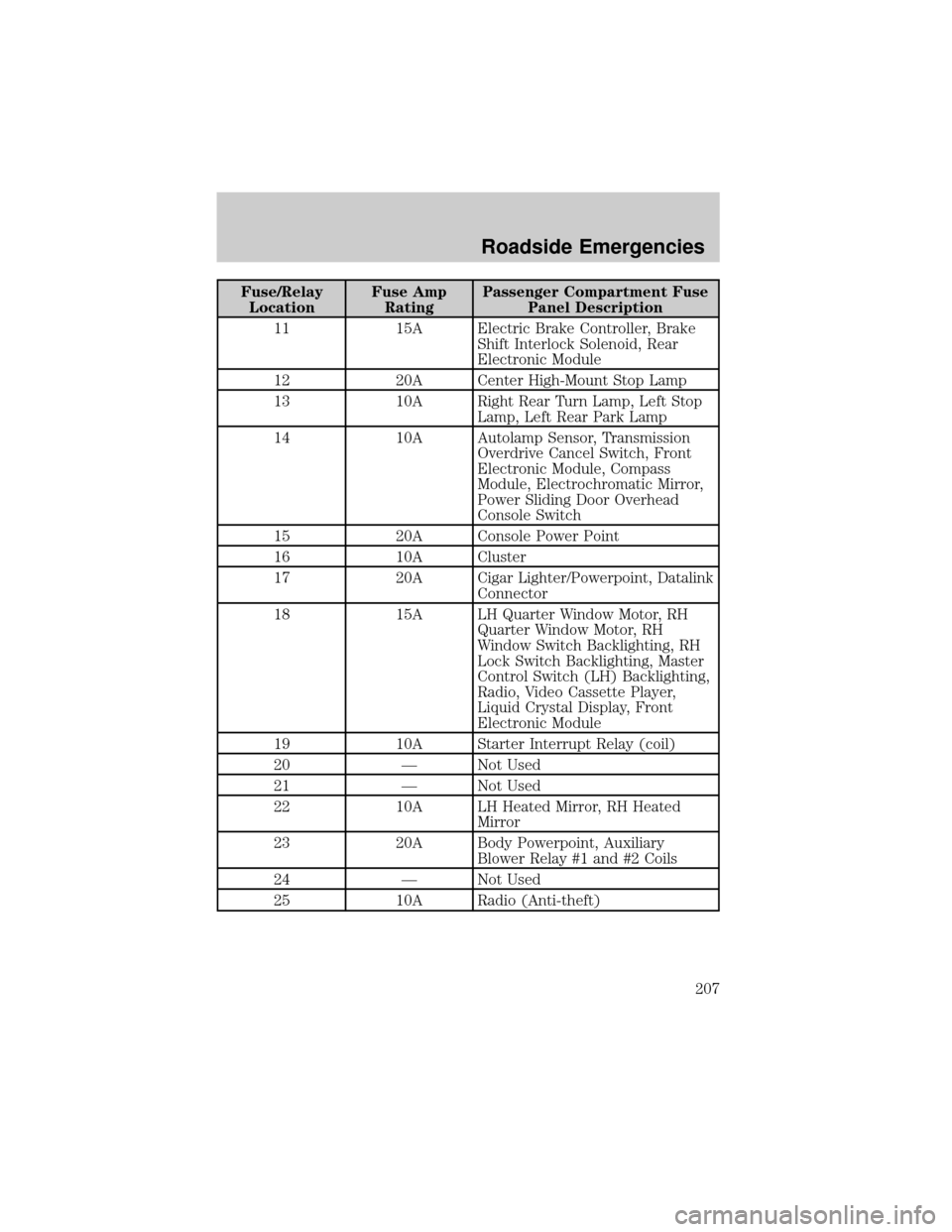
Fuse/Relay
LocationFuse Amp
RatingPassenger Compartment Fuse
Panel Description
11 15A Electric Brake Controller, Brake
Shift Interlock Solenoid, Rear
Electronic Module
12 20A Center High-Mount Stop Lamp
13 10A Right Rear Turn Lamp, Left Stop
Lamp, Left Rear Park Lamp
14 10A Autolamp Sensor, Transmission
Overdrive Cancel Switch, Front
Electronic Module, Compass
Module, Electrochromatic Mirror,
Power Sliding Door Overhead
Console Switch
15 20A Console Power Point
16 10A Cluster
17 20A Cigar Lighter/Powerpoint, Datalink
Connector
18 15A LH Quarter Window Motor, RH
Quarter Window Motor, RH
Window Switch Backlighting, RH
Lock Switch Backlighting, Master
Control Switch (LH) Backlighting,
Radio, Video Cassette Player,
Liquid Crystal Display, Front
Electronic Module
19 10A Starter Interrupt Relay (coil)
20 Ð Not Used
21 Ð Not Used
22 10A LH Heated Mirror, RH Heated
Mirror
23 20A Body Powerpoint, Auxiliary
Blower Relay #1 and #2 Coils
24 Ð Not Used
25 10A Radio (Anti-theft)
Roadside Emergencies
207
Page 210 of 296
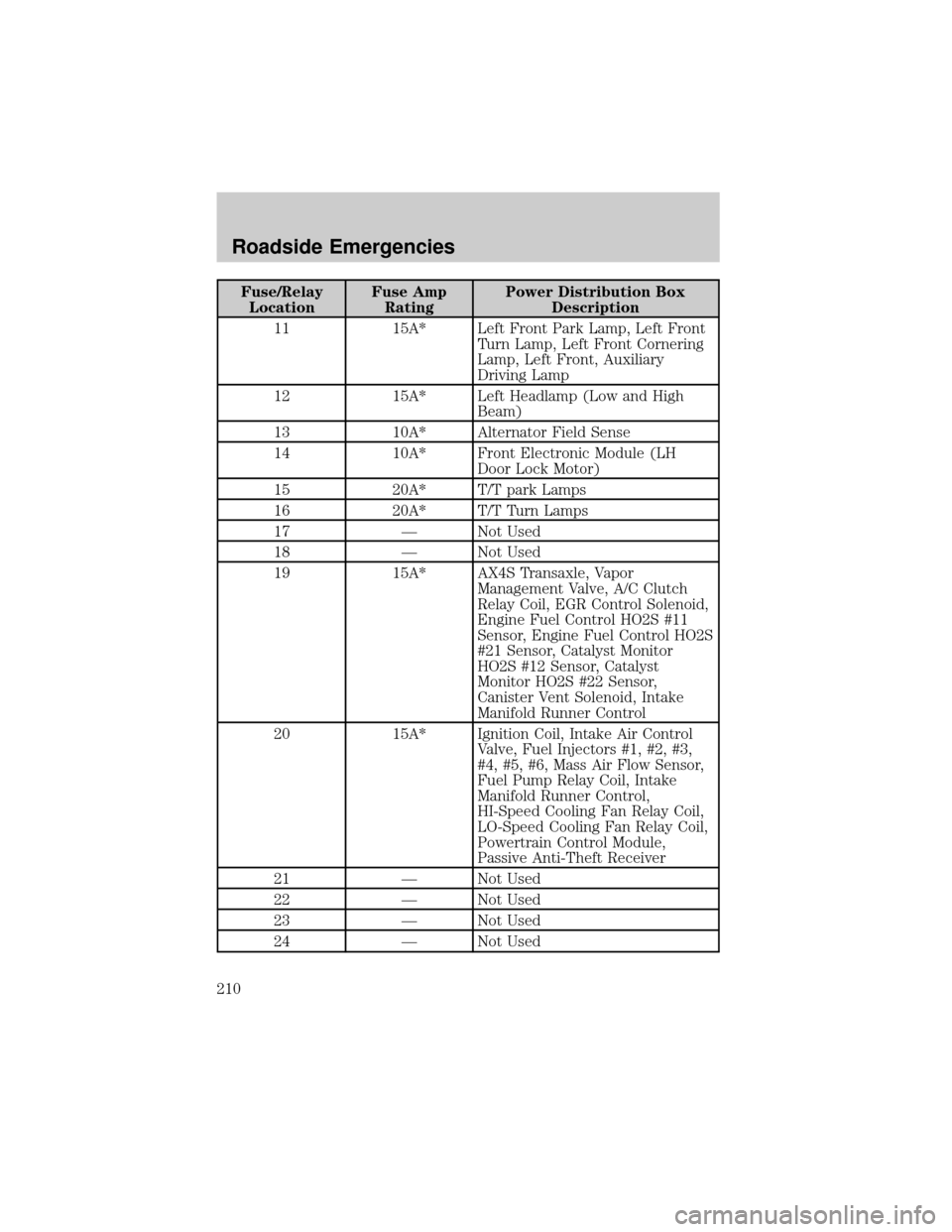
Fuse/Relay
LocationFuse Amp
RatingPower Distribution Box
Description
11 15A* Left Front Park Lamp, Left Front
Turn Lamp, Left Front Cornering
Lamp, Left Front, Auxiliary
Driving Lamp
12 15A* Left Headlamp (Low and High
Beam)
13 10A* Alternator Field Sense
14 10A* Front Electronic Module (LH
Door Lock Motor)
15 20A* T/T park Lamps
16 20A* T/T Turn Lamps
17 Ð Not Used
18 Ð Not Used
19 15A* AX4S Transaxle, Vapor
Management Valve, A/C Clutch
Relay Coil, EGR Control Solenoid,
Engine Fuel Control HO2S #11
Sensor, Engine Fuel Control HO2S
#21 Sensor, Catalyst Monitor
HO2S #12 Sensor, Catalyst
Monitor HO2S #22 Sensor,
Canister Vent Solenoid, Intake
Manifold Runner Control
20 15A* Ignition Coil, Intake Air Control
Valve, Fuel Injectors #1, #2, #3,
#4, #5, #6, Mass Air Flow Sensor,
Fuel Pump Relay Coil, Intake
Manifold Runner Control,
HI-Speed Cooling Fan Relay Coil,
LO-Speed Cooling Fan Relay Coil,
Powertrain Control Module,
Passive Anti-Theft Receiver
21 Ð Not Used
22 Ð Not Used
23 Ð Not Used
24 Ð Not Used
Roadside Emergencies
210
Page 214 of 296
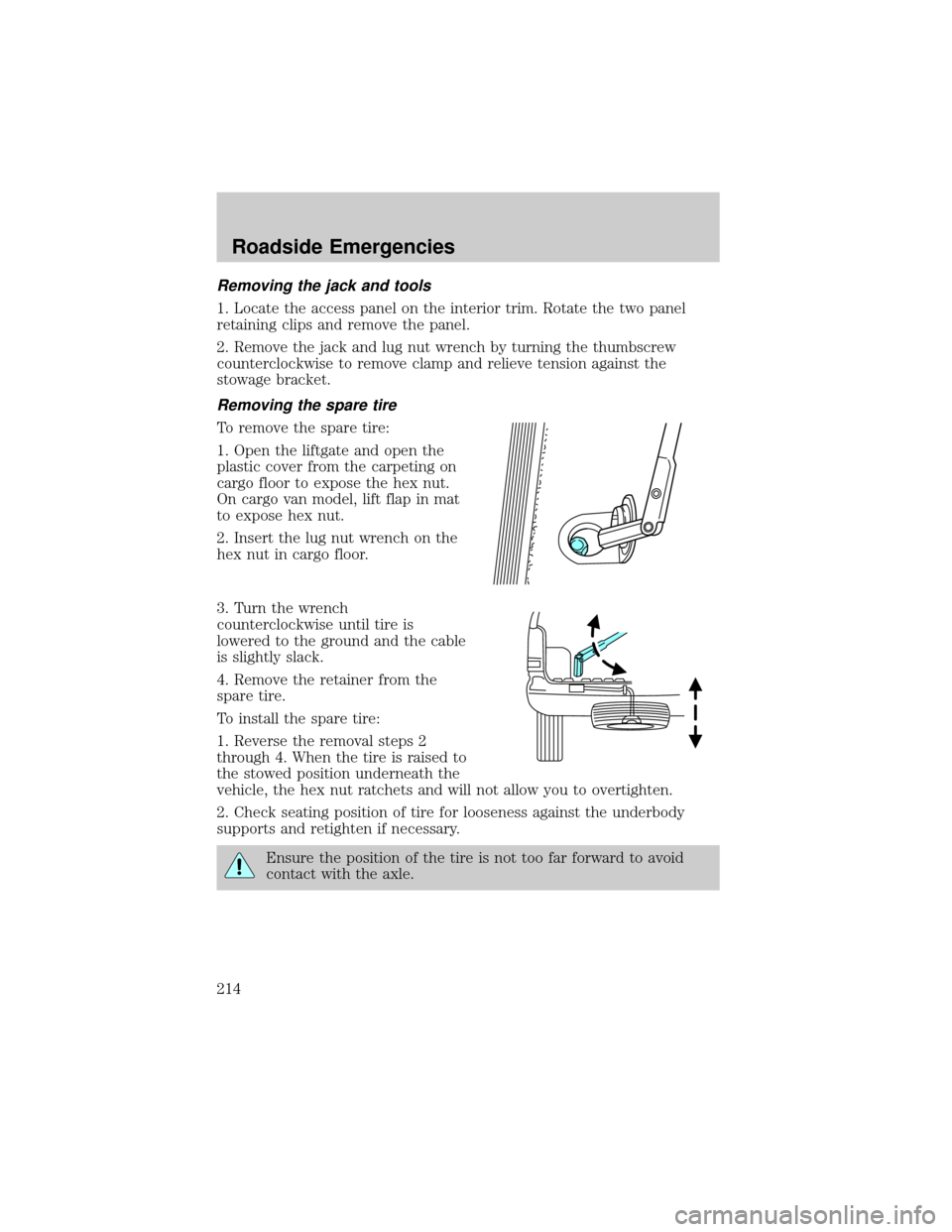
Removing the jack and tools
1. Locate the access panel on the interior trim. Rotate the two panel
retaining clips and remove the panel.
2. Remove the jack and lug nut wrench by turning the thumbscrew
counterclockwise to remove clamp and relieve tension against the
stowage bracket.
Removing the spare tire
To remove the spare tire:
1. Open the liftgate and open the
plastic cover from the carpeting on
cargo floor to expose the hex nut.
On cargo van model, lift flap in mat
to expose hex nut.
2. Insert the lug nut wrench on the
hex nut in cargo floor.
3. Turn the wrench
counterclockwise until tire is
lowered to the ground and the cable
is slightly slack.
4. Remove the retainer from the
spare tire.
To install the spare tire:
1. Reverse the removal steps 2
through 4. When the tire is raised to
the stowed position underneath the
vehicle, the hex nut ratchets and will not allow you to overtighten.
2. Check seating position of tire for looseness against the underbody
supports and retighten if necessary.
Ensure the position of the tire is not too far forward to avoid
contact with the axle.
Roadside Emergencies
214
Page 215 of 296
Tire change procedure
When one of the front wheels is off the ground, the transaxle
alone will not prevent the vehicle from moving or slipping off the
jack, even if the vehicle is in P (Park).
To prevent the vehicle from moving when you change a tire, be
sure the parking brake is set, then block (in both directions) the
wheel that is diagonally opposite (other side and end of the vehicle) to
the tire being changed.
If the vehicle slips off the jack, you or someone else could be
seriously injured.
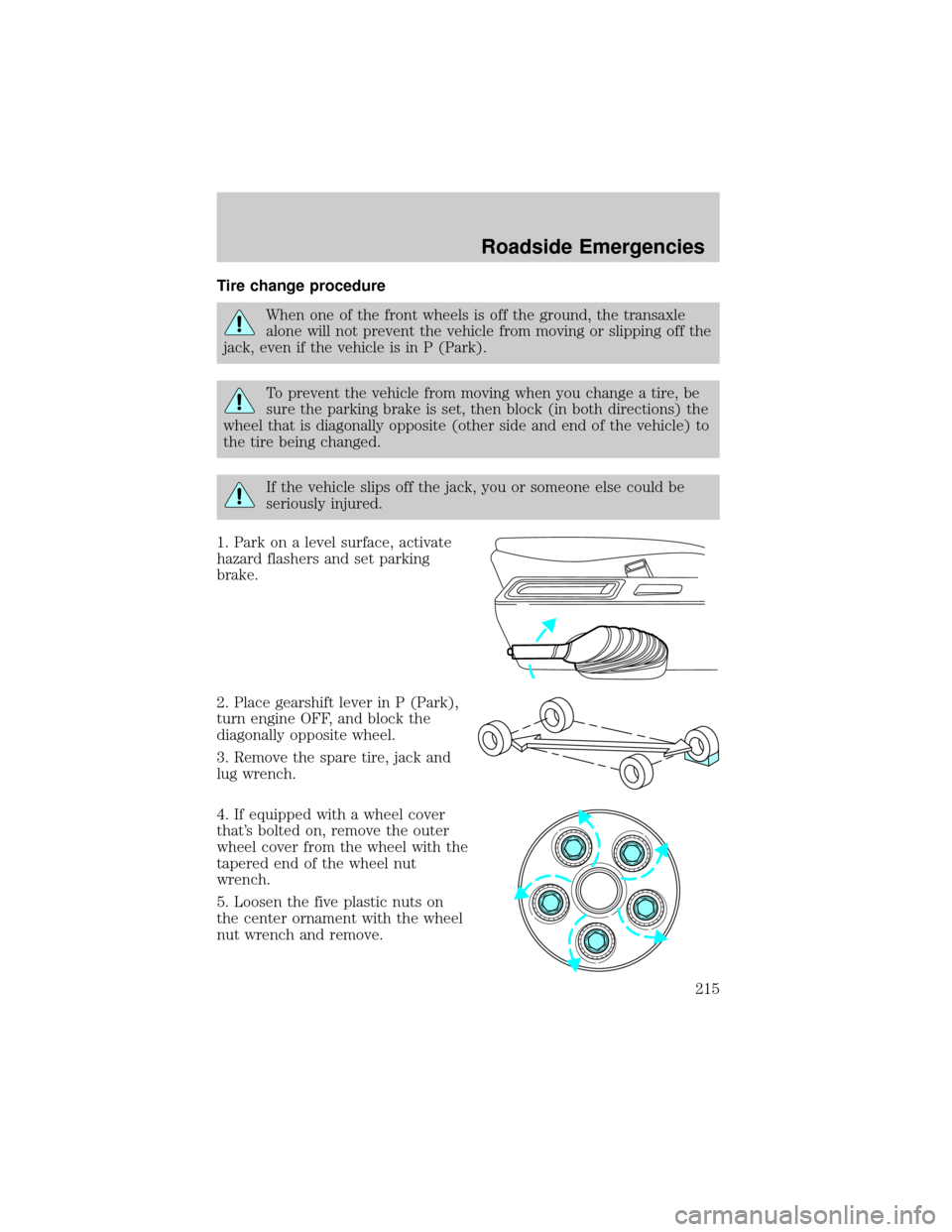
1. Park on a level surface, activate
hazard flashers and set parking
brake.
2. Place gearshift lever in P (Park),
turn engine OFF, and block the
diagonally opposite wheel.
3. Remove the spare tire, jack and
lug wrench.
4. If equipped with a wheel cover
that's bolted on, remove the outer
wheel cover from the wheel with the
tapered end of the wheel nut
wrench.
5. Loosen the five plastic nuts on
the center ornament with the wheel
nut wrench and remove.
Roadside Emergencies
215
Page 216 of 296
6. Remove the center ornament or wheel cover from the wheel with the
tapered end of the wheel nut wrench. Insert and twist the handle, then
pry against the wheel.
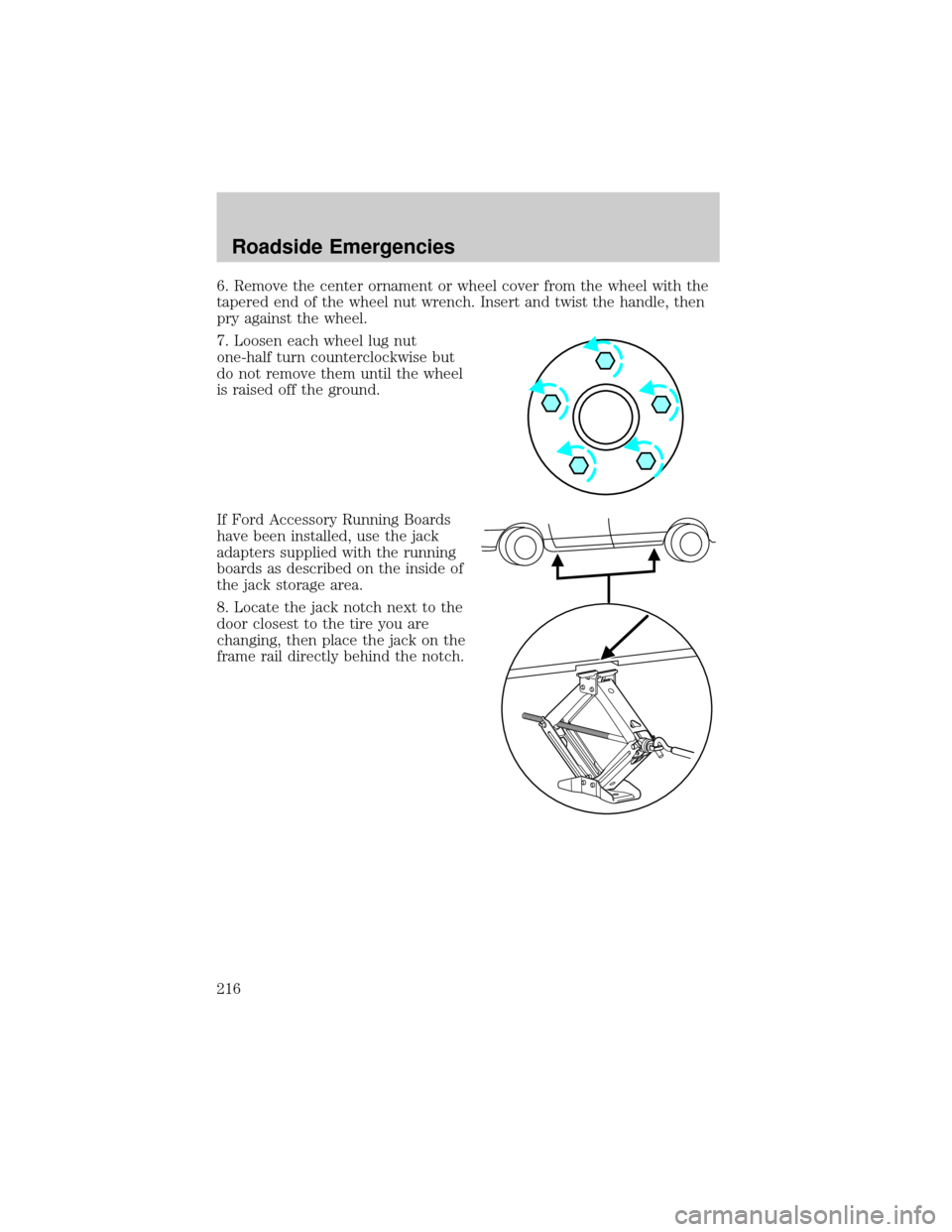
7. Loosen each wheel lug nut
one-half turn counterclockwise but
do not remove them until the wheel
is raised off the ground.
If Ford Accessory Running Boards
have been installed, use the jack
adapters supplied with the running
boards as described on the inside of
the jack storage area.
8. Locate the jack notch next to the
door closest to the tire you are
changing, then place the jack on the
frame rail directly behind the notch.
Roadside Emergencies
216
Page 217 of 296
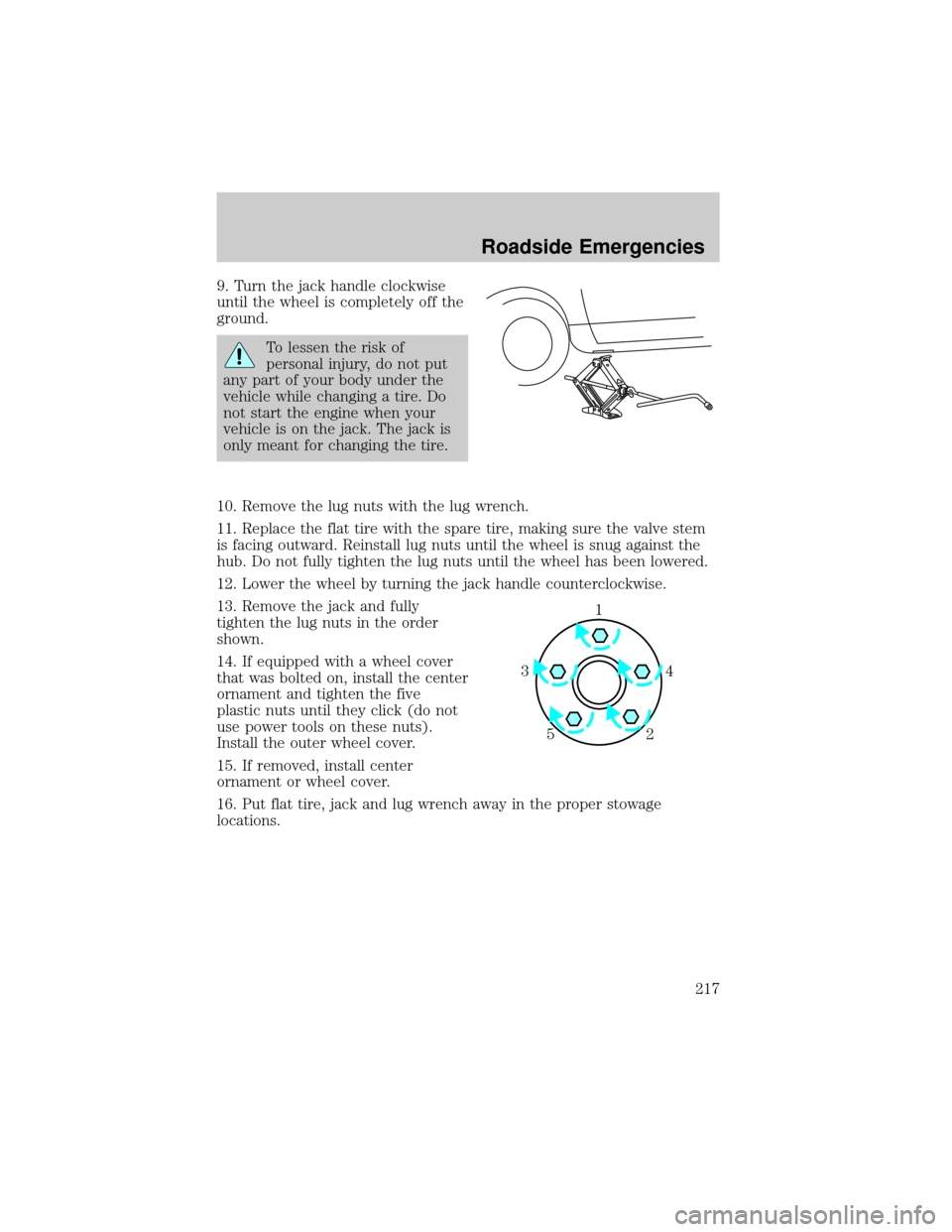
9. Turn the jack handle clockwise
until the wheel is completely off the
ground.
To lessen the risk of
personal injury, do not put
any part of your body under the
vehicle while changing a tire. Do
not start the engine when your
vehicle is on the jack. The jack is
only meant for changing the tire.
10. Remove the lug nuts with the lug wrench.
11. Replace the flat tire with the spare tire, making sure the valve stem
is facing outward. Reinstall lug nuts until the wheel is snug against the
hub. Do not fully tighten the lug nuts until the wheel has been lowered.
12. Lower the wheel by turning the jack handle counterclockwise.
13. Remove the jack and fully
tighten the lug nuts in the order
shown.
14. If equipped with a wheel cover
that was bolted on, install the center
ornament and tighten the five
plastic nuts until they click (do not
use power tools on these nuts).
Install the outer wheel cover.
15. If removed, install center
ornament or wheel cover.
16. Put flat tire, jack and lug wrench away in the proper stowage
locations.
1
4 3
2 5
Roadside Emergencies
217