towing GENESIS G80 2017 User Guide
[x] Cancel search | Manufacturer: GENESIS, Model Year: 2017, Model line: G80, Model: GENESIS G80 2017Pages: 496, PDF Size: 12.82 MB
Page 374 of 496

6-22
What to do in an emergency
Towing service
If emergency towing is necessary,
we recommend having it done by an
authorized HYUNDAI dealer or a
commercial tow-truck service.
Proper lifting and towing procedures
are necessary to prevent damage to
the vehicle. The use of wheel dollies
or flatbed is recommended.When towing the vehicle by flatbed
equipment, secure wheels by using
chocks and tie-down straps (or soft
belts).
Do not place straps over body panels
or through the wheels.On AWD vehicles, your vehicle must
be towed with a wheel lift and dollies
or flatbed equipment with all the
wheels off the ground.
On 2WD vehicles, it is acceptable to
tow the vehicle with the front wheels
on the ground (without dollies) and
the rear wheels off the ground.
If any of the loaded wheels or sus-
pension components are damaged
or the vehicle is being towed with the
rear wheels on the ground, use a
towing dolly under the rear wheels.
When being towed by a commercial
tow truck and wheel dollies are not
used, the rear of the vehicle should
always be lifted, not the front.
T T
O
O W
W I
IN
N G
G
ODH063020 Dolly
A
B
C
ODH063033
Do not lift the vehicle by the tow
fitting or body and chassis
parts. Otherwise the vehicle
may be damaged.
CAUTION
The AWD vehicle should never
be towed with the wheels on the
ground. This can cause serious
damage to the transmission or
the AWD system.
CAUTION
Dolly
Page 375 of 496

6-23
What to do in an emergency
6
When towing your vehicle in an
emergency without wheel dollies :
1.Set the Engine Start/Stop button inthe ACC position.
2.Place the shift lever in N (Neutral).
3.Release the parking brake.Removable towing hook
(if equipped)
1.Open the trunk, and remove the towing hook from the tool case.
2.Remove the hole cover pressing the lower part of the cover on the
bumper.
ODH063021
ODH063022
Do not tow the vehicle with
the rear wheels on the ground
as this may cause damage to
the vehicle.
Do not tow with sling-type
equipment. Use wheel lift or
flatbed equipment.
CAUTION
Failure to place the transmis-
sion shift lever in N (Neutral)
may cause internal damage to
the transmission.
CAUTION
ODH063015
ODH063016
■Front
■Rear
Page 376 of 496

6-24
What to do in an emergency
3.Install the towing hook by turning it clockwise into the hole until it is
fully secured.
4.Remove the towing hook and install the cover after use.
Emergency towing
(if equipped)
If towing is necessary, we recom-
mend you to have it done by an
authorized HYUNDAI dealer or a
commercial tow truck service. If towing service is not available in an
emergency, your vehicle may be
temporarily towed using a cable or
chain secured to the emergency tow-
ing hook at the front (or rear) of the
vehicle.
Use extreme caution when towing
the vehicle with a cable or chain. A
driver must be in the vehicle to steer
it and operate the brakes.
Towing in this manner may be done
only on hard-surfaced roads for a
short distance and at low speeds.
Also, the wheels, axles, power train,
steering and brakes must all be in
good condition.
ODH063017
ODH063018
■Front
■Rear
Page 377 of 496

6-25
What to do in an emergency
6
Always follow these emergency tow-
ing precautions:
Place the Engine Start/Stop buttonin the ACC position so the steering
wheel is not locked.
Place the shift lever in N (Neutral).
Release the parking brake.
Depress the brake pedal with more force than normal since you will
have reduced braking perform-
ance.
More steering effort will be required because the power steer-
ing system will be disabled.
Use a vehicle heavier than your own to tow your vehicle.
The drivers of both vehicles should communicate with each other fre-
quently.
Before emergency towing, check that the hook is not broken or dam-
aged.
Fasten the towing cable or chain securely to the hook.
Do not jerk the hook. Apply steady and even force. Use a towing cable or chain less
than 16 feet (5 m) long. Attach a
white or red cloth (about 12 inches
(30 cm) wide) in the middle of the
cable or chain for easy visibility.
Drive carefully so the towing cable or chain remains tight during tow-
ing.
Before towing, check the automat- ic transmission for fluid leaks under
your vehicle. If the automatic trans-
mission fluid is leaking, flatbed
equipment or a towing dolly must
be used.
ODH063025
To avoid damage to your vehicle
and vehicle components when
towing:
Always pull straight ahead
when using the towing hooks.
Do not pull from the side or at
a vertical angle.
Do not use the towing hooks
to pull a vehicle out of mud,
sand or other conditions from
which the vehicle cannot be
driven out under its own
power.
Limit the vehicle speed to 10
mph (15 km/h) and drive less
than 1 mile (1.5 km) when tow-
ing to avoid serious damage
to the automatic transmis-
sion.
CAUTION
Page 400 of 496
7-23
7
Maintenance
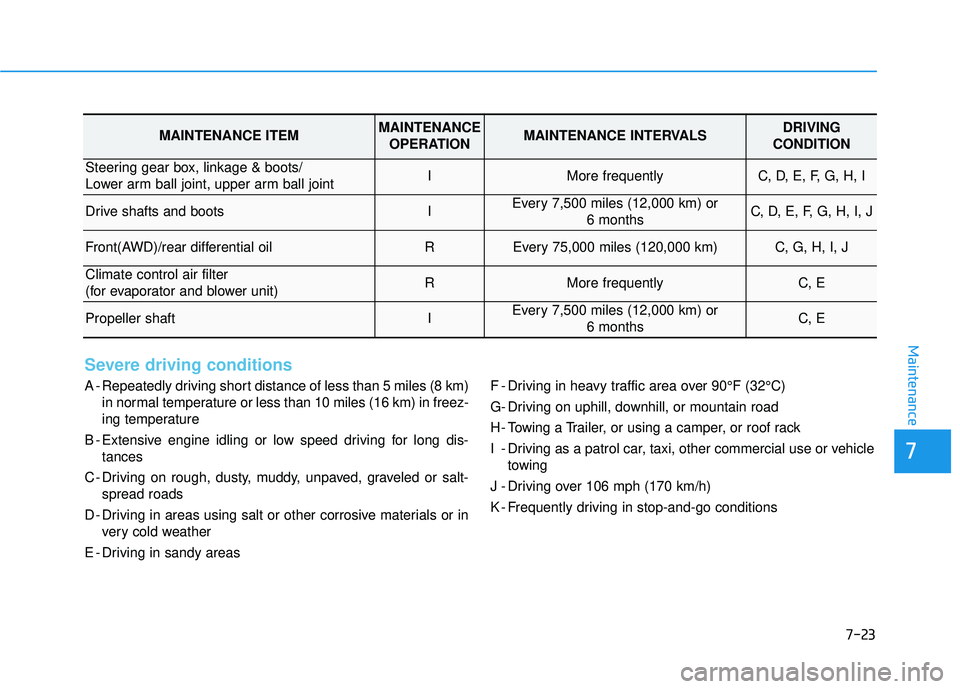
Severe driving conditions
A - Repeatedly driving short distance of less than 5 miles (8 km)in normal temperature or less than 10 miles (16 km) in freez-
ing temperature
B - Extensive engine idling or low speed driving for long dis- tances
C - Driving on rough, dusty, muddy, unpaved, graveled or salt- spread roads
D - Driving in areas using salt or other corrosive materials or in very cold weather
E - Driving in sandy areas F - Driving in heavy traffic area over 90°F (32°C)
G- Driving on uphill, downhill, or mountain road
H - Towing a Trailer, or using a camper, or roof rack
I - Driving as a patrol car, taxi, other commercial use or vehicle
towing
J - Driving over 106 mph (170 km/h)
K - Frequently driving in stop-and-go conditions
MAINTENANCE ITEMMAINTENANCE OPERATIONMAINTENANCE INTERVALSDRIVING
CONDITION
Steering gear box, linkage & boots/
Lower arm ball joint, upper arm ball jointIMore frequentlyC, D, E, F, G, H, I
Drive shafts and bootsIEvery 7,500 miles (12,000 km) or 6 monthsC, D, E, F, G, H, I, J
Front(AWD)/rear differential oilREvery 75,000 miles (120,000 km)C, G, H, I, J
Climate control air filter
(for evaporator and blower unit)RMore frequentlyC, E
Propeller shaftIEvery 7,500 miles (12,000 km) or 6 monthsC, E
Page 417 of 496

7-40
Maintenance
B
BA
A T
TT
TE
ER
R Y
Y
Jump starting can be dangerous if
done incorrectly. Follow the jump
starting procedure in this section to
avoid serious injury or damage to
your vehicle. If in doubt about how to
properly jump start your vehicle, we
strongly recommend that you have a
service technician or towing service
do it for you. To prevent SERIOUS INJURY or
DEATH to you or bystanders,
always follow these precautions
when working near or handling
the battery:
Always read and follow
instructions carefully
when handling a battery.Wear eye protection
designed to protect the
eyes from acid splashes.
Keep all flames, sparks,
or smoking materials
away from the battery.
Hydrogen is always present in battery cells,
is highly combustible,
and may explode if ignit-
ed.
Keep batteries out of
reach of children.
(Continued)WARNING (Continued)Batteries contain sulfu-
ric acid which is highly
corrosive. Do not allow
acid to contact your
eyes, skin or clothing.
If acid gets into your eyes, flush
your eyes with clean water for at
least 15 minutes and get imme-
diate medical attention. If acid
gets on your skin, thoroughly
wash the area. If you feel pain or
a burning sensation, get med-
ical attention immediately.
When lifting a plastic-cased
battery, excessive pressure
on the case may cause battery
acid to leak. Lift with a battery
carrier or with your hands on
opposite corners.
Do not attempt to jump start
your vehicle if your battery is
frozen. (Continued)
Page 490 of 496
I-4
Drinks holders, see cup holders ....................................3-155
Drive mode integrated control system ............................5-42
Driver assist system ......................................................3-126Rear view camera .....................................................3-126
Parking guide system ...............................................3-127
Parking assist system................................................3-128
Driver position memory system .....................................3-16
Driver’s air bag ...............................................................2-48
Driving at night ...............................................................5-87
Driving in flooded areas .................................................5-88
Driving in the rain...........................................................5-88
Electric chromic mirror...................................................3-22
Electric chromic mirror (ECM) with HomeLink
®system......................................................3-22
Electronic parking brake (EPB) ......................................5-26
Electric power steering ...................................................3-19
Electronic control suspension (ECS) ..............................5-44
Electronic stability control (ESC)...................................5-38
Emergency starting Jump starting ................................................................6-4
Push starting .................................................................6-6
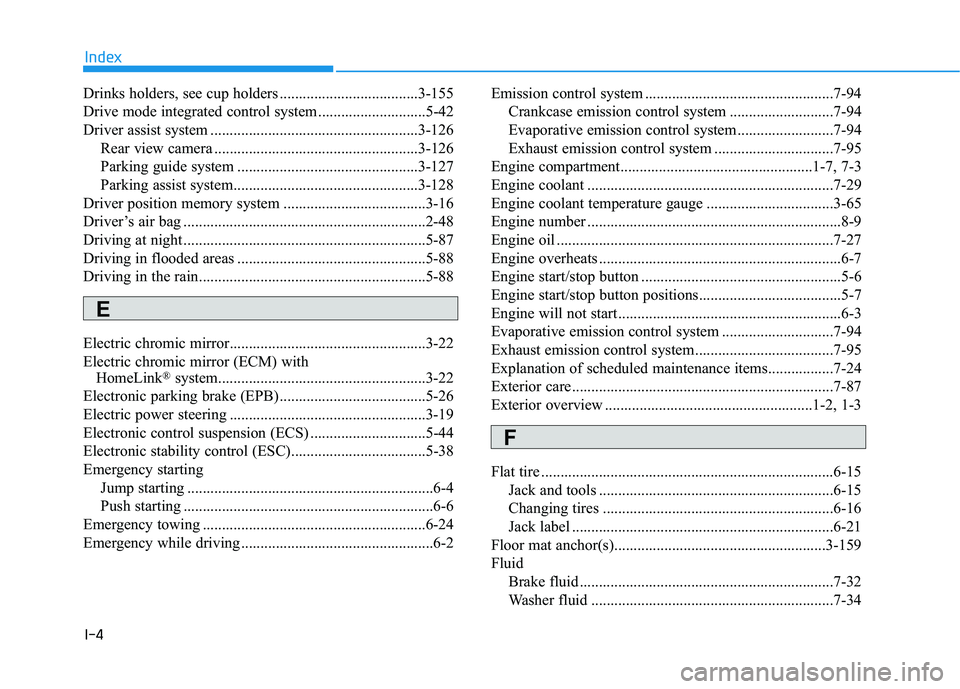
Emergency towing ..........................................................6-24
Emergency while driving ..................................................6-2 Emission control system .................................................7-94
Crankcase emission control system ...........................7-94
Evaporative emission control system .........................7-94
Exhaust emission control system ...............................7-95
Engine compartment..................................................1-7, 7-3
Engine coolant ................................................................7-29
Engine coolant temperature gauge .................................3-65
Engine number ..................................................................8-9
Engine oil ........................................................................\
7-27
Engine overheats ...............................................................6-7
Engine start/stop button ....................................................5-6
Engine start/stop button positions.....................................5-7
Engine will not start..........................................................6-3
Evaporative emission control system .............................7-94
Exhaust emission control system....................................7-95
Explanation of scheduled maintenance items.................7-24
Exterior care....................................................................7-87\
Exterior overview ......................................................1-2, 1-3
Flat tire ........................................................................\
....6-15 Jack and tools .............................................................6-15
Changing tires ............................................................6-16
Jack label ....................................................................6-21\
Floor mat anchor(s).......................................................3-159
Fluid Brake fluid ..................................................................7-32
Washer fluid ...............................................................7-34
Index
E
F
Page 495 of 496

I-9
Storage compartment ....................................................3-153Center console storage .............................................3-153
Glove box .................................................................3-154
Sunglass holder ........................................................3-154
Sunglass holder .............................................................3-154
Sunroof........................................................................\
....3-44
Sunvisor ........................................................................\
3-156
Tachometer ......................................................................3-\
64
Theft-alarm system .........................................................3-16
Tilt steering / Telescope steering ....................................3-19
Tire pressure....................................................................7-46\
Tire pressure monitoring system (TPMS) ........................6-9 Changing a tire with TPMS .......................................6-14
Tire rotation ....................................................................7-48\
Tire specification and pressure label ................................8-9
Tires and wheels ......................................................7-45, 8-4 Tire care ......................................................................7-\
45
Recommended cold tire inflation pressures ...............7-46
Check tire inflation pressure ......................................7-47
Tire rotation ................................................................7-48
Wheel alignment and tire balance ..............................7-49
Tire replacement .........................................................7-49
Compact spare tire replacement .................................7-50
Wheel replacement .....................................................7-50
Tire traction ................................................................7-50 Tire maintenance ........................................................7-51
Tire sidewall labeling .................................................7-51
Tire terminology and definitions ................................7-55
All season tires ...........................................................7-58
Summer tires ..............................................................7-58
Snow tires ...................................................................7-58
Radial-ply tires ...........................................................7-59
Low aspect ratio tires .................................................7-59
Towing ........................................................................\
....6-22 Emergency towing......................................................6-24
Transmission Automatic transmission ..............................................5-11
Trip computer..................................................................3-90
Trunk ........................................................................\
.......3-49 Non-powered trunk ....................................................3-49
Power trunk ................................................................3-50
Emergency trunk safety release .................................3-54
Smart trunk .................................................................3-55
Vehicle break-in process ...................................................F-9
Vehicle certification label .................................................8-8
Vehicle data collection and event data recorders ...........F-10
Vehicle identification number (VIN) ................................8-8
I
Index
T
V