steering wheel GENESIS G80 2017 Workshop Manual
[x] Cancel search | Manufacturer: GENESIS, Model Year: 2017, Model line: G80, Model: GENESIS G80 2017Pages: 496, PDF Size: 12.82 MB
Page 376 of 496

6-24
What to do in an emergency
3.Install the towing hook by turning it clockwise into the hole until it is
fully secured.
4.Remove the towing hook and install the cover after use.
Emergency towing
(if equipped)
If towing is necessary, we recom-
mend you to have it done by an
authorized HYUNDAI dealer or a
commercial tow truck service. If towing service is not available in an
emergency, your vehicle may be
temporarily towed using a cable or
chain secured to the emergency tow-
ing hook at the front (or rear) of the
vehicle.
Use extreme caution when towing
the vehicle with a cable or chain. A
driver must be in the vehicle to steer
it and operate the brakes.
Towing in this manner may be done
only on hard-surfaced roads for a
short distance and at low speeds.
Also, the wheels, axles, power train,
steering and brakes must all be in
good condition.
ODH063017
ODH063018
■Front
■Rear
Page 377 of 496

6-25
What to do in an emergency
6
Always follow these emergency tow-
ing precautions:
Place the Engine Start/Stop buttonin the ACC position so the steering
wheel is not locked.
Place the shift lever in N (Neutral).
Release the parking brake.
Depress the brake pedal with more force than normal since you will
have reduced braking perform-
ance.
More steering effort will be required because the power steer-
ing system will be disabled.
Use a vehicle heavier than your own to tow your vehicle.
The drivers of both vehicles should communicate with each other fre-
quently.
Before emergency towing, check that the hook is not broken or dam-
aged.
Fasten the towing cable or chain securely to the hook.
Do not jerk the hook. Apply steady and even force. Use a towing cable or chain less
than 16 feet (5 m) long. Attach a
white or red cloth (about 12 inches
(30 cm) wide) in the middle of the
cable or chain for easy visibility.
Drive carefully so the towing cable or chain remains tight during tow-
ing.
Before towing, check the automat- ic transmission for fluid leaks under
your vehicle. If the automatic trans-
mission fluid is leaking, flatbed
equipment or a towing dolly must
be used.
ODH063025
To avoid damage to your vehicle
and vehicle components when
towing:
Always pull straight ahead
when using the towing hooks.
Do not pull from the side or at
a vertical angle.
Do not use the towing hooks
to pull a vehicle out of mud,
sand or other conditions from
which the vehicle cannot be
driven out under its own
power.
Limit the vehicle speed to 10
mph (15 km/h) and drive less
than 1 mile (1.5 km) when tow-
ing to avoid serious damage
to the automatic transmis-
sion.
CAUTION
Page 384 of 496
7-7
7
Maintenance
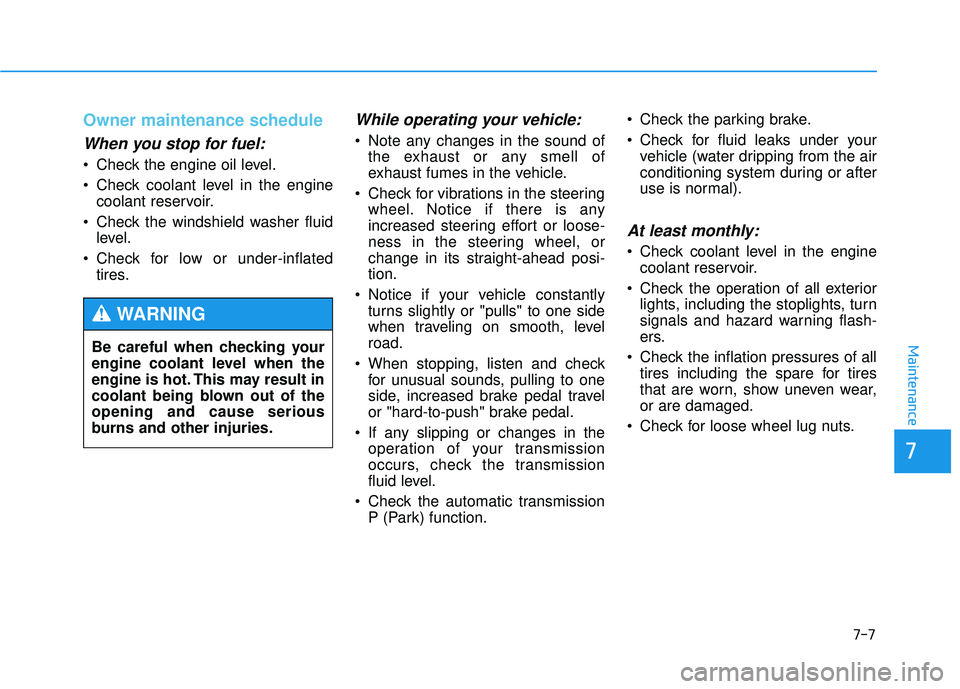
Owner maintenance schedule
When you stop for fuel:
• Check the engine oil level.
Check coolant level in the enginecoolant reservoir.
Check the windshield washer fluid level.
Check for low or under-inflated tires.
While operating your vehicle:
Note any changes in the sound ofthe exhaust or any smell of
exhaust fumes in the vehicle.
Check for vibrations in the steering wheel. Notice if there is any
increased steering effort or loose-
ness in the steering wheel, or
change in its straight-ahead posi-
tion.
Notice if your vehicle constantly turns slightly or "pulls" to one side
when traveling on smooth, level
road.
When stopping, listen and check for unusual sounds, pulling to one
side, increased brake pedal travel
or "hard-to-push" brake pedal.
If any slipping or changes in the operation of your transmission
occurs, check the transmission
fluid level.
Check the automatic transmission P (Park) function. Check the parking brake.
Check for fluid leaks under your
vehicle (water dripping from the air
conditioning system during or after
use is normal).
At least monthly:
Check coolant level in the enginecoolant reservoir.
Check the operation of all exterior lights, including the stoplights, turn
signals and hazard warning flash-
ers.
Check the inflation pressures of all tires including the spare for tires
that are worn, show uneven wear,
or are damaged.
Check for loose wheel lug nuts.
Be careful when checking your
engine coolant level when the
engine is hot. This may result in
coolant being blown out of the
opening and cause serious
burns and other injuries.
WARNING
Page 403 of 496

7-26
Maintenance
Brake hoses and lines
Visually check for proper installation,
chafing, cracks, deterioration and
any leakage. Replace any deteriorat-
ed or damaged parts immediately.
Brake fluid
Check brake fluid level in the brake
fluid reservoir. The level should be
between the MIN and the MAX
marks on the side of the reservoir.
Use only hydraulic brake fluid con-
forming to DOT 3 or DOT 4 specifi-
cation.
Parking brake
Inspect the parking brake system
including the parking brake pedal
and cables.
Brake discs, pads, calipers
and rotors
Check the pads for excessive wear,
discs for run out and wear, and
calipers for fluid leakage.
Exhaust pipe and muffler
Visually inspect the exhaust pipes,
muffler and hangers for cracks, dete-
rioration, or damage. Start the
engine and listen carefully for any
exhaust gas leakage. Tighten con-
nections or replace parts as neces-
sary.
Suspension mounting bolts
Check the suspension connections
for looseness or damage. Retighten
to the specified torque.
Steering gear box, linkage &
boots/lower arm ball joint
With the vehicle stopped and the
engine off, check for excessive free-
play in the steering wheel. Check the
linkage for bends or damage. Check
the dust boots and ball joints for
deterioration, cracks, or damage.
Replace any damaged parts.
Drive shafts and boots
Check the drive shafts, boots and
clamps for cracks, deterioration, or
damage. Replace any damaged
parts and, if necessary, repack the
grease.
Air conditioning refrigerant
Check the air conditioning lines and
connections for leakage and dam-
age.
Page 422 of 496
7-45
7
Maintenance
T
TI
IR
R E
ES
S
A
A N
N D
D
W
W H
HE
EE
EL
LS
S
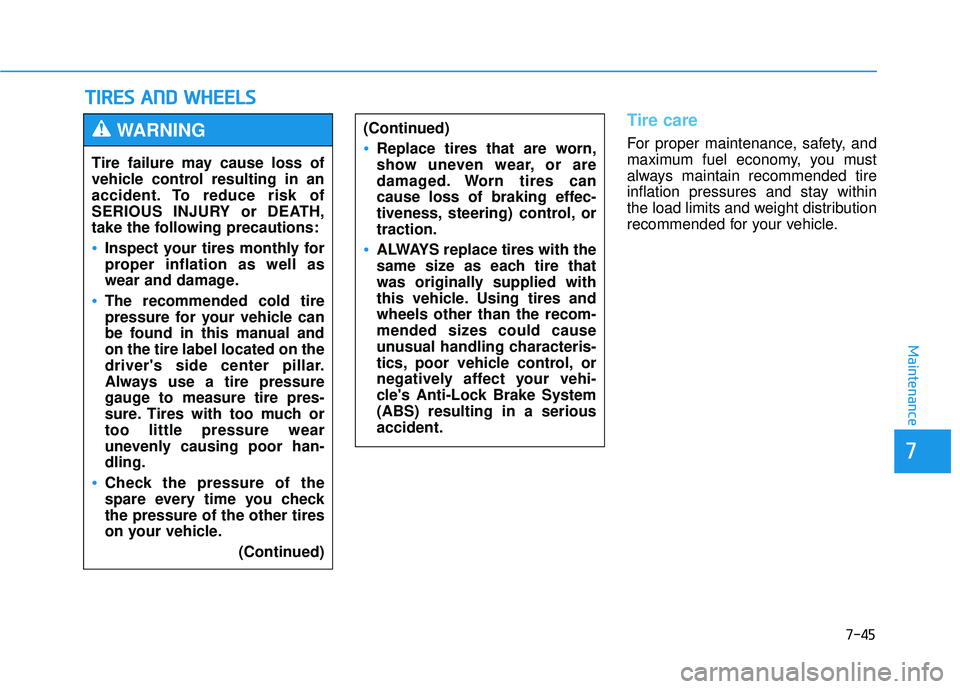
Tire care
For proper maintenance, safety, and
maximum fuel economy, you must
always maintain recommended tire
inflation pressures and stay within
the load limits and weight distribution
recommended for your vehicle.
(Continued)Replace tires that are worn,
show uneven wear, or are
damaged. Worn tires can
cause loss of braking effec-
tiveness, steering) control, or
traction.
ALWAYS replace tires with the
same size as each tire that
was originally supplied with
this vehicle. Using tires and
wheels other than the recom-
mended sizes could cause
unusual handling characteris-
tics, poor vehicle control, or
negatively affect your vehi-
cle's Anti-Lock Brake System
(ABS) resulting in a serious
accident.
Tire failure may cause loss of
vehicle control resulting in an
accident. To reduce risk of
SERIOUS INJURY or DEATH,
take the following precautions:
Inspect your tires monthly for
proper inflation as well as
wear and damage.
The recommended cold tire
pressure for your vehicle can
be found in this manual and
on the tire label located on the
driver's side center pillar.
Always use a tire pressure
gauge to measure tire pres-
sure. Tires with too much or
too little pressure wear
unevenly causing poor han-
dling.
Check the pressure of the
spare every time you check
the pressure of the other tires
on your vehicle.
(Continued)
WARNING
Page 445 of 496
7-68
Maintenance
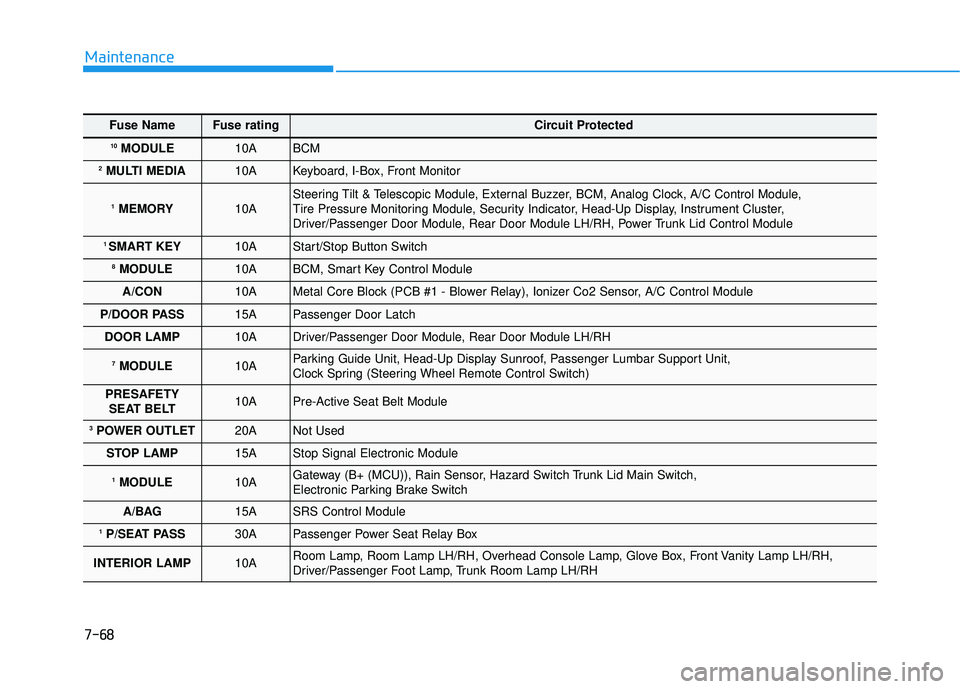
Fuse NameFuse ratingCircuit Protected
10MODULE10A BCM
2MULTI MEDIA 10A Keyboard, I-Box, Front Monitor
1MEMORY10A Steering Tilt & Telescopic Module, External Buzzer, BCM, Analog Clock, A/C Control Module,
Tire Pressure Monitoring Module, Security Indicator, Head-Up Display, Instrument Cluster,
Driver/Passenger Door Module, Rear Door Module LH/RH, Power Trunk Lid Control Module
1 SMART KEY10A Start/Stop Button Switch
8MODULE10A BCM, Smart Key Control Module
A/CON 10A Metal Core Block (PCB #1 - Blower Relay), Ionizer Co2 Sensor, A/C Control Module
P/DOOR PASS 15A Passenger Door Latch
DOOR LAMP 10A Driver/Passenger Door Module, Rear Door Module LH/RH
7MODULE 10A Parking Guide Unit, Head-Up Display Sunroof, Passenger Lumbar Support Unit,
Clock Spring (Steering Wheel Remote Control Switch)
PRESAFETY SEAT BELT 10A Pre-Active Seat Belt Module
3POWER OUTLET 20A Not Used
STOP LAMP 15A Stop Signal Electronic Module
1MODULE10A Gateway (B+ (MCU)), Rain Sensor, Hazard Switch Trunk Lid Main Switch,
Electronic Parking Brake Switch
A/BAG 15A SRS Control Module
1P/SEAT PASS 30A Passenger Power Seat Relay Box
INTERIOR LAMP 10A Room Lamp, Room Lamp LH/RH, Overhead Console Lamp, Glove Box, Front Vanity Lamp LH/RH,
Driver/Passenger Foot Lamp, Trunk Room Lamp LH/RH
Page 446 of 496

7-69
7
Maintenance
Fuse NameFuse ratingCircuit Protected
2SMART KEY15A Smart Key Control Module
1 POWER OUTLET 20A Front Power Outlet & Cigarette Lighter
6MODULE 15A Head Lamp LH/RH, Auto Hold & Drive Mode Switch, Auto Head Lamp Leveling Device Module, A/T Shift
Lever IND.
P/WDW LH 30A Driver Power Window Module, Rear Door Module LH, Rear Power Window Module LH
SUNROOF 25A Sunroof Motor
BRAKE SWITCH 10A Stop Lamp Switch, Smart Key Control Module
2POWER OUTLET 20A Front Power Outlet & Cigarette Lighter
HTD STRG 15A Clock Spring (Steering Wheel Heated Module)
1P/SEAT DRV 30A Driver IMS Control Module, Driver Power Seat Relay Box
P/DOOR DRV 15A Driver Door Latch
2MODULE10A BCM, Smart Key Control Module, Overhead Console Lamp, Analog Clock, A/V & Navigation Head Unit,
Keyboard, I-Box, Front Monitor, Parking Guide Unit
Page 469 of 496

7-92
Maintenance
vehicle, pay particular attention to
the components under the fenders
and other areas that are hidden
from view. Do a thorough job; just
dampening the accumulated mud
rather than washing it away will
accelerate corrosion rather than
prevent it. Water under high pres-
sure and steam are particularly
effective in removing accumulated
mud and corrosive materials.
When cleaning lower door panels, rocker panels and frame members,
be sure that drain holes are kept
open so that moisture can escape
and not be trapped inside to accel-
erate corrosion.
Keep your garage dry
Don't park your car in a damp, poor-
ly ventilated garage. This creates a
favorable environment for corrosion.
This is particularly true if you wash
your vehicle in the garage or drive it
into the garage when it is still wet or
covered with snow, ice or mud. Even
a heated garage can contribute to
corrosion unless it is well ventilated
so moisture is dispersed.
Keep paint and trim in good condition
Scratches or chips in the finish
should be covered with "touch-up"
paint as soon as possible to reduce
the possibility of corrosion. If bare
metal is showing through, the atten-
tion of a qualified body and paint
shop is recommended.
Bird droppings are highly corrosive
and may damage painted surfaces in
just a few hours. Always remove bird
droppings as soon as possible.
Interior care
Interior general precautions
Prevent caustic solutions such as
perfume and cosmetic oil, from con-
tacting the interior parts because
they may cause damage or discol-
oration. If they do contact the interior
parts, wipe them off immediately.
See the instructions for the proper
way to clean vinyl.
Never allow water or other liq-
uids to come in contact with
electrical/electronic compo-
nents inside the vehicle as
this may damage them.
When cleaning leather prod-
ucts (steering wheel, seats
etc.), use neutral detergents
or low alcohol content solu-
tions. If you use high alcohol
content solutions or
acid/alkaline detergents, the
color of the leather may fade
or the surface may get
stripped off.
CAUTION
Page 491 of 496

I-5
Fog light ........................................................................\
3-115
Front seats ........................................................................\
.2-6
Fuel filler door ................................................................3-59
Fuel gauge .......................................................................3\
-65
Fuel requirements .............................................................F-6
Fuses ........................................................................\
.......7-61Fuse switch .................................................................7-63
Main fuse ....................................................................7-64\
Multi fuse ...................................................................7-65
Fuse/relay panel description .......................................7-66
Gauge Engine coolant temperature gauge .............................3-65
Fuel gauge ..................................................................3-65
Outside Temperature Gauge .......................................3-67
Glassroof, see sunroof ....................................................3-44
Glove box......................................................................3-\
154
Hazard warning flasher .....................................................6-2
Hazardous driving conditions .........................................5-86
Head up display (HUD) ................................................3-107
Headlamp delay functionn ............................................3-116
Headrest ........................................................................\
..2-14
Heated steering wheel .....................................................3-20
Heater system................................................................3-134 Hill-start assist control (HAC)........................................5-41
Hood........................................................................\
........3-48
Horn ........................................................................\
........3-21
Immobilizer system.........................................................3-10
Indicators and warnings ..................................................3-95
Inside rearview mirror ....................................................3-22
Instrument cluster ...........................................................3-62
Instrument panel illumination ....................................3-63
LCD display control ...................................................3-63
Speedometer ...............................................................3-64
Tachometer .................................................................3-64
Engine coolant temperature gauge .............................3-65
Fuel gauge ..................................................................3-65
Odometer ....................................................................3-66\
Outside temperature gauge .........................................3-67
Automatic transmission shift indicator ......................3-67
Trip computer .............................................................3-90
Warning and indicators...............................................3-95
Instrument panel illumination .........................................3-63
Instrument panel overview ........................................1-5, 1-6
Interior care .....................................................................7-9\
2
Interior features .............................................................3-155 Cup holder ................................................................3-155
Sunvisor ....................................................................3-15\
6
I
Index
H
I
G
Page 493 of 496
I-7
Maintenance under severe usage conditions ..............7-22
Explanation of scheduled maintenance items ............7-24
Tire maintenance ........................................................7-51
Maintenance schedule Normal maintenance schedule .....................................7-9
Maintenance under severe usage conditions ..............7-22
Maintenance services ........................................................7-5
Manual heating and air conditioning ............................3-136
Mirrors ........................................................................\
....3-22 Inside rearview mirror ................................................3-22
Electric chromic mirror (ECM) with HomeLink
®
system......................................................................3-\
22
Side view mirrors .......................................................3-36
Moonroof, see sunroof ....................................................3-44
Multi fuse ........................................................................\
7-65
Multimedia system............................................................4-2 AUX, USB and iPod
®port ..........................................4-2
Antenna ........................................................................\
4-3
Steering wheel audio control........................................4-4
Audio / Video / Navigation system (AVN) ..................4-5
Bluetooth
®Wireless Technology hands-free................4-5
Neck restraints, see headrest ...........................................2-14 Odometer........................................................................\
.3-66
Oil (Engine) ....................................................................7-27\
Overheats ........................................................................\
..6-7
Owner maintenance ..........................................................7-6
Panorama sunroof ...........................................................3-44
Parking assist system ....................................................3-128
Parking brake.........................................................5-24, 5-26
Parking brake inspect......................................................7-34
Passenger's front air bag .................................................2-48
Power brakes ...................................................................5-23
Power outlet ..................................................................3-156
Power window lock button .............................................3-43
Push starting......................................................................6-\
6
Rear seat ........................................................................\
..2-11
Recommended cold tire inflation pressures ...................7-46
Recommended lubricants and capacities ..........................8-6
Recommended SAE viscosity number .........................8-7
Refrigerant label ...............................................................8-9
Reporting safety defects..................................................8-11
I
Index
O
P
R
N