fuel GENESIS G80 2017 Repair Manual
[x] Cancel search | Manufacturer: GENESIS, Model Year: 2017, Model line: G80, Model: GENESIS G80 2017Pages: 496, PDF Size: 12.82 MB
Page 474 of 496

7-97
7
Maintenance
Your vehicle is equipped with a cat-
alytic converter emission control
device.
To prevent damage to the catalytic
converter and to your vehicle, take
the following precautions:
Use only UNLEADED FUEL
for gasoline engines.
Do not operate the vehicle
when there are signs of
engine malfunction, such as
misfire or a noticeable loss of
performance.
Do not misuse or abuse the
engine. Examples of misuse
are coasting with the engine
off and descending steep
grades in gear with the engine
off.
Do not operate the engine at
high idle speed for extended
periods (5 minutes or more).(Continued)
CAUTION
(Continued)
Keep away from the exhaust
system and catalytic convert-
er or you may get burned.
Also, Do not remove the heat
sink around the exhaust sys-
tem, do not seal the bottom of
the vehicle, and do not coat
the vehicle for corrosion con-
trol. It may present a fire risk
under certain conditions.
(Continued)
Do not modify or tamper with
any part of the engine or
emission control system. All
inspections and adjustments
must be made by an author-
ized retailer of Genesis
Branded products.
Avoid driving with extremely
low fuel level. If you run out of
gasoline, it could cause the
engine to misfire and result in
excessive loading of the cat-
alytic converter.
Page 481 of 496
8-6
Specifications, Consumer information and Reporting safety defects
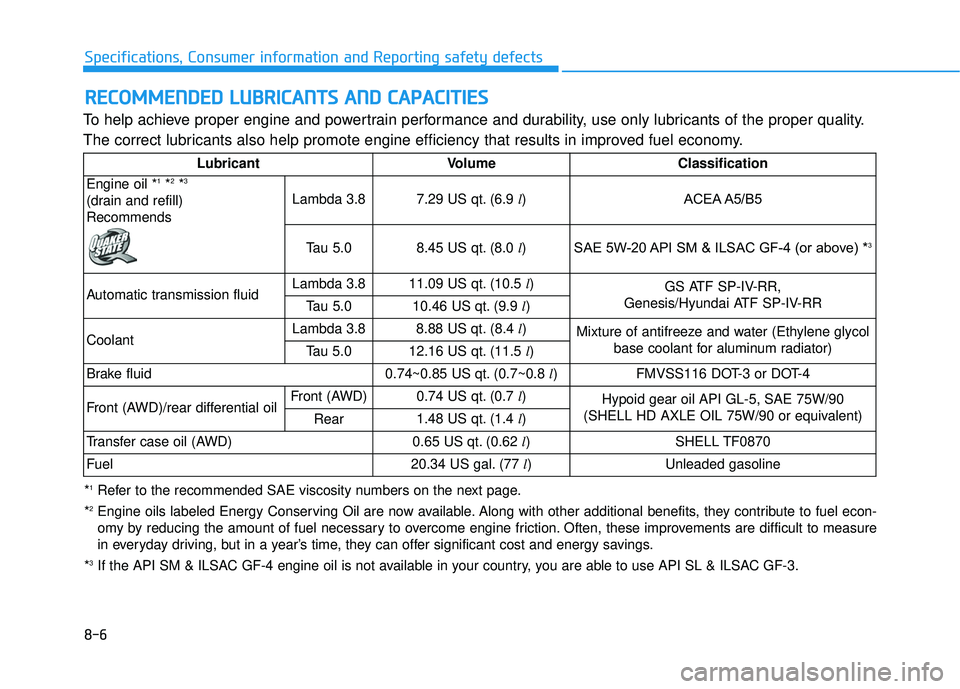
To help achieve proper engine and powertrain performance and durability, use only lubricants of the proper quality.
The correct lubricants also help promote engine efficiency that results in improved fuel economy.
R R E
EC
CO
O M
M M
ME
EN
N D
DE
ED
D
L
L U
U B
BR
RI
IC
C A
A N
N T
TS
S
A
A N
N D
D
C
C A
A P
PA
A C
CI
IT
T I
IE
E S
S
*1Refer to the recommended SAE viscosity numbers on the next page.
*
2Engine oils labeled Energy Conserving Oil are now available. Along with other additional benefits, they contribute to fuel econ-
omy by reducing the amount of fuel necessary to overcome engine friction. Often, these improvements are difficult to measure
in everyday driving, but in a year’s time, they can offer significant cost and energy savings.
*
3If the API SM & ILSAC GF-4 engine oil is not available in your country, you are able to use API SL & ILSAC GF-3. Lubricant
Volume
Classification
Engine oil *
1*2*3
(drain and refill)
Recommends Lambda 3.87.29 US qt. (6.9
l)
ACEA A5/B5
Tau 5.08.45 US qt. (8.0l)SAE 5W-20 API SM & ILSAC GF-4 (or above) *3
Automatic transmission fluid Lambda 3.811.09 US qt. (10.5
l)
GS ATF SP-IV-RR,
Genesis/Hyundai ATF SP-IV-RR
Tau 5.010.46 US qt. (9.9 l)
Coolant Lambda 3.8
8.88 US qt. (8.4
l)
Mixture of antifreeze and water (Ethylene glycol
base coolant for aluminum radiator)
Tau 5.0
12.16 US qt. (11.5 l)
Brake fluid
0.74~0.85 US qt. (0.7~0.8 l) FMVSS116 DOT-3 or DOT-4
Front (AWD)/rear differential oilFront (AWD)0.74 US qt. (0.7l)Hypoid gear oil API GL-5, SAE 75W/90
(SHELL HD AXLE OIL 75W/90 or equivalent)
Rear1.48 US qt. (1.4 l)
Transfer case oil (AWD)0.65 US qt. (0.62 l)SHELL TF0870
Fuel20.34 US gal. (77 l)Unleaded gasoline
Page 482 of 496

8-7
88
Specifications, Consumer information and Reporting safety defects
Recommended SAE viscosity
number
Engine oil viscosity (thickness) has
an effect on fuel economy and cold
weather operating (engine start and
engine oil flowability). Lower viscosi-
ty engine oils can provide better fuel
economy and cold weather perform-
ance, however, higher viscosity
engine oils are required for satisfac-
tory lubrication in hot weather. Using
oils of any viscosity other than those
recommended could result in engine
damage.Always be sure to clean the area
around any filler plug, drain
plug, or dipstick before check-
ing or draining any lubricant.
This is especially important in
dusty or sandy areas and when
the vehicle is used on unpaved
roads. Cleaning the plug and
dipstick areas will prevent dirt
and grit from entering the
engine and other mechanisms
that could be damaged.
CAUTION
Temperature Range for SAE Viscosity Numbers
Temperature
Engine Oil *1
°C
°F
-30 -20 -10 0 10 20 30 40 50
-10 0 20 40 60 80 100 120
10W-30
5W-20, 5W-30
*1: For better fuel economy, it is recommended to use the engine oil ofa viscosity grade SAE 5W-20 (API SM & ILSAC GF-4 (or above)).
However, if the engine oil is not available in your country, select the
proper engine oil using the engine oil viscosity chart.
When choosing an oil, consider the range of temperature your vehicle will be
operated in before the next oil change. Proceed to select the recommended
oil viscosity from the chart.
Temperature Range for SAE Viscosity Numbers
Temperature
Engine Oil *
1
°C
(°F)-30 -20 -10 0 10 20 30 40 50 -10 0 20 40 60 80 100 120
*1: For better fuel economy, it is recommended to use the engine oil of
a viscosity grade SAE 5W-30 (ACEA A5/B5). However, if the
engine oil is not available in your country, select the proper engine
oil using the engine oil viscosity chart.
10W-30
5W-30
■
■ Lambda 3.8
■
■ Tau 5.0
Page 491 of 496

I-5
Fog light ........................................................................\
3-115
Front seats ........................................................................\
.2-6
Fuel filler door ................................................................3-59
Fuel gauge .......................................................................3\
-65
Fuel requirements .............................................................F-6
Fuses ........................................................................\
.......7-61Fuse switch .................................................................7-63
Main fuse ....................................................................7-64\
Multi fuse ...................................................................7-65
Fuse/relay panel description .......................................7-66
Gauge Engine coolant temperature gauge .............................3-65
Fuel gauge ..................................................................3-65
Outside Temperature Gauge .......................................3-67
Glassroof, see sunroof ....................................................3-44
Glove box......................................................................3-\
154
Hazard warning flasher .....................................................6-2
Hazardous driving conditions .........................................5-86
Head up display (HUD) ................................................3-107
Headlamp delay functionn ............................................3-116
Headrest ........................................................................\
..2-14
Heated steering wheel .....................................................3-20
Heater system................................................................3-134 Hill-start assist control (HAC)........................................5-41
Hood........................................................................\
........3-48
Horn ........................................................................\
........3-21
Immobilizer system.........................................................3-10
Indicators and warnings ..................................................3-95
Inside rearview mirror ....................................................3-22
Instrument cluster ...........................................................3-62
Instrument panel illumination ....................................3-63
LCD display control ...................................................3-63
Speedometer ...............................................................3-64
Tachometer .................................................................3-64
Engine coolant temperature gauge .............................3-65
Fuel gauge ..................................................................3-65
Odometer ....................................................................3-66\
Outside temperature gauge .........................................3-67
Automatic transmission shift indicator ......................3-67
Trip computer .............................................................3-90
Warning and indicators...............................................3-95
Instrument panel illumination .........................................3-63
Instrument panel overview ........................................1-5, 1-6
Interior care .....................................................................7-9\
2
Interior features .............................................................3-155 Cup holder ................................................................3-155
Sunvisor ....................................................................3-15\
6
I
Index
H
I
G