Engine number GENESIS G80 2017 Owner's Manual
[x] Cancel search | Manufacturer: GENESIS, Model Year: 2017, Model line: G80, Model: GENESIS G80 2017Pages: 496, PDF Size: 12.82 MB
Page 6 of 496
F4
FOREWORD
Thank you for choosing Genesis Branded Vehicle. We are pleased to welcome you to the growing number of discrim-
inating people who drive Genesis Branded Vehicle. The advanced engineering and high-quality construction of each
Genesis Branded Vehicle we build is something of which we're very proud.
Your Owner's Manual will introduce you to the features and operation of your new Genesis Branded Vehicle. It is sug-
gested that you read it carefully because the information it contains can contribute greatly to the satisfaction you
receive from your new car.
The manufacturer also recommends that all service and maintenance on your car be performed by an authorized
retailer of Genesis Branded products. An authorized retailer of Genesis Branded Products is prepared to provide high-
quality service, maintenance and any other assistance that may be required.
GENESIS CUSTOMER CARE
Note :Because future owners will also need the information included in this manual, if you sell this Genesis Branded
Vehicle, please leave the manual in the vehicle for their use. Thank you.
Copyright 2016 Genesis Customer Care. All rights reserved. No part of this publication may be reproduced, stored
in any retrieval system or transmitted in any form or by any means without the prior written permission of Genesis
Customer Care. Severe engine and transmission damage may result from the use of poor quality fuels and lubricants that
do not meet Genesis Branded Vehicle specifications. You must always use high quality fuels and lubricants
that meet the specifications listed on Page 8-6 in the Vehicle Specifications section of the Owner's Manual.
CAUTION
Page 8 of 496
F6
Introduction
We want to help you get the greatest
possible driving pleasure from your
vehicle. Your Owner’s Manual can
assist you in many ways. We strong-
ly recommend that you read the
entire manual. In order to minimize
the chance of death or injury, you
must read the WARNING and CAU-
TION sections in this manual.
Illustrations complement the words
in this manual to best explain how to
enjoy your vehicle. By reading your
manual, you will learn about fea-
tures, important safety information,
and driving tips under various road
conditions.
The general layout of the manual is
provided in the Table of Contents. A
good place to start is the index; it has
an alphabetical listing of all informa-
tion in your manual.
Sections: This manual has eight
chapter plus an index. Each chapters
begins with a brief list of contents so
you can tell at a glance if that chap-
ter has the information you want. You will find various WARNINGs,
CAUTIONs, and NOTICEs in this
manual. These WARNINGs were pre-
pared to enhance your personal safe-
ty. You should carefully read and fol-
low ALL procedures and recommen-
dations provided in these WARN-
INGS, CAUTIONS and NOTICES.
✽ ✽
NOTICE
A NOTICE indicates interesting or
helpful information is being provided.
Your new vehicle is designed to
obtain maximum performance with
UNLEADED FUEL, as well as mini-
mize exhaust emissions and spark
plug fouling.
3.8 engine
Your new vehicle is designed to use
only unleaded fuel having an octane
number ((R+M)/2) of 87 (Research
Octane Number 91) or higher. (Do not
use methanol blended fuels.)
5.0 engine
Your new vehicle is designed to use
only unleaded fuel having an octane
number ((R+M)/2) of 87 (Research
Octane Number 91) or higher. For
improved vehicle performance, premi-
um unleaded fuel with an octane
number ((R+M)/2) of 91 (Research
Octane Number 96) or higher is rec-
ommended. (Do not use methanol
blended fuels.)
H H O
O W
W
T
T O
O
U
U S
SE
E
T
T H
H I
IS
S
M
M A
AN
N U
U A
AL
L
A WARNING indicates a situation
in which harm, serious bodily
injury, or death could result if the
warning is ignored.
WARNING
A CAUTION indicates a situation
in which damage to your vehicle
could result if the caution is
ignored.
CAUTION
F FU
U E
EL
L
R
R E
EQ
Q U
UI
IR
R E
EM
M E
EN
N T
TS
S
Page 73 of 496
2-53
Safety system of your vehicle
2
During a moderate to severe frontal
collision, sensors will detect the vehi-
cle’s rapid deceleration. If the rate of
deceleration is high enough, the con-
trol unit will inflate the front air bags.
The front air bags help protect the
driver and front passenger by
responding to frontal impacts in
which seat belts alone cannot provide
adequate restraint. When needed,
the side air bags help provide protec-
tion in the event of a side impact or
rollover by supporting the side upper
body area.
Air bags are activated (able toinflate if necessary) only when the
Engine Start/Stop button is in the
ON position.
Air bags inflate in the event of a severe frontal or side collision to
help protect the occupants from
serious physical injury.
There is no single speed at which the air bags will inflate. Generally,
air bags are designed to inflate
based upon the severity of a colli-
sion and its direction. These two
factors determine whether the sen-
sors produce an electronic deploy-
ment/inflation signal. Air bag deployment depends on a
number of factors including vehicle
speed, angles of impact and the
density and stiffness of the vehicles
or objects which your vehicle
impacts during a collision. The
determining factors are not limited
to those mentioned above.
The front air bags will completely inflate and deflate in an instant. It is
virtually impossible for you to see
the air bags inflate during an acci-
dent. It is much more likely that you
will simply see the deflated air bags
hanging out of their storage com-
partments after the collision.
In addition to inflating in serious side collisions, vehicles equipped
with a rollover sensor, side and
curtain air bags will inflate if the
sensing system detects a rollover.
When a rollover is detected, side
and curtain air bags will remain
inflated longer to help provide pro-
tection from ejection, especially
when used in conjunction with the
seat belts. To help provide protection, the air
bags must inflate rapidly. The speed
of air bag inflation is a consequence
of extremely short time in which to
inflate the air bag between the
occupant and the vehicle structures
before the occupant impacts those
structures. This speed of inflation
reduces the risk of serious or life-
threatening injuries and is thus a
necessary part of air bag design.
However, the rapid air bag inflation
can also cause injuries which can
include facial abrasions, bruises
and broken bones because the
inflation speed also causes the air
bags to expand with a great deal of
force.
There are even circumstances under which contact with the air
bag can cause fatal injuries, espe-
cially if the occupant is positioned
excessively close to the air bag.
Page 152 of 496

3-64
Convenient features of your vehicle
(1) : MODE button for changing modes
(2) ▲, ▼: MOVE switch for chang-
ing items
(3) OK : SELECT/RESET button for setting or resetting the
selected item
(4) : BACK b utton for moving to
upper level menu (if equipped)
For more information on LCD
modes, refer to "LCD Display" in
the next pages of this chapter.
Gauges
Speedometer
The speedometer indicates the
speed of the vehicle and is calibrated
in miles per hour (mph) and/or kilo-
meters per hour (km/h).
Tachometer
The tachometer indicates the
approximate number of engine revo-
lutions per minute (rpm).
ODH043064
■ Type A
■Type B
ODH043054N
Do not operate the engine with-
in the tachometer's RED ZONE.
This may cause severe engine
damage.
CAUTION
ODH043055
Page 205 of 496
3-117
Convenient features of your vehicle
3
Headlamp leveling device (if equipped)
Automatically adjusts the headlamp
beam level according to the number
of passengers and loading weight in
the luggage area.
If the Headlight Leveling Device is
not working properly have your vehi-
cle inspected by an authorized retail-
er of Genesis Branded products.
Headlamp washer (if equipped)
Washer fluid will be sprayed on the
headlamps at the same time you
operate the windshield washer when:
1. The Engine Start/Stop button is in
the ON position.
2. The light switch is in the headlamp position (low beam).
✽ ✽NOTICE
• Check the headlamp washers peri-
odically to confirm that the wash-
er fluid is being sprayed properly
onto the headlamp lenses.
• The headlamp washer can be operated 15 minutes after the last
operation.
Welcome system (if equipped)
Welcome light (if equipped)
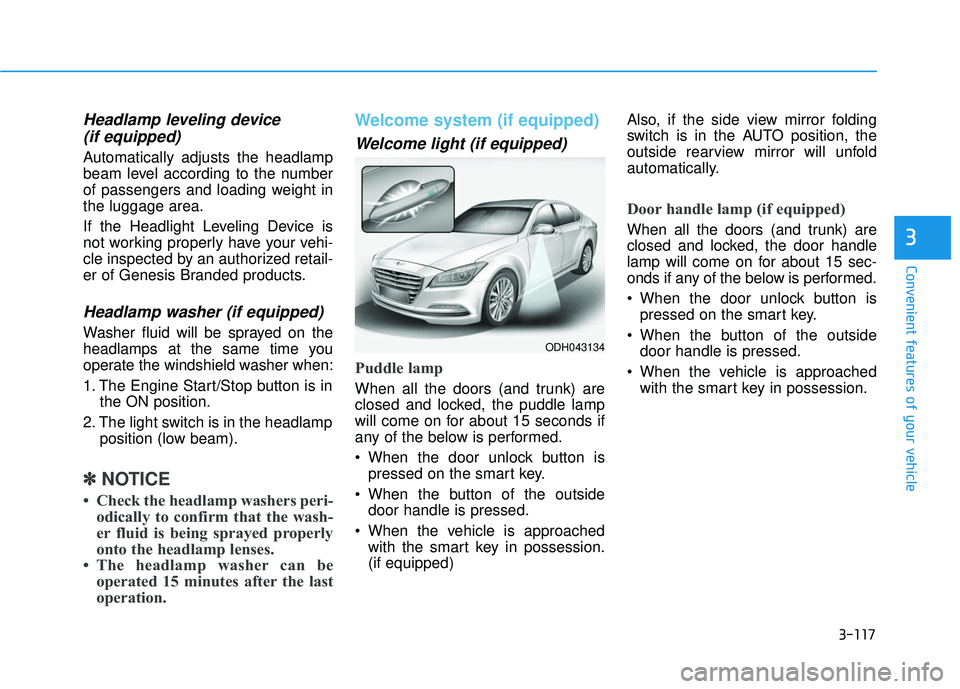
Puddle lamp
When all the doors (and trunk) are
closed and locked, the puddle lamp
will come on for about 15 seconds if
any of the below is performed.
When the door unlock button is
pressed on the smart key.
When the button of the outside door handle is pressed.
When the vehicle is approached with the smart key in possession.
(if equipped) Also, if the side view mirror folding
switch is in the AUTO position, the
outside rearview mirror will unfold
automatically.
Door handle lamp (if equipped)
When all the doors (and trunk) are
closed and locked, the door handle
lamp will come on for about 15 sec-
onds if any of the below is performed.
When the door unlock button is
pressed on the smart key.
When the button of the outside door handle is pressed.
When the vehicle is approached with the smart key in possession.
ODH043134
Page 476 of 496

888
Specifications & Consumer information
8
Specifications, Consumer information and Reporting safety defects
8
Dimensions ..............................................................8-2
Engine ......................................................................8-\
2
Bulb wattage ...........................................................8-3
Tires and wheels ....................................................8-4
Luggage volume .....................................................8-5
Air conditioning system ........................................8-5
Gross vehicle weight .............................................8-5
Recommended lubricants and capacities ...........8-6
Recommended SAE viscosity number .........................8-7
Vehicle identification number (VIN) ....................8-8
Vehicle certification label .....................................8-8
Tire specification and pressure label .................8-9
Engine number .......................................................8-9
Refrigerant label ....................................................8-9
Consumer information .........................................8-10
Reporting safety defects ....................................8-11
Page 481 of 496
8-6
Specifications, Consumer information and Reporting safety defects
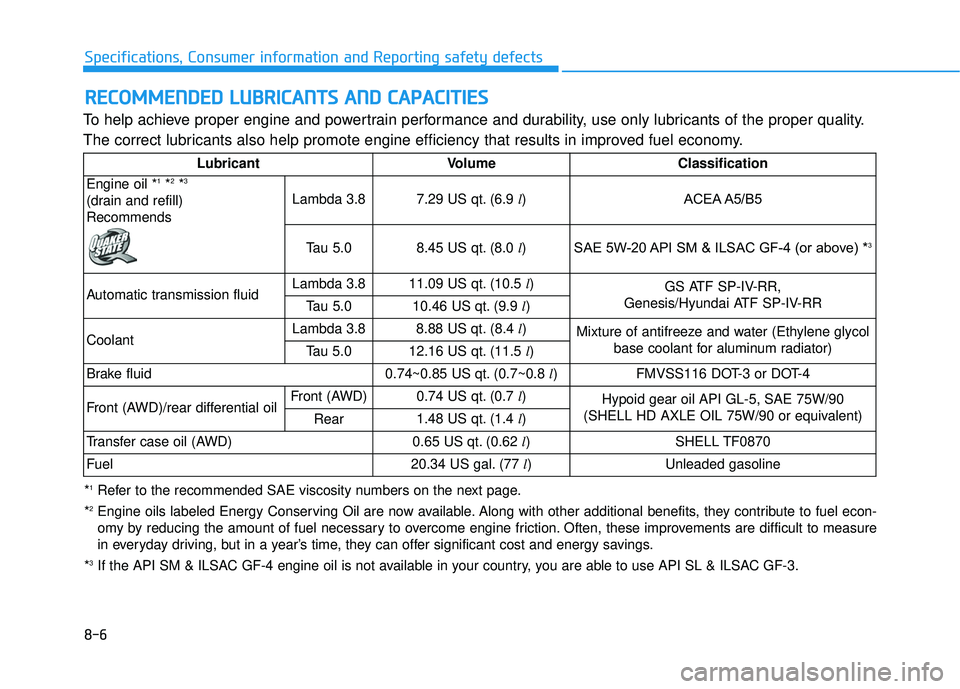
To help achieve proper engine and powertrain performance and durability, use only lubricants of the proper quality.
The correct lubricants also help promote engine efficiency that results in improved fuel economy.
R R E
EC
CO
O M
M M
ME
EN
N D
DE
ED
D
L
L U
U B
BR
RI
IC
C A
A N
N T
TS
S
A
A N
N D
D
C
C A
A P
PA
A C
CI
IT
T I
IE
E S
S
*1Refer to the recommended SAE viscosity numbers on the next page.
*
2Engine oils labeled Energy Conserving Oil are now available. Along with other additional benefits, they contribute to fuel econ-
omy by reducing the amount of fuel necessary to overcome engine friction. Often, these improvements are difficult to measure
in everyday driving, but in a year’s time, they can offer significant cost and energy savings.
*
3If the API SM & ILSAC GF-4 engine oil is not available in your country, you are able to use API SL & ILSAC GF-3. Lubricant
Volume
Classification
Engine oil *
1*2*3
(drain and refill)
Recommends Lambda 3.87.29 US qt. (6.9
l)
ACEA A5/B5
Tau 5.08.45 US qt. (8.0l)SAE 5W-20 API SM & ILSAC GF-4 (or above) *3
Automatic transmission fluid Lambda 3.811.09 US qt. (10.5
l)
GS ATF SP-IV-RR,
Genesis/Hyundai ATF SP-IV-RR
Tau 5.010.46 US qt. (9.9 l)
Coolant Lambda 3.8
8.88 US qt. (8.4
l)
Mixture of antifreeze and water (Ethylene glycol
base coolant for aluminum radiator)
Tau 5.0
12.16 US qt. (11.5 l)
Brake fluid
0.74~0.85 US qt. (0.7~0.8 l) FMVSS116 DOT-3 or DOT-4
Front (AWD)/rear differential oilFront (AWD)0.74 US qt. (0.7l)Hypoid gear oil API GL-5, SAE 75W/90
(SHELL HD AXLE OIL 75W/90 or equivalent)
Rear1.48 US qt. (1.4 l)
Transfer case oil (AWD)0.65 US qt. (0.62 l)SHELL TF0870
Fuel20.34 US gal. (77 l)Unleaded gasoline
Page 482 of 496

8-7
88
Specifications, Consumer information and Reporting safety defects
Recommended SAE viscosity
number
Engine oil viscosity (thickness) has
an effect on fuel economy and cold
weather operating (engine start and
engine oil flowability). Lower viscosi-
ty engine oils can provide better fuel
economy and cold weather perform-
ance, however, higher viscosity
engine oils are required for satisfac-
tory lubrication in hot weather. Using
oils of any viscosity other than those
recommended could result in engine
damage.Always be sure to clean the area
around any filler plug, drain
plug, or dipstick before check-
ing or draining any lubricant.
This is especially important in
dusty or sandy areas and when
the vehicle is used on unpaved
roads. Cleaning the plug and
dipstick areas will prevent dirt
and grit from entering the
engine and other mechanisms
that could be damaged.
CAUTION
Temperature Range for SAE Viscosity Numbers
Temperature
Engine Oil *1
°C
°F
-30 -20 -10 0 10 20 30 40 50
-10 0 20 40 60 80 100 120
10W-30
5W-20, 5W-30
*1: For better fuel economy, it is recommended to use the engine oil ofa viscosity grade SAE 5W-20 (API SM & ILSAC GF-4 (or above)).
However, if the engine oil is not available in your country, select the
proper engine oil using the engine oil viscosity chart.
When choosing an oil, consider the range of temperature your vehicle will be
operated in before the next oil change. Proceed to select the recommended
oil viscosity from the chart.
Temperature Range for SAE Viscosity Numbers
Temperature
Engine Oil *
1
°C
(°F)-30 -20 -10 0 10 20 30 40 50 -10 0 20 40 60 80 100 120
*1: For better fuel economy, it is recommended to use the engine oil of
a viscosity grade SAE 5W-30 (ACEA A5/B5). However, if the
engine oil is not available in your country, select the proper engine
oil using the engine oil viscosity chart.
10W-30
5W-30
■
■ Lambda 3.8
■
■ Tau 5.0
Page 484 of 496

8-9
88
Specifications, Consumer information and Reporting safety defects
The tires supplied on your new vehi-
cle are chosen to provide the best
performance for normal driving.
The tire label located on the driver's
side center pillar gives the tire pres-
sures recommended for your car.The engine number is stamped on
the engine block as shown in the
drawing.The refrigerant label provides infor-
mation such as refrigerant type and
amount.
The label is located on the underside
of the hood.
E E
N
N G
GI
IN
N E
E
N
N U
U M
M B
BE
ER
R R
RE
EF
FR
R I
IG
G E
ER
R A
A N
N T
T
L
L A
A B
BE
EL
L
(
( I
IF
F
E
E Q
Q U
UI
IP
P P
PE
ED
D )
)
T
T
I
IR
R E
E
S
S P
P E
EC
CI
IF
F I
IC
C A
A T
TI
IO
O N
N
A
A N
N D
D
P
P R
R E
ES
SS
SU
U R
RE
E
L
L A
A B
BE
EL
L
ODH083005L
ODH086003N
ODH086007N
■ Lambda Engine
■Tau Engine
ODH083006L
Page 490 of 496
I-4
Drinks holders, see cup holders ....................................3-155
Drive mode integrated control system ............................5-42
Driver assist system ......................................................3-126Rear view camera .....................................................3-126
Parking guide system ...............................................3-127
Parking assist system................................................3-128
Driver position memory system .....................................3-16
Driver’s air bag ...............................................................2-48
Driving at night ...............................................................5-87
Driving in flooded areas .................................................5-88
Driving in the rain...........................................................5-88
Electric chromic mirror...................................................3-22
Electric chromic mirror (ECM) with HomeLink
®system......................................................3-22
Electronic parking brake (EPB) ......................................5-26
Electric power steering ...................................................3-19
Electronic control suspension (ECS) ..............................5-44
Electronic stability control (ESC)...................................5-38
Emergency starting Jump starting ................................................................6-4
Push starting .................................................................6-6
Emergency towing ..........................................................6-24
Emergency while driving ..................................................6-2 Emission control system .................................................7-94
Crankcase emission control system ...........................7-94
Evaporative emission control system .........................7-94
Exhaust emission control system ...............................7-95
Engine compartment..................................................1-7, 7-3
Engine coolant ................................................................7-29
Engine coolant temperature gauge .................................3-65
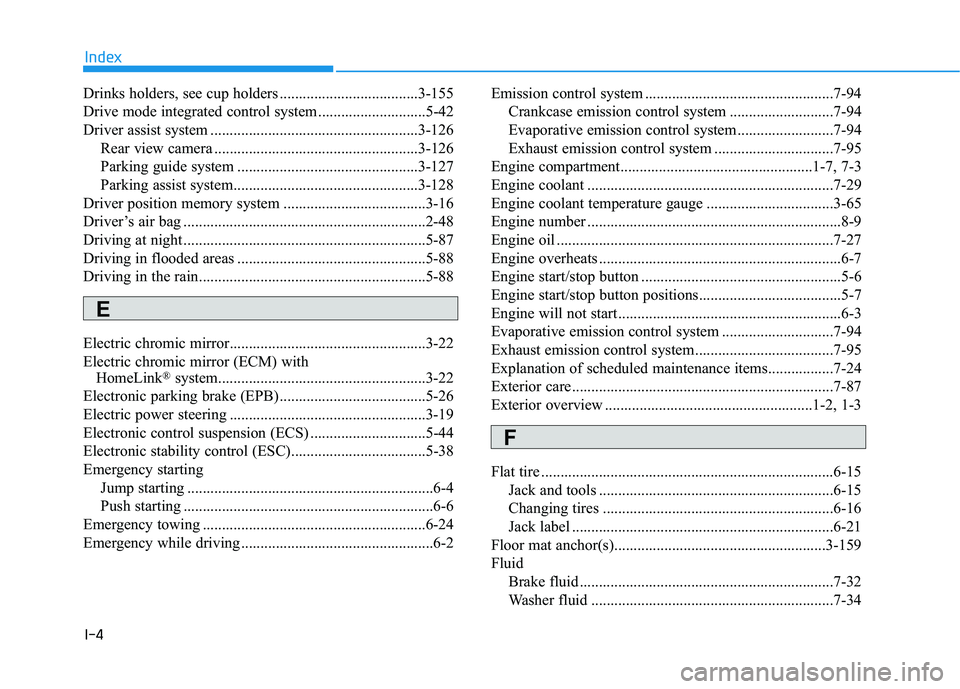
Engine number ..................................................................8-9
Engine oil ........................................................................\
7-27
Engine overheats ...............................................................6-7
Engine start/stop button ....................................................5-6
Engine start/stop button positions.....................................5-7
Engine will not start..........................................................6-3
Evaporative emission control system .............................7-94
Exhaust emission control system....................................7-95
Explanation of scheduled maintenance items.................7-24
Exterior care....................................................................7-87\
Exterior overview ......................................................1-2, 1-3
Flat tire ........................................................................\
....6-15 Jack and tools .............................................................6-15
Changing tires ............................................................6-16
Jack label ....................................................................6-21\
Floor mat anchor(s).......................................................3-159
Fluid Brake fluid ..................................................................7-32
Washer fluid ...............................................................7-34
Index
E
F