oil pan GENESIS G80 2017 Owner's Manual
[x] Cancel search | Manufacturer: GENESIS, Model Year: 2017, Model line: G80, Model: GENESIS G80 2017Pages: 496, PDF Size: 12.82 MB
Page 258 of 496

5-3
Driving your vehicle
5
Carbon monoxide (CO) gas is toxic. Breathing CO can cause unconsciousness and death.
Engine exhaust contains carbon monoxide which cannot be seen or smelled.
Do not inhale engine exhaust.
If at any time you smell engine exhaust inside the vehicle, open the windows immediately. Exposure to CO can cause
unconsciousness and death by asphyxiation.
Be sure the exhaust system does not leak.
The exhaust system should be checked whenever the vehicle is raised to change the oil or for any other purpose. If
you hear a change in the sound of the exhaust or if you drive over something that strikes the underneath side of the
vehicle, have the exhaust system checked as soon as possible by an authorized HYUNDAI dealer.
Do not run the engine in an enclosed area.
Letting the engine idle in your garage, even with the garage door open, is a hazardous practice. Run the engine only
long enough to start the engine and to move the vehicle out of the garage.
Avoid idling the engine for prolonged periods with people inside the vehicle.
If it is necessary to idle the engine for a prolonged period with people inside the vehicle , be sure to do so only in an
open area with the air intake set at "Fresh" and fan control set to high so fresh air is drawn into the interior.
Keep the air intakes clear.
To assure proper operation of the ventilation system, keep the ventilation air intakes located in front of the windshield
clear of snow, ice, leaves, or other obstructions.
If you must drive with the trunk open:
Close all windows.
Open instrument panel air vents.
Set the air intake control at "Fresh", the air flow control at "Floor" or "Face", and the fan control set to high.
WARNING
Page 404 of 496
7-27
7
Maintenance
E
EN
N G
GI
IN
N E
E
O
O I
IL
L
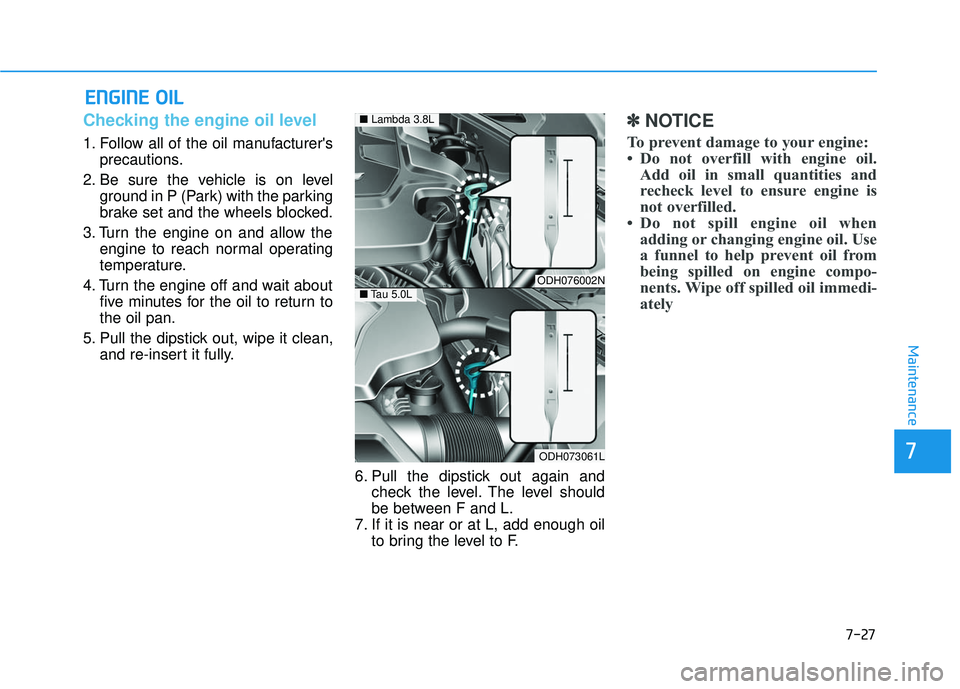
Checking the engine oil level
1. Follow all of the oil manufacturer's
precautions.
2. Be sure the vehicle is on level ground in P (Park) with the parking
brake set and the wheels blocked.
3. Turn the engine on and allow the engine to reach normal operating
temperature.
4. Turn the engine off and wait about five minutes for the oil to return to
the oil pan.
5. Pull the dipstick out, wipe it clean, and re-insert it fully.
6. Pull the dipstick out again andcheck the level. The level should
be between F and L.
7. If it is near or at L, add enough oil to bring the level to F.
✽ ✽NOTICE
To prevent damage to your engine:
• Do not overfill with engine oil.
Add oil in small quantities and
recheck level to ensure engine is
not overfilled.
• Do not spill engine oil when adding or changing engine oil. Use
a funnel to help prevent oil from
being spilled on engine compo-
nents. Wipe off spilled oil immedi-
ately
ODH076002N
ODH073061L
■ Lambda 3.8L
■Tau 5.0L
Page 438 of 496

7-61
7
Maintenance
F
FU
U S
SE
E S
S
A vehicle's electrical system is pro-
tected from electrical overload dam-
age by fuses.
This vehicle has 2 (or 3) fuse panels,
one located in the driver's side panel
bolster, the other in the engine com-
partment near the battery.
If any of your vehicle's lights, acces-
sories, or controls do not work, check
the appropriate circuit fuse. If a fuse
has blown, the element inside the
fuse will be melted or broken.
If the electrical system does not
work, first check the driver's side
fuse panel. Before replacing a blown
fuse, disconnect the negative battery
cable. Always replace a blown fuse
with one of the same rating.
If the replacement fuse blows, this
indicates an electrical problem. Avoid
using the system involved and imme-
diately consult an authorized retailer
of Genesis Branded products.✽ ✽
NOTICE
Three kinds of fuses are used: blade
type for lower amperage rating, car-
tridge type, and fusible link for
higher amperage ratings.
NEVER replace a fuse with any-
thing but another fuse of the
same rating.
A higher capacity fuse could
cause damage and possibly
cause a fire.
Do not install a wire or alu-
minum foil instead of the
proper fuse - even as a tem-
porary repair. It may cause
extensive wiring damage and
possibly a fire.
WARNING
Normal
Normal
■
Blade type
■ Cartridge type
■ Multi fuse Blown
Blown
Normal Blown
■Fusible link
Normal Blown
OLMB073029/OBH072060
Page 469 of 496

7-92
Maintenance
vehicle, pay particular attention to
the components under the fenders
and other areas that are hidden
from view. Do a thorough job; just
dampening the accumulated mud
rather than washing it away will
accelerate corrosion rather than
prevent it. Water under high pres-
sure and steam are particularly
effective in removing accumulated
mud and corrosive materials.
When cleaning lower door panels, rocker panels and frame members,
be sure that drain holes are kept
open so that moisture can escape
and not be trapped inside to accel-
erate corrosion.
Keep your garage dry
Don't park your car in a damp, poor-
ly ventilated garage. This creates a
favorable environment for corrosion.
This is particularly true if you wash
your vehicle in the garage or drive it
into the garage when it is still wet or
covered with snow, ice or mud. Even
a heated garage can contribute to
corrosion unless it is well ventilated
so moisture is dispersed.
Keep paint and trim in good condition
Scratches or chips in the finish
should be covered with "touch-up"
paint as soon as possible to reduce
the possibility of corrosion. If bare
metal is showing through, the atten-
tion of a qualified body and paint
shop is recommended.
Bird droppings are highly corrosive
and may damage painted surfaces in
just a few hours. Always remove bird
droppings as soon as possible.
Interior care
Interior general precautions
Prevent caustic solutions such as
perfume and cosmetic oil, from con-
tacting the interior parts because
they may cause damage or discol-
oration. If they do contact the interior
parts, wipe them off immediately.
See the instructions for the proper
way to clean vinyl.
Never allow water or other liq-
uids to come in contact with
electrical/electronic compo-
nents inside the vehicle as
this may damage them.
When cleaning leather prod-
ucts (steering wheel, seats
etc.), use neutral detergents
or low alcohol content solu-
tions. If you use high alcohol
content solutions or
acid/alkaline detergents, the
color of the leather may fade
or the surface may get
stripped off.
CAUTION
Page 493 of 496
I-7
Maintenance under severe usage conditions ..............7-22
Explanation of scheduled maintenance items ............7-24
Tire maintenance ........................................................7-51
Maintenance schedule Normal maintenance schedule .....................................7-9
Maintenance under severe usage conditions ..............7-22
Maintenance services ........................................................7-5
Manual heating and air conditioning ............................3-136
Mirrors ........................................................................\
....3-22 Inside rearview mirror ................................................3-22
Electric chromic mirror (ECM) with HomeLink
®
system......................................................................3-\
22
Side view mirrors .......................................................3-36
Moonroof, see sunroof ....................................................3-44
Multi fuse ........................................................................\
7-65
Multimedia system............................................................4-2 AUX, USB and iPod
®port ..........................................4-2
Antenna ........................................................................\
4-3
Steering wheel audio control........................................4-4
Audio / Video / Navigation system (AVN) ..................4-5
Bluetooth
®Wireless Technology hands-free................4-5
Neck restraints, see headrest ...........................................2-14 Odometer........................................................................\
.3-66
Oil (Engine) ....................................................................7-27\
Overheats ........................................................................\
..6-7
Owner maintenance ..........................................................7-6
Panorama sunroof ...........................................................3-44
Parking assist system ....................................................3-128
Parking brake.........................................................5-24, 5-26
Parking brake inspect......................................................7-34
Passenger's front air bag .................................................2-48
Power brakes ...................................................................5-23
Power outlet ..................................................................3-156
Power window lock button .............................................3-43
Push starting......................................................................6-\
6
Rear seat ........................................................................\
..2-11
Recommended cold tire inflation pressures ...................7-46
Recommended lubricants and capacities ..........................8-6
Recommended SAE viscosity number .........................8-7
Refrigerant label ...............................................................8-9
Reporting safety defects..................................................8-11
I
Index
O
P
R
N