under cover GENESIS G80 2017 Owner's Manual
[x] Cancel search | Manufacturer: GENESIS, Model Year: 2017, Model line: G80, Model: GENESIS G80 2017Pages: 496, PDF Size: 12.82 MB
Page 7 of 496
F5
1. What are Genesis/Hyundai Parts?Genesis/Hyundai Parts are the
same parts used by HYUNDAI
Motor Company to manufacture
vehicles. They are designed and
tested for the optimum safety, per-
formance, and reliability to our cus-
tomers. 2. Why should you use Genesis/
Hyundai Parts?
Genesis/Hyundai Parts are engi-
neered and built to meet rigid man-
ufacturing requirements. Damage
caused by using imitation, counter-
feit or used salvage parts is not
covered under the Genesis
Branded New Vehicle Limited
Warranty or any other Genesis
Branded Vehicle warranty.
In addition, any damage to or fail-
ure of Genesis/Hyundai Part
caused by the installation or failure
of an imitation, counterfeit or used
salvage part is not covered by any
Genesis Branded Vehicle Warranty. 3. How can you tell if you are pur-
chasing Genesis/Hyundai Parts?
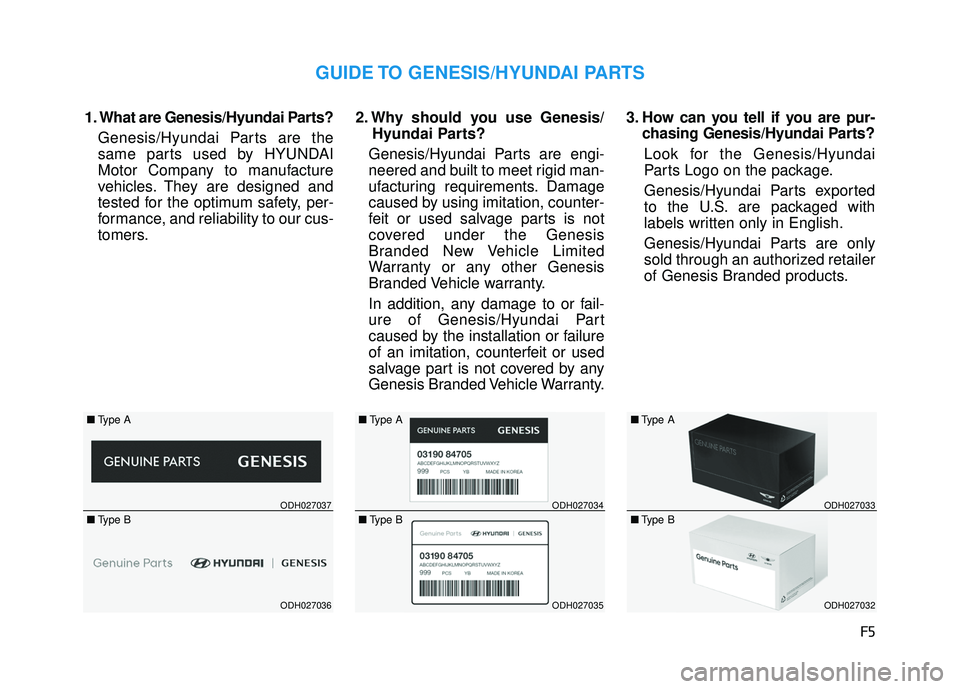
Look for the Genesis/Hyundai
Parts Logo on the package.
Genesis/Hyundai Parts exported
to the U.S. are packaged with
labels written only in English.
Genesis/Hyundai Parts are only
sold through an authorized retailer
of Genesis Branded products.
GUIDE TO GENESIS/HYUNDAI PARTS
■ Type A
ODH027037■Type B
ODH027036
■Type A
ODH027034■Type B
ODH027035
■Type A
ODH027033■Type B
ODH027032
Page 75 of 496

2-55
Safety system of your vehicle
2
Upon deployment, tear seams mold-
ed directly into the pad covers will
separate under pressure from the
expansion of the air bags. Further
opening of the covers allows full
inflation of the air bags.
A fully inflated air bag, in combina-
tion with a properly worn seat belt,
slows the driver's or the passenger's
forward motion, reducing the risk of
head and chest injury.After complete inflation, the air bag
immediately starts deflating,
enabling the driver to maintain for-
ward visibility and the ability to steer
or operate other controls.
OLMB033055
■Driver’s front air bag (2)
OLMB033056
■Driver’s front air bag (3)
OLMB033057
■Passenger’s front air bag
To prevent objects from becom-
ing dangerous projectiles when
the passenger's air bag inflates:
Do not install or place any
objects (drink holder, CD
holder, stickers, etc.) on the
front passenger's panel above
the glove box where the pas-
senger's air bag is located.
Do not install a container of
liquid air freshener near the
instrument cluster or on the
instrument panel surface.
WARNING
Page 304 of 496

5-49
Driving your vehicle
5
(Continued)- There is interference by elec-tromagnetic waves.
- There are strong radar reflections.
- Driving in a curve.
- Driving uphill or downhill.
- Driving in areas under con- struction.
- An object ahead is very nar- row such as motorcycles or
bicycles.
- A vehicle suddenly enters your lane.
- The camera cannot secure a clear view.
- The camera cannot catch the whole vehicle.
- An unusual shape vehicle is ahead such as a trailer, spe-
cial access vehicle or a truck
with unique shaped cargo.
(Continued)(Continued)- Driving at night, the tail lampof the vehicle ahead is miss-
ing, installed on an unusual
place or installed unevenly.
- Coming in or out a tunnel, where the illumination inten-
sity is high.
Even if there is a malfunction
to the brake operation of the
AEB, when you depress the
brake pedal, the brake oper-
ates normally. AEB brake
operation does not operate in
certain hazardous situations.
The AEB is designed to func-
tion above approximately
5 mph (8 km/h) and below
approximately 110 mph (180
km/h).
The AEB does not detect:
- Persons or animals.
- Oncoming vehicles in theopposite lane or a vehicle in
an intersection.
- Stopped objects.
The AEB cannot detect
objects, when:
- The sensors are covered with dirt.
- There is heavy rain or heavy snow.
(Continued)
WARNING
Page 330 of 496

5-75
Driving your vehicle
5
(Continued)
• The lane is very wide or narrow.
• The windshield is fogged byhumid air in the vehicle.
• A shadow is on the lane line.
• There is a mark that looks like a lane line.
• There is a boundary structure, such as a concrete barrier.
• The distance from the vehicle ahead is very short or the vehicle
ahead drives covering the lane
line.
• The vehicle vibrates heavily due to road conditions.
• The number of lanes increases or decreases or the lane lines are
crossing.
• Putting something on the dash- board.
• Driving with the sun in front of you.
• Driving in areas under construc- tion.
• There are more than two lane lines.
• The lane is merged or divided.
• Driving through a toll plaza or toll gate. LKAS malfunction
If there is a problem with the system
a message will appear for 2 seconds.
If the problem continues the LKAS
failure indicator will illuminate.
LKAS failure indicator
The LKAS failure indicator (yellow)
will illuminate if the LKAS is not
working properly. Have your vehicle
checked by an authorized HYUNDAI
dealer.
ODH053147L
ODH053118
ODH053117
■ Type A
■Type B
Page 367 of 496

6-15
What to do in an emergency
6
Jack and tools
➀Jack handle
② Jack
③ Wheel nut wrench
④ Screw driver
⑤ Spanner
\b Towing hook
The jack, jack handle, and wheel lug
nut wrench are stored in the luggage
compartment under the luggage box
cover.
The jack is provided for emergency
tire changing only. Turn the winged hold down bolt
counterclockwise to remove the
spare tire.
Store the spare tire in the same com-
partment by turning the winged hold
down bolt clockwise.
To prevent the spare tire and tools
from “rattling,” store them in their
proper location.
I I
F
F
Y
Y O
O U
U
H
H A
AV
VE
E
A
A
F
F L
LA
A T
T
T
T I
IR
R E
E
Changing a tire can be danger-
ous. Follow the instructions in
this section when changing a
tire to reduce the risk of serious
injury or death.
WARNING
ODH063008
ODH063030
Page 466 of 496
7-89
7
Maintenance
Finish damage repair
Deep scratches or stone chips in the
painted surface must be repaired
promptly. Exposed metal will quickly
rust and may develop into a major
repair expense.
✽ ✽NOTICE
If your vehicle is damaged and
requires any metal repair or
replacement, be sure the body shop
applies anti-corrosion materials to
the parts repaired or replaced.
Bright-metal maintenance
To remove road tar and insects,
use a tar remover, not a scraper or
other sharp object.
To protect the surfaces of bright- metal parts from corrosion, apply a
coating of wax or chrome preser-
vative and rub to a high luster.
During winter weather or in coastal areas, cover the bright metal parts
with a heavier coating of wax or
preservative. If necessary, coat the
parts with non-corrosive petroleum
jelly or other protective compound.
Underbody maintenance
Corrosive materials used for ice and
snow removal and dust control may
collect on the underbody. If these
materials are not removed, acceler-
ated rusting can occur on underbody
parts such as the fuel lines, frame,
floor pan and exhaust system, even
though they have been treated with
rust protection.
Thoroughly flush the vehicle under-
body and wheel openings with luke-
warm or cold water once a month,
after off-road driving and at the end
of each winter. Pay special attention
to these areas because it is difficult
to see all the mud and dirt. It will do
more harm than good to wet down
the road grime without removing it.
The lower edges of doors, rocker
panels, and frame members have
drain holes that should not be
allowed to clog with dirt; trapped
water in these areas can cause rust-
ing.
Wiping dust or dirt off the
body with a dry cloth will
scratch the finish.
Do not use steel wool, abra-
sive cleaners, or strong deter-
gents containing highly alka-
line or caustic agents on
chrome-plated or anodized
aluminum parts. This may
result in damage to the pro-
tective coating and cause dis-
coloration or paint deteriora-
tion.
CAUTION
Page 469 of 496

7-92
Maintenance
vehicle, pay particular attention to
the components under the fenders
and other areas that are hidden
from view. Do a thorough job; just
dampening the accumulated mud
rather than washing it away will
accelerate corrosion rather than
prevent it. Water under high pres-
sure and steam are particularly
effective in removing accumulated
mud and corrosive materials.
When cleaning lower door panels, rocker panels and frame members,
be sure that drain holes are kept
open so that moisture can escape
and not be trapped inside to accel-
erate corrosion.
Keep your garage dry
Don't park your car in a damp, poor-
ly ventilated garage. This creates a
favorable environment for corrosion.
This is particularly true if you wash
your vehicle in the garage or drive it
into the garage when it is still wet or
covered with snow, ice or mud. Even
a heated garage can contribute to
corrosion unless it is well ventilated
so moisture is dispersed.
Keep paint and trim in good condition
Scratches or chips in the finish
should be covered with "touch-up"
paint as soon as possible to reduce
the possibility of corrosion. If bare
metal is showing through, the atten-
tion of a qualified body and paint
shop is recommended.
Bird droppings are highly corrosive
and may damage painted surfaces in
just a few hours. Always remove bird
droppings as soon as possible.
Interior care
Interior general precautions
Prevent caustic solutions such as
perfume and cosmetic oil, from con-
tacting the interior parts because
they may cause damage or discol-
oration. If they do contact the interior
parts, wipe them off immediately.
See the instructions for the proper
way to clean vinyl.
Never allow water or other liq-
uids to come in contact with
electrical/electronic compo-
nents inside the vehicle as
this may damage them.
When cleaning leather prod-
ucts (steering wheel, seats
etc.), use neutral detergents
or low alcohol content solu-
tions. If you use high alcohol
content solutions or
acid/alkaline detergents, the
color of the leather may fade
or the surface may get
stripped off.
CAUTION
Page 472 of 496

7-95
7
Maintenance
Canister
Fuel vapors generated inside the fuel
tank are absorbed and stored in the
onboard canister. When the engine is
running, the fuel vapors absorbed in
the canister are drawn into the surge
tank through the purge control sole-
noid valve.
Purge Control Solenoid Valve(PCSV)
The purge control solenoid valve is
controlled by the Engine Control
Module (ECM); when the engine
coolant temperature is low during
idling, the PCSV closes so that evap-
orated fuel is not taken into the
engine. After the engine warms-up
during ordinary driving, the PCSV
opens to introduce evaporated fuel to
the engine.
3. Exhaust emission control system
The Exhaust Emission Control
System is a highly effective system
which controls exhaust emissions
while maintaining good vehicle per-
formance.
When the engine starts or fails to
start, excessive attempts to restart
the engine may cause damage to the
emission system.
Vehicle modifications
This vehicle should not be modi-
fied. Modification of your vehicle
could affect its performance, safety
or durability and may even violate
governmental safety and emis-
sions regulations.
In addition, damage or performance
problems resulting from any modifi-
cation may not be covered under
warranty.
If you use unauthorized electronic devices, it may cause the vehicle to
operate abnormally, wire damage,
battery discharge and fire. For your
safety, do not use unauthorized
electronic devices.
Engine exhaust (carbon monox-ide) precautions
Carbon monoxide can be present
with other exhaust fumes. If you
smell exhaust fumes of any kind in
your vehicle, drive with all the win-
dows fully open. Have your vehicle
checked and repaired immediately.
Engine exhaust gases contain
carbon monoxide (CO). Though
colorless and odorless, it is
dangerous and could be lethal if
inhaled. Follow the instructions
on this page to avoid CO poi-
soning.
WARNING
Page 483 of 496

8-8
Specifications, Consumer information and Reporting safety defects
V
VE
EH
H I
IC
C L
LE
E
C
C E
E R
R T
TI
IF
F I
IC
C A
A T
TI
IO
O N
N
L
L A
A B
BE
EL
L
The vehicle identification number
(VIN) is the number used in register-
ing your car and in all legal matters
pertaining to its ownership, etc.
The number is punched on the floor
under the passenger seat. To check
the number, open the cover. The VIN is also on a plate attached
to the top of the dashboard. The
number on the plate can easily be
seen through the windshield from
outside.
The vehicle certification label
attached on the driver’s side center
pillar gives the Vehicle Identification
Number (VIN).
V V
E
EH
H I
IC
C L
LE
E
I
ID
D E
EN
N T
TI
IF
F I
IC
C A
A T
TI
IO
O N
N
N
N U
U M
M B
BE
ER
R
(
( V
V I
IN
N )
)
ODH083004L
■ VIN label (if equipped)
ODH083001
■ Frame number
ODH083002