check oil GENESIS G80 2021 User Guide
[x] Cancel search | Manufacturer: GENESIS, Model Year: 2021, Model line: G80, Model: GENESIS G80 2021Pages: 604, PDF Size: 11.47 MB
Page 522 of 604
09
9 -7
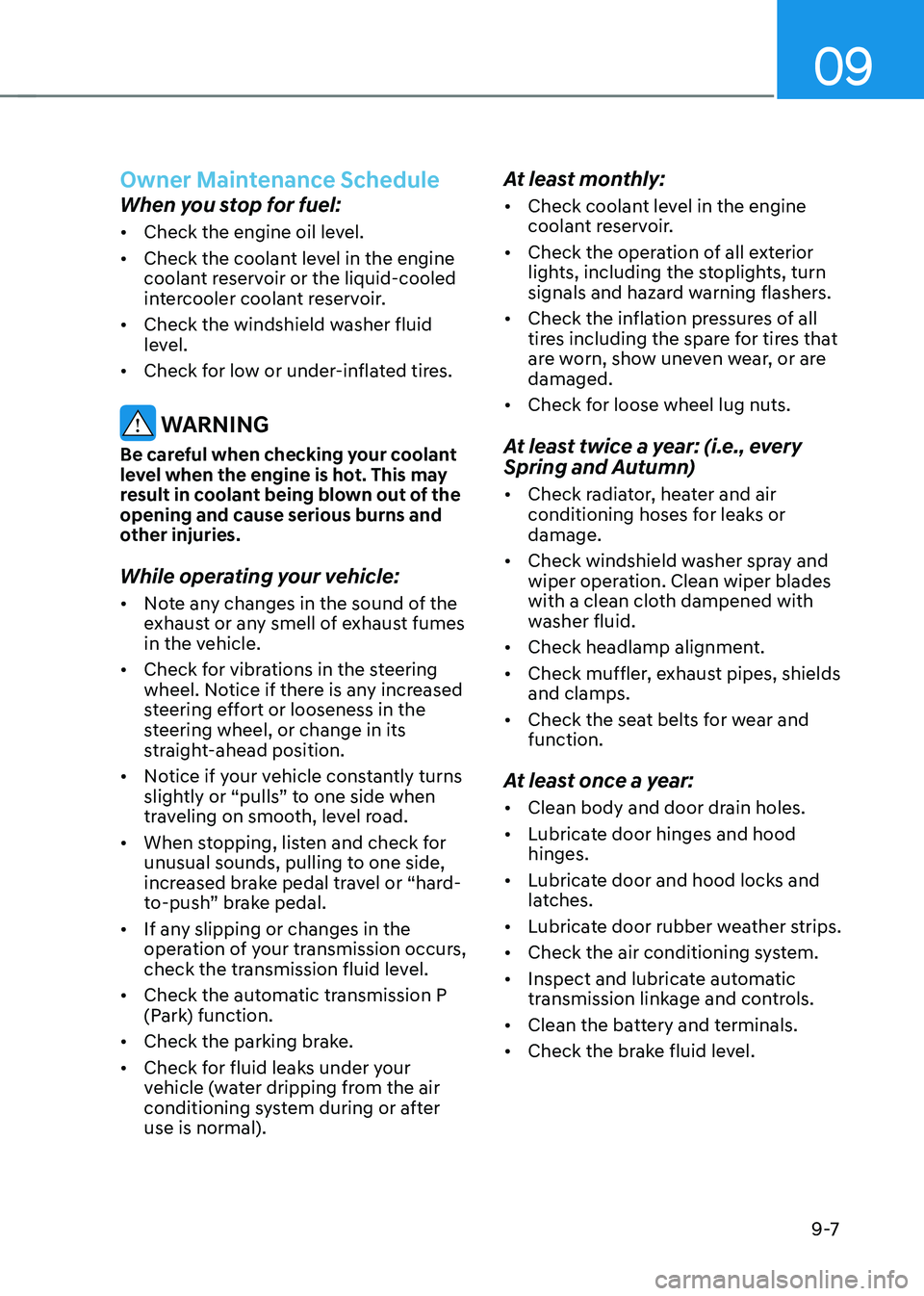
Owner Maintenance Schedule
When you stop for fuel:
• Check the engine oil level.
• Check the coolant level in the engine
coolant reservoir or the liquid-cooled
intercooler coolant reservoir.
• Check the windshield washer fluid
level.
• Check for low or under-inflated tires.
WARNING
Be careful when checking your coolant
level when the engine is hot. This may
result in coolant being blown out of the
opening and cause serious burns and
other injuries.
While operating your vehicle:
• Note any changes in the sound of the
exhaust or any smell of exhaust fumes
in the vehicle.
• Check for vibrations in the steering
wheel. Notice if there is any increased
steering effort or looseness in the
steering wheel, or change in its
straight-ahead position.
• Notice if your vehicle constantly turns
slightly or “pulls” to one side when
traveling on smooth, level road.
• When stopping, listen and check for
unusual sounds, pulling to one side,
increased brake pedal travel or “hard-
to-push” brake pedal.
• If any slipping or changes in the
operation of your transmission occurs,
check the transmission fluid level.
• Check the automatic transmission P
(Park) function.
• Check the parking brake.
• Check for fluid leaks under your
vehicle (water dripping from the air
conditioning system during or after
use is normal).
At least monthly:
• Check coolant level in the engine
coolant reservoir.
• Check the operation of all exterior
lights, including the stoplights, turn
signals and hazard warning flashers.
• Check the inflation pressures of all
tires including the spare for tires that
are worn, show uneven wear, or are
damaged.
• Check for loose wheel lug nuts.
At least twice a year: (i.e., every
Spring and Autumn)
• Check radiator, heater and air
conditioning hoses for leaks or
damage.
• Check windshield washer spray and
wiper operation. Clean wiper blades
with a clean cloth dampened with
washer fluid.
• Check headlamp alignment.
• Check muffler, exhaust pipes, shields
and clamps.
• Check the seat belts for wear and
function.
At least once a year:
• Clean body and door drain holes.
• Lubricate door hinges and hood
hinges.
• Lubricate door and hood locks and
latches.
• Lubricate door rubber weather strips.
• Check the air conditioning system.
• Inspect and lubricate automatic
transmission linkage and controls.
• Clean the battery and terminals.
• Check the brake fluid level.
Page 526 of 604
09
9-11
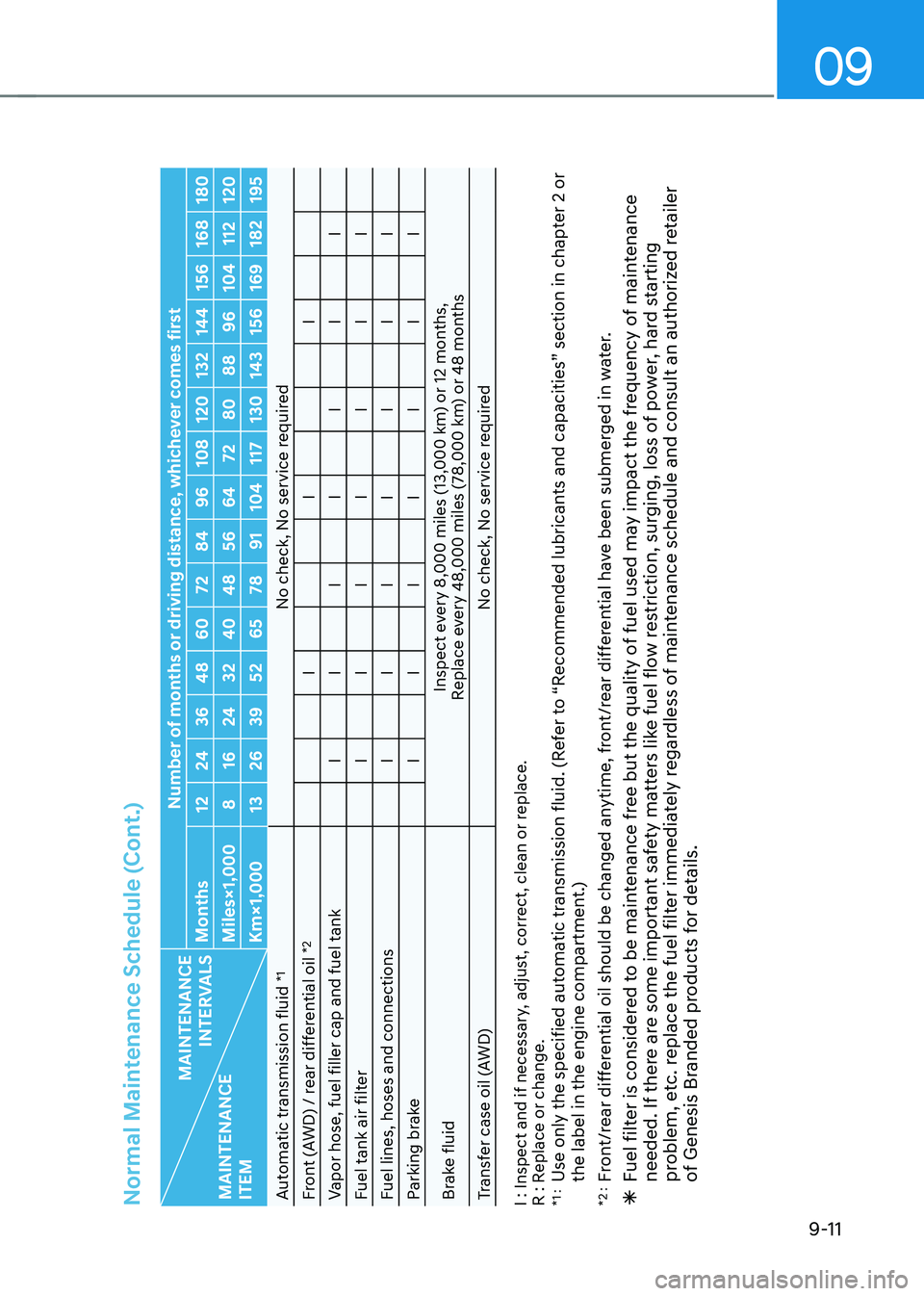
Normal Maintenance Schedule (Cont.)
MAINTENANCE
INTERVALS
MAINTENANCE
ITEM Number of months or driving distance, whichever comes first
Months 1224 3648 60 7284 96108 120 132144 156168 180
Miles×1,000 816 24 3240 48 5664 7280 8896104 112120
Km×1,000 1326 39 5265 78 91104 117130 143156169 182195
Automatic transmission fluid
*1
No check, No service required
Front (AWD) / rear differential oil
*2
I II
Vapor hose, fuel filler cap and fuel tank IIIIIII
Fuel tank air filter IIIIIII
Fuel lines, hoses and connections IIIIIII
Parking brake IIIIIII
Brake fluid Inspect every 8,000 miles (13,000 km) or 12 months,
Replace every 48,000 miles (78,000 km) or 48 months
Transfer case oil (AWD) No check, No service required
I : Inspect and if necessary, adjust, correct, clean or replace.
R : Replace or change.
*1 : Use only the specified automatic transmission fluid. (Refer to “Recommended lubricants and capacities” section in chapter 2 or
the label in the engine compartment.)
*2 : Front/rear differential oil should be changed anytime, front/rear differential have been submerged in water. Ã Fuel filter is considered to be maintenance free but the quality of fuel used may impact the frequency of maintenance
needed. If there are some important safety matters like fuel flow restriction, surging, loss of power, hard starting
problem, etc. replace the fuel filter immediately regardless of maintenance schedule and consult an authorized retailer
of Genesis Branded products for details.
Page 527 of 604
Maintenance
9-12
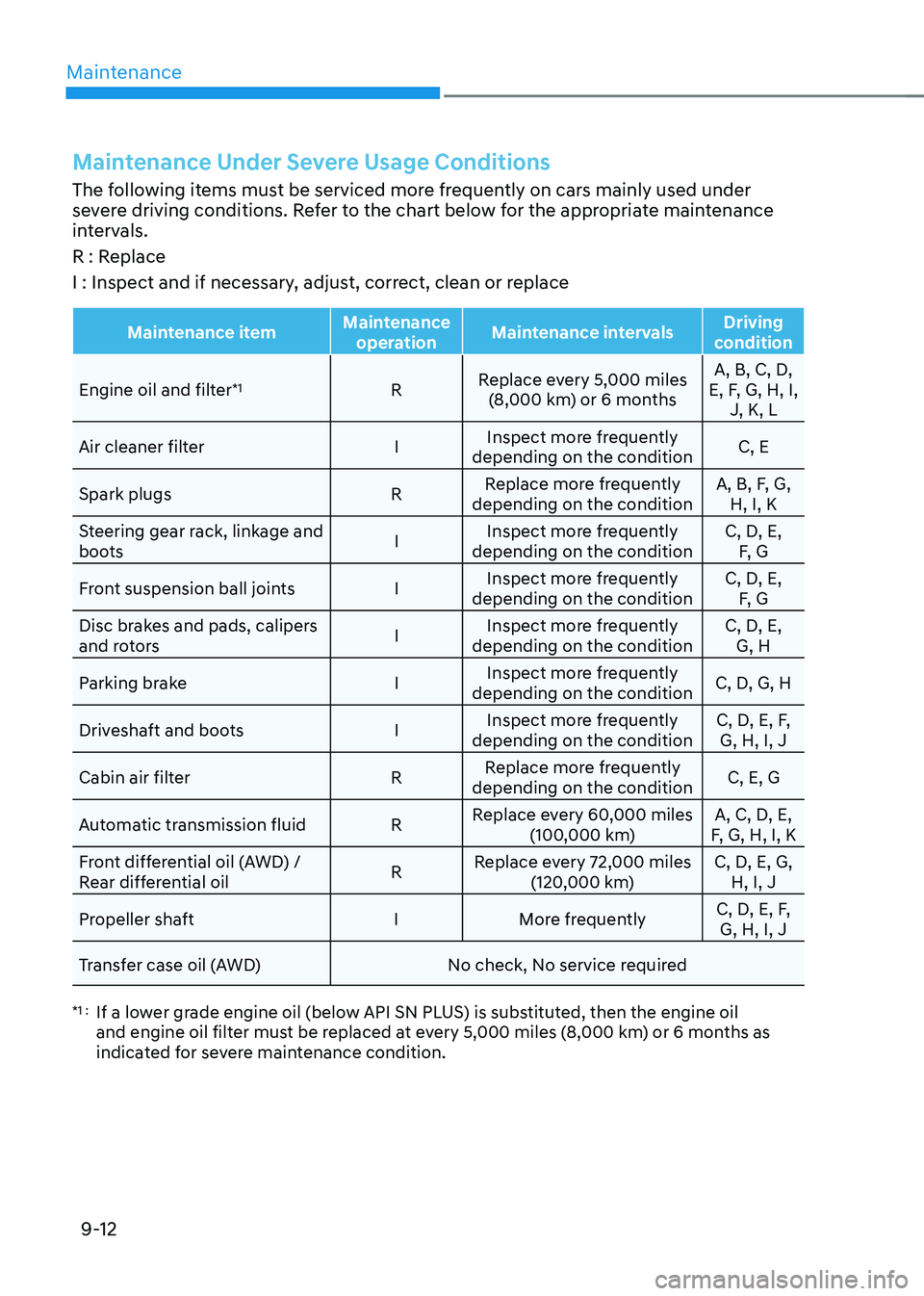
Maintenance Under Severe Usage Conditions
The following items must be serviced more frequently on cars mainly used under
severe driving conditions. Refer to the chart below for the appropriate maintenance
intervals.
R : Replace
I : Inspect and if necessary, adjust, correct, clean or replace
Maintenance itemMaintenance
operation Maintenance intervals Driving
condition
Engine oil and filter
*1R Replace every 5,000 miles
(8,000 km) or 6 months A, B, C, D,
E, F, G, H, I, J, K, L
Air cleaner filter IInspect more frequently
depending on the condition C, E
Spark plugs RReplace more frequently
depending on the condition A, B, F, G,
H, I, K
Steering gear rack, linkage and
boots IInspect more frequently
depending on the condition C, D, E,
F, G
Front suspension ball joints IInspect more frequently
depending on the condition C, D, E,
F, G
Disc brakes and pads, calipers
and rotors IInspect more frequently
depending on the condition C, D, E,
G, H
Parking brake IInspect more frequently
depending on the condition C, D, G, H
Driveshaft and boots IInspect more frequently
depending on the condition C, D, E, F,
G, H, I, J
Cabin air filter RReplace more frequently
depending on the condition C, E, G
Automatic transmission fluid RReplace every 60,000 miles
(100,000 km) A, C, D, E,
F, G, H, I, K
Front differential oil (AWD) /
Rear differential oil RReplace every 72,000 miles
(120,000 km) C, D, E, G,
H, I, J
Propeller shaft IMore frequently C, D, E, F,
G, H, I, J
Transfer case oil (AWD) No check, No service required
*1 : If a lower grade engine oil (below API SN PLUS) is substituted, then the engine oil
and engine oil filter must be replaced at every 5,000 miles (8,000 km) or 6 months as
indicated for severe maintenance condition.
Page 529 of 604

Maintenance
9-14
Engine Oil and Filter
The engine oil and filter should be
changed at the intervals specified in the
maintenance schedule. If the vehicle
is being driven in severe conditions,
more frequent oil and filter changes are
required.
Drive Belts
Inspect all drive belts for evidence
of cuts, cracks, excessive wear or oil
saturation and replace if necessary.
Drive belts should be checked
periodically for proper tension and
adjusted as necessary.
Information
When you are inspecting the belt, turn the
engine off.
Fuel Lines, Fuel Hoses and
Connections
Check the fuel lines, fuel hoses and
connections for leakage and damage.
Have an authorized retailer of Genesis
Branded products replace any damaged
or leaking parts immediately.
Fuel Filter
The fuel filter is considered to be
maintenance free but periodic inspection
is recommended for this maintenance
depends on fuel quality. If there are
some important matters like fuel flow
restriction, surging, loss of power, hard
starting problem etc., replace the fuel
filter immediately. We recommend that
you consult an authorized retailer of
Genesis Branded products for details.
Vapor Hose and Fuel Filler Cap
The vapor hose and fuel filler cap should
be inspected at those intervals specified
in the maintenance schedule. Make sure
a new vapor hose or fuel filler cap is
correctly replaced.
Air Cleaner Filter
We recommend that the air cleaner filter
be replaced by an authorized retailer of
Genesis Branded products.
Spark Plugs
Make sure to install new spark plugs of
the correct heat range.
Cooling System
Check cooling system components, such
as radiator, coolant reservoir, hoses and
connections for leakage and damage.
Replace any damaged parts.
EXPLANATION OF SCHEDULED MAINTENANCE ITEMS
Page 531 of 604
Maintenance
9-16
ENGINE OIL
Suspension Mounting Bolts
Check the suspension connections for
looseness or damage. Retighten to the
specified torque.
Steering Gear box, Linkage &
Boots/Lower Arm Ball Joint
With the vehicle stopped and the engine
off, check for excessive free-play in the
steering wheel. Check the linkage for
bends or damage. Check the dust boots
and ball joints for deterioration, cracks,
or damage.
Replace any damaged parts.
Drive Shafts and Boots
Check the drive shafts, boots and clamps
for cracks, deterioration, or damage.
Replace any damaged parts and, if
necessary, repack the grease.
Air Conditioning Refrigerant
Check the air conditioning lines and
connections for leakage and damage.
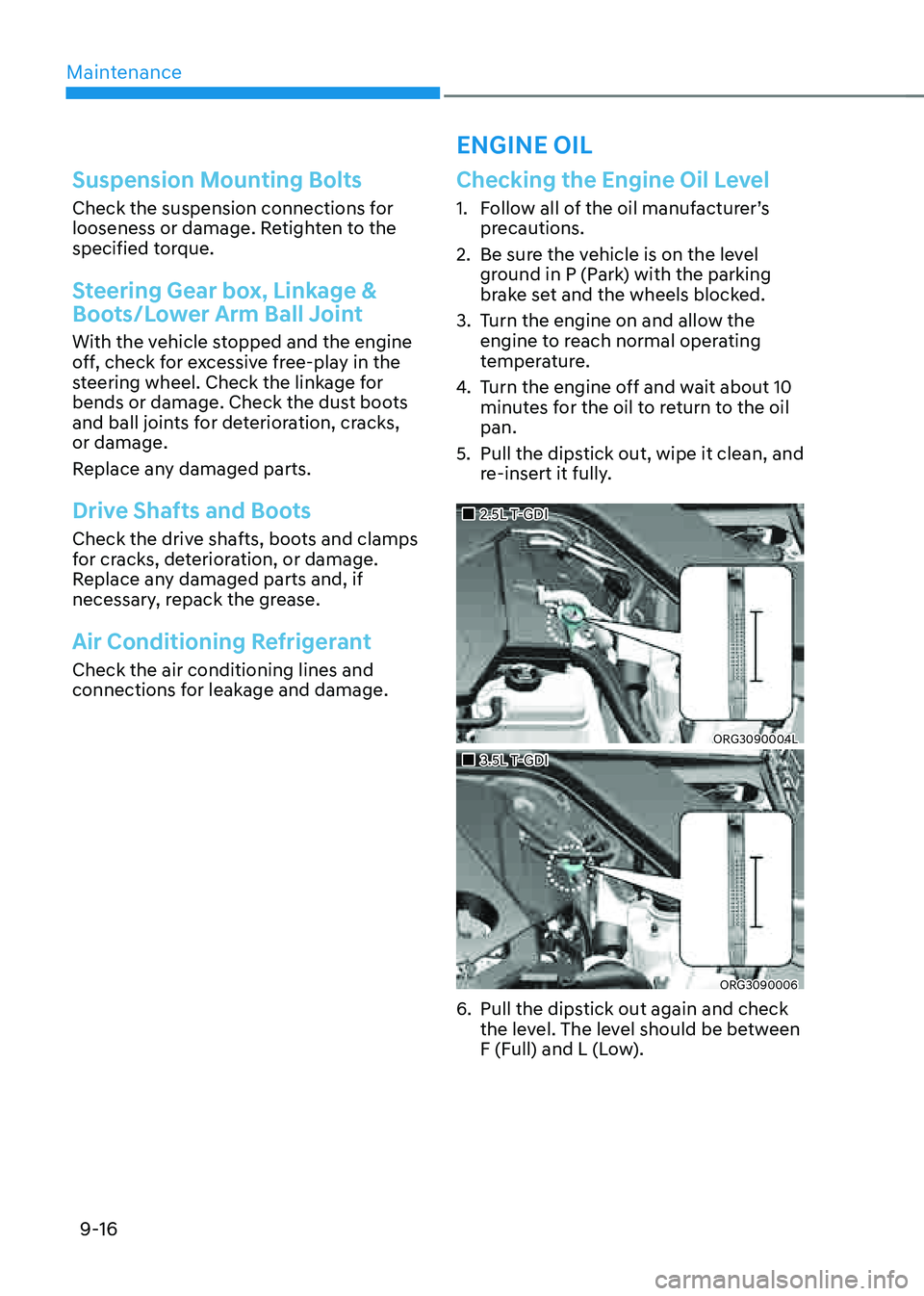
Checking the Engine Oil Level
1. Follow all of the oil manufacturer’s
precautions.
2. Be sure the vehicle is on the level
ground in P (Park) with the parking
brake set and the wheels blocked.
3. Turn the engine on and allow the
engine to reach normal operating
temperature.
4. Turn the engine off and wait about 10
minutes for the oil to return to the oil
pan.
5. Pull the dipstick out, wipe it clean, and
re-insert it fully.
„„2.5L T-GDI
ORG3090004L
„„3.5L T-GDI
ORG3090006
6. Pull the dipstick out again and check
the level. The level should be between
F (Full) and L (Low).
Page 532 of 604
09
9-17
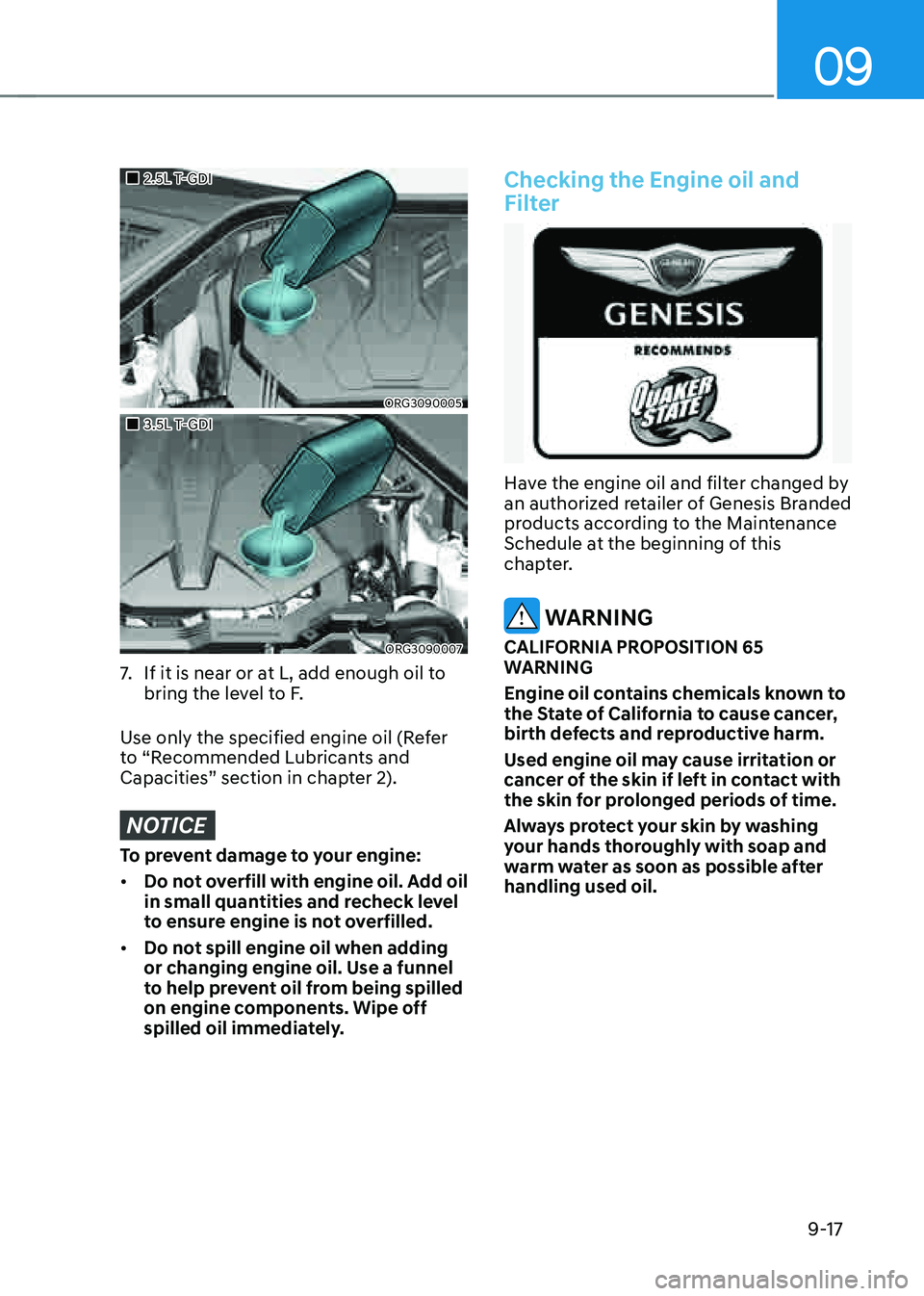
„„2.5L T-GDI
ORG3090005
„„3.5L T-GDI
ORG3090007
7. If it is near or at L, add enough oil to
bring the level to F.
Use only the specified engine oil (Refer
to “Recommended Lubricants and
Capacities” section in chapter 2).
NOTICE
To prevent damage to your engine:
• Do not overfill with engine oil. Add oil
in small quantities and recheck level
to ensure engine is not overfilled.
• Do not spill engine oil when adding
or changing engine oil. Use a funnel
to help prevent oil from being spilled
on engine components. Wipe off
spilled oil immediately.
Checking the Engine oil and
Filter
Have the engine oil and filter changed by an authorized retailer of Genesis Branded
products according to the Maintenance
Schedule at the beginning of this
chapter.
WARNING
CALIFORNIA PROPOSITION 65
WARNING
Engine oil contains chemicals known to
the State of California to cause cancer,
birth defects and reproductive harm.
Used engine oil may cause irritation or
cancer of the skin if left in contact with
the skin for prolonged periods of time.
Always protect your skin by washing
your hands thoroughly with soap and
warm water as soon as possible after
handling used oil.
Page 536 of 604
09
9-21
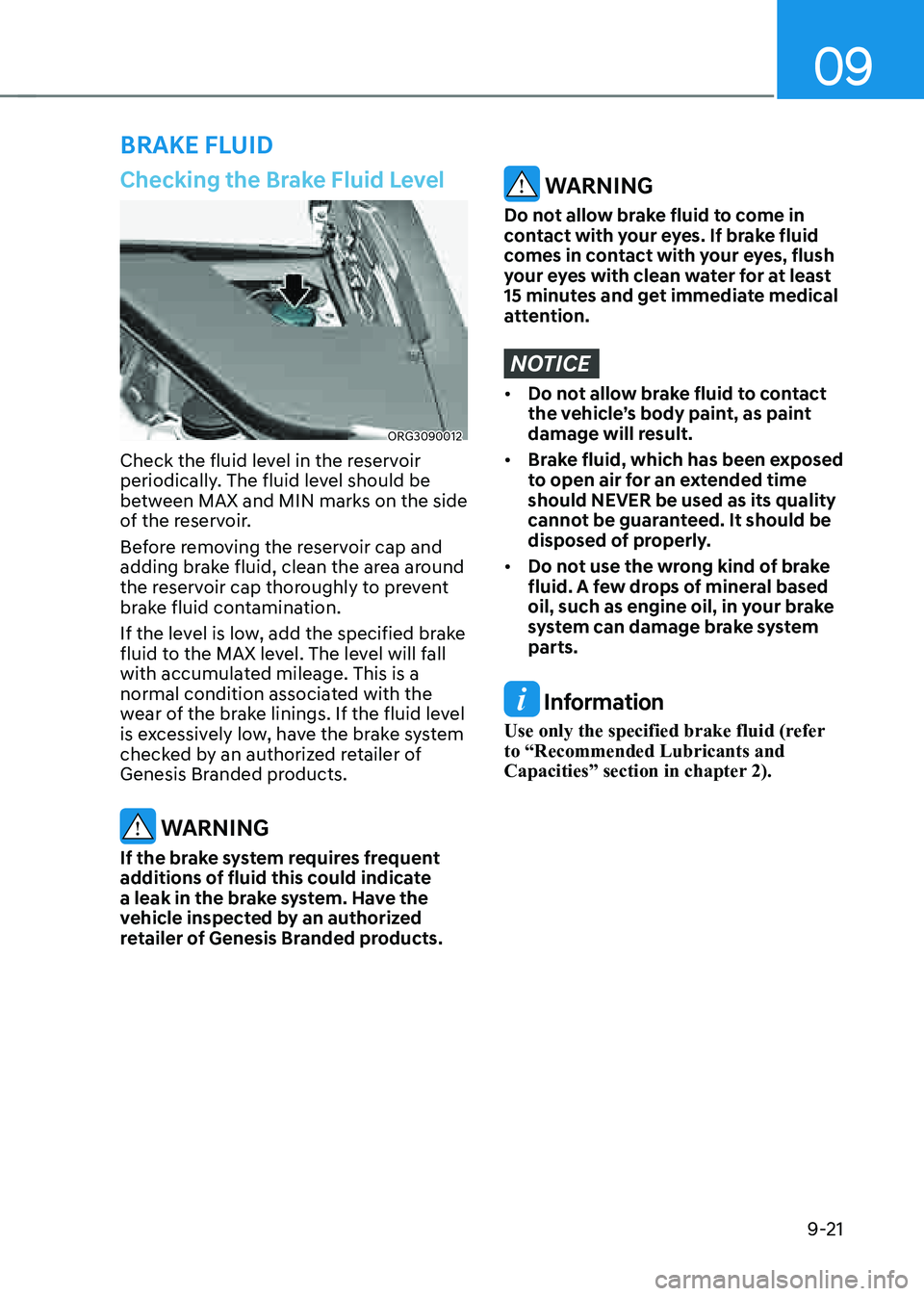
Checking the Brake Fluid Level
ORG3090012
Check the fluid level in the reservoir
periodically. The fluid level should be
between MAX and MIN marks on the side
of the reservoir.
Before removing the reservoir cap and
adding brake fluid, clean the area around
the reservoir cap thoroughly to prevent
brake fluid contamination.
If the level is low, add the specified brake
fluid to the MAX level. The level will fall
with accumulated mileage. This is a
normal condition associated with the
wear of the brake linings. If the fluid level
is excessively low, have the brake system
checked by an authorized retailer of
Genesis Branded products.
WARNING
If the brake system requires frequent
additions of fluid this could indicate
a leak in the brake system. Have the
vehicle inspected by an authorized
retailer of Genesis Branded products.
WARNING
Do not allow brake fluid to come in
contact with your eyes. If brake fluid
comes in contact with your eyes, flush
your eyes with clean water for at least
15 minutes and get immediate medical
attention.
NOTICE
• Do not allow brake fluid to contact
the vehicle’s body paint, as paint
damage will result.
• Brake fluid, which has been exposed
to open air for an extended time
should NEVER be used as its quality
cannot be guaranteed. It should be
disposed of properly.
• Do not use the wrong kind of brake
fluid. A few drops of mineral based
oil, such as engine oil, in your brake
system can damage brake system
parts.
Information
Use only the specified brake fluid (refer
to “Recommended Lubricants and
Capacities” section in chapter 2).
BRAKE FLUID
Page 543 of 604
Maintenance
9-28
Battery Usage
Recommendations
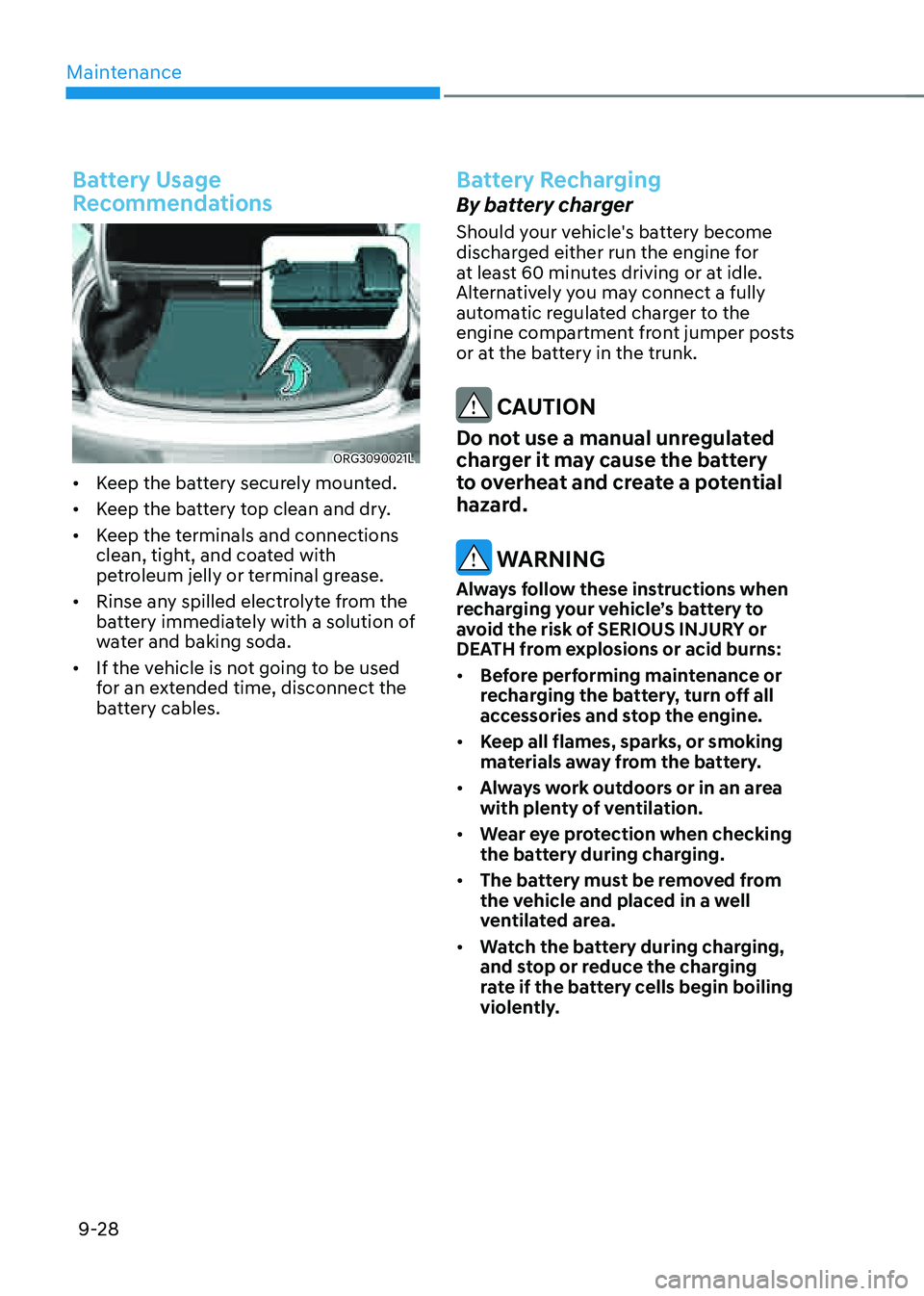
ORG3090021L
• Keep the battery securely mounted.
• Keep the battery top clean and dry.
• Keep the terminals and connections
clean, tight, and coated with
petroleum jelly or terminal grease.
• Rinse any spilled electrolyte from the
battery immediately with a solution of
water and baking soda.
• If the vehicle is not going to be used
for an extended time, disconnect the
battery cables.
Battery Recharging
By battery charger
Should your vehicle's battery become
discharged either run the engine for
at least 60 minutes driving or at idle.
Alternatively you may connect a fully
automatic regulated charger to the
engine compartment front jumper posts
or at the battery in the trunk.
CAUTION
Do not use a manual unregulated
charger it may cause the battery
to overheat and create a potential
hazard.
WARNING
Always follow these instructions when
recharging your vehicle’s battery to
avoid the risk of SERIOUS INJURY or
DEATH from explosions or acid burns:
• Before performing maintenance or
recharging the battery, turn off all
accessories and stop the engine.
• Keep all flames, sparks, or smoking
materials away from the battery.
• Always work outdoors or in an area
with plenty of ventilation.
• Wear eye protection when checking
the battery during charging.
• The battery must be removed from
the vehicle and placed in a well
ventilated area.
• Watch the battery during charging,
and stop or reduce the charging
rate if the battery cells begin boiling
violently.
Page 558 of 604
09
9-43
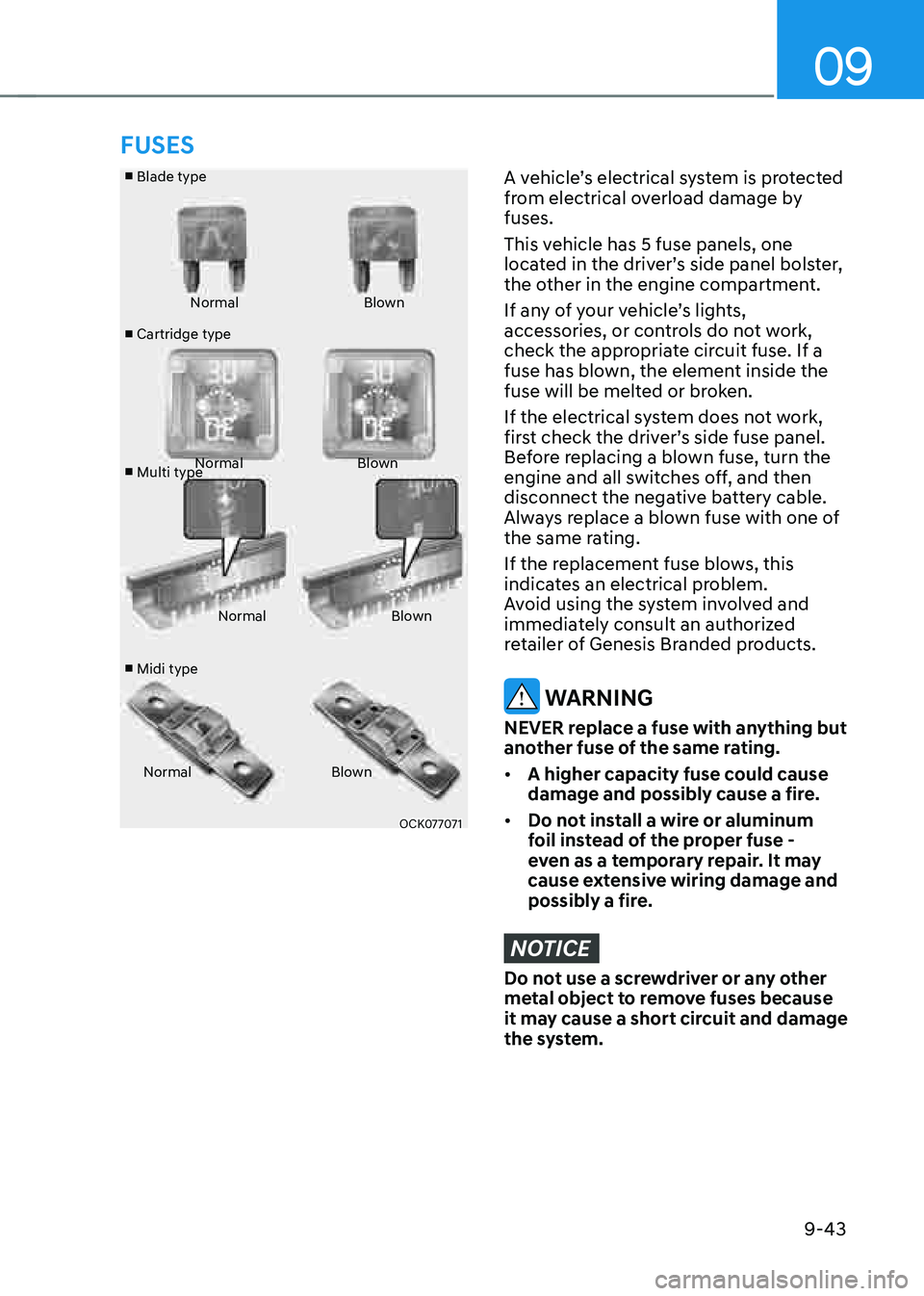
■ Blade type
■ Cartridge type
■ Multi type
■ Midi type Normal
Blown
Normal Blown
Normal Blown
Normal Blown
OCK077071
A vehicle’s electrical system is protected
from electrical overload damage by
fuses.
This vehicle has 5 fuse panels, one
located in the driver’s side panel bolster,
the other in the engine compartment.
If any of your vehicle’s lights,
accessories, or controls do not work,
check the appropriate circuit fuse. If a
fuse has blown, the element inside the
fuse will be melted or broken.
If the electrical system does not work,
first check the driver’s side fuse panel.
Before replacing a blown fuse, turn the
engine and all switches off, and then
disconnect the negative battery cable.
Always replace a blown fuse with one of
the same rating.
If the replacement fuse blows, this
indicates an electrical problem.
Avoid using the system involved and
immediately consult an authorized
retailer of Genesis Branded products.
WARNING
NEVER replace a fuse with anything but
another fuse of the same rating.
• A higher capacity fuse could cause
damage and possibly cause a fire.
• Do not install a wire or aluminum
foil instead of the proper fuse -
even as a temporary repair. It may
cause extensive wiring damage and
possibly a fire.
NOTICE
Do not use a screwdriver or any other
metal object to remove fuses because
it may cause a short circuit and damage
the system.
FUSES
Page 594 of 604

I
I-5
E
Electronic Control Suspension
........................................................................\
...6-41
Electronically Controlled Suspension with Road Preview
............................6-41
Limitations of the System
........................................................................\
.......6-42
System Malfunction
........................................................................\
................6-41
System Malfunction
........................................................................\
................6-42
Emission Control System
........................................................................\
............9-72
Crankcase Emission Control System
..............................................................9-72
Evaporative Emission Control System Including Onboard Refueling Vapor
Recovery (ORVR)
........................................................................\
...................9-72
Exhaust Emission Control System
..................................................................9-73
Engine
........................................................................\
............................................2-8
Engine Compartment
........................................................................\
.....................9-3
Engine Compartment
........................................................................\
.....................2-7
Engine Number
........................................................................\
............................2-15
Engine Oil
........................................................................\
....................................9-16
Changing Coolant ........................................................................\
.................... 9-20
Checking the Coolant Level
........................................................................\
....9-18
Checking the Engine Oil and Filter
.................................................................9-17
Checking the Engine Oil Level
.......................................................................9-16
Engine Coolant/Liquid-Cooled Intercooler Coolant
.......................................9-18
Engine Start/Stop Button
........................................................................\
...............6-5
Engine Stop/Start Button Positions
...................................................................6-6
Remote Start
........................................................................\
..............................6-9
Smart Key Slot - Emergency Starting
...............................................................6-8
Starting the Engine
........................................................................\
....................6-7
Turning Off the Engine
........................................................................\
.............6-8
Explanation of Scheduled Maintenance Items
....................................................9-14
Exterior Features
........................................................................\
..........................5-62
Fuel Filler Door
........................................................................\
.......................5-73
Hood
........................................................................\
........................................5-62
Non-Powered Trunk
........................................................................\
...............5-63
Power Trunk
........................................................................\
...........................5-65
Smart Trunk
........................................................................\
............................5-70
Exterior Overview (I)
........................................................................\
....................2-2
Exterior Overview (II)
........................................................................\
...................2-3