child seat GENESIS G80 2021 Owner's Manual
[x] Cancel search | Manufacturer: GENESIS, Model Year: 2021, Model line: G80, Model: GENESIS G80 2021Pages: 604, PDF Size: 11.47 MB
Page 16 of 604
2-4
Vehicle Information, Consumer Information and Reporting Safety Defects
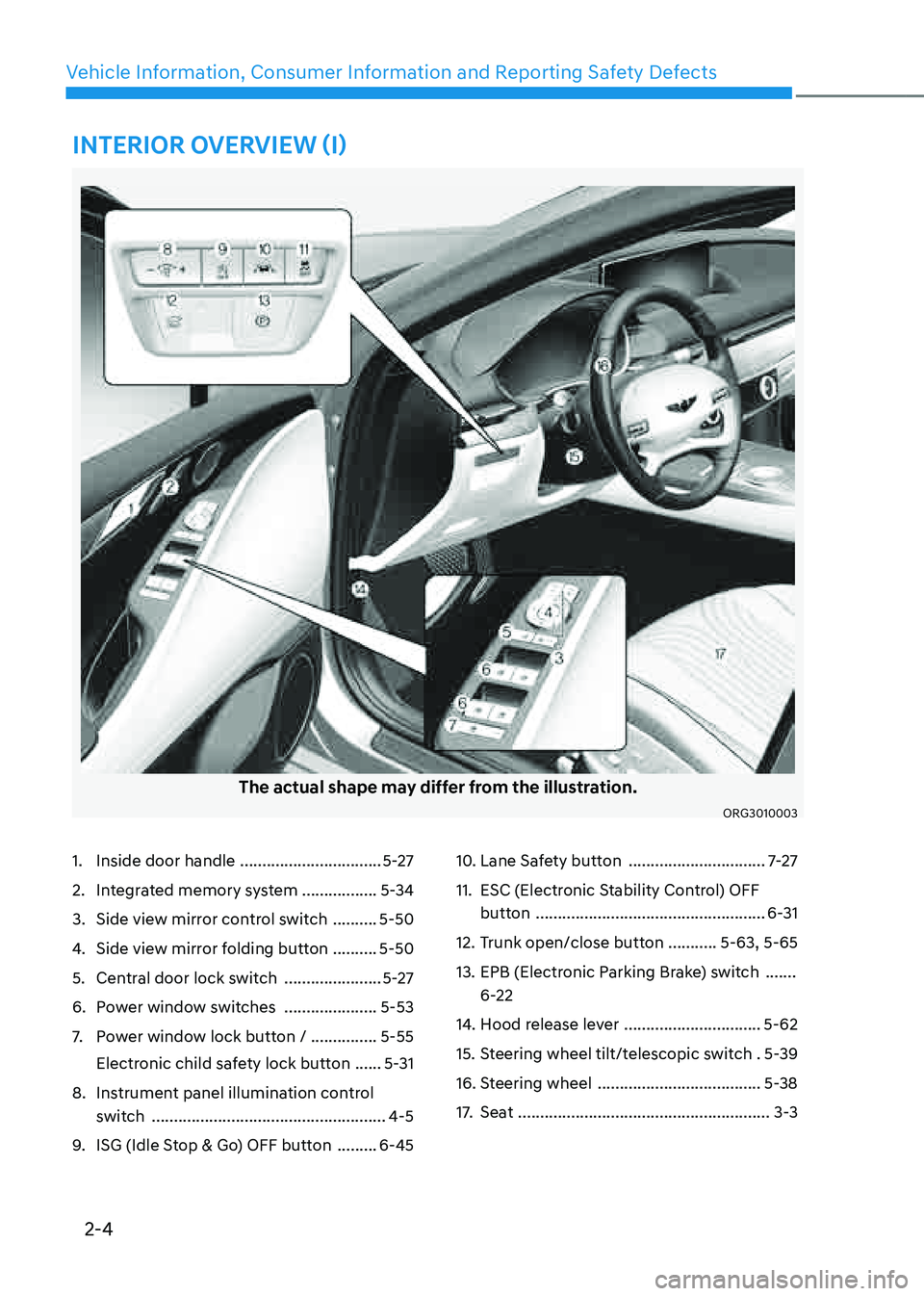
The actual shape may differ from the illustration.
ORG3010003
1. Inside door handle ................................5-27
2. Integrated memory system .................5-34
3. Side view mirror control switch ..........5-50
4. Side view mirror folding button ..........5-50
5. Central door lock switch ......................5-27
6. Power window switches .....................5-53
7. Power window lock button / ...............5-55
Electronic child safety lock button
......5-31
8. Instrument panel illumination control
switch
.....................................................4-5
9. ISG (Idle Stop & Go) OFF button .........6-45
10. Lane Safety button ...............................7-27
11. ESC (Electronic Stability Control) OFF
button
....................................................6-31
12. Trunk open/close button ...........5-63, 5-65
13. EPB (Electronic Parking Brake) switch .......
6-22
14. Hood release lever ...............................5-62
15. Steering wheel tilt/telescopic switch .5-39
16. Steering wheel .....................................5-38
17. Seat .........................................................3-3
INTERIOR OVERVIEW (I)
Page 31 of 604

Safety System
3. Safety System
3
Important Safety Precautions ........................................................................\
...3-2Always Wear Your Seat Belt ........................................................................\
.................3-2
Restrain All Children ........................................................................\
.............................3-2
Air Bag Hazards ........................................................................\
....................................3-2
Driver Distraction ........................................................................\
.................................3-2
Control Your Speed ........................................................................\
..............................3-2
Keep Your Vehicle in Safe Condition ........................................................................\
...3-2
Seats ........................................................................\
..........................................3-3Safety Precautions ........................................................................\
...............................3-6
Front Seats ........................................................................\
............................................3 -7
Rear Seats ........................................................................\
............................................3-13
Head Restraints ........................................................................\
..................................3-16
Seat Warmers ........................................................................\
.....................................3-19
Air Ventilation Seats ........................................................................\
...........................3-22
Rear Occupant Alert (ROA) ........................................................................\
...............3-23
Seat Belts ........................................................................\
.................................3-25Seat Belt Safety Precautions ........................................................................\
.............3-25
Seat Belt Warning Light ........................................................................\
.....................3-26
Seat Belt Restraint System ........................................................................\
................3-27
Pre-Active Seat Belt (PSB) ........................................................................\
................3-33
Additional Seat Belt Safety Precautions ...................................................................3-34
Care of Seat Belts ........................................................................\
...............................3-36
Child Restraint System (CRS) ........................................................................\
..3-37Children Always in the Rear ........................................................................\
...............3-37
Selecting a Child Restraint System (CRS) .................................................................3-38
Installing a Child Restraint System (CRS) ................................................................3-40
Air Bag - Supplemental Restraint System .....................................................3-46Where are the Air Bags? ........................................................................\
....................3-48
How does the Air Bags System Operate? .................................................................3-52
What to Expect After an Air Bag Inflates ..................................................................3-56
Occupant Classification System (OCS) .....................................................................3-57
Why Didn’t My Air Bag Go Off in a Collision? ...........................................................3-62
SRS Care
........................................................................\
.............................................3-67
Additional Safety Precautions ........................................................................\
..........3-68
Air Bag Warning Labels ........................................................................\
.....................3-68
Active Hood Lift System ........................................................................\
........3-69System Activation ........................................................................\
..............................3-69
System Limitation ........................................................................\
............................... 3-70
System Malfunction
........................................................................\
............................3-71
Page 32 of 604
Safety System
3-2
You will find many safety precautions
and recommendations throughout this
section, and throughout this manual.
The safety precautions in this section are
among the most important.
Always Wear Your Seat Belt
A seat belt is your best protection in all
types of accidents. Air bags are designed
to supplement seat belts, not replace
them. So even though your vehicle is
equipped with air bags, ALWAYS make
sure you and your passengers wear your
seat belts, and wear them properly.
Restrain All Children
All children under age 13 should ride
in your vehicle properly restrained in a
rear seat, not the front seat. Infants and
small children should be restrained in
an appropriate Child Restraint System.
Larger children should use a booster
seat with the lap/shoulder belt until they
can use the seat belt properly without a
booster seat.
Air Bag Hazards
While air bags can save lives, they can
also cause serious or fatal injuries to
occupants who sit too close to them, or
who are not properly restrained. Infants,
young children, and short adults are at
the greatest risk of being injured by an
inflating air bag. Follow all instructions
and warnings in this manual.
Driver Distraction
Driver distraction presents a serious and
potentially deadly danger, especially for
inexperienced drivers. Safety should be
the first concern when behind the wheel
and drivers need to be aware of the wide
array of potential distractions, such as
drowsiness, reaching for objects, eating,
personal grooming, other passengers,
and using mobile phones.Drivers can become distracted when
they take their eyes and attention off
the road or their hands off the wheel to
focus on activities other than driving.
To reduce your risk of distraction and an
accident:
• ALWAYS set up your mobile devices
(i.e., MP3 players, phones, navigation
units, etc.) when your vehicle is
parked or safely stopped.
• ONLY use your mobile device when
allowed by laws and conditions permit
safe use. NEVER text or email while
driving. Most countries have laws
prohibiting drivers from texting. Some
countries and cities also prohibit
drivers from using handheld phones.
• NEVER let the use of a mobile device
distract you from driving. You have a
responsibility to your passengers and
others on the road to always drive
safely, with your hands on the wheel
as well as your eyes and attention on
the road.
Control Your Speed
Excessive speed is a major factor in crash
injuries and deaths. Generally, the higher
the speed, the greater the risk, but
serious injuries can also occur at lower
speeds. Never drive faster than is safe
for current conditions, regardless of the
maximum speed posted.
Keep Your Vehicle in Safe
Condition
Having a tire blowout or a mechanical
failure can be extremely hazardous. To
reduce the possibility of such problems,
check your tire pressures and condition
frequently, and perform all regularly
scheduled maintenance.
IMPORTANT SAFETY PRECAUTIONS
Page 36 of 604
Safety System
3-6
Information
The information provided may differ
depending on which functions are
applicable to your vehicle.
Safety Precautions
Adjusting the seats so that you are sitting
in a safe and comfortable position plays
an important role for the safety of the
driver an passengers, along with seat
belts and air bags when in an accident.
WARNING
Do not use a cushion that reduces
friction between the seat and the
passenger. The passenger’s hips may
slide under the lap portion of the seat
belt during an accident or a sudden
stop.
Serious or fatal internal injuries could
result because the seat belt cannot
operate properly.
Air bags
You can take steps to reduce the risk
of being injured by an inflating air bag.
Sitting too close to an air bag greatly
increases the risk of injury in the event
the air bag inflates.
The National Highway Traffic Safety
Administration (NHTSA) recommends
that drivers allow at least 10 inches (25
cm) between the center of the steering
wheel and their chest.
WARNING
To reduce the risk of serious injury or
death from an inflating air bag, take the
following precautions:
• Adjust the driver’s seat as far to the
rear as possible maintaining the
ability to control the vehicle.
• Adjust the front passenger seat as far
to the rear as possible.
• Hold the steering wheel by the rim
with hands at the 9 o’clock and 3
o’clock positions to minimize the risk
of injuries to your hands and arms.
• NEVER place anything or anyone
between you and the air bag.
• Do not allow the front passenger to
place feet or legs on the dashboard
to minimize the risk of leg injuries.
Seat belts
Always fasten your seat belt before
starting any trip. At all times, passengers
should sit upright and be properly
restrained. Infants and small children
must be restrained in appropriate Child
Restraint Systems. Children who have
outgrown a booster seat and adults must
be restrained using the seat belts.
WARNING
Take the following precautions when
adjusting your seat belt:
• NEVER use one seat belt for more
than one occupant.
• Always position the seatback upright
with the lap portion of the seat belt
snug and low across the hips.
• NEVER allow children or small infants
to ride on a passenger’s lap.
• Do not route the seat belt across your
neck, across sharp edges, or reroute
the shoulder strap away from your
body.
• Do not allow the seat belt to become
caught or jammed.
Page 37 of 604
03
3 -7
Front Seats
The front seat can be adjusted by using
the control switches located on the
outside of the seat cushion. Before
driving, adjust the seat to the proper
position so that you can easily control
the steering wheel, foot pedals and
controls on the instrument panel.
WARNING
Take the following precautions when
adjusting your seat:
• NEVER attempt to adjust the seat
while the vehicle is moving. The seat
could respond with unexpected
movement and may cause loss
of vehicle control resulting in an
accident.
• Do not place anything under the
front seats. Loose objects in the
driver’s foot area could interfere
with the operation of the foot pedals,
causing an accident.
• Do not allow anything to interfere
with the normal position and proper
locking of the seatback.
• Do not place a cigarette lighter on
the floor or seat. When you operate
the seat, gas may exit out of the
lighter causing a fire.
• Use extreme caution when picking
up small objects trapped under the
seats or between the seat and the
center console. Your hands might be
cut or injured by the sharp edges of
the seat mechanism.
• If there are occupants in the rear
seats, be careful while adjusting the
front seat position.
• Make sure that the seat is locked in
place after the adjustment. If not,
the seat might move unexpectedly
resulting in an accident.
CAUTION
To prevent injury:
• Do not adjust your seat while
wearing your seat belt. Moving the
seat cushion forward may cause
strong pressure on your abdomen.
• Do not allow your hands or fingers to
get caught in the seat mechanisms
while the seat is moving.
WARNING
NEVER allow children in the vehicle
unattended. The power seats are
operable when the vehicle is turned off.
NOTICE
To prevent damage to the seats:
• Always stop adjusting the seats when
the seat has been adjusted as far
forward or rearward as possible.
• Do not adjust the seats longer than
necessary when the vehicle is turned
off. This may result in unnecessary
battery drain.
• Do not operate two or more seats at
the same time. This may result in an
electrical malfunction.
Page 43 of 604

03
3-13
• When sudden braking or sharp turning
occurs, Pre-active Safety Seat will
tighten the seat belt to prevent the
passenger from leaning forward or
sideway and provide driving stability.
In the following circumstances, the
system will consider it as a hazardous
situation and the system will operate
when:
-The passenger leans forward due to
sudden braking
-The passenger leans sideway due to
sharp turning
-Driving on slippery roads
-Driving in off-road conditions
-High risk of rollover is detected
• If the seat is manually adjusted while
Pre-active Safety Seat is operating,
the system will immediately stop
operating. However, after 5 seconds,
if a possible collision or hazardous
situation is detected, the system will
operate again.
System malfunction
When the Pre-active Adjustment Seat
system does not operate properly, have
the vehicle inspected by an authorized
retailer of Genesis Branded products.
Rear Seats
WARNING
NEVER adjust the rear power seats
when a Child Restraint System is
installed in that seat.
WARNING
To prevent injury:
• Do not adjust your seat while
wearing your seat belt. Moving the
seat cushion forward may cause
strong pressure on your abdomen.
• Do not allow your hands or fingers to
get caught in the seat mechanisms
while the seat is moving.
NOTICE
To prevent damage to the seats:
• Always stop adjusting the seats when
the seat has been adjusted as far
forward or rearward as possible.
• Do not adjust the seats longer than
necessary when the engine is turned
off. This may result in unnecessary
drain of the battery.
• Do not operate two or more seats at
the same time. This may result in an
electrical malfunction.
Page 49 of 604

03
3-19
Rear seat head restraints
ORG3030064L
The rear seats are equipped with head
restraints in all the seating positions for
the passenger’s safety and comfort.
ORG3030007
Adjusting the height up and down
To raise the head restraint:
1. Pull it up to the desired position (1).
To lower the head restraint:
1. Push and hold the release button (2)
on the head restraint support.
2. Lower the head restraint to the
desired position (3).
Seat Warmers
Seat warmers are provided to warm the
seats during cold weather.
During mild weather or under conditions
where the operation of the seat warmer
is not needed, keep the seat warmers
OFF.
WARNING
The seat warmers can cause a SERIOUS
BURN, even at low temperatures and
especially if used for long periods of
time.
Passengers must be able to feel if the
seat is becoming too warm so they can
turn it off, if needed.
People who cannot detect temperature
change or pain to the skin should
use extreme caution, especially the
following types of passengers:
• Infants, children, elderly or disabled
persons, or hospital outpatients.
• People with sensitive skin or who
burn easily.
• Fatigued individuals.
• Intoxicated individuals.
• People taking medication that can
cause drowsiness or sleepiness.
Page 55 of 604
03
3-25
This section describes how to use the
seat belts properly. It also describes
some of the things not to do when using
seat belts.
Seat Belt Safety Precautions
Always fasten your seat belt and make
sure all passengers have fastened their
seat belts before starting any trip. Air
bags are designed to supplement the
seat belt as an additional safety device,
but they are not a substitute. Most
countries require all occupants of a
vehicle to wear seat belts.
WARNING
Seat belts must be used by ALL
passengers whenever the vehicle is
moving. Take the following precautions
when adjusting and wearing seat belts:
• Children under the age of 13 should
be properly restrained in the rear
seats.
• NEVER allow children to ride in the
front passenger seat, unless the air
bag is deactivated. If a child is seated
in the front passenger seat, move
the seat as far back as possible and
properly restrain them in the seat.
• NEVER allow an infant or child to be
carried on an occupant’s lap.
• NEVER ride with the seatback
reclined when the vehicle is moving.
• Do not allow children to share a seat
or seat belt.
• Do not wear the shoulder belt under
your arm or behind your back.
• NEVER wear a seat belt over fragile
objects. If there is a sudden stop or
impact, the seat belt can damage it.
• Do not use the seat belt if it is
twisted. A twisted seat belt will not
protect you properly in an accident.
• Do not use a seat belt if the webbing
or hardware is damaged.
• Do not latch the seat belt into the
buckles of other seats.
• NEVER unfasten the seat belt
while driving. This may cause loss
of vehicle control resulting in an
accident.
• Make sure there is nothing in the
buckle interfering with the seat belt
latch mechanism. This may prevent
the seat belt from fastening securely.
• No modifications or additions
should be made by the user which
will either prevent the seat belt
adjusting devices from operating to
remove slack, or prevent the seat
belt assembly from being adjusted to
remove slack.
WARNING
Damaged seat belts and seat belt
assemblies will not operate properly.
Always replace:
• Frayed, contaminated, or damaged
webbing.
• Damaged hardware.
• The entire seat belt assembly after it
has been worn in an accident, even
if damage to webbing or assembly is
not apparent.
SEAT BELTS
Page 59 of 604
03
3-29
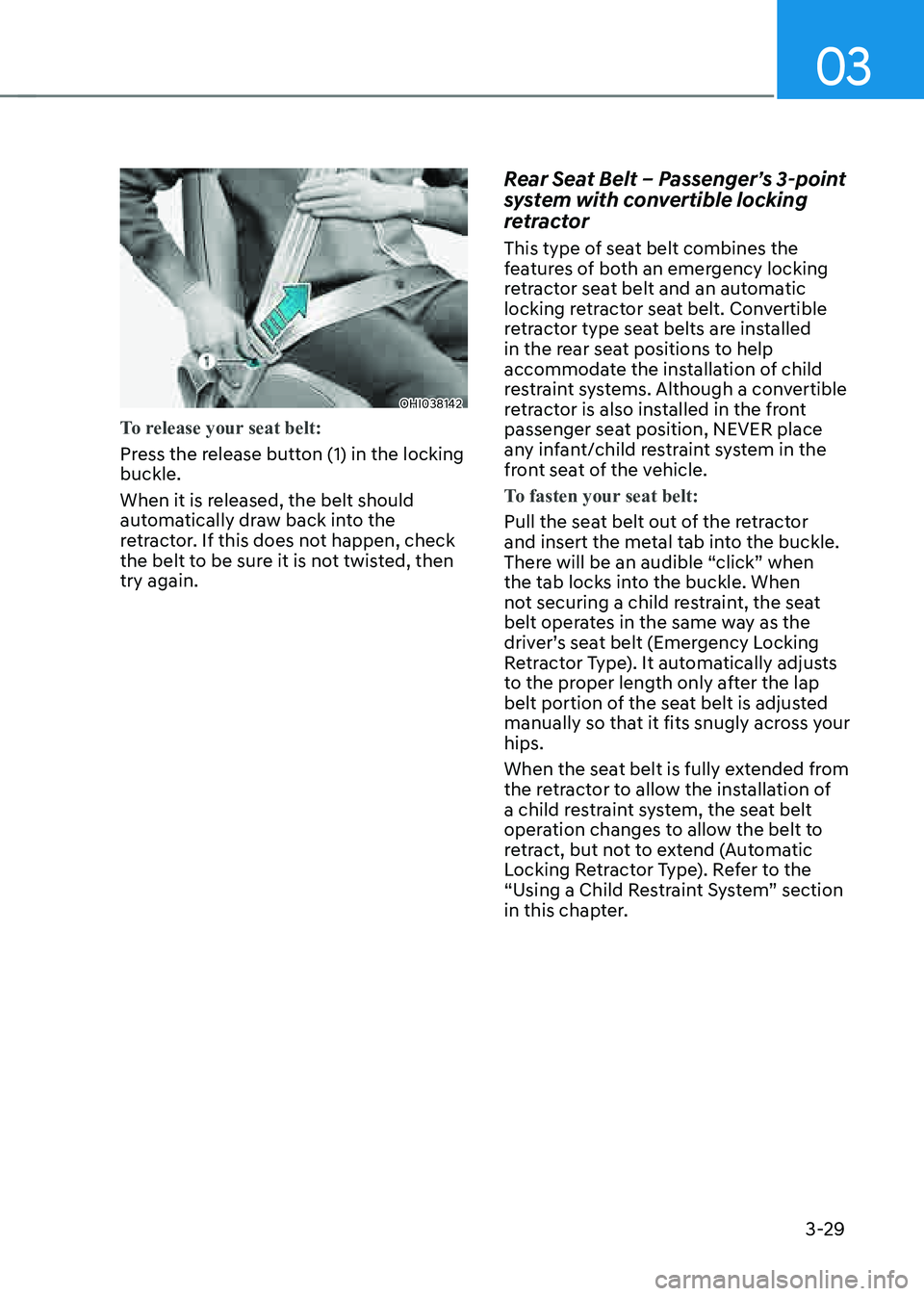
OHI038142
To release your seat belt:
Press the release button (1) in the locking
buckle.
When it is released, the belt should
automatically draw back into the
retractor. If this does not happen, check
the belt to be sure it is not twisted, then
try again.
Rear Seat Belt – Passenger’s 3-point
system with convertible locking
retractor
This type of seat belt combines the
features of both an emergency locking
retractor seat belt and an automatic
locking retractor seat belt. Convertible
retractor type seat belts are installed
in the rear seat positions to help
accommodate the installation of child
restraint systems. Although a convertible
retractor is also installed in the front
passenger seat position, NEVER place
any infant/child restraint system in the
front seat of the vehicle.
To fasten your seat belt:
Pull the seat belt out of the retractor
and insert the metal tab into the buckle.
There will be an audible “click” when
the tab locks into the buckle. When
not securing a child restraint, the seat
belt operates in the same way as the
driver’s seat belt (Emergency Locking
Retractor Type). It automatically adjusts
to the proper length only after the lap
belt portion of the seat belt is adjusted
manually so that it fits snugly across your
hips.
When the seat belt is fully extended from
the retractor to allow the installation of
a child restraint system, the seat belt
operation changes to allow the belt to
retract, but not to extend (Automatic
Locking Retractor Type). Refer to the
“Using a Child Restraint System” section
in this chapter.
Page 64 of 604

Safety System
3-34
Additional Seat Belt Safety
Precautions
Seat belt use during pregnancy
The seat belt should always be used
during pregnancy. The best way to
protect your unborn child is to protect
yourself by always wearing the seat belt.
Pregnant women should always wear
a lap-shoulder seat belt. Place the
shoulder belt across your chest, routed
between your breasts and away from
your neck. Place the lap belt line so
that it fits snugly and as low as possible
across the hips, not across the abdomen.
WARNING
• A pregnant woman or a patient is
more vulnerable to any imapcts on
the abdomen during an abrupt stop
or accident. If you are in an accident
while pregnant, we recommend you
consult your doctor.
• To reduce the risk of serious injury or
death to an unborn child during an
accident, pregnant women should
NEVER place the lap portion of the
seat belt above or over the area of
the abdomen where the unborn child
is located.
Seat belt use and children
Infant and small children
All 50 states have child restraint laws
which require children to travel in
approved child restraint devices,
including booster seats. The age at
which seat belts can be used instead
of child restraints differs among states,
so you should be aware of the specific
requirements in your state, and where
you are travelling. Infant and child
restraints must be properly placed
and installed in a rear seat. For more
information refer to the “Child Restraint
Systems” section in this chapter.
WARNING
ALWAYS properly restrain infants
and small children in a child restraint
appropriate for the child’s height and
weight.
To reduce the risk of serious injury or
death to a child and other passengers,
NEVER hold a child in your lap or arms
when the vehicle is moving. The violent
forces created during an accident will
tear the child from your arms and throw
the child against the interior of the
vehicle.
Small children are best protected
from injury in an accident when
properly restrained in the rear seat
by a child restraint system that meets
the requirements of the Federal Motor
Vehicle Safety Standards. Before buying
any child restraint system, make sure
that it has a label certifying that it meets
Federal Motor Vehicle Safety Standard
FMVSS 213. The restraint must be
appropriate for your child’s height and
weight. Check the label on the child
restraint for this information. Refer to the
“Child Restraint Systems” section in this
chapter.