driver GENESIS G90 2017 User Guide
[x] Cancel search | Manufacturer: GENESIS, Model Year: 2017, Model line: G90, Model: GENESIS G90 2017Pages: 524, PDF Size: 19.3 MB
Page 55 of 524

2-35
02
Front Seat Belt – Driver's 3-point system with emergencylocking retractor
To fasten your seat belt:
Pull the seat belt out of the retractor
and insert the metal tab (1) into the
buckle (2). There will be an audible
"click" when the tab locks into the
buckle.
The seat belt automatically adjusts to
the proper length after the lap belt por-
tion is adjusted manually so that it fits
snugly around your hips. If you lean
forward in a slow, easy motion, the belt
will extend and move with you.
If there is a sudden stop or impact,
the belt will lock into position. It will
also lock if you try to lean forward too
quickly.
Information
If you are not able to smoothly pull
enough of the seat belt out from the
retractor, firmly pull the seat belt out
and release it. After release, you will
be able to pull the belt out smoothly.
Height adjustment
You can adjust the height of the
shoulder belt anchor to one of the
three different positions for maximum
comfort and safety.
The shoulder portion should be
adjusted so it lies across your chest
and midway over your shoulder near-
est the door, not over your neck.
To adjust the height of the seat belt
anchor, lower or raise the height
adjuster into an appropriate position.
To raise the height adjuster, pull it up
(1). To lower it, push it down (3) while
pressing the height adjuster button (2).
Release the button to lock the anchor
into position. Try sliding the height
adjuster to make sure that it has
locked into position.
i
OHI036036
■ Front seat
OHI036102
Page 56 of 524
2-36
Safety system of your vehicle
Rear Seat Belt – Passenger's 3-point system with convertiblelocking retractor
This type of seat belt combines the
features of both an emergency lock-
ing retractor seat belt and an auto-
matic locking retractor seat belt.
Convertible retractor type seat belts
are installed in the rear seat posi-
tions to help accommodate the
installation of child restraint systems.
Although a convertible retractor is
also installed in the front passenger
seat position, NEVER place any
infant/child restraint system in the
front seat of the vehicle.
To fasten your seat belt:
Pull the seat belt out of the retractor
and insert the metal tab into the
buckle. There will be an audible
"click" when the tab locks into the
buckle. When not securing a child
restraint, the seat belt operates in the
same way as the driver's seat belt
(Emergency Locking Retractor
Type). It automatically adjusts to the
proper length only after the lap belt
portion of the seat belt is adjusted
manually so that it fits snugly across
your hips.
When the seat belt is fully extended
from the retractor to allow the instal-
lation of a child restraint system, the
seat belt operation changes to allow
the belt to retract, but not to extend
(Automatic Locking Retractor Type).
Refer to the "Using a Child Restraint
System" section in this chapter.
Improperly positioned seat
belts may increase the risk of
serious injury in an accident.
Take the following precautions
when adjusting the seat belt:
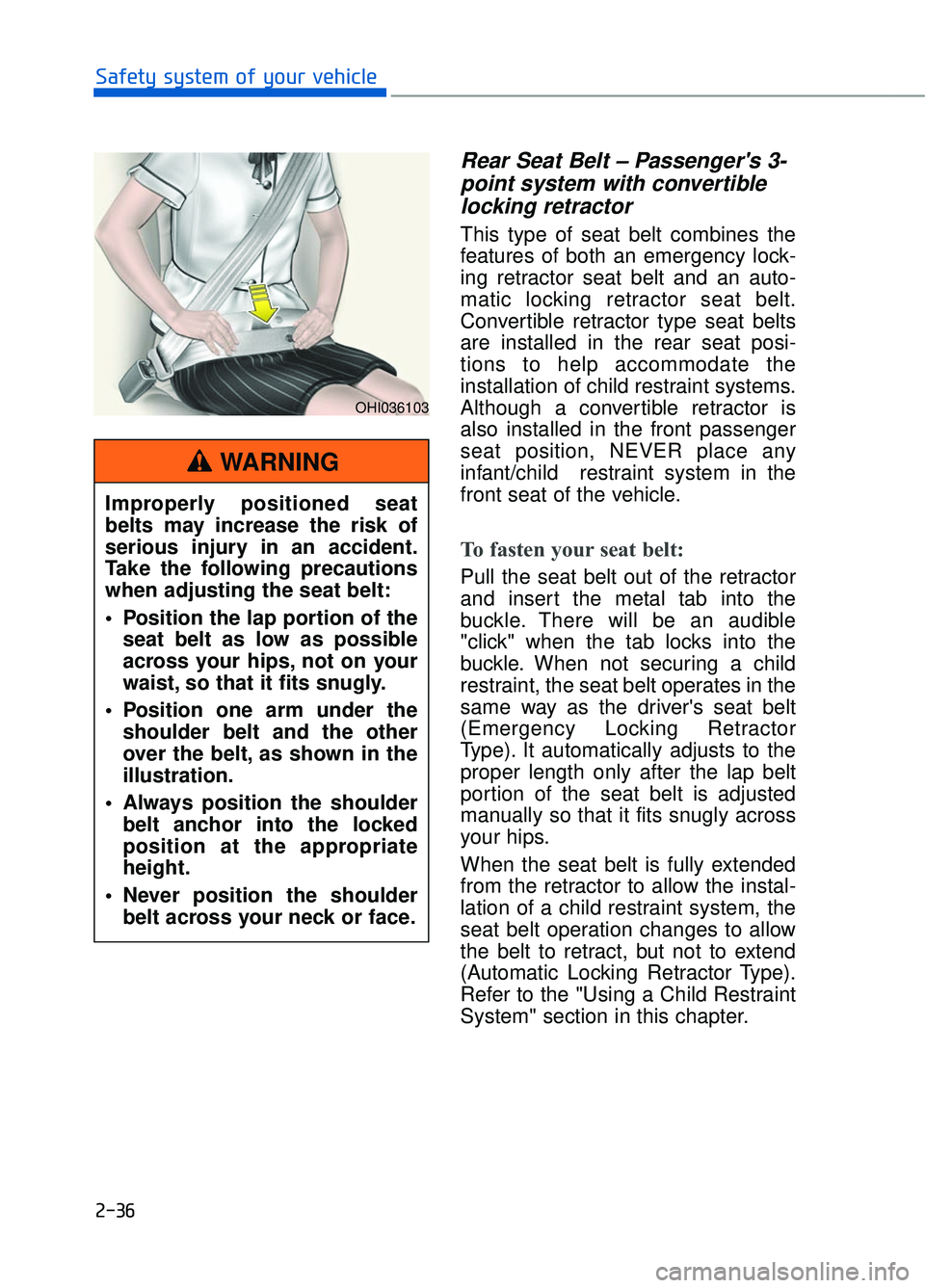
Position the lap portion of the
seat belt as low as possible
across your hips, not on your
waist, so that it fits snugly.
Position one arm under the shoulder belt and the other
over the belt, as shown in the
illustration.
Always position the shoulder belt anchor into the locked
position at the appropriate
height.
Never position the shoulder belt across your neck or face.
WARNING
OHI036103
Page 58 of 524
2-38
Safety system of your vehicle
Pre-tensioner seat belt (Driver and front passenger)
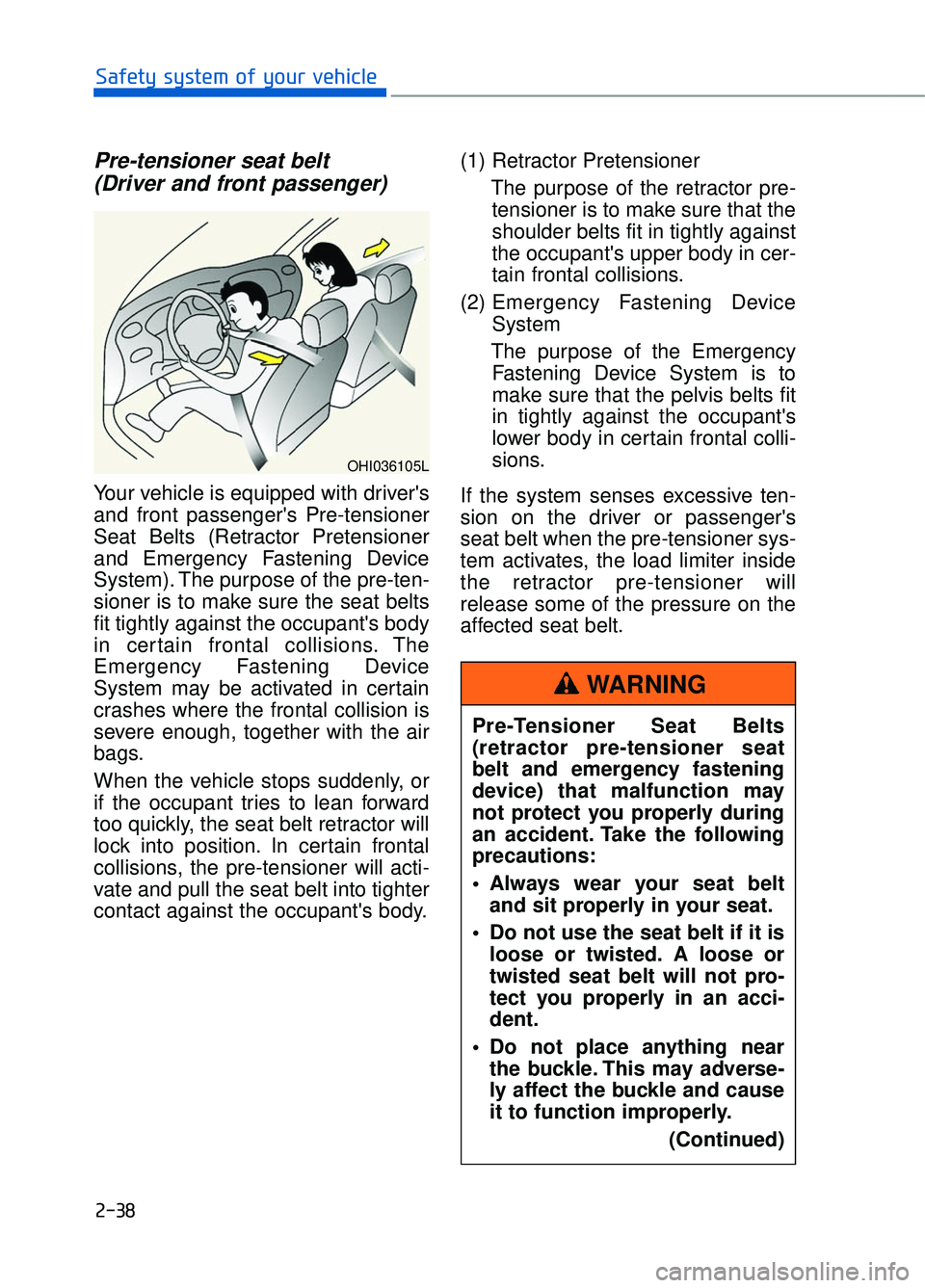
Your vehicle is equipped with driver's
and front passenger's Pre-tensioner
Seat Belts (Retractor Pretensioner
and Emergency Fastening Device
System). The purpose of the pre-ten-
sioner is to make sure the seat belts
fit tightly against the occupant's body
in certain frontal collisions. The
Emergency Fastening Device
System may be activated in certain
crashes where the frontal collision is
severe enough, together with the air
bags.
When the vehicle stops suddenly, or
if the occupant tries to lean forward
too quickly, the seat belt retractor will
lock into position. In certain frontal
collisions, the pre-tensioner will acti-
vate and pull the seat belt into tighter
contact against the occupant's body. (1) Retractor Pretensioner
The purpose of the retractor pre-tensioner is to make sure that the
shoulder belts fit in tightly against
the occupant's upper body in cer-
tain frontal collisions.
(2) Emergency Fastening Device
System
The purpose of the Emergency Fastening Device System is to
make sure that the pelvis belts fit
in tightly against the occupant's
lower body in certain frontal colli-
sions.
If the system senses excessive ten-
sion on the driver or passenger's
seat belt when the pre-tensioner sys-
tem activates, the load limiter inside
the retractor pre-tensioner will
release some of the pressure on the
affected seat belt.
OHI036105L
Pre-Tensioner Seat Belts
(retractor pre-tensioner seat
belt and emergency fastening
device) that malfunction may
not protect you properly during
an accident. Take the following
precautions:
Always wear your seat belt and sit properly in your seat.
Do not use the seat belt if it is loose or twisted. A loose or
twisted seat belt will not pro-
tect you properly in an acci-
dent.
Do not place anything near the buckle. This may adverse-
ly affect the buckle and cause
it to function improperly.
(Continued)
WARNING
Page 60 of 524
2-40
Safety system of your vehicle
Information
• Both the driver's and front passen-ger's pre-tensioner seat belts may be
activated in certain frontal or side
collisions or rollovers.
• When the pre-tensioner seat belts are activated, a loud noise may be
heard and fine dust, which may
appear to be smoke, may be visible
in the passenger compartment.
These are normal operating condi-
tions and are not hazardous.
• Although it is non-toxic, the fine dust may cause skin irritation and
should not be breathed for pro-
longed periods. Wash all exposed
skin areas thoroughly after an acci-
dent in which the pre-tensioner seat
belts were activated.
• The pre-tensioner seat belt system may get adversely affected by
installing an audio system to the
center console or welding/painting
the frontal vehicle body.
In this case, consult an authorized
Dealer of Genesis Brand Products.
The air bag warning light illumi-
nates, if there is a malfunction with
the pre-tensioner seat belt system.
• In following situations, immediately have the air bag system and the pre-
tensioner seat belt system checked
by an authorized Dealer of Genesis
Brand Products.
- The air bag warning light does notilluminate at all after turning ON
the engine.
- The air bag warning light remains ON over 6 seconds after turning
ON the engine.
i
Fasten your seat belt while sitting properly in an upright
position to maximize the
effectiveness of the pre-ten-
sioner seat belt system.
A pre-tensioner seat belt sys- tem is designed to activate
only once. Replace the pre-
tensioner seat belt system, if
it was activated in an acci-
dent.
Properly fasten a seat belt in an upright position to maxi-
mize protection from a pre-
tensioner seat belt system.
The pre-tensioner seat belt
instantly tightens the seat belt
to hold an occupant body in
position in forward collision.
A pre-tensioner seat belt sys- tem is designed to activate
only once. Replace the pre-
tensioner seat belt system, if
it was activated in an acci-
dent.
WARNING
Page 64 of 524
One person per belt
Two people (including children) should
never attempt to use a single seat belt.
This could increase the severity of
injuries in case of an accident.
Do not lie down
Sitting in a reclined position when the
vehicle is in motion can be dangerous.
Even when buckled up, the protec-
tions of your restraint system (seat
belts and air bags) is greatly reduced
by reclining your seatback.
To reduce the chance of injuries in the
event of an accident and to achieve
the maximum effectiveness of the
restraint system, all passengers
should be sitting up and the front and
rear seats should be in an upright
position when the car is moving.
A seat belt cannot provide proper
protection if the person is lying down
in the rear seat or if the front or rear
seats are in a reclined position.
Care of Seat Belts
Seat belt systems should never be
disassembled or modified. In addi-
tion, care should be taken to assure
that seat belts and belt hardware are
not damaged by seat hinges, doors
or other abuse.
Periodic inspection
All seat belts should be inspected
periodically for wear or damage of
any kind. Any damaged parts should
be replaced as soon as possible by
an authorized Dealer of Genesis
Brand Products.
Keep belts clean and dry
Seat belts should be kept clean and
dry. If belts become dirty, they can be
cleaned by using a mild soap solu-
tion and warm water. Bleach, dye,
strong detergents or abrasives
should not be used because they
may damage and weaken the fabric.
When to replace seat belts
The entire seat belt assembly or
assemblies should be replaced if the
vehicle has been involved in an acci-
dent. This should be done even if no
damage is visible. Additional ques-
tions concerning seat belt operation
should be directed to an authorized
Dealer of Genesis Brand Products.
2-44
Safety system of your vehicle NEVER ride with a reclined seatback when the vehicle is
moving.
Riding with a reclined seat- back increases your chance
of serious or fatal injuries in
the event of a collision or sud-
den stop.
Drivers and passengers should always sit well back in
their seats, properly belted,
and with the seatbacks
upright.
WARNING
Page 77 of 524
2-57
02
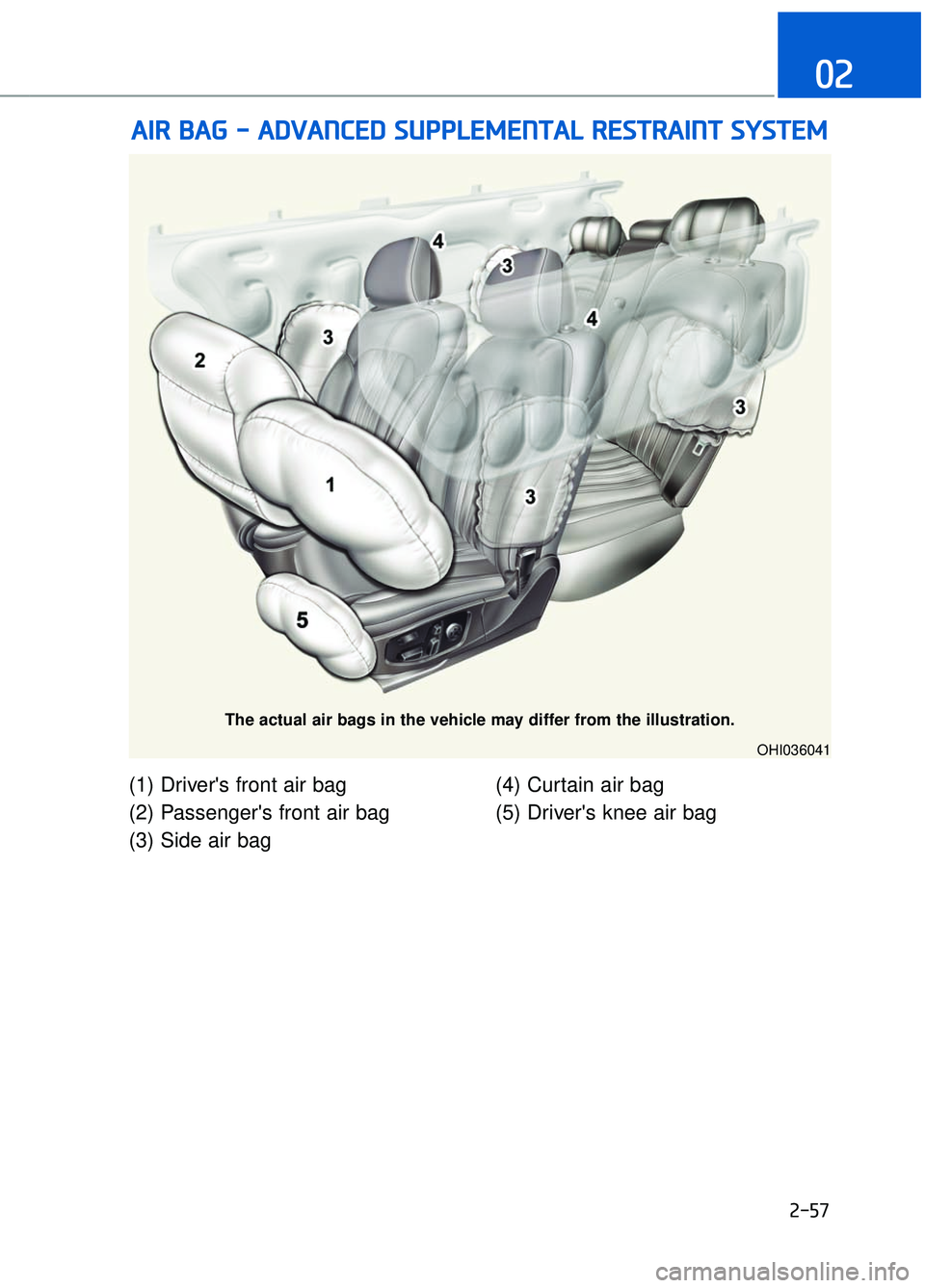
(1) Driver's front air bag
(2) Passenger's front air bag
(3) Side air bag(4) Curtain air bag
(5) Driver's knee air bag
A A
I
IR
R
B
B A
A G
G
-
-
A
A D
DV
VA
A N
N C
CE
E D
D
S
S U
U P
PP
PL
LE
E M
M E
EN
N T
TA
A L
L
R
R E
ES
ST
T R
R A
A I
IN
N T
T
S
S Y
Y S
ST
T E
EM
M
The actual air bags in the vehicle may differ from the illustration.
OHI036041
Page 78 of 524
2-58
Safety system of your vehicle
This vehicle is equipped with an Advanced Supplemental Air Bag System for
the driver's seat and front passenger's seats.
The front air bags are designed to supplement the three-point seat belts\
. For
these air bags to provide protection, the seat belts must be worn at all times
when driving.
You can be severely injured or killed in an accident if you are not wearing a
seat belt. Air bags are designed to supplement seat belts, but do not replace
them. Also, air bags are not designed to deploy in every collision. In some
accidents, the seat belts are the only restraint protecting you.
AIR BAG SAFETY PRECAUTIONS
ALWAYS use seat belts and child restraints - every trip, every time,
everyone! Even with air bags, you can be seriously injured or killed in
a collision if you are improperly belted or not wearing your seat belt
when the air bag inflates.
NEVER place a child in any child restraint or booster seat in the front
passenger seat. An inflating air bag could forcefully strike the infant
or child causing serious or fatal injuries.
ABC - Always Buckle Children under age 13 in the back seat. It is the
safest place for children of any age to ride. If a child age 13 or older
must be seated in the front seat, he or she must be properly belted
and the seat should be moved as far back as possible.
All occupants should sit upright with the seatback in an upright posi-
tion, centered on the seat cushion with their seat belt on, legs com-
fortably extended and their feet on the floor until the vehicle is parked
and the engine is turned off. If an occupant is out of position during
an accident, the rapidly deploying air bag may forcefully contact the
occupant causing serious or fatal injuries.
You and your passengers should never sit or lean unnecessarily
close to the air bags or lean against the door or center console.
Move your seat as far back as possible from front air bags, while still
maintaining control of the vehicle. The U.S. National Highway Traffic
Safety Administration (NHTSA) recommends that drivers allow at
least 10 inches (25 cm) between the center of the steering wheel and
the chest.
WARNING
Page 79 of 524
2-59
02
Where Are the Air Bags?
Driver's and passenger's front air bags
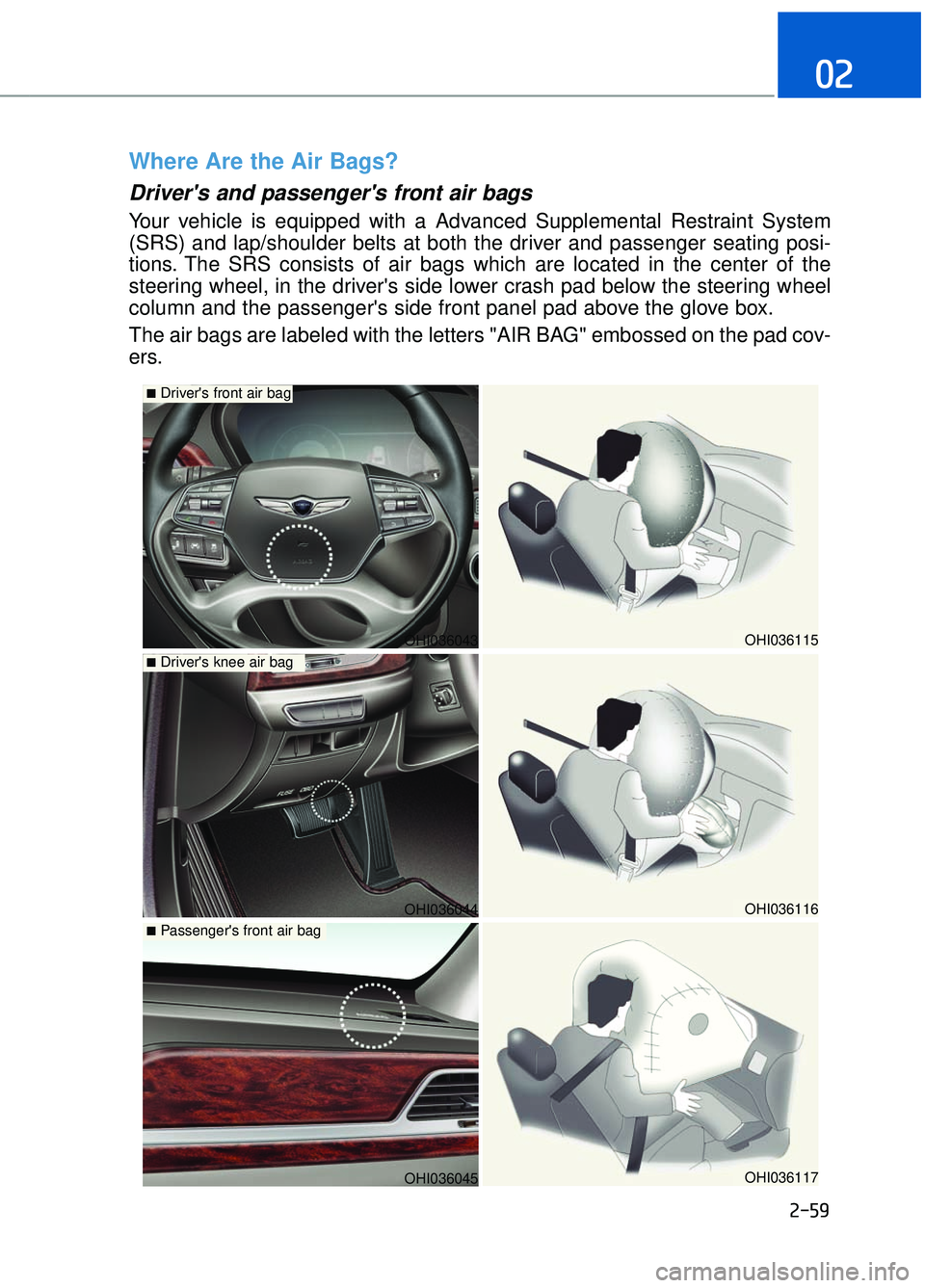
Your vehicle is equipped with a Advanced Supplemental Restraint System
(SRS) and lap/shoulder belts at both the driver and passenger seating posi-
tions. The SRS consists of air bags which are located in the center of the
steering wheel, in the driver's side lower crash pad below the steering wheel
column and the passenger's side front panel pad above the glove box.
The air bags are labeled with the letters "AIR BAG" embossed on the pad cov-
ers.
OHI036043
■Driver's front air bag
OHI036115
OHI036044
■Driver's knee air bag
OHI036116
OHI036045
■Passenger's front air bag
OHI036117
Page 80 of 524
2-60
Safety system of your vehicle
The purpose of the SRS is to provide
the vehicle's driver and front passen-
gers with additional protection than
that offered by the seat belt system
alone. The SRS uses sensors to
gather information about the driver’s
and front passenger's seat belt
usage and impact severity.
The seat belt buckle sensors deter-
mine if the driver and front passen-
ger's seat belts are fastened. These
sensors provide the ability to control
the SRS deployment based on
whether or not the seat belts are fas-
tened, and how severe the impact is.
The advanced SRS offers the ability
to control the air bag inflation within
two levels. A first stage level is pro-
vided for moderate-severity impacts.
A second stage level is provided for
more severe impacts.
According to the impact severity, and
seat belt usage, the SRS Control
Module (SRSCM) controls the air
bag inflation. Failure to properly wear
seat belts can increase the risk or
severity of injury in an accident. To reduce the risk of serious
injury or death from an inflating
front air bags, take the following
precautions:
Seat belts must be worn at all
times to help keep occupants
positioned properly.
Move your seat as far back as possible from front air bags,
while still maintaining control
of the vehicle.
Never lean against the door or center console.
Do not allow the front passen- ger to place their feet or legs
on the dashboard.
No objects should be placed over or near the air bag mod-
ules on the steering wheel,
instrument panel, and the
front passenger's panel above
the glove box. Such objects
could cause harm if the vehi-
cle is in a crash severe
enough to cause the air bags
to deploy.
WARNING
Page 81 of 524
2-61
02
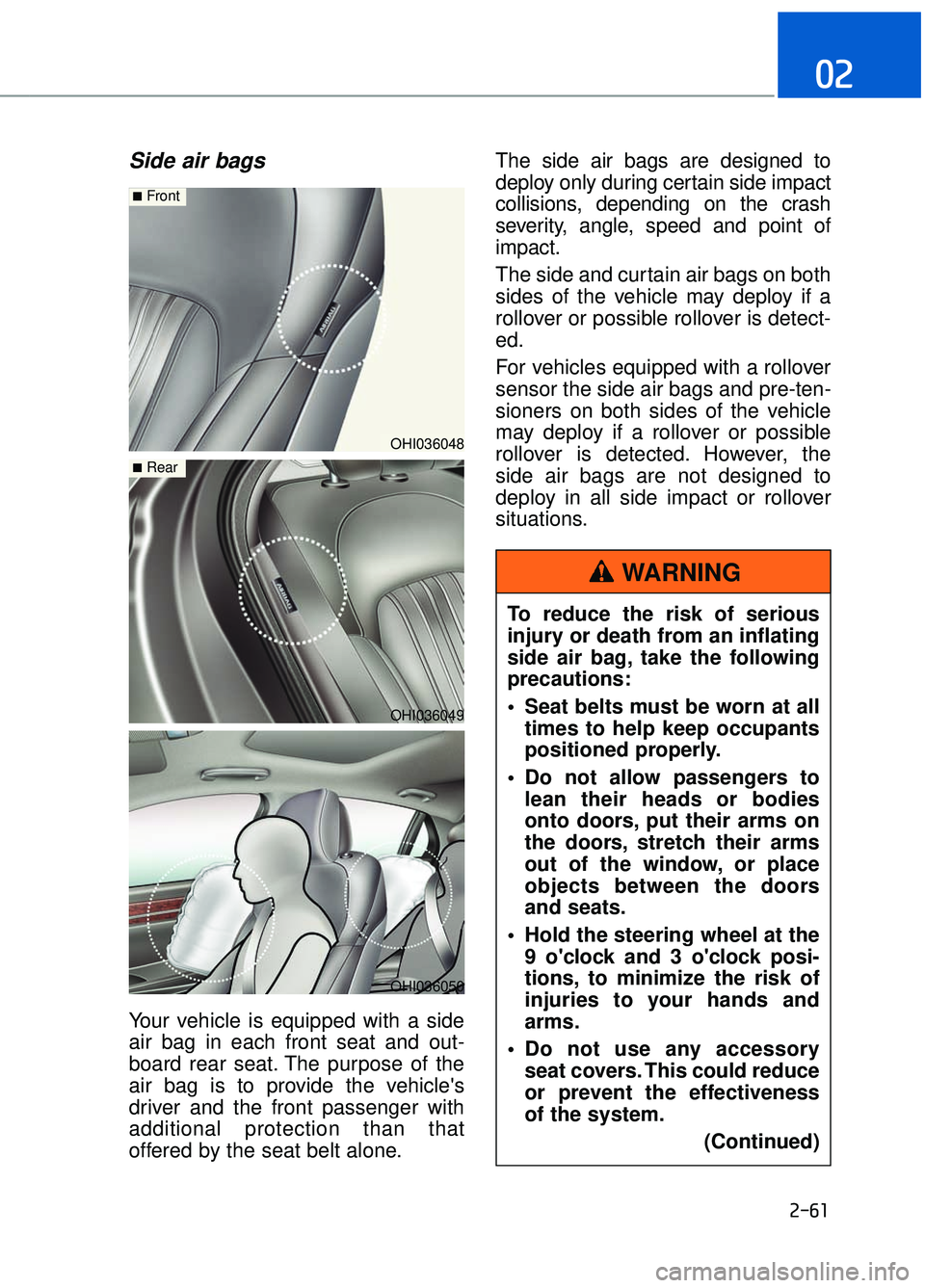
Side air bags
Your vehicle is equipped with a side
air bag in each front seat and out-
board rear seat. The purpose of the
air bag is to provide the vehicle's
driver and the front passenger with
additional protection than that
offered by the seat belt alone.The side air bags are designed to
deploy only during certain side impact
collisions, depending on the crash
severity, angle, speed and point of
impact.
The side and curtain air bags on both
sides of the vehicle may deploy if a
rollover or possible rollover is detect-
ed.
For vehicles equipped with a rollover
sensor the side air bags and pre-ten-
sioners on both sides of the vehicle
may deploy if a rollover or possible
rollover is detected. However, the
side air bags are not designed to
deploy in all side impact or rollover
situations.
OHI036048
■Front
OHI036049
■Rear
OHI036050
To reduce the risk of serious
injury or death from an inflating
side air bag, take the following
precautions:
Seat belts must be worn at all
times to help keep occupants
positioned properly.
Do not allow passengers to lean their heads or bodies
onto doors, put their arms on
the doors, stretch their arms
out of the window, or place
objects between the doors
and seats.
Hold the steering wheel at the 9 o'clock and 3 o'clock posi-
tions, to minimize the risk of
injuries to your hands and
arms.
Do not use any accessory seat covers. This could reduce
or prevent the effectiveness
of the system.
(Continued)
WARNING