AC pressure GMC ACADIA 2008 Owner's Guide
[x] Cancel search | Manufacturer: GMC, Model Year: 2008, Model line: ACADIA, Model: GMC ACADIA 2008Pages: 472, PDF Size: 5.72 MB
Page 329 of 472
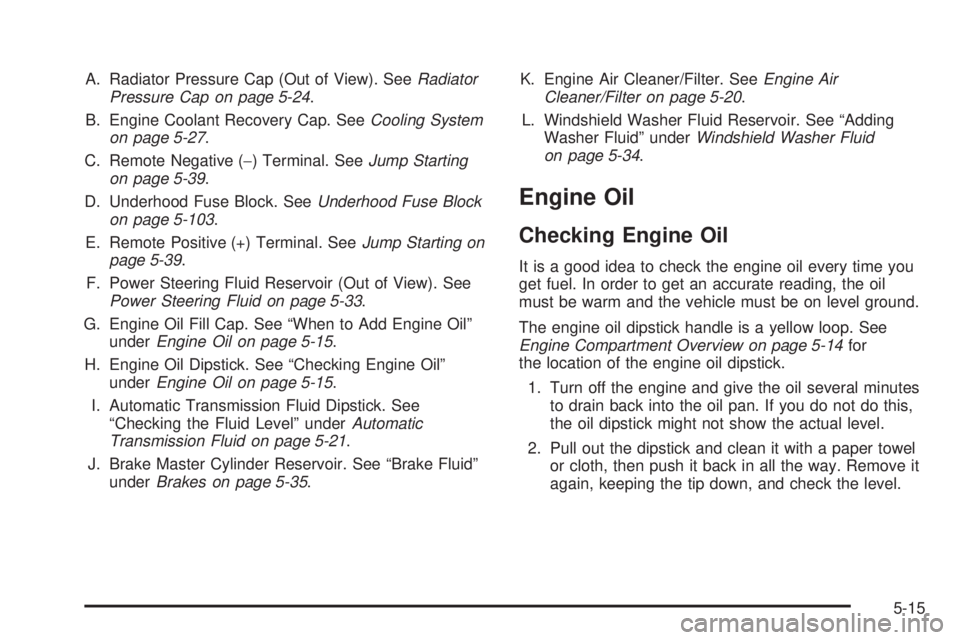
A. Radiator Pressure Cap (Out of View). SeeRadiator
Pressure Cap on page 5-24.
B. Engine Coolant Recovery Cap. SeeCooling System
on page 5-27.
C. Remote Negative (−) Terminal. SeeJump Starting
on page 5-39.
D. Underhood Fuse Block. SeeUnderhood Fuse Block
on page 5-103.
E. Remote Positive (+) Terminal. SeeJump Starting on
page 5-39.
F. Power Steering Fluid Reservoir (Out of View). See
Power Steering Fluid on page 5-33.
G. Engine Oil Fill Cap. See “When to Add Engine Oil”
underEngine Oil on page 5-15.
H. Engine Oil Dipstick. See “Checking Engine Oil”
underEngine Oil on page 5-15.
I. Automatic Transmission Fluid Dipstick. See
“Checking the Fluid Level” underAutomatic
Transmission Fluid on page 5-21.
J. Brake Master Cylinder Reservoir. See “Brake Fluid”
underBrakes on page 5-35.K. Engine Air Cleaner/Filter. SeeEngine Air
Cleaner/Filter on page 5-20.
L. Windshield Washer Fluid Reservoir. See “Adding
Washer Fluid” underWindshield Washer Fluid
on page 5-34.
Engine Oil
Checking Engine Oil
It is a good idea to check the engine oil every time you
get fuel. In order to get an accurate reading, the oil
must be warm and the vehicle must be on level ground.
The engine oil dipstick handle is a yellow loop. See
Engine Compartment Overview on page 5-14for
the location of the engine oil dipstick.
1. Turn off the engine and give the oil several minutes
to drain back into the oil pan. If you do not do this,
the oil dipstick might not show the actual level.
2. Pull out the dipstick and clean it with a paper towel
or cloth, then push it back in all the way. Remove it
again, keeping the tip down, and check the level.
5-15
Page 338 of 472
Adding Coolant
If more coolant is needed, add the proper DEX-COOL®
coolant mixture at the coolant recovery tank, but be
careful not to spill it.
If the coolant recovery tank is completely empty, add
coolant to the radiator. SeeEngine Overheating
on page 5-25.
{CAUTION:
Turning the radiator pressure cap when the
engine and radiator are hot can allow steam
and scalding liquids to blow out and burn you
badly. With the coolant recovery tank, you will
almost never have to add coolant at the
radiator. Never turn the radiator pressure
cap — even a little — when the engine and
radiator are hot.
{CAUTION:
You can be burned if you spill coolant on hot
engine parts. Coolant contains ethylene glycol,
and it will burn if the engine parts are hot
enough. Do not spill coolant on a hot engine.
Occasionally check the coolant level in the radiator. For
information on how to add coolant to the radiator,
seeCooling System on page 5-27.
Radiator Pressure Cap
Notice:If the pressure cap is not tightly installed,
coolant loss and possible engine damage may
occur. Be sure the cap is properly and tightly
secured.
SeeEngine Compartment Overview on page 5-14for
more information on location.
5-24
Page 341 of 472
Cooling System
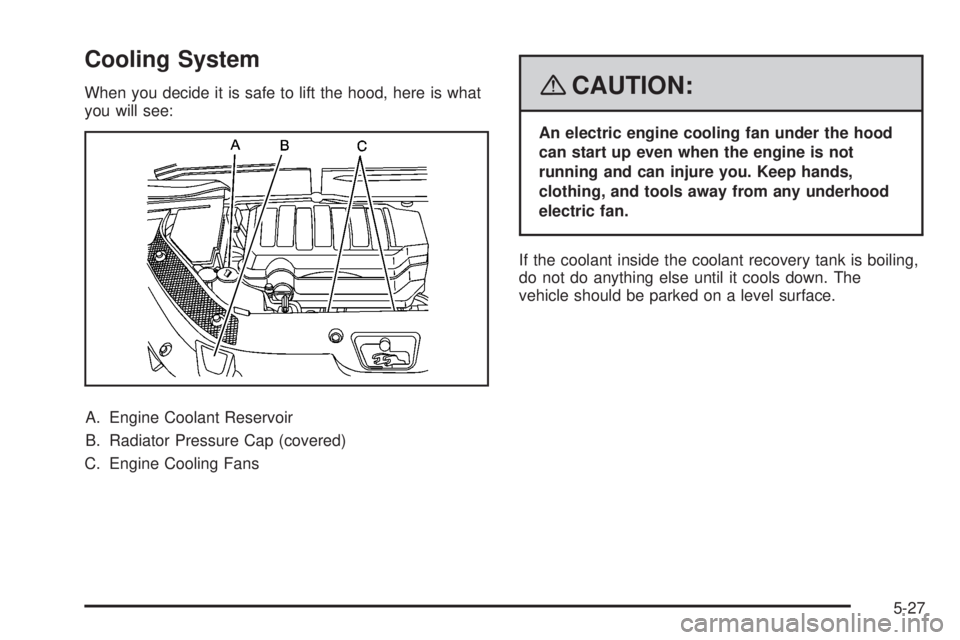
When you decide it is safe to lift the hood, here is what
you will see:
A. Engine Coolant Reservoir
B. Radiator Pressure Cap (covered)
C. Engine Cooling Fans{CAUTION:
An electric engine cooling fan under the hood
can start up even when the engine is not
running and can injure you. Keep hands,
clothing, and tools away from any underhood
electric fan.
If the coolant inside the coolant recovery tank is boiling,
do not do anything else until it cools down. The
vehicle should be parked on a level surface.
5-27
Page 342 of 472
When the engine is cold, the coolant level should be at
least up to the FULL COLD mark. If it is not, you
may have a leak at the pressure cap or in the radiator
hoses, heater hoses, radiator, water pump or
somewhere else in the cooling system.
{CAUTION:
Heater and radiator hoses, and other engine
parts, can be very hot. Do not touch them. If
you do, you can be burned.
Do not run the engine if there is a leak. If you
run the engine, it could lose all coolant. That
could cause an engine re, and you could be
burned. Get any leak xed before you drive the
vehicle.
If there seems to be no leak, with the engine on, check
to see if the electric engine cooling fans are running.
If the engine is overheating, both fans should be
running. If they are not, your vehicle needs service.
Notice:Engine damage from running the engine
without coolant is not covered by the warranty.Notice:Using coolant other than DEX-COOL
®may
cause premature engine, heater core, or radiator
corrosion. In addition, the engine coolant could
require changing sooner, at 30,000 miles (50 000 km)
or 24 months, whichever occurs rst. Any repairs
would not be covered by the warranty. Always
use DEX-COOL
®(silicate-free) coolant in the vehicle.
How to Add Coolant to the Coolant
Recovery Tank
Notice:This vehicle has a specic coolant ll
procedure. Failure to follow this procedure could
cause your engine to overheat and be severely
damaged.
If you have not found a problem yet, check to see if
coolant is visible in the coolant recovery tank. If coolant
is visible but the coolant level is not at or above the
FULL COLD mark, add a 50/50 mixture of clean,
drinkable water and DEX-COOL
®coolant at the coolant
recovery tank, but be sure the cooling system,
including the coolant recovery tank pressure cap, is cool
before you do it. SeeEngine Coolant on page 5-22
for more information.
5-28
Page 343 of 472
{CAUTION:
Steam and scalding liquids from a hot cooling
system can blow out and burn you badly. They
are under pressure, and if you turn the radiator
pressure cap — even a little — they can come
out at high speed. Never turn the cap when the
cooling system, including the radiator pressure
cap, is hot. Wait for the cooling system and
radiator pressure cap to cool if you ever have
to turn the pressure cap.
{CAUTION:
Adding only plain water to the cooling system
can be dangerous. Plain water, or some other
liquid such as alcohol, can boil before the
proper coolant mixture will. The vehicle’s
coolant warning system is set for the proper
coolant mixture. With plain water or the wrong
mixture, the engine could get too hot but you
would not get the overheat warning. The
engine could catch re and you or others
could be burned. Use a 50/50 mixture of clean,
drinkable water and DEX-COOL
®coolant.
Notice:In cold weather, water can freeze and crack
the engine, radiator, heater core and other parts.
Use the recommended coolant and the proper
coolant mixture.
5-29
Page 344 of 472
{CAUTION:
You can be burned if you spill coolant on hot
engine parts. Coolant contains ethylene glycol
and it will burn if the engine parts are hot
enough. Do not spill coolant on a hot engine.
When the coolant in the coolant recovery tank is at the
FULL COLD mark, start your vehicle. If the overheat
warning continues, there is one more thing you can try.
You can add the proper mixture directly to the
radiator, but be sure the cooling system is cool before
you do it.1. To remove the panel that covers the radiator cap,
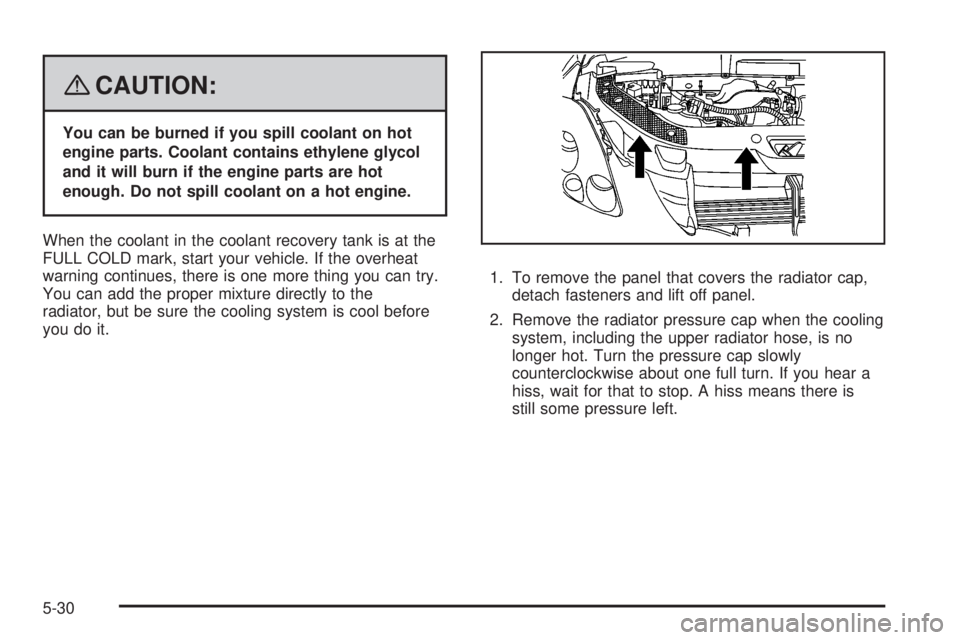
detach fasteners and lift off panel.
2. Remove the radiator pressure cap when the cooling
system, including the upper radiator hose, is no
longer hot. Turn the pressure cap slowly
counterclockwise about one full turn. If you hear a
hiss, wait for that to stop. A hiss means there is
still some pressure left.
5-30
Page 345 of 472
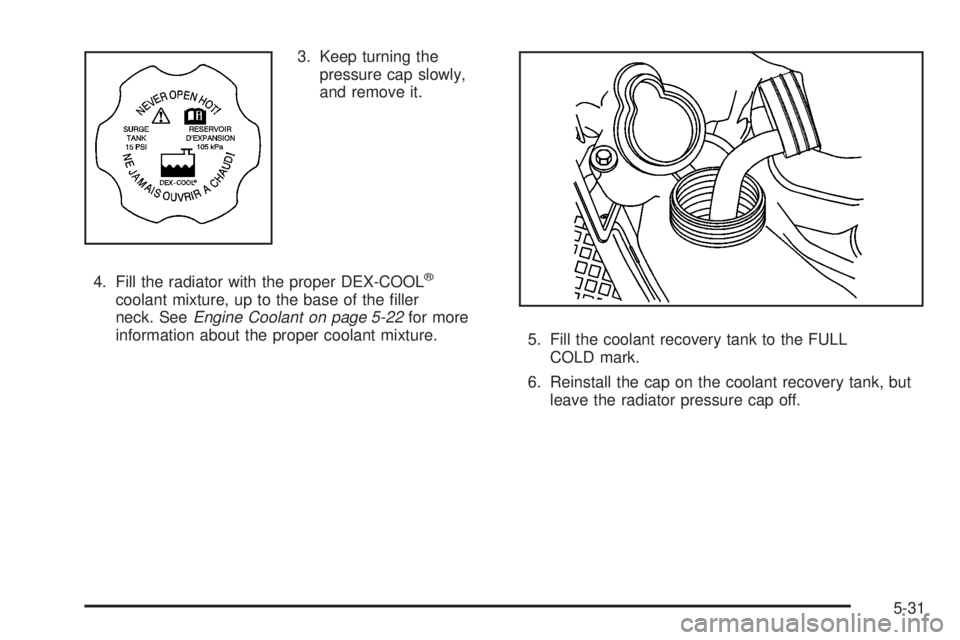
3. Keep turning the
pressure cap slowly,
and remove it.
4. Fill the radiator with the proper DEX-COOL
®
coolant mixture, up to the base of the ller
neck. SeeEngine Coolant on page 5-22for more
information about the proper coolant mixture.
5. Fill the coolant recovery tank to the FULL
COLD mark.
6. Reinstall the cap on the coolant recovery tank, but
leave the radiator pressure cap off.
5-31
Page 346 of 472
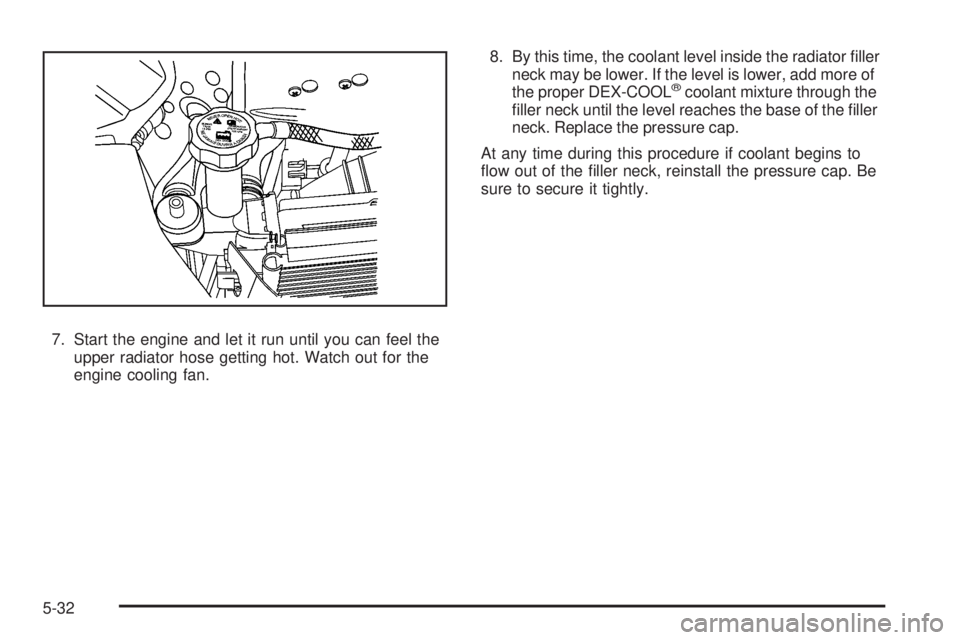
7. Start the engine and let it run until you can feel the
upper radiator hose getting hot. Watch out for the
engine cooling fan.8. By this time, the coolant level inside the radiator ller
neck may be lower. If the level is lower, add more of
the proper DEX-COOL
®coolant mixture through the
ller neck until the level reaches the base of the ller
neck. Replace the pressure cap.
At any time during this procedure if coolant begins to
ow out of the ller neck, reinstall the pressure cap. Be
sure to secure it tightly.
5-32
Page 362 of 472
Tires
Your new vehicle comes with high-quality tires
made by a leading tire manufacturer. If you ever
have questions about your tire warranty and where
to obtain service, see your vehicle Warranty
booklet for details.{CAUTION:
Poorly maintained and improperly used
tires are dangerous.
Overloading your vehicle’s tires can
cause overheating as a result of too
much exing. You could have an
air-out and a serious accident. See
Loading Your Vehicle on page 4-21.
Underinated tires pose the same
danger as overloaded tires. The
resulting accident could cause serious
injury. Check all tires frequently to
maintain the recommended pressure.
Tire pressure should be checked when
your vehicle’s tires are cold. See
Inflation - Tire Pressure on page 5-55.
Overinated tires are more likely to be
cut, punctured, or broken by a sudden
impact — such as when you hit a
pothole. Keep tires at the
recommended pressure.
Worn, old tires can cause accidents. If
the tire’s tread is badly worn, or if
your vehicle’s tires have been
damaged, replace them.
5-48
Page 364 of 472
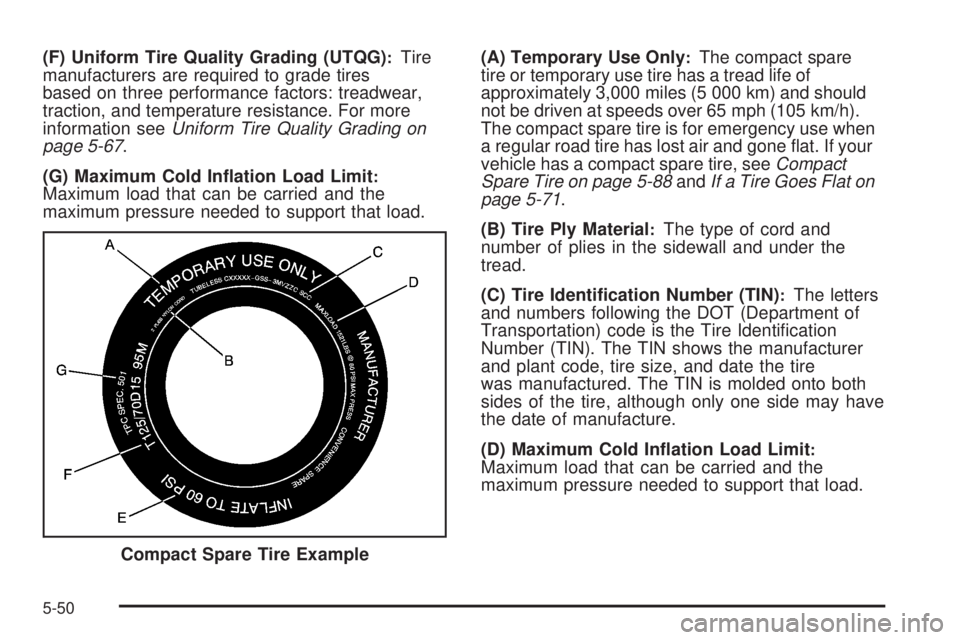
(F) Uniform Tire Quality Grading (UTQG):Tire
manufacturers are required to grade tires
based on three performance factors: treadwear,
traction, and temperature resistance. For more
information seeUniform Tire Quality Grading on
page 5-67.
(G) Maximum Cold Ination Load Limit
:Maximum load that can be carried and the
maximum pressure needed to support that load.(A) Temporary Use Only
:The compact spare
tire or temporary use tire has a tread life of
approximately 3,000 miles (5 000 km) and should
not be driven at speeds over 65 mph (105 km/h).
The compact spare tire is for emergency use when
a regular road tire has lost air and gone at. If your
vehicle has a compact spare tire, seeCompact
Spare Tire on page 5-88andIf a Tire Goes Flat on
page 5-71.
(B) Tire Ply Material
:The type of cord and
number of plies in the sidewall and under the
tread.
(C) Tire Identication Number (TIN)
:The letters
and numbers following the DOT (Department of
Transportation) code is the Tire Identication
Number (TIN). The TIN shows the manufacturer
and plant code, tire size, and date the tire
was manufactured. The TIN is molded onto both
sides of the tire, although only one side may have
the date of manufacture.
(D) Maximum Cold Ination Load Limit
:Maximum load that can be carried and the
maximum pressure needed to support that load.
Compact Spare Tire Example
5-50