Traction GMC ACADIA 2008 Owner's Guide
[x] Cancel search | Manufacturer: GMC, Model Year: 2008, Model line: ACADIA, Model: GMC ACADIA 2008Pages: 472, PDF Size: 5.72 MB
Page 364 of 472
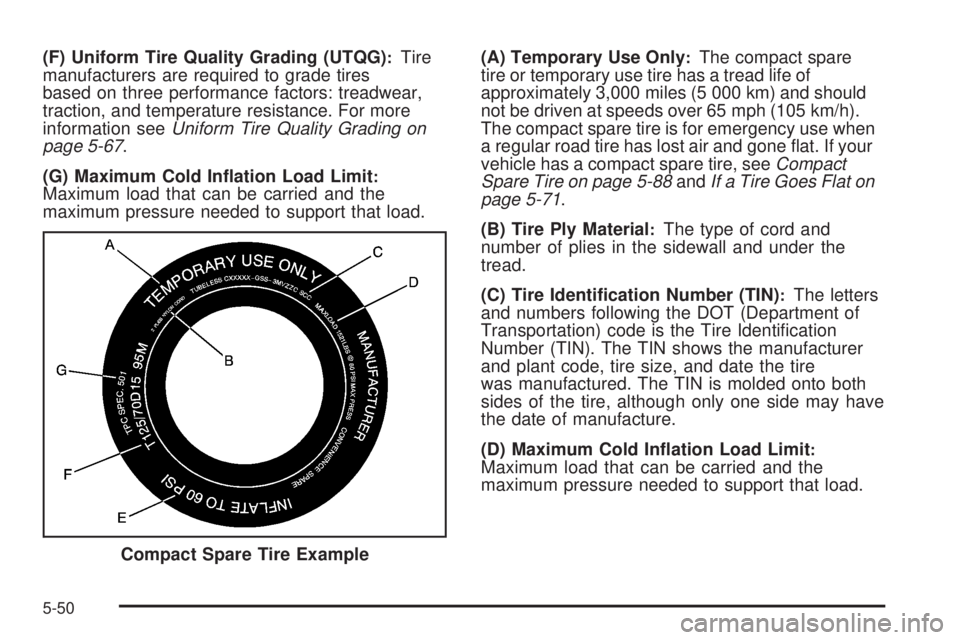
(F) Uniform Tire Quality Grading (UTQG):Tire
manufacturers are required to grade tires
based on three performance factors: treadwear,
traction, and temperature resistance. For more
information seeUniform Tire Quality Grading on
page 5-67.
(G) Maximum Cold Ination Load Limit
:Maximum load that can be carried and the
maximum pressure needed to support that load.(A) Temporary Use Only
:The compact spare
tire or temporary use tire has a tread life of
approximately 3,000 miles (5 000 km) and should
not be driven at speeds over 65 mph (105 km/h).
The compact spare tire is for emergency use when
a regular road tire has lost air and gone at. If your
vehicle has a compact spare tire, seeCompact
Spare Tire on page 5-88andIf a Tire Goes Flat on
page 5-71.
(B) Tire Ply Material
:The type of cord and
number of plies in the sidewall and under the
tread.
(C) Tire Identication Number (TIN)
:The letters
and numbers following the DOT (Department of
Transportation) code is the Tire Identication
Number (TIN). The TIN shows the manufacturer
and plant code, tire size, and date the tire
was manufactured. The TIN is molded onto both
sides of the tire, although only one side may have
the date of manufacture.
(D) Maximum Cold Ination Load Limit
:Maximum load that can be carried and the
maximum pressure needed to support that load.
Compact Spare Tire Example
5-50
Page 368 of 472
Outward Facing Sidewall:The side of an
asymmetrical tire that has a particular side that
faces outward when mounted on a vehicle.
The side of the tire that contains a whitewall, bears
white lettering, or bears manufacturer, brand,
and/or model name molding that is higher
or deeper than the same moldings on the other
sidewall of the tire.
Passenger (P-Metric) Tire
:A tire used on
passenger cars and some light duty trucks and
multipurpose vehicles.
Recommended Ination Pressure
:Vehicle
manufacturer’s recommended tire ination
pressure as shown on the tire placard. See
Inflation - Tire Pressure on page 5-55andLoading
Your Vehicle on page 4-21.
Radial Ply Tire
:A pneumatic tire in which the
ply cords that extend to the beads are laid at
90 degrees to the centerline of the tread.
Rim
:A metal support for a tire and upon which
the tire beads are seated.Sidewall
:The portion of a tire between the tread
and the bead.
Speed Rating
:An alphanumeric code assigned to
a tire indicating the maximum speed at which a
tire can operate.
Traction
:The friction between the tire and the
road surface. The amount of grip provided.
Tread
:The portion of a tire that comes into
contact with the road.
Treadwear Indicators
:Narrow bands, sometimes
called wear bars, that show across the tread of
a tire when only 1/16 inch (1.6 mm) of tread
remains. SeeWhen It Is Time for New Tires on
page 5-63.
UTQGS (Uniform Tire Quality Grading
Standards)
:A tire information system that
provides consumers with ratings for a tire’s
traction, temperature, and treadwear. Ratings are
determined by tire manufacturers using
government testing procedures. The ratings are
molded into the sidewall of the tire. SeeUniform
Tire Quality Grading on page 5-67.
5-54
Page 378 of 472
You need new tires if any of the following statements
are true:
You can see the indicators at three or more places
around the tire.
You can see cord or fabric showing through the
tire’s rubber.
The tread or sidewall is cracked, cut, or snagged
deep enough to show cord or fabric.
The tire has a bump, bulge, or split.
The tire has a puncture, cut, or other damage that
cannot be repaired well because of the size or
location of the damage.
The rubber in tires degrades over time, even if they are
not being used. This is also true for the spare tire, if
your vehicle has one. Multiple conditions affect how fast
this aging takes place, including temperatures, loading
conditions, and ination pressure maintenance. With
proper care and maintenance tires will typically wear out
before they degrade due to age. If you are unsure
about the need to replace your tires as they get older,
consult the tire manufacturer for more information.
Buying New Tires
GM has developed and matched specic tires for
your vehicle. The original equipment tires
installed on your vehicle, when it was new, were
designed to meet General Motors Tire
Performance Criteria Specication (TPC Spec)
system rating. If you need replacement tires, GM
strongly recommends that you get tires with
the same TPC Spec rating. This way, your vehicle
will continue to have tires that are designed to
give the same performance and vehicle safety,
during normal use, as the original tires.
GM’s exclusive TPC Spec system considers over
a dozen critical specications that impact the
overall performance of your vehicle, including
brake system performance, ride and handling,
traction control, and tire pressure monitoring
performance. GM’s TPC Spec number is molded
onto the tire’s sidewall near the tire size. If the
tires have an all-season tread design, the
TPC Spec number will be followed by an MS for
mud and snow. SeeTire Sidewall Labeling on
page 5-49for additional information.
5-64
Page 380 of 472
Your vehicle’s original equipment tires are listed
on the Tire and Loading Information Label.
SeeLoading Your Vehicle on page 4-21, for more
information about the Tire and Loading Information
Label and its location on your vehicle.
Different Size Tires and Wheels
If you add wheels or tires that are a different size than
your original equipment wheels and tires, this could
affect the way your vehicle performs, including its
braking, ride and handling characteristics, stability, and
resistance to rollover. Additionally, if your vehicle
has electronic systems such as anti-lock brakes, rollover
airbags, traction control, and electronic stability control,
the performance of these systems can be affected.
{CAUTION:
If you add different sized wheels, your vehicle
may not provide an acceptable level of
performance and safety if tires not
recommended for those wheels are selected.
You may increase the chance that you will
crash and suffer serious injury. Only use GM
specic wheel and tire systems developed for
your vehicle, and have them properly installed
by a GM certied technician.
SeeBuying New Tires on page 5-64andAccessories
and Modifications on page 5-4for additional information.
5-66
Page 381 of 472
Uniform Tire Quality Grading
Quality grades can be found where applicable on
the tire sidewall between tread shoulder and
maximum section width. For example:
Treadwear 200 Traction AA Temperature A
The following information relates to the system
developed by the United States National Highway
Traffic Safety Administration (NHTSA), which
grades tires by treadwear, traction, and
temperature performance. This applies only to
vehicles sold in the United States. The grades are
molded on the sidewalls of most passenger car
tires. The Uniform Tire Quality Grading (UTQG)
system does not apply to deep tread, winter-type
snow tires, space-saver, or temporary use
spare tires, tires with nominal rim diameters of
10 to 12 inches (25 to 30 cm), or to some
limited-production tires.
While the tires available on General Motors
passenger cars and light trucks may vary with
respect to these grades, they must also conform
to federal safety requirements and additional
General Motors Tire Performance Criteria (TPC)
standards.
Treadwear
The treadwear grade is a comparative rating
based on the wear rate of the tire when tested
under controlled conditions on a specied
government test course. For example, a tire
graded 150 would wear one and a half (1.5) times
as well on the government course as a tire
graded 100. The relative performance of tires
depends upon the actual conditions of their use,
however, and may depart signicantly from
the norm due to variations in driving habits, service
practices, and differences in road characteristics
and climate.
Traction – AA, A, B, C
The traction grades, from highest to lowest, are AA,
A, B, and C. Those grades represent the tire’s
ability to stop on wet pavement as measured under
controlled conditions on specied government test
surfaces of asphalt and concrete. A tire marked C
may have poor traction performance.
Warning
:The traction grade assigned to this
tire is based on straight-ahead braking
traction tests, and does not include
acceleration, cornering, hydroplaning, or peak
traction characteristics.
5-67
Page 384 of 472
Used Replacement Wheels
{CAUTION:
Putting a used wheel on your vehicle is
dangerous. You cannot know how it has been
used or how far it has been driven. It could fail
suddenly and cause a crash. If you have to
replace a wheel, use a new GM original
equipment wheel.
Tire Chains
{CAUTION:
Do not use tire chains. There is not enough
clearance. Tire chains used on a vehicle
without the proper amount of clearance can
cause damage to the brakes, suspension or
other vehicle parts. The area damaged by the
tire chains could cause you to lose control of
your vehicle and you or others may be injured
in a crash.
Use another type of traction device only if its
manufacturer recommends it for use on your
vehicle and tire size combination and road
conditions. Follow that manufacturer’s
instructions. To help avoid damage to your
vehicle, drive slowly, readjust or remove the
device if it is contacting your vehicle, and do
not spin your vehicle’s wheels. If you do nd
traction devices that will t, install them on the
front tires.
5-70
Page 448 of 472
Alternative Service (Canada only):There may be
times, when Roadside Assistance cannot provide
timely assistance. Your advisor may authorize
you to secure local emergency road service, and
you will be reimbursed up to $100 (Canadian) upon
submission of the original receipt to Roadside
Assistance.
In many instances, mechanical failures may be covered.
However, when other services are utilized, our
Roadside Assistance Representatives will explain any
payment obligations you might incur.
GMC and General Motors of Canada Limited reserve
the right to limit services or reimbursement to an owner
or driver when, in their sole discretion, the claims
become excessive in frequency or type of occurrence.
Calling For Assistance
For prompt and efficient assistance when calling, please
provide the following to the Roadside Assistance
Representative:
Your name, home address, and home telephone
number
Telephone number of your location
Location of the vehicle.
Model, year, color, and license plate number of the
vehicle
Odometer reading, Vehicle Identication Number
(VIN), and delivery date of the vehicle
Description of the problem
Towing and Road Service Exclusions
Specically excluded from Roadside Assistance
coverage are towing or services for vehicles operated
on a non-public roadway or highway, nes, impound
towing caused by a violation of local, Municipal, State,
Provincial, or Federal law, and mounting, dismounting or
changing of snow tires, chains, or other traction
devices.
Roadside Assistance is not part of or included in the
coverage provided by the New Vehicle Limited Warranty.
GMC and General Motors of Canada Limited reserve
the right to make any changes or discontinue the
Roadside Assistance program at any time without
notication.
Scheduling Service Appointments
When your vehicle requires warranty service, contact
your dealer/retailer and request an appointment.
By scheduling a service appointment and advising your
service consultant of your transportation needs, your
dealer/retailer can help minimize your inconvenience.
7-8
Page 471 of 472
Tires (cont.)
Changing a Flat Tire....................................5-72
Cleaning....................................................5-95
Compact Spare Tire.....................................5-88
Different Size..............................................5-66
If a Tire Goes Flat.......................................5-71
Ination - Tire Pressure................................5-55
Inspection and Rotation................................5-62
Installing the Spare Tire................................5-76
Pressure Monitor Operation...........................5-58
Pressure Monitor System..............................5-57
Removing the Flat Tire.................................5-76
Removing the Spare Tire and Tools...............5-73
Secondary Latch System..............................5-81
Storing a Flat or Spare Tire and Tools............5-84
Tire Sidewall Labeling..................................5-49
Tire Terminology and Denitions....................5-52
Uniform Tire Quality Grading.........................5-67
Wheel Alignment and Tire Balance.................5-68
Wheel Replacement.....................................5-68
When It Is Time for New Tires......................5-63
Tow/Haul Mode...............................................2-34
Tow/Haul Mode Light.......................................3-55
Towing
Recreational Vehicle.....................................4-26
Towing a Trailer..........................................4-30
Your Vehicle...............................................4-26Traction
StabiliTrak®System....................................... 4-6
Transmission
Fluid, Automatic...........................................5-21
Transmission Operation, Automatic....................2-30
Turn and Lane-Change Signals.......................... 3-8
Turn Signal/Multifunction Lever........................... 3-8
U
Ultrasonic Rear Parking Assist (URPA)...............2-45
Uniform Tire Quality Grading............................5-67
Universal Home Remote System.......................2-50
Operation...................................................2-51
Using this Manual............................................... iii
V
Vehicle
Control........................................................ 4-3
Damage Warnings........................................... iv
Loading......................................................4-21
Symbols......................................................... iv
Vehicle Customization, DIC..............................3-75
Vehicle Data Recording and Privacy..................7-15
13